Your Move, My Move
What Makes a Situation Strategic
The distinction between a decision and a game; the three ingredients that turn one into the other; and the most famous payoff matrix ever written.
It's 2 a.m. and you're sitting in a police interrogation room. The detective leans back and says, "Your partner is in the next room. We're offering you both the same deal. If you confess and your partner stays silent, you walk free — and your partner gets ten years. If you both stay silent, we can only hold you for one year each on the lesser charge. But if you both confess, you both get five years." He pauses. "Your partner is hearing this same offer right now."
You've never taken a game theory course, but your mind is already doing game theory. You're not just weighing your own choices — you're imagining what your partner is thinking, knowing your partner is imagining what you're thinking. The detective has placed you in the most famous strategic situation ever constructed. And the rational answer, as you're about to discover, is deeply troubling.
Decisions vs. Strategic Interactions
Every day, you make dozens of decisions. Some are simple: you check the weather forecast and grab an umbrella. Others are complex: you calculate your budget and choose how much to save for retirement. But no matter how complicated these decisions get, they share one crucial feature — the outcome depends on your choice and on the state of the world, but not on what another thinking agent is simultaneously choosing in response to what they think you'll do.
Now consider a different kind of situation. Two coffee shops sit on opposite ends of a beach. Each owner must decide where along the beach to position their cart for the day. If they park close together, they split the customers down the middle. If one parks near the centre while the other stays at the far end, the centre cart captures most of the beach. Each owner's best position depends entirely on where the other owner parks — and both know this, and both know that the other knows this.
The difference between grabbing an umbrella and positioning a coffee cart captures the most fundamental distinction in this entire course: the distinction between a decision and a strategic interaction.
The Game Against Nature
In a decision — sometimes called a "game against nature" — you face uncertainty (the weather might surprise you, the stock market might crash), but that uncertainty isn't created by a thinking agent who is trying to anticipate your moves. Nature doesn't check what umbrella you brought and then decide to make it rain to spite you. A decision has a single agent optimising against an environment.
The Strategic Interaction
A strategic interaction — which game theorists simply call a game — is fundamentally different. In a game, your best choice depends on the choices of other players, their best choices depend on yours, and everyone is aware of this mutual dependence. The weather doesn't care about your umbrella, but the other coffee cart owner cares enormously about your location.
This distinction sounds straightforward, but it's sharper and more consequential than it first appears. An entire toolkit of decision theory — expected utility calculations, decision trees, probability-weighted outcomes — works beautifully for decisions against nature. But the moment another strategic mind enters the picture, those tools are no longer sufficient. You need a new framework. You need game theory.
The key word is interdependence. In the single-farmer scenario, rainfall is uncertain but doesn't respond to the farmer's choice. In the two-farmer scenario, if both plant wheat, wheat prices collapse and both suffer. Each farmer's payoff is directly shaped by the other's choice. This strategic interdependence — the mutual entanglement of choices and outcomes — is what transforms a decision into a game (Osborne & Rubinstein, 1994).
The Three Ingredients of a Game
Game theory, at its mathematical core, is a framework for modelling strategic interactions precisely enough to analyse them rigorously. Every game — from poker to international trade negotiations to the mating dances of bower birds — can be described using exactly three ingredients (von Neumann & Morgenstern, 1944).
1 · Players
A game must have two or more players — the decision-makers in the interaction. Players might be individuals, firms, political parties, nations, or even genes in evolutionary game theory. What matters is that each player has the capacity to choose and that each player's fate is entangled with the choices of others.
2 · Strategies
Each player has a set of strategies — the complete list of actions available to them. A strategy is not just a single move; in more complex games, a strategy is a complete plan that specifies what a player will do in every possible situation they might face. In the coffee cart example, a strategy might be a specific location along the beach. In chess, a strategy is an astronomically complex contingency plan specifying a response to every conceivable sequence of the opponent's moves.
For now, we'll focus on simple games where each player has just a few discrete options — Cooperate or Defect, Enter the market or Stay out, Swerve or Drive straight. Even with just two players and two strategies each, the strategic possibilities are rich enough to reveal fundamental insights about human conflict and cooperation.
3 · Payoffs
The payoffs are the outcomes each player receives for each possible combination of strategies. Here is where the magic — and the difficulty — of strategic interaction lives. Your payoff depends not just on what you do, but on what everyone else does simultaneously. A payoff can represent money, years in prison, utility, evolutionary fitness, or anything else the players care about.
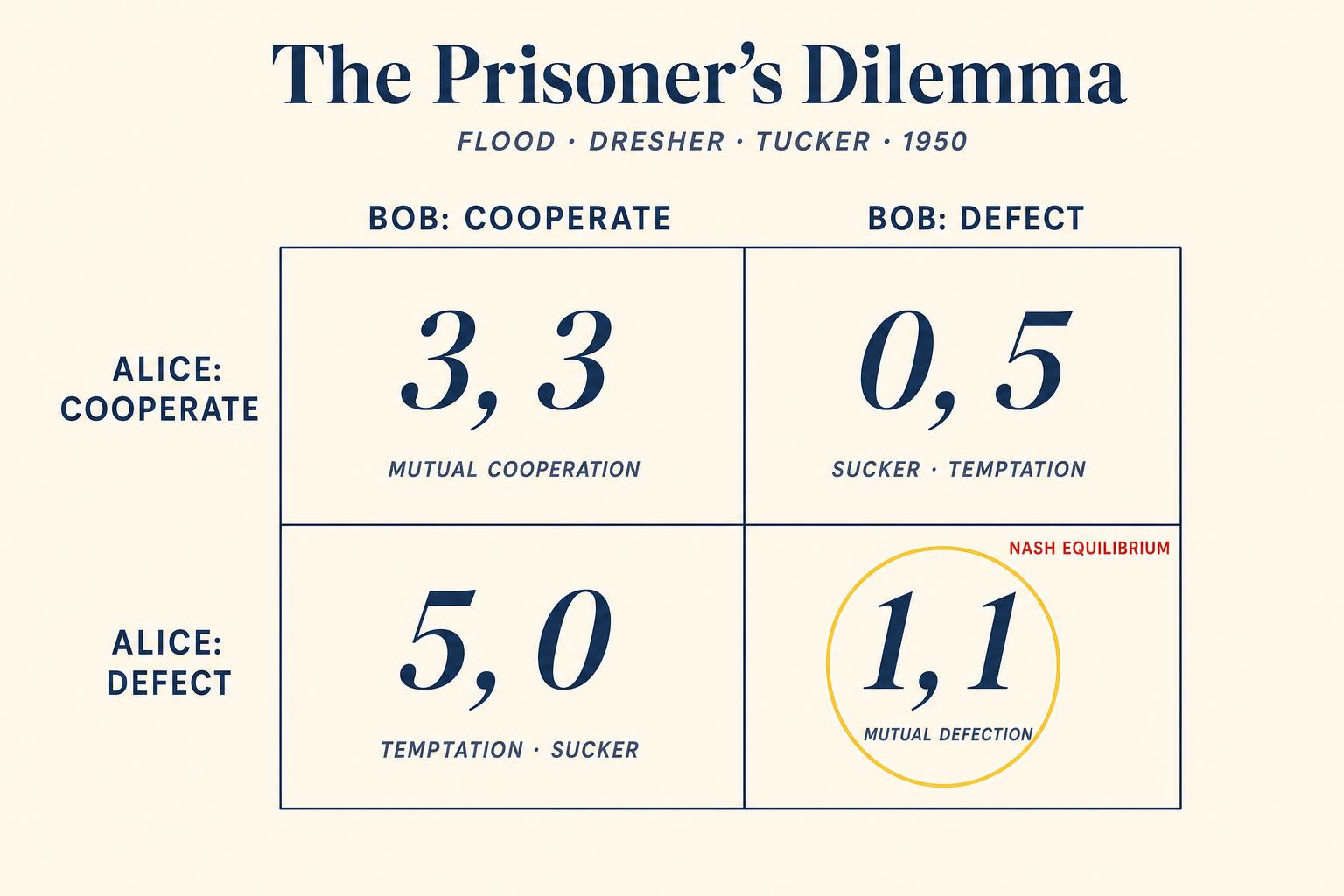
The standard way to represent payoffs in a two-player, two-strategy game is the payoff matrix — also called the "normal form" or "strategic form" of the game. This deceptively simple table — just four cells — is one of the most powerful analytical tools in all of social science. Player One selects a row, Player Two selects a column, and the cell where row meets column contains two numbers: the first is Player One's payoff, the second is Player Two's. Players choose simultaneously — neither knows the other's choice when deciding.
The Prisoner's Dilemma, Formalised
We now have the vocabulary to examine the most celebrated — and most disturbing — game in all of game theory. Return to the interrogation room from our opening scenario. Let's formalise it.
Two suspects — call them Alice and Bob — are held in separate cells. Each faces a choice: Cooperate (with each other, by staying silent), or Defect (by betraying the partner and confessing). The payoffs, expressed as years in prison (where fewer is better), are: if both cooperate by staying silent, each gets 1 year. If both defect by confessing, each gets 5 years. If Alice defects while Bob cooperates, Alice walks free (0 years) and Bob gets 10. Converting to payoffs where higher is better (by negating years or using utility values), the classic matrix becomes: mutual cooperation = (3, 3); mutual defection = (1, 1); defection-cooperation = (5, 0) or (0, 5).
Put yourself in Alice's shoes. She doesn't know what Bob will do, but she reasons as follows: "Suppose Bob cooperates. Then if I cooperate I get 3; if I defect I get 5. Defecting is better. Suppose Bob defects. If I cooperate I get 0; if I defect I get 1. Defecting is still better. No matter what Bob does, I'm better off defecting."
Bob, being equally rational, reaches the identical conclusion in his cell. Both defect. Both receive 1. And both stare at the outcome they could have reached — mutual cooperation, paying 3 each — and recognise that they have reasoned their way into a collectively inferior result.
This is the Prisoner's Dilemma, first formalised by Merrill Flood and Melvin Dresher at the RAND Corporation in 1950 and given its evocative name by Albert Tucker. Its power lies not in its cleverness but in its ubiquity. The Prisoner's Dilemma is everywhere.
Arms Races · Price Wars · The Apartment Kitchen
During the Cold War, the U.S. and the Soviet Union each faced a choice: Arm (defect) or Disarm (cooperate). If both disarmed, both saved trillions and reduced existential risk. If one armed while the other disarmed, the armed nation gained a decisive strategic advantage. If both armed, both spent ruinous sums and lived under mutual annihilation. Both armed. For decades, rational calculation produced collectively catastrophic outcomes — exactly as the Prisoner's Dilemma predicts.
Two dominant firms in an industry can either maintain high prices (cooperate) or undercut the competition (defect). This is why cartels — from OPEC to the lysine price-fixing cartel of the 1990s — are so tempting to form and so difficult to maintain. Every member has an individual incentive to cheat. You share an apartment with a flatmate. Both prefer a clean kitchen but neither enjoys cleaning. Each flatmate's dominant strategy — the strategy that's best regardless of what the other does — is to not clean. The result? A kitchen that would make a health inspector weep.
The Prisoner's Dilemma is the invisible hand's evil twin — a proof by example that individual rationality can produce collective disaster.
after Adam Smith
A Glimmer of Hope · Repetition
One crucial insight comes from considering what happens when the Prisoner's Dilemma is played repeatedly. In a one-shot game, defection dominates. But when the same two players interact over and over, with the possibility of future encounters, cooperation becomes possible — because defection today can be punished tomorrow.
Robert Axelrod famously demonstrated this in 1984 by organising computer tournaments in which dozens of strategies competed in a repeated Prisoner's Dilemma. The winner was one of the simplest strategies submitted: Tit-for-Tat, programmed by Anatol Rapoport. Tit-for-Tat cooperates on the first move and then simply mirrors whatever the opponent did on the previous round. It is nice (never the first to defect), retaliatory (punishes defection immediately), forgiving (returns to cooperation as soon as the opponent does), and clear (its pattern is easy for opponents to recognise). Axelrod's tournaments revealed that cooperation can evolve among self-interested agents — but only when the shadow of the future is long enough. We'll return to this idea in depth in Chapter 6.
Common Knowledge · The Infinite Regress
There's a subtle but vital ingredient that makes strategic interaction so much more complex than individual decision-making: common knowledge.
It's not enough that Alice is rational. It's not even enough that Alice knows Bob is rational. For the logic of the Prisoner's Dilemma to go through, Alice must know that Bob is rational, Bob must know that Alice is rational, Alice must know that Bob knows she's rational, Bob must know that Alice knows he's rational, and so on — to infinity. This infinite regress of mutual knowledge is what the mathematician Robert Aumann formalised in 1976 as common knowledge.
Common knowledge is not merely "everyone knows X." It is "everyone knows X, everyone knows that everyone knows X, everyone knows that everyone knows that everyone knows X," and so on infinitely. The distinction matters enormously. Consider a thought experiment: two generals on opposite sides of a valley need to coordinate an attack. They can only communicate by sending messengers through enemy territory, and any messenger might be captured. General A sends "Attack at dawn." Does General B know the plan? Yes — if the messenger arrived. Does General A know that General B knows? Only if General B sends a confirmation. Does General B know that General A received the confirmation? Only if there's a confirmation of the confirmation. The chain never resolves.
In game theory, we typically assume that the structure of the game itself — the players, strategies, and payoffs — is common knowledge. When this assumption is relaxed — when players have private information about payoffs or types — we enter the territory of games of incomplete information, a revolution launched by Harsanyi between 1967 and 1968 that we'll explore in Chapter 7.
The Boundary Question · Decision or Game?
Now that we have the three ingredients of a game and a working intuition for strategic interdependence, let's sharpen our ability to draw the boundary between games and decisions. This skill is more subtle than it appears, because many real-world situations sit near the boundary.
Consider choosing a university major. At first glance, this seems like a pure decision: you weigh your interests, aptitudes, and career prospects, then choose. But think deeper. The value of an economics degree depends partly on how many other students choose economics — if the market is flooded with economics graduates, wages fall. The value of learning Mandarin depends on whether your future business partners will also speak English. Suddenly, what seemed like an individual decision has strategic elements. Other people's choices affect your payoffs.
The key question is: Does the outcome depend on the choices of another thinking agent who is aware of and responding to my choice? If yes, you're in a game. If the outcome depends only on your choice and the state of the world (weather, chance, fixed market conditions), you're making a decision. Many situations contain both elements — a farmer's yield depends on weather (nature) and on other farmers' planting decisions (strategy). Good strategic thinkers learn to identify and isolate the game-theoretic component.
A Short History of the Field
Game theory didn't emerge fully formed from a single mind. It was built in stages, across decades, by mathematicians, economists, and military strategists — often working under enormous pressure.
von Neumann · Minimax · 1928
The story begins with John von Neumann, arguably the most brilliant mathematician of the twentieth century. In 1928 von Neumann proved the minimax theorem: in any two-player, zero-sum game (where one player's gain is exactly the other's loss), there exists an optimal strategy for each player, and these strategies are in equilibrium. The theorem was a landmark — it showed that competitive strategic situations have mathematically determinate solutions.
In 1944, von Neumann teamed with the economist Oskar Morgenstern to publish Theory of Games and Economic Behavior, a 600-page work that created game theory as a field. The book established the mathematical framework for analysing strategic interactions, developed the concept of utility theory that underpins the notion of payoffs, and made the case — revolutionary at the time — that economics should be understood not as a problem of individual optimisation but as a problem of strategic interdependence.
Nash · The Equilibrium · 1950
Von Neumann's framework had a limitation: it worked beautifully for zero-sum games but struggled with non-zero-sum games — the kind where mutual benefit or mutual harm is possible. This is where a 21-year-old graduate student at Princeton named John Forbes Nash Jr. changed everything.
In 1950, Nash published a one-page paper in the Proceedings of the National Academy of Sciences that announced one of the most important results in the history of social science. He proved that every finite game — any game with a finite number of players and strategies — has at least one equilibrium point. At a Nash equilibrium, each player's strategy is a best response to the strategies of all other players. No one has an incentive to unilaterally change their behaviour. Nash's full PhD dissertation, published in 1951 in the Annals of Mathematics, ran to just 27 pages — and earned him a share of the 1994 Nobel Prize in Economics, alongside Reinhard Selten and John Harsanyi.
Selten · Harsanyi · The Refinements
Reinhard Selten (1975) addressed the "permissive" character of Nash equilibrium by developing the concept of subgame perfect equilibrium, which eliminates equilibria that rely on non-credible threats. John Harsanyi (1967–68) tackled a different problem: games of incomplete information, where players don't know each other's payoffs. His framework introduced "types" drawn from a probability distribution and showed how Bayesian reasoning could be applied to strategic settings. Together, Selten and Harsanyi's refinements made Nash equilibrium applicable to a vastly wider range of strategic situations.
One of the most remarkable features of game theory's history is its migration across disciplines. Military strategists at RAND used it to analyse nuclear deterrence. Evolutionary biologists, led by John Maynard Smith, used it to explain animal behaviour without assuming conscious strategy. Political scientists used it to model voting, bargaining, and institutional design. Computer scientists used it to design auctions, algorithms, and internet protocols. Game theory is not a discipline — it is a way of thinking that travels across disciplines. This course will follow that same migratory path.
Key Takeaways
- A decision is a single agent optimising against an environment; a game is a strategic interaction where each player's best choice depends on the choices of others (Osborne & Rubinstein, 1994).
- Every game has exactly three ingredients: players, strategies, and payoffs (von Neumann & Morgenstern, 1944).
- The Prisoner's Dilemma (Flood & Dresher, 1950; Tucker) is the canonical demonstration that individually rational behaviour can produce a collectively inferior outcome.
- A dominant strategy is one that is best regardless of what the other player does. When both players have a dominant strategy and it produces a worse result than mutual cooperation, you are in a Prisoner's Dilemma.
- Repetition changes everything: Axelrod (1984) showed that simple strategies like Tit-for-Tat can sustain cooperation when "the shadow of the future" is long enough.
- Strategic interaction depends on common knowledge (Aumann, 1976) — an infinite regress of mutual knowledge, not just "everyone knows."
- The field was built in stages — von Neumann's minimax (1928, 1944), Nash's equilibrium (1950, 1951), Selten's subgame perfection (1975), Harsanyi's incomplete information (1967–68) — and migrated across economics, biology, political science, and computer science.
In the next chapter we learn the formal grammar of games — payoff matrices and game trees, simultaneous and sequential play, perfect and imperfect information — and use it to take the Prisoner's Dilemma apart at the screw.
References
Aumann, R. J. (1976). Agreeing to disagree. The Annals of Statistics, 4(6), 1236–1239.
Axelrod, R. (1984). The Evolution of Cooperation. Basic Books.
Flood, M. M., & Dresher, M. (1950). Notes on a 2 × 2 nonsymmetric game. RAND Corporation; the dilemma was named by Albert Tucker.
Harsanyi, J. C. (1967–68). Games with incomplete information played by Bayesian players (Parts I–III). Management Science, 14(3, 5, 7).
Nash, J. F. (1950). Equilibrium points in n-person games. Proceedings of the National Academy of Sciences, 36(1), 48–49.
Nash, J. F. (1951). Non-cooperative games. Annals of Mathematics, 54(2), 286–295.
Osborne, M. J., & Rubinstein, A. (1994). A Course in Game Theory. MIT Press.
Selten, R. (1975). Reexamination of the perfectness concept for equilibrium points in extensive games. International Journal of Game Theory, 4(1), 25–55.
von Neumann, J. (1928). Zur Theorie der Gesellschaftsspiele. Mathematische Annalen, 100, 295–320.
von Neumann, J., & Morgenstern, O. (1944). Theory of Games and Economic Behavior. Princeton University Press.