The Equilibrium Idea
When Rational Players Stop
Best responses, Nash's existence theorem, and the strange shape of games with two answers — or none — at once.
In the spring of two thousand eighteen, the United States imposed steep tariffs on steel and aluminum imports from China. Beijing retaliated within days, slapping equivalent tariffs on American soybeans, aircraft, and automobiles. Both countries' consumers paid higher prices. Both countries' exporters lost markets. Economists on both sides warned that the escalation was making everyone worse off, yet neither government backed down. How could two sophisticated, well-advised governments pursue a strategy that seemed so clearly self-defeating?
The answer lies in the concept you are about to learn. Each government was choosing its best response to what the other was doing. Given that China was retaliating, the U.S. had no incentive to unilaterally drop its tariffs — it would look weak and gain nothing. Given that the U.S. was escalating, China had no incentive to absorb the blow quietly. Both were stuck. Neither could improve their situation by changing course alone. In the language of game theory, they had reached a NASH EQUILIBRIUM, and it was making both of them worse off.
Dominant Strategies · A Warm-Up
Before we tackle Nash equilibrium head-on, let's start with something simpler and more intuitive. Sometimes, in a strategic situation, one of your options is just better than all the others no matter what anyone else does. When that happens, the strategic analysis practically solves itself.
A STRICTLY DOMINANT STRATEGY is one that yields a strictly higher payoff than every other available strategy, regardless of what the other player chooses, as Osborne and Rubinstein described in nineteen ninety-four. Consider a stylized version of the trade war scenario. Two countries — call them Freedonia and Sylvania — each decide whether to impose tariffs or allow free trade.
Here's how the payoffs work. If both choose Free Trade, each gets four, representing mutual prosperity. If one imposes Tariffs while the other allows Free Trade, the tariff-imposing country gets five — it protects domestic industry while still accessing the other's open market — and the free-trading country gets one, exposed and unprotected. If both impose Tariffs, each gets two, as retaliation destroys trade gains.
Look at Freedonia's decision. If Sylvania chooses Free Trade, Freedonia gets four from Free Trade but five from Tariffs — so Tariffs is better. If Sylvania chooses Tariffs, Freedonia gets one from Free Trade but two from Tariffs — so Tariffs is still better. No matter what Sylvania does, Tariffs gives Freedonia a higher payoff. Tariffs is Freedonia's strictly dominant strategy. And by the same logic, Tariffs is Sylvania's strictly dominant strategy too.
If you are a rational player with a strictly dominant strategy, the analysis is over. You play it. You don't need to predict what the other player will do, you don't need to guess their beliefs, you don't need to know anything about their payoffs. Your best move is your best move, period. This is the most powerful, and the rarest, situation in game theory.
The Weakly Dominant Cousin
A close cousin is the WEAKLY DOMINANT STRATEGY: one that does at least as well as every other strategy against every opponent choice, and strictly better against at least one. The distinction matters. Consider a sealed-bid auction where you bid for a painting you value at one hundred dollars. If you bid one hundred dollars, you never pay more than the painting is worth to you. If you bid less, say eighty dollars, you might lose an auction you could have won — when the other bid is, say, ninety dollars. Bidding your true value weakly dominates: it ties your other strategies in some cases but beats them in others, as discussed in the strategic dominance literature in two thousand twenty-five. We will see this logic again when we study auction design in Chapter eleven.
Iterated Elimination · Peeling the Onion
Strictly dominant strategies are wonderful when they exist, but most interesting games don't have them. Players' best choices depend on what others do. However, even when no strategy dominates outright, we can often narrow the field by noticing that some strategies are dominated — they are never the best choice — and systematically removing them.
This procedure is called ITERATED ELIMINATION OF DOMINATED STRATEGIES, and it works like peeling an onion. In each round, you identify strategies that are strictly dominated and remove them from the game. This shrinks the matrix. In the smaller game, new strategies may now be dominated that weren't before — because the opponent strategies that used to justify them are gone. You peel another layer. And another. You continue until no more dominated strategies remain, as the strategic dominance literature describes.
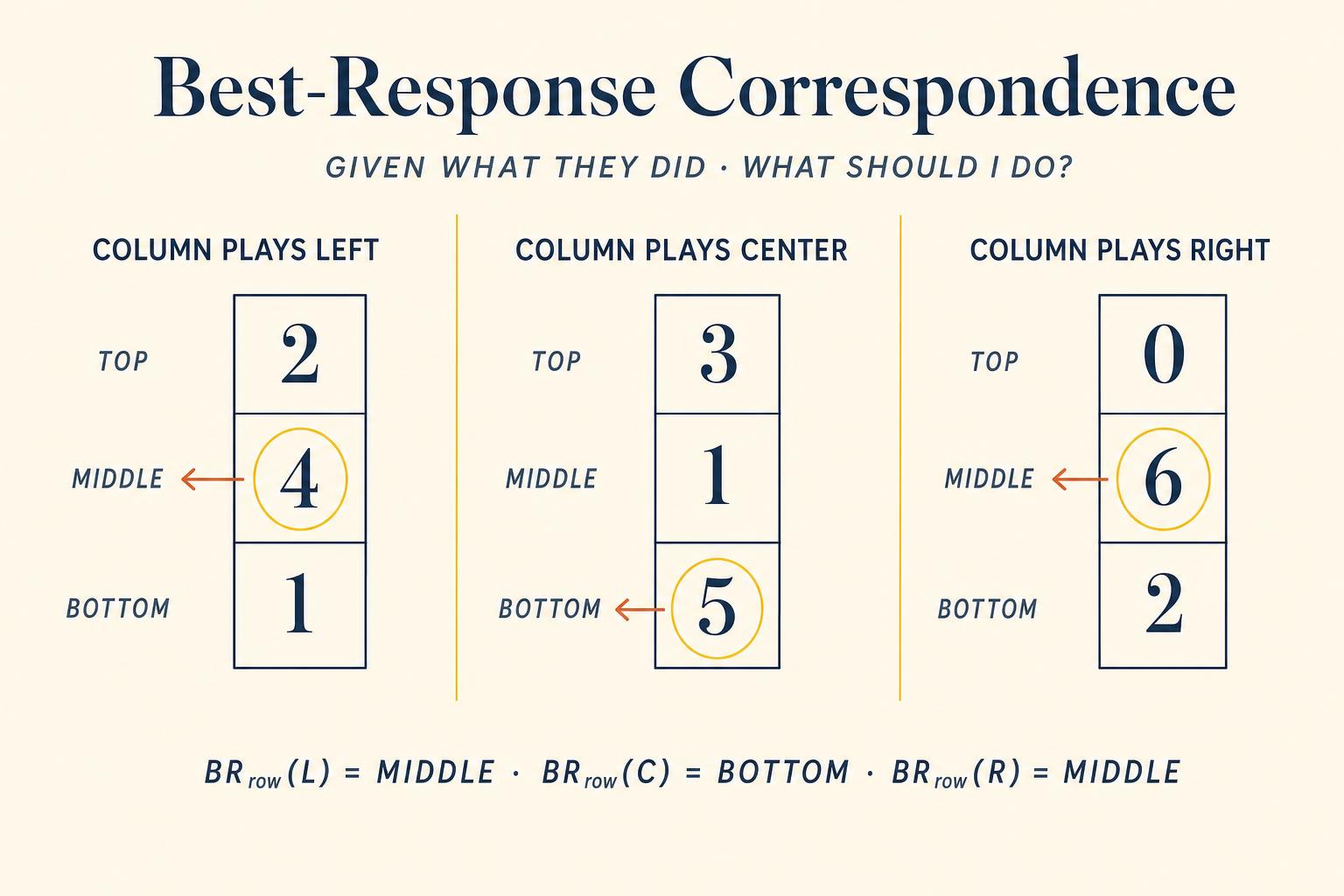
Imagine three tech companies in a technology adoption race. Each combination of strategies yields payoffs that reflect market share, development costs, and network effects. Let's call one player the Row Player, choosing among strategies Top, Middle, and Bottom, and the other the Column Player, choosing among Left, Center, and Right.
No player has a strictly dominant strategy here. But look at Row Player's Bottom strategy. Compare it with Top. Top beats Bottom in every column. Bottom is strictly dominated by Top, so a rational Row Player would never play it. Eliminate Bottom.
Now look at the reduced game from Column Player's perspective. Column's Right strategy is now strictly dominated by Left. Left beats Right in every remaining row. Eliminate Right.
We are down to a smaller game. Row chooses between Top and Middle. Top dominates Middle. Eliminate Middle. Finally, Column chooses between Left and Center. Left dominates. The unique survivor is Top and Left.
An important technical point: for strictly dominated strategies, the order in which you eliminate does not matter. You will always arrive at the same surviving set of strategies, regardless of which dominated strategy you remove first, as the strategic dominance literature notes. This is reassuring — the procedure is robust. However, for weakly dominated strategies, the order of elimination can change the result, which is one reason game theorists treat weak dominance with greater caution, as Osborne and Rubinstein observed in nineteen ninety-four.
The Best-Response Method
Iterated elimination is powerful, but it doesn't always solve a game completely. Many games have multiple strategies that survive elimination. To go further, we need a more general tool: the concept of a BEST RESPONSE.
Your best response to a particular strategy chosen by the other player is the strategy, or strategies, that gives you the highest payoff given that specific opponent choice. Formally, a strategy is a best response if no other strategy available to that player yields a higher payoff when the others play their chosen strategies, as Osborne and Rubinstein described in nineteen ninety-four.
Here is the key method for finding best responses. For the Row Player, look at each column one at a time. Within that column, find the cell where Row Player's payoff is highest. That cell is Row's best response to that column strategy. For the Column Player, look at each row one at a time. Within that row, find the cell where Column Player's payoff is highest. That cell is Column's best response to that row strategy.
A cell where both players are playing best responses to each other is special. At that outcome, Row is playing the best response to Column's strategy, and Column is playing the best response to Row's strategy. Neither player has any incentive to deviate. That cell is a Nash equilibrium.
Nash Equilibrium · The Definition
We have arrived at the most important definition in this course — arguably the most important concept in all of modern social science.
A Nash equilibrium is a profile of strategies — one for each player — such that each player's strategy is a best response to the strategies of all other players. No player can increase their payoff by unilaterally changing their own strategy.
after Nash, 1950
The concept was introduced by John Nash in a remarkable one-page paper published in the Proceedings of the National Academy of Sciences when he was just twenty-one years old, according to Nash's nineteen fifty paper. His follow-up doctoral dissertation in nineteen fifty-one provided the full treatment and proved, using Brouwer's fixed-point theorem, that every finite game — any game with a finite number of players and a finite number of strategies — has at least one Nash equilibrium, provided we allow mixed strategies, that is, randomization over pure strategies, which we will study in Chapter four.
The power of Nash's concept lies in its self-enforcing nature. At a Nash equilibrium, no player regrets their choice after seeing what everyone else did. If players could communicate before the game and agree to play a Nash equilibrium, no one would have an incentive to cheat on the agreement. As Holt and Roth observed in two thousand four in their retrospective, Nash equilibrium has become "the most prominent unifying theory of social science" precisely because it captures this idea of strategic stability.
Back to Freedonia and Sylvania
Let's return to the Freedonia-Sylvania tariff game. Using the best-response method: If Sylvania chooses Free Trade, Freedonia gets four from Free Trade, five from Tariffs. Best response: Tariffs. If Sylvania chooses Tariffs, Freedonia gets one from Free Trade, two from Tariffs. Best response: Tariffs. If Freedonia chooses Free Trade, Sylvania gets four from Free Trade, five from Tariffs. Best response: Tariffs. If Freedonia chooses Tariffs, Sylvania gets one from Free Trade, two from Tariffs. Best response: Tariffs.
The only cell where both are playing best responses is Tariffs, Tariffs, with payoffs two, two. This is the unique Nash equilibrium — and it is precisely the outcome we observe in real trade wars.
The Prisoner's Dilemma · A Hated Equilibrium
The Freedonia-Sylvania game — better known as the PRISONER'S DILEMMA — delivers the first deeply uncomfortable lesson of game theory. Both countries would be better off at Free Trade, Free Trade with payoffs four, four. Yet the unique Nash equilibrium is Tariffs, Tariffs with payoffs two, two. The equilibrium is Pareto-dominated: there exists another outcome that makes every player better off.
The original Prisoner's Dilemma, developed by Merrill Flood and Melvin Dresher at the RAND Corporation in nineteen fifty and formalized by Albert Tucker, tells the story of two suspects in separate interrogation rooms, as described in the Prisoner's Dilemma literature. Each can Cooperate — stay silent — or Defect — confess. Mutual cooperation yields a light sentence for both, but each individual does better by defecting regardless of what the partner does. The logic is airtight, the conclusion is grim, and the applications are everywhere: arms races between nuclear powers, firms in a price war, roommates deciding whether to clean the kitchen, nations deciding whether to reduce carbon emissions.
This is not a failure of the theory. It is the theory revealing a genuine feature of strategic life: rational individual choices can produce collectively irrational outcomes. The tension between individual incentives and collective welfare is one of the deepest themes in social science, and Nash equilibrium gives it a precise and unforgettable formulation. We will explore escape routes — repeated interaction, enforceable agreements, reputation — in Chapters six, eight, and ten.
Multiple Equilibria · Which One?
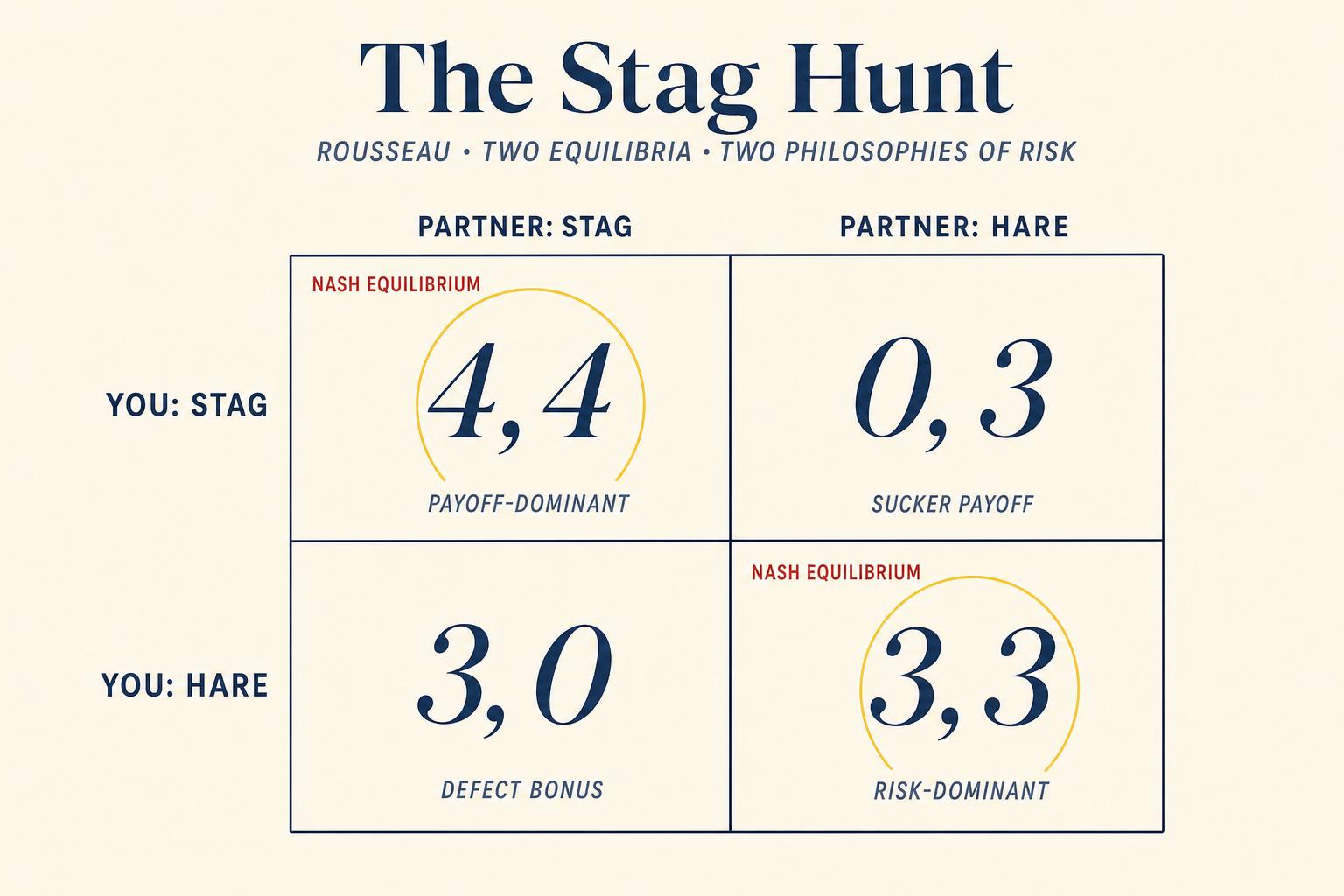
The Prisoner's Dilemma has one equilibrium that everyone hates. The opposite problem is just as challenging: some games have multiple equilibria and no obvious way to choose among them.
Consider two drivers approaching each other on a narrow road. Each must swerve Left or swerve Right. If both swerve the same direction, they pass safely with payoff one each. If they swerve in opposite directions, they crash with payoff zero each. This game has two pure-strategy Nash equilibria: Left, Left and Right, Right. Both are perfectly stable — if you know the other driver will go left, you should go left; if you know they'll go right, you should go right. But which one should you expect?
In countries that drive on the right, the answer is obvious: everyone swerves right, because that's the social convention. The game theory alone doesn't tell you this. The equilibrium selection comes from outside the model — from culture, history, and law. This is one of the deepest limitations of Nash equilibrium as a predictive tool.
The Battle of the Sexes
The BATTLE OF THE SEXES, introduced by Luce and Raiffa in nineteen fifty-seven, adds a twist. Two partners are deciding between attending the opera or a football match. Both prefer to be together than apart, but one prefers opera and the other prefers football. The game has two pure-strategy Nash equilibria — Opera, Opera and Football, Football — but the players disagree about which is better. There is also a mixed-strategy equilibrium, which we'll compute in Chapter four, where both randomize and sometimes end up apart. The multiplicity of equilibria here reflects genuine strategic tension: coordination is valuable, but the players' interests are not perfectly aligned.
Focal Points · Grand Central at Noon
How do people actually solve coordination problems? Thomas Schelling, in his brilliant nineteen sixty book The Strategy of Conflict, ran a famous experiment: he asked people where they would go to meet a stranger in New York City if they couldn't communicate beforehand. The most common answer? Grand Central Station, at noon. There is nothing strategically special about Grand Central — any location would serve equally well as an equilibrium. But Grand Central is prominent, salient, obvious — it's a FOCAL POINT, as Schelling described in nineteen sixty.
Focal points draw on shared cultural knowledge, symmetry, precedent, and psychological salience. They remind us that game theory, powerful as it is, operates within a social context. The mathematics identifies the set of equilibria; human cognition, culture, and convention determine which one is played. Schelling received the Nobel Prize in Economics in two thousand five, in large part for this insight.
Equilibrium as the Organising Principle
Nash equilibrium is not just one concept among many. It is the organizing principle of game theory. Every subsequent chapter in this course either applies it in a new setting or refines it to handle new complications.
Chapter four extends equilibrium to mixed strategies, handling games where no pure-strategy equilibrium exists. Chapter five introduces sequential games, where we'll need subgame perfect equilibrium — a refinement of Nash. Chapter six studies repeated games, asking whether cooperation can be sustained as an equilibrium when the Prisoner's Dilemma is played over and over. Chapters seven through eleven apply equilibrium thinking to information asymmetries, mechanism design, evolution, bargaining, and auctions.
The concept you've learned today — a strategy profile where no one wants to deviate — is the foundation on which all of that rests. As Holt and Roth noted in two thousand four on the fiftieth anniversary of Nash's paper, the concept has transformed not just economics but political science, biology, computer science, and philosophy. It earned Nash the Nobel Prize in nineteen ninety-four, shared with John Harsanyi and Reinhard Selten, who extended the equilibrium concept to games of incomplete information and sequential play, respectively.
Master the best-response method. Practice iterated elimination until it feels automatic. Internalize the meaning of equilibrium — not "best outcome," not "fair outcome," but STABLE OUTCOME from which no individual wants to unilaterally move. With that foundation secure, the rest of this course will be a ride.
Key Takeaways
- A strictly dominant strategy yields a higher payoff than every alternative, no matter what the other player does. A rational player always plays one if it exists.
- A weakly dominant strategy does at least as well as every alternative against every opponent choice, and strictly better against at least one.
- Iterated elimination of dominated strategies removes strategies no rational player would choose, layer by layer; each layer requires another level of common knowledge of rationality.
- A player's best response to an opponent's strategy is the one that maximises their own payoff given that opponent choice.
- A Nash equilibrium is a strategy profile where every player is simultaneously playing a best response. No one can benefit by unilaterally changing strategy.
- Nash (1950, 1951) proved that every finite game has at least one Nash equilibrium, in pure or mixed strategies.
- Equilibrium does not mean optimal — the Prisoner's Dilemma has a unique Nash equilibrium that is Pareto-dominated.
- Some games have multiple equilibria; theory alone cannot predict which will be played. Focal points (Schelling, 1960) — culturally or psychologically salient features — often guide real-world coordination.
You may have noticed that some games have no pure-strategy equilibrium — every outcome leaves one player wanting to switch. How can Nash's existence theorem guarantee an equilibrium? The answer: mixed strategies. In Chapter four, we'll learn how players can randomize to make their opponents indifferent, and we'll compute the mixed-strategy Nash equilibria that pure-strategy analysis misses. Get ready to flip some coins — strategically.
References
Flood, M. M., & Dresher, M. (1950). Notes on a 2 × 2 nonsymmetric game. RAND Corporation; the dilemma was named by Albert Tucker.
Holt, C. A., & Roth, A. E. (2004). The Nash equilibrium: A perspective. Proceedings of the National Academy of Sciences, 101(Suppl. 1), 3999–4002.
Luce, R. D., & Raiffa, H. (1957). Games and decisions: Introduction and critical survey. Wiley.
Maynard Smith, J., & Price, G. R. (1973). The logic of animal conflict. Nature, 246, 15–18.
Nash, J. F. (1950). Equilibrium points in n-person games. Proceedings of the National Academy of Sciences, 36(1), 48–49.
Nash, J. F. (1951). Non-cooperative games. Annals of Mathematics, 54(2), 286–295.
Osborne, M. J., & Rubinstein, A. (1994). A Course in Game Theory. MIT Press.
Schelling, T. C. (1960). The Strategy of Conflict. Harvard University Press.