Looking Ahead, Reasoning Back
The Logic of Sequential Decisions
Backward induction, subgame perfect equilibrium, and the brutal arithmetic that separates threats people actually carry out from threats they only say they will.
In 1999, Amazon was burning through cash at a terrifying rate, expanding into new product categories while established retailers watched nervously. Barnes and Noble, the dominant bookseller, faced a choice: launch an aggressive online counter-attack or cede the digital marketplace. Behind closed doors, Barnes and Noble's executives reportedly debated a scorched-earth pricing strategy — matching or beating every Amazon price, regardless of cost, to drive the upstart out of business. The threat was communicated through industry channels and press interviews. Amazon's Jeff Bezos had to decide: was this threat real?
The answer depended not on what Barnes and Noble said it would do, but on what it would actually do once Amazon had committed to expansion. A prolonged price war would devastate Barnes and Noble's profitable physical stores. The threat, however menacing in press releases, was strategically empty — carrying it out would hurt the threatener more than backing down. Bezos, whether he knew the formal game theory or not, was reasoning backward from the end of the game. This chapter teaches you to do the same.
From Matrices to Trees · The Sequential Turn
In Chapters 3 and 4, we analysed games where players chose simultaneously — or more precisely, where each player chose without observing the other's decision. Rock-Paper-Scissors, the Prisoner's Dilemma, the Battle of the Sexes: these are all games of imperfect information, where you must decide before knowing what your opponent has done. The analytical tool for those settings was the strategic or normal form — the payoff matrix — and the solution concept was Nash equilibrium.
But many strategic situations unfold over time. A firm decides whether to enter a market, and then the incumbent decides how to respond. A prosecutor offers a plea deal, and then the defendant decides whether to accept. A country builds a military base on disputed territory, and then the rival country decides whether to escalate. In these sequential games, the order of moves matters profoundly, because later movers can observe — and respond to — earlier choices.
This seemingly small change — adding the ability to observe — transforms the strategic landscape. In a simultaneous game, you must anticipate what your opponent will do. In a sequential game, you can see what they have done and react. And the first mover, knowing that the second mover will react rationally, can exploit that predictability. The analytical framework for these games is the extensive form — the game tree we introduced in Chapter 2 — and the solution technique is an elegant procedure called backward induction.
Reading the Game Tree
Recall from Chapter 2 that a game tree represents a sequential game as a branching structure. Each decision node represents a point where a specific player must choose an action. Each branch emanating from a node represents an available action. Each terminal node at the end of a path through the tree specifies the payoffs for all players. The tree is read from top to bottom or left to right, with the first mover's decision at the root.
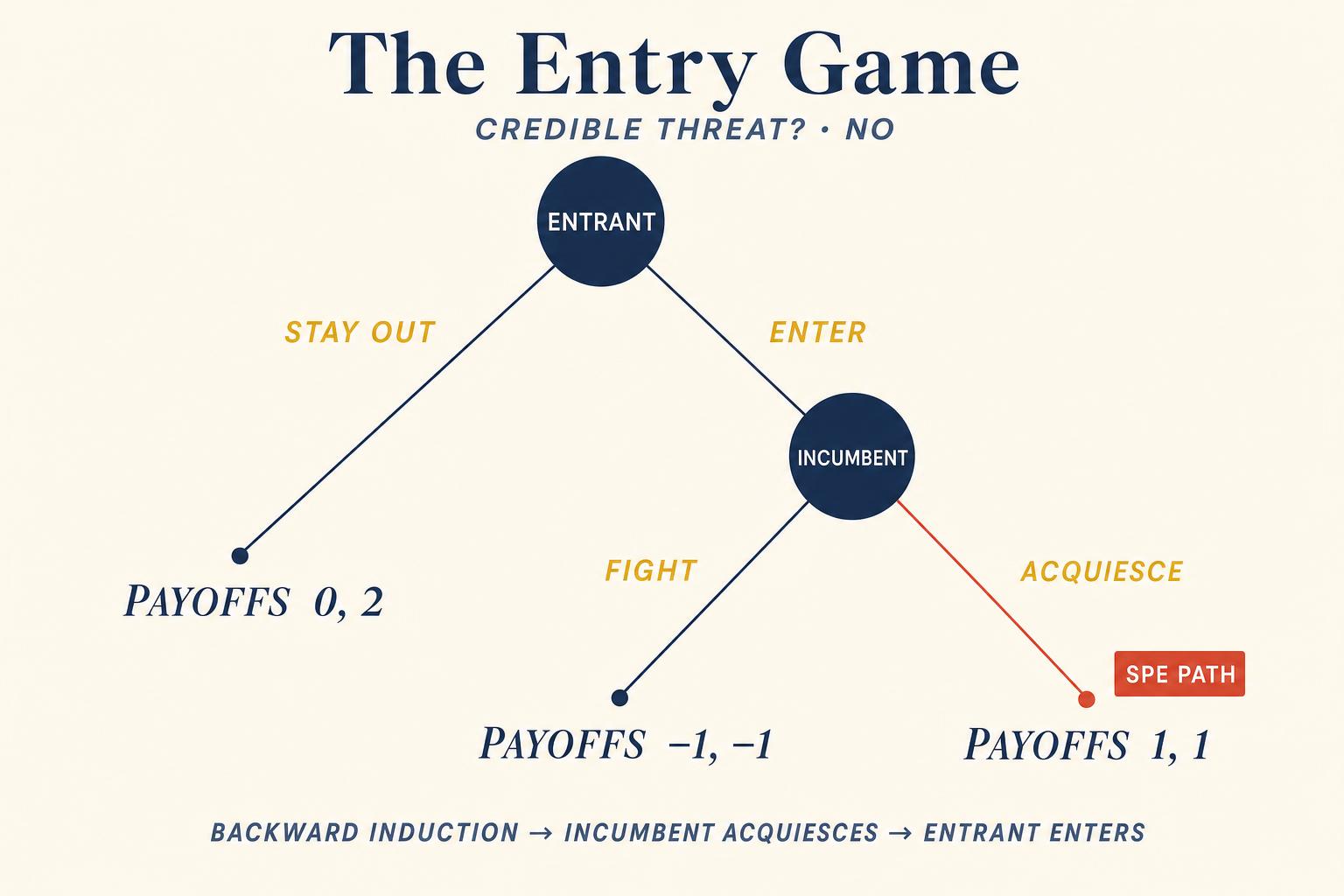
Consider a simple example. A technology startup, Player 1, must decide whether to Enter a market dominated by an incumbent, Player 2, or Stay Out. If the startup enters, the incumbent must decide whether to Fight — launch a costly price war — or Accommodate, accept the new competitor and share the market. If the startup stays out, the game ends and the incumbent keeps its monopoly profits.
The payoffs tell the story. If the startup stays out, it earns zero and the incumbent earns five — monopoly profits. If the startup enters and the incumbent fights, both suffer: the startup loses two and the incumbent loses one. The price war destroys value for both, but especially for the vulnerable newcomer. If the startup enters and the incumbent accommodates, they split the market: each earns two.
Now, the incumbent might say it will fight any entrant. But will it? This is where backward induction enters.
Backward Induction · The Algorithm
The principle of backward induction is deceptively simple: to determine what a rational player will do at the beginning of a game, start at the end and work backward. At each terminal decision node — a node where the next step is a final outcome — ask: "What will the deciding player choose?" Then replace that decision node with the outcome the player will select. Move up one level and repeat until you reach the root of the tree, as Osborne noted in 2004.
Let's apply this to our entry game. Start at the end — the incumbent's decision node, reached only if the startup has entered.
Step 1 · The Incumbent's Choice
If the incumbent fights, it gets negative one. If it accommodates, it gets two. Since two is greater than negative one, the incumbent will accommodate. We can now replace the incumbent's decision node with the outcome of two comma two, because that's what will happen if we reach this point in the game.
Step 2 · The Startup's Choice
Now the startup knows, through this logic, that if it enters, the incumbent will accommodate, yielding a payoff of two for the startup. If the startup stays out, it gets zero. Since two is greater than zero, the startup enters.
The backward induction solution: the startup enters, the incumbent accommodates. The outcome is two comma two. Notice that the incumbent's threat to fight is never actually tested — not because the startup fears it, but precisely because the startup doesn't fear it. The startup can look ahead and reason that fighting is against the incumbent's own interest.
This is the essence of strategic thinking in sequential games. You don't ask "What has my opponent said they'll do?" You ask "What will my opponent actually do when the moment of decision arrives?" And you answer that question by putting yourself in their shoes at the relevant decision node, looking at their payoffs, and predicting rational choice.
Subgame Perfect Equilibrium · Selten's Refinement
Backward induction doesn't just give us a solution — it gives us a very specific kind of solution. The Nash equilibrium concept from Chapters 3 and 4 required that no player wants to unilaterally change their strategy given the other players' strategies. But it allowed for something troubling: strategies that prescribe irrational behaviour at parts of the game tree that are never actually reached.
In our entry game, consider this pair of strategies: the startup stays out, and the incumbent plans to fight if the startup enters. This is, remarkably, a Nash equilibrium. Neither player wants to deviate: the startup stays out and gets zero, which is better than entering and facing a fight, which would give negative two. The incumbent is happy with the outcome too. But the incumbent's strategy — "fight if they enter" — is an empty threat. If the startup did enter, the incumbent would never actually fight, because fighting gives negative one while accommodating gives two.
This is the problem that Reinhard Selten solved. In his groundbreaking 1965 paper on oligopoly behaviour and his more widely known 1975 formalization, Selten introduced the concept of subgame perfect equilibrium, or S-P-E — a refinement of Nash equilibrium that requires players to play optimally not just on the equilibrium path, but at every decision point in the game, including those that are never reached in equilibrium play.
A strategy profile is a subgame perfect equilibrium if and only if it constitutes a Nash equilibrium in every subgame of the original game — including the game itself and every possible continuation of the game from any decision node onward.
A subgame is any part of the game tree that begins at a decision node, includes all subsequent nodes, and can stand alone as a complete game. In our entry game, there are two subgames: the game itself, starting from the startup's decision, and the continuation game starting from the incumbent's decision node after entry. Subgame perfection requires Nash equilibrium in both.
The Nash equilibrium "Stay Out slash Fight if Entry" fails the subgame perfection test. In the subgame starting at the incumbent's node, "Fight" is not a best response — "Accommodate" is. The only subgame perfect equilibrium is "Enter slash Accommodate" — the outcome that backward induction delivers, as Rubinstein described in 1994. This is not a coincidence. In every finite game of perfect information, backward induction and subgame perfect equilibrium yield the same solution.
Credible and Non-Credible Threats
The entry game illustrates a principle that extends far beyond industrial organization. A credible threat is one that the threatener would actually carry out if called upon to do so — because carrying it out is in their interest at the moment of execution. A non-credible threat is one the threatener would not carry out, because following through would hurt them more than backing down.
Non-credible threats are everywhere in daily life. A parent who threatens to cancel the family holiday if a child doesn't clean their room — would they really cancel a non-refundable holiday that the entire family, including the parent, has been anticipating for months? A professor who threatens to fail the entire class if anyone is caught cheating — would they really punish dozens of honest students? A country that threatens nuclear retaliation over a minor territorial dispute — would they really invite mutually assured destruction over a few square kilometres?
In each case, the threat fails the backward induction test. When you reach the decision node where the threat must be executed, the threatener has every incentive to back down. And a sophisticated opponent — one who reasons backward — will recognize this.
The Chain Store Paradox
Selten, in 1978, explored this logic in a famous thought experiment called the Chain Store Paradox. Imagine an incumbent chain store operating in twenty markets. In each market, a potential entrant sequentially decides whether to enter. The chain store can fight each entrant, which is costly for both, or accommodate, sharing the market. Intuition suggests the chain store should fight early entrants to build a reputation for toughness, deterring later ones. But backward induction unravels this reasoning entirely.
Start with market twenty — the last. The chain store has no future reputation to protect, so it accommodates. Knowing this, entrant twenty enters. Now consider market nineteen. The chain store knows it will accommodate in market twenty regardless, so fighting in market nineteen cannot deter entrant twenty. The chain store accommodates in market nineteen too. By induction, the logic unravels all the way to market one. The subgame perfect equilibrium has every entrant entering and the chain store always accommodating — the reputation-building strategy completely collapses.
Selten himself found this result troubling and suggested that real businesspeople might reasonably fight early entrants despite the theoretical prediction. This tension between the clean logic of backward induction and the messy reality of human behaviour is a theme we will encounter again shortly — and develop much further in later chapters.
Commitment as Power · The Stackelberg Twist
If non-credible threats are strategically empty, does moving first confer any advantage at all? The answer is a resounding yes — but only when the first move involves a genuine commitment that constrains your future behaviour in a way that benefits you strategically.
The classic illustration is Heinrich von Stackelberg's 1934 model of duopoly competition. Recall from Chapter 4 the Cournot model, where two firms simultaneously choose production quantities. In Stackelberg's model, one firm — the leader — moves first, choosing and publicly committing to a production quantity. The other firm — the follower — observes this quantity and then chooses its own.
As always with sequential games, we solve backward. Step one: given the leader's quantity q-one, the follower maximizes its own profit by choosing the best response quantity q-two equals B-R-two of q-one — the same reaction function as in the Cournot model. Step two: the leader, knowing the follower will play this best response, substitutes B-R-two of q-one into its own profit function and maximizes over q-one.
The result is striking. The leader produces more than the Cournot quantity, and the follower produces less. The leader earns higher profits than in the Cournot equilibrium, and the follower earns lower profits. Moving first is a genuine advantage — not because of any threat, but because of commitment. By irreversibly committing to a high production level, the leader forces the follower's hand. The follower, observing the large quantity already on the market, rationally scales back its own production, as Osborne noted in 2004.
The key insight is that commitment changes the game. In the simultaneous Cournot game, both firms are in identical strategic positions. In the sequential Stackelberg game, the leader exploits the follower's rationality — precisely because the follower will best-respond to the leader's committed quantity. This is the paradox of strategic commitment: you gain power by reducing your own flexibility.
Why doesn't the follower simply ignore the leader's committed quantity and produce the Cournot amount? What makes the leader's commitment credible in a way that the chain store's threat to fight was not?
backward-induction asks the follow-up question
The difference is that the leader's commitment is a sunk action — the quantity has already been produced, or the factory has already been built. It cannot be taken back. A threat, by contrast, is a promise about future behaviour — and promises about future behaviour are only credible if, when the future arrives, carrying them out remains in the promiser's interest.
When Backward Induction Breaks · Centipede & Ultimatum
Backward induction is logically impeccable. But is it descriptively accurate? Two famous games reveal a stark gap between theoretical prediction and observed behaviour, challenging us to think carefully about what our models assume and where those assumptions break down.
The Centipede Game
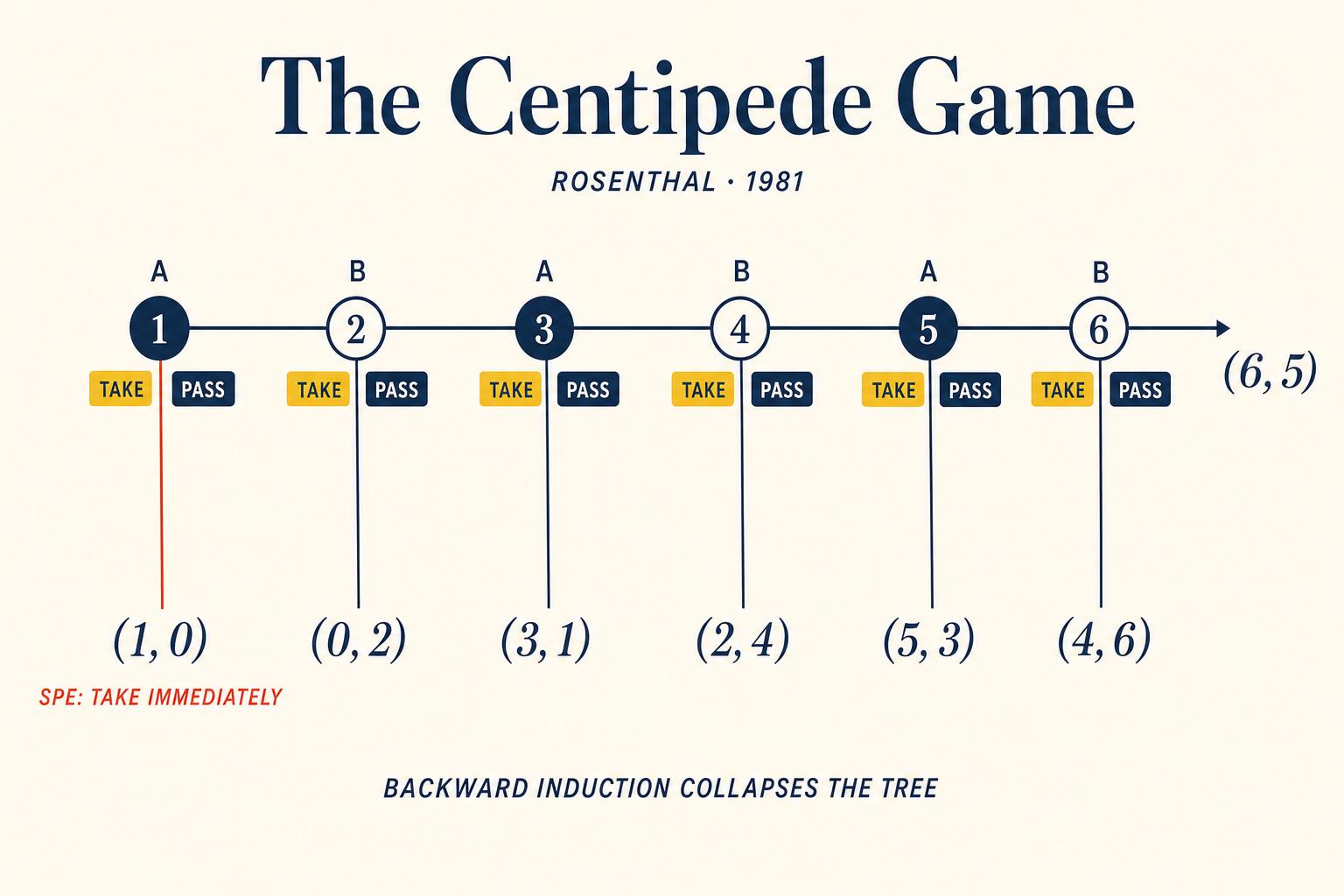
The centipede game, introduced by Rosenthal in 1981 and studied experimentally by McKelvey and Palfrey in 1992, is a sequential game of breathtaking simplicity and deeply counterintuitive implications. Two players alternate making decisions. At each turn, the active player can either Take the pot, ending the game, or Pass, letting the pot grow but giving the other player the next move. The pot grows with each round of passing, but the split always slightly favors the player who takes.
Here's a concrete version with six stages. In round one, Player 1 can take, getting one while Player 2 gets zero, or pass. In round two, Player 2 can take, getting two while Player 1 gets one, or pass. In round three, Player 1 can take, getting three while Player 2 gets two, or pass. And so on, up to round six, where Player 2 can take, getting six while Player 1 gets five, or pass to the final outcome where Player 1 gets seven and Player 2 gets six.
Backward induction produces a devastating prediction. At the final node, round six, Player 2 can take, getting six, or pass, getting six — let's say they are indifferent but we extend one more: if passing gives Player 2 less than taking at that last node, Player 2 takes. Back up one step: Player 1, knowing Player 2 will take at round six, prefers to take at round five, getting a higher payoff than waiting. Back up further: Player 2 takes at round four. The logic unravels all the way to the beginning. Player 1 takes immediately at round one. Neither player ever passes. The mutual gains from cooperation evaporate in a puff of backward reasoning.
But when McKelvey and Palfrey ran this game in the laboratory in 1992, subjects almost never took at the first node. Most players passed for several rounds before someone eventually took. The average game lasted well beyond the first move, and both players earned substantially more than the backward induction prediction. Players seemed to understand — perhaps intuitively — that cooperation could be sustained, at least temporarily, if neither party unraveled the logic too aggressively.
The Ultimatum Game
The ultimatum game, first studied experimentally by Güth, Schmittberger, and Schwarze in 1982, presents an even more direct challenge to backward induction. The game is simple: Player 1, the proposer, is given a sum of money — say, ten dollars — and proposes a split with Player 2, the responder. Player 2 can either Accept, and both players receive the proposed amounts, or Reject, and both players receive nothing.
Backward induction is straightforward. Player 2 should accept any positive offer, because something is better than nothing. Player 1, knowing this, should offer the minimum possible — perhaps one cent — keeping nine dollars and ninety-nine cents. The subgame perfect equilibrium is a maximally unfair split, accepted without complaint.
Real humans don't play this way. Across thousands of experiments in dozens of countries and cultures, two robust findings emerge. First, proposers typically offer between thirty percent and fifty percent of the total — far more than the minimum. Second, responders frequently reject offers below about twenty percent, preferring to receive nothing rather than accept a split they perceive as unfair. Responders are willing to pay — in foregone money — to punish proposers who violate norms of fairness.
This poses a genuine puzzle for backward induction. The responder who rejects a low offer is behaving "irrationally" in the narrow sense that they are choosing zero dollars over a positive amount. But they may be acting on preferences that extend beyond money — preferences for fairness, reciprocity, or the desire to punish exploitative behaviour. If we modify the payoff structure to include these social preferences, backward induction may still work — but the game we're solving is different from the one we initially wrote down.
The Three Assumptions of Backward Induction
The centipede game and the ultimatum game don't invalidate backward induction — they sharpen our understanding of when and where it applies. The logic of backward induction depends on several key assumptions, as Rubinstein described in 1994:
Rationality
Every player maximizes their own payoff at every decision node.
Common Knowledge of Rationality
Every player knows that every other player is rational, knows that they know, knows that they know that they know, and so on, infinitely.
Correct Payoffs
The game tree accurately represents what players care about.
If any of these assumptions fail, backward induction's predictions may be wrong — but for identifiable, well-understood reasons. In the centipede game, the common knowledge of rationality assumption is fragile: if Player 1 assigns even a small probability to Player 2 being "cooperative" rather than strictly rational, passing becomes a reasonable gamble. In the ultimatum game, the payoff assumption is the issue: if responders derive utility from fairness or from punishing unfairness, their "irrational" rejections are actually perfectly rational responses to a richer set of preferences.
This is an important lesson about models in general. A model's predictions depend on its assumptions. When predictions fail, the productive response is not to abandon the model but to ask: which assumption is doing the work, and how should we revise it? We will pursue this question in depth when we encounter behavioral game theory in later chapters.
Despite these boundary cases, backward induction remains one of the most powerful tools in the strategic analyst's arsenal. It cuts through the noise of threats and promises to reveal the underlying strategic logic. It explains why some first-mover advantages are real and others illusory. It distinguishes commitments that change the game from bluffs that don't. And it provides the conceptual foundation for subgame perfect equilibrium — the solution concept we will use throughout the remainder of this course.
From Finite Trees to Infinite Horizons
The games in this chapter have been finite — a definite number of moves, a clear end point. This finiteness is what makes backward induction work: you can start at the last decision node and reason backward without ambiguity. But what happens when the game has no clear ending?
In Chapter 6, we'll encounter repeated games, where players interact in the same strategic situation over and over, potentially forever. The game tree for such a game stretches to infinity, and the backward induction technique we've developed here seems to break down — there is no "last" node to start from. Yet the logic of subgame perfection still applies, leading to startling results about when and how cooperation can emerge between self-interested players.
In Chapter 7, we'll add another layer of complexity: incomplete information. When you don't know your opponent's type — their preferences, their costs, their resolve — observing their early moves becomes a source of information. Players will signal their types through their actions, and the game becomes one of inference as well as strategy. The extensive form representation from this chapter will expand to include "nature's moves" — random events that determine which type each player is.
And in Chapter 10, we'll see backward induction's most beautiful application: Rubinstein's alternating-offers bargaining model, where two players take turns proposing how to split a surplus. The sequential structure, combined with impatience — each round of delay shrinks the pie — yields a unique subgame perfect equilibrium that tells us exactly how the surplus will be divided, and it depends on who is more patient, not on who is more stubborn.
All of these applications rest on the foundation built in this chapter: the game tree, backward induction, subgame perfect equilibrium, and the critical distinction between credible and non-credible threats. Master these tools, and you hold the key to an enormous range of strategic problems.
Key Takeaways
- Sequential games involve players moving in an observable order, represented as game trees, or extensive form — fundamentally different from the simultaneous-move games of earlier chapters.
- Backward induction solves sequential games by starting at the terminal decision nodes and reasoning backward to the root — asking at each step what a rational player would actually do (Osborne, 2004).
- Subgame perfect equilibrium, developed by Selten in 1975, refines Nash equilibrium by requiring rational play at every decision node — including nodes never reached in equilibrium. This eliminates non-credible threats.
- A credible threat is one the threatener would carry out when the moment arrives; a non-credible threat is one the threatener would abandon because following through hurts them more than backing down.
- First-mover advantage arises from commitment, not from threats. The Stackelberg leader (von Stackelberg, 1934) gains by irreversibly committing to an action that constrains the follower's rational response.
- The centipede game (Rosenthal, 1981; McKelvey & Palfrey, 1992) and ultimatum game (Güth, Schmittberger & Schwarze, 1982) reveal gaps between backward induction predictions and human behaviour — prompting richer models of preferences and bounded rationality rather than abandonment of the theory.
- Backward induction depends on rationality, common knowledge of rationality, and accurate payoff specification. When predictions fail, identify which assumption is violated (Rubinstein, 1994).
Chapter 6 extends the game tree to infinity. In repeated games, the same interaction occurs round after round, and the shadow of the future transforms strategic incentives. Can backward induction explain cooperation between rivals who meet again and again? Can the threat of future punishment sustain deals that would collapse in a one-shot game? The answer involves a beautiful interplay between sequential logic and the infinite horizon — and it begins with the Folk Theorem.
References
Güth, W., Schmittberger, R., & Schwarze, B. (1982). An experimental analysis of ultimatum bargaining. Journal of Economic Behavior & Organization, 3(4), 367–388.
McKelvey, R. D., & Palfrey, T. R. (1992). An experimental study of the centipede game. Econometrica, 60(4), 803–836.
Osborne, M. J. (2004). An introduction to game theory. Oxford University Press.
Rosenthal, R. W. (1981). Games of perfect information, predatory pricing and the chain-store paradox. Journal of Economic Theory, 25(1), 92–100.
Rubinstein, A. (1994). A course in game theory. MIT Press.
Selten, R. (1965). Spieltheoretische Behandlung eines Oligopolmodells mit Nachfrageträgheit. Zeitschrift für die gesamte Staatswissenschaft, 121(2), 301–324.
Selten, R. (1975). Reexamination of the perfectness concept for equilibrium points in extensive games. International Journal of Game Theory, 4(1), 25–55.
Selten, R. (1978). The chain store paradox. Theory and Decision, 9(2), 127–159.
von Stackelberg, H. (1934). Marktform und Gleichgewicht. Springer.