Splitting the Pie
The Logic of Bargaining
Nash's four axioms, Rubinstein's alternating-offers model, the convergence theorem, and the simple truth that patience is power.
In October 2013, the Australian automotive workers' union sat across from Toyota management in Melbourne, negotiating wage conditions for the next enterprise agreement. Everyone at the table knew what was at stake: Toyota was openly considering closing its Australian manufacturing operations. The union wanted higher wages and better conditions. Toyota wanted cost reductions. There were gains from agreement — the factory could keep running, workers could keep their jobs, Toyota could keep producing. But how would those gains be divided?
The union's problem was patience — or rather, the lack of it. Workers needed their next pay cheque. Toyota, backed by a global corporation, could afford to wait. And Toyota had an outside option that the union couldn't match: moving production to Thailand, where labour costs were a fraction of Australia's. Within eighteen months, Toyota announced it would close the plant. The bargaining had failed — not because there were no gains from trade, but because the structure of the negotiation itself made agreement impossible at terms both sides could accept. This chapter gives you the tools to understand exactly why.
The Bargaining Problem
Bargaining is everywhere. You negotiate your salary, your rent, the price of a used car. Nations negotiate trade agreements, arms treaties, and climate commitments. Divorcing couples negotiate the division of assets. Roommates negotiate who does the dishes. In every case, the structure is the same: two or more parties can create value by reaching agreement, but they have conflicting preferences over how that value is divided. The central question of bargaining theory is deceptively simple: what determines the division?
Formally, a bargaining problem consists of three elements. First, there is a set of possible agreements — all the ways the parties could divide the surplus. Second, there is a disagreement point, sometimes called the threat point or status quo — what each party gets if no agreement is reached. Third, each party has preferences over the possible outcomes, captured by a utility function. The challenge is to predict, or prescribe, which agreement will be reached.
Game theory offers two fundamentally different approaches to this problem. The first, due to John Nash, asks: what properties should a "reasonable" solution satisfy? From a set of axioms about fairness and rationality, Nash derived a unique answer. The second, due to Ariel Rubinstein, asks: what happens when two fully rational players actually play a sequential bargaining game? From strategic self-interest alone, Rubinstein also derived a unique answer. The stunning punchline — and one of game theory's most beautiful results — is that these two radically different approaches converge on the same solution.
Nash's Axiomatic Bargaining Solution
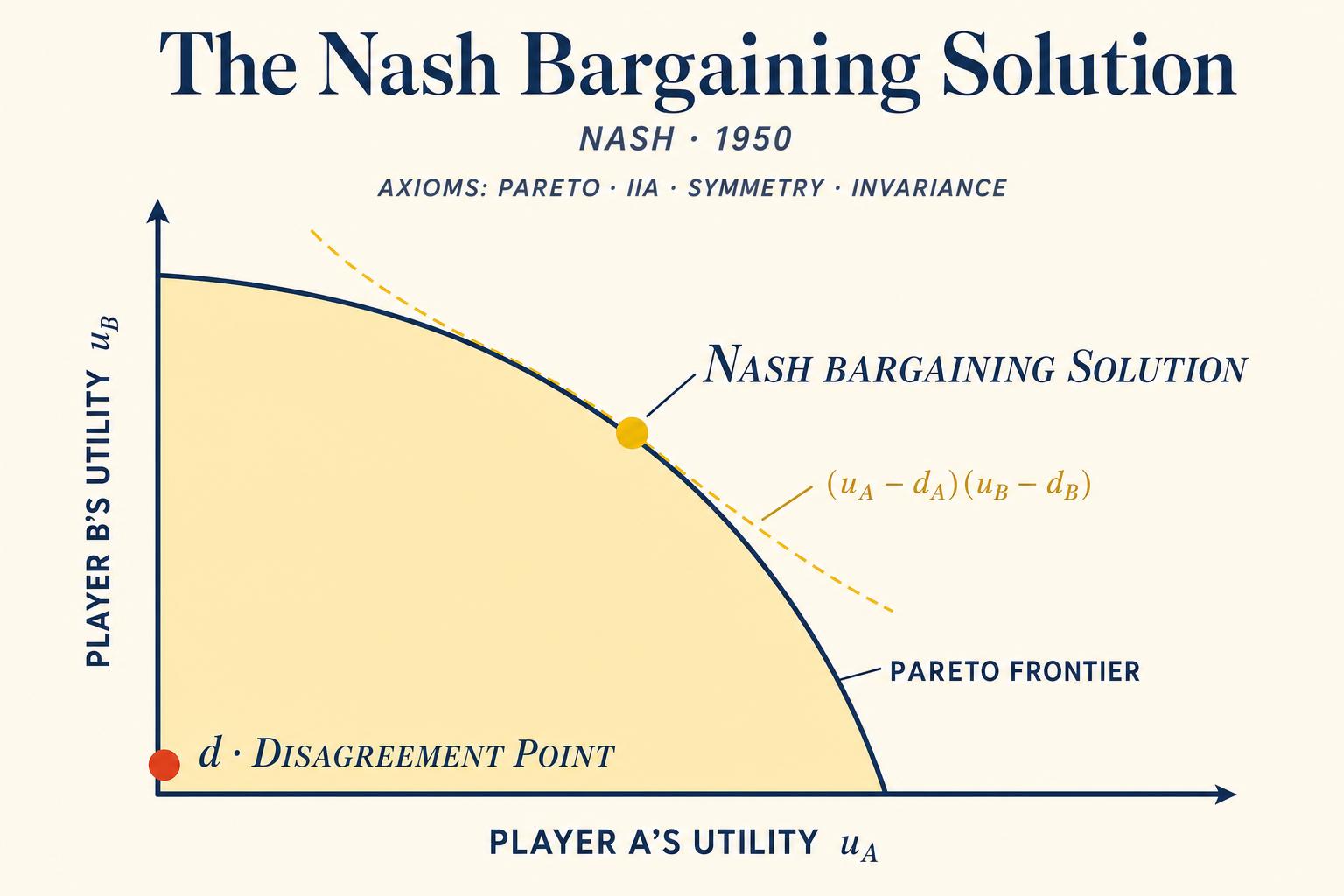
In 1950, John Nash published a two-page paper that transformed the study of bargaining. Rather than modelling the messy process of offers and counteroffers, Nash asked a more abstract question: if we agree on certain principles that a bargaining solution should satisfy, what solution do those principles imply?
Nash proposed four axioms. The first is Pareto efficiency: the solution should not leave money on the table. If there exists an agreement that makes both parties better off, the solution should not recommend an inferior one. The second is symmetry: if the bargaining problem is perfectly symmetric — both players have the same utility functions and the same disagreement payoffs — then they should split the surplus equally. The third is scale invariance: the solution should not change if we rescale one player's utility, say, by converting from dollars to cents. What matters is the structure of preferences, not the arbitrary units we use to measure them. The fourth — and most controversial — is the independence of irrelevant alternatives: if we remove some possible agreements from the feasible set, and the original solution is still feasible, then it should remain the solution.
Nash proved that exactly one solution satisfies all four axioms. It is the agreement that maximises the Nash product: you maximize the product of u-one minus d-one, times u-two minus d-two, where u-one and u-two are the players' utilities from the agreement and d-one and d-two are their utilities at the disagreement point.
The intuition is elegant. Each player's gain above their disagreement payoff is multiplied together, and the solution maximises this product. In the symmetric case, this gives an equal split of the surplus. In asymmetric cases — where one player has a better disagreement payoff — the solution shifts in that player's favour. You can think of the Nash product as a measure of the "joint gains from agreement," weighted so that neither player's gains are disproportionately sacrificed.
The Nash bargaining solution is powerful because it provides a unique prediction from minimal assumptions. But it is silent on the process — it tells us what the outcome should look like, not how the players get there. For that, we need a strategic model.
Rubinstein's Alternating-Offers Model
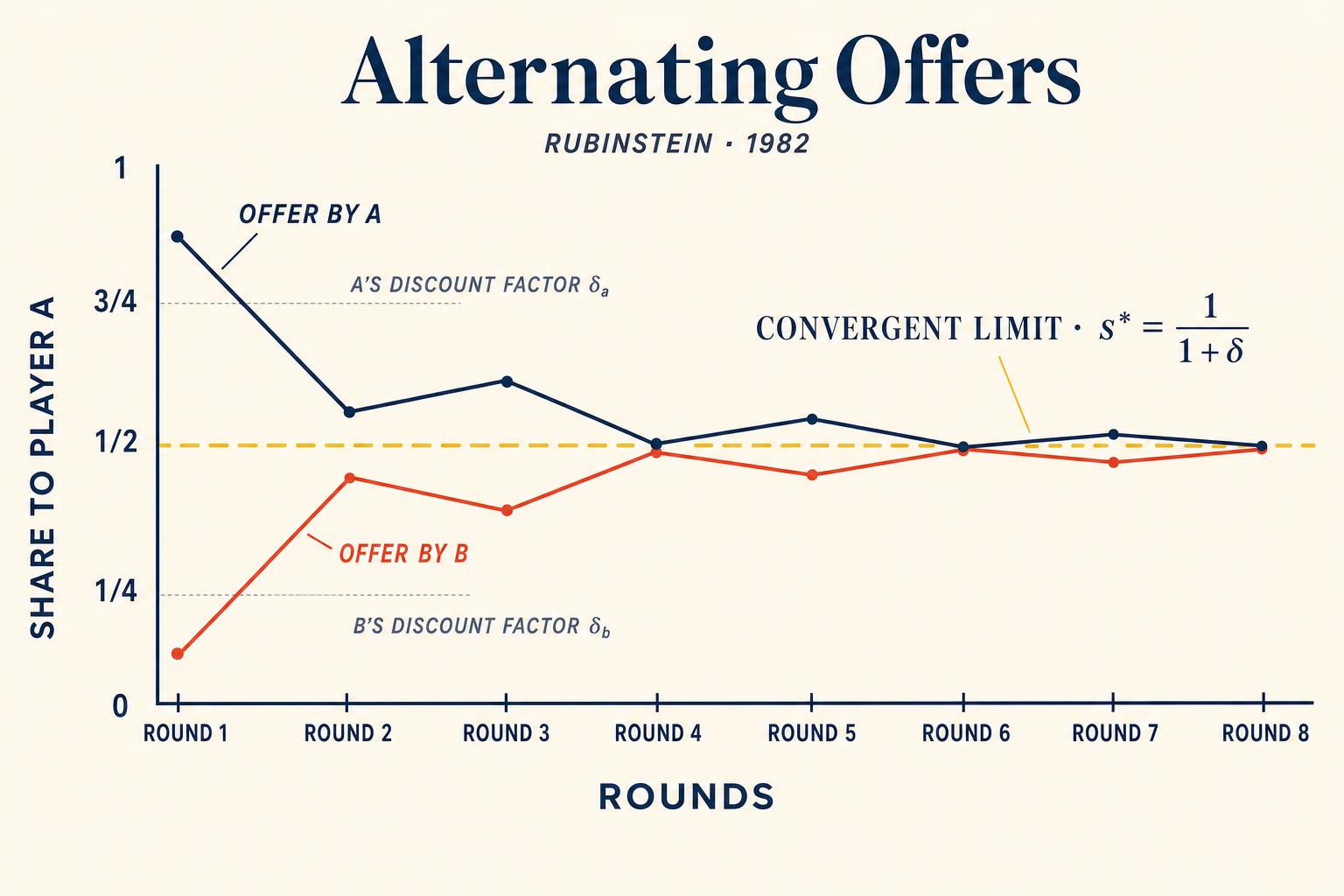
In 1982, Ariel Rubinstein published a paper that provided the strategic foundations for bargaining theory. His model is disarmingly simple. Two players must divide a pie of size one. They take turns making proposals. Player One proposes a division; Player Two can accept, and the game ends, or reject and make a counter-proposal. The offers alternate until agreement is reached.
The critical ingredient is time preference. Each player has a discount factor — call them delta-one and delta-two — representing how much they value future payoffs relative to present ones. If your discount factor is zero point nine, receiving one dollar next period is worth only ninety cents to you today. A higher discount factor means you are more patient: you lose less from delay. Recall from Chapter Six that discount factors also sustain cooperation in repeated games; here, they play a different but equally fundamental role.
Solving by Backward Induction
Rubinstein's genius was recognising that this infinite-horizon game has a unique subgame perfect equilibrium. The logic is a beautiful application of backward induction — or rather, of the stationarity of the game's structure.
Consider what happens when it is Player One's turn to propose. Player One knows that if Player Two rejects, Player Two will make a counter-offer next period. In that counter-offer, Player Two will extract the best deal possible. Player One also knows that Player Two discounts the future, so whatever Player Two could get next period is worth less to Player Two now. Therefore, Player One should offer Player Two exactly enough to make Player Two indifferent between accepting now and waiting — no more, no less.
By the same logic applied symmetrically, Player Two would offer Player One just enough to make Player One indifferent. Solving these two equations simultaneously gives us the unique equilibrium: Player One's equilibrium share equals one minus delta-two, divided by one minus delta-one times delta-two. Player Two's equilibrium share equals delta-two times one minus delta-one, divided by one minus delta-one times delta-two.
Several features of this solution are remarkable. First, agreement is reached immediately. In equilibrium, Player One makes an offer in the first period and Player Two accepts. There is no delay, no wasteful haggling, no breakdown. All the strategic reasoning happens before the first word is spoken. Second, the first-mover advantage: Player One, who gets to propose first, does slightly better than Player Two, all else being equal. Third — and most importantly — patience is power.
Patience Is Power
The Rubinstein model delivers a crisp insight: the more patient player captures a larger share of the surplus. If delta-one is greater than delta-two — if Player One is more patient than Player Two — then Player One's equilibrium share increases. The reason is intuitive once you see it: a patient player loses little from delay, which means threats to reject an offer and wait are more credible. An impatient player, by contrast, is desperate to reach agreement quickly, and that desperation is exploitable.
Consider two extremes. If Player Two is perfectly impatient — delta-two approaches zero — Player Two values the future not at all. Player One can offer Player Two virtually nothing — an infinitesimal amount above zero — and Player Two must accept, because any delay yields zero utility. Player One captures nearly the entire surplus. Conversely, if both players are equally patient — delta-one equals delta-two equals delta — the equilibrium share for Player One simplifies to one divided by one plus delta, which approaches one-half as both players become very patient, as delta approaches one. Equal patience produces an approximately equal split.
This connects directly to our Toyota example. The union's effective discount factor was low — workers facing mortgage payments and grocery bills could not afford to strike indefinitely. Toyota's effective discount factor was high — a global corporation with alternative production facilities could afford to wait. The Rubinstein model predicts exactly what happened: the patient player captured the lion's share of any agreement, and the impatient player's weak bargaining position ultimately made agreement impossible at terms the union could accept.
In hostage negotiations, police negotiators are trained to slow the situation down and extend the timeline. Using the Rubinstein model, we can explain why this tactic shifts bargaining power toward the negotiator and away from the hostage-taker. By extending the timeline, negotiators increase the number of bargaining "rounds" and effectively raise their own discount factor relative to the hostage-taker's. The hostage-taker, under stress and facing an unstable situation, becomes increasingly impatient with each passing hour. The negotiator, by remaining calm and methodical, demonstrates patience. In this context, "patience" means the ability to withstand the psychological and practical costs of delay — and that ability translates directly into bargaining leverage.
The insight extends far beyond economics. In international climate negotiations — which we will examine in depth in Chapter Twelve — wealthy nations can typically afford to delay action more than low-lying island states facing imminent flooding. The Rubinstein model predicts that this asymmetry in patience translates directly into bargaining power: those who can afford to wait will extract more favourable terms from those who cannot. As Muthoo emphasises in his 1999 treatment, understanding the sources of patience — wealth, time horizons, access to alternatives — is essential for understanding bargaining power.
The Elegant Convergence
We now arrive at one of game theory's most satisfying results. Nash's solution comes from axioms — abstract principles about what a fair bargain should look like. Rubinstein's solution comes from strategy — the cold logic of rational players maximising their own payoffs. Yet as Binmore, Rubinstein, and Wolinsky proved in 1986, as the time between offers shrinks to zero — that is, as the bargaining process becomes arbitrarily fast — the Rubinstein equilibrium converges exactly to the Nash bargaining solution.
The technical details require care about how one maps discount factors to the disagreement point, but the core result is this: if both players have the same discount rate but potentially different outside options, the strategic equilibrium approaches a fifty-fifty split of the surplus above the disagreement point — exactly the symmetric Nash bargaining solution. If discount rates differ, the solution converges to the asymmetric Nash bargaining solution, where bargaining weights correspond to the players' relative patience, as Osborne and Rubinstein showed in 1990.
Why does this matter? Because it means that our two approaches to bargaining are not competitors — they are complements. The axiomatic approach tells us what the outcome should look like if the process is "fair" by certain standards. The strategic approach tells us why that outcome emerges from rational self-interest. Fairness, it turns out, is not the enemy of self-interest. Under the right conditions, they produce the same result.
Outside Options and BATNA
In their influential book Getting to Yes, Fisher, Ury, and Patton introduced the concept of BATNA: the Best Alternative to a Negotiated Agreement. Your BATNA is what you walk away to if this negotiation fails. It is, they argued, the single most important source of negotiating power — and the concept maps directly onto the formal theory.
In the Nash bargaining framework, your BATNA determines your disagreement payoff. In the Rubinstein model, your BATNA determines your outside option — the payoff you can secure by permanently leaving the negotiation. In both frameworks, a better BATNA shifts the bargaining outcome in your favour, for a simple reason: the ability to walk away credibly makes you less desperate, and less desperation means more power.
Consider a salary negotiation. Suppose you are interviewing for a position that you and the employer value at one hundred twenty thousand dollars in total surplus. You could earn eighty thousand dollars elsewhere — that's your BATNA. The employer could hire someone else who generates ninety thousand dollars in value — that represents the employer's alternative. The surplus from your specific agreement is the value created by hiring you specifically, above and beyond what each party could get from their next-best alternative. The Nash solution splits that surplus equally. The key insight: as your BATNA improves — say you get a competing offer at ninety thousand dollars — your bargaining position strengthens. You capture a larger share because your credible threat to walk away has become more powerful.
This is why Fisher, Ury, and Patton insist that improving your BATNA is the most effective negotiation preparation. You are not just improving your fallback; you are shifting the equilibrium in the negotiation itself. Recall from Chapter Five how outside options affect behaviour in strategic interactions — BATNA is the bargaining-specific instance of that general principle.
When Bargaining Fails · Information & Breakdown
The Rubinstein model predicts immediate agreement — no strikes, no wars, no litigation, no delay. Yet in reality, bargaining frequently breaks down. Negotiations collapse, strikes occur, wars are fought, and lawsuits drag on for years. If both sides would be better off reaching agreement, why does agreement sometimes fail?
The answer, as you might suspect from Chapter Seven, lies largely in information asymmetry. When one party has private information about their valuation, patience, or outside options, the other party faces a dilemma. Making a generous offer wastes surplus if the other side would have accepted less. Making an aggressive offer risks breakdown if the other side's private information makes them unwilling to accept. This trade-off between extracting surplus and risking breakdown creates an inherent inefficiency.
Consider a union negotiating wages with a firm. The firm knows its true profitability; the union does not. A highly profitable firm could afford to pay high wages but wants to claim poverty to keep wages low. An unprofitable firm genuinely cannot pay high wages. The union, unable to distinguish the two, must make offers that account for both possibilities. If the union demands high wages, unprofitable firms reject, leading to costly strikes. If the union demands low wages, profitable firms enjoy a windfall at the union's expense. As Acemoglu and Shimer demonstrated in 1995, asymmetric information about productivity creates bargaining frictions that increase unemployment beyond what complete-information models predict. The information problem is not merely an inconvenience — it is a structural source of inefficiency.
Barbara Walter extends this logic in her 2009 work to one of bargaining's most consequential failures: civil war. She identifies three mechanisms through which bargaining breaks down between governments and rebel groups. First, asymmetric information: each side has private information about its military capabilities and resolve, creating mutual overoptimism about the likely outcome of fighting. Second, commitment problems: even if a mutually beneficial deal exists, parties may be unable to credibly commit to its terms, particularly when the agreement requires one side to disarm. Third, issue indivisibility: some stakes — sovereignty, sacred territory — resist the kind of continuous division that bargaining models assume.
The Ultimatum Game Revisited
Recall from Chapter Five the experimental anomaly of the ultimatum game. In a one-shot interaction, the proposer should offer the smallest possible amount, and the responder should accept any positive offer. Yet experiments consistently show that proposers offer forty to fifty percent of the pie, and responders reject offers below about twenty percent. This behaviour puzzled economists committed to the assumption of narrow self-interest.
The Rubinstein model provides a partial resolution. The ultimatum game is the limiting case of the alternating-offers model when the responder has no opportunity to counter-offer — effectively, the responder's discount factor is zero. With alternating offers and any positive discount factor, the equilibrium becomes less extreme: the responder's ability to delay, even slightly, gives them genuine bargaining power. The ultimatum game's extreme predictions arise from the extreme assumption that the responder has no recourse whatsoever — a condition rarely met in practice.
Cultural Variation in Fairness
The forty-to-fifty-percent figure is not a universal constant of human nature. Henrich and colleagues (2001), in a now-classic cross-cultural study spanning fifteen small-scale societies — including hunter-gatherers, pastoralists, and horticulturalists — found that mean ultimatum-game offers ranged from roughly twenty-six to fifty-eight percent, and rejection thresholds varied just as widely. Among the Machiguenga of Peru, low offers were common and rarely rejected; among the Lamalera whale-hunters of Indonesia, offers regularly exceeded half the pie. The pattern correlated with the degree of market integration and cooperation in production. Fairness norms, in other words, are calibrated to the local economic environment — a finding that fits comfortably alongside the formal theory rather than contradicting it.
Distributive vs Integrative Bargaining
Everything we have discussed so far assumes distributive bargaining — dividing a fixed surplus. But many real negotiations involve integrative bargaining, where creative agreements can expand the pie. A salary negotiation might include not just the dollar figure but also flexible hours, remote work options, professional development funds, and signing bonuses. Each party may value these components differently, creating opportunities for trades that make everyone better off. Fisher, Ury, and Patton built their entire approach to negotiation around this distinction. Their method of "principled negotiation" emphasises four principles: separate the people from the problem, focus on interests not positions, invent options for mutual gain, and insist on objective criteria. The third principle — inventing options — is precisely about moving from distributive to integrative bargaining. The Nash bargaining solution extends naturally to this case: when integrative options are available, the set of possible agreements expands outward, and the Nash product is maximised at a point that captures these mutual gains.
Patience in Practice · Applications
Union–Firm Wage Negotiations
Australian enterprise bargaining provides a natural laboratory for testing bargaining theory. Under the Fair Work Act 2009, enterprise agreements are negotiated between employers and employee representatives, typically unions. The Rubinstein model predicts that the party more able to withstand a work stoppage will secure better terms. Unions build strike funds precisely to increase their effective patience; firms stockpile inventory or arrange contingency plans for the same reason. The model also predicts that mandatory conciliation and arbitration procedures — which impose costs of delay on both sides — should push outcomes toward equal splits, which is broadly consistent with the role these procedures play in Australian industrial relations.
International Climate Negotiations
Climate negotiations offer a sobering application of bargaining failure. The surplus from a global climate agreement is enormous — avoided damages worth trillions. But the distribution of costs and benefits is deeply asymmetric. Wealthy nations have higher discount factors — they can afford to wait — and stronger BATNAs; their economies are more diversified and less vulnerable to near-term climate impacts. Small island developing states face existential threats from sea-level rise, giving them effectively low discount factors — they cannot afford to wait. The Rubinstein model predicts that this patience asymmetry will tilt agreements toward the interests of wealthy nations, even when fairness considerations would suggest the opposite. We will explore this application in depth in Chapter Twelve.
Hostage Negotiation
Law enforcement hostage negotiation provides perhaps the most vivid illustration of patience as power. Trained negotiators follow a protocol designed to maximise their effective discount factor while minimising the hostage-taker's. They slow the process down, increasing the number of "rounds." They establish rapport, reducing the hostage-taker's impatience. They avoid deadlines, which would make the negotiator the impatient party. They also work to improve their own BATNA through tactical positioning while degrading the hostage-taker's outside options. The entire playbook reads like an applied Rubinstein model, even though few negotiators have heard of it.
Bringing It Together
Let us step back and see the full picture. Bargaining outcomes are determined by three fundamental forces: the surplus available from agreement, the outside options — the BATNAs — of each party, and the relative patience of each party. The Nash bargaining solution captures these forces axiomatically; the Rubinstein model derives them strategically. As Binmore, Rubinstein, and Wolinsky showed in 1986, these approaches converge, giving us confidence that the theory is robust.
Information asymmetry is the primary source of bargaining failure. When parties cannot observe each other's true valuations, patience, or alternatives, the equilibrium involves positive probability of breakdown — strikes, wars, litigation — even when both sides would benefit from agreement, as Muthoo explains in his 1999 work. This is not irrational behaviour; it is the rational consequence of strategic interaction under incomplete information.
Fairness, it turns out, is not the enemy of self-interest. Under the right conditions, they produce the same result.
after Binmore, Rubinstein & Wolinsky · 1986
The practical implications are clear. To negotiate well, you should: first, improve your BATNA before entering any negotiation; second, cultivate patience and signal your willingness to wait; third, seek to understand the other party's true interests, enabling integrative bargaining; and fourth, be aware that private information creates unavoidable risks of breakdown. These principles follow directly from the formal theory — they are not mere folk wisdom, but consequences of rigorous strategic reasoning.
Key Takeaways
- The Nash bargaining solution (Nash, 1950) derives a unique division from four axioms — efficiency, symmetry, scale invariance, and independence of irrelevant alternatives — and maximises the product of each player's gains above the disagreement point.
- The Rubinstein alternating-offers model (Rubinstein, 1982) derives a unique subgame-perfect equilibrium from strategic reasoning. Agreement occurs immediately; shares are determined by discount factors.
- As offers become arbitrarily frequent, the Rubinstein equilibrium converges to the Nash bargaining solution (Binmore, Rubinstein, & Wolinsky, 1986; Osborne & Rubinstein, 1990) — strategy and axioms agree at the limit.
- BATNA — the Best Alternative to a Negotiated Agreement (Fisher, Ury, & Patton) — is the primary determinant of bargaining power. A better outside option shifts the equilibrium in your favour.
- Patience is power. The party that loses less from delay captures a larger share. Strategies that increase your patience or decrease your opponent's are sources of bargaining advantage.
- Information asymmetry is the primary cause of bargaining failure: strikes, wars, and failed deals occur even when mutually beneficial agreements exist (Acemoglu & Shimer, 1995; Walter, 2009; Muthoo, 1999).
- Behavioural deviations from theory — fair offers and costly rejections in the ultimatum game — vary systematically across cultures with the degree of market integration (Henrich et al., 2001).
- Integrative bargaining expands the pie by addressing underlying interests, allowing both parties to do better than in a purely distributive negotiation.
In Chapter Eleven, The Will of the People, we move from bilateral negotiation to group decision-making by examining voting and social choice. Arrow's impossibility theorem will show us that aggregating preferences is far harder than splitting a pie — and the strategic manipulation of voting rules introduces a new dimension of game-theoretic reasoning.
References
Acemoglu, D., & Shimer, R. (1995). Asymmetric information, bargaining, and unemployment fluctuations. International Economic Review, 40(4), 1003–1024.
Binmore, K., Rubinstein, A., & Wolinsky, A. (1986). The Nash bargaining solution in economic modelling. The RAND Journal of Economics, 17(2), 176–188.
Fisher, R., Ury, W., & Patton, B. (2011). Getting to yes: Negotiating agreement without giving in (3rd ed.). Penguin Books. (Original work published 1981.)
Henrich, J., Boyd, R., Bowles, S., Camerer, C., Fehr, E., Gintis, H., & McElreath, R. (2001). In search of Homo economicus: Behavioral experiments in 15 small-scale societies. American Economic Review, 91(2), 73–78.
Muthoo, A. (1999). Bargaining theory with applications. Cambridge University Press.
Nash, J. F. (1950). The bargaining problem. Econometrica, 18(2), 155–162.
Osborne, M. J., & Rubinstein, A. (1990). Bargaining and markets. Academic Press.
Rubinstein, A. (1982). Perfect equilibrium in a bargaining model. Econometrica, 50(1), 97–109.
Walter, B. F. (2009). Bargaining failures and civil war. Annual Review of Political Science, 12, 243–261.