The Will of the People
Voting Paradoxes and Mechanism Design
Why majority preferences can cycle, why no voting system can be perfectly fair, and how mechanism designers build institutions that work despite strategic behaviour.
November seventh, 2000. Florida. George W. Bush leads Al Gore by 537 votes out of nearly six million cast. Ralph Nader, the Green Party candidate, has received 97,488 votes. Exit polls suggest that Nader voters preferred Gore to Bush by a substantial margin. Had those voters been able to express their full preference rankings, or had a different voting rule been in place, Gore would almost certainly have won Florida, and with it the presidency. Was the "will of the people" that Bush should be president? Or Gore? The answer, unsettlingly, depends entirely on which voting rule you use to ask the question.
This reveals why that ambiguity isn't a bug in American elections. It's a deep mathematical feature of all democratic decision-making. We'll discover that majority preferences can be incoherent, that no voting system can be perfectly fair, that every system can be gamed by strategic voters, and that the best response isn't despair but rather the careful design of institutions that work despite strategic behaviour.
The Condorcet Paradox
Democracy rests on a comforting assumption: when a group of people votes, a coherent collective preference emerges. Person by person, each individual knows what they want. Surely the group, taken together, also "wants" something. The Marquis de Condorcet, an eighteenth-century French mathematician and political philosopher, discovered that this assumption is spectacularly wrong.
Consider a city council with three members: Anika, Ben, and Clara, choosing among three budget proposals. A, increase parks spending. B, increase transit spending. And C, increase housing spending. Their preferences are:
Anika prefers A over B over C. Parks first, then transit, then housing. Ben prefers B over C over A. Transit first, then housing, then parks. Clara prefers C over A over B. Housing first, then parks, then transit.
Now let's hold pairwise majority votes. A versus B: Anika and Clara both prefer A to B, so A wins two to one. B versus C: Anika and Ben both prefer B to C, so B wins two to one. By transitivity, the principle that if you prefer apples to bananas and bananas to cherries, you prefer apples to cherries, we'd expect A to beat C. But A versus C: Ben and Clara both prefer C to A, so C wins two to one.
The result is a Condorcet cycle: A beats B, B beats C, and C beats A. The group's majority preferences cycle, like rock-paper-scissors. There is no option that a majority prefers to all others, no Condorcet winner. The "will of the people" is not merely unclear; it is logically incoherent.
This is the Condorcet paradox, and it shattered the Enlightenment dream that rational individual preferences automatically produce rational collective decisions. The paradox isn't exotic or unlikely. With three or more alternatives and diverse preferences, cycles emerge with surprising frequency. Computational studies suggest that with many voters and alternatives drawn from random preference profiles, cycles occur in roughly ten to fifteen percent of elections, and the probability rises as the number of alternatives increases, as reported in the Stanford Encyclopedia of Philosophy in 2014.
The answer reveals something profound: when preferences cycle, the order in which alternatives are considered can determine the outcome. Whoever controls the agenda controls the result. This isn't a minor procedural detail. It means that the outcome of democratic deliberation can be manufactured by the person who decides the sequence of votes.
Voting Systems · Same Preferences, Different Winners
If pairwise majority voting can cycle, perhaps a different voting rule does better? Unfortunately, different voting rules can produce different winners from the same set of preferences, and there's no principled way to declare one rule "right."
Consider these common voting systems:
Plurality
Plurality: each voter casts one vote for their top choice. The candidate with the most votes wins. This is the system used in most United States and United Kingdom elections.
Borda Count
Borda count: voters rank all candidates. With n candidates, your top choice gets n minus one points, your second gets n minus two, and so on. The candidate with the most total points wins.
Instant Runoff
Instant runoff voting, or IRV: voters rank candidates. The candidate with the fewest first-place votes is eliminated, and their ballots transfer to those voters' next choices. This repeats until one candidate has a majority.
Copeland's Rule
Copeland's rule: each candidate gets plus one for every pairwise majority win and minus one for every loss. The highest score wins.
Approval
Approval voting: each voter can "approve" as many candidates as they like. The most-approved candidate wins.
Each rule embodies a different philosophy of fairness. Plurality rewards intense first-choice support. Borda count rewards broad acceptability. IRV tries to find a majority winner through iterative elimination. And remarkably, they can all disagree.
Arrow's Impossibility Theorem · 1951
The fact that different rules produce different outcomes raises an urgent question: is there some perfect voting rule out there, one that always produces a coherent, fair ranking of alternatives? In 1951, the economist Kenneth Arrow proved the devastating answer: no.
Arrow's impossibility theorem demonstrates that when there are three or more alternatives, no ranked-choice voting system can simultaneously satisfy all of the following conditions, as Arrow showed in 1951:
Unrestricted Domain
Unrestricted domain: the rule must work for any possible combination of individual preference rankings. We can't require that voters' preferences have a special structure.
Pareto Efficiency
Pareto efficiency: if every voter prefers A to B, then the social ranking must also rank A above B. Unanimity should be respected.
Independence of Irrelevant Alternatives
Independence of irrelevant alternatives, or IIA: the social ranking of A versus B should depend only on how individuals rank A versus B, not on how they rank some third option C. Introducing or removing an "irrelevant" alternative should not change whether society prefers A or B.
Non-Dictatorship
Non-dictatorship: there is no single individual whose preferences automatically determine the social ranking regardless of what everyone else thinks.
Each condition seems not merely reasonable but indispensable. Unrestricted domain says we shouldn't have to police people's beliefs. Pareto efficiency says unanimous agreement should count. Independence of irrelevant alternatives says the introduction of spoiler candidates shouldn't change the relative ranking of other candidates, precisely the condition violated in the 2000 Florida election, where Nader's presence plausibly changed the Bush-Gore outcome. And non-dictatorship is the bare minimum of democratic legitimacy.
Yet Arrow proved, with rigorous mathematical logic, that these four conditions are mutually inconsistent. Any voting rule that satisfies three of them must violate the fourth. This is not a claim that we haven't found the right rule yet. It's a proof that the right rule cannot exist.
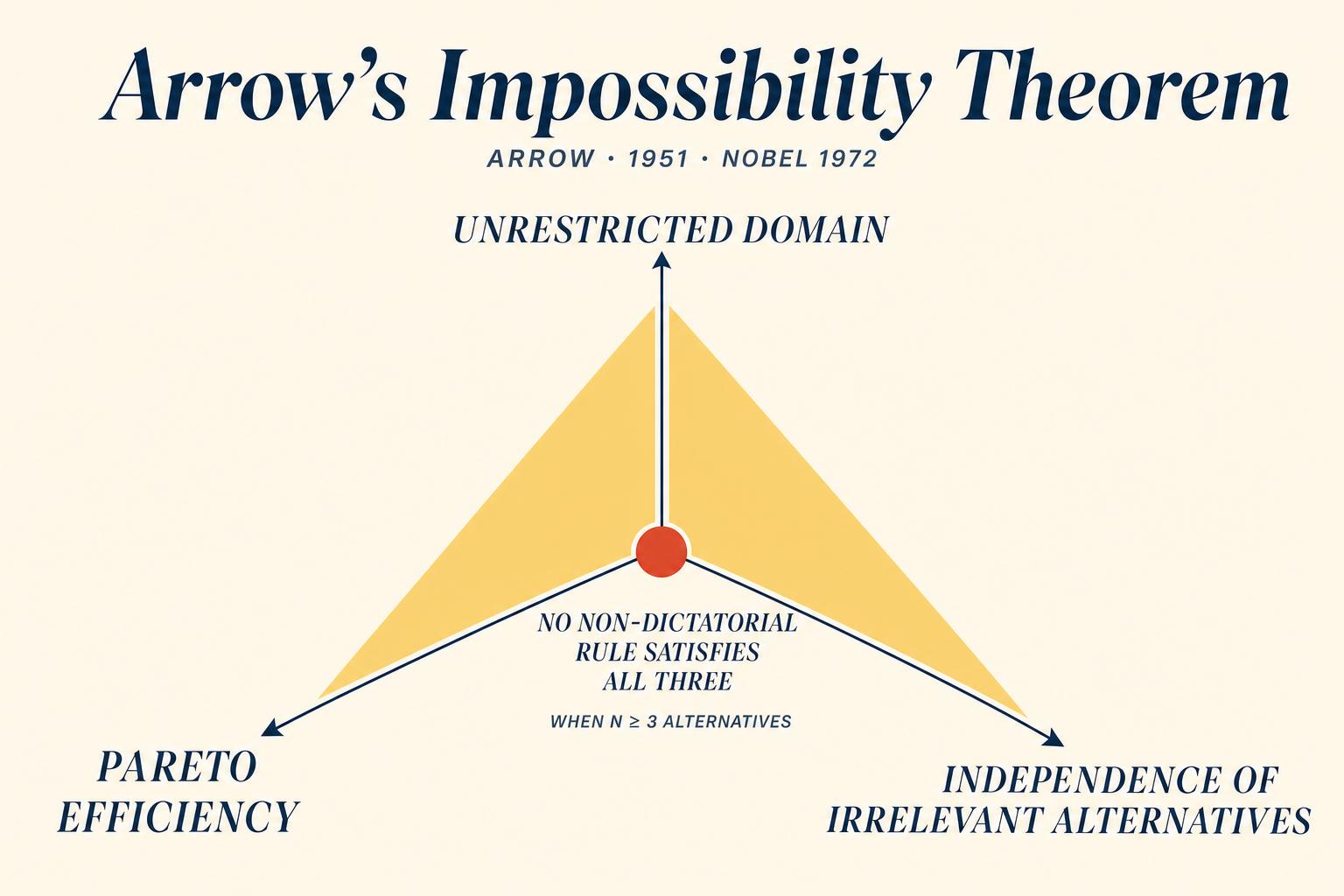
The theorem's implications ripple far beyond political science. Any organization that must aggregate individual preferences into a group decision, a corporate board, a hiring committee, an international climate negotiation, faces Arrow's constraint. There is no escape from trade-offs in collective choice, as described in the Stanford Encyclopedia of Philosophy in 2014. The question is never "which rule is perfect?" but rather "which imperfection can we best live with?"
Escape Routes from the Impossibility
Arrow's theorem doesn't mean democracy is doomed. It means we must be thoughtful about which conditions to relax. One important escape route is domain restriction. Duncan Black showed in 1948 that if voters' preferences are single-peaked, meaning each voter has an ideal point on a single dimension and prefers alternatives closer to that ideal, then majority rule produces a transitive social ordering, and the median voter's preferred alternative is the Condorcet winner. This is the median voter theorem, which we'll explore in depth shortly.
Another escape route is to abandon ordinal rankings and allow cardinal information, intensities of preference, not just orderings. Approval voting, where voters can approve multiple candidates, captures some intensity information and avoids some paradoxes, though it introduces new strategic considerations. Still another approach accepts the impossibility and asks: if we can't guarantee perfect outcomes, can we design systems that are strategically robust? This leads us to mechanism design.
Strategic Voting · Gibbard–Satterthwaite
So far we've assumed voters report their preferences honestly. But voters are strategic agents, a lesson that should be second nature by this point in a game theory course. When a voting rule can produce bad outcomes for you, you have every incentive to misrepresent your preferences, to vote strategically rather than sincerely.
Return to the 2000 election. A Nader supporter in Florida whose true ranking is Nader over Gore over Bush faces a strategic dilemma. Voting sincerely for Nader, their true first choice, helps elect Bush, their last choice. Voting strategically for Gore, their second choice, prevents their worst outcome. This is strategic voting, sometimes called "tactical voting," and it's ubiquitous in plurality systems.
You might hope that a cleverer voting rule could eliminate the incentive for strategic voting. The Gibbard–Satterthwaite theorem proves this hope is futile. Independently proved by Allan Gibbard in 1973 and Mark Satterthwaite in 1975, the theorem states:
Any voting rule that, first, allows at least three possible outcomes, second, is not a dictatorship, and third, can produce every alternative as a winner for some preference profile, is susceptible to strategic manipulation — meaning there exists at least one situation where some voter can achieve a better outcome by misreporting their preferences.
Gibbard, 1973; Satterthwaite, 1975
The parallel with Arrow's theorem is striking, and not coincidental. Arrow showed that no rule can perfectly aggregate preferences. Gibbard and Satterthwaite showed that no rule can make it always safe to reveal your preferences honestly. Together, these results establish fundamental limits on what democratic institutions can achieve.
But recognizing that every system is manipulable doesn't mean all systems are equally manipulable. Some systems require sophisticated strategic calculations and are manipulable only in rare circumstances. Others, like plurality, practically beg voters to vote strategically. The degree and frequency of strategic vulnerability varies enormously across rules, and designing rules that are hard to manipulate is a central goal of mechanism design.
Let's analyze strategic voting with the game-theoretic tools we've developed. An election with strategic voters is simply a game: voters are players, votes are strategies, and outcomes are determined by the voting rule. We can find Nash equilibria of this game and ask whether the equilibrium outcome differs from the sincere outcome.
Strategic voting illustrates a key insight: under plurality voting, strategic behavior is often rational, even beneficial. The Nader voter who switches to Gore isn't "gaming the system" so much as rationally responding to a system that punishes sincere expression of minority preferences. This is precisely the Gibbard–Satterthwaite result in action: the system itself creates the incentive to misrepresent.
The Median Voter Theorem · Downs, 1957
Despite the impossibility results, there is one elegant case where majority rule works beautifully. When political competition occurs along a single dimension and voters have single-peaked preferences, the result is one of the most powerful and widely applied predictions in political science: the median voter theorem.
The setup, formalized by Black in 1948 and extended to political competition by Anthony Downs in 1957, works as follows. Imagine voters arrayed along a left-right policy spectrum. Each voter has an ideal point, their most preferred policy position, and prefers policies closer to their ideal over policies further away. That's single-peaked preferences. Two parties compete by choosing policy positions, and each voter votes for the nearer party.
The striking result: in equilibrium, both parties converge to the position of the median voter, the voter whose ideal point has exactly half the electorate on each side. Why? If Party A positions to the left of the median, Party B can capture a majority by positioning just to A's right. A then has an incentive to leapfrog B back toward the median. This iterative best-response process converges to a Nash equilibrium where both parties sit at the median, the same equilibrium concept we developed earlier, now applied to spatial competition, as Downs described in 1957.
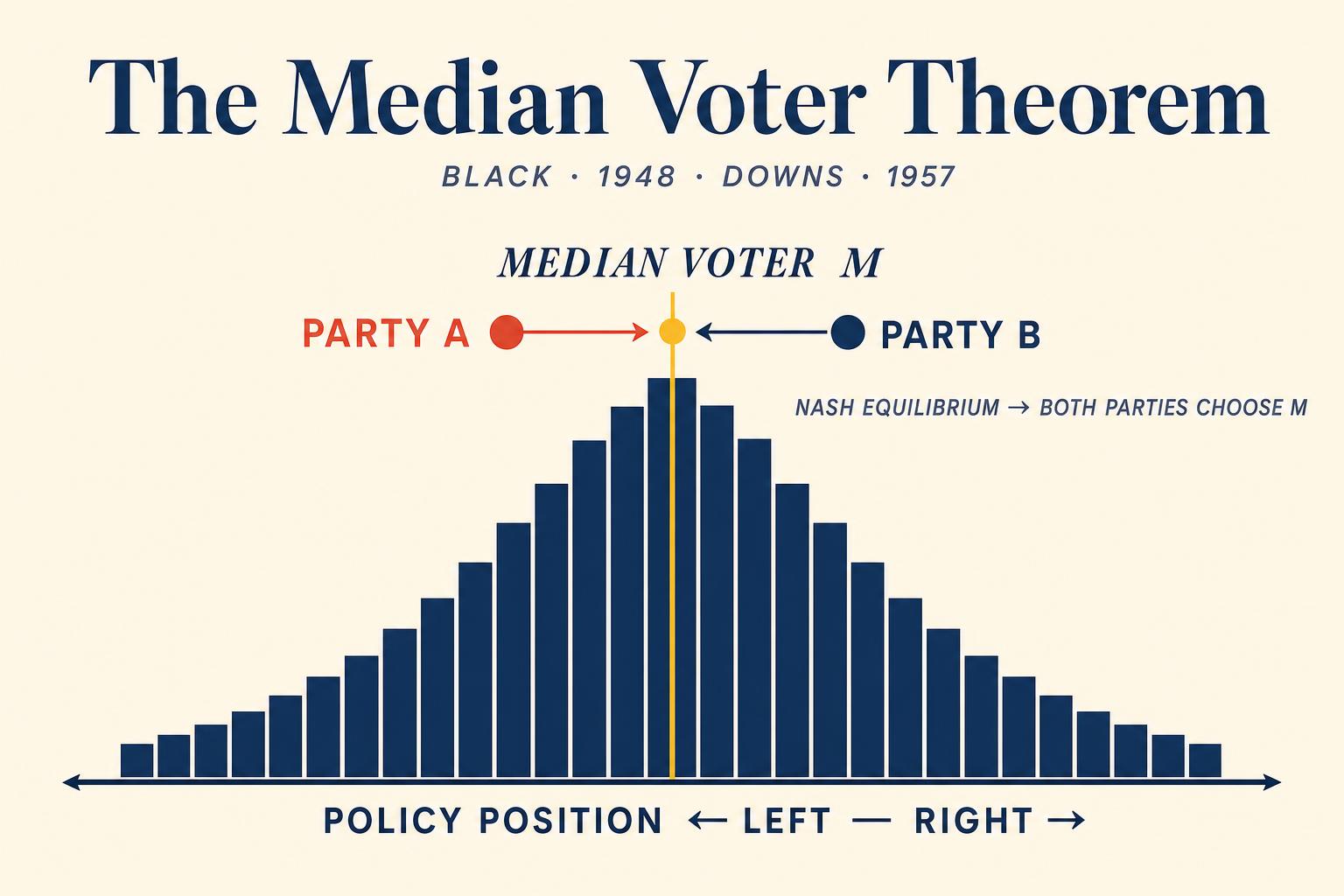
The median voter theorem explains several empirical patterns: why candidates in two-party systems often seem frustratingly similar, why candidates "pivot to the center" after winning primary elections, and why moderate policies tend to be more stable than extreme ones. It also connects beautifully to our analysis of spatial competition from earlier chapters. The Hotelling model of firms choosing locations on a street is mathematically identical.
When the Theorem Breaks
The median voter theorem is powerful but rests on strong assumptions. When those assumptions fail, so does convergence, and real-world political polarization becomes easier to explain.
First, if the policy space is multidimensional, voters care about both economic policy and social policy, for example, then a median voter typically doesn't exist, and cycling returns, as implied by Arrow's theorem. Second, if the voter distribution is bimodal, clustered at the extremes rather than the center, then parties may find it advantageous to position near the peaks rather than the middle.
Third, the theorem assumes parties are pure vote-maximizers with no policy preferences of their own. If party leaders or primary voters have strong ideological commitments, they may prefer losing with principled positions to winning with centrist ones. Fourth, voter turnout is not uniform: extremist voters may be more motivated to vote, shifting the "effective median" away from the population median. These complications help explain why, despite the theorem's prediction of convergence, contemporary politics in many democracies features persistent, even increasing, polarization.
Mechanism Design · Reverse Game Theory
Arrow's theorem and the Gibbard–Satterthwaite theorem might seem like counsel of despair. If no voting rule is perfect and every system can be gamed, should we give up on designing good institutions? Absolutely not. Instead, these impossibility results define the landscape within which institutional design must operate. The field that navigates this landscape is mechanism design, sometimes called "reverse game theory."
In game theory, we take the rules of the game as given and predict behavior. In mechanism design, we choose the rules to produce desired outcomes, knowing that participants will behave strategically. The question becomes: can we design institutions where self-interested, strategic behavior leads to socially desirable results? Leonid Hurwicz, Eric Maskin, and Roger Myerson shared the 2007 Nobel Prize in Economics for foundational work on exactly this question.
The Revelation Principle
One central result is the revelation principle: any social outcome that can be implemented by some mechanism can also be implemented by a direct mechanism in which participants are simply asked to report their preferences truthfully, and truth-telling is incentive-compatible. The principle radically simplifies the search for good institutions: instead of imagining every possible game form, the designer can restrict attention to truthful direct mechanisms.
Auctions as Mechanism Design
You've already encountered one triumph of mechanism design: the Vickrey, or second-price, auction. William Vickrey showed that when bidders pay the second-highest bid rather than their own, truthful bidding is a dominant strategy. Each bidder's optimal move is to bid exactly their true valuation, regardless of what others do. This idea was generalized by Clarke in 1971 and Groves in 1973 into the Vickrey–Clarke–Groves mechanism, or VCG mechanism, which extends dominant-strategy truthfulness to arbitrary allocation problems with transferable utility, as Vickrey showed in 1961, and Clarke and Groves extended in the early 1970s.
The VCG mechanism achieves truthfulness by charging each agent their marginal externality, the cost their participation imposes on others. If your arrival changes the allocation in a way that harms other participants, you pay a tax equal to that harm. Under this payment rule, reporting your true preferences is always optimal, because your payment doesn't depend on your own report. It depends only on the impact you have on others. This elegant alignment of private incentives with social welfare is the holy grail of mechanism design. Auction design, then, is mechanism design in its purest form: choose the payment rule so that truth-telling is dominant, and the allocation that results is efficient by construction.
Matching Markets · Kidney Exchange
Perhaps the most celebrated practical application of mechanism design is in matching markets, settings where money can't or shouldn't determine allocation. The National Resident Matching Program, or NRMP, which matches medical students to residency positions, uses the Gale–Shapley deferred acceptance algorithm, a strategy-proof mechanism that produces stable matches where no doctor-hospital pair would prefer to break their assignments and match with each other instead.
Even more dramatically, Roth, Sönmez, and Ünver applied mechanism design to kidney exchange in 2004. When a patient needs a kidney transplant but their willing donor is incompatible, the patient-donor pair can be matched with another incompatible pair for a swap. The mechanism must be designed so that hospitals and patients have no incentive to withhold pairs from the exchange, a strategy-proofness requirement directly motivated by the Gibbard–Satterthwaite insight that agents will manipulate if they can. The top trading cycles algorithm achieves this, and the resulting kidney exchange programs have facilitated thousands of transplants that would otherwise never have occurred.
The Limits of Mechanism Design
Mechanism design has limits, too. The celebrated Myerson–Satterthwaite theorem shows that in bilateral trade with private information, no mechanism can simultaneously achieve efficiency, incentive compatibility, individual rationality, and budget balance. Just as Arrow's theorem identifies unavoidable trade-offs in social choice, Myerson–Satterthwaite identifies unavoidable trade-offs in market design.
Moreover, many real-world settings involve bounded rationality, agents who are not perfectly strategic optimizers. A mechanism that is theoretically strategy-proof may still produce poor outcomes if participants don't understand it. This is why mechanism designers increasingly combine game-theoretic analysis with insights from behavioral economics and experimental testing.
The arc from Condorcet's paradox through Arrow's impossibility to mechanism design tells a coherent story. Collective decision-making is fundamentally harder than it looks. Perfect fairness is impossible, and strategic manipulation is unavoidable. But by understanding these constraints mathematically, we can design institutions that are imperfect by theoretical standards yet remarkably effective in practice, saving lives through kidney exchanges, allocating public resources more efficiently, and creating markets that function despite the self-interest of every participant.
Key Takeaways
- The Condorcet paradox shows that majority preferences can cycle — A beats B, B beats C, C beats A — meaning there may be no coherent "will of the people" when three or more alternatives are in play.
- Different voting rules — plurality, Borda, IRV, Copeland — can produce different winners from identical preferences. The "right" outcome depends on which rule you choose.
- Arrow's impossibility theorem (1951) proves that no ranked-choice voting system can simultaneously satisfy unrestricted domain, Pareto efficiency, independence of irrelevant alternatives, and non-dictatorship when there are three or more alternatives.
- The Gibbard–Satterthwaite theorem (1973/1975) shows that every non-dictatorial voting rule with three or more outcomes is susceptible to strategic manipulation — voters can sometimes benefit by misrepresenting their preferences.
- The median voter theorem (Black, 1948; Downs, 1957) shows that with single-peaked preferences on one dimension, two competing parties converge to the median voter's position in Nash equilibrium — but it breaks down with multidimensional issues or bimodal voter distributions.
- Mechanism design — "reverse game theory" — accepts strategic behaviour as given and asks how to design institutions that produce good outcomes despite it. The VCG mechanism, matching algorithms, and kidney exchange programmes are landmark successes (Hurwicz, Maskin & Myerson, 2007 Nobel).
- Impossibility results don't counsel despair — they define the trade-offs that institutional designers must navigate, making the design of practical institutions both more challenging and more important.
We've seen that institutions shape the game people play. In our next chapter — Games in the Wild, the course finale — we'll broaden this lens to examine how game theory illuminates the design of all institutions, from constitutions and legal systems to online platforms and international organisations. We'll ask: when institutions fail, can game theory help us understand why, and what to do about it? The tools of mechanism design from this chapter will be essential as we move from voting to the full architecture of social cooperation.
References
Arrow, K. J. (1951). Social choice and individual values. Yale University Press.
Black, D. (1948). On the rationale of group decision-making. Journal of Political Economy, 56(1), 23–34.
Clarke, E. H. (1971). Multipart pricing of public goods. Public Choice, 11, 17–33.
Downs, A. (1957). An economic theory of democracy. Harper & Row.
Gibbard, A. (1973). Manipulation of voting schemes: A general result. Econometrica, 41(4), 587–601.
Groves, T. (1973). Incentives in teams. Econometrica, 41(4), 617–631.
Myerson, R. B., & Satterthwaite, M. A. (1983). Efficient mechanisms for bilateral trading. Journal of Economic Theory, 29(2), 265–281.
Roth, A. E., Sönmez, T., & Ünver, M. U. (2004). Kidney exchange. Quarterly Journal of Economics, 119(2), 457–488.
Satterthwaite, M. A. (1975). Strategy-proofness and Arrow's conditions: Existence and correspondence theorems for voting procedures and social welfare functions. Journal of Economic Theory, 10(2), 187–217.
Stanford Encyclopedia of Philosophy. (2014). Arrow's theorem.
Vickrey, W. (1961). Counterspeculation, auctions, and competitive sealed tenders. Journal of Finance, 16(1), 8–37.