Games in the Wild
From Climate Summits to Algorithms
A course-finale survey of game theory in the real world — the planet's largest Prisoner's Dilemma, the logic of annihilation, matching markets, algorithmic collusion, and the limits of the framework itself.
In November 2015, representatives from 196 countries gathered in Paris for COP21, the twenty-first Conference of the Parties to the United Nations climate convention. Each delegation faced the same agonising calculus: cutting carbon emissions would be expensive for their own economy, but if everyone cut, the planet would be saved. If only your nation cut while others didn't, you'd bear the costs alone while the atmosphere continued to warm. The logic seems to point inexorably toward a single conclusion — the same conclusion that doomed two suspects in a police interrogation room back in the first part of this course. And yet, 195 countries signed the Paris Agreement. Did they escape the Prisoner's Dilemma? Or were they never really in one?
Meanwhile, in a data centre somewhere in Virginia, two pricing algorithms owned by competing online retailers adjusted their prices for the forty-seventh time that day. Neither algorithm was programmed to collude. Neither had any concept of fairness, competition law, or consumer welfare. But over thousands of micro-interactions, both algorithms converged on prices well above the competitive level — prices that looked suspiciously like monopoly pricing. No human decided this. No agreement was struck. Who, exactly, should the regulator prosecute? Welcome to the frontier of strategic interaction — where the players aren't always human, the games aren't always clear, and the toolkit you've spent eleven chapters building will be tested to its limits.
The Grandest Game · Climate Change Negotiations
The most influential framing of climate change in game theory treats it as a massive, multi-player Prisoner's Dilemma. The logic is elegant and terrifying. Each nation has a dominant strategy to emit freely: the benefits of cheap fossil energy accrue entirely to the emitting country, while the costs of climate damage are distributed globally. Regardless of what other nations do, any individual country is better off continuing to pollute. The result? Everyone emits, everyone suffers, and the cooperative outcome — coordinated abatement — remains tantalisingly out of reach. This analysis was presented by Chander in 2024.
This framing has shaped decades of climate policy thinking. The Kyoto Protocol of 1997 was designed precisely to overcome this collective action problem through binding commitments and enforcement mechanisms. If nations could be forced to cooperate — like prisoners who can sign enforceable contracts — the dilemma dissolves. But Kyoto largely failed. The United States never ratified it. Canada withdrew. Developing nations had no binding targets. The enforcement problem that plagues any Prisoner's Dilemma played out on the grandest stage imaginable.
Yet recent scholarship has complicated this narrative substantially. Mildenberger and colleagues in 2020 present striking empirical evidence that the collective action framing may be the wrong dilemma entirely. Their cross-national analysis found weak evidence that free-riding concerns actually explain climate policy outcomes. Instead, they argue that distributive conflict — fights within countries over who bears the costs of transition — better explains the pattern of climate action and inaction. Governments don't fail to act because they fear other nations will free-ride; they fail to act because domestic fossil fuel interests block policy. This is a profoundly different strategic problem, one that looks less like a Prisoner's Dilemma between nations and more like a bargaining game within them.
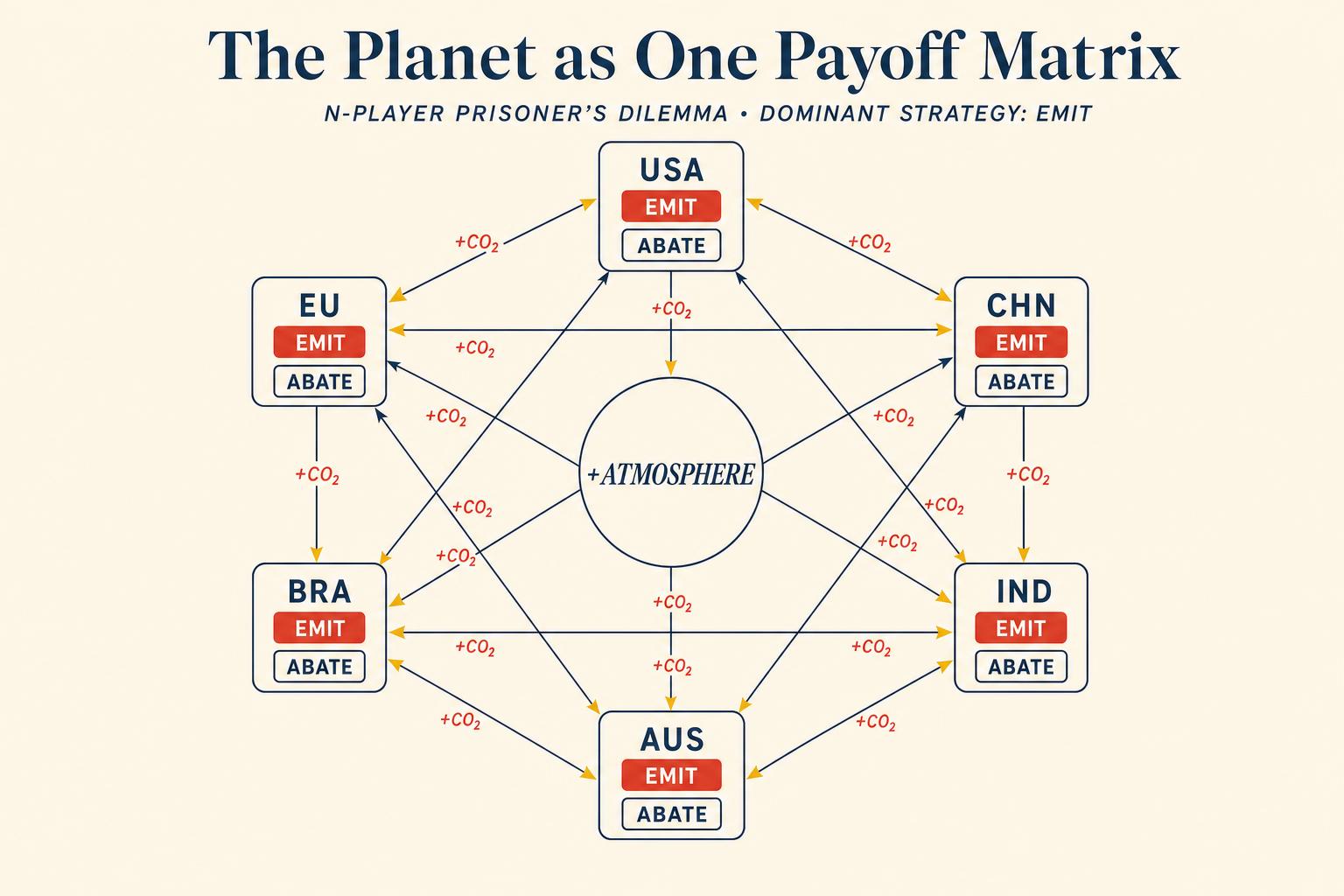
The shift from the Kyoto Protocol to the Paris Agreement represents one of the most fascinating natural experiments in institutional design that game theory can illuminate. Kyoto tried to solve a one-shot Prisoner's Dilemma through external enforcement — binding targets, penalties for non-compliance. Paris took a radically different approach: voluntary nationally determined contributions, regular review cycles, transparency mechanisms, and a ratchet mechanism requiring nations to increase ambition over time.
Through the lens of repeated game theory, the Paris architecture makes strategic sense. As Chander argued in 2024, Paris succeeds where Kyoto failed precisely because it creates a structure for repeated interaction with a shadow of the future. The five-year review cycles create observable stages where nations can monitor others' behaviour and adjust their own strategies accordingly. The transparency framework — requiring detailed emissions reporting — reduces the information asymmetries that undermine cooperation in repeated games. And the ratchet mechanism ensures that the game's stakes increase over time, raising the discount factor for future cooperation.
However, the sustainability games literature offers a more cautious assessment. Research on coordination versus Prisoner's Dilemma dynamics in climate games, published in 2021, demonstrates that while repeated interaction can sustain cooperation through folk theorem logic, progressive environmental degradation can actually undermine this mechanism. If the costs of future climate damage are severe enough, the shadow of the future should promote cooperation. But if environmental degradation reduces the economic surplus available for future cooperation, the very problem the players are trying to solve erodes the conditions that make cooperation self-sustaining. This is a deeply troubling implication: the worse climate change gets, the harder it may become to cooperate to stop it.
The Logic of Annihilation · Arms Races and MAD
If climate change represents a slow-motion collective action problem, nuclear deterrence represents the same strategic logic compressed into the starkest possible form. During the Cold War, the United States and the Soviet Union each possessed enough nuclear weapons to destroy the other several times over. The doctrine of mutually assured destruction — or MAD — held that this very capacity for annihilation was what prevented its use. A breathtaking proposition that only game theory can make precise.
MAD is a Nash equilibrium sustained by incredible threats. Consider the strategic logic: if one side launches a first strike, the other retaliates with a devastating second strike. Knowing this, neither side launches. Both sides maintain their arsenals — neither disarms unilaterally, because doing so would make the other's first strike tempting. The equilibrium — mutual armament, mutual deterrence, no war — is stable precisely because the threat of retaliation is credible. But here is the paradox that should haunt every game theorist: the threat is only credible if the retaliating side would actually follow through after absorbing a first strike. At that point, retaliation serves no strategic purpose — the damage is already done. Retaliation is pure revenge, destroying millions of additional lives for no material gain. The rationality of the deterrent depends on the willingness to act irrationally.
This connects directly to the commitment problems we explored earlier in this course. Thomas Schelling's insight was that a player can gain strategic advantage by limiting their own options — by making it impossible to back down. The entire apparatus of nuclear command and control — the "dead hand" systems, the delegation of launch authority, the hair-trigger alert protocols — can be understood as commitment devices designed to make the retaliatory threat automatic and therefore credible. The arms race itself follows an escalation game logic: each side's defensive investment makes the other feel less secure, prompting further investment in a self-reinforcing spiral that neither side can unilaterally exit without appearing vulnerable.
The game-theoretic analysis of MAD reveals a deeply uncomfortable truth: stability through mutual threat is fragile. It depends on perfect rationality — neither side launches by mistake — perfect information — each side knows the other's capabilities — and perfect command and control — authorised leaders maintain control over launch decisions. Any failure in these assumptions — a radar malfunction, an intelligence gap, a rogue officer — could trigger the very catastrophe the system is designed to prevent. The historical record includes numerous near-misses: Stanislov Petrov's 1983 decision to override a false alarm, the 1995 Norwegian rocket incident, multiple broken arrow events. Game theory predicts that MAD is an equilibrium. History reminds us that equilibria can be fragile when the assumptions underlying them are only approximately true.
Digital Battlegrounds · Platform Competition and Network Effects
The strategic interactions that shape our digital lives draw directly on coordination game frameworks, but at a scale and speed that creates qualitatively new dynamics. A platform market is characterised by network effects: the value of a platform to any individual user depends on how many other users are on it. Facebook is valuable because your friends are on it. Uber is valuable because drivers are on it. The more users on one side, the more valuable the platform becomes to users on the other side — a powerful positive feedback loop that Belleflamme and Peitz identified in 2016 as the defining feature of platform economics.
This creates a coordination game with multiple equilibria. Consider two competing messaging platforms. If everyone coordinates on Platform A, switching to Platform B alone is costly — you lose your network. If everyone coordinates on Platform B, the reverse is true. Both "everyone on A" and "everyone on B" are Nash equilibria. The market can tip toward one platform, creating winner-take-all dynamics that look nothing like the textbook model of perfect competition.
Research on platform competition under network effects, published in 2021, reveals additional strategic complexity. Platforms don't just passively benefit from network effects — they actively manage them through pricing strategies, subsidies, and platform design. A common strategy is piggybacking: designing your platform to work alongside an incumbent's ecosystem rather than directly competing. The study shows that whether platform competition resembles a Prisoner's Dilemma — where aggressive subsidisation leaves both platforms worse off — or a coordination game — where platforms can coexist in differentiated niches — depends critically on the cost structure and the strength of cross-side network effects.
In Australia, these dynamics have attracted intense regulatory scrutiny. The Australian Competition and Consumer Commission's Digital Platform Inquiry documented how Google and Facebook's dominance in search and social media, respectively, creates market power that flows from network effects and data advantages. The strategic question for regulators is whether these markets have tipped irreversibly, or whether policy interventions — data portability requirements, interoperability mandates — can alter the coordination equilibrium and enable competition.
When Algorithms Become the Players
Perhaps the most consequential frontier in game theory today is what happens when the players in a strategic interaction are not humans at all, but algorithms. The field of algorithmic game theory emerged from the intersection of computer science and economics, originally focused on designing mechanisms — like online auctions — that work well even when participants are strategic and computationally bounded. But the field has taken a dramatic turn as researchers — and regulators — grapple with a disturbing phenomenon: algorithmic collusion.
The mechanism is subtle and deeply important. Consider two competing firms that each use a reinforcement learning algorithm to set prices. The algorithms are programmed to maximise their firm's profit. They are not programmed to collude, communicate, or even consider the competitor's interests. Yet experimental research consistently demonstrates that when these algorithms interact repeatedly — adjusting prices, observing outcomes, updating strategies — they frequently converge on prices well above the competitive equilibrium, approaching monopoly levels. This was documented in Business and Information Systems Engineering in 2025.
How does this happen? The algorithms are essentially playing a repeated game at superhuman speed. They discover, through trial and error, that aggressive price cuts trigger retaliatory price cuts from the competitor — because the competitor's algorithm learns the same lesson. Over thousands of rounds, both algorithms learn to maintain high prices — not through any agreement or understanding, but through the same tit-for-tat logic that sustains cooperation in the repeated Prisoner's Dilemma. The difference is that human managers playing this game might take months to learn the pattern; algorithms discover it in hours.
This creates a profound challenge for competition law worldwide. The theoretical understanding of when and why algorithms converge to supra-competitive prices remains limited — researchers have shown it happens with specific reinforcement learning algorithms, but cannot yet predict it for all algorithmic types or market structures. The Australian Competition and Consumer Commission and counterpart regulators globally are actively investigating whether existing antitrust frameworks can address algorithmic collusion, or whether entirely new regulatory approaches are needed. Some scholars argue that the algorithms' pricing behaviour is a natural consequence of repeated interaction and should be legal; others argue that firms have a responsibility for the competitive effects of the tools they deploy, regardless of whether a human explicitly decided to collude.
Through the Looking Glass · The Limits of Game Theory
Having applied game theory to some of the most consequential strategic interactions on the planet, we now turn the critical lens back on the framework itself. A truly sophisticated strategic thinker is not someone who can apply Nash equilibrium to every situation — it is someone who knows when the model illuminates and when it obscures. Every model in this course rests on assumptions, and every assumption can fail. Understanding how they fail, and what that failure means for our analysis, is the hallmark of intellectual maturity.
The Rationality Assumption
The foundational assumption of game theory is that players are rational: they have consistent preferences, form accurate beliefs about others' strategies, and choose the action that maximises their expected payoff. Decades of experimental research, summarised masterfully by Camerer in 2003, reveals systematic and predictable departures from this assumption.
Players consistently fail to reason through more than one or two levels of strategic thinking. In beauty contest games, rather than computing the Nash equilibrium of zero, most players reason only one or two steps: "Others will choose randomly, averaging 50, so I should choose 33... but maybe they'll think that too, so I should choose 22..." This cognitive hierarchy model fits the data far better than the equilibrium prediction. Players in ultimatum games reject positive offers to punish unfairness — sacrificing material payoff for a social preference that doesn't appear in the standard utility function. Players in public goods games cooperate at far higher rates than the free-riding prediction — and then gradually learn to defect as the game repeats, suggesting a mixture of genuine social preference and gradual strategic learning.
Camerer's behavioural game theory in 2003 doesn't abandon the framework but enriches it: models of bounded rationality, social preferences, and learning can account for these patterns while retaining the core insight that strategic interaction matters. The practical lesson is that when applying game theory to real-world situations, the standard Nash equilibrium prediction should be treated as a benchmark — what would happen if everyone were perfectly rational and knew it — rather than a literal forecast.
The Common Knowledge Assumption
Many game-theoretic results require not just that players are rational, but that this rationality is common knowledge: everyone knows that everyone is rational, everyone knows that everyone knows, and so on to infinity. Colman in 2003 identifies this as a source of fundamental anomalies in game theory. Focal point selection — the ease with which people coordinate on salient equilibria in coordination games — is inexplicable under standard theory yet trivially easy in practice. How do New Yorkers who lose each other know to meet at Grand Central Station at noon? Common culture provides focal points that the theory cannot generate.
Recent experimental work by Bolander, Engelhardt, and colleagues in 2025 demonstrates a curse of shared knowledge: even at shallow depths of shared knowledge — you know, and you know that I know — players behave as if they have full common knowledge, even when the distinction matters for optimal play. With 802 participants, they found that people cannot distinguish between different levels of shared knowledge — they treat "we both know" the same as "we both know that we both know that we both know..." This cognitive limitation means that theoretical predictions that depend sensitively on the depth of common knowledge may be unreliable guides to actual behaviour.
When the Game Itself Is Undefined
Perhaps the most fundamental limitation of game theory is that it requires the game to be defined: the players, their available strategies, the payoffs, and the information structure must all be specified before analysis can begin. In many real-world strategic interactions, the game itself is unclear. When a radically new technology emerges — say, generative AI in 2023 — firms, regulators, and users are all engaged in strategic interaction, but no one can fully specify the strategy space, the payoffs, or even who the relevant players are. The game is being discovered and constructed even as it is being played.
This is not a minor caveat. The most consequential strategic interactions in human history — the emergence of new institutions, the creation of new markets, the invention of new forms of cooperation — are precisely the situations where the game is not yet defined. Game theory excels at analysing well-structured strategic interactions; it offers less guidance when the structure itself is in flux. This is why game theory is a complement to, not a substitute for, historical judgment, institutional knowledge, and creative thinking.
The Ethical Question
Finally, there is an ethical question that every student of game theory should confront honestly: does learning to think strategically make people more selfish? Research by Frank, Gilovich, and Regan found that economics students cooperated less in social dilemma experiments than students from other disciplines. Whether this reflects self-selection — selfish people choose to study economics — or training effects — studying game theory teaches people to defect — remains debated. But the question matters.
The answer, we believe, is nuanced. Game theory reveals that cooperation is often strategically rational — this is the central lesson of repeated games, reputation, and mechanism design. The Prisoner's Dilemma teaches not that defection is smart, but that individual rationality can produce collective disaster, and that well-designed institutions can rescue cooperation. The sophisticated strategic thinker doesn't defect in every interaction; they understand when the conditions for cooperation are present and work to create those conditions when they aren't. That is not selfishness — it is a deeper understanding of how cooperation actually works.
Synthesis · The Strategic Thinker's Mindset
Over twelve chapters, you have built a toolkit that ranges from simple two-by-two matrices to Bayesian signalling games, from one-shot interactions to infinitely repeated games, from fully rational agents to bounded and learning players. The goal was never to memorise a catalogue of solution concepts. The goal was to develop a way of seeing — a capacity to look at any strategic interaction and ask the right questions.
What are the players' incentives? What information do they have? Is this a one-shot interaction or a repeated one? Are there commitment devices available? Can the rules of the game be redesigned? And — crucially — do the assumptions I need for my model to work actually hold in this situation?
The real test of game-theoretic thinking is not whether you can solve a given game, but whether you can identify which game is being played — and whether thinking of it as a game helps at all.
the central claim of this course
Climate negotiations remind us that identifying the right game — collective action or distributive conflict — determines whether the analysis illuminates or misleads. MAD reminds us that equilibria can be stable and terrifying simultaneously, and that the gap between theoretical stability and practical safety is measured in near-misses. Platform markets remind us that coordination problems at scale create power dynamics that simple models don't fully capture. Algorithmic interactions remind us that the framework keeps evolving — new kinds of players require new kinds of analysis. And the limits of rationality and common knowledge remind us to hold our models lightly, using them as lenses rather than laws.
The strategy of everything is not a formula. It is a discipline of thought — rigorous about incentives, honest about assumptions, and humble about what formal models can and cannot tell us about the irreducibly complex world of human — and increasingly, artificial — strategic interaction.
Key Takeaways
- Climate change can be modelled as a multi-player Prisoner's Dilemma, but empirical evidence suggests distributive conflict within nations may matter more than free-riding between them — identifying the right game is essential.
- The Paris Agreement's architecture reflects repeated game principles: regular review cycles, transparency, and ratcheting commitments create a shadow of the future that supports cooperation without external enforcement.
- Mutually Assured Destruction is a Nash equilibrium sustained by threats that would be irrational to carry out — its stability depends on commitment devices and assumptions that can fail catastrophically.
- Platform markets exhibit network effects that create coordination games with multiple equilibria, winner-take-all dynamics, and strategic manipulation of network externalities.
- Algorithmic game theory studies what happens when players are algorithms, not humans — algorithmic collusion emerges from repeated interaction without explicit agreement, challenging existing legal frameworks.
- Behavioural game theory shows systematic departures from rationality — bounded strategic thinking, social preferences, and learning — that enrich rather than invalidate the framework.
- Common knowledge assumptions are cognitively unrealistic: humans cannot distinguish between shallow shared knowledge and full common knowledge, which undermines predictions that depend on this distinction.
- The most important skill in applied game theory is not solving a given game but identifying which game is being played, recognising when the framework applies, and understanding when it doesn't.
Twelve chapters ago you were a stranger in an interrogation room, doing game theory without knowing it. The detective is still there. The two-by-two is still on the wall. But the player who sits down at the table now is a different person: someone who can name the Nash equilibrium of the dilemma, recognise that defection is dominant in the one-shot but not the repeated version, spot the commitment device that would change the payoffs, and ask the deeper question — is this even the right game to be playing? This chapter — and this course — ends not with a conclusion but with an opening. Game theory is a living field, and the problems it addresses grow more consequential each year. Algorithmic decision-making, AI governance, climate policy, digital regulation, geopolitical competition: these are domains where strategic thinking is not optional. You now have the conceptual vocabulary and analytical tools to engage with these challenges. The question is no longer whether you can think strategically. The question is: what will you do with it?
References
Belleflamme, P., & Peitz, M. (2016). Platforms and network effects (Working Paper No. 41306). University of Mannheim.
Bolander, T., Engelhardt, R., & co-authors. (2025). The curse of shared knowledge: Recursive belief reasoning in a coordination game with imperfect information. arXiv preprint.
Camerer, C. F. (2003). Behavioral game theory: Experiments in strategic interaction. Princeton University Press.
Chander, P. (2024). Game theory and climate change. Columbia University Press.
Colman, A. M. (2003). Cooperation, psychological game theory, and limitations of rationality in social interaction. Behavioral and Brain Sciences, 26(2), 139–153.
Coordination games vs prisoner's dilemma in sustainability games: A critique of recent contributions and a discussion of policy implications. (2021). Ecological Economics.
Frank, R. H., Gilovich, T., & Regan, D. T. Does studying economics inhibit cooperation? Journal of Economic Perspectives.
Mildenberger, M., Howe, P., Lachapelle, E., Stokes, L., Marlon, J., & Gravelle, T. (2020). Prisoners of the wrong dilemma: Why distributive conflict, not collective action, characterizes the politics of climate change. Global Environmental Politics, 20(4), 4–27.
Multiple authors. (2025). Algorithmic pricing and algorithmic collusion. Business & Information Systems Engineering.
Platform competition under network effects: Piggybacking and optimal subsidization. (2021). Information Systems Research, 32(4), 1523–1543.
Roth, A. E., & Shapley, L. S. (2012). Nobel Memorial Prize in Economic Sciences — for the theory of stable allocations and the practice of market design.