Not Every Emergency
Is a Crisis
Before you can lead through a crisis, you must be able to recognise that you are in one. And most organisations, most of the time, cannot.
At 12:54 a.m. on June 14, 2017, a resident of Flat 16 on the fourth floor of Grenfell Tower called the fire brigade to report a kitchen fire. Firefighters arrived within six minutes. The incident commander treated it as exactly what it appeared to be: a single-flat fire in a high-rise building.
Within thirty minutes, the building's exterior cladding had turned Grenfell Tower into a vertical chimney of flame.
The Question Behind Every Inquiry
Seventy-two people would die at Grenfell. The stay-put policy that was correct for a contained flat fire became catastrophically wrong for what was actually happening. But the system was slow — agonisingly slow — to recognise that the situation had crossed a threshold. The question that would haunt every subsequent inquiry was not "Why did the fire spread?" but something more fundamental: why did the people in charge keep treating a crisis as if it were a manageable emergency?
That question — the failure to recognise a crisis when one has begun — is where this course starts. Not with leadership techniques or communication frameworks or decision-making heuristics, but with the more primitive and consequential act of classification. Before you can lead through a crisis, you must be able to recognise that you are in one. And most organisations, most of the time, cannot.
This chapter draws a hard, consequential line between three categories of adverse events: incidents, emergencies, and crises. It introduces three foundational frameworks — Boin and colleagues' crisis characteristics, James Reason's Swiss Cheese model of systemic failure, and Karl Weick's sensemaking framework — that together explain how crises emerge, why they are different from other bad events, and why the human capacity to understand what is happening can collapse at precisely the moment it matters most.
The Definitional Problem
Organisations face adverse events constantly. A server crashes. A patient falls. A delivery truck breaks down. Most of these events are absorbed by existing systems without requiring anything more than routine response. But the language we use to describe these events is often imprecise, and that imprecision has consequences.
Researchers have long noted the "definitional ambiguity" that plagues the field (Samarasinghe & Hettiarachchi, 2016). The terms incident, emergency, crisis, and disaster are frequently used interchangeably in both popular and professional discourse. A hospital administrator describes a staffing shortage as a "crisis." A news anchor calls a house fire an "emergency." A government spokesperson labels a political scandal a "disaster." Each usage feels intuitively reasonable. Each is, technically, wrong — and the confusion matters because the leadership response demanded by each category is fundamentally different.
Incident
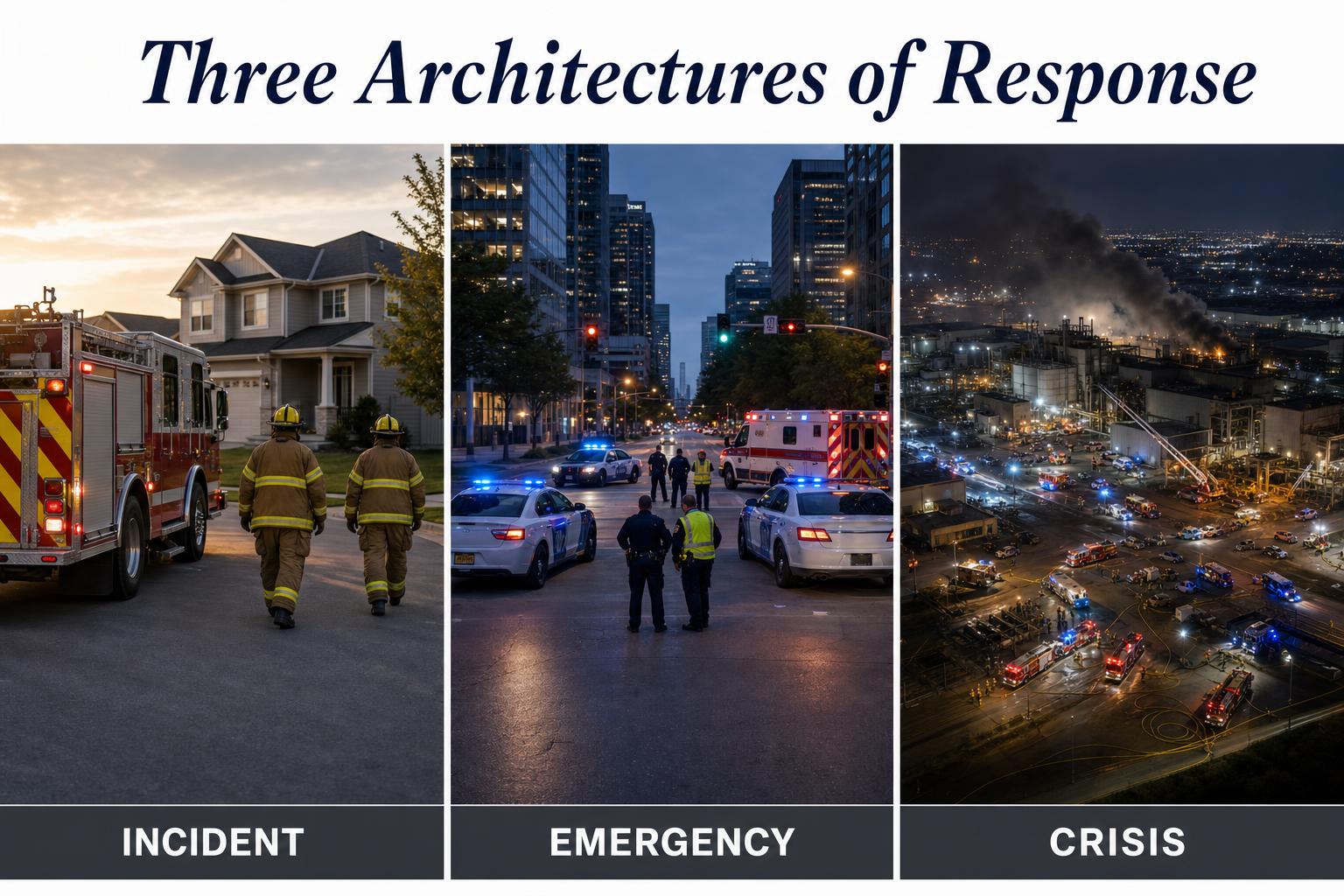
An incident is an adverse event that falls within the routine capacity of existing systems and personnel. It may be unwelcome, even dangerous to the individuals immediately involved, but it does not overwhelm the organisation's standard operating procedures. A construction worker cuts their hand. A fire alarm triggers in a building and is quickly traced to burnt toast. A quality control system catches a defective product batch before it ships. Each of these events activates a response — but the response is well-rehearsed, adequately resourced, and carried out within normal authority structures. The key feature of an incident is that the gap between what is happening and what the organisation is equipped to handle is essentially zero.
Emergency
An emergency escalates the stakes. There is genuine threat — to life, property, or organisational continuity — and there is time pressure. But the defining feature that separates an emergency from a crisis is that the nature of the problem is understood. A chemical spill at an industrial facility is dangerous and urgent, but if the substance is known, the containment protocols are established, and the response teams are trained for this specific scenario, the situation remains an emergency. It demands more resources, higher authority, and faster action than a routine incident, but it does not demand a fundamentally different way of thinking. Emergencies are, in a phrase, serious but solvable within existing frameworks. The leadership challenge is one of execution and coordination, not of comprehension.
Crisis
A crisis is categorically different. In their seminal work The Politics of Crisis Management, Boin, 't Hart, Stern, and Sundelius (2005, revised 2016) define crisis through the simultaneous presence of three characteristics: threat — to core values, life-sustaining systems, or critical infrastructure; urgency — severe time compression that demands immediate decision-making; and uncertainty — deep ambiguity about the nature of the threat, its trajectory, and the appropriateness of available responses. Leaders do not simply face a difficult problem; they face a problem they do not yet fully understand.
Crucially, Boin and colleagues argue that all three characteristics must be present simultaneously for a situation to constitute a genuine crisis. Remove any one, and the leadership challenge changes fundamentally. A situation with threat and urgency but no uncertainty is an emergency — serious and time-pressured, but manageable through known procedures. A situation with threat and uncertainty but no urgency allows for deliberation, consultation, and careful analysis. Only when all three converge does the organisation face the distinctive challenge this course addresses: making consequential decisions under time pressure about a problem you do not fully understand.
This framework also illuminates an important dynamic: situations become crises. They travel what Boin and colleagues describe as a continuum from "no problem" to "deep crisis," and the transition can be gradual or shockingly abrupt. The Grenfell Tower fire began as an incident, passed through emergency, and crossed into crisis territory — but the command structure continued operating in emergency mode long after the threshold had been crossed.
The Anatomy of How Crises Emerge
If crises are defined by the convergence of threat, urgency, and uncertainty, the next question is: where do they come from? The answer, almost without exception, is not "a single catastrophic failure." It is the quiet, incremental accumulation of weaknesses across an entire system.
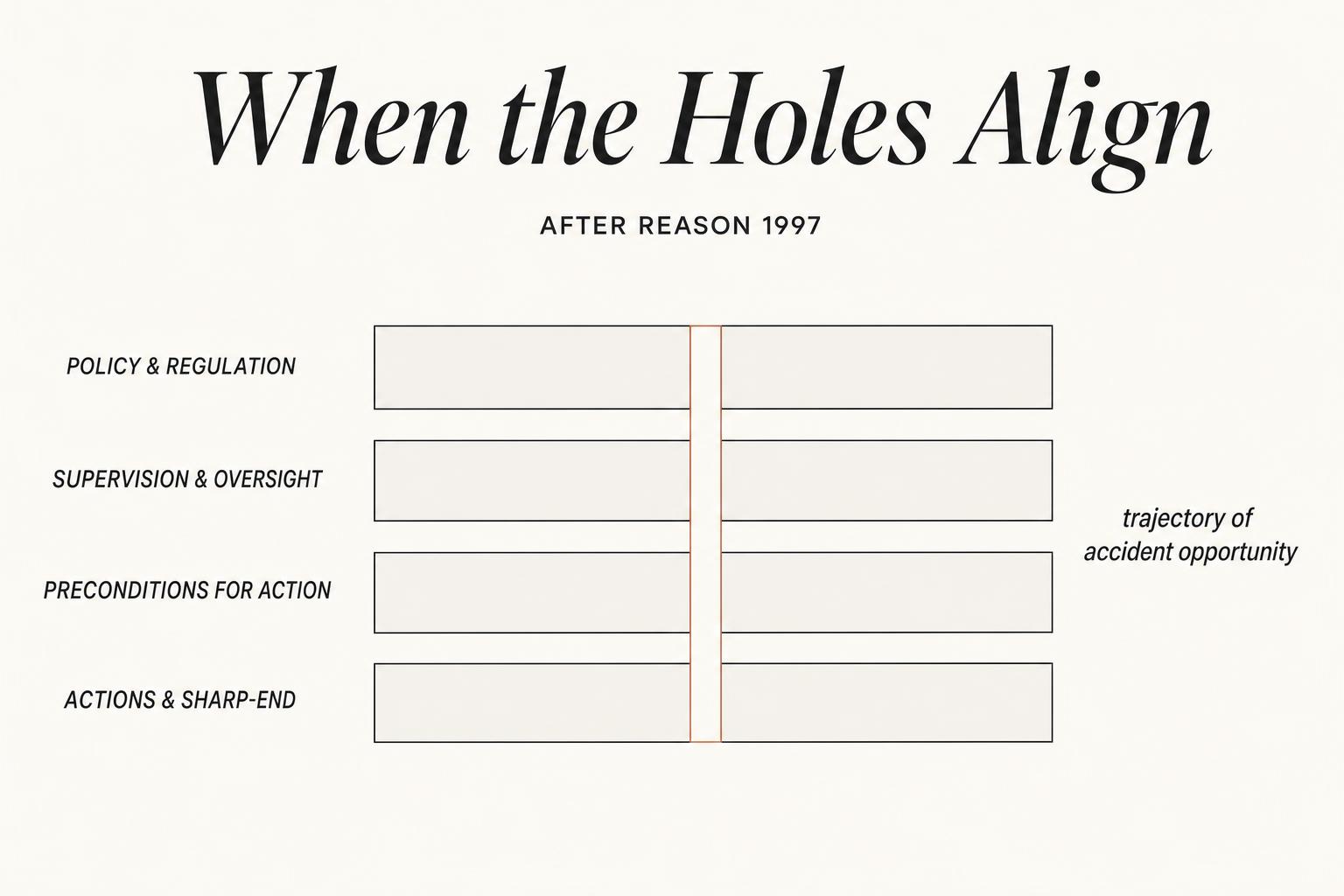
James Reason's Swiss Cheese model (Reason, 1997) provides the most influential framework for understanding this dynamic. Reason observed that organisations build multiple layers of defence against hazards — policies, training programs, supervision structures, safety equipment, procedural checklists, regulatory oversight. Each layer is designed to catch failures that slip through the layers above it. In theory, these defences make catastrophic failure impossible. In practice, every layer has weaknesses — holes, like the holes in slices of Swiss cheese.
These holes come in two forms. Active failures are the unsafe acts committed by individuals at the sharp end of the system — the pilot who misreads an instrument, the nurse who administers the wrong dosage, the firefighter who misjudges a situation. These are the failures that are most visible and most frequently blamed. But Reason argued that active failures are almost always the final link in a much longer causal chain. The more dangerous weaknesses are latent conditions: organisational decisions and systemic factors that create vulnerabilities long before any individual makes an error. Budget cuts that reduce staffing. Maintenance schedules that are deferred. Training programs that are abbreviated. Regulations that are ambiguous or unenforced.
No single hole in any single layer causes a catastrophe. The holes must align. When a latent weakness in policy coincides with a gap in supervision, which coincides with a degraded precondition, which coincides with an active failure at the operational level, the result is what Reason calls "a trajectory of accident opportunity" — a clear path through all defences that allows a hazard to become a disaster. As Larouzée and Le Coze noted in their 2020 critical review, the model has become the dominant paradigm for analysing safety incidents precisely because it shifts attention from blaming individuals to examining the systemic conditions that made their errors possible — and lethal.
Grenfell Revisited
The Grenfell Tower fire is a devastating case study in hole alignment. The Phase 1 Inquiry Report (Moore-Bick, 2019) revealed layer upon layer of degraded defences. At the policy level: building regulations that permitted combustible cladding materials. At the supervisory level: inadequate training of incident commanders in recognising the need for a building-wide evacuation and the failure to revise the "stay put" strategy when conditions changed. At the preconditions level: a building lacking a central fire alarm, sprinkler system, or adequate firebreaks in the cladding. At the level of actions: the continued issuance of stay-put advice long after the fire had breached all containment.
No single failure killed seventy-two people. The alignment of failures across every defensive layer did.
When Understanding Itself Collapses
Reason's model explains how the conditions for crisis accumulate. But it does not fully explain what happens to the people inside a crisis once it has begun. For that, we turn to Karl Weick's sensemaking framework — and to one of the most devastating case studies in organisational theory.
Sensemaking, as Weick defined it in 1988, is the ongoing process by which people construct plausible explanations for what is happening around them. It is not simply "understanding" — it is the active, social process of creating a shared narrative that allows coordinated action. In normal operations, sensemaking is so automatic that we scarcely notice it. We walk into a meeting, read the room, infer the agenda, and adjust our behaviour accordingly. The cues in our environment are familiar, the roles are clear, and our shared frameworks for interpretation are stable.
Crisis destroys all of this. When the environment suddenly becomes unfamiliar, when the cues contradict our expectations, when the roles that define our identity are stripped away, the process of sensemaking can collapse — and with it, the capacity for coordinated action (Weick, 1993). As Maitlis and Christianson observed in their 2014 review of the sensemaking literature, this collapse is especially dangerous because it can happen faster than the physical threat advances. People do not simply face a dangerous situation; they face a situation they can no longer understand, and it is the loss of understanding, not the danger itself, that paralyses them.
Mann Gulch, 1949
On August 5, 1949, fifteen smokejumpers parachuted into Mann Gulch, Montana, to fight what appeared to be a routine wildfire. Within two hours, thirteen of them were dead. Weick's 1993 analysis of this disaster — The Collapse of Sensemaking in Organizations — remains one of the most cited articles in organisational theory, not because of the fire itself, but because of what it reveals about how groups lose the ability to understand what is happening to them.
The crew that jumped into Mann Gulch was a minimal organisation — a group with limited shared experience, thin role structures, and shallow interpersonal trust. When conditions changed rapidly — the fire crossed the gulch and cut off their route to the river — the crew's shared framework for understanding the situation disintegrated. Their foreman, Wagner Dodge, did something unprecedented: he lit an escape fire, burning away the grass around him so the approaching fire would pass over the cleared ground. He shouted to his crew to join him in the ashes.
No one did. Not because they were irrational, but because Dodge's action was incomprehensible within their existing framework. You do not light a fire when you are running from a fire. The act made no sense — and in a situation where sensemaking had already collapsed, an action that could not be interpreted was an action that could not be followed. Dodge survived. Most of his crew did not.
People drop their defining roles, and with their roles they lose the framework that made sense of what was happening to them.
after Karl Weick · 1993
Weick identified four sources of resilience that might have prevented the collapse: improvisation, the ability to invent new responses; virtual role systems, the ability to imagine and coordinate roles mentally; the attitude of wisdom, knowing that you do not fully understand the situation; and respectful interaction, the social fabric that holds collective understanding together. At Mann Gulch, none of these were sufficiently developed. The organisation was too thin, too new, and too reliant on a single framework that the fire had already rendered obsolete.
Why the Classification Determines the Response
The distinction between incidents, emergencies, and crises is not an academic exercise. It determines the entire architecture of the leadership response. Consider the differences across just three dimensions.
Tempo
Incident response operates at normal organisational pace. Emergency response accelerates — more resources are mobilised, communication frequency increases, decision authority elevates. Crisis response demands a fundamentally different rhythm: rapid cycling between action and reassessment, because the situation itself is changing in ways that invalidate previous decisions. At Grenfell, the fire brigade continued operating at emergency tempo when crisis tempo was required (Moore-Bick, 2019).
Authority Structures
Incidents are handled within normal chains of command. Emergencies typically activate pre-established command structures — a gold-silver-bronze framework, an incident management team, a crisis operations centre. Crises often demand the abandonment of normal authority structures because those structures were designed for situations that are already understood. Wagner Dodge's escape fire was an act of improvised authority that fell outside any existing command structure — which is precisely why his crew could not follow it.
Communication
Incident communication is routine and internal. Emergency communication is broader and more frequent but still follows established channels. Crisis communication must be fundamentally different: it must openly acknowledge uncertainty, resist premature narrative closure, and actively seek disconfirming information. As Weick argued in 1988, sensemaking in crisis requires leaders to act in order to discover what is happening — but this means communicating tentative, evolving interpretations rather than confident, fixed ones.
When an organisation applies emergency procedures to a crisis, the result is not merely inefficiency — it is the systematic production of the wrong decisions at the worst possible time. The stay-put advice at Grenfell was the correct emergency procedure applied to a crisis situation. The crew at Mann Gulch ran uphill because that was the correct emergency response to a wildfire that had not yet become something else entirely.
Getting the classification right is not the beginning of effective leadership. It is effective leadership, in its most fundamental form.
The argument of this course
Key Takeaways
- Crises are defined by the simultaneous presence of threat, urgency, and deep uncertainty (Boin et al., 2005/2016). Remove any one, and the leadership challenge changes fundamentally.
- Incidents, emergencies, and crises require categorically different leadership responses in terms of tempo, authority structures, and communication.
- Reason's Swiss Cheese model (1997) demonstrates that crises emerge from the alignment of multiple systemic weaknesses across organisational defence layers — not from single failures.
- Latent conditions — budget cuts, deferred maintenance, inadequate training, ambiguous policies — are more dangerous than active failures because they persist unnoticed until holes align.
- Sensemaking (Weick, 1988) is the active, social process of constructing shared understanding; in crisis, it can collapse faster than the physical threat advances.
- The Mann Gulch disaster (Weick, 1993) shows that when roles and shared frameworks disintegrate, even life-saving innovations cannot be followed because they cannot be understood.
- Misclassifying a crisis as an emergency — as occurred at Grenfell Tower (Moore-Bick, 2019) — leads to the systematic application of the wrong response at the worst possible time.
In the next class we move from recognising a crisis to the first thirty minutes of one — the rapid initial assessment, the establishment of a crisis cell, and the discipline of acting under uncertainty before all the facts are in.
References
Boin, A., 't Hart, P., Stern, E., & Sundelius, B. (2005, rev. 2016). The Politics of Crisis Management: Public Leadership Under Pressure. Cambridge University Press.
Larouzée, J., & Le Coze, J.-C. (2020). Good and bad reasons: The Swiss cheese model and its critics. Safety Science, 126, 104660.
Maitlis, S., & Christianson, M. (2014). Sensemaking in organizations: Taking stock and moving forward. Academy of Management Annals, 8(1), 57–125.
Moore-Bick, M. (2019). Grenfell Tower Inquiry: Phase 1 Report. Her Majesty's Stationery Office.
Reason, J. (1997). Managing the Risks of Organizational Accidents. Ashgate.
Samarasinghe, D., & Hettiarachchi, S. (2016). Definitional ambiguity in disaster and crisis terminology. International Journal of Disaster Risk Reduction.
Weick, K. E. (1988). Enacted sensemaking in crisis situations. Journal of Management Studies, 25(4), 305–317.
Weick, K. E. (1993). The collapse of sensemaking in organizations: The Mann Gulch disaster. Administrative Science Quarterly, 38(4), 628–652.