The First
Thirty Minutes
The opening phase of a crisis is where the most consequential decisions are made with the least available information. The gap between “something is wrong” and “we are now in crisis response mode” is rarely closed by accident.
At 3:27 p.m. on March 11, 2011, the largest earthquake in Japan's recorded history had just triggered a massive tsunami racing toward the Fukushima Daiichi Nuclear Power Station. Operators watched as external power was lost. Emergency diesel generators kicked in — the system was performing as designed.
Fourteen minutes later, a wall of water fourteen meters high overwhelmed the seawall. The generators drowned. Batteries began to fail.
The Question Behind Every Activation
Inside the control rooms at Fukushima, operators faced a cascade of contradictory instrument readings, severed communication lines, and a situation for which no procedure manual had been written. The question confronting the shift supervisors and plant management was not whether something was wrong — it was staggeringly, obviously wrong — but rather: how wrong is this, and what mode of response does it demand?
Seven thousand kilometers away and seven years later, a group of boys from a Thai football team and their coach wandered into the Tham Luang cave complex after practice. When monsoon rains flooded the entrance, the local governor activated emergency protocols within hours, and an international rescue coordination effort was underway before most of the world even knew the boys were missing. The contrast between these two cases — one defined by catastrophic delay, the other by remarkably swift mobilization — illuminates something fundamental about crisis leadership: the first thirty minutes don't just shape the response. They are the response.
This chapter draws a hard line between recognizing a threshold and actually crossing it in organizational terms. It introduces the activation gap, Turner's four categories of information failure, the politics of activation thresholds, and the discipline of triaging information when the signal-to-noise ratio is abysmal — the moment when sensemaking and deciding must happen at the same time.
The Gap That Kills
Every crisis has an inflection point — a moment when the situation crosses from manageable abnormality into something that demands a fundamentally different mode of operating. The distance between recognizing that threshold and actually crossing it in organizational terms is what we might call the activation gap: the period between “something is wrong” and “we are now in crisis response mode.” Research consistently shows that this gap is where the most consequential decisions are made, almost always with the least available information, as Boin and colleagues found in 2016.
The activation gap is not primarily a problem of speed, though speed matters. It is a problem of recognition. Barry Turner's foundational work on man-made disasters identified what he called the incubation period — a phase in which warning signals accumulate but are systematically overlooked, misinterpreted, or rationalized away. As Turner and Pidgeon described in 1997, Turner identified four categories of information failure that characterize this period: information that is completely unknown; information that exists but is not fully appreciated; information that exists but is not correctly assembled; and information that does not fit existing mental models. All four of these failures are dramatically compressed during the first thirty minutes of an acute crisis, when the incubation period collapses and the event itself arrives.
What makes this opening phase so treacherous is not the absence of information — there is usually quite a lot of it — but rather the abysmal signal-to-noise ratio. Reports flood in from multiple sources, many of them contradictory, incomplete, or distorted by the stress and confusion of the moment. Leaders must make sense of this stream while simultaneously deciding whether to activate emergency protocols that, once triggered, carry significant organizational and sometimes political costs. This dual burden — sensemaking and deciding simultaneously — is what Weick identified in 1988 as the central paradox of crisis: the actions you take to understand the situation often change the situation itself.
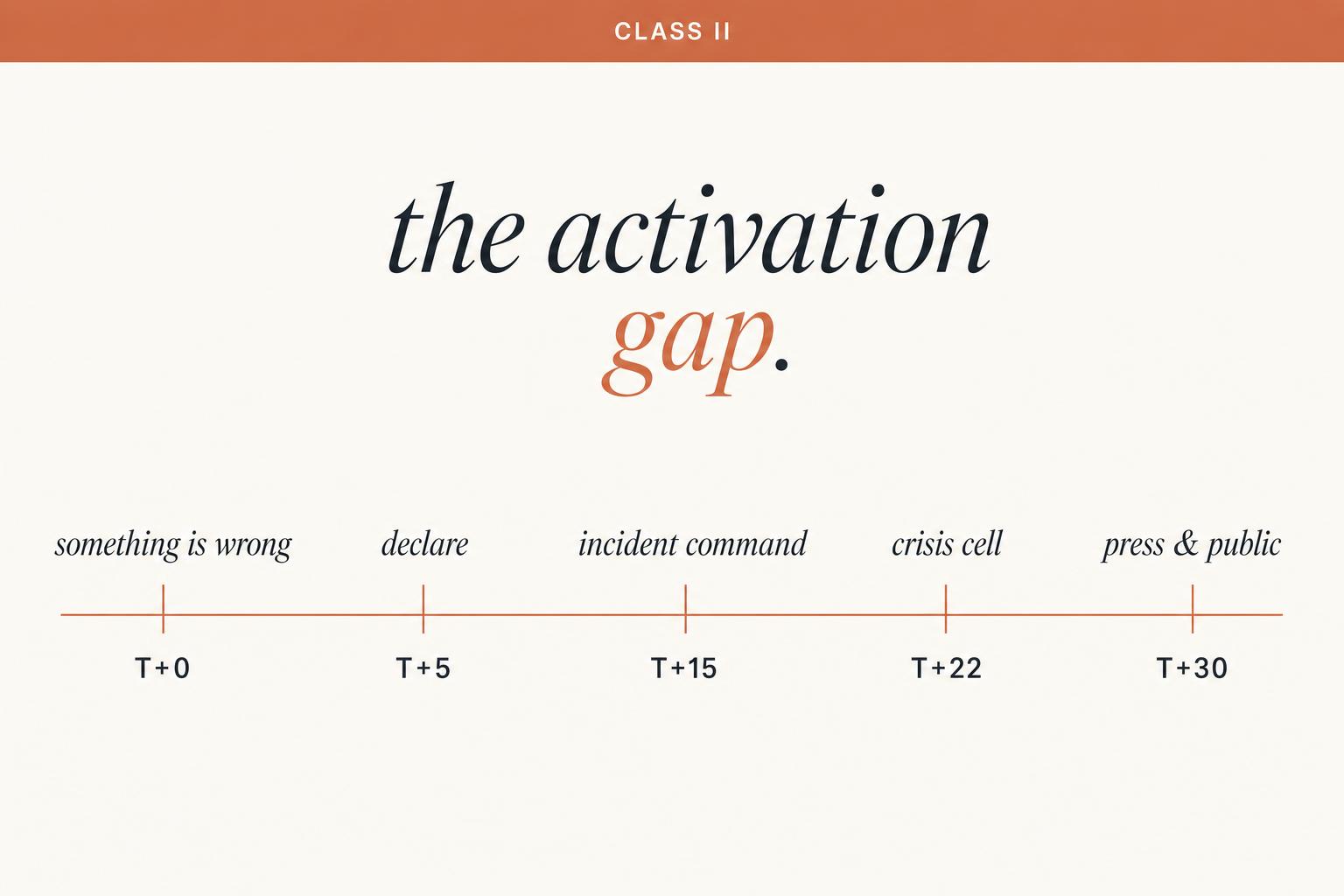
Activation Thresholds: When “Something” Becomes “Crisis”
An activation threshold is the point at which an organization shifts from routine operations to crisis response mode. It sounds simple in theory — you set criteria, and when those criteria are met, you activate. In practice, activation thresholds are among the most poorly designed elements of organizational preparedness. The Institute of Medicine's toolkit on crisis standards, published in 2013, distinguishes between indicators — data points that suggest a situation is developing — and triggers — specific thresholds that demand action — noting that the gap between the two is where most organizations struggle. An indicator might be a sensor reading that is slightly above normal; a trigger is the determination that the reading represents a genuine emergency requiring immediate resource mobilization.
The challenge is that activation carries costs. Declaring a crisis when one does not materialize — a false positive — wastes resources, disrupts operations, erodes credibility, and can create a “cry wolf” dynamic that makes future activation harder. As Boin and colleagues documented in 2020, this calculation produces a systematic bias toward under-activation. Organizations develop what might be called an institutional immune response that resists the disruption of emergency mobilization. The more bureaucratic the organization, the stronger this resistance tends to be.
Fukushima — Failure of Escalation
The Fukushima Daiichi disaster illustrates this failure with devastating clarity. After the tsunami struck and backup power was lost, plant operators and management faced a cascading series of escalation decisions. The National Research Council's subsequent investigation in 2014 revealed that decision-making was paralyzed by the lack of reliable, real-time information on plant status. Instrument readings were unreliable or absent. Communication between the control room, plant management, and TEPCO's — the Tokyo Electric Power Company's — Tokyo headquarters was fragmentary. At each escalation point — from declaring an emergency at the plant level, to requesting external assistance, to ordering civilian evacuation — there was delay. Not because individuals were incompetent, but because the system was designed to process information through layers of confirmation and approval that were wholly inadequate for the speed of the unfolding event.
The report documented how emergency management plans were “inadequate to deal with the magnitude of the accident, requiring emergency responders to improvise.” This is a critical insight: when formal activation protocols fail, the quality of the response depends entirely on the ability of individuals to improvise — and improvisation without clear role authority creates its own cascading failures.
Tham Luang — Activation Done Right
The Tham Luang cave rescue presents a striking counter-example. When the boys failed to return from practice, the alarm was raised quickly. Chiang Rai's provincial governor, Narongsak Osatanakorn, assumed incident command and activated emergency coordination protocols that rapidly scaled from local to national to international scope. The Australian Government's post-rescue analysis in 2018 identified several factors that enabled this swift activation: pre-existing relationships between Thai emergency agencies, a cultural willingness to escalate without excessive procedural gatekeeping, and crucially, a single decision-maker with clear authority to activate and expand the response.
What distinguished Tham Luang was not that the situation was simpler — a flooded cave system with thirteen lives at stake and no proven rescue methodology was extraordinarily complex — but that the activation architecture was clear. The governor did not need to convene a committee to decide whether this constituted a crisis. The threshold was unambiguous, the authority to activate was vested in a single role, and the escalation pathway from local to national to international resources was well-defined.
The Institutional Immune System
If timely activation saves lives and resources, why do organizations so often fail at it? Boin and colleagues in 2016 identify several interacting barriers that operate at the institutional level, distinct from the cognitive biases explored earlier. First, there is the problem of distributed information: the person who first detects an anomaly is rarely the person with the authority to activate a crisis response. Information must travel upward through organizational layers, and at each layer it is subject to filtering, reinterpretation, and delay. Second, organizations develop normalcy routines — deeply embedded patterns of behavior that assume events fall within normal operating parameters. These routines are efficient under ordinary conditions but become actively dangerous when conditions are extraordinary.
Boin and colleagues' later work on “creeping crises” extends this analysis, documenting how threats that develop gradually can pass entirely through organizational detection filters. The psychological factors are formidable: the inconceivability of certain events, communication failures across organizational boundaries, and the challenge of recognizing threats that do not conform to existing mental models. These are not failures of intelligence or diligence; they are structural features of how organizations process information.
Maitlis and Christianson in 2010 build on Weick's framework to argue that crisis and change contexts are “especially likely to impede sensemaking processes” because they disrupt the shared meanings and emotional equilibrium that sensemaking depends upon. When the emotional temperature in an organization spikes — when people are frightened, confused, or overwhelmed — the very cognitive processes needed to interpret the situation are degraded. This creates a vicious cycle: the more severe the crisis, the harder it is to recognize it as such, because the cognitive resources needed for recognition are consumed by the emotional demands of the situation.
Organizations are not designed to look for crises. They are designed for efficiency, for routine, for the smooth processing of predictable inputs.
Boin et al. · The Politics of Crisis Management · 2016
Role Clarity Under Ambiguity
Even when the activation threshold is crossed, a second challenge immediately emerges: role clarity. Who is in charge? Who does what? In routine operations, role assignments are well-understood and largely automatic. In the opening minutes of a crisis, formal organizational structures are often suddenly insufficient. The normal chain of command may be disrupted — key personnel may be unreachable, the nature of the crisis may fall outside any single department's jurisdiction, or the scale of the event may overwhelm the resources assigned to normal emergency roles.
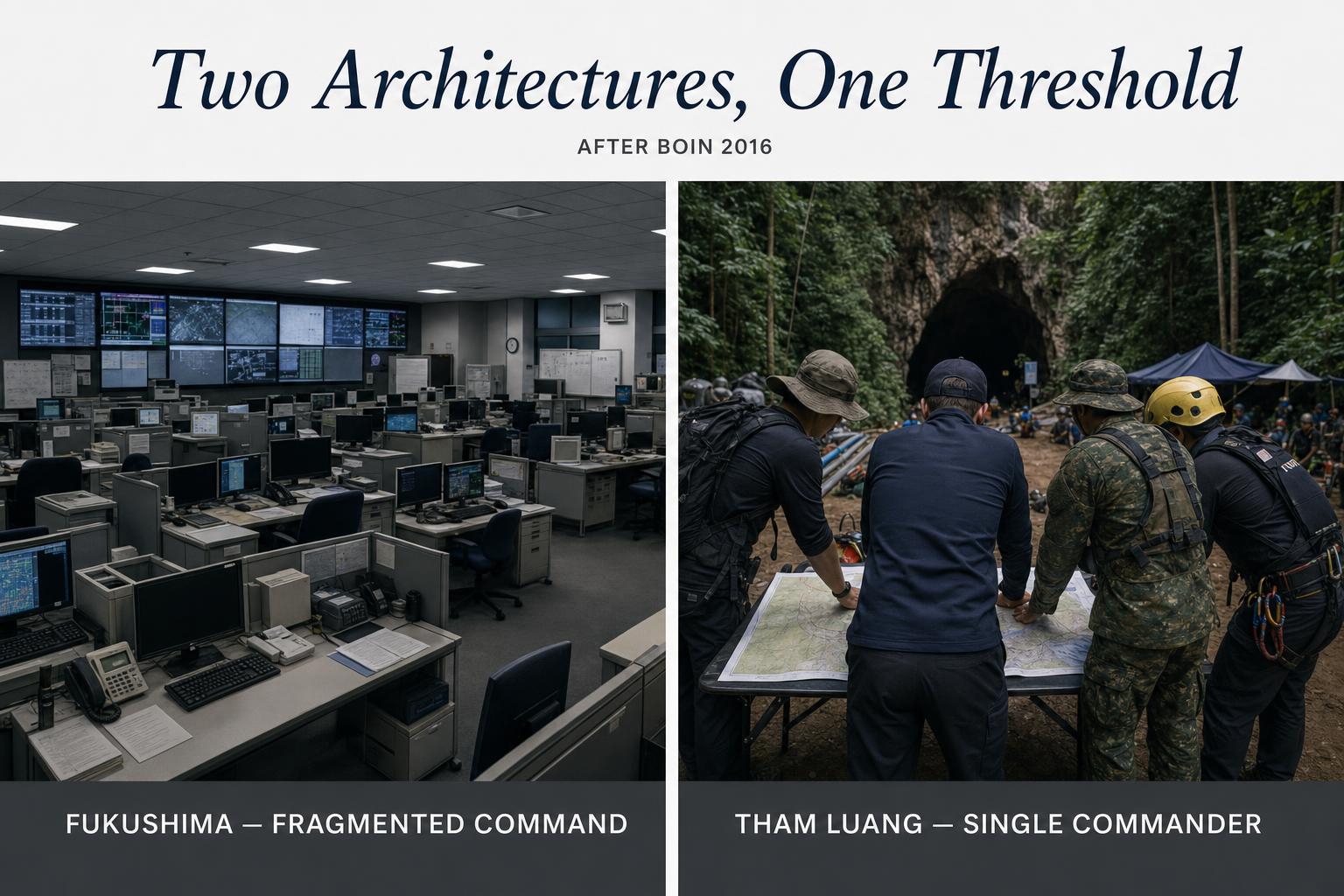
The Tham Luang rescue symposium report emphasized that one of the most critical success factors was the early establishment of clear command, control, and coordination structures that spanned strategic, operational, and tactical levels. This was not accidental. Thai disaster management frameworks vest clear authority in provincial governors for events within their jurisdiction, which meant that the question “who is in charge?” had an immediate, unambiguous answer.
Contrast this with Fukushima, where command authority was fragmented between the plant operator TEPCO, the nuclear regulator, the Prime Minister's office, and local government officials responsible for evacuation. The National Research Council report documented how this fragmentation produced conflicting directives, duplicated efforts, and critical gaps where no one believed they held responsibility.
The Mobilisation Sequence
Role clarity is not just about knowing who is in charge — it is about understanding the mobilization sequence: the order in which roles are activated and the dependencies between them. A common failure mode is activating resources before the situation assessment that determines what resources are needed. Another is failing to activate communications capacity early enough, which means that subsequent mobilization decisions cannot be effectively transmitted. The sequence matters because crisis response is not a parallel process where everything happens simultaneously — it is a cascading series of dependent actions where early decisions constrain later options.
Information Triage: Sorting Signal from Noise
Once activation has occurred and roles are being mobilized, the next critical challenge is information triage — the process of sorting, prioritizing, and routing the flood of incoming data. In the opening phase of a crisis, information arrives from multiple sources simultaneously: automated sensor systems, eyewitness reports, social media posts, media inquiries, peer agency notifications, and internal status updates. Much of this information is incomplete, contradictory, or simply wrong. The leader's task is not to process all of it — that is impossible — but to identify the signals that matter most and route them to the people who can act on them.
Weick's concept of enacted sensemaking is particularly relevant here. As Weick argued in 1988, sensemaking in crisis is not a passive process of receiving and interpreting information — it is an active process in which the actions you take to understand the situation shape what information becomes available and relevant. When a leader decides to focus attention on one data stream, they necessarily de-prioritize others. When they commit resources to investigating one hypothesis, they constrain their capacity to investigate alternatives.
Action precedes cognition and focuses it — emphasizing that specific action renders many cues irrelevant and consolidates an otherwise unorganized set of environmental elements.
Karl Weick · 1988
This creates a fundamental tension in information triage. Acting on early information is necessary to shape the response, but acting too quickly on unreliable information can commit the organization to a course of action that becomes difficult to reverse. As Maitlis and Christianson described in 2010, this is the challenge of maintaining sensemaking fluidity — the capacity to hold multiple interpretations simultaneously and revise them as new information arrives, rather than prematurely locking onto a single narrative.
The Information Hierarchy
Effective information triage depends on establishing what we might call an information hierarchy: a structured understanding of who needs to know what, and in what order. During the first thirty minutes, not everyone needs all the information. The incident commander needs situation awareness — a broad picture of what is happening and what resources are available. Operational leads need specific, actionable intelligence relevant to their function. External communications personnel need verified facts they can release without creating additional confusion. Political and senior leadership need enough context to make strategic decisions without being overwhelmed by operational detail.
Turner and Pidgeon's framework in 1997 suggests that the most dangerous information failures are not missing data but misassembled data — information that exists within the system but is not correctly combined to reveal the true picture. In the first thirty minutes, this assembly function is perhaps the most critical and most difficult leadership task. It requires someone — usually the incident commander or a dedicated intelligence function — to hold the threads together and continually ask: What picture does this information paint, and what are the most important things we still don't know?
Setting the Trajectory
The first thirty minutes of a crisis set a trajectory that is extraordinarily difficult to alter. Early activation decisions determine which resources are available and which are not. Early role assignments create command structures that persist even when they prove suboptimal. Early information triage decisions establish narratives that shape subsequent interpretation. As Weick described in 1988, this is the commitment dimension of sensemaking: once an organization commits to a particular interpretation and course of action, the psychological and structural investments in that commitment make reversal costly and unlikely.
This does not mean that early decisions must be perfect — perfection is impossible with fragmentary information. It means that early decisions must be designed for revision. The most effective crisis leaders make initial decisions that preserve optionality: activating broadly rather than narrowly, establishing communication channels before they are needed, and explicitly flagging assumptions that need to be tested as more information arrives. They treat the first thirty minutes not as the period in which the right answer must be found, but as the period in which the capacity to find the right answer must be built.
The contrast between Fukushima and Tham Luang is ultimately a story about trajectory. At Fukushima, delayed activation, fragmented authority, and overwhelmed information systems set a trajectory toward cascading failure that brave individual actions could slow but not reverse. At Tham Luang, swift activation, clear authority, and effective coordination set a trajectory toward successful resolution despite enormous technical challenges. The boys were trapped for eighteen days — but the response architecture that would eventually save them was established in the first hours.
As Boin and colleagues remind us in 2016, crisis management is fundamentally a political activity, not merely a technical one. The decisions made in the first thirty minutes are shaped by institutional cultures, power structures, legal frameworks, and the individual courage of the people who happen to be on duty when the call comes in. Understanding these dynamics — and designing systems that account for them — is the difference between organizations that survive crises and organizations that are consumed by them.
The first thirty minutes are not the period in which the right answer must be found. They are the period in which the capacity to find the right answer must be built.
The argument of this class
Key Takeaways
- The activation gap — the distance between recognizing something is wrong and entering crisis response mode — is where the most consequential decisions are made with the least information (Boin et al., 2016).
- Activation thresholds must distinguish between indicators, which are data points suggesting a problem, and triggers, which are specific thresholds demanding action (Institute of Medicine, 2013).
- Organizations systematically bias toward under-activation because false positives carry organizational, reputational, and political costs (Boin et al., 2020).
- Turner's four categories of information failure — unknown, unappreciated, unassembled, and unfitting information — are dramatically compressed during the first thirty minutes (Turner & Pidgeon, 1997).
- Role clarity is not just about who is in charge, but about the mobilization sequence: the order of activation and the dependencies between roles that determine whether resources arrive in a usable configuration.
- Information triage requires balancing the need to act on early data against the risk of committing to interpretations based on unreliable information — Weick's insight that action precedes and focuses cognition (Weick, 1988).
- The institutional barriers to crisis recognition — normalcy routines, distributed information, and organizational resistance to disruption — are structural features, not individual failures, and must be addressed through system design.
- Early decisions should be designed for revision: preserving optionality, establishing communication capacity, and explicitly flagging assumptions that need testing as information improves.
Next class: Thinking in the Burning Building. Once the initial mobilization is complete and the situation continues to evolve in unpredictable ways, leaders must make high-stakes choices under deep uncertainty — navigating between paralysis and premature commitment when waiting for complete information is not an option.
References
Australian Government Department of Home Affairs, Emergency Management Australia. (2018). Thai cave rescue symposium 2018: Symposium report.
Boin, A., Brown, C., & Lodge, M. (2020). Hiding in plain sight: Conceptualizing the creeping crisis. Risk, Hazards & Crisis in Public Policy, 12(2), 116–138.
Boin, A., 't Hart, P., Stern, E., & Sundelius, B. (2016). The Politics of Crisis Management: Public Leadership Under Pressure (2nd ed.). Cambridge University Press.
Institute of Medicine Committee on Guidance for Establishing Standards of Care for Use in Disaster Situations. (2013). Crisis standards of care: A toolkit for indicators and triggers. National Academies Press.
Maitlis, S., & Christianson, M. (2010). Sensemaking in crisis and change: Inspiration and insights from Weick (1988). Journal of Management Studies.
National Research Council Committee on Lessons Learned from the Fukushima Nuclear Accident. (2014). Lessons learned from the Fukushima Nuclear Accident for improving safety of U.S. nuclear plants. National Academies Press.
Turner, B. A., & Pidgeon, N. F. (1997). Man-made disasters (2nd ed.). Butterworth-Heinemann.
Weick, K. E. (1988). Enacted sensemaking in crisis situations. Journal of Management Studies, 25(4), 305–317.