Who Needs to Know
What, and When
In a crisis, information is both the most valuable resource and the most dangerous weapon. Before you can communicate, you must architect.
On March twelfth, 2011, the hydrogen explosion at Fukushima Daiichi's Unit 1 reactor building was broadcast live on Japanese television. Prime Minister Naoto Kan watched the footage from his office in Tokyo, and it was the first he had learned of it.
The plant operator, TEPCO, had not informed the government. The regulator had no independent information about conditions inside the plant.
A Failure of Information Architecture
For hours, national-level decision-makers debated evacuation zones and reassured the public based on assumptions that bore no relationship to what was actually happening at the reactor cores, as documented by Funabashi and Kitazawa in 2012.
This was not a failure of technology or intelligence. It was a failure of information architecture, of not having answered the deceptively simple question at the heart of every crisis: who needs to know what, and when? That question, and the systems we build to answer it, is the subject of this chapter.
Beyond the Two-by-Two Grid: Dynamic Stakeholder Mapping
Most students of management or public policy will have encountered stakeholder mapping, the familiar exercise of plotting stakeholders on a two-by-two grid of power and interest, then tailoring engagement strategies accordingly. In calm conditions, this exercise is genuinely useful. In crisis, it can be dangerously misleading. The reason is simple: crisis fundamentally alters who matters.
The foundational work on stakeholder identification comes from Mitchell, Agle, and Wood, who argued in 1997 that stakeholder salience, the degree to which managers give priority to competing stakeholder claims, depends on three attributes: power, the stakeholder's ability to impose its will; legitimacy, the perceived appropriateness of the stakeholder's claim; and urgency, the time-sensitivity and criticality of the stakeholder's claim. Stakeholders possessing all three attributes are definitive and demand immediate attention. Those possessing only one are latent, they exist in the background, often unnoticed.
Here is what makes crisis so disorienting for leaders: crisis reshuffles these attributes with extraordinary speed. As Alpaslan, Green, and Mitroff demonstrated in 2009, dormant stakeholders, those possessing power but lacking legitimacy or urgency in normal operations, can become dangerous and definitive overnight. Consider the families of victims. In routine operations, they are not stakeholders at all. The moment a crisis produces casualties, they become among the most legitimate, most urgent, and through media amplification, most powerful stakeholders in the entire system. A community group that a corporation has routinely ignored may suddenly hold the keys to the organisation's social license to operate. A mid-level regulator whom senior leaders have never met may become the person whose sign-off is needed before any remediation can begin.
Conversely, people who normally hold definitive authority can find their salience evaporating. As Boin, 't Hart, Stern, and Sundelius documented in 2017, formal hierarchies are routinely bypassed during crisis, with information and decision authority flowing to whoever happens to be closest to the problem, most trusted by the media, or most politically convenient. A CEO who is definitive in normal operations may become irrelevant if the crisis is technical and they lack expertise, or if the crisis is political and a government minister takes over the narrative.
The Temporal Dimension
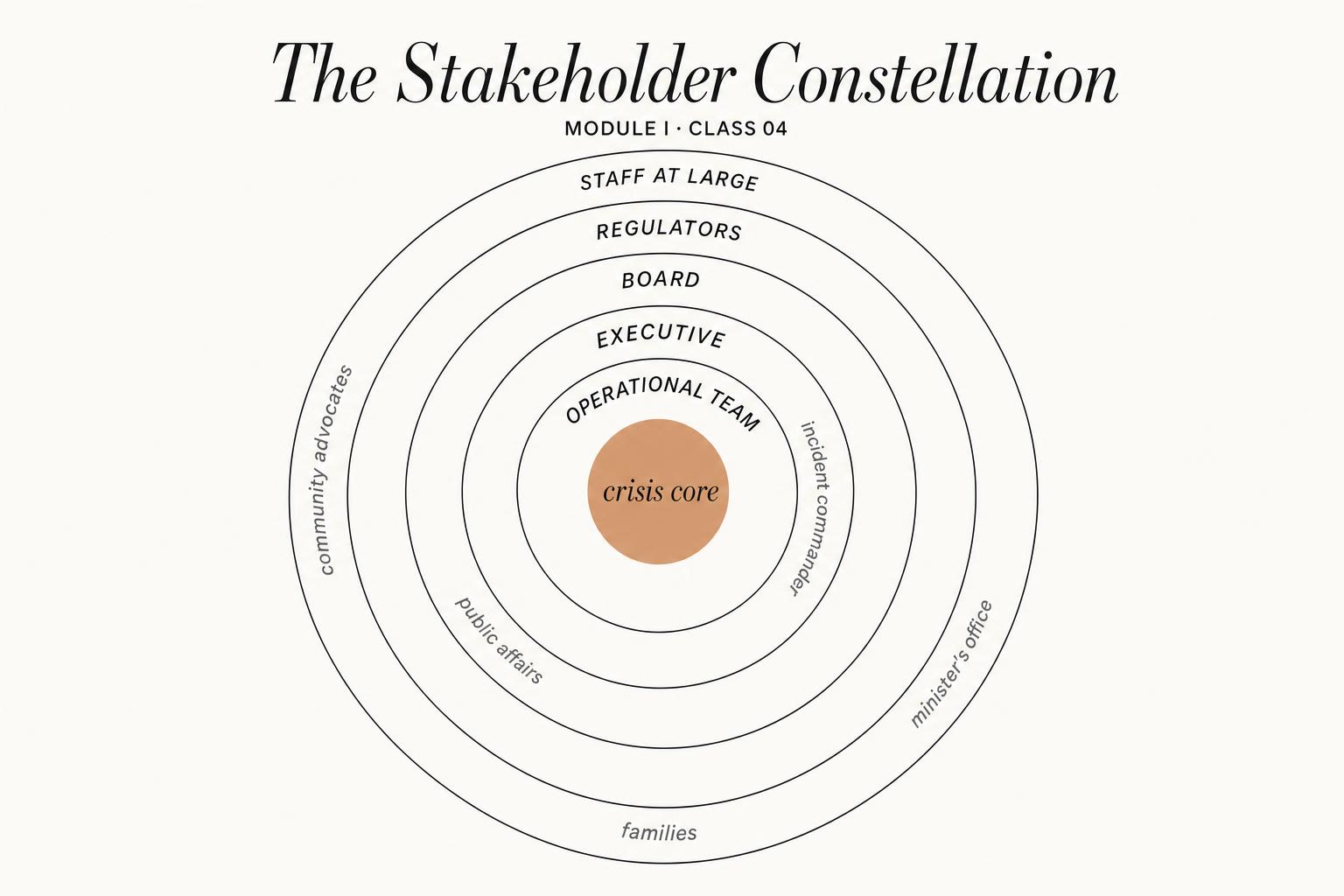
What makes dynamic stakeholder mapping even more challenging is that salience does not shift once and stabilise. It shifts continuously as the crisis evolves through phases. In the initial hours, operational responders, fire crews, medical teams, on-site engineers, are the definitive stakeholders. They need information immediately, at high fidelity, and without distortion. By the escalation phase, external agencies, political actors, and media outlets have entered the picture, and the information needs diversify dramatically. By the time public attention peaks, the families, community advocates, and opposition politicians who were entirely absent from the initial response may be driving the narrative.
This is why static stakeholder maps fail in crisis. A map drawn in hour one is obsolete by hour six. Leaders who do not actively reassess stakeholder salience as the crisis evolves will find themselves directing information at the wrong people and ignoring the people who now matter most.
Information Hierarchy: Matching Fidelity to Authority
Once you know who your stakeholders are and how their salience shifts, the next challenge is determining what information each stakeholder needs. This is the problem of information hierarchy, the deliberate structuring of who receives what information, at what level of detail, through which channels, and in what sequence.
The instinct of many leaders, particularly in transparent and democratic cultures, is that everyone should get all the information. This instinct is well-meaning and catastrophically wrong. Recall from Chapter 3 that cognitive load theory tells us the human working memory can only process a limited amount of novel information simultaneously. Every piece of information routed to a decision-maker either supports or degrades their capacity to decide. A minister who receives raw technical telemetry data from a nuclear plant is not better informed, they are overwhelmed and less capable of making the political decisions that are actually within their authority.
The principle that should govern information hierarchy is information fidelity matched to decision authority. The incident commander at a disaster site needs granular, real-time, technical data because they are making operational decisions that depend on that data. The executive leadership team needs synthesised situation reports because they are making strategic decisions about resource allocation and organisational positioning. The minister's office needs headline-level summaries with political implications highlighted because they are making decisions about public communication and policy response. The families of affected people need accurate, compassionate, timely updates because their decisions are about whether to trust the organisation managing the crisis.
The Filtering Problem
Between the raw information generated at the crisis point and the synthesised summaries that reach senior leaders lies a chain of information filtering. At every node in that chain, someone is deciding what to pass up, what to push down, what to hold, and what to discard. This filtering is essential. Without it, senior decision-makers would drown in noise. But filtering introduces risk.
The Grenfell Tower fire of 2017 illustrates what happens when filtering goes wrong. The Phase 1 report of the Grenfell Tower Inquiry documented in 2019 that the London Fire Brigade, the Metropolitan Police, and the London Ambulance Service each operated with different situational pictures because there was no shared information hierarchy. Fire control room operators received calls from residents trapped on upper floors but this critical intelligence, which directly contradicted the operational assumption that residents should stay put, was not systematically routed to the incident commander on scene. The information existed within the system. The filtering architecture failed to move it to the people who needed it for the decisions they were making.
Comes, Hiete, Wijngaards, and Schultmann add an important nuance in 2022: the people doing the filtering are themselves subject to the cognitive biases we discussed in Chapter 3. Their experimental research demonstrated that crisis managers are prone to significant confirmation bias when selecting which information to pass upward. They preferentially route information that confirms the existing operational picture and deprioritise information that contradicts it. Under high cognitive load, this bias intensifies. The result is that precisely the information most likely to change a leader's decision, the disconfirming signal, the unexpected data point, the report that the situation is worse than assumed, is the information most likely to be filtered out.
Multi-Agency Coordination: When Organisations Collide
The challenges of stakeholder mapping and information hierarchy become exponentially more complex when a crisis requires coordination across multiple organisations. This is the norm, not the exception. Almost every significant crisis, from bushfires to pandemics to terrorist attacks, demands coordinated action by agencies that do not normally work together, do not share terminology, do not use compatible communication systems, and carry fundamentally different assumptions about who is in charge.
Bharosa, Lee, and Janssen conducted systematic research on multi-agency disaster response exercises in 2010 and identified information sharing as the single greatest bottleneck in inter-agency coordination. Their findings documented a cascade of challenges: different agencies use different data formats, different classification systems, different communication protocols, and different organisational cultures around information security. A fire service that operates on a principle of share everything fast collides with a police service that operates on need to know. A health authority that communicates in clinical precision encounters a local government that communicates in bureaucratic circumlocution.
The Terminology Problem
One of the most insidious coordination failures is terminology mismatch, the phenomenon where different agencies use the same words to mean different things, or different words to mean the same thing. Ackerman, Wulf, Pipek, and Randall documented this extensively in 2014 in their study of inter-organisational crisis management, finding that even organisations operating within the same country and the same broad sector carried distinct vocabularies that created dangerous miscommunication under pressure.
During Australia's Black Summer bushfires of 2019 to 2020, fire agencies across different states used different warning level systems, different terminology for evacuation categories, and different protocols for requesting interstate assistance. The phrase watch and act carried different implications in different jurisdictions. Controlled could mean the fire was contained, or merely that resources were being applied, a potentially lethal ambiguity for a community deciding whether to evacuate. These are not academic distinctions. When information hierarchy crosses organisational boundaries, terminology alignment becomes a matter of life and death.
The Authority Problem
Beyond terminology lies the deeper problem of authority confusion. Boin and colleagues describe in 2017 the crisis of governance that emerges when multiple organisations, each with legitimate authority over some aspect of the response, must coordinate without a clear overarching command structure. Who is in charge of a crisis that is simultaneously a public health emergency, health authority, a law enforcement matter, police, an environmental disaster, environmental agency, and a political crisis, elected officials?
The Grenfell Tower response illustrated this with tragic clarity. The London Fire Brigade assumed it was the lead agency and that police and ambulance services would support its operational plan. The Metropolitan Police, however, had its own operational priorities around evidence preservation and witness management. The London Ambulance Service needed access to information about which floors were survivable to triage its response. Each organisation operated on its own institutional assumptions about information flow and decision authority, and there was no mechanism to reconcile these assumptions in real time, as documented in the Phase 1 report in 2019.
Information Filtering: Protection or Blind Spot?
We return now to the filtering problem introduced earlier, because it requires one final, critical distinction. Information filtering in crisis exists on a spectrum between two poles: protective filtering, which shields decision-makers from noise so they can focus on signal, and pathological filtering, which creates blind spots that disconnect leaders from reality.
Protective filtering is what allows a minister to make sound decisions during a crisis without being paralysed by data. It is the intelligence cell that synthesises forty field reports into a coherent situation assessment. It is the public affairs officer who shields the incident commander from media inquiries so they can focus on operations. It is the executive assistant who holds all but the most critical calls. Without protective filtering, the cognitive load on senior decision-makers would make effective leadership impossible.
Pathological filtering is what happened at Fukushima. TEPCO's internal culture created what Funabashi and Kitazawa describe in 2012 as an information silo in which critical technical data about reactor core conditions was trapped within the plant operator's hierarchy. The national government was not merely receiving filtered information, it was receiving a filtered picture that systematically excluded the most alarming data. The filtering was pathological because it did not serve the decision needs of the people it was shielding; it served the institutional interests of the people doing the filtering.
How do you tell the difference? Three diagnostic questions help. First, who benefits from the filtering? If the filtering serves the decision-maker by reducing noise, it is protective. If it serves the filter by avoiding difficult conversations, it is pathological. Second, is disconfirming information getting through? If the information reaching decision-makers consistently confirms the existing operational picture, the filtering system should be treated as suspect. As we learned in Chapter 3, the absence of bad news is not the same as the presence of good news. Third, can the decision-maker pull information when needed? Protective filtering allows leaders to request deeper detail on any topic. Pathological filtering creates structures where lower levels actively resist sharing information upward, even when asked.
The absence of bad news is not the same as the presence of good news.
The diagnostic of pathological filtering
Building the Architecture Before the Crisis
The central lesson of this chapter is that information architecture cannot be improvised during a crisis. By the time you are asking who needs to know this in the middle of an unfolding disaster, you have already lost critical time. Research by Bharosa and colleagues in 2010 found that the organisations that performed best in multi-agency exercises were those that had established information-sharing protocols, common terminology glossaries, and pre-agreed escalation pathways before the crisis occurred.
This does not mean creating rigid, bureaucratic protocols that cannot adapt. It means establishing three things: a stakeholder map that has been stress-tested against crisis scenarios and updated regularly; an information hierarchy that specifies what level of detail each node in the response structure needs and has the authority to act on; and coordination agreements with partner agencies that resolve terminology, authority, and communication protocol conflicts before those conflicts matter.
The relationship between this chapter and the communication chapter that follows is deliberate. You cannot communicate effectively if you have not first worked out the information architecture. Communication is the outward expression of decisions about audience, message, channel, and timing, but those decisions depend entirely on the stakeholder mapping, information hierarchy, and coordination structures we have examined here. Get the architecture right, and communication becomes a matter of execution. Get the architecture wrong, and no amount of polished messaging will prevent the chaos that results.
Get the architecture right, and communication becomes execution. Get it wrong, and no polished messaging will hold.
The argument of this chapter
Key Takeaways
- Stakeholder salience is dynamic in crisis: power, legitimacy, and urgency (Mitchell, Agle, & Wood, 1997) shift continuously, making static maps dangerously misleading.
- Dormant stakeholders — those with latent power but no current legitimacy or urgency — can become definitive overnight (Alpaslan, Green, & Mitroff, 2009), while previously authoritative actors may lose relevance.
- Information hierarchy should match information fidelity to decision authority: operational leaders need granular data; strategic leaders need synthesised assessments; political leaders need implication summaries.
- Information filtering is essential but carries inherent risk, particularly the risk that disconfirming information is disproportionately filtered out due to confirmation bias under cognitive load (Comes et al., 2022).
- Multi-agency coordination fails most often at three points: terminology mismatches (Ackerman et al., 2014), information gaps between agencies (Bharosa, Lee, & Janssen, 2010), and conflicting assumptions about decision-making authority.
- Protective filtering reduces noise so decisions can be made; pathological filtering — Fukushima's TEPCO silo (Funabashi & Kitazawa, 2012) — disconnects leaders from reality.
- Information architecture must be designed, tested, and refined before a crisis occurs. It cannot be improvised under pressure.
With the information architecture established, Class 5 — Speaking into the Void — turns to what most people think of when they hear crisis communication: the public-facing dimension. How do you communicate when information is incomplete, the situation is evolving, and every word will be scrutinised?
References
Ackerman, M., Wulf, V., Pipek, V., & Randall, D. (2014). Designing for inter-organisational crisis management. CSCW & HCI literature.
Alpaslan, C. M., Green, S. E., & Mitroff, I. I. (2009). Corporate governance in the context of crises: Towards a stakeholder theory of crisis management. Journal of Contingencies and Crisis Management, 17(1), 38–49.
Bharosa, N., Lee, J., & Janssen, M. (2010). Challenges and obstacles in sharing and coordinating information during multi-agency disaster response. Information Systems Frontiers, 12(1), 49–65.
Boin, A., 't Hart, P., Stern, E., & Sundelius, B. (2017). The Politics of Crisis Management: Public Leadership Under Pressure (2nd ed.). Cambridge University Press.
Comes, T., Hiete, M., Wijngaards, N., & Schultmann, F. (2022). Cognitive bias and information filtering in crisis management. Risk Analysis / Safety Science.
Funabashi, Y., & Kitazawa, K. (2012). Fukushima in review: A complex disaster, a disastrous response. Bulletin of the Atomic Scientists, 68(2), 9–21.
Mitchell, R. K., Agle, B. R., & Wood, D. J. (1997). Toward a theory of stakeholder identification and salience. Academy of Management Review, 22(4), 853–886.
Moore-Bick, M. (2019). Grenfell Tower Inquiry: Phase 1 Report. Her Majesty's Stationery Office.