Speaking into the Void
In a crisis, you will almost certainly have to say something before you know what is happening. Silence is never neutral. It is read as concealment.
It is three forty-seven a.m. Your phone is ringing. There has been an explosion at one of your organisation's facilities. Early reports mention casualties — two confirmed dead, possibly more. The cause is unknown. Social media is already alive with shaky video footage, and a local news crew is parked at the perimeter. A reporter calls your communications director. "We're going live at the top of the hour. Do you have a statement?"
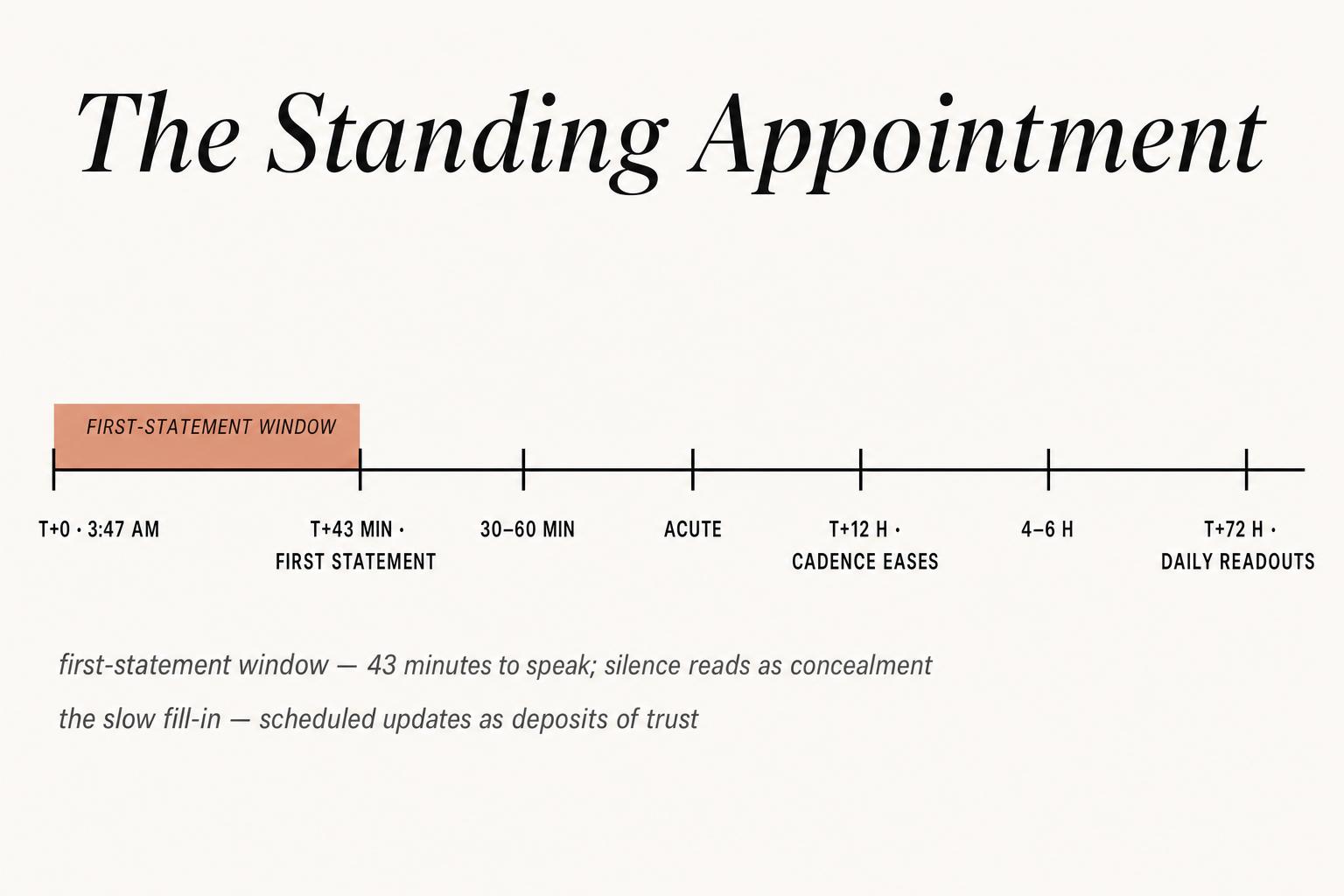
You have forty-three minutes. You do not know if the explosion was accidental, structural, or something worse. You do not know the final casualty count. You do not know whether the site is safe. But you know this with absolute certainty: if you say nothing, someone else will fill the silence — and they will fill it with speculation, fear, and blame.
Welcome to the void. This is about learning to speak into it.
The Instinct That Kills Trust
Every instinct in a careful, legally trained, risk-averse leader screams the same thing during a crisis: wait. Wait until the facts are confirmed. Wait until legal has reviewed the statement. Wait until the investigation team reports back. The impulse is understandable. It is also catastrophic.
The foundational insight of modern crisis communication research is that stakeholders do not wait for you to be ready. As Sellnow and colleagues demonstrated in 2016 in their systematic review of crisis uncertainty communication, crises create a unique paradox: the moments when organisations have the least information are precisely the moments when the demand for communication is at its peak. Base knowledge is incomplete, yet the public, the media, and your own employees require communication immediately — not when it is convenient.
W. Timothy Coombs's Situational Crisis Communication Theory, known as S-C-C-T, provides the theoretical architecture for understanding why this matters. S-C-C-T establishes that post-crisis communication is not merely informational — it is reputational and relational, as Coombs established in 2007. The way you communicate in the first hours doesn't just convey facts; it signals what kind of organisation you are. Are you accountable or evasive? Do you care about people or about liability? Every hour of silence answers those questions for you, and never in your favour.
The reason is simple but important to internalise: silence in a crisis is never interpreted as "nothing to report." It is interpreted as "they are hiding something." This asymmetry — between the leader's intention of caution and the public's interpretation of concealment — is the central challenge we need to address.
Three Failure Modes, Three Mechanisms of Trust Destruction
Before we extract principles, we need to study wreckage. The three cases that follow represent different failure modes in crisis communication. Each eroded public trust through a distinct mechanism, and together they map the full terrain of what can go wrong when leaders speak — or fail to speak — during a crisis.
Fukushima — Evasion
When the Tōhoku earthquake and tsunami struck Japan on the eleventh of March, 2011, the Fukushima Daiichi nuclear power plant lost power and began a catastrophic meltdown sequence. What followed was not merely a nuclear disaster but a communication disaster of historic proportions. As Funabashi and Kitazawa documented in 2012 in their independent investigation, TEPCO — the plant's operator — and the Japanese government engaged in a pattern of communication that moved from delay to evasion to outright concealment.
The meltdown of Reactor 1 began on the first day. TEPCO did not publicly acknowledge it for over two months. In the intervening period, public statements were characterised by technical jargon designed to obscure rather than clarify, contradictions between government and company spokespeople, and a persistent refusal to use the word "meltdown" even when the physical reality was undeniable. The government, for its part, made no effective effort to educate the public about radiation levels or explain what evacuation zones meant in practical terms.
The mechanism of trust destruction here was incremental credibility erosion. Each statement that was later contradicted by events did not merely damage trust in that specific statement — it retroactively poisoned every previous statement. By week three, TEPCO could have issued a perfectly accurate, perfectly transparent update and it would not have been believed. The lesson is stark: once you have been caught understating a crisis, your audience assumes you are still understating it.
Grenfell — Vacuum
On the fourteenth of June, 2017, Grenfell Tower in west London caught fire, killing seventy-two people. The Phase 1 Report of the Grenfell Tower Inquiry, led by Moore-Bick in 2019, documented communication failures at every level. Internally, the fire service's communication links were so degraded that neither the control room nor the incident commanders knew whether rescue attempts on upper floors had been made — or what their outcomes were. Externally, the local council's response was described as emotionally tone-deaf, bureaucratically rigid, and agonisingly slow.
But the most damaging failure was structural: no single entity owned the public communication. Bereaved families received contradictory information about where to seek help, whether their loved ones had survived, and what the council would do for them. Volunteer organisations were not coordinated. The result was a communication vacuum — a space where information should have existed but didn't — which was rapidly filled by grief, rumour, and rage.
Where Fukushima demonstrated the cost of saying the wrong thing, Grenfell demonstrated the cost of failing to say anything at all. The absence of a clear, empathetic, authoritative voice left families to interpret institutional silence as institutional indifference — and in many cases, that interpretation was correct.
Airlines — Wrong Register
The airline industry has produced some of crisis communication's sharpest lessons. As Ray documented in 1999, there are cases where technically precise statements — factually accurate, legally vetted, operationally sound — landed with the public as cold, mechanical, and inhuman. An airline might issue a statement confirming that "an incident involving flight such-and-such occurred at such-and-such time" while families were desperately trying to learn whether their loved ones were alive.
The failure mode here is different from Fukushima's evasion or Grenfell's vacuum. It is a failure of register — the emotional key in which a message is delivered. The information was often accurate, but it was delivered in the language of operations rather than the language of human concern. As Schoofs and colleagues demonstrated experimentally in 2019, stakeholder empathy is not a soft, optional dimension of crisis response — it is a critical mechanism through which reputational outcomes are determined. Their three studies show that when organisations communicate in ways that evoke empathy, the reputational damage of even severe crises is significantly reduced.
Three distinct failure modes in crisis communication — evasion, vacuum, and wrong register — all converge on the same outcome: the destruction of public trust.
What the Thai Cave Team Did Differently
On the twenty-third of June, 2018, twelve boys and their football coach entered the Tham Luang cave complex in northern Thailand. Rising floodwaters trapped them. What followed was a seventeen-day international rescue operation conducted under the glare of a global media siege, with thousands of journalists from dozens of countries camped outside the cave.
The communication strategy was, by all accounts, extraordinary in its discipline. Analysis of the response, published in 2018, identifies several key features: regular press briefings were held regardless of whether there was new information to share; the messaging was consistent, with no conflicting statements despite dozens of agencies being involved; families were given direct, private channels of communication including handwritten notes between them and the trapped boys; and setbacks — including the death of a former Thai Navy SEAL diver — were confirmed promptly and with appropriate gravity.
What made the Thai cave rescue communication work was not that the communicators had more information than TEPCO or the Grenfell authorities. They often had very little. What they had was a communication architecture — a deliberate system that governed who spoke, when, to whom, and in what register. That architecture rested on three principles that we can now extract and formalise.
Three Principles for Speaking into the Void
One — Empathy First
The first principle is empathy first. Before your audience processes a single fact in your statement, they have already answered one question: does this person care about what we're going through? If the answer is no — or even uncertain — nothing that follows will land correctly. Schoofs and colleagues in 2019 provide the experimental evidence: empathy is not a rhetorical nicety but a cognitive gateway. It determines whether subsequent information is processed as trustworthy or defensive.
In practice, empathy first means that the opening of any crisis statement must acknowledge the human reality before addressing the operational situation. "Our thoughts are with the families and all those affected" is not a cliché if it is followed by concrete evidence of care — what you are doing for them, what resources are available, where they can go. It becomes a cliché when it substitutes for action, or when it is immediately followed by legal hedging.
The question to ask yourself before every crisis communication is: What are people feeling and fearing right now? Your first sentences should demonstrate that you know the answer.
Two — Transparency About Uncertainty
The second principle is transparency about uncertainty. This is the principle that most leaders find counterintuitive, and it is the one that the research most strongly supports. Sellnow and colleagues established in 2016 that acknowledging uncertainty — openly stating what you do not know — does not erode credibility. Concealing uncertainty erodes credibility. The formula is deceptively simple: say what you know, say what you don't know, and say when you expect to know more.
"We can confirm that an explosion occurred at our facility at approximately three fifteen a.m. We can confirm that emergency services are on site. We cannot yet confirm the cause of the explosion, and we cannot yet confirm the number of people affected. We expect to have more information within the next two hours, and we will update you at that time." That statement contains almost no information. It is, nonetheless, a far more effective crisis communication than silence, evasion, or premature certainty — because it gives the audience a framework for understanding the situation and a reason to wait for the next update rather than seek answers elsewhere.
Three — Update Cadence
The third principle is update cadence. The Thai cave rescue's most underappreciated innovation was its update cadence — the regular rhythm of communication events that gave the media and public a predictable pattern to anchor to. This matters because the rhythm of communication is as important as its content. A twelve-hour gap between updates, even if justified by the pace of events, creates a twelve-hour window in which speculation replaces information.
Cadence serves three functions. First, it pre-empts the "why aren't they saying anything?" narrative. Second, it creates a Pavlovian expectation — journalists and the public learn to wait for the next scheduled update rather than filling the gap. Third, it gives the communicating team a structure that reduces the cognitive load of deciding when to communicate, freeing them to focus on what to communicate.
The appropriate cadence depends on the crisis phase. In the acute phase — the first six to twelve hours — updates may need to come every thirty to sixty minutes. In the sustained phase, every four to six hours. In the recovery phase, daily. The key is that the cadence must be announced and kept. A missed update is worse than a content-free update.
Trust as a Resource, Not a State
Trust in a crisis is not binary — it is a resource that depletes and sometimes replenishes based on the pattern of communication decisions over time. Think of it as a bank account that you did not know you had until the crisis began. Every honest update is a small deposit. Every evasion, delay, or contradiction is a large withdrawal. And the exchange rate is deeply unfair: it takes ten deposits to recover from one significant withdrawal.
This metaphor becomes operationally important when you recognise that different stakeholder groups maintain separate trust accounts. The public's trust in your organisation, the media's trust in your spokesperson, affected families' trust in your commitment to them, and your own staff's trust in leadership — these are four different accounts with different balances, different sensitivities, and different triggers for collapse. The Thai cave rescue succeeded in part because the communication architecture addressed each group through dedicated channels: press briefings for media, private notes for families, operational briefings for the multi-agency team.
Coombs formalised this insight in 2007 in S-C-C-T by demonstrating that the appropriate communication strategy must be matched not just to the crisis type but to the attribution of responsibility that each stakeholder group applies. If your stakeholders believe you caused the crisis, empathetic, accommodative responses protect reputation. If the crisis is seen as externally caused, informational responses suffice. Misjudging the attribution — communicating as though you are a victim when your audience holds you responsible — is one of the fastest routes to trust destruction.
Silence in a crisis is never interpreted as "nothing to report." It is interpreted as "they are hiding something."
The argument of this chapter
The Two-Audience Problem
Every crisis communication leader faces a problem that is rarely discussed in public accounts of crisis response: you are always speaking to at least two audiences simultaneously, and what each audience needs is different — sometimes contradictory.
Your external communication — press statements, social media updates, press conferences — must be empathetic, measured, legally careful, and accessible to a general audience. Your internal communication — messages to your own staff, operational teams, and middle management — must be operationally specific, emotionally honest, and free of the corporate hedging that, while appropriate for external audiences, destroys trust when directed at the people doing the work.
Research on internal crisis communication from 2024 demonstrates that transparent, timely communication during crises helps employees feel supported and engaged, reduces uncertainty, and maintains the morale essential for sustained operations. When internal communication fails — when staff learn about developments from the news rather than from their own leadership, or when internal messages use the same sanitised language as press releases — the consequences extend beyond morale. Information flow degrades. Staff who do not trust leadership stop reporting problems upward, precisely when accurate upward information flow is most critical. This connects directly to the information hierarchy challenges we examined in the previous chapter.
The trap, however, is inconsistency. In our hyper-connected world, the distinction between internal and external communication is porous. Staff share internal emails. Screenshots leak. If your internal message says "this is serious and we are deeply concerned" while your external statement says "we are confident the situation is under control," you have created a coherence gap — and when that gap becomes public, it destroys trust with both audiences simultaneously.
The discipline, therefore, is to draft internal and external messages that are different in register and detail but consistent in substance. Your staff need more operational specificity and less legal hedging. The public needs less jargon and more actionable guidance. But both messages must be defensible if the other were read alongside it.
The Operational Checklist
From the cases and principles we've examined, we can distil an operational checklist for any crisis communication. Before issuing any public or internal statement, a crisis leader should verify the following:
Empathy gate
Do the first two sentences acknowledge the human reality of what is happening?
Known-unknown structure
Does the statement clearly separate confirmed facts from unconfirmed reports?
Next-update commitment
Does it state when the audience will hear from you again?
Actionability
Does it tell affected people what to do right now?
Legal review
Has it been checked for promises you cannot keep and admissions you are not authorised to make?
Coherence check
If your internal and external messages were read side by side, would they tell a consistent story?
Audience calibration
Is the register appropriate — operational detail for staff, plain language for public?
This checklist does not guarantee a perfect crisis communication. No checklist can. But it ensures that you avoid the failure modes that destroyed trust at Fukushima, Grenfell, and in the airline cases we examined — and that you build the communication architecture that sustained trust during the Thai cave rescue.
Key Takeaways
- Silence during a crisis is never neutral — it is interpreted as concealment, evasion, or indifference, regardless of the leader's intent (Sellnow et al., 2016; Coombs, 2007).
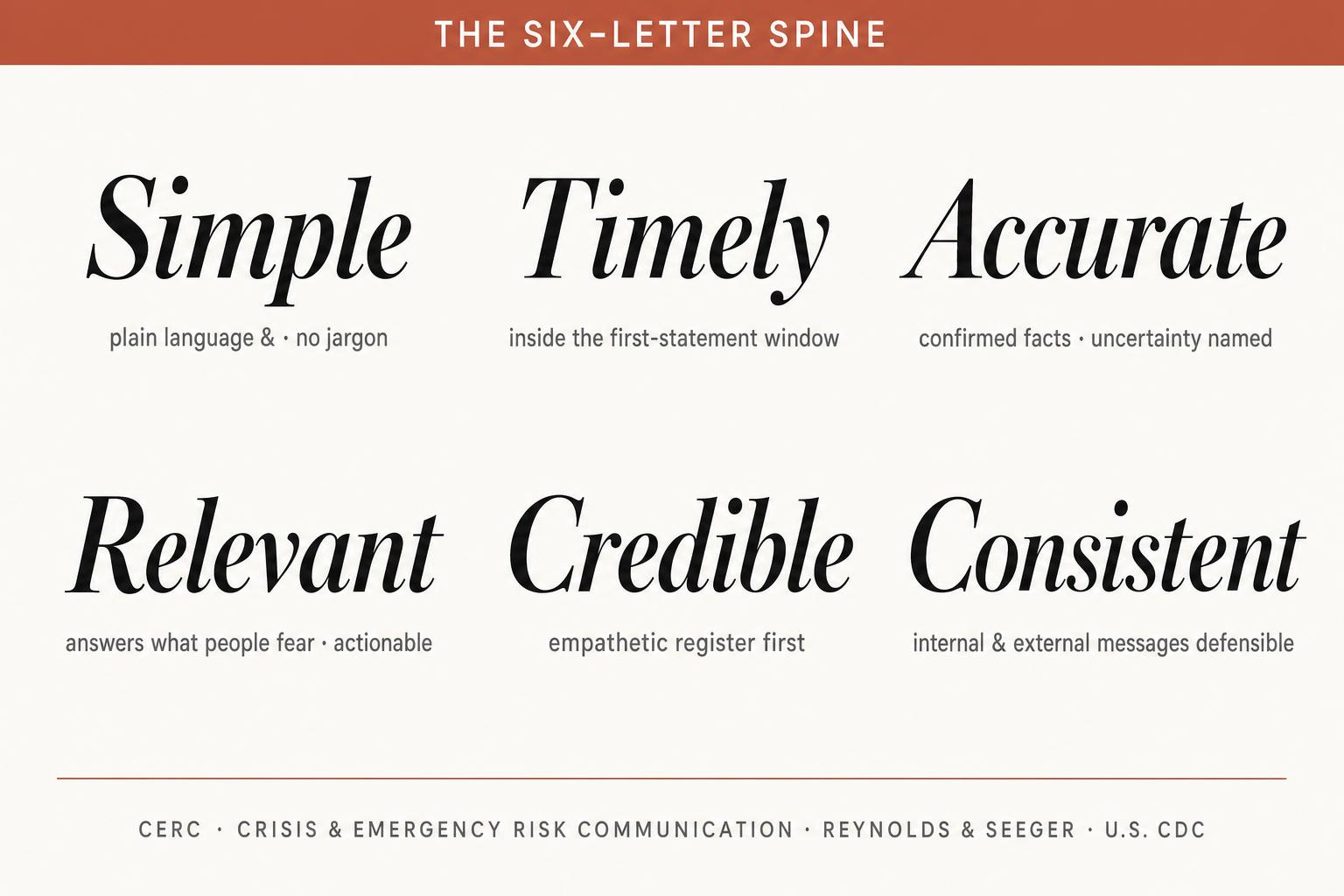
- The CERC / STARCC discipline — Simple, Timely, Accurate, Relevant, Credible, Consistent — is the operational spine of every credible first statement (Reynolds & Seeger / CDC).
- Three failure modes destroy trust: evasion (Fukushima / TEPCO), vacuum (Grenfell Tower), and wrong register (airline cases, Ray 1999). All converge on the same outcome.
- Empathy is not a rhetorical flourish but a cognitive gateway: audiences decide whether to trust your information based on whether they believe you care about their experience (Schoofs et al., 2019).
- Transparency about uncertainty — stating what you know, what you don't, and when you'll know more — builds credibility more effectively than waiting for complete information.
- Update cadence is a structural tool: the regular rhythm of communication pre-empts speculation, manages expectations, and reduces the cognitive load on the communication team.
- Internal and external crisis messages must differ in register and detail but remain consistent in substance — because in practice, the wall between them is always permeable.
- Trust erodes asymmetrically: a single evasion or contradiction costs more credibility than ten honest updates can rebuild. Different stakeholder groups hold separate trust accounts (Coombs, 2007).
You now understand how to communicate during a crisis. The Long Night turns to the teams who must sustain crisis operations not for hours but for days, weeks, or months — how fatigue degrades decision-making, how leaders maintain morale when there is no end in sight, and why the communication practices you've just learned are essential to keeping your people functional when the crisis refuses to end.
References
Coombs, W. T. (2007). Protecting organization reputations during a crisis: The development and application of Situational Crisis Communication Theory. Corporate Reputation Review, 10(3), 163–176.
Funabashi, Y., & Kitazawa, K. (2012). Fukushima in review: A complex disaster, a disastrous response. Bulletin of the Atomic Scientists, 68(2), 9–21.
Moore-Bick, M. (2019). Grenfell Tower Inquiry: Phase 1 Report. Her Majesty's Stationery Office.
Ray, S. J. (1999). Strategic Communication in Crisis Management: Lessons from the Airline Industry. Quorum Books.
Reynolds, B., & Seeger, M. W. (2005). Crisis and emergency risk communication as an integrative model. Journal of Health Communication, 10(1), 43–55. (CERC framework, U.S. Centers for Disease Control and Prevention.)
Schoofs, L., Claeys, A.-S., De Waele, A., & Cauberghe, V. (2019). The role of empathy in crisis communication: Providing a deeper understanding of how organizational crises and crisis communication affect reputation. Public Relations Review, 45(5), 101851.
Sellnow, D. D., Lane, D. R., Sellnow, T. L., & Littlefield, R. S. (2016). The IDEA model as a best practice for effective instructional risk and crisis communication. Communication Studies, 67(5), 552–567. (Systematic treatment of crisis uncertainty communication.)
Thai cave rescue communication analysis. (2018). Case study analysis of the Tham Luang rescue communication architecture.