The Long Night
Some crises end in minutes. The ones that break organisations — and the people in them — last days, weeks, or months. What remains when the adrenaline runs out determines whether the response holds or collapses.
On the afternoon of June 23, 2018, twelve boys from the Wild Boars football team and their coach entered the Tham Luang cave in northern Thailand. Within hours, monsoon rains flooded the entrance passages behind them.
What followed was not a single dramatic rescue but seventeen days of continuous operations — a grinding, exhausting effort involving over ten thousand people, during which the initial adrenaline-fueled urgency slowly gave way to something far harder to sustain.
Endurance Outrun
By the eighth day, divers had located the boys alive on a muddy ledge four kilometers inside the mountain. The relief was enormous. But the hardest decisions still lay ahead, and the people who would make them had already been working for over a week without meaningful rest.
The Thai cave rescue is a study in what happens when crisis demands outrun human endurance. Several of the international cave divers later described moments of impaired judgment during the operation — small errors in equipment checks, slowness in processing new information, a creeping rigidity in thinking that they recognized, with alarm, as the early signatures of fatigue. One diver, Richard Harris, an anesthetist who would sedate each boy for the underwater extraction, had been awake for most of the preceding forty-eight hours when he administered the first dose. He later acknowledged that the decision to proceed relied as much on the team structure around him — the checks, the redundancy, the people willing to say "stop" — as on his own clinical judgment. The crisis did not care that everyone was tired.
When the Adrenaline Runs Out
Every crisis begins with mobilization. The alarm sounds, the team assembles, and a surge of neurochemical energy — cortisol, adrenaline, norepinephrine — sharpens attention, accelerates processing, and suppresses the body's signals for rest. In those first hours, decision-makers often report a sense of heightened clarity. Problems feel tractable. The team feels unified. There is an almost intoxicating sense of shared purpose.
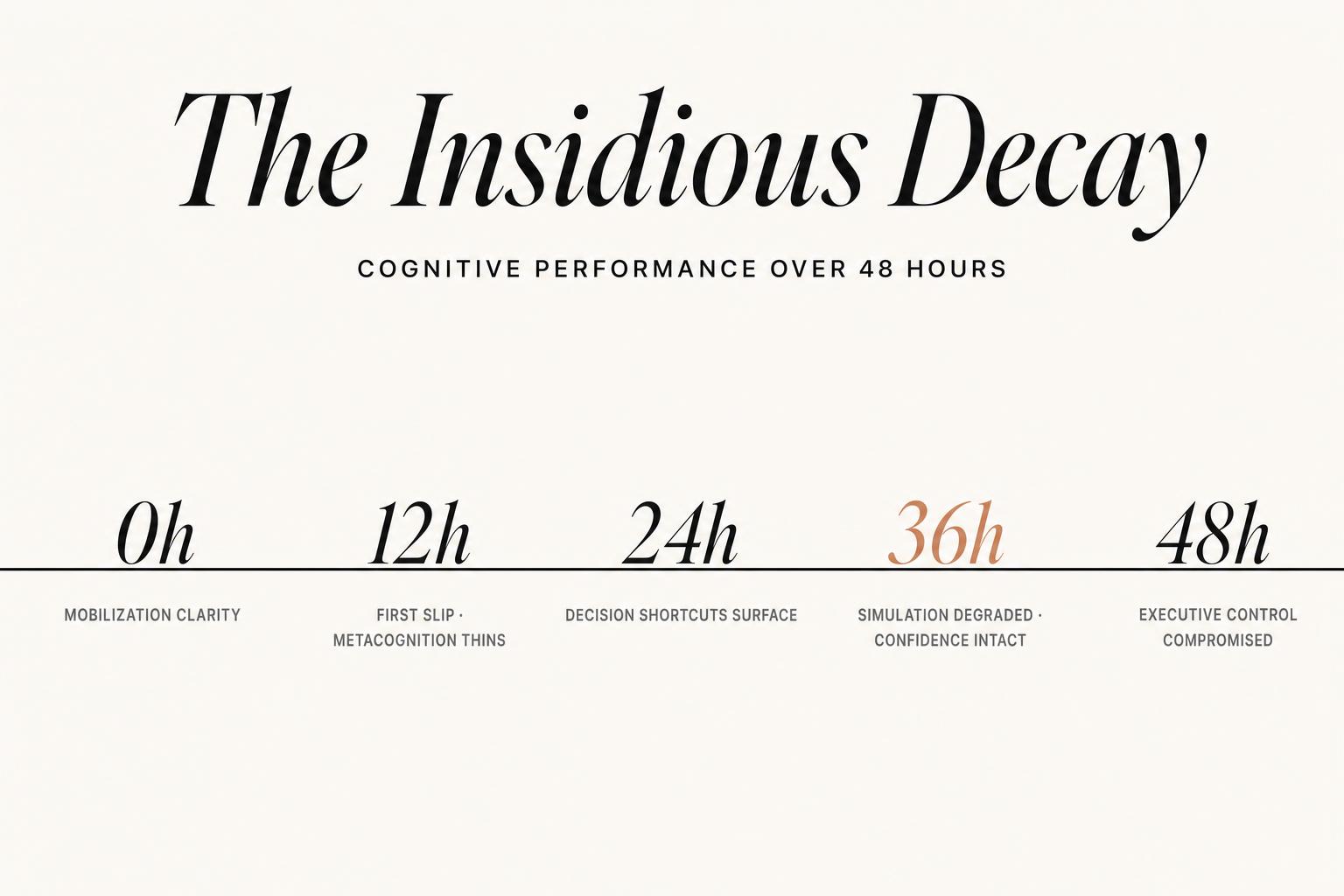
This phase is real and physiologically grounded. But it is also temporary. Research on decision fatigue demonstrates that the quality of decisions degrades measurably after prolonged periods of cognitive effort, as studies from 2025 have shown. The decline is not dramatic — it is insidious. Decision-makers do not suddenly become incompetent. Instead, they begin taking shortcuts. They default to simpler heuristics. They become more risk-averse, choosing the safe option even when the situation demands boldness, according to research findings from 2022. And critically, they lose the metacognitive awareness to recognize that their judgment has changed.
The Fukushima Daiichi nuclear disaster illustrates this trajectory at scale. When the earthquake and tsunami struck on March 11, 2011, the on-site response team at the plant worked with remarkable clarity under extraordinary pressure during the first twenty-four hours. Plant Superintendent Masao Yoshida made a series of bold, technically sound decisions — including defying orders from TEPCO headquarters to continue seawater injection into Reactor 1. But as the crisis stretched into its second week, with multiple reactor buildings exploding and radiation levels climbing, the quality of coordination between the site team and external agencies visibly deteriorated. Communications became confused. Critical information was delayed or distorted. Decisions that should have taken minutes took hours, not because of bureaucratic obstruction but because the people making them were cognitively depleted.
The Neuroscience of Sustained Operations
To understand why prolonged crises break decision-making, we need to revisit the cognitive load framework introduced in Chapter 4. Working memory — the mental workspace where we hold, manipulate, and integrate information — has a finite and surprisingly small capacity, as Paas and van Merriënboer described in 2020. Under normal conditions, experienced professionals manage this limitation through expertise: well-rehearsed patterns and mental models reduce the load on working memory by packaging complex information into recognizable chunks.
Sustained stress disrupts this system at multiple levels. First, the stress response itself consumes working memory resources. The intrusive worries that accompany prolonged uncertainty — What if we're wrong? What are we missing? What happens if this fails? — occupy the same cognitive workspace needed for analytical thought, as Paas and van Merriënboer noted. Second, sleep deprivation and physical exhaustion degrade the prefrontal cortex functions that support executive control, the very capacities that distinguish expert judgment from reactive impulse. Third, and perhaps most dangerously, cumulative fatigue erodes the capacity for mental simulation — the ability to project a course of action forward and evaluate its likely consequences before committing to it.
The answer, supported by Klein's own research and subsequent experimental work, according to research spanning from 1989 to 2004, is that mental simulation degrades first. Pattern matching is relatively automatic in experienced professionals — it draws on deeply encoded long-term memory and requires less active working memory. Mental simulation, however, demands sustained, effortful processing: you must hold the proposed action in mind, project it forward through multiple steps, and evaluate the outcome against your goals. This is exactly the kind of cognitive work that fatigue undermines. The result is a dangerous condition where experienced professionals continue to recognize patterns correctly — they still feel like they know what is going on — but they lose the ability to critically evaluate whether their proposed response actually fits the evolving situation. They match to the right pattern from yesterday while failing to notice that conditions changed overnight.
The Fatigue Trap
If fatigue degrades decision quality so predictably, why do experienced leaders consistently fail to rest during prolonged crises? The answer lies in a convergence of psychological, social, and organizational pressures that create what we might call the indispensability trap.
During the 2019 to 2020 Australian Black Summer bushfire season — five months of relentless escalation across multiple states — Rural Fire Service volunteer captains and incident controllers routinely worked sixteen to twenty hour days for weeks on end. Many later described feeling that stepping away, even for a few hours, would constitute a kind of abandonment. "If my crew is out there," one captain recalled, "I should be in the control room." The feeling was genuine, deeply held, and profoundly counterproductive.
Research on burnout in emergency response environments reveals that this pattern is not a character flaw but a predictable system failure, as Uccheddu and colleagues found in 2025. Burnout rates among emergency professionals exceed seventy percent in some high-demand settings, driven by workload, inadequate rest, and the emotional burden of sustained responsibility. The same qualities that make someone an effective crisis leader — commitment, ownership, accountability — become liabilities when they prevent the leader from recognizing their own impairment.
VanSlyke, Brunell, and Simons examined this dynamic during the COVID-19 pandemic in 2020, observing that leaders who thrived during temporary crises often struggled during prolonged ones precisely because they treated every phase with the same intensity as the opening hours. Their adaptive capacity — the ability to modulate effort across time — was poorly developed. The researchers emphasized that sustainable crisis leadership requires leaders to model self-care, appoint trusted deputies, and create the psychological safety necessary for team members to say, without penalty, "I need to step back."
Recognising Impairment in Yourself
The challenge is that cognitive fatigue actively undermines the self-monitoring capacity you need to detect cognitive fatigue. This is not a paradox — it is a design feature of the human brain. The prefrontal cortex, which supports self-awareness and metacognition, is among the first regions to suffer under sustained stress and sleep deprivation. Leaders in the grip of fatigue frequently report feeling fine, or at least functional, even as their teams observe obvious signs of degradation.
The observable warning signs are remarkably consistent across contexts: irritability and shortened temper — snapping at team members over minor issues that would normally be handled with patience. Inability to delegate — reclaiming tasks previously assigned to others, driven by a narrowing trust in anyone else's competence. Repetitive checking — reviewing the same information multiple times without retaining it, a direct marker of working memory impairment. Neglect of basic needs — skipping meals, ignoring hydration, dismissing the body's signals as irrelevant to the mission. Rigidity of thought — dismissing team concerns, resisting alternative viewpoints, and becoming locked into a single interpretation of the situation. And loss of narrative coherence — difficulty summarizing the current situation clearly and concisely, a sign that the leader's own mental model has become fragmented.
Because self-detection is unreliable, the solution must be structural rather than individual. The most effective prolonged-crisis organizations build impairment detection into their operating procedures — through mandatory rest protocols, designated "challenger" roles, and decision audit partnerships where a colleague is specifically tasked with monitoring the decision-maker's cognitive state.
The same qualities that make someone an effective crisis leader become liabilities when they prevent the leader from recognising their own impairment.
after Uccheddu et al. · 2025
When the Team Changes but the Crisis Doesn't
Sustainable crisis response requires shift rotation. But shift rotation introduces a problem that is deceptively difficult to solve: information continuity. When a fresh team arrives to relieve an exhausted one, the crisis does not pause to provide a summary. The incoming shift inherits not just a set of facts but an evolving situation with context, nuance, and unspoken assumptions that the outgoing team has absorbed gradually over hours.
Research in emergency medicine demonstrates just how much is lost in transition. A study implementing standardized handover tools in an emergency department found that baseline handover adequacy was only fifty percent — meaning that half the time, critical information was either omitted or poorly communicated during shift changes, as research from 2020 showed. Written communication of handover information was even worse, at just 19.2%. Through structured intervention, these numbers improved dramatically — to eighty-three percent adequacy and 68.7% written communication — but the baseline figures reveal the default state of human handover performance: it is poor.
In crisis contexts, the stakes of handover failure are amplified. The incoming shift commander must not only know what has happened but must understand why specific decisions were made, which assumptions those decisions rested on, and what to watch for that might invalidate those assumptions. This is where Karl Weick's concept of collective sensemaking becomes critically important, as Maitlis and Sonenshein described in 2010. A team's shared understanding of a crisis is not merely a collection of individual facts — it is a collectively constructed narrative that gives those facts meaning, priority, and emotional resonance. When team members rotate through shifts, they carry slightly different versions of this narrative. The incoming team builds a new shared understanding that may diverge subtly but consequentially from the one held by the outgoing team.
Designing Effective Handover Protocols
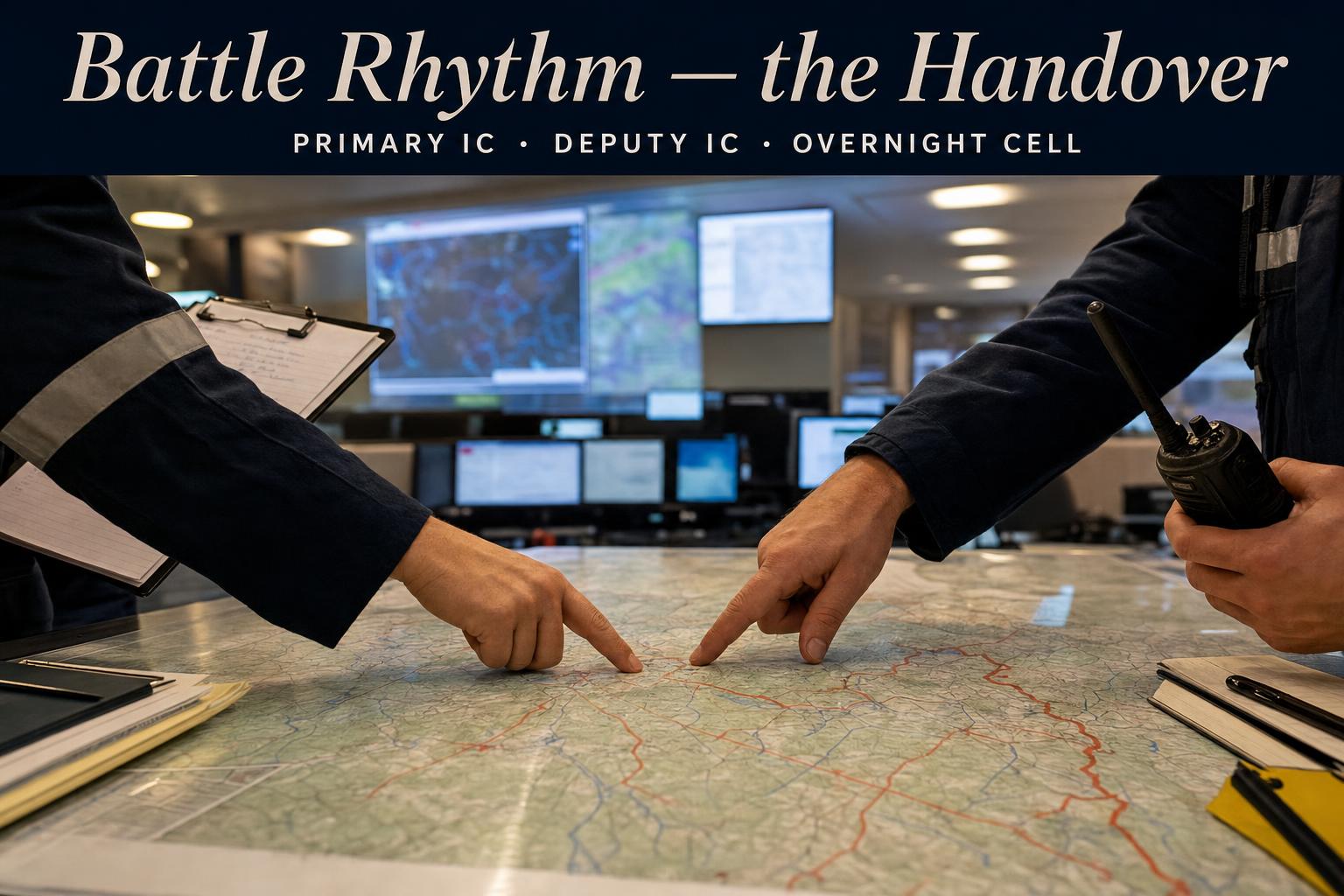
The most effective handover protocols share several structural features, derived from both military operations and hospital shift-change research. First, a situation summary: a concise narrative of where things stand right now — not the full history, but the current operational picture. Second, critical changes: what has changed in the last shift period that the incoming team must know immediately. Third, pending decisions: decisions that are in progress or imminent, including the options under consideration and any deadlines. Fourth, assumptions under strain: explicitly identified assumptions that the outgoing team relied on but that may no longer hold. Fifth, key contacts and relationships: who has been engaged, what they have committed to, and any interpersonal dynamics the incoming team should be aware of. And sixth, watch items: specific indicators or triggers that the incoming team should monitor — the things that, if they change, would require a fundamental reassessment of the current plan.
Notice that this structure goes well beyond "what happened." It transfers not just information but judgment context — the reasoning and assumptions that give information its operational meaning. The goal is not to make the incoming shift as knowledgeable as the outgoing one — that is impossible — but to ensure they know what they need to know to make the next set of decisions well.
Structure Over Speeches
There is a persistent myth in crisis leadership that team morale during prolonged operations is sustained through inspirational communication — the speech in the command center, the rallying call, the leader who projects calm confidence. In reality, research on emergency team resilience points to a different set of factors: structural interventions that protect cognitive capacity, maintain social cohesion, and create genuine psychological safety, as Uccheddu and colleagues found in 2025.
Shift Design as a Leadership Decision
How shifts are designed is itself a critical leadership decision, not an administrative detail to be delegated. The evidence on shift length and decision quality is clear: decision fatigue increases as shifts progress, with measurable effects on judgment quality, risk assessment, and error rates, according to research from 2025. Yet crisis organizations routinely default to extended shifts on the assumption that continuity of personnel is more important than freshness of judgment. This assumption deserves scrutiny.
The optimal shift structure for sustained crisis operations balances three competing needs: cognitive freshness — shorter shifts; information continuity — longer shifts to reduce handover frequency; and team cohesion — consistent teams who develop shared mental models. There is no universal answer, but the research suggests that eight to twelve hour operational shifts with structured handover protocols and a mandatory overlap period represent a reasonable compromise for most crisis contexts. Critically, the shift schedule must apply to senior leaders, not just frontline operators. The incident commander who exempts themselves from the rotation "because I need to maintain oversight" is making exactly the kind of fatigued decision that the rotation is designed to prevent.
Deliberate Rest as Operational Discipline
Rest during prolonged operations is not the absence of work — it is a deliberate operational practice that must be planned, resourced, and enforced with the same rigor as any other element of the response. VanSlyke, Brunell, and Simons emphasized in 2020 that leaders must model rest behavior, visibly stepping away and returning refreshed, to signal that rest is not weakness but professional discipline. This is particularly important in cultures where endurance is valorized and exhaustion is worn as a badge of commitment.
Effective rest protocols include designated rest areas removed from the operational environment, minimum rest periods that are non-negotiable except under predefined escalation conditions, and a clear chain of delegation so that the resting leader knows exactly who holds authority during their absence. The goal is to make rest easy — to remove the friction and anxiety that prevent fatigued people from actually disengaging.
Psychological Safety Under Pressure
Perhaps the most important structural intervention is the creation of conditions where team members can acknowledge their own limitations without fear. In the Thai cave rescue, one of the most critical moments came when a support diver told the operation's leadership that he did not feel confident performing a particular role in the extraction plan. In many organizational cultures, this admission would have been met with pressure, disappointment, or reassignment to lesser duties. In the Tham Luang operation, it was treated as valuable safety information — the plan was adjusted, another diver was assigned, and the individual was given a different role where his skills were better matched to his current state.
This kind of psychological safety does not emerge spontaneously under crisis pressure. It must be established before the crisis through team norms, rehearsed during training, and actively reinforced during operations by leaders who respond to admissions of limitation with gratitude rather than frustration. As Maitlis and Sonenshein observed in 2010, collective sensemaking in crisis involves shared meanings and emotions — a team that suppresses honest emotional signals is also suppressing the information those signals carry about operational readiness.
The Ninety-Six Hour Framework
Drawing together the concepts in this chapter, we can outline a practical framework for sustaining decision quality across a prolonged crisis. The framework assumes a ninety-six hour — that is, four-day — operational window, long enough to exhaust initial mobilization energy but short enough to plan concretely. For crises lasting weeks or months, the framework is applied in rolling cycles.
Hours zero to twelve — Mobilisation. Adrenaline is high, the team is fresh, and decisions are sharp. The critical leadership task in this phase is not making decisions — it is establishing the operational rhythm that will sustain the response when the adrenaline fades. Set the shift schedule. Identify deputies. Establish the handover protocol. Designate rest areas. These investments feel premature when the crisis feels urgent, but they are the most important decisions a leader makes in the first twelve hours.
Hours twelve to thirty-six — The Compensation Phase. Fatigue is accumulating but experience is compensating. Pattern recognition remains effective; mental simulation is beginning to degrade. The critical intervention is the first structured handover — getting it right sets the standard for every subsequent transition. Leaders should begin rotating in this phase, not waiting until they feel tired.
Hours thirty-six to seventy-two — The Degradation Zone. Decision quality is measurably declining. Risk aversion increases. Teams begin defaulting to established plans even when conditions have changed. The critical intervention is active challenging — designated roles or processes that force reassessment of assumptions. This is also when burnout warning signs become visible in leaders who have not rested adequately.
Hours seventy-two to ninety-six — The Endurance Test. Only teams with well-functioning shift rotations, disciplined handovers, and enforced rest protocols maintain effective decision quality in this phase. Teams without these structures experience cascading degradation: poor decisions compound, morale erodes, and the response begins to fragment. The critical leadership task is recognition — acknowledging the strain, celebrating the endurance, and making visible the structural supports that are sustaining the response.
The ability to say "I am not fit to make this decision right now" is among the most important leadership competencies in sustained crisis.
The argument of this chapter
Key Takeaways
- Decision quality degrades predictably during prolonged crisis operations, with mental simulation capacity declining before pattern recognition (Klein, 1989–2004) — creating a dangerous gap where leaders feel confident but reason poorly.
- The indispensability trap prevents leaders from resting because stepping away feels like abandonment; structural interventions such as mandatory rotations, designated deputies, and modeled rest are more reliable than individual willpower (VanSlyke et al., 2020).
- Working memory has a finite and surprisingly small capacity (Paas & van Merriënboer, 2020); sustained stress consumes it through intrusive worry, degraded executive control, and eroded mental simulation.
- Shift handovers are high-risk moments for information loss; baseline adequacy is only fifty percent (2020 research) — effective handover protocols transfer not just facts but judgment context.
- Collective sensemaking degrades across shift changes as incoming teams construct slightly different shared narratives (Maitlis & Sonenshein, 2010); overlap periods and structured protocols mitigate but cannot eliminate this drift.
- Team resilience during prolonged operations depends on structural pillars — shift design, handover discipline, deliberate rest protocols, and psychological safety — not on motivational communication (Uccheddu et al., 2025).
- The ability to say "I am not fit to make this decision right now" is among the most important leadership competencies in sustained crisis, and it requires organisational conditions that make such honesty safe.
In After the Smoke Clears, we move from the internal dynamics of the crisis team to the aftermath — post-incident review, the political question of blame, and the construction of learning cultures that translate failure into change.
References
Klein, G. A., Calderwood, R., & Clinton-Cirocco, A. (1989–2004). Recognition-Primed Decision (RPD) Model.
Maitlis, S., & Sonenshein, S. (2010). Sensemaking in crisis and change: Inspiration and insights from Weick (1988). Journal of Management Studies, 47(3), 551–580.
Multiple authors. (2020). Development and implementation of a standardised emergency department intershift handover tool to improve physician communication. BMJ Open Quality, 9(1), e000780.
Multiple authors. (2022). Effects of mental fatigue on risk preference and feedback processing in risk decision-making. Scientific Reports, 12, Article 10581.
Multiple authors. (2025). An integrative review on unveiling the causes and effects of decision fatigue to develop a multi-domain conceptual framework. Frontiers in Cognition, 4, 1719312.
Paas, F., & van Merriënboer, J. J. G. (2020). Cognitive-load theory: Methods to manage working memory load in the learning of complex tasks. Current Directions in Psychological Science, 29(4), 394–398.
Uccheddu, D., et al. (2025). Burnout and resilience in emergency medicine health professionals. Internal and Emergency Medicine, 20, 615–630.
VanSlyke, S., Brunell, K., & Simons, A. (2020). Leadership in the COVID crisis: The importance of building personal resilience. Control Risks.