The Crisis
Before the Crisis
Every crisis is decided before it begins. The cladding is already on the building. The generators are already below the flood line. The reporting culture already does, or does not, surface the warnings.
In the early morning hours of the fourteenth of June, 2017, a small kitchen fire in Flat sixteen of Grenfell Tower ignited the polyethylene-core aluminium composite cladding that had been installed during a refurbishment completed two years earlier.
Within minutes, the fire had spread to the exterior of the building. Within hours, seventy-two people were dead.
The Decision Made Years Before
The public inquiry that followed would reveal a cascade of failures in regulation, in procurement, in building management, in emergency response. But the single most consequential decision in the entire Grenfell disaster was not made on the night of the fire. It was made years before, in a meeting room, by people reviewing material specifications and cost estimates, who chose a cladding system that saved roughly two hundred ninety-three thousand pounds over a fire-resistant alternative.
This pattern repeats with eerie consistency across every crisis this course has examined. Fukushima Daiichi's backup generators were placed below the flood line during construction in the nineteen sixties. The organisational culture that delayed the Thai cave rescue's early coordination was built over years of institutional separation between agencies. The communication failures of every case study we have analysed were embedded in systems designed, or neglected, long before the crisis began. This final chapter asks the question that now, after seven chapters of studying how crises unfold, you are equipped to answer: What should have happened before any of it started?
Chronic Wariness, Not Confidence
Some organisations operate every day in conditions where a single error could produce catastrophic consequences, and yet they sustain remarkably low rates of failure. Nuclear aircraft carriers launch and recover jet aircraft from a space the size of a few football pitches, in weather that would shut down most airports, with a crew whose average age is nineteen. Air traffic control centres manage thousands of aircraft in close proximity, day after day, with vanishingly rare incidents. Elite surgical teams perform procedures where a millimetre of miscalculation means the difference between recovery and death. These are not organisations that merely respond well to crises. They are organisations structured to prevent crises from occurring, and to contain them rapidly when prevention fails.
As Weick and Sutcliffe described in 2015, these are high-reliability organisations, or HROs, and their research reveals something counterintuitive: what distinguishes HROs is not that they are more confident in their safety systems. It is that they are less confident. They operate with a chronic wariness, a suspicion that the next failure is already incubating somewhere in the system and that their current understanding is incomplete. Vogus and Sutcliffe found in 2011 that this represents a dual orientation: HROs pursue both anticipation, identifying and preventing potential problems before they materialise, and containment, developing the capacity to detect and limit problems that have already begun but are not yet catastrophic.
This dual orientation is what separates genuine preparedness from what most organisations actually practice: a confidence-building exercise of writing plans, filing them in binders, and assuming that the existence of the plan constitutes readiness. Jin, Cameron, and Coombs argued in 2024 that traditional preparedness frameworks are insufficient precisely because they focus on artefacts, plans, checklists, resource inventories, rather than on the organisational capacities that determine whether those artefacts will actually function under the cognitive, emotional, and coordinative pressures of a real crisis. They propose crisis readiness as a more demanding concept: a state that includes not just planning but multilevel efficacy, mental adaptability, and what they call "dynamic process-driven agility," the capacity to improvise coherently when the plan meets reality.
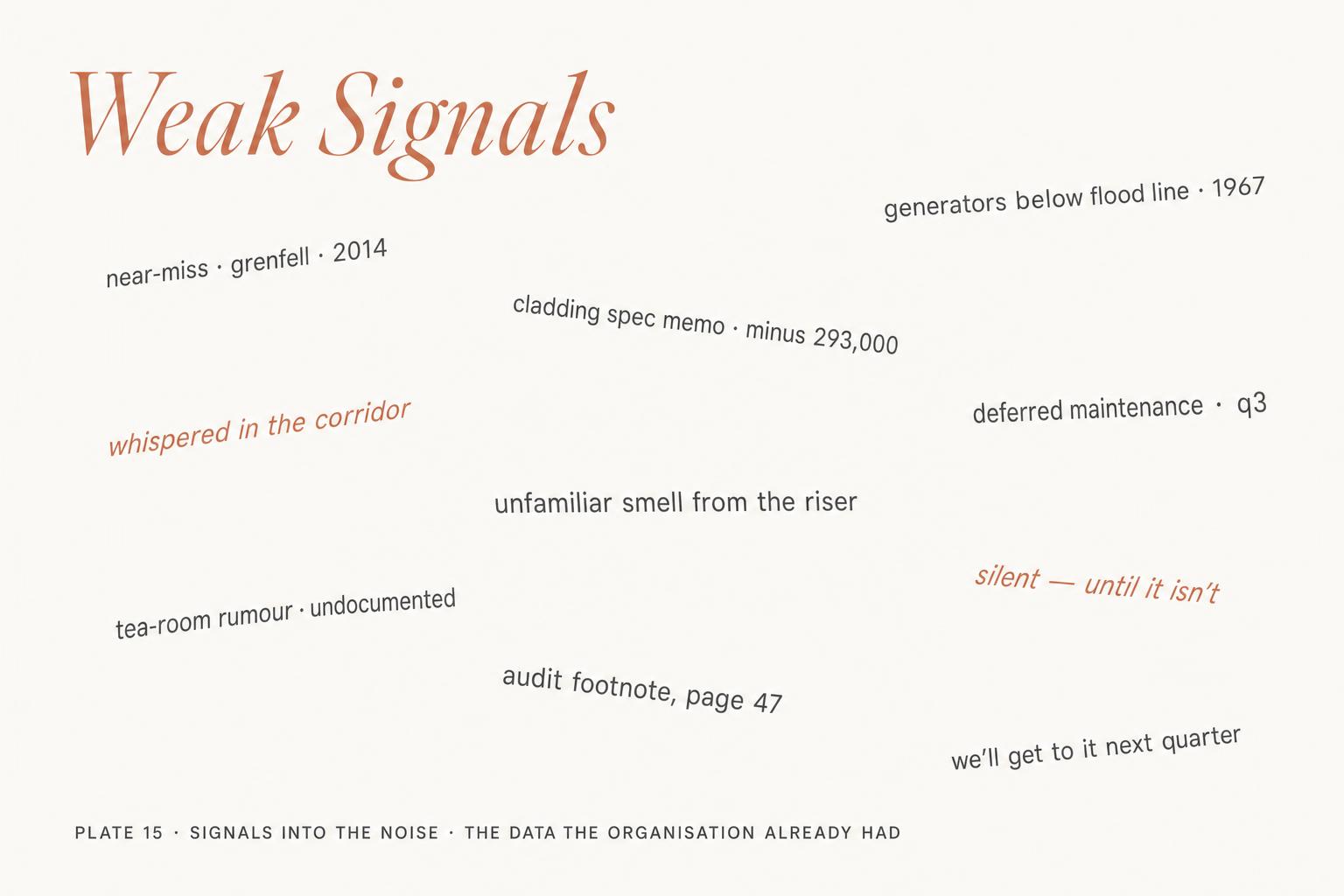
Fig. 15 Weak signals. The information the organisation needed was almost always already present — set in smaller type, in the margins, in the corridor, in the footnote nobody read.
Five Processes of Collective Mindfulness
Weick, Sutcliffe, and Obstfeld identified in 1999 five processes that characterise how high-reliability organisations maintain this state of alert readiness. Together, these processes constitute collective mindfulness, not a meditative practice, but a quality of organisational attention that enables groups to notice weak signals and respond to them before they amplify into catastrophe.
One · Preoccupation with Failure
HROs treat near-misses not as evidence that the system works but as evidence that it almost did not. They actively seek out failure signals rather than taking comfort in success.
Two · Reluctance to Simplify Interpretations
When something unexpected occurs, HROs resist the temptation to explain it away with a simple narrative. They maintain nuance, seek additional perspectives, and tolerate ambiguity long enough to develop accurate understanding.
Three · Sensitivity to Operations
Leaders in HROs maintain close contact with the front line. They know what is actually happening, not just what reports and dashboards say is happening.
Four · Commitment to Resilience
HROs invest in the capacity to detect, contain, and recover from errors that have already occurred. They assume some failures will penetrate their defences and prepare for that eventuality.
Five · Deference to Expertise
In crisis moments, authority migrates to the person with the most relevant expertise, regardless of rank. The organisational hierarchy flexes to match the demands of the situation.
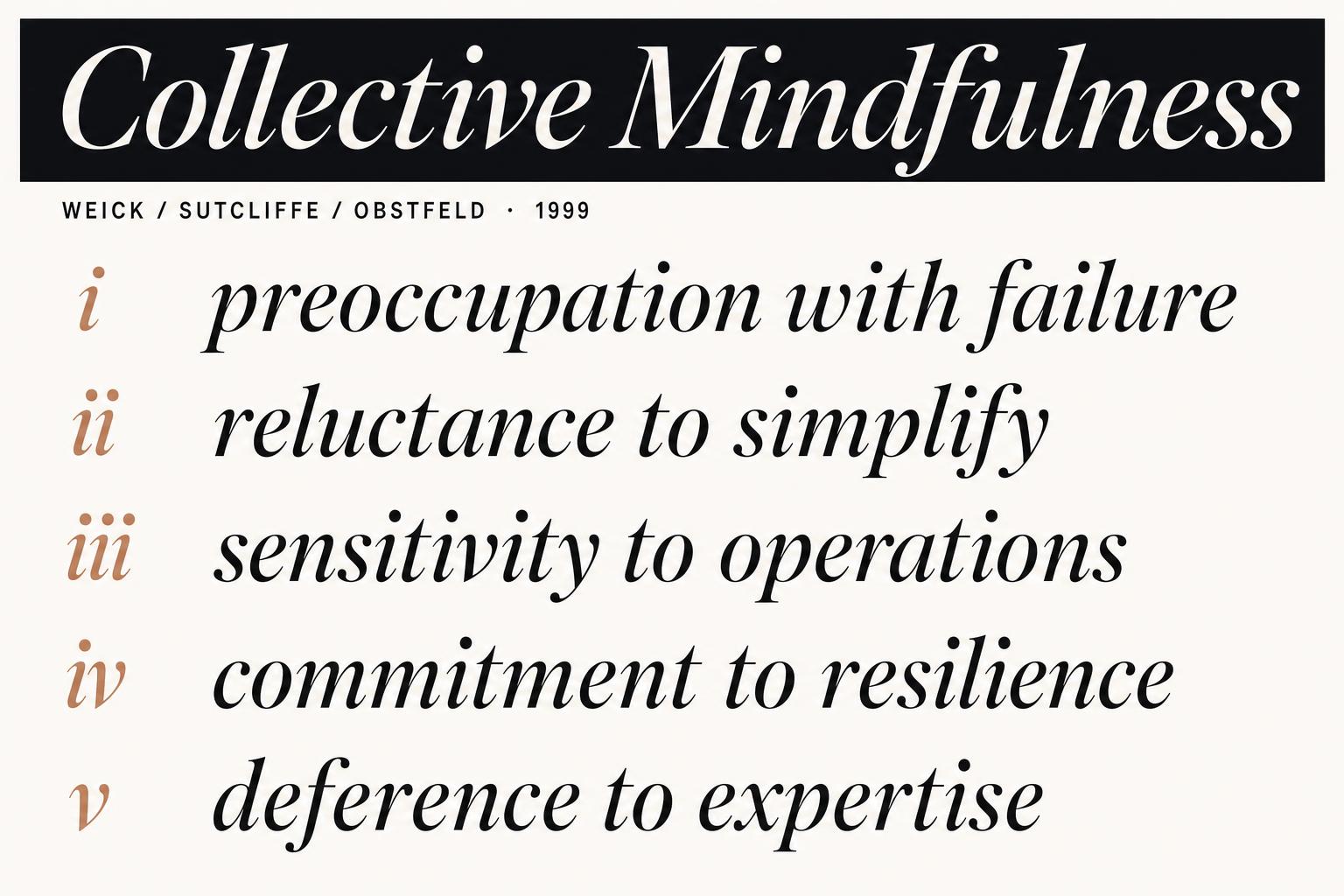
Fig. 16 Collective mindfulness. Not a meditative practice but a quality of organisational attention — five processes that keep the group tuned to the signals it would otherwise miss.
Swiss Cheese, Applied Forward
Throughout this course, we have used James Reason's Swiss Cheese Model as a retrospective lens, a way to trace how latent conditions and active failures aligned to produce a catastrophic outcome. But the model's greatest practical value lies in its proactive application: systematically examining each layer of defence in your organisation before a crisis, identifying where the holes are, and critically, identifying where holes in adjacent layers might align.
This is the shift from accident investigation to proactive vulnerability assessment. Instead of asking "what failed?" after a disaster, you ask "what could fail?" while there is still time to intervene. The method is deceptively simple: enumerate your layers of defence, governance, plans, training, culture, resources, examine the integrity of each layer, and look for the dangerous alignments, the places where a weakness in one layer is not compensated by strength in an adjacent one.
The difficulty, of course, is that organisations are systematically biased against seeing their own vulnerabilities. According to Haas, Kulbacki, and McGuire in 2020, near-miss reporting systems, one of the most powerful tools for surfacing latent weaknesses, function effectively only when workers have genuine decision-making autonomy, when they are involved in analysing the events they report, and when the organisational response to reports is visibly constructive. Reporting systems that merely collect data without feeding it back into decision-making are, in effect, a defence layer with a hole in it.
Stress, Scenario, and the Last Crisis Trap
If vulnerability assessment identifies where your defences are weak, stress testing reveals how those weaknesses will behave under pressure. As Younis described in 2024, there are two complementary approaches: stress testing, which applies extreme but plausible conditions to see where systems break, and scenario analysis, which envisions a range of possible futures to test the breadth of organisational response capacity. Both are necessary. Stress testing without scenario breadth will prepare you very well for the last crisis you experienced. Scenario analysis without stress intensity will surface problems in theory that never get tested in practice.
Most organisational exercises fail on one or both dimensions. They test only the most obvious scenarios, the ones everyone expects and has rehearsed. They allow leaders to perform well because the exercise is designed to confirm existing plans rather than challenge them. They run for a few hours rather than the days or weeks a real crisis demands. They skip the parts that are genuinely difficult: the moment when two stakeholders want contradictory things, when the information arriving is ambiguous and potentially wrong, when the team has been operating for sixteen hours and is exhausted.
Effective stress tests are built on the understanding developed across this entire course. They incorporate activation threshold ambiguity from Chapter two, because real crises do not announce themselves clearly. They create genuine cognitive load from Chapter three, because decisions under pressure are qualitatively different from decisions in a meeting room. They embed stakeholder conflicts from Chapter four and require communication under uncertainty from Chapter five, because the social dynamics of crisis are at least as challenging as the operational ones. They run long enough to test fatigue and decision degradation from Chapter six, and they include post-exercise review processes designed to surface real learning from Chapter seven.
Crisis as Event, Crisis as Process
These tools, vulnerability assessment and stress testing, are necessary but insufficient. An organisation can complete a vulnerability scan, design excellent exercises, and still fail in crisis if these activities remain isolated projects rather than expressions of an embedded organisational culture. As Vogus and Sutcliffe noted in 2016, there's a critical distinction between crisis-as-event thinking, which treats crises as discrete occurrences to be managed, and crisis-as-process thinking, which understands crises as emerging from ongoing organisational dynamics. Preparedness, in this view, is not something you do periodically. It is something you are, continuously.
Hanssen, Meidell, and Lindøe reinforced this point in their 2022 systematic review of organisational resilience and learning. They find that resilient organisations learn not only from crisis but in crisis and for crisis, that is, they develop learning systems that operate before, during, and after disruptive events. Critically, they find that learning from normal functioning and minor events is as important as learning from major incidents. This aligns directly with the HRO principle of preoccupation with failure: it is the organisations that treat everyday anomalies as data, not noise, that build the deepest reserves of adaptive capacity.
This is where the concept of crisis readiness becomes essential. Readiness is not a checklist state. It is a dynamic condition that encompasses multilevel efficacy, confidence at individual, team, and organisational levels, mental adaptability, the capacity to revise mental models rapidly, and emotional leadership, the ability to manage the affective dimensions of crisis response. Training and plans contribute to readiness, but they do not constitute it. An organisation can have excellent plans and well-trained individuals and still lack readiness if those plans have never been tested under realistic conditions, if the individuals have never worked together under genuine pressure, or if the organisational culture punishes the kind of honest reporting that surfaces problems before they escalate.
The Maturity Continuum
Organisational preparedness is not a binary state. You are not either ready or unready. It exists on a continuum, and understanding where your organisation sits on that continuum is essential for knowing what interventions will actually make a difference. An organisation at the very beginning of its preparedness journey needs different things than one that has strong plans but weak culture, or one that exercises regularly but fails to learn from what the exercises reveal.
A useful framework maps five levels of preparedness: reactive, aware, prepared, adaptive, and resilient, across six organisational dimensions. Each level is defined by observable behaviours, not aspirational statements. The goal is not to reach the top of every dimension. For most organisations, that would require resources they do not have. The goal is to understand your current state honestly, identify the highest-value improvements, and build a realistic pathway toward greater readiness.
The Arc Reversed
This chapter, and this course, has traced an arc from the moment a crisis is first recognised through the decisions, communications, and coordinating structures that shape the response, through the review processes that determine whether the organisation learns from its experience, and finally to the preparedness practices that determine whether the next crisis will unfold differently. But that arc is misleading in one important respect: it implies a sequence. In reality, every element operates simultaneously. The organisation that is responding to today's crisis is also, whether it knows it or not, shaping its readiness for the next one.
The frameworks you have studied in this course are not academic abstractions. Reason's Swiss Cheese Model is a tool you can use tomorrow morning to examine the defence layers in your own organisation. Klein's Recognition-Primed Decision model tells you exactly what kind of training your people need: not rule memorisation, but pattern library development through realistic scenario exposure. Weick's sensemaking framework specifies what your communication systems must do under stress: maintain shared situational awareness through continuous information exchange, not periodic briefings. Dekker's just culture framework tells you what must be true about your reporting systems if you want near-misses to surface before they become catastrophes. And Boin and colleagues' crisis leadership model tells you what governance arrangements must be in place, and tested, before the crisis calls for them.
The most important lesson of this course may be the simplest: every crisis is decided before it begins.
Class 08 · The Argument
The cladding is already on the building. The generators are already below the flood line. The reporting culture already does, or does not, surface the warnings. The leaders have already been trained, or they have not. The question is not whether your organisation will face a crisis. The question is what kind of organisation it will be when the crisis arrives.
As a Chinese proverb frequently cited in emergency management literature reminds us: "The best time to plant a tree was twenty years ago. The second best time is now."
You now have the conceptual tools to answer that question, and to change the answer. The work of preparedness is never finished, because the threats evolve, the organisation changes, people turn over, and the comfortable assumption that "it won't happen here" creeps back in the moment you stop actively resisting it. High-reliability organisations understand this. They know that safety is not a state you achieve. It is a condition you maintain through continuous, deliberate, often uncomfortable attention to the possibility that you might be wrong about what you think you know.
Bringing These Ideas Together
- High-reliability organisations distinguish themselves not through confidence in their systems but through chronic wariness and collective mindfulness — five principles that keep organisational attention tuned to weak signals of emerging failure (Weick & Sutcliffe, 2015).
- Proactive vulnerability assessment applies the Swiss Cheese Model forward rather than backward, identifying where defence layers are weak and, critically, where weaknesses in multiple layers align to create compound failure paths.
- Effective crisis exercises must create the conditions that make real crises difficult: cognitive load, ambiguity, time pressure, stakeholder conflict, fatigue, and novel scenarios that cannot be solved by following the existing plan.
- Near-miss reporting systems are among the most powerful preparedness tools available, but only when workers have autonomy, are involved in analysis, and see visible organisational responses to their reports (Haas, Kulbacki & McGuire, 2020).
- Crisis readiness is a dynamic condition encompassing multilevel efficacy, mental adaptability, and emotional leadership. Training and plans contribute to readiness but do not constitute it (Jin, Cameron & Coombs, 2024).
- Organisational resilience depends on learning not only from crises but from normal operations and minor events. The organisations that treat everyday anomalies as data build the deepest adaptive capacity (Hanssen, Meidell & Lindøe, 2022).
- Every major framework in this course — Reason, Klein, Weick, Dekker, Boin — can be applied proactively to design systems, training, cultures, and governance structures that shape crisis outcomes before crises begin.
You began this course learning to recognise crises. You studied how leaders decide under pressure, how communication shapes collective action, how teams coordinate and fragment, how fatigue and stress degrade performance, and how organisations succeed or fail at learning from their experiences.
In this final chapter, you reversed the entire arc. The course returns to its first act — the discipline of classification from Class 01 — and discloses what that discipline actually requires. The line between incident, emergency, and crisis is only ever as sharp as the organisation's willingness to detect the precursors in the first place. The Swiss Cheese is only ever as useful as the eyes prepared to see its holes before they align.
Carry these frameworks forward. The organisations you lead, the systems you design, and the cultures you shape will determine how the next crisis unfolds — not on the day it arrives, but in the months and years before it. That work begins now.
References
Haas, M., Kulbacki, J., & McGuire, J. (2020). Near-miss reporting and the conditions for organisational learning. Safety Science.
Hanssen, G. K., Meidell, A., & Lindøe, P. (2022). Organisational resilience and learning: A systematic review. Safety Science.
Jin, Y., Cameron, G. T., & Coombs, W. T. (2024). Crisis readiness: Beyond plans, toward dynamic process-driven agility. Journal of Contingencies and Crisis Management.
Vogus, T. J., & Sutcliffe, K. M. (2011). Organizational mindfulness and mindful organizing: A reconciliation and path forward. Academy of Management Learning & Education, 11(4), 722–735.
Vogus, T. J., & Sutcliffe, K. M. (2016). Crisis as event versus crisis as process. In The Cambridge Handbook of Organizational Reliability.
Weick, K. E., & Sutcliffe, K. M. (2015). Managing the Unexpected: Sustained Performance in a Complex World (3rd ed.). Wiley.
Weick, K. E., Sutcliffe, K. M., & Obstfeld, D. (1999). Organizing for high reliability: Processes of collective mindfulness. Research in Organizational Behavior, 21, 81–123.
Younis, M. (2024). Stress testing and scenario analysis for organisational preparedness. Journal of Risk Research.