Before They Arrive
Setting Up for Success (Not Perfection)
A week of preparation that prevents months of regret. What to do — and what to ignore — before your puppy comes home.
It's 9 pm on a Thursday. You're sitting on the couch scrolling through photos of eight-week-old puppies, and your heart is doing that thing where rational thought takes a back seat. One of them is looking directly at the camera with its head tilted slightly to the left, and you're already mentally naming it. By Friday morning you've messaged the seller. By Saturday afternoon, you're standing in a car park somewhere in outer Melbourne, handing over $3,500 in cash to a stranger while a trembling puppy urinates on your passenger seat.
This is how a surprising number of Australians acquire their dogs. And while many of these stories end perfectly well — the puppy grows up happy, the family bonds beautifully — just as many begin a spiral of veterinary bills, behavioural challenges, and regret that could have been avoided with a week of preparation. This chapter is that week. It won't make everything perfect, but it will make the first days dramatically less chaotic, and it will help you avoid mistakes that are expensive, stressful, or both.
Where Your Puppy Comes From Matters More Than You Think
Let's start with the decision most people make on emotion and justify with logic afterward: where to get your puppy. Research consistently shows that prospective dog owners underestimate the time, effort, and financial cost of dog ownership, and that this mismatch between expectations and reality is one of the most frequent reasons dogs are surrendered to shelters (Packer et al., 2021). The acquisition decision — where you get your puppy, and how you choose — sets the trajectory for everything that follows.
In Australia, your main pathways are: a registered breeder (registered with your state's canine body, such as Dogs Victoria, Dogs NSW, or Dogs Queensland), a rescue or rehoming organisation, or a private seller (which includes online platforms like Gumtree, Facebook Marketplace, and dedicated pet sales sites). Each comes with different levels of transparency, different protections, and different risks.
Registered Breeders
A registered breeder is required to meet breeding standards set by their state's canine body, including health testing for breed-specific conditions, limiting the number of litters per breeding dog, and providing documented lineage. They should welcome your questions, invite you to meet the puppy's parents (at minimum the mother), and provide a contract that includes a health guarantee. Good breeders will also ask you questions — about your living situation, your experience with dogs, your work schedule. If a breeder seems more interested in your payment method than your lifestyle, that's a red flag.
What to ask: Can I see the health testing results for both parents? What socialisation experiences have the puppies had so far? What's your return policy if things don't work out? That last question matters enormously. Responsible breeders will always take a dog back rather than see it end up in rescue — it's one of the clearest markers of someone who breeds with integrity.
Rescue and Rehoming Organisations
Adopting through a reputable rescue is a wonderful option, and one that often comes with unexpected advantages: many rescue puppies have already received initial vaccinations, desexing, and microchipping, all included in the adoption fee. Rescue organisations typically conduct behavioural assessments and can give you honest information about a puppy's temperament. Be aware that rescue puppies may come with unknown histories, which isn't necessarily a problem — it just means you'll need to observe carefully and be patient as they settle in.
The Online Marketplace — Proceed with Caution
Private sales through online platforms account for a significant and growing proportion of dog acquisitions. Research from the UK and US shows that friends, relatives, and private sellers collectively account for as many puppy acquisitions as breeders and shelters combined (Packer et al., 2021). The challenge here is the complete absence of oversight. There is no requirement for health testing, no breeding standards, and no contract. The puppy you meet in a car park could be a well-raised litter from a family whose pet had an accidental mating, or it could be the product of a puppy farm where the mother lives in a cage and produces litter after litter until she is discarded.
Red flags include: the seller wanting to meet somewhere other than where the puppies were raised, multiple breeds available from the same seller, no opportunity to meet the mother, vague or evasive answers about veterinary care, and high-pressure sales tactics. The cheapest puppy is rarely the most affordable one. Puppies from unscreened parents can carry genetic conditions that cost thousands in veterinary treatment, and puppies raised without early socialisation can develop behavioural problems that are far more expensive — in money, time, and heartbreak — than the purchase price you saved.
Legal Responsibilities: Microchipping and Registration
Owning a dog in Australia comes with legal obligations that vary slightly by state and territory but share common foundations. Understanding these before your puppy arrives means you won't be scrambling to figure them out during week one, when you'll have quite enough on your plate.
Microchipping is mandatory across all Australian states and territories. In most states, puppies must be microchipped by 12 weeks of age, and breeders are typically required to microchip before sale. A microchip is a rice-grain-sized transponder injected under the skin between the shoulder blades. It does not contain GPS — it's a unique identification number linked to your contact details in a national database. It only works if your details are current. Every year, thousands of lost dogs are scanned at shelters and veterinary clinics, and a heartbreaking proportion cannot be returned because the microchip details haven't been updated after the owner moved house or changed phone numbers.
Council registration is also mandatory in most jurisdictions and must usually be completed within a set period of your puppy arriving home (often by 3–6 months of age, depending on your state). Registration involves a fee that is significantly reduced if your dog is desexed — this is deliberate policy designed to encourage responsible ownership. Contact your local council before your puppy arrives to understand your specific requirements, including any breed-specific legislation that may apply in your area.
Puppy-Proofing: Seeing Your Home Through Eight-Week-Old Eyes
Here's something that surprises most new puppy owners: an eight-week-old puppy experiences the world primarily through its mouth. Everything gets tasted, chewed, and tested. Your job in the days before arrival isn't to create a sterile environment — it's to remove the things that could genuinely harm your puppy while accepting that some of your possessions will probably sustain minor damage anyway.
Think of puppy-proofing as an exercise in environmental management: setting up your surroundings to encourage safe behaviour and reduce the opportunity for dangerous or destructive ones (Management and Environmental Control, 2024). This is not about controlling your dog — it's about controlling the environment so your dog can succeed.
Inside the House
Start at ground level — literally get on your hands and knees and look at each room from puppy height. Electrical cords are the most immediately dangerous household item: a chewed power cord can cause fatal electrocution or severe burns. Secure cords behind furniture, use cord covers, or unplug items when not in use. Accessible rubbish bins are puppy magnets; switch to lidded bins or move them behind closed doors. Common houseplants including lilies, sago palms, pothos, and dieffenbachia are toxic to dogs. If in doubt about a plant, move it to a high shelf or remove it entirely — you can always bring it back later.
Medications (including paracetamol, which is lethal to dogs in small doses), chocolate, grapes, raisins, xylitol-containing products (often found in sugar-free gum and peanut butter), and macadamia nuts should all be stored well out of reach. Small objects — children's toys, hair ties, socks — are swallowing hazards. A baby gate across the entrance to rooms you can't fully puppy-proof is one of the best investments you'll make.
The Australian Backyard
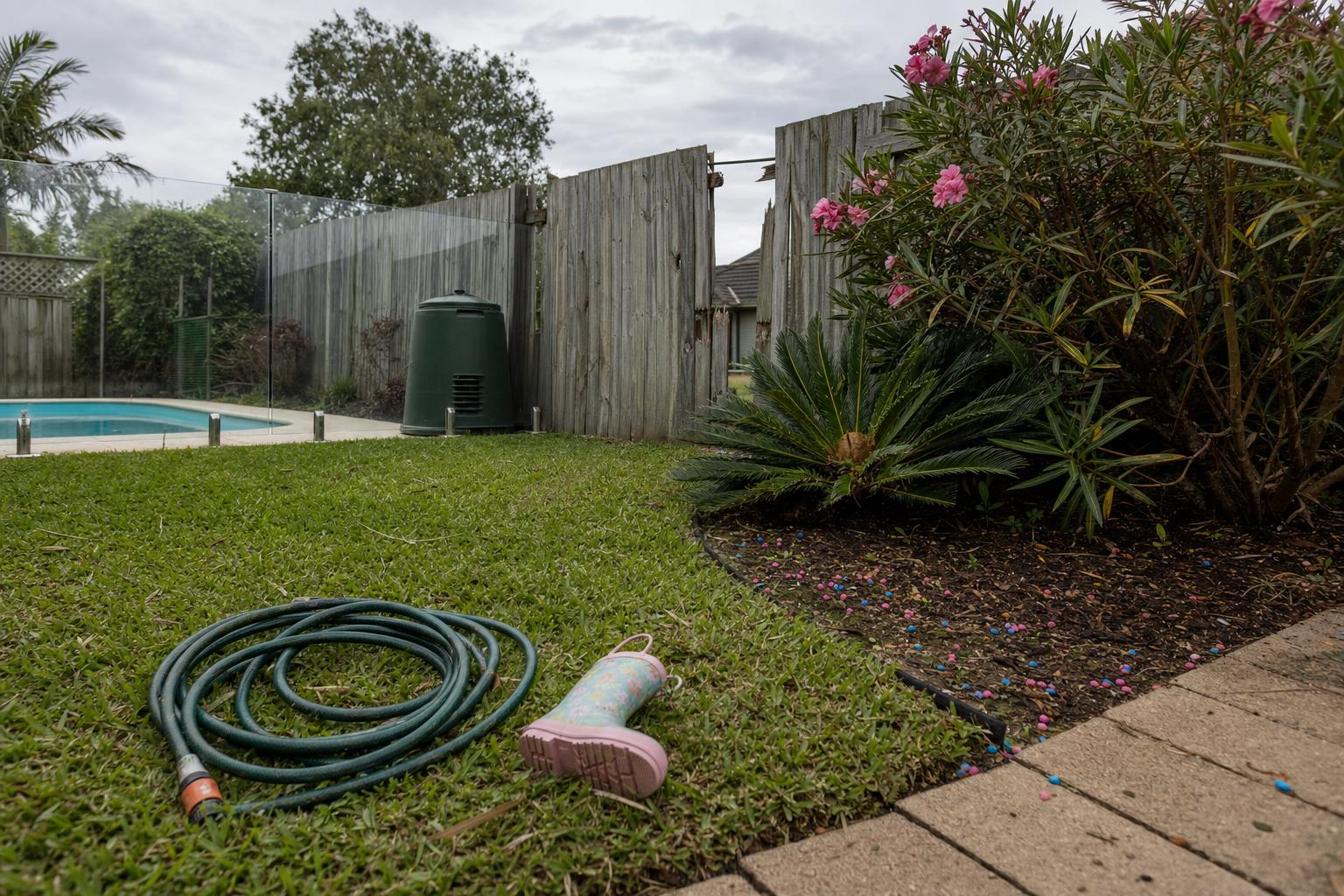
Your backyard presents a different set of challenges, many of them uniquely Australian. Pool fencing is legally required in every state and territory, but check that your pool gate is self-closing and self-latching and that the gaps are too small for a puppy to squeeze through. Many standard pool fences meet regulations for children but leave gaps that a small puppy could fit through.
Check your perimeter fencing carefully. Puppies are remarkably skilled at finding gaps, digging under, and squeezing through spaces you'd never think possible. Pay particular attention to shared fencing with neighbours — you're generally not entitled to modify your neighbour's side, so any reinforcement needs to happen on yours. Common toxic garden plants in Australian yards include yesterday-today-and-tomorrow (Brunfelsia), oleander, cycads, and many mushrooms that appear after rain. If you use snail bait, switch to a pet-safe (iron-based) formula — metaldehyde-based snail bait is one of the most common causes of dog poisoning in Australia.
Your Equipment List: What You Actually Need
Walk into any pet store before bringing home a puppy and you'll walk out having spent $500 on things you don't need and forgotten at least one thing you do. The pet industry is very good at selling anxiety. Let's cut through that.
Your genuine essentials — the things you need before your puppy walks through the door — are fewer than you think. You need: an appropriately sized crate (more on why in a moment), a stainless steel water bowl and food bowl, a flat collar with an ID tag, a fixed-length lead (not retractable — we'll explain why), enzymatic cleaner for accidents, poo bags, small soft training treats, and a baby gate or two. That's it for day one.
Why a Crate Isn't a Cage
The crate deserves special mention because it's the item that generates the most emotional resistance, and it's also one of the most important management tools you'll use. A crate, properly introduced, becomes your puppy's den — a safe, enclosed space where they can rest without being overstimulated and where they can't rehearse unwanted behaviours while you're not supervising. Crate training is not about confinement; it's about giving your puppy a space that is unambiguously theirs. We'll cover crate training in detail in later chapters, but for now, choose a crate large enough for your puppy to stand, turn around, and lie down in at their expected adult size, with a divider panel to make it smaller while they're young.
What to Skip (For Now or Forever)
Retractable leads teach puppies to pull — the mechanism only releases more line when the puppy applies pressure, which is the opposite of what you want. A standard 1.8-metre fixed lead gives you control and starts building loose-lead walking habits from day one. Bark collars, prong collars, and choke chains have no place in evidence-based puppy raising. Research consistently demonstrates that aversive training methods are associated with increased aggression and fear in dogs, while reward-based methods are associated with fewer behavioural problems (Blackwell et al., 2008; Herron et al., 2009). There is no training problem you will encounter with a puppy that requires pain or intimidation to solve.
Puppy pads are a grey area: useful in apartments or for very young puppies in the first week, but they can delay toilet training by teaching your puppy that going inside is acceptable. If you have access to outdoor space, you're usually better off skipping them entirely.
Management Versus Training: Your Most Powerful Early Tool
Here's a concept that will save you enormous frustration: management and training are both valid approaches to behaviour, and in the first weeks of puppy ownership, management is often more effective and more important.
Training means teaching your puppy to make good choices — sit instead of jump, chew a toy instead of a shoe, come when called. Management means arranging the environment so the wrong choice isn't available in the first place. Evidence-based practice confirms that environmental control involves setting up surroundings to encourage positive behaviours and reduce the opportunity for undesirable ones proactively, preventing unwanted actions before they start (Management and Environmental Control, 2024).
A baby gate across the kitchen doorway is management. Teaching your puppy a rock-solid "stay" so they never enter the kitchen is training. Both achieve the same outcome, but one works with an eight-week-old puppy today, and the other requires weeks or months of practice. When people tell you their puppy is "naughty" for chewing shoes, the real question is: why did the puppy have access to shoes? That's not a training failure — it's a management gap.
The best puppy training plan in the world means nothing if your environment keeps setting your puppy up to fail. Manage first, train as you go.
A working puppy-raiser's maxim
This isn't about never training. You'll start simple training exercises almost immediately. But in those first chaotic days, management — crates, baby gates, closed doors, putting your shoes in the cupboard — does the heavy lifting while your puppy learns the household rules at a pace their developing brain can handle.
Three Foundations You'll Build On
Every chapter in this course rests on three foundational concepts. We're not going to teach them fully here — that would be overwhelming and premature. Instead, think of this section as planting seeds. You'll see these ideas grow more detailed and more practical as we move through the course. For now, we just want you to know they exist and why they matter.
Foundation 1 · Reading Canine Body Language
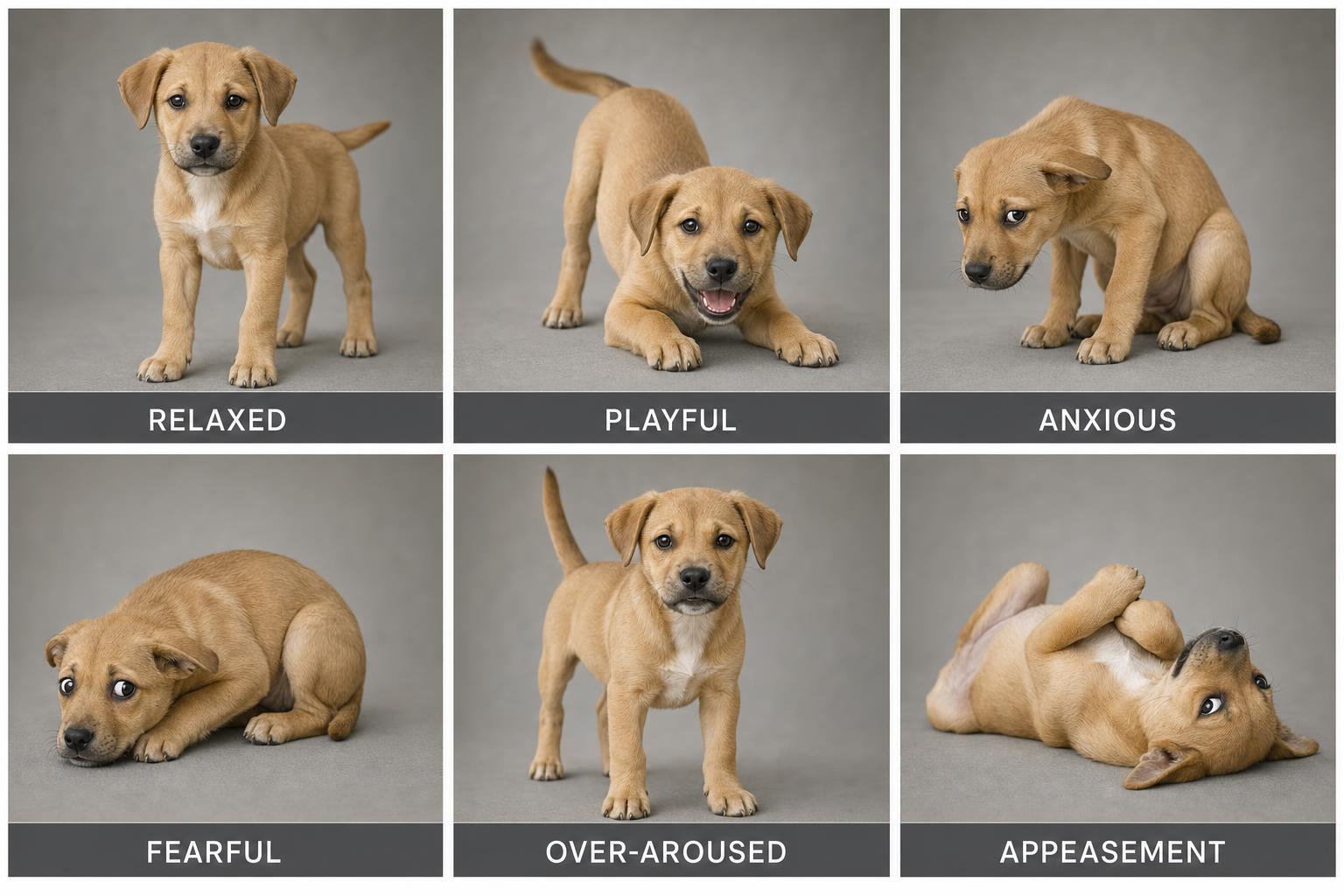
Most people believe they're good at reading dogs. Most people are wrong. Research has demonstrated that specific body language patterns — including eye shape, ear position, tail carriage, and weight distribution — reliably predict a dog's emotional state and learning readiness (Hasegawa et al., 2015). The problem is that humans tend to project human emotions onto dog behaviour. A dog showing its teeth isn't smiling. A wagging tail doesn't always mean happiness. A dog that rolls onto its back isn't always asking for a belly rub — it may be displaying appeasement behaviour, signalling that it's overwhelmed and wants the interaction to stop.
Learning to read your puppy accurately is the single most impactful skill you'll develop in this course. It affects everything: how you socialise them, how you train them, when you push them gently forward and when you give them space. We'll build this skill systematically, starting with the basics below.
Foundation 2 · Positive Reinforcement — The Science, Not the Sentiment
Positive reinforcement is not a philosophy. It's not a lifestyle choice or a "soft" approach to training. It is a principle of learning theory — specifically, operant conditioning — which states that behaviours followed by pleasant consequences are more likely to be repeated. When your puppy sits and receives a treat, sitting becomes more likely in the future. It's that simple, and it's that powerful.
The evidence base here is substantial and consistent. Blackwell et al. (2008) found that dogs trained using only positive reinforcement showed significantly less aggression and fear than those trained with punishment-based methods. Herron et al. (2009) documented that confrontational training techniques — alpha rolls, stare-downs, physical corrections — elicited aggressive responses in 25–31% of dogs tested. More recent work continues to confirm that reward-based methods are not only safer but comparably or more effective than aversive methods (Fernandes et al., 2020).
Throughout this course, every training technique you learn will be grounded in positive reinforcement and, when needed, negative punishment (the removal of something desirable, like turning away when a puppy jumps). You will never be asked to use pain, fear, or intimidation. Not because we're sentimental about dogs — because the science is clear.
Foundation 3 · The Power of Routine
Puppies are learning machines, but their developing brains operate best within predictable structures. The socialisation period — roughly 3 to 12 weeks of age, with some researchers extending it to 14 weeks (Howell et al., 2015) — is the window during which puppies are most receptive to new experiences and most capable of forming positive associations. This period will be the focus of our next chapter, but it's worth noting now that research demonstrates early, structured exposure to novel stimuli produces puppies that are bolder, less reactive, and faster problem-solvers (Rooney et al., 2022).
Routine provides the scaffolding for this learning. Consistent mealtimes, regular toilet breaks, predictable sleep schedules, and a reliable daily rhythm don't just make your life easier — they reduce your puppy's baseline stress, making them better able to engage with new learning. A puppy who knows what comes next is a puppy who can relax. And a relaxed puppy learns faster, sleeps better, and has fewer accidents.
Good Enough Is Genuinely Good Enough
If you've read this far and you're feeling a mixture of motivation and mild panic, that's completely normal. The goal of this chapter is not perfection — it's preparation. You don't need to have identified every toxic plant in your suburb or memorised the six canine emotional states before your puppy arrives. You need a safe home, the right basic equipment, and a willingness to learn.
The families who struggle most with new puppies are rarely the ones who didn't prepare enough. They're the ones who didn't know what they didn't know — who assumed that loving a puppy would be enough, or who acquired a puppy impulsively without understanding the commitment. By reading this chapter, you've already done something the research suggests is critically protective: you've engaged with preventive education before the puppy arrived (Packer et al., 2021). You've thought about where your puppy is coming from, what legal obligations you're taking on, how to make your home safe, what equipment you actually need, and how management can carry you through the early days while training catches up.
That's a strong start. And in the next chapter, we'll build on it by diving into the most important developmental window in your puppy's life.
Key Takeaways
- Where you acquire your puppy matters: research the source, ask hard questions, and be wary of red flags in private sales and online marketplaces.
- Microchipping and council registration are legal requirements in Australia — understand your obligations before your puppy arrives and keep details updated.
- Puppy-proofing is environmental management: remove genuine dangers (electrical cords, toxic plants, accessible chemicals) and use baby gates and crates to limit access.
- Your essential equipment list is shorter than you think — crate, flat collar, fixed lead, bowls, enzymatic cleaner, treats, poo bags, and baby gates cover day one.
- Avoid retractable leads, bark collars, and any aversive training tools — the evidence consistently shows these are ineffective at best and harmful at worst.
- Management (controlling the environment) is just as valid as training (teaching behaviours) and is often more effective in the first weeks.
- Positive reinforcement is a principle of learning science, not a soft option — it produces fewer behavioural problems and safer outcomes than punishment-based methods.
- Learning to read canine body language accurately will be the most important skill you develop in this course.
- Routine reduces puppy stress and creates the scaffolding for effective learning during the critical socialisation period.
In Class 2, we dive into the socialisation window — the most important developmental period in your puppy's life, and the one with the tightest deadline. You'll learn what socialisation actually means (it's not just "meeting other dogs"), how to create a structured socialisation plan, and why the quality of early experiences matters far more than the quantity. If you've just brought your puppy home, Class 2 is time-sensitive — this window doesn't stay open forever.
References
Blackwell, E. J., Twells, C., Seawright, A., & Casey, R. A. (2008). The relationship between training methods and the occurrence of behavior problems, as reported by owners, in a population of domestic dogs. Journal of Veterinary Behavior, 3(5), 207–217.
Fernandes, J. G., Olsson, I. A. S., & Vieira de Castro, A. C. (2020). Improving dog training methods: Efficacy and efficiency of reward and mixed training methods. PLoS ONE, 16(2), e0247321.
Hasegawa, M., Ohtani, N., & Ohta, M. (2015). Dogs' body language relevant to learning achievement. Animals, 5(3), 382–401.
Herron, M. E., Shofer, F. S., & Reisner, I. R. (2009). Survey of the use and outcome of confrontational and non-confrontational training methods in client-owned dogs showing undesired behaviors. Applied Animal Behaviour Science, 117(1–2), 47–54.
Howell, T. J., King, T., & Bennett, P. C. (2015). Puppy parties and beyond: The role of early age socialization practices on adult dog behavior. Veterinary Medicine: Research and Reports, 6, 143–153.
Management and environmental control for dog behavior modification. (2024). Proven Dog Training.
Packer, R. M. A., Brand, C. L., Belshaw, Z., Pegram, C. L., Stevens, K. B., & O'Neill, D. G. (2021). Acquiring a pet dog: A review of factors affecting the decision-making of prospective dog owners. Animals, 9(10), 796.
Rooney, N. J., Clark, C. C. A., & Casey, R. A. (2022). Optimising puppy socialisation — Short- and long-term effects of a training programme during the early socialisation period. Animals, 12(23), 3390.