The First 72 Hours
Surviving the Beautiful Chaos
An hour-by-hour companion for the first three days — with the science of why "tough love" is the opposite of what the puppy needs.
It's 11:47pm on a Tuesday. You're sitting on the kitchen floor in your pyjamas, one hand resting on the wire door of a crate where a ten-week-old puppy is crying with a conviction that suggests genuine existential despair. Your partner is googling "is it normal for a puppy to cry this much" and getting contradictory answers. The puppy pauses, makes eye contact with you through the crate bars, and lets out a sound that is somewhere between a whimper and a howl. Every instinct in your body says pick them up. The internet says don't or you'll create a monster. You've had this dog for six hours.
If this is you — or if this will be you soon — this chapter is designed to sit right beside you on that kitchen floor. We're going to walk through the first 72 hours with a new puppy: what to expect, what to do, and — critically — why the "tough love" advice you'll find on forums is not what the science actually says.
The Journey Home: It Starts in the Car
The first thing most people get wrong is the car ride home. You're elated. The breeder has handed over a warm, wriggling creature that smells like milk and straw, and your immediate impulse is to hold it on your lap for the drive. Resist this impulse — not because it's emotionally harmful, but because it's physically dangerous. An unrestrained puppy in a car is a projectile in the event of sudden braking, and an anxious puppy on a driver's lap is a genuine road hazard.
The ideal setup is a small, secure crate or carrier in the back seat, lined with a towel or blanket that carries the scent of the puppy's littermates. Many breeders will give you a cloth that has been with the litter — this is gold. If yours doesn't offer, ask. Place the carrier where a passenger can sit beside it, offering a calm hand and quiet voice. This is, for most puppies, the first time they have ever been in a vehicle, and it is simultaneously the first time they have been separated from their mother and siblings. That's two enormous stressors at once. Your job is not to make it fun. Your job is to make it survivable.
Keep the drive calm: no loud music, no excited chatter, no passing the puppy around. If the puppy vomits — and many do, because motion sickness is extremely common in young dogs — pull over, clean up quietly, and carry on. This is not a sign that something is wrong. It is a sign that a baby animal is having a big day.
Arriving Home — Less Is More
When you walk through your front door, the temptation is to introduce the puppy to everything: the whole house, the garden, the children, the neighbours who've been waiting for this moment. Don't. Remember what we learned about the sensitive socialisation period in Chapter 1 — controlled, positive exposure is what builds confidence. Overwhelming exposure does the opposite.
Start small. Take the puppy directly to the spot you've designated as their toilet area — outside if you have a garden, on a puppy pad if you don't. Wait. If they go, quiet praise. If they don't, that's fine too; their world just turned upside down and their bladder is not their top priority. Then bring them into one room — just one — where their crate, water bowl, and a few safe toys are already set up. Let them sniff. Let them explore at their own pace. Sit on the floor and let the puppy come to you rather than pursuing them. This is your first act of building secure attachment: being available without being overwhelming (Topál et al., 2017–2025).
Who Should the Puppy Meet on Day One?
Household members only. That's it. Not the neighbours. Not your mum. Not your best friend who "just wants a quick cuddle." Each new person is a stimulus the puppy has to process, and they are already processing at maximum capacity. The visitors can come on Day 3 or 4, one or two at a time, calmly and briefly. Research on early socialisation confirms that quality of exposure matters far more than quantity — controlled, positive introductions during the sensitive period produce better stress-coping outcomes than flooding (Vaterlaws-Whiteside & Hartmann, 2022).
If you have children, prepare them in advance: sit quietly, let the puppy approach, no picking the puppy up, no squealing. A child's natural enthusiasm is beautiful but physiologically indistinguishable from a threat to an already overwhelmed puppy. Supervision during every child-puppy interaction in these early days is non-negotiable.
The First Night — The Emotional Heart of It All
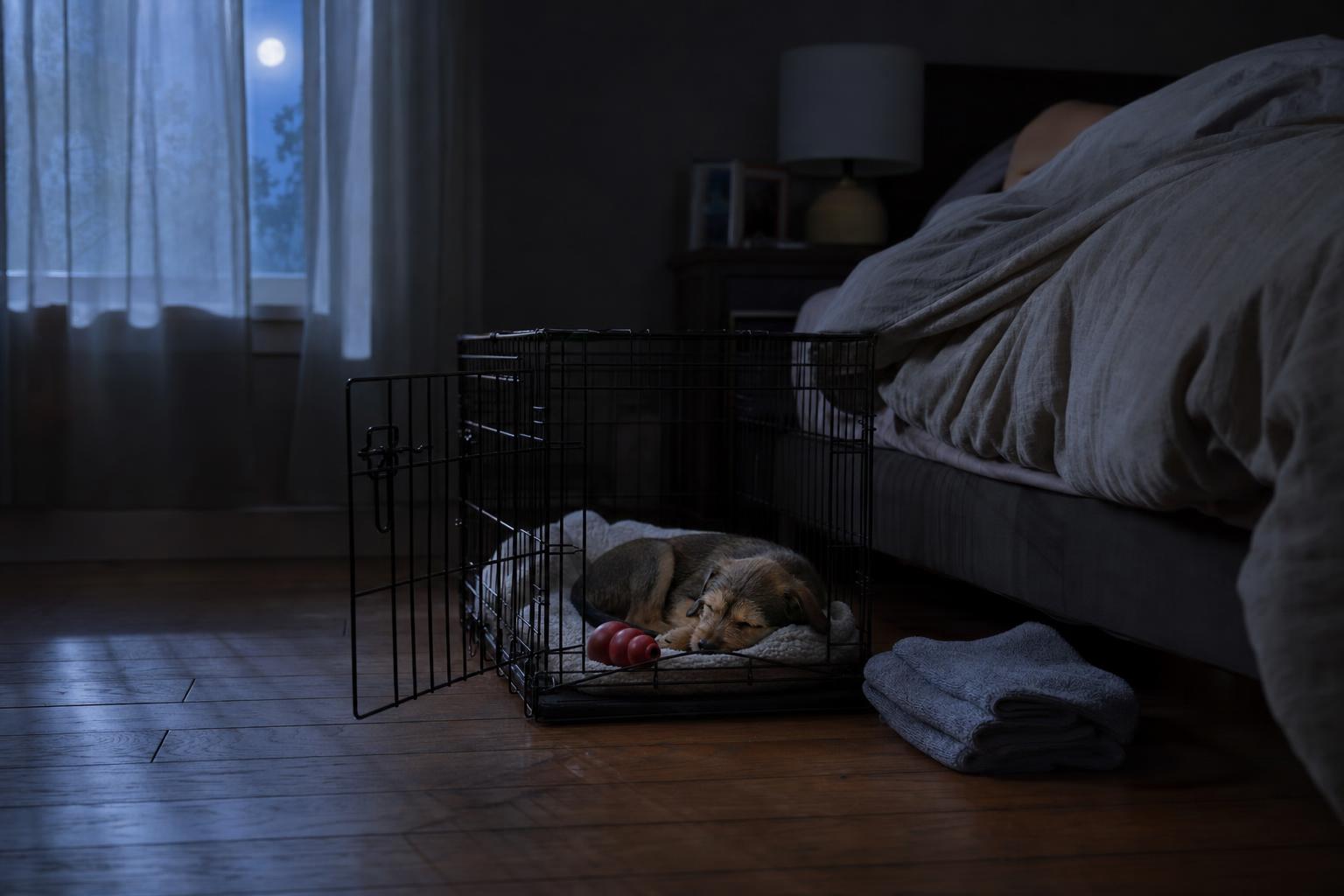
Let's be direct: the first night will probably be hard. Not because you're doing it wrong, but because the biology of the situation makes it hard. Your puppy has spent every night of their life sleeping in a warm pile of siblings, with the sound and smell of their mother nearby. Tonight, for the first time in their entire existence, they are alone. The whimpering, crying, and sometimes howling that follows is not manipulation. It is separation distress — a hardwired survival response in social mammals that says, "I am alone and I am vulnerable and I need my group" (Sargisson, 2014).
Where Should the Puppy Sleep?
There are several options, and the evidence points in a clear direction. The safest choice for the puppy's emotional wellbeing is a crate or secure sleeping area in your bedroom, right next to your bed. Not downstairs. Not in the laundry. Not in a separate room where you can't hear them and they can't sense you.
Here's why: attachment research in dogs has demonstrated that puppies, like human infants, use their caregiver as a secure base — a safe point from which to explore and to which they return when stressed (Topál et al., 2017–2025). On the first night, you are the only familiar social presence in this new world. Your proximity — your scent, the sound of your breathing — is a genuine physiological regulator of the puppy's stress. A longitudinal study tracking 145 puppies found that appropriate overnight sleeping arrangements in the first 16 weeks were associated with lower rates of separation-related behaviours later in life (Generation Pup study, 2024).
This doesn't mean the puppy sleeps in your bed forever, or even beyond the first week. It means that right now, proximity is medicine. You can gradually move the crate farther from your bed over subsequent nights and weeks — a few inches at a time — once the puppy has learned that this new world is safe and that you reliably come back.
The Hour-by-Hour Plan
Here is what a realistic first night looks like. Pin this to your fridge.
Responding to Distress Is Not "Spoiling"
This is perhaps the most important paragraph in this chapter. There is a persistent myth in dog training culture that responding to a crying puppy "teaches them that crying works" and creates a spoiled, demanding dog. The behavioural science tells a different story entirely.
Research on attachment in dogs shows that consistent, attuned responsiveness from the caregiver produces secure attachment — dogs that are actually more independent, more confident, and better able to cope with being alone, because they have learned that their person is reliable (Topál et al., 2017–2025). It is the inconsistently responded-to dogs, and the ignored dogs, that develop anxious attachment styles and are more prone to separation anxiety later (Sargisson, 2014). Avoidant caregiving styles — the "let them figure it out" approach — are correlated with increased separation-related disorders.
This does not mean you must hold the puppy every time they whimper for the rest of their life. It means that in these first days, when the puppy has no evidence yet that you are trustworthy, you build that evidence by showing up. Responding to distress now is what makes independence possible later. Think of it as making a deposit in a trust account you'll draw on for years.
Establishing Routines — Your Most Powerful Tool
If the first night is the emotional heart of the first 72 hours, then routine is the structural backbone. Research consistently shows that predictability reduces anxiety in dogs — significantly (Cornell Veterinary Medicine; behavioural research sources, 2014–2025). When a puppy can begin to anticipate what happens next — "after eating, we go outside; after playing, we rest" — their stress levels drop measurably. One body of research suggests dogs raised with predictable routines show up to 70% more reliable behaviour compared to those in chaotic environments.
This isn't about rigidity. You don't need to feed the puppy at exactly 7:12am every morning for the rest of your life. It's about establishing patterns — recognisable sequences of events that the puppy can learn to predict. In the first 72 hours, those patterns are simple:
- Wake up → toilet trip → breakfast → play → nap.
- Wake from nap → toilet trip → short play/training → nap.
- Late afternoon → dinner → play → wind down → final toilet trip → bed.
That's it. That cycle, repeated with gentle consistency, is the scaffolding on which everything else — house training, crate training, socialisation — gets built.
The Nap Equation Most People Get Wrong
New puppy owners almost universally underestimate how much sleep a puppy needs. An eight-to-ten-week-old puppy needs 18 to 20 hours of sleep per day. That is not a typo. They need substantially more sleep than they need waking activity, and many of the behavioural problems people report in the first week — biting, hyperactivity, inability to settle — are symptoms of an overtired puppy, not a "bad" one.
Think of a toddler who has missed their nap and is now screaming in the supermarket. That toddler doesn't need discipline. That toddler needs to sleep. The same is true of the puppy who is suddenly zooming around biting your ankles at 7pm. They have been awake too long. Enforced naps — gently placed in the crate with something to chew — are an act of care, not confinement.
Reading Your New Puppy — Body Language Under Stress
In Chapter 1, we introduced the foundations of canine body language. Now we need to apply that knowledge in real time, with a puppy who is navigating the most disorienting experience of their young life. The signals are the same, but the context changes everything.
In the first 72 hours, you will likely see a constellation of displacement behaviours — actions that occur out of context and signal internal conflict or stress (VCA Animal Hospitals; Best Friends, 2019–2025). A puppy who suddenly starts sniffing the floor intensely in a new room may not be tracking a fascinating scent — they may be using sniffing as a coping mechanism, a way to self-soothe when overwhelmed. A puppy who yawns repeatedly isn't sleepy (or isn't only sleepy); yawning is one of the most common canine stress signals. Lip-licking when no food is present, scratching when not itchy, sudden shaking off as if wet when dry — these are all displacement behaviours worth recognising.
Exploring vs. Shut Down — A Critical Distinction
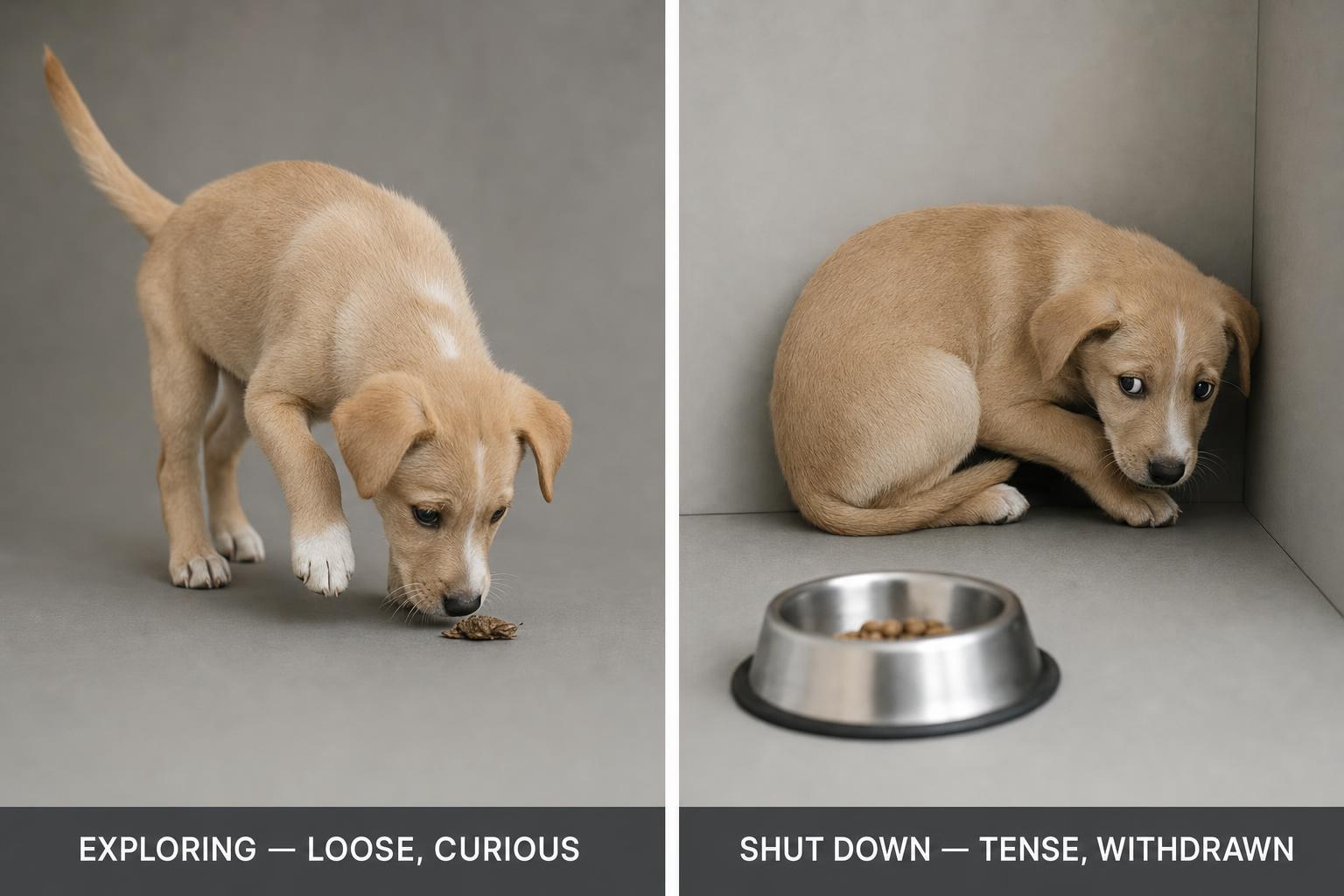
There is an important difference between a puppy who is calmly exploring and a puppy who has shut down. Both may appear quiet, which is why people miss it. A puppy who is exploring moves with a loose body, a slightly wagging tail held at mid-height, and approaches objects with curiosity — sniffing, pawing, sometimes startling but recovering quickly. Their ears are relaxed or pricked forward with interest.
A puppy who has shut down is also quiet, but the quality of that quiet is entirely different. They may be still, with a tense body. Their tail may be tucked or motionless. They may refuse food — a significant indicator in a puppy, since healthy puppies are almost universally food-motivated. They may avoid eye contact, turn their head away (a "cut-off" signal), or press themselves into a corner or under furniture. This puppy is not "being good" or "settling in nicely." This puppy is overwhelmed and has run out of active coping strategies.
If you see shut-down behaviour, the answer is not more stimulation or forced interaction. The answer is to reduce the input: fewer people, quieter room, a covered crate where they can retreat. Recovery comes from feeling safe, and safety comes from having control over the pace of engagement (Vieira de Castro et al., 2020).
Planting Seeds — The Crate and the First Steps of House Training
We will devote significant attention to both crate training and house training in later chapters. But their foundations are laid in the first 72 hours, so let's plant the seeds now.
The Crate as a Safe Space
A crate is not a cage. That distinction is not semantic — it's functional, and it depends entirely on how you introduce it. A crate used as punishment, or as a place to stuff a puppy for eight hours while you go to work, is a cage. A crate introduced gradually, associated with good things (treats, chews, meals, naps after play), and respected as the puppy's private retreat is a safe space — the canine equivalent of a bedroom with the door closed (AKC; animal welfare organisations, 2019–2025).
In the first 72 hours, your goals with the crate are modest: the puppy eats meals in or near the crate, takes naps in the crate with the door initially open, and sleeps in the crate at night near you. That's it. No extended confinement. No shutting the door while they scream. A ten-minute nap with the door closed and you sitting right there is a success. Build from that. Dogs have a natural denning instinct — a preference for small, enclosed sleeping areas — but that instinct only expresses itself if the crate has been associated with safety, not with isolation or distress.
House Training Logic — It's About Physiology, Not Morality
Your puppy will have accidents. This is not a training failure; it is a physiological inevitability. At eight weeks, a puppy lacks full bladder muscle development and can hold urine for approximately 30 to 60 minutes during active waking hours, and slightly longer stretches — perhaps four to five hours — overnight when their metabolism slows (veterinary development sources, 2021–2025). They have no concept of "indoors" versus "outdoors" as meaningful categories. They just know they need to go, and they need to go now.
The entire logic of house training rests on two principles: maximise the chance of success (take the puppy to the right spot frequently enough that they mostly go there) and never punish failure (because the puppy cannot connect your anger to something they did minutes or even seconds ago, and punishment is strongly associated with increased anxiety and behavioural problems; Vieira de Castro et al., 2020). If you catch the puppy mid-accident, calmly interrupt and carry them to the toilet area. If you find an accident after the fact, clean it up and adjust your timing. That's it. We'll build a comprehensive house training system in Chapter 4.
Permission to Feel Overwhelmed
Let's close with something that no puppy training manual talks about enough: your feelings. There is a phenomenon so common it has its own informal name — the "puppy blues" — in which new puppy owners experience a wave of regret, anxiety, and overwhelm in the first days and weeks. It feels like you've made a terrible mistake. Your house is chaos. You haven't slept. The puppy has bitten you forty times today and has weed on the rug again and you are wondering, with genuine sincerity, whether you are cut out for this.
You are. This is normal. The first 72 hours are a crash-landing into a new reality, and they are not representative of what life with this dog will be. The sleep deprivation alone is enough to distort your perception of everything. Be kind to yourself with the same patience you're extending to the puppy. Lower the bar. If everyone is fed, nobody is injured, and the puppy has slept in a safe place — you are succeeding.
The goal of the first 72 hours is not to begin training a perfect dog. It is to begin building a relationship in which a perfect dog becomes possible.
A working puppy-raiser's reflection
Key Takeaways
- The journey home and first introductions should be calm, controlled, and limited to household members only — overwhelming the puppy on Day 1 undermines the socialisation process.
- The puppy should sleep in a crate near your bed on the first night. Proximity is a physiological stress-regulator and builds the secure attachment that makes later independence possible.
- Responding to a crying puppy is not spoiling them — it is building trust. Attachment research shows that consistent responsiveness produces more independent, confident dogs.
- Routine and predictability are your most powerful tools: feeding, toileting, play, and nap cycles reduce anxiety for both puppy and owner.
- Puppies need 18–20 hours of sleep per day. Most "problem behaviours" in the first week are symptoms of overtiredness, not defiance.
- Learn to distinguish between a puppy who is calmly exploring (loose body, curiosity) and one who has shut down (tense, avoidant, refusing food). Both can look "quiet."
- The crate is a safe space when introduced positively. House training is about physiology and timing, never punishment.
- The puppy blues are real and normal. Lower the bar for yourself. If everyone is safe and fed, you are doing well.
In Chapter 3, we explore socialisation in depth — what it really means (hint: it's not just "meeting lots of people"), the critical windows during which it happens, and how to create a structured socialisation plan that builds your puppy's confidence without overwhelming them. You'll learn the difference between exposure and flooding, and we'll give you a practical socialisation checklist calibrated to your puppy's age and temperament.
References
Sargisson, R. J. (2014). Canine separation anxiety: Strategies for treatment and management. Veterinary Medicine: Research and Reports, 5, 143–151.
Generation Pup Longitudinal Study. (2024). Canine separation-related behaviour at six months of age: Dog, owner and early-life risk factors.
Vaterlaws-Whiteside, H., & Hartmann, A. (2022). Optimising puppy socialisation — short- and long-term effects of a training programme during the early socialisation period. Animals, 12(22), 3067.
Topál, J., et al. (2017–2025). Attachment behaviour in dogs: Application of the Ainsworth Strange Situation Procedure [compiled research literature].
VCA Animal Hospitals, & Best Friends Animal Society. (2019–2025). Canine body language — reading stress signals and displacement behaviors.
Vieira de Castro, A. C., et al. (2020). Does training method matter? Evidence for the negative impact of aversive-based methods on companion dog welfare. PLOS ONE, 15(12), e0225023.
American Kennel Club & animal welfare organisations. (2019–2025). Crate training benefits and welfare considerations.
UC Davis School of Veterinary Medicine & veterinary sources. (2021–2025). Puppy bladder control development and house-training physiology.
Cornell University College of Veterinary Medicine & behavioural research sources. (2014–2025). The impact of routine and predictability on canine anxiety and behavior.