The Socialisation Window
A Once-in-a-Lifetime Opportunity
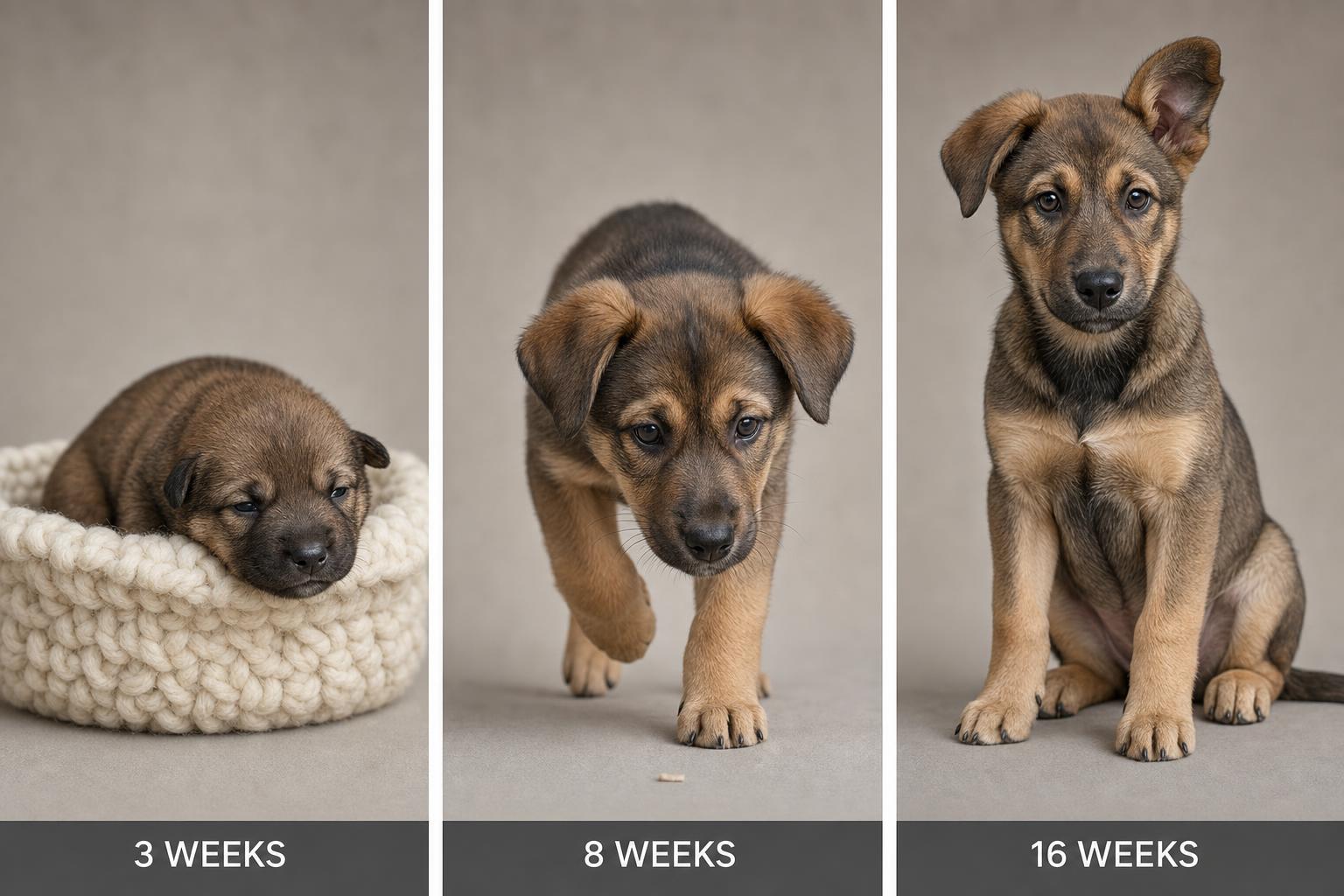
Three to sixteen weeks. The narrow neurological window in which everything your puppy meets — or doesn't — sets the temperature of their adult emotional life.
It's Saturday morning at a busy café in Newtown. At one table, a twelve-week-old Golden Retriever lies calmly under a chair, tail gently swishing as a toddler toddles past. She glances at the hissing espresso machine, looks back at her owner, and accepts a piece of chicken. Three suburbs away, a dog of the same breed — same age, same genetics from a related litter — cowers behind the couch every time someone knocks on the front door. She has never been to a café. She has never met a child. The espresso machine sound would send her into a panic spiral that lasts twenty minutes.
The difference between these two dogs is not temperament, not breed, and not luck. It's what happened — or didn't happen — between the ages of three and sixteen weeks. You are reading this chapter during the most consequential developmental period your puppy will ever experience. Let's make it count.
What Socialisation Actually Means
When most people hear "socialisation," they picture a puppy playing with other puppies. That's a small fraction of the picture. Socialisation is the process by which a young animal learns to accept and feel comfortable with the full range of stimuli it will encounter throughout its life — people of all ages and appearances, other animals, sounds, surfaces, environments, handling, and transport. It is the systematic, positive introduction of a puppy to the world.
Dr Sophia Yin, one of the most influential veterinary behaviourists of the modern era, put it simply: the goal is not just exposure but positive exposure. A puppy who meets thirty people but is frightened by twenty-five of them has not been socialised — they've been traumatised (Yin, 2011). The quality of each experience matters infinitely more than the quantity. We'll return to this principle throughout the chapter because it is the single most common mistake new puppy owners make.
The Seven Domains of Socialisation
A thorough socialisation programme covers seven key domains: people (children, elderly people, mobility aids, hats, sunglasses, high-vis, helmets, beards, different skin tones, different body sizes, delivery drivers); animals (calm adult dogs, cats, birds, livestock if relevant, dogs of very different sizes); surfaces and textures (grass, concrete, sand, metal grates, wet surfaces, wooden decking, gravel, bubble wrap, wobble boards); sounds (vacuum, thunder recordings, bin trucks, magpie calls, fireworks recordings, hairdryer, lawn mower, school bell); environments (vet clinic for a happy visit, cafés, Bunnings, the beach, busy streets, school pick-up zones, car parks, parks with joggers and cyclists); handling and restraint (paw handling, ear inspection, mouth opening, nail-trimming position, gentle restraint, brushing, towel drying); and transport (car travel short and long, crate in the car, different seating positions, stopping and starting).
Notice that "playing with other puppies" is just one item in one of seven categories. If your socialisation plan consists only of puppy play dates, you're covering roughly five percent of the territory.
The Neuroscience: Why Timing Is Everything
The concept of a critical period in canine development was established by Scott and Fuller's landmark twenty-year study at the Jackson Laboratory, published in 1965. Their research — meticulous, multi-breed, and experimental — showed that puppies between approximately three and twelve weeks of age were uniquely receptive to forming social bonds and accepting novel stimuli (Scott & Fuller, 1965). Freedman, King, and Elliot (1961) further demonstrated that puppies not exposed to humans before fourteen weeks of age developed intense withdrawal reactions that proved essentially irreversible, even with extensive later handling.
Modern researchers have refined the terminology from "critical period" to sensitive period, recognising that the window doesn't slam shut at a precise moment but rather gradually closes (Baqueiro-Espinosa et al., 2022). Think of it less as a door that locks and more as wet cement that slowly hardens. Early on, impressions form quickly and permanently. As the weeks pass, each new impression requires more effort to make, and the default response to unfamiliar stimuli shifts from curiosity to caution.
The neurological mechanism involves shifts in the autonomic nervous system. Between three and five weeks, parasympathetic dominance means puppies are physiologically primed to approach novel stimuli. From around five weeks onward, sympathetic activation increases, and puppies begin developing fear responses (Battaglia, 2009). By around five weeks, a puppy can first identify something as "novel" — which means they must already have a mental template of "normal" to compare it against. Anything missing from that template after the sensitive period closes is, by default, potentially threatening.
A small amount of experience during a critical period will produce a great effect on later behaviour.
Scott & Fuller (1965), as cited in Battaglia (2009)
This is why the work you do in these few weeks is so disproportionately powerful. Five minutes of calm, treat-paired exposure to a person in a wheelchair at eight weeks of age does more than five hours of remedial counter-conditioning at eight months. You are literally shaping neural architecture.
Safe Socialisation Before Vaccination Is Complete
Here is where many new puppy owners receive dangerously conflicting advice. Some veterinarians — operating from an infectious disease perspective — advise keeping puppies isolated until two weeks after their final vaccination, typically around sixteen weeks of age. This advice, while well-intentioned, effectively tells you to lock the door on socialisation just as the sensitive period closes.
The American Veterinary Society of Animal Behavior (AVSAB) addressed this conflict directly in their position statement: "The primary and most important time for puppy socialization is the first three months of life… Puppies should receive appropriate socialization before the vaccination series is complete" (AVSAB, 2008/2014). Their reasoning is stark: behavioural problems are the number one cause of death for dogs under three years of age, far exceeding infectious disease. Dogs are surrendered and euthanised for fear-based aggression, anxiety, and reactivity — conditions rooted in inadequate socialisation.
Practical Strategies for Safe Socialisation
Safe socialisation before full vaccination is not about throwing caution to the wind. It's about smart risk management.
Carry, don't walk. In high-traffic dog areas where parvovirus risk is elevated, carry your puppy or use a stroller or trolley. They can still see, hear, and smell the world. Choose low-risk environments. A friend's fully vaccinated dog's backyard is low risk; the local off-lead dog park where vaccination status is unknown is high risk. Use controlled settings. Well-run puppy classes that require proof of first vaccination and maintain clean surfaces are recommended from seven to eight weeks of age (AVSAB, 2008/2014). Socialise at home. Invite people over. Play sound recordings. Introduce surfaces in your backyard. Most of socialisation doesn't require a park. Visit Bunnings. The concrete floors are regularly cleaned, the parvovirus risk is low, and the sensory environment — trolley wheels, PA announcements, forklifts beeping, strangers wanting to pat your puppy — is socialisation gold. Visit your vet for happy visits. Sit in the waiting room, accept treats, get weighed, and leave. No needles. This is pure counter-conditioning for future veterinary experiences.
The AVSAB's position is clear: the risk of a puppy developing permanent behavioural problems from insufficient socialisation is far greater than the risk of contracting infectious disease in controlled environments with minimum first vaccination (AVSAB, 2008/2014; Seksel et al., 2018).
Reading Your Puppy During Socialisation
In Chapters 1 and 2, you learned to read canine body language — the ladder of aggression, calming signals, and stress indicators. Now we apply those skills in a new context: real-time assessment during socialisation outings. Your ability to read your puppy in the moment is what separates positive socialisation from flooding.
Green Light · Continue
- Loose, wiggly body with relaxed tail
- Soft, slightly squinty eyes
- Voluntarily approaching the new stimulus
- Play bows, soft open mouth
- Taking treats easily and enthusiastically
Amber Light · Pause and Assess
- Lip licking or yawning (displacement behaviours)
- Turning head away (avoidance)
- Ears pinned back
- Refusing treats (stress suppresses appetite)
- Stillness or freezing (often misread as "being good")
Red Light · Remove Immediately
- Whale eye (showing whites of the eyes)
- Tucked tail, crouched body
- Trembling
- Attempting to flee or hide behind you
- Vocalising — whimpering, barking in a high pitch
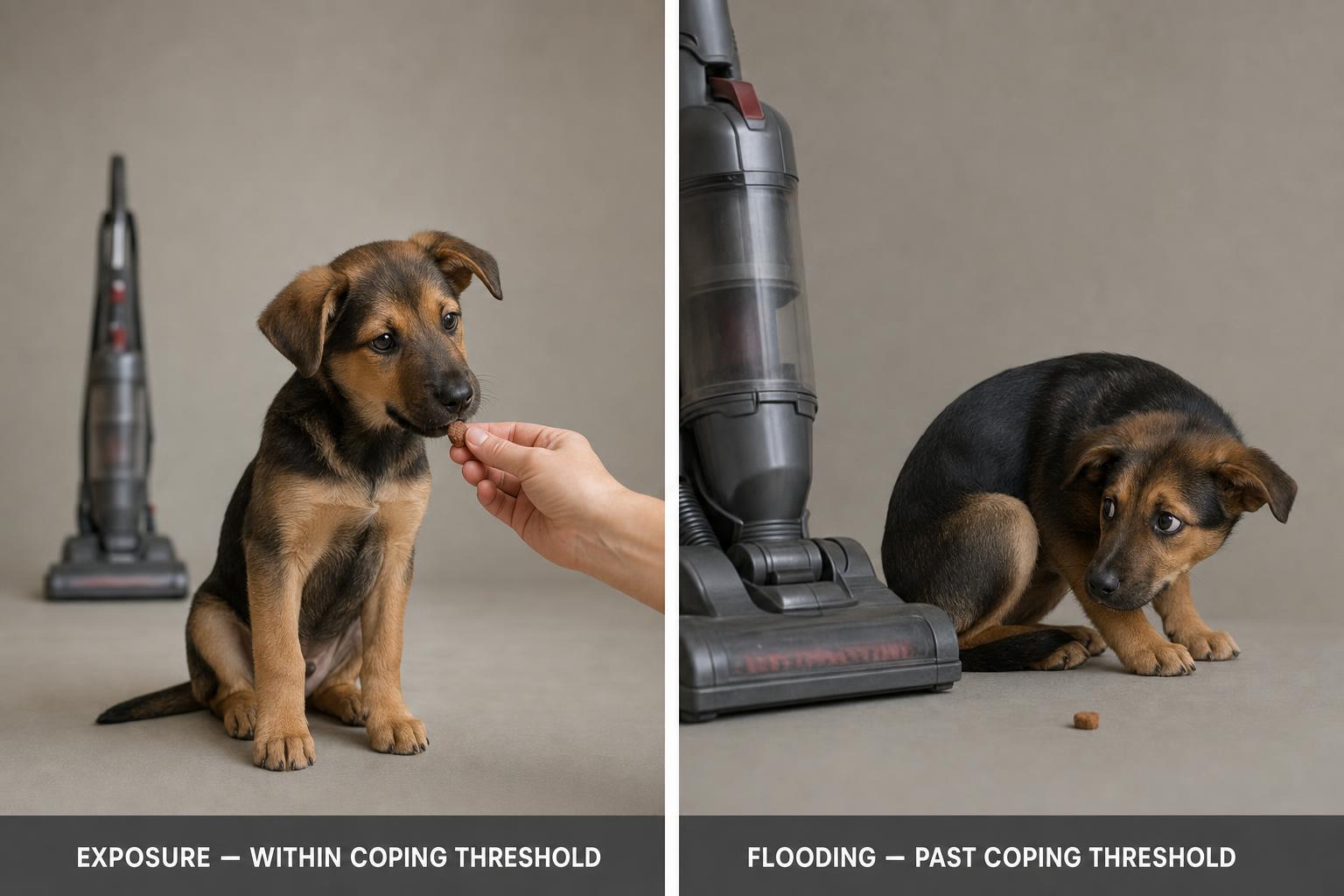
The amber zone is where most learning happens — and where most mistakes are made. A puppy who is slightly uncertain but coping, paired with high-value treats and the freedom to retreat, is learning that unfamiliar things predict good outcomes. A puppy who is forced to remain in a situation they're signalling discomfort about is being flooded — and that experience may create a lasting negative association rather than a positive one.
Fear Periods · When the Window Gets Wobbly
Within the broader sensitive period, puppies experience fear periods — short developmental phases where they are particularly susceptible to forming fearful associations. The first fear period typically occurs around eight to ten weeks of age, and a second often appears around six to fourteen months (Battaglia, 2009; Seksel et al., 2018).
During a fear period, a single frightening experience can create a disproportionately strong and lasting negative association. A puppy who has happily tolerated traffic noise for weeks may suddenly startle at a truck backfiring during a fear period and develop a lasting sound sensitivity. This doesn't mean you should stop socialisation during fear periods — but it means you should reduce intensity, increase distance from stimuli, increase treat value, and watch body language with extra vigilance.
Exposure vs. Flooding · The Critical Distinction
Exposure means presenting a stimulus at an intensity the puppy can process while maintaining a generally positive emotional state. Flooding means overwhelming the puppy with a stimulus they cannot escape, past their coping threshold. The difference is not in the stimulus itself but in the puppy's emotional experience of it.
Consider the sound of fireworks. Playing a fireworks recording at low volume in the background while your puppy eats dinner is exposure. Taking your puppy to a New Year's Eve fireworks display is flooding. Same stimulus, vastly different emotional experience, vastly different outcomes.
The goal is not to expose puppies to the most stimuli possible, but to ensure that all exposures are positive.
Sophia Yin (2011)
Introducing Counter-Conditioning
Counter-conditioning is the process of changing an emotional response by pairing a previously neutral or mildly scary stimulus with something the puppy loves — usually food. Puppy sees a person in a hat → puppy gets roast chicken. After repetitions, the sight of a hat-wearing person triggers not wariness but happy anticipation. This technique will become central in Chapter 4 (redirecting mouthing) and Chapter 7 (positive veterinary experiences), but you begin using it now during every socialisation outing.
The protocol is simple: new thing appears at comfortable distance → treat arrives → puppy processes → repeat, gradually reducing distance only when the puppy shows green-light body language. If at any point your puppy shows amber signals, increase distance. If they show red signals, leave and try again another day at lower intensity.
Building Your Socialisation Plan · The Australian Context
Socialisation plans should be locally relevant. Your Australian puppy will encounter specific stimuli that a puppy in Minnesota will not — and vice versa. Bin night brings the weekly thunderous roll of wheelie bins on concrete and the rumble of the truck at 6 a.m.; start with wheeling your own bin while treating your puppy, then progress to the bin truck from a distance. Magpie season is real if your puppy's socialisation window falls between August and November — expose your puppy to magpie calls (recordings first), and walk near magpie territory at low-risk times while counter-conditioning. The Bunnings run offers rolling trolleys, beeping forklifts, PA announcements, timber being dropped, and every second person asking to pat your puppy — a goldmine, but manage the duration; fifteen minutes is plenty. School pick-up means screaming children, scooters, bikes, car doors slamming, high-pitched excitement; start from across the road and work closer over days. Off-lead dogs at the park are a socialisation challenge unique to Australia's strong off-lead dog culture — your un-vaccinated or partially vaccinated puppy should not be on the ground at an off-lead park, but they can observe from your arms or a car with the boot open. The beach means sand, waves, wind, seagulls, wet sandy dogs shaking; after first vaccination, a quiet beach at a low-traffic time is wonderful — but don't start with Bondi on a summer Saturday.
Putting It All Together · Quality Over Quantity
Research consistently supports the principle that well-managed socialisation predicts better behavioural outcomes in adult dogs. Seksel et al. (2018) found that appropriately socialised puppies were significantly less likely to develop aggression and fearfulness, and engaged more positively with humans throughout life. Baqueiro-Espinosa et al. (2022) note in their systematic review that while we still lack precise data on the minimum "dose" of socialisation needed, the consensus is overwhelming that positive early exposure produces lasting benefits.
Your aim across the sensitive period is not to tick every box in a single frenzied week. It is to provide a steady, varied, positive stream of new experiences — two to three new things per day, interspersed with rest, sleep, and consolidation. Puppies need sixteen to twenty hours of sleep per day. An overtired puppy is a puppy more likely to have a negative socialisation experience, because fatigue lowers their coping threshold. Balance exposure with recovery.
Remember: you're not training your puppy to do anything during socialisation outings. You're training their brain to file new experiences under "safe and normal" rather than "unknown and threatening." Every positive encounter is a deposit in a lifelong emotional bank account. Every flooding experience is a withdrawal. Make more deposits than withdrawals, and you're building a resilient, confident adult dog.
Key Takeaways
- The sensitive period for socialisation (roughly 3–16 weeks) is a neurologically unique window when your puppy's brain is primed to accept new experiences as normal — and it gradually closes.
- Socialisation means positive exposure across seven domains: people, animals, surfaces, sounds, environments, handling, and transport — not just meeting other dogs.
- Quality always trumps quantity: one positive experience is worth more than ten neutral or negative ones. Pair new stimuli with high-value treats (counter-conditioning).
- Veterinary behaviourists recommend starting socialisation before the vaccination course is complete, using smart risk management — the behavioural risk of missing the window far outweighs the infectious disease risk in controlled settings.
- Use the traffic-light system (green / amber / red body language signals) to monitor your puppy's emotional state during every outing and adjust in real time.
- Fear periods (especially 8–10 weeks) are normal — reduce intensity during these phases but don't stop socialising altogether.
- Balance is essential: two to three new experiences per day, plenty of rest, and at least one recovery day per week.
In Chapter 4, we tackle one of the most common — and painful — puppy challenges: mouthing and biting. You'll learn why your puppy isn't being aggressive (they're learning bite inhibition), and how to use the counter-conditioning principles introduced in this chapter to redirect their mouthy enthusiasm toward appropriate outlets. The body-language reading skills you're building now will help you distinguish between playful mouthing, overstimulated nipping, and genuine fear-based behaviour.
References
American Veterinary Society of Animal Behavior. (2014). AVSAB position statement on puppy socialization (Rev. ed.).
Baqueiro-Espinosa, U., Crump, A., & Arnott, G. (2022). Canine socialisation: A narrative systematic review. Animals, 12(21), 2895.
Battaglia, C. L. (2009). Periods of early development and the effects of stimulation and social experiences in the canine. Journal of Veterinary Behavior, 4(5), 203–210.
Freedman, D. G., King, J. A., & Elliot, O. (1961). Critical period in the social development of dogs. Science, 133(3457), 1016–1017.
Scott, J. P., & Fuller, J. L. (1965). Genetics and the social behavior of the dog. University of Chicago Press.
Seksel, K., Mazrier, H., & Bain, M. J. (2018). Puppy parties and beyond: The role of early age socialization practices on adult dog behavior. Veterinary Medicine: Research and Reports, 6, 143–153.
Yin, S. (2011). Perfect puppy in 7 days: How to start your puppy off right. CattleDog Publishing.