Bite Inhibition & Mouthing
Why Your Puppy Is Not a Tiny Shark
A naturalist's guide to needle teeth — the developmental purpose of mouthing, and how to shape it without force, fear, or frustration.
It's 6:47pm. You've just sat down after a long day, and your twelve-week-old Labrador has decided that your ankle is the most fascinating object in the known universe. She's latched on with those impossibly sharp teeth, shaking her head with the gleeful intensity of a predator taking down a wildebeest — except she weighs four kilograms, and the wildebeest is your favourite pair of joggers. You pull away, and she lunges right back. You say "no," and she seems to bite harder. You search your phone one-handed while fending her off with the other: is my puppy aggressive?
She isn't. And you're not doing anything wrong. What you're experiencing is one of the most normal, most important, and most misunderstood behaviours in puppy development. Those needle teeth are not a design flaw — they are a feature. The next few weeks represent a critical window for teaching one of the most valuable skills your dog will ever learn: the ability to control the force of her jaws.
Why Puppies Mouth — and Why That's a Good Thing
Puppies explore the world with their mouths the way human infants explore it with their hands. They mouth objects, surfaces, other dogs, and — yes — your skin, not out of malice, dominance, or aggression, but because it is their primary sensory tool. Mouthing is how puppies gather information about texture, resistance, and social boundaries. It is as natural as breathing, and suppressing it entirely during the critical socialisation window (roughly 3–16 weeks) can actually prevent your puppy from learning the very skill you most want them to develop.
That skill is called bite inhibition — the learned ability to control the force of a bite. Veterinarian and animal behaviourist Dr Ian Dunbar has described bite inhibition as "the single most important thing your puppy can learn" — more important than sit, stay, or recall (Dunbar, 2007). His reasoning is straightforward: a dog who has learned to moderate jaw pressure is a dog who, even if startled or frightened later in life, is unlikely to cause serious injury. A dog who never learned this skill is a ticking time bomb, regardless of how obedient they are in every other respect.
The Litter Curriculum
Puppy teeth are sharp for a reason. In the litter, when one puppy bites another too hard during play, the bitten puppy yelps, stops playing, and moves away. The biting puppy learns: that level of force ends the fun. Over repeated interactions, puppies calibrate their jaw pressure downward. The sharpness of puppy teeth amplifies feedback — a relatively gentle bite from needle teeth still produces a strong reaction, teaching the lesson at low force levels. By the time adult teeth come in (around four to six months), the dog should have already internalised the principle that gentler mouths keep social interactions going.
This is why puppies who are removed from their litters too early (before 7–8 weeks) often have more severe mouthing problems — they missed critical weeks of peer feedback. It's also why, as Moeller (2021) noted in a thoughtful analysis of the bite inhibition literature, much of this capacity appears to be partly innate: puppies come pre-equipped with the potential for bite inhibition, and social experience activates and refines it. Your job as the puppy's new social partner is to continue the education that the litter started.
Graduated Pressure Reduction · The Two-Phase Method
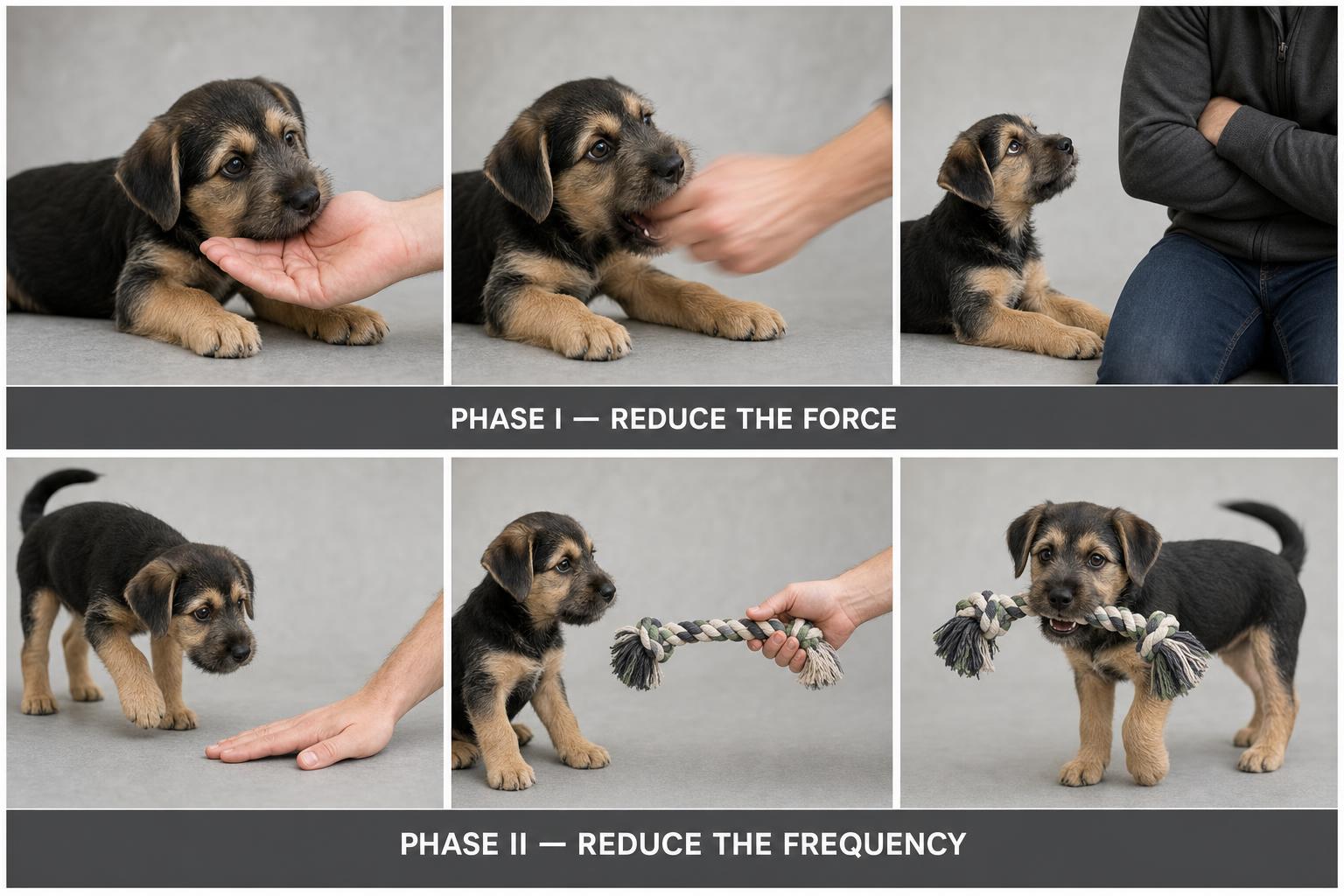
The approach endorsed by Dr Sophia Yin, Dr Ian Dunbar, and the AVSAB in their 2021 position statement is not to eliminate mouthing overnight. Instead, you teach bite inhibition in two deliberate phases — a method known as graduated pressure reduction.
Phase 1 · Reduce the Force
In this phase, you allow mouthing to continue but teach the puppy that hard bites end good things. When your puppy bites down with noticeable pressure, you respond with a brief, high-pitched "ouch!" or yelp, immediately withdraw your hand, and turn away for five to ten seconds. If the puppy escalates, you calmly stand up and step behind a baby gate or out of the puppy's space for fifteen to thirty seconds. You are not punishing. You are delivering the same social consequence the puppy's littermates would have delivered: too hard, game over.
Crucially, during this phase, you do not react to gentle mouthing. Soft contact is permitted. This distinction is essential. If you penalise all mouth contact from day one, the puppy never gets the feedback loops needed to learn pressure calibration (Dunbar, 2007). You are shaping behaviour, not suppressing it. Over one to three weeks, most puppies noticeably soften their bite.
Phase 2 · Reduce the Frequency
Once your puppy consistently mouths gently — you can feel teeth but there is no pressure — you raise the bar. Now, even gentle mouthing leads to a brief withdrawal of attention. You redirect to a toy, reward the puppy for taking the toy instead, and gradually build toward the rule: no teeth on human skin at all. Yin (2010) recommended pairing this with a simple hand-targeting exercise — teaching the puppy to touch your open palm with their nose for a treat — which gives them an incompatible behaviour that earns reinforcement.
Redirection · Proactive, Not Reactive
Redirection is one of the most useful tools in your kit, but it works best when done proactively rather than reactively. Keep appropriate chew toys within arm's reach at all times. When you see your puppy approaching with that familiar gleam in their eyes — before teeth make contact — offer a rope toy, a rubber chew, or a stuffed Kong. When the puppy takes it, praise warmly. You are not bribing — you are teaching them what is appropriate to bite.
What about when redirection doesn't work? When a puppy ignores the toy and goes straight for your hand? That is usually a signal that something else is going on, and the answer is almost always one of two things: the puppy is over-aroused, or the puppy is overtired. We'll address both shortly.
What the Internet Tells You to Do · And Why It's Wrong
If you've searched for puppy biting advice online, you've encountered some version of the following: hold the puppy's mouth shut, scruff shake them, flip them on their back (the so-called "alpha roll"), spray them with water, yell "NO" in a deep voice, or — most disturbingly — "bite them back." These methods persist because they seem to produce immediate results. The puppy stops, for a moment. But the science is unequivocal: these methods do not teach bite inhibition, they damage the dog-human relationship, and they frequently make biting worse.
Herron, Shofer, and Reisner (2009) conducted a landmark survey of 140 dog owners using various training methods. Their findings were stark: confrontational techniques including the alpha roll provoked aggressive responses in 31% of dogs. Grabbing a dog by the jowls and shaking elicited aggression in 26% of dogs. Hitting or kicking produced aggression in 43% of cases. By contrast, non-aversive methods — food rewards, redirection, clicker training — produced aggressive responses in 0–6% of cases. The confrontational methods weren't just less effective; they were actively creating the aggression they claimed to fix.
Vieira de Castro and colleagues (2020) provided even more damning evidence in the first systematic study of training methods and companion dog welfare. Dogs trained with aversive-based methods showed significantly higher cortisol levels — a stress hormone — more stress-related behaviours during training, and, perhaps most striking, more "pessimistic" responses on cognitive bias tasks afterward. These dogs were not just stressed in the moment; their entire emotional outlook shifted toward anxiety. Even mixed methods that used low proportions of aversive techniques compromised welfare compared to purely reward-based approaches.
Ziv's (2017) comprehensive review of seventeen studies reached the same conclusion: aversive methods jeopardise both physical and mental health, elevate cortisol, and produce the very fear and aggression they purport to address. The AVSAB position statement on dominance theory is explicit — dominance-based approaches lead to confrontational methods that cause fear and anxiety, and veterinarians should refer only to trainers using positive reinforcement (AVSAB, 2008/2021).
A puppy who has been scruff-shaken into stillness has not learned anything about pressure. They have learned that their human is unpredictable and potentially dangerous.
A working puppy-raiser's reflection
That freeze response, sometimes mistaken for calm submission, is actually a fear response. The puppy has learned to suppress warning signals. And a dog who has learned to skip the warning growl and go straight to a bite is far more dangerous than a mouthy puppy ever was.
The Real Diagnosis · It's Almost Always Arousal
Here is the insight that transforms most new puppy owners' experience: the majority of "biting problems" are actually arousal problems. A calm, well-rested puppy can absolutely learn to redirect to a toy, soften their bite, or disengage when you withdraw attention. A puppy whose arousal level has climbed past a critical threshold literally cannot process this information. Their prefrontal cortex — the brain region responsible for impulse control and decision-making — is offline. They are running on adrenaline and instinct, and no amount of "ouch!" or toy-waving will reach them.
Arousal, in behavioural science, refers to the physiological and emotional activation state of the animal — how "revved up" they are. Think of it as a spectrum from deeply asleep (very low arousal) to completely frenzied (very high arousal). Learning happens best in the middle range. At very low arousal, the puppy isn't engaged enough to learn. At very high arousal, they can't inhibit impulses.
The Witching Hour
If you've noticed your puppy turns into a tiny velociraptor around 4–6pm every day, you're witnessing overtiredness-driven arousal. Just like human toddlers, overtired puppies don't get quieter — they get wilder. The solution to this behaviour is not correction, redirection, or training. It's a nap. Remember the routine structure from Chapter 2: young puppies need 18–20 hours of sleep per day. A puppy who has been awake for more than 60–90 minutes is likely heading toward their arousal threshold, and mouthing intensity is one of the first signs.
Yin (2010) emphasised that recognising the conditions under which problem behaviours occur is often more important than the training response itself. If your puppy only bites hard when they've been awake for two hours, the "training" intervention is an earlier enforced nap — not a more sophisticated consequence for biting.
Three Flavours of Mouthing · Read Before You Respond
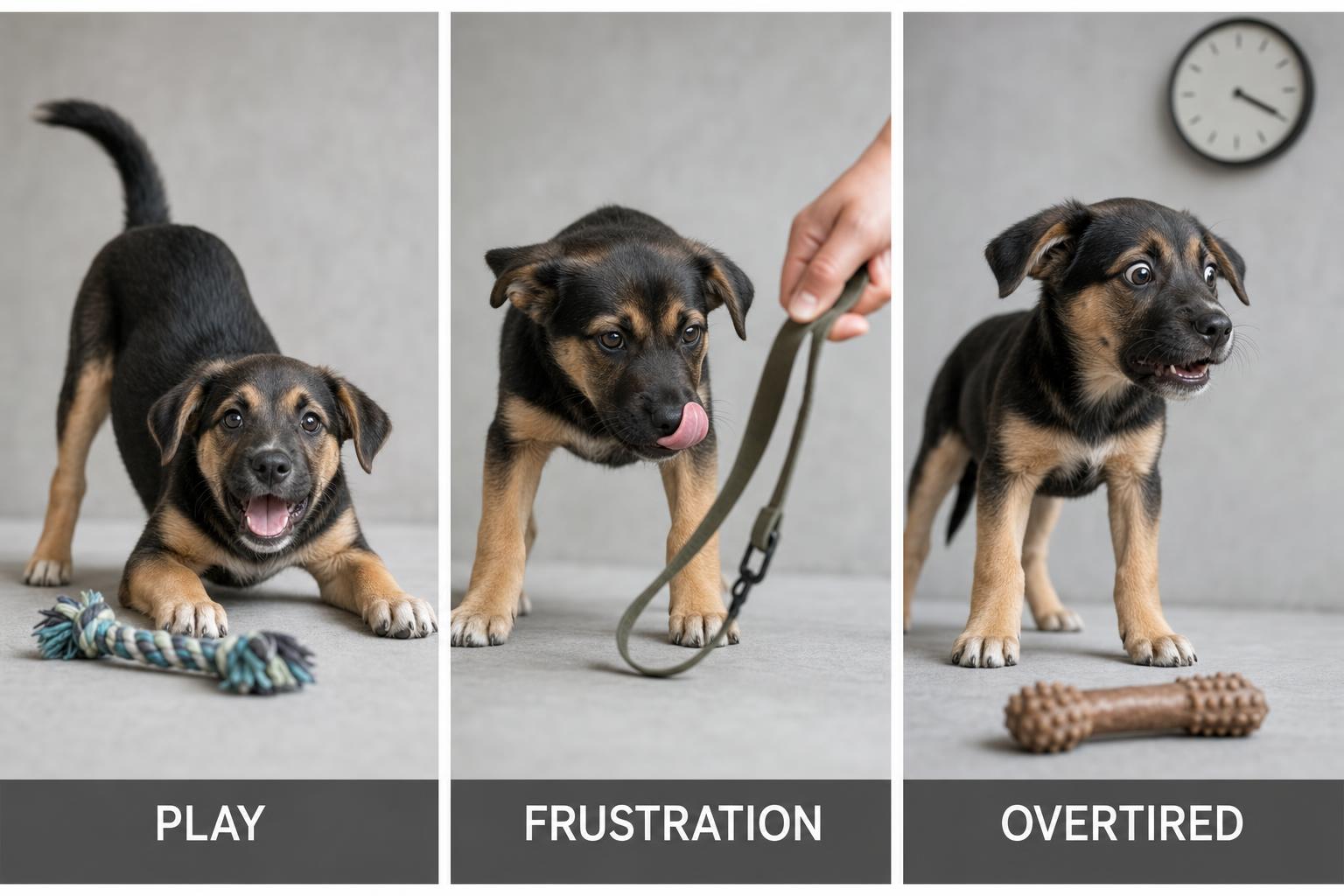
Not all mouthing is the same, and learning to distinguish between types will help you respond appropriately. Revisiting the body language skills from earlier:
Play mouthing is accompanied by a loose, wiggly body, a relaxed open mouth (the "play face"), bouncy movements, and frequent pauses. The puppy voluntarily disengages and comes back. Bites are typically inhibited, though they may escalate if arousal rises.
Frustration mouthing often appears when a puppy is restrained, prevented from accessing something they want, or overstimulated. The body is stiffer. The bites may be harder and more repetitive. You might see lip-licking, yawning, or whale eye — the stress signals from Chapter 3. This puppy needs space and calm, not a correction.
Overtired mouthing looks the most "aggressive" to new owners but is actually the most predictable. It often occurs at specific times of day, after prolonged wakefulness, or during transitions like visitors arriving or children playing. The puppy seems frantic, won't take toys, won't respond to cues they know. The intervention is an enforced rest — guide them to their crate or pen with a calm voice and a chew, and let them sleep.
Genuine aggressive behaviour in puppies under sixteen weeks is extremely rare. If your puppy is snarling, snapping, and showing sustained stiff body posture with hard, direct stares — especially over resources — consult a veterinary behaviourist. But in the vast majority of cases, what you're seeing is normal developmental mouthing that simply needs shaping.
The Integrated Plan
Drawing together graduated pressure reduction, redirection, arousal management, and the counter-conditioning principles from Chapter 3:
1 · Prevent where possible. Keep chew toys everywhere. Monitor wake windows — no more than 60–90 minutes for young puppies. Enforce naps before the witching hour.
2 · Shape pressure first. Allow gentle mouthing. Withdraw attention for hard bites. Be consistent — everyone in the household must follow the same protocol.
3 · Redirect proactively. When you see arousal climbing, offer a toy or a food puzzle before teeth hit skin. Reward engagement with the toy.
4 · Manage arousal. If the puppy is past the point of responding to redirection, they are over threshold. This is not a training moment. Calmly guide them to their rest space.
5 · Shape frequency second. Once bites are consistently gentle (typically after 2–4 weeks of Phase 1), begin withdrawing attention for any teeth-on-skin contact. Teach a hand target as a replacement behaviour.
6 · Never punish. No holding mouths shut, no scruff shakes, no alpha rolls, no yelling. These increase fear, damage trust, and escalate the behaviour (Herron et al., 2009; Vieira de Castro et al., 2020; Ziv, 2017).
When the Yelp Backfires
The "yelp like a littermate" technique is widely recommended, and for some puppies, it works beautifully. But it is not universal. Moeller (2021) pointed out that for some puppies — especially those who are already highly aroused — a high-pitched yelp actually increases excitement. If you yelp and your puppy's eyes widen and they lunge back harder, yelping is not the right tool for that individual. In those cases, a calm, quiet withdrawal of attention — simply standing up and turning away — is more effective.
This is a broader lesson in dog training: evidence-based does not mean one-size-fits-all. It means using methods supported by research, observing your individual puppy's response, and adjusting accordingly. Positive reinforcement is the framework; the specific techniques within that framework should be tailored to the learner in front of you (AVSAB, 2021).
Key Takeaways
- Puppy mouthing is a normal, essential developmental behaviour — not aggression. Those needle teeth serve a critical purpose in teaching bite-pressure calibration.
- Bite inhibition is taught in two phases: first reduce the force (allow gentle mouthing, withdraw attention for hard bites), then reduce the frequency (work toward no teeth on skin).
- Confrontational methods — alpha rolls, scruff shakes, holding mouths shut, yelling — are not only ineffective but actively harmful. They increase fear, cortisol, and aggression (Herron et al., 2009; Vieira de Castro et al., 2020).
- Most "biting problems" are actually arousal-management problems. An over-threshold puppy cannot learn. The solution is often a nap, not a correction.
- Learn to distinguish play mouthing, frustration mouthing, and overtired mouthing — each requires a different response strategy.
- Redirection works best when done proactively, before teeth hit skin — and combined with consistent arousal management and enforced rest schedules.
- Progress is not linear. Teething and adolescence will create temporary regressions. Trust the process and stay consistent.
In Chapter 5 we turn to another hot topic that generates late-night internet searches: crate training, and the patience-game that is house training. You'll learn why the crate is a management tool, not a punishment, how to build a positive association using counter-conditioning, and how the arousal-management principles from this chapter directly apply to crate resistance.
References
American Veterinary Society of Animal Behavior. (2008). AVSAB position statement on the use of dominance theory in behavior modification of animals.
American Veterinary Society of Animal Behavior. (2021). Position statement on humane dog training.
Dunbar, I. (2007). Before and after getting your puppy: The positive approach to raising a happy, healthy, & well-behaved dog. New World Library.
Herron, M. E., Shofer, F. S., & Reisner, I. R. (2009). Survey of the use and outcome of confrontational and non-confrontational training methods in client-owned dogs showing undesired behaviors. Applied Animal Behaviour Science, 117(1–2), 47–54.
Moeller, B. A. (2021). The dog bite literature: Bite inhibition revisited. Journal of Veterinary Behavior, 44, 1–8.
Vieira de Castro, A. C., Fuchs, D., Morello, G. M., Pastur, S., de Sousa, L., & Olsson, I. A. S. (2020). Does training method matter? Evidence for the negative impact of aversive-based methods on companion dog welfare. PLOS ONE, 15(12), e0225023.
Yin, S. (2010). Low stress handling, restraint and behavior modification of dogs and cats. CattleDog Publishing.
Ziv, G. (2017). The effects of using aversive training methods in dogs — A review. Journal of Veterinary Behavior, 19, 50–60.