Crate Training & House Training
The Patience Chapter
A naturalist's guide to scheduling, bladder physiology, and the systematic art of slow. Patience is a strategy, not a sigh.
It's 2:14 a.m. and you're standing in the garden in your pyjamas, barefoot in wet grass, holding a torch in one hand and a bag of treats in the other. Your ten-week-old puppy is sniffing every blade of grass with zero apparent urgency. You brought her out because she whined in her crate — the right call — but now she seems more interested in a moth than in toileting. You're cold. You're tired. You're wondering if you made a terrible mistake getting a puppy.
Then she squats. You mark the moment with a cheerful "Yes!" and deliver a treat. Back inside, she settles into her crate with a sigh and falls asleep in under a minute. That — all of it, the cold and the waiting and the tiny victory — is what house training actually looks like. It isn't glamorous. It isn't fast. But it works, reliably and predictably, when you understand the biology behind it and commit to the process.
Reframing Patience as Strategy
Before we get into the mechanics of crate training and house training, we need to address the word in the chapter's subtitle: patience. In everyday language, patience implies passively enduring something unpleasant. In puppy training, patience means something entirely different. It means deliberately choosing to go slowly because the science tells you that slow is faster.
Research consistently demonstrates that aversive-based training methods — rushing, punishing, forcing — don't just fail to accelerate learning. They actively impede it. According to Vieira de Castro and colleagues (2020), dogs trained with aversive methods showed significantly higher cortisol levels and more stress-related behaviours than dogs trained with rewards, not only during training sessions but in baseline resting states afterward. As Casey and colleagues (2021) demonstrated, dogs whose owners used two or more punishment-based techniques showed more pessimistic cognitive biases — a validated measure of negative emotional state (Mendl et al., 2009). In plain terms: punished dogs not only learn less efficiently, they become more pessimistic about the world in general.
This matters enormously for crate training and house training, because both involve situations where it's tempting to get frustrated. The puppy has another accident. The puppy screams in the crate. The puppy was "doing so well" and then regressed. Every one of these moments is a fork in the road: you can respond with patience — the strategic, evidence-based kind — or you can react with frustration. The research is unambiguous about which path leads to a well-adjusted dog.
Crate Training · Building a Safe Haven
In Chapter 2, we introduced the crate as part of your puppy's safe space. Now we're going to build a complete, positive association with it using systematic desensitisation — the same graduated-exposure technique we discussed in Chapter 3. The principle is simple: start at an intensity so low the puppy feels zero distress, and increase so gradually the puppy barely notices the change (VCA Animal Hospitals, 2025).
Why Crates Matter
A crate serves four critical functions in your puppy's life, and understanding all four will help you see why proper crate training is worth every minute you invest. House training management: dogs have an instinct to avoid soiling their sleeping area, and a properly sized crate leverages this instinct to help your puppy develop bladder control. Safety during travel: an unrestrained dog in a car is a projectile in a collision; a crate-trained dog rides safely and calmly. Enforced rest for overtired puppies: remember the arousal thermometer from Chapter 4 — a puppy in the red zone (bitey, frantic, unable to settle) often needs rest, not more stimulation, and a crate the puppy loves is your off switch. Veterinary preparation: your dog will almost certainly need to spend time in a crate at a veterinary clinic, and research on desensitisation and counter-conditioning for veterinary fear (Stellato et al., 2019) confirms that dogs with prior positive crate experience show significantly reduced fear indicators during veterinary confinement.
The Cardinal Rule
Dr Sophia Yin's approach to confinement training rests on one non-negotiable principle: the crate must never be used as punishment (Yin, 2009). Not once. Not even when your puppy has destroyed your favourite shoes. Placing a puppy in a crate while you're angry, slamming the door shut, or using the crate as a time-out creates a negative association that can take weeks to undo — and may lead to lasting confinement anxiety. The crate is a bedroom, not a prison cell.
The Ten-Step Progression
Yin's systematic desensitisation protocol for crate training follows a graduated ladder. You begin with the crate door removed or wired open, treats scattered inside, and zero expectation that the puppy enter. Over days and weeks — not hours — you progress through stages: puppy enters voluntarily, puppy eats meals inside, door closes briefly, door closes for longer, you step away, you leave the room. At every stage you're reading your puppy's body language — the arousal signals from Chapter 4 — and only advancing when you see relaxed posture, soft eyes, and voluntary engagement.
House Training · A Management Exercise
Here is the single most important sentence in this chapter: house training is a management problem, not a training problem. Dr Ian Dunbar's concept of "errorless housetraining" (Dunbar, 2004) captures this perfectly. Your goal is not to teach your puppy where to toilet — puppies don't need to be taught to urinate. Your goal is to manage the environment so that virtually every toileting event happens in the right place, then reinforce that heavily. Get the management right, and the training takes care of itself.
The Biology · Bladder Capacity by Age
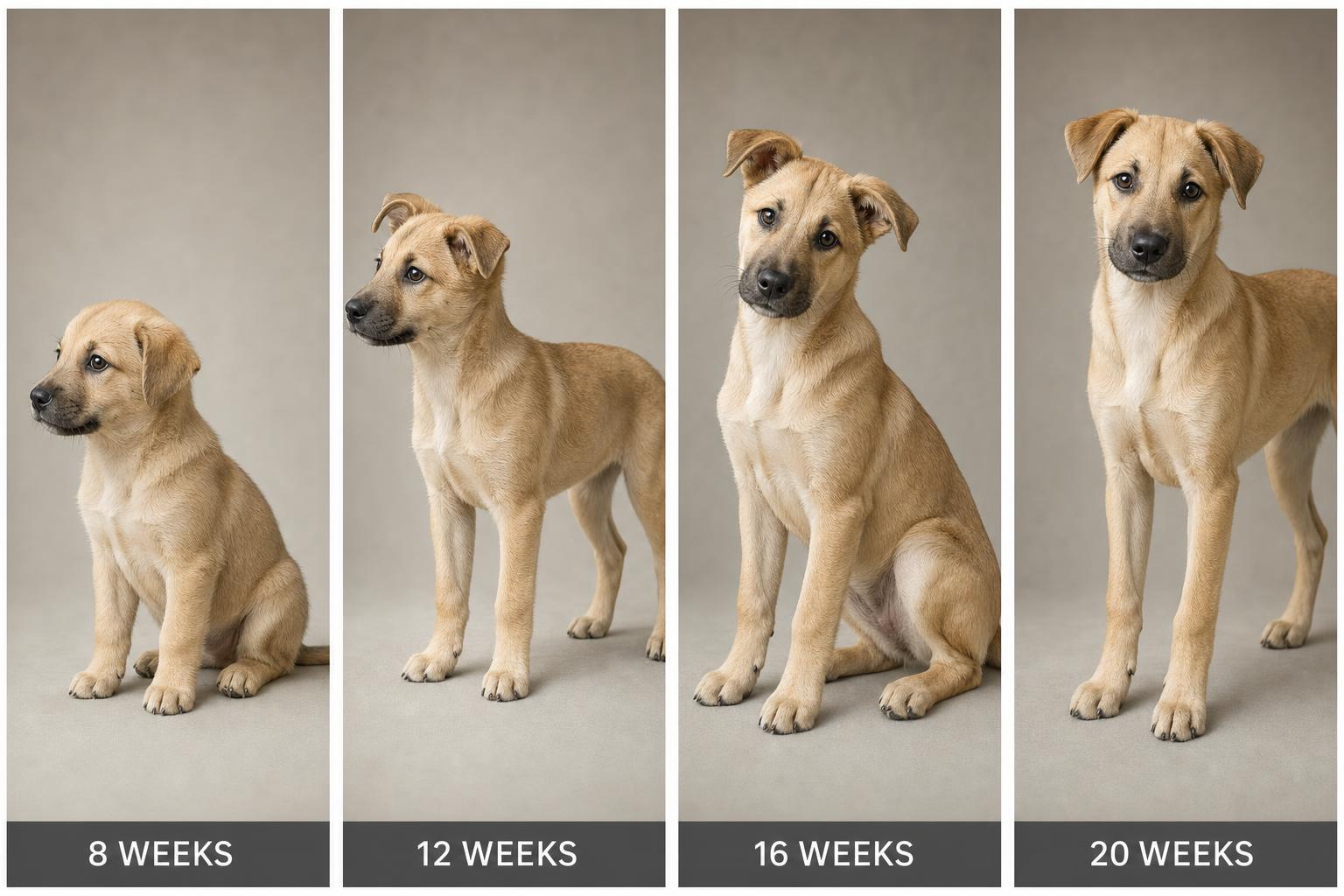
You cannot manage what you don't understand, so let's start with physiology. Puppy bladder capacity increases predictably with age, but it's much more limited than most new owners realise (Dunbar, 2025).
| Age | Approx. maximum hold (resting) |
|---|---|
| 8 weeks | ~75 minutes |
| 12 weeks | ~90 minutes |
| 16 weeks | ~2 hours |
| 20 weeks | ~2½ hours |
These are maximums — they represent what a sleeping puppy can hold, not an active, playing, eating, drinking puppy. After meals, after play, after waking, and during excitement, the practical window is much shorter. A common rule of thumb is that a puppy can hold it for roughly one hour per month of age during waking hours, but this varies by individual, breed size, and activity level.
The Predictable Pattern
Puppies need to toilet at predictable times. Once you internalise this pattern, house training becomes a scheduling exercise. Your puppy will need to go immediately upon waking (every single time, naps included); within 5–15 minutes after eating or drinking; during or immediately after play or excitement; every 30–90 minutes during active waking periods, depending on age; and as the last activity before crating or bedtime.
Dunbar emphasises that house training is both a spatial and temporal problem. You need the puppy in the right place at the right time, and then you need to make that moment feel spectacularly rewarding. That means taking your puppy to the designated toilet spot, waiting calmly, and the instant they begin to go, marking the behaviour and following up with a high-value treat — not praise from across the garden, a treat delivered within two seconds, right there at the scene.
Recognising Toileting Cues
As your puppy matures, they'll begin to signal before they need to go. Learning to read these toileting cues is essential — and it builds directly on the body-language reading skills from Chapter 4. Common cues include circling (walking in tight circles, nose to ground), sniffing intensely (sudden focused sniffing of the floor or carpet), heading toward the door or toward a spot where they've previously toileted, restlessness (whining, pacing, sudden disengagement from play), and squatting — by the time you see this, you have about one second to act.
When Accidents Happen · The Evidence Against Punishment
Let's be direct: your puppy will have accidents. Even with perfect management, you'll miss a cue, lose track of time, or encounter a bout of digestive upset. How you respond to accidents matters enormously — not just ethically, but in terms of training effectiveness.
Why Punishment Doesn't Work
The practice of "rubbing a puppy's nose in it" persists despite being contradicted by every credible veterinary and behavioural authority. The Australian Veterinary Association's position statement is unequivocal: punishment-based methods can increase stress responses, cause learned helplessness, suppress communication signals, and lead to unpredictable aggression (AVA, 2019). When you punish a puppy for a puddle on the carpet, the puppy does not think "I should not toilet indoors." The puppy thinks "toileting near this human is dangerous" — and may begin hiding to eliminate, making house training dramatically harder.
As Vieira de Castro and colleagues demonstrated (2020) with hard data: dogs trained with aversive methods showed elevated cortisol not just during training, but at rest. The stress of punishment leaks into the puppy's general experience of the world. For house training specifically, this creates a devastating paradox — a stressed puppy needs to urinate more frequently, meaning punishment for accidents literally causes more accidents.
The Correct Response
When you catch your puppy mid-accident, calmly interrupt with a gentle "oops!" or handclap — not shouting — pick the puppy up, and carry them to the designated toilet area. If they finish there, reward. If you find an accident after the fact, simply clean it up. Your puppy cannot connect your displeasure with something that happened even thirty seconds ago.
Clean all accident sites with an enzymatic cleaner — not standard household cleaners. Standard products mask the odour to human noses but leave protein residues that a dog's nose can still detect. To your puppy, that spot still smells like a toilet. Enzymatic cleaners break down the organic compounds completely, eliminating the scent signal that says "go here again."
Understanding Regression
Regression — a period of apparent backsliding after consistent progress — is entirely normal in house training. Your puppy may be reliable for a week and then have three accidents in one day. This doesn't mean training has failed. It means one of several things: a developmental change, a routine disruption, a dietary change, overexcitement, or simply the normal non-linearity of learning. The correct response is to tighten management — go back to more frequent toilet breaks, reduce unsupervised time, and increase reinforcement for outdoor toileting.
We'll explore the concept of regression in much more depth in Chapter 8, where it applies to socialisation, obedience, and adolescent behaviour changes. For now, know this: regression is not failure. It's data. It tells you to adjust your management, not your expectations.
When to See a Vet
Some toileting problems have medical origins. Consult your veterinarian if you observe a sudden increase in urination frequency without schedule changes, straining to urinate or producing very small amounts, blood in urine or stool, persistent diarrhoea lasting more than twenty-four hours, excessive water consumption, or a previously reliable puppy (sixteen weeks or older) suddenly regressing despite no changes in routine. Urinary tract infections, gastrointestinal parasites, and dietary intolerances are common in young puppies and can mimic house training problems. Treating the medical issue typically resolves the toileting issue.
Night-Time Toileting · Weeks Two Through Eight
In Chapter 2 we covered your puppy's first night home. Now let's expand that plan into the following weeks. The good news: night-time bladder capacity develops faster than daytime capacity, because sleeping puppies produce less urine. The general progression looks like this.
Weeks 1–2 home (8–10 weeks old): set an alarm every three hours. Take the puppy out, reward toileting, return to crate. Keep interactions boring — no play, minimal light, quiet voice.
Weeks 3–4 (10–12 weeks): extend to every 3½–4 hours. If your puppy is consistently dry at each alarm, push the interval out by thirty minutes.
Weeks 5–6 (12–14 weeks): many puppies can manage a five-hour stretch. Some can do six.
Weeks 7–8 (14–16 weeks): most puppies can sleep six to seven hours. You may be able to drop the overnight alarm entirely.
The key is to follow your puppy's lead. If they're waking and whining before your alarm, the interval is too long. If they're sound asleep when the alarm goes off and dry in the crate, you can stretch it. This is systematic desensitisation applied to duration — exactly the same principle as crate training (Sargisson, 2014).
Connecting the Crate to House Training
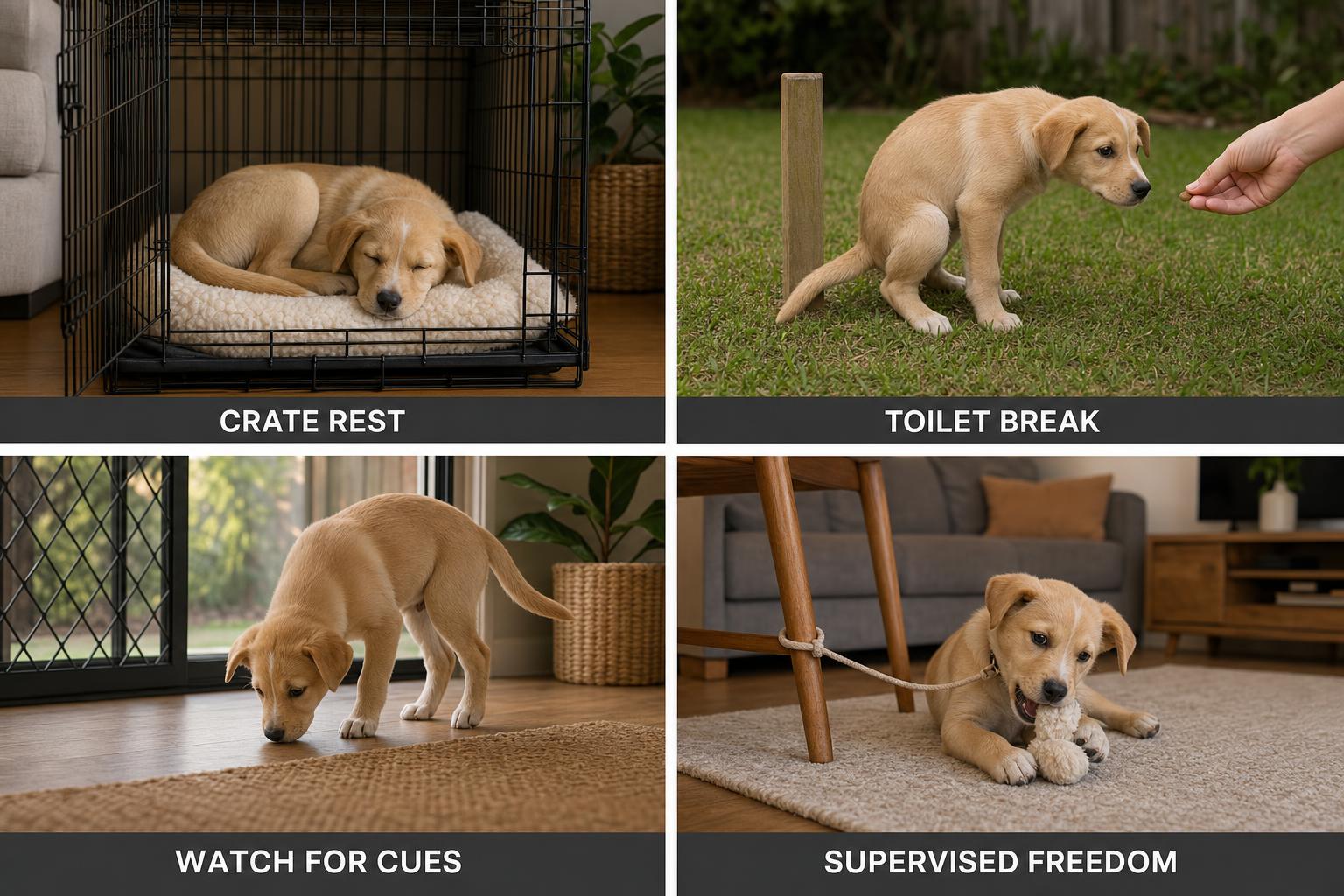
The crate and the house training schedule work as an integrated system. Dunbar describes this as a cycle of confinement, toileting, and supervised freedom. The rhythm goes like this: 1 · Crate rest — puppy rests in the crate for a duration appropriate to their age and crate training stage. 2 · Toilet break — immediately upon exiting the crate, puppy goes to the designated toilet area. Wait, reward success. 3 · Supervised freedom — after toileting, the puppy earns a period of supervised exploration and play. "Supervised" means your eyes are on the puppy, or the puppy is tethered to you. 4 · Back to crate — after the supervised period (15–45 minutes depending on age), or if you spot toileting cues, cycle back to step 1 or 2.
This cycle is the engine of house training. It uses the crate's function — puppies avoid soiling their bed — to build bladder control, creates predictable toileting opportunities that you can reward, and prevents unsupervised accidents that would reinforce indoor toileting. It's not exciting. It's not Instagram-worthy. It works.
The single most important skill in house training is not teaching — it's scheduling. Get the schedule right, and the puppy will teach itself.
Ian Dunbar (2004)
Crate Stress vs. Toileting Need
One of the most common questions new puppy owners ask: "Is my puppy crying because they need to toilet, or because they don't want to be in the crate?" The answer matters, because the correct response is different for each. Apply the body language skills from Chapter 4.
For toileting need: restlessness, circling inside the crate, sudden waking from sleep, whining that escalates in urgency. Respond by taking the puppy out to toilet immediately.
For crate discomfort or boredom: barking or whining that starts immediately upon closing the door, digging at the crate floor, attempts to push through the door. This suggests you've advanced too quickly in your crate training progression — go back a step.
For attention seeking: intermittent barking with pauses — the puppy is checking whether it's working — usually after having recently toileted. If you're confident the puppy doesn't need to go, wait for a brief quiet moment and reward the quiet.
When in doubt, especially in the early weeks, assume it's a toileting need. A false trip to the garden is far less damaging than a forced accident in the crate — which can undermine the very instinct that makes crate-based house training effective.
Key Takeaways
- Patience in puppy training is an active, evidence-based strategy — not passive waiting. Aversive methods increase stress, slow learning, and create pessimistic emotional states in dogs.
- Crate training uses systematic desensitisation: start with zero pressure, progress in tiny increments, and read your puppy's body language at every stage. The crate must never be used as punishment.
- House training is fundamentally a management exercise. A puppy's bladder capacity is roughly one hour per month of age during waking hours — structure your schedule around this biological reality.
- Accidents are inevitable and should be handled calmly: interrupt gently, redirect to the toilet area, and clean with enzymatic cleaner. Punishment teaches puppies to hide, not to hold it.
- Regression is normal and is data, not failure. Tighten your management, increase toilet break frequency, and maintain reinforcement. Rule out medical causes if regression is sudden or severe.
- The crate and house training work as an integrated cycle: confinement, toilet break, supervised freedom, repeat. This cycle builds bladder control and reinforces outdoor toileting through predictable success.
In Chapter 6 we turn our attention to nutrition — feeding schedules that interlock with the toileting rhythm you've just built, age-appropriate portions, the toxic-food map, and using meals as enrichment and training currency. Bring everything you've learned about routine and reading your puppy — feeding decisions touch every other part of the day.
References
Australian Veterinary Association. (2019). The use of punishment and negative reinforcement in dog training.
Casey, R. A., Naj-Oleari, M., Campbell, S., Mayfield, M., & Sherwin, C. M. (2021). Dogs are more pessimistic if their owners use two or more aversive training methods. PLoS ONE, 16(7), e0254402.
Dunbar, I. (2004). Before and after getting your puppy: The positive approach to raising a happy, healthy, and well-behaved dog. New World Library.
Dunbar, I. (2025). Errorless housetraining [updated guidance]. Dog Star Daily.
Mendl, M., Burman, O. H. P., Parker, R. M. A., & Paul, E. S. (2009). Cognitive bias as an indicator of animal emotion and welfare: Emerging evidence and underlying mechanisms. Applied Animal Behaviour Science, 118(3–4), 161–181.
Sargisson, R. J. (2014). Canine separation anxiety: Strategies for treatment and management. Veterinary Medicine: Research and Reports, 5, 143–151.
Stellato, A. C., Flint, H. E., Dewey, C. E., Widowski, T. M., & Niel, L. (2019). Risk factors associated with veterinary-related fear and aggression in companion dogs. Applied Animal Behaviour Science, 213, 14–22.
Vieira de Castro, A. C., Fuchs, D., Morello, G. M., Pastur, S., de Sousa, L., & Olsson, I. A. S. (2020). Does training method matter? Evidence for the negative impact of aversive-based methods on companion dog welfare. PLOS ONE, 15(12), e0225023.
Yin, S. (2009). Low stress handling, restraint and behavior modification of dogs and cats. CattleDog Publishing.