Nutrition & Feeding
What Goes In Matters — And So Does How
A naturalist's pantry: how to read a label, build a meal schedule, recognise the toxic, and weigh a puppy with your hands.
You're standing in the pet food aisle, and there are forty-seven options staring back at you. One bag promises "ancestral grain-free nutrition" with a wolf on the label. Another claims to be "holistically crafted" with ingredients you'd find on a restaurant menu. The one your breeder recommended looks plain by comparison. Your phone has three open tabs: a blog insisting raw feeding is the only ethical option, a Facebook group where someone swears by a home-cooked diet supplemented with bone meal, and a forum post declaring that all kibble is "processed poison." Your eight-week-old puppy, meanwhile, is cheerfully trying to eat a stick in the car park.
Feeding a puppy shouldn't require a degree in nutritional science, but the sheer volume of conflicting advice — much of it driven by marketing rather than evidence — has turned mealtime into a source of guilt for many new owners. This chapter cuts through the noise. There is no single "perfect" diet, but there are informed choices, and by the end of this chapter you'll be equipped to make them.
Why Puppy Food Isn't Just Small-Dog Food
Puppies aren't miniature adults. They're biological construction projects. In the first twelve months of life, most puppies will multiply their birth weight by forty to fifty times. That extraordinary rate of growth requires a nutritional profile fundamentally different from what an adult dog needs — particularly when it comes to protein concentration, fat content, and the minerals that build the skeleton.
The most critical nutritional consideration during puppyhood involves calcium and phosphorus — not just the amounts, but the ratio between them. Research by Dobenecker et al. (2019) found that during peak growth (2–4 months of age), puppies require a calcium-to-phosphorus ratio of approximately 2:1, gradually decreasing to about 1.49:1 by 7–12 months. Unlike adult dogs, puppies cannot adequately regulate calcium absorption from the intestinal tract. If you feed excess calcium — through over-supplementation or an unbalanced diet — a puppy's body will absorb it regardless, potentially leading to serious skeletal developmental disorders, particularly in large and giant breeds.
This is precisely why well-meaning supplementation can be dangerous. Adding calcium powder, ground eggshell, or bone meal to a puppy's already complete diet can push that ratio out of balance, causing conditions like osteochondrosis or hypertrophic osteodystrophy. The safest approach: feed a food specifically formulated for growth, and resist the urge to add supplements unless your veterinarian has specifically prescribed them based on a diagnosed deficiency.
Decoding "Complete and Balanced"
The phrase complete and balanced isn't marketing fluff. It has a specific regulatory meaning. In Australia, pet food labelling follows guidelines aligned with the standards established by the Association of American Feed Control Officials (AAFCO), which define minimum (and some maximum) nutrient requirements that a food must meet. AAFCO maintains two primary nutrient profiles: Growth and Reproduction (for puppies and pregnant or lactating dogs), and Adult Maintenance. Updated profiles from 2016 include specific provisions for large and giant breed puppies, reflecting the different calcium needs we just discussed.
When you pick up a bag of puppy food, look for two things on the label. First, a statement that the food meets AAFCO nutrient profiles for "growth" or "all life stages." Second, check whether this was demonstrated through feeding trials (the food was actually fed to dogs and evaluated) or through formulation method (the recipe was calculated to meet nutrient minimums on paper). Both approaches are acceptable, but feeding trials provide an additional layer of real-world validation.
Feeding Schedules · Connecting Meals to the Day's Rhythm
If you've been following the routines we established in Chapter 2 and the house training schedules from Chapter 5, you already know that predictability is your puppy's best friend. Feeding schedules are the connective tissue that ties your whole daily routine together — because when you feed directly determines when your puppy needs to toilet, which determines when you need to be ready with leash in hand by the back door.
Evidence-based guidance on meal frequency is straightforward and age-dependent. According to the American Kennel Club, puppies aged 6–12 weeks need four meals per day. Small, frequent meals support steady blood sugar and rapid growth. At 3–6 months, transition to three meals per day, as stomach capacity increases and growth rate begins to moderate. From 6–12 months, move to two meals per day — the schedule most adult dogs will maintain for life.
The transition between meal frequencies should be gradual. When moving from four meals to three, for example, slowly increase portion sizes at the remaining meals over about a week while phasing out the dropped meal. Watch your puppy's energy levels and stool consistency during transitions. Loose stools may indicate portions that are too large for the puppy's digestive capacity at that sitting.
Timing Meals Around Toilet Breaks
Most puppies will need to toilet within 15–30 minutes after eating. This is driven by the gastrocolic reflex — the physiological response in which food entering the stomach triggers movement in the colon. Planning for this reflex is the single most effective thing you can do to accelerate house training. If your puppy eats at 7 a.m., have your shoes on and be ready to go outside by 7:15. The toileting schedule we developed in Chapter 5 slots cleanly into the feeding rhythm here.
How You Feed Matters as Much as What You Feed
A food bowl is the least interesting way to deliver your puppy's meals, and this is actually a missed opportunity. Every meal is a chance to build your relationship, provide mental enrichment, or reinforce training behaviours.
Hand-feeding for bond building. Especially in the first few weeks home, hand-feeding a portion of each meal teaches your puppy that wonderful things come from your hands. It builds trust, encourages eye contact, and establishes you as the source of good things. This is particularly valuable for shy or anxious puppies.
Food puzzles and scatter feeding. Spreading kibble across a snuffle mat, freezing wet food inside a Kong, or using a slow-feeder puzzle engages your puppy's brain and natural foraging instincts. A meal that takes two minutes from a bowl can take fifteen minutes from a puzzle — fifteen minutes of calm, focused mental work. For puppies who eat too fast (a common issue that can cause vomiting or bloat risk), slow feeders serve a practical health purpose as well.
Training-session feeding. This approach — which connects directly to the positive reinforcement principles from Chapter 1 — involves using a portion of your puppy's daily meal allowance as training reinforcers throughout the day. Rather than delivering all food in discrete meals, you measure out the day's kibble and use handfuls of it during short training sessions. Research supports food rewards as powerful primary reinforcers, and using the regular meal ration rather than additional treats keeps caloric intake in check (China et al., 2021; VCA Animal Hospitals, 2025).
Treats, Reinforcers, and the Toxic List
Using Treats Without Creating a Treat-Dependent Dog
One of the most common concerns new owners raise is, "If I use treats for training, won't my dog only listen when I have food?" This is a legitimate question with a clear evidence-based answer: the key lies in understanding reinforcement schedules.
When teaching a new behaviour, you use continuous reinforcement — rewarding every correct response. This is essential during the learning phase because the puppy needs to clearly understand what earns the reward. Once the behaviour is reliably established, you transition to intermittent reinforcement, rewarding some correct responses but not all. According to VCA Animal Hospitals, intermittent reinforcement actually makes behaviours more resistant to extinction, not less. Think of it like a slot machine: the unpredictability of the reward makes the behaviour more persistent.
Additionally, as training progresses, you diversify your reinforcers. Praise, play, access to a favourite toy, the opportunity to sniff on a walk — all of these become powerful rewards that supplement and eventually partially replace food. The goal isn't to eliminate food rewards entirely; it's to build a dog that responds to a rich variety of reinforcement, with food being one tool among many. We'll explore this progression in detail in Chapter 8 when we address maintaining training through adolescence.
The Ten-Percent Rule
A simple guideline: treats and extras should comprise no more than 10% of your puppy's daily caloric intake, with the remaining 90% coming from nutritionally complete food (AKC, 2025). This is where most owners go wrong — not through the meals, but through the accumulation of small treats throughout the day. A single dental chew can represent 20–30% of a small puppy's daily calories. Those tiny training treats? At ten sessions of twenty repetitions each, that's two hundred treats in a day.
The practical solution: measure out your puppy's daily food allowance each morning. Set aside a portion of it for training use. Any additional treats should be tiny (about the size of a pea) and mentally deducted from the day's total. If you've used a lot of training treats, reduce the next meal portion slightly.
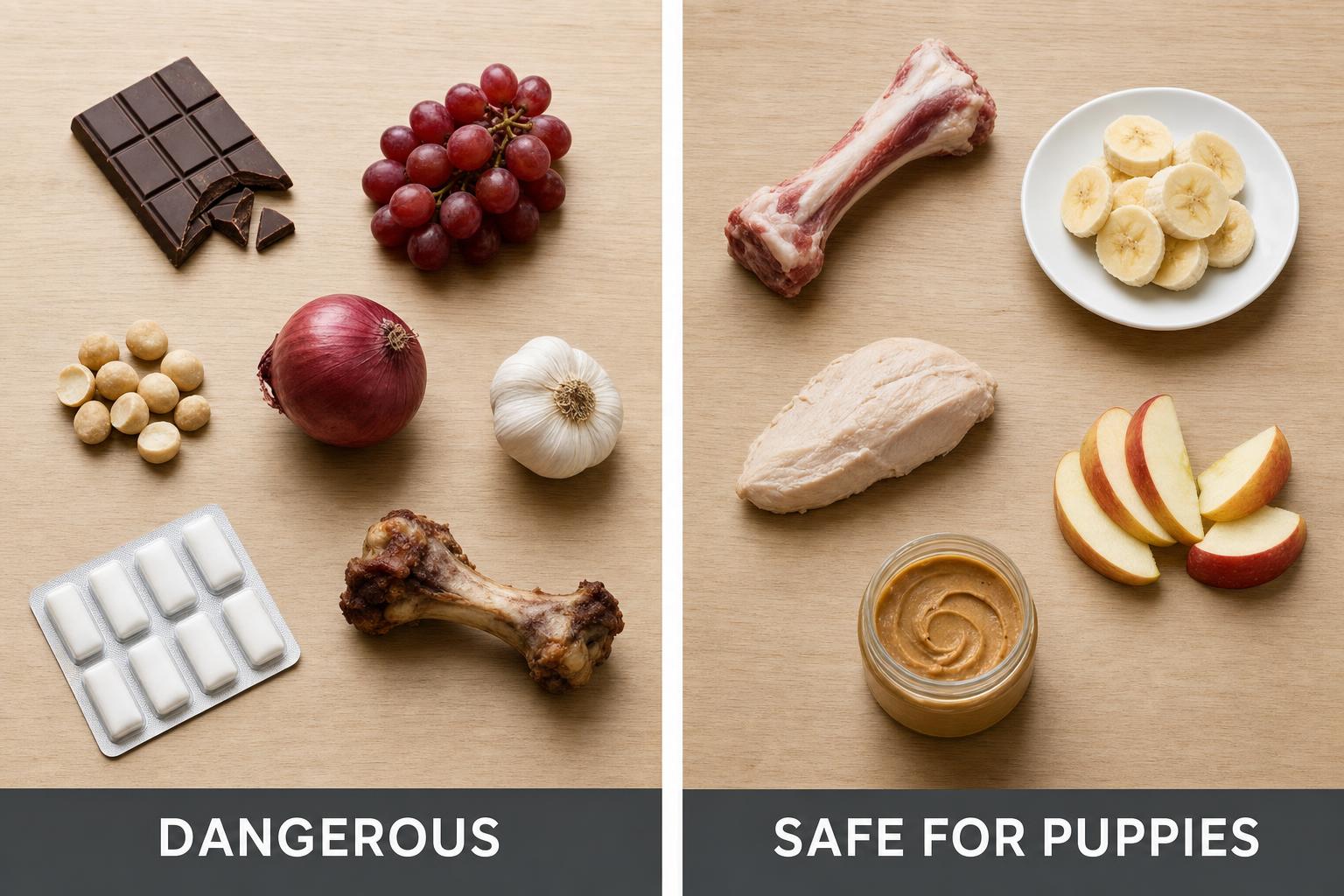
What's Actually Dangerous · A Brief Toxicity Field-Guide
Food-associated poisoning accounts for approximately 14.8% of all hazardous exposures in companion animals, with many episodes resulting from simple lack of awareness rather than negligence (Cortinovis & Caloni, 2016). The most dangerous household foods for dogs:
Chocolate and cocoa products contain theobromine and caffeine; dark chocolate and cocoa powder are most dangerous. They can cause vomiting, diarrhoea, seizures, cardiac arrhythmias, and death. Grapes and raisins can cause acute kidney failure even in small amounts; the exact toxic compound is not yet fully identified, making any amount potentially dangerous. Xylitol (also known as birch sugar) is found in sugar-free gum, some peanut butters, baked goods, and dental products; it causes rapid, life-threatening hypoglycaemia and liver failure, and is increasingly common in Australian households. Onion and garlic in all forms cause oxidative damage to red blood cells, leading to haemolytic anaemia — cooked, raw, and powdered forms are all toxic. Macadamia nuts, particularly relevant for Australian households, cause weakness, vomiting, tremors, and hyperthermia; usually not fatal but requires veterinary attention. Cooked bones become brittle and prone to splintering into sharp fragments that can cause oral injuries, oesophageal obstruction, intestinal perforation, and peritonitis (VCA Animal Hospitals, 2025). Corn cobs are not toxic but are a common cause of intestinal obstruction requiring emergency surgery — dogs swallow large pieces that cannot be digested or passed. Bread dough, raw or rising: yeast continues to ferment in the warm stomach, producing ethanol (causing alcohol poisoning) and gas (causing dangerous gastric distension).
Keep the Poison Information Hotline number saved in your phone: 13 11 26. This service is available 24 hours. If your puppy ingests something toxic, call immediately.
Body Condition Scoring · Weighing the Puppy With Your Hands
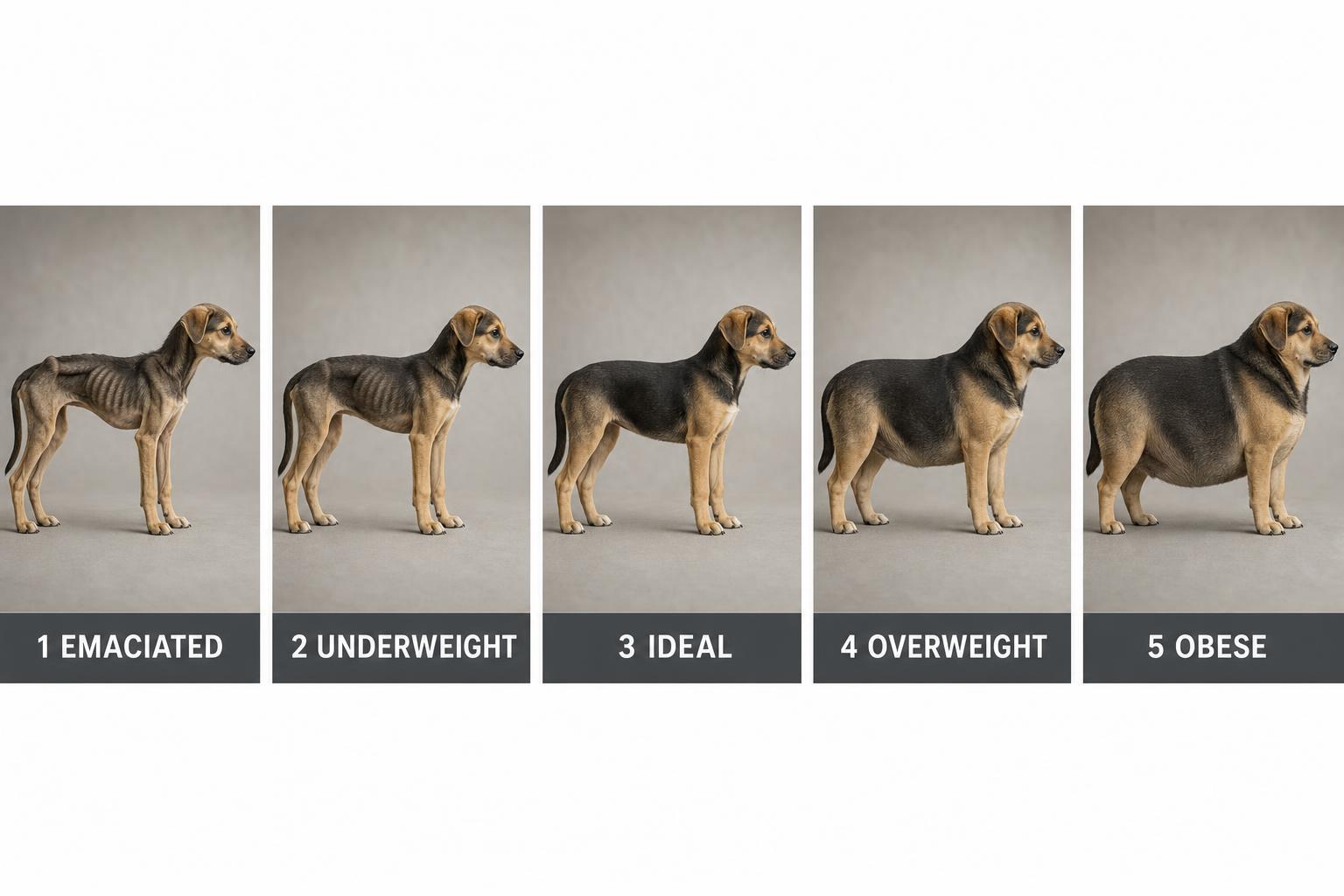
Portion guides on food packaging are starting points, not prescriptions. They're based on averages and cannot account for your individual puppy's metabolism, activity level, or growth phase. The most reliable way to determine whether your puppy is eating the right amount isn't the scale — it's body condition scoring (BCS).
Developed by Laflamme (1997) and now adopted by the World Small Animal Veterinary Association, body condition scoring uses a combination of visual assessment and hands-on palpation to evaluate fat cover. The system looks at three primary landmarks: rib coverage (can you easily feel the ribs with light pressure?), waist definition (when viewed from above, does the body narrow behind the ribs?), and abdominal tuck (when viewed from the side, does the belly tuck up behind the ribcage?).
One crucial point: a puppy's coat can mask body condition. A fluffy Samoyed puppy and a short-coated Vizsla puppy might look very different, but the assessment is done primarily by touch, not sight. You should be able to feel your puppy's ribs easily under a thin layer of fat — like feeling the back of your hand. If you have to press firmly to find the ribs, your puppy is likely carrying excess weight.
Why Puppy Weight Matters Long-Term
This isn't just about aesthetics. Research associated with the Purina Lifespan Study demonstrated that dogs maintained at a lean body condition from puppyhood lived up to 15% longer, and — more importantly — had significantly delayed onset of chronic diseases like osteoarthritis (Laflamme, 1997). Overweight puppies are also more prone to developmental orthopaedic diseases, as excess weight places additional stress on growing joints and bones. The habits you set now have consequences that extend over your dog's entire life.
The Raw Feeding Question
No nutrition chapter would be complete without addressing raw feeding, and we'll do so directly and without judgement — while being honest about what the evidence currently shows.
The American Veterinary Medical Association (2012) and the Australian Veterinary Association both advise against feeding raw or undercooked animal-source protein to pets. Their position is based on documented risks rather than theoretical concerns: studies have consistently found pathogenic bacteria — including Salmonella, E. coli, Listeria, and Campylobacter — in commercially available raw pet food products. These pose risks not only to the dog but to household members, particularly children, elderly individuals, and immunocompromised people who may come into contact with the food, the dog's saliva, or faeces.
Beyond pathogen risk, nutritional imbalance is a well-documented concern in both home-prepared and commercial raw diets. Multiple analyses have found that many raw feeding recipes — including those published in books and on popular websites — fail to meet established nutrient requirements, with calcium-to-phosphorus ratio imbalances being among the most common deficiencies (AVMA, 2012). For puppies specifically, given their inability to regulate calcium absorption (Dobenecker et al., 2019), this risk is amplified.
Proponents of raw feeding cite benefits including shinier coats, smaller stools, increased energy, and improved dental health. It's important to acknowledge that some of these observations may reflect real differences — a diet higher in animal protein and fat may produce visible coat improvements, for instance. However, the vast majority of purported benefits remain scientifically unproven, while the risks are documented and measurable.
If you choose to feed raw despite the current veterinary consensus, the most responsible approach is to work with a board-certified veterinary nutritionist who can formulate a diet specific to your puppy's breed, size, and growth stage — and to implement rigorous food handling hygiene protocols in your home.
Putting It All Together · Practical Feeding Guidelines
1 · Choose a food labelled for growth. Look for the AAFCO nutritional adequacy statement specifying "growth" or "all life stages." For large breed puppies, seek a formula specifically designed for large breed growth.
2 · Feed on a consistent schedule aligned with your daily routine and toilet training plan. Use the age-appropriate meal frequency guidelines: four meals → three → two. Plan toilet breaks 15–30 minutes after each meal.
3 · Measure, don't estimate. Use a kitchen scale or measuring cup for every meal. Adjust based on body condition scoring, not the packaging suggestion alone.
4 · Use meals as enrichment and training. Rotate between hand-feeding, food puzzles, scatter feeding, and training sessions. Your puppy's daily food ration is your most powerful training resource.
5 · Follow the 10% treat rule. Keep extras to a minimum and choose training treats that are tiny, soft, and quick to eat.
6 · Body condition score weekly. Run your hands over your puppy's ribs every week. Adjust portions before weight becomes a problem, not after.
7 · Keep toxic foods secured. Store chocolate, grapes, onions, macadamia nuts, and xylitol-containing products out of reach. Know the Poison Information Hotline number: 13 11 26.
There is no single "correct" diet for every puppy. Feed with evidence, not anxiety, and you'll be setting your puppy up for a lifetime of health.
A working puppy-raiser's reflection
Key Takeaways
- Puppies require food specifically formulated for growth, with carefully balanced calcium-to-phosphorus ratios that they cannot self-regulate.
- Look for the AAFCO nutritional adequacy statement for "growth" on puppy food labels — "complete and balanced" has a specific regulatory meaning.
- Feeding schedules should align with your house training routine: expect a toilet break 15–30 minutes after every meal.
- Use meals as enrichment and training opportunities. Hand-feeding, food puzzles, and training sessions transform mealtime into relationship-building time.
- Transition from continuous to intermittent reinforcement as behaviours are learned, to avoid treat-dependency.
- Treats should be no more than 10% of daily calories. Measure your puppy's food daily and account for everything.
- Know the toxic foods — chocolate, grapes and raisins, xylitol, onions and garlic, macadamia nuts, cooked bones, corn cobs, and bread dough. Save the Poison Hotline: 13 11 26.
- Body condition scoring (feeling ribs, assessing waist and tuck) is more reliable than the scale. Puppies kept lean live longer, healthier lives.
- Current veterinary consensus advises against raw feeding due to documented pathogen and nutritional imbalance risks, especially for growing puppies.
In Chapter 7 we turn to your puppy's veterinary roadmap — vaccinations and the immunity gap, parasite prevention with east-coast tick focus, the desexing decision, and how to make every vet visit a deposit in the cooperative-care bank rather than a withdrawal.
References
American Kennel Club. (2025). Puppy feeding fundamentals.
American Veterinary Medical Association. (2012). Policy on raw or undercooked animal-source protein in cat and dog diets.
China, L., Mills, D. S., & Cooper, J. J. (2021). Frontiers — efficacy of dog training with and without remote electronic collars vs. reward-based training. Frontiers in Veterinary Science, 7, 508.
Cortinovis, C., & Caloni, F. (2016). Household food items toxic to dogs and cats. Frontiers in Veterinary Science, 3, 26.
Dobenecker, B., et al. (2019). Calcium homeostasis in growing dogs: Effects of dietary intake on calcium absorption and metabolism. British Journal of Nutrition.
Laflamme, D. P. (1997). Development and validation of a body condition score system for dogs. Canine Practice, 22(4), 10–15.
VCA Animal Hospitals. (2025). Feeding and nutrition for puppies and toxic food guidance.
World Small Animal Veterinary Association. (2020). Body condition score guidelines.