One Leaf, a Thousand Mountains
How a single species became every tea on Earth — and why the mountain where it grows matters as much as the hands that shape it.
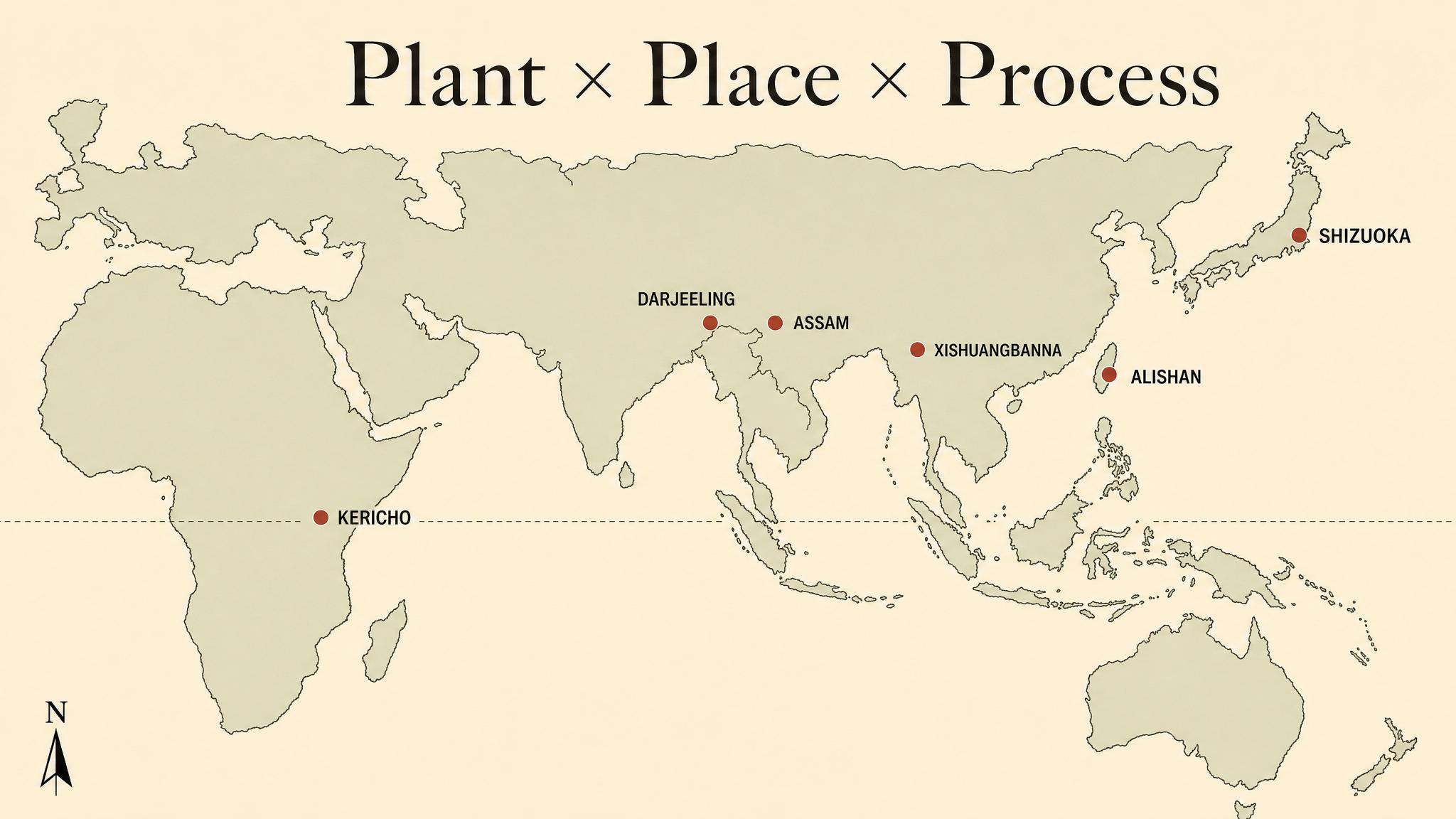
Deep in the Xishuangbanna Prefecture of southern Yunnan, there are tea trees that were already old when the Ming Dynasty fell. Their trunks are thick enough that a person cannot wrap their arms around them, and their canopies stretch ten meters skyward — a far cry from the waist-high hedgerows most people picture when they think of a tea garden. A single leaf plucked from one of these ancient giants, withered in the afternoon sun and dried over charcoal, will produce a brew that is dark, thick-bodied, and sweet in the throat, with a fragrance that lingers like forest air after rain.
Now fly six thousand kilometers east and north to Shizuoka, Japan, where the same species — the very same Camellia sinensis — has been pruned into immaculate green rows curving along volcanic hillsides. A leaf from these bushes, steamed within hours of harvest and rolled into tight needles, yields a cup that is vivid jade, grassy, and bristling with umami. Same species. Radically different cup. How is this possible? The answer involves botany, chemistry, geography, and centuries of human ingenuity — and it begins right here.
The Plant Behind the Cup
Every tea you have ever tasted — every jasmine pearl, every smoky Lapsang Souchong, every frothy bowl of matcha — comes from the same botanical species: Camellia sinensis. This is not a metaphor. The genus Camellia contains some 200-plus species, many prized as ornamental flowers, but only one has been cultivated for drinking on a global scale (Zhao, 2024). Understanding tea means understanding this plant first: its anatomy, its genetic flexibility, and its remarkable willingness to express different flavors depending on where and how it grows.
Camellia sinensis is an evergreen belonging to the family Theaceae, native to the highlands of what is now southwest China and parts of northern Southeast Asia (Banerjee, 1992). Left unpruned, it can grow into a tree exceeding fifteen meters. Under cultivation, it is typically maintained as a shrub for ease of harvest. Its leaves are glossy, serrated at the edges, and slightly leathery — a design refined over millions of years of evolution to thrive in humid, subtropical mountain forests.
Two Varieties, One Species
Within this single species, two major botanical varieties dominate the world's tea gardens, and learning to distinguish them is one of the first steps toward reading a cup of tea with understanding.
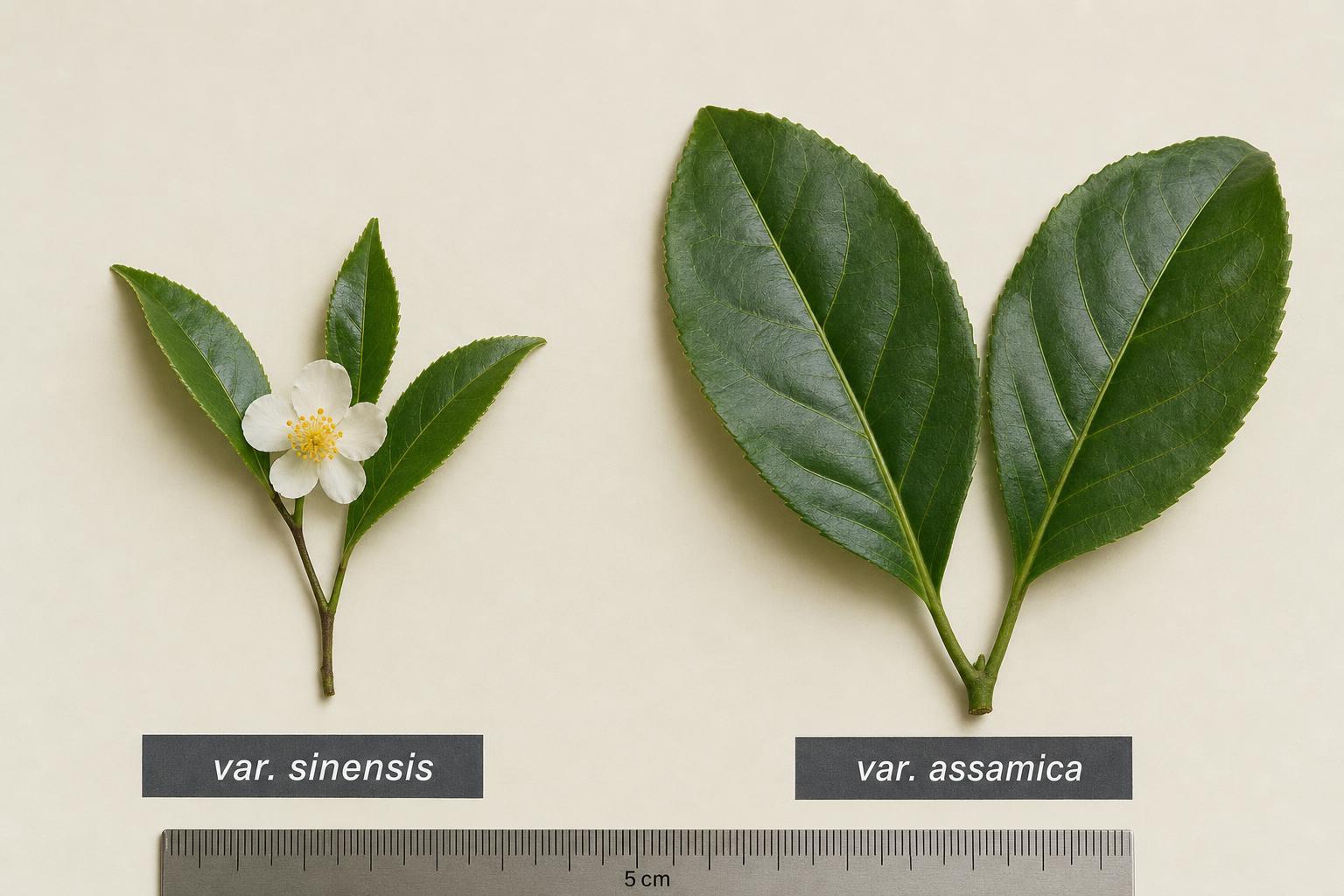
Camellia sinensis var. sinensis — often called the "Chinese variety" — is a smaller-leafed, cold-tolerant bush that grows well at higher elevations and cooler latitudes. Its leaves are typically 5 to 12 centimeters long, relatively thick, and rich in aromatic precursors. This is the variety behind most Chinese green teas, Taiwanese oolongs, and Japanese teas. Genomic analysis has revealed that var. sinensis and its cousin evolved along independent evolutionary paths, with distinct selection pressures shaping their chemistry (Zhang et al., 2021).
Camellia sinensis var. assamica — the "Assam variety" — is a larger-leafed, heat-loving plant that thrives in tropical lowlands and warm, wet environments. Its leaves can stretch 15 to 25 centimeters, are thinner and softer, and contain higher concentrations of catechins and polyphenols. This is the variety that built the British tea industry in India and that still dominates production in Assam, Sri Lanka, and East Africa. Its vigor and high yield also make it the backbone of most commercial blends worldwide.
These two varieties are not locked in separate boxes. Large-scale genomic studies of over 1,300 Camellia accessions from fourteen tea-producing countries have revealed extensive hybridization between them, producing a rich spectrum of intermediate cultivars with blended traits (Multiple authors, 2025). Many modern tea cultivars are, in fact, genetic mosaics — part sinensis, part assamica — selected by growers over centuries for specific flavor profiles or resilience to local conditions. Recognizing the two poles of this continuum, however, gives you a powerful starting framework: when someone tells you a tea is made from assamica-type material, you can already anticipate a bolder, more astringent character; sinensis-type material suggests a lighter, more aromatic cup.
Terroir: The Taste of Place
Wine lovers have long spoken of terroir — the French concept that a product's flavor reflects its environment in ways that cannot be replicated elsewhere. Tea drinkers deserve the same vocabulary. Terroir in tea encompasses soil composition, altitude, latitude, rainfall, temperature, humidity, surrounding vegetation, and even the microorganisms in the local ecosystem (Verdant Tea, 2021). Together, these factors act upon the tea plant like a sculptor acts upon stone, shaping which compounds the leaf produces, in what concentrations, and at what pace.
Altitude and Temperature
Consider altitude. Tea grown at high elevations — above 1,200 meters — experiences cooler temperatures, thinner air, more ultraviolet radiation, and greater temperature swings between day and night. These stresses slow the plant's growth, allowing more time for complex flavor precursors to accumulate in each leaf. The result is a cup with greater sweetness, more nuanced aroma, and less bitterness. This is why Darjeeling, perched at 600 to 2,100 meters in the eastern Himalayas, produces teas celebrated for their floral "muscatel" character — a quality that lowland plantations in the same region simply cannot replicate, even with identical cultivars and processing (Verdant Tea, 2021).
Soil and Mineral Content
Soil matters profoundly. Tea thrives in slightly acidic, well-drained soils rich in organic matter — but the specific mineral profile of that soil leaves a fingerprint on the cup. The volcanic soils of Uji, Japan, contribute to the intense umami that defines its gyokuro and matcha. The red, iron-rich laterite soils of Kenya's highlands yield brisk, coppery black teas with a clean finish. The deep, sandy loams of Yunnan support the ancient trees whose roots reach minerals inaccessible to shallower-rooted bushes, producing the complex sweetness that pu-erh lovers call huigan — a returning sweetness felt in the back of the throat.
Rainfall and Humidity
Water is the medium through which a plant absorbs its soil. Tea-growing regions receive between 1,200 and 6,000 millimeters of rain annually, and the pattern matters as much as the total. Assam's monsoon climate — over 2,500 mm of rain concentrated in intense bursts — pushes explosive leaf growth and high yields, producing a bold, malty cup. Taiwan's Alishan, by contrast, is shrouded in cool mist for much of the year, creating a gentler, steadier hydration that contributes to the silky, floral quality of high-mountain oolongs.
Six Categories, One Leaf
Walk into a well-stocked tea shop and you might see hundreds of teas, each with its own name — Longjing, Silver Needle, Tieguanyin, Keemun, Gyokuro, Shou Pu-erh. It can feel overwhelming. But here is the essential insight that simplifies the entire world of tea: every one of these teas belongs to one of six major categories, and the categories are defined not by the plant but by what happens to the leaf after it is plucked. The fresh leaf is the starting material. Processing is the script. The six categories are the resulting performances.
The key variable is oxidation — a chemical process in which enzymes in the leaf (especially polyphenol oxidase) react with oxygen to transform catechins into new compounds, darkening the leaf and fundamentally changing its flavor. Think of it as the tea equivalent of an apple browning after you bite it. How much oxidation a tea master allows — and how they control it — is the primary axis along which the six categories are arranged (Wong et al., 2022).
- Green tea — Oxidation is halted almost immediately through heat (steaming in Japan, pan-firing in China). The leaf stays green; the cup is fresh, vegetal, sometimes nutty.
- White tea — Minimal processing: leaves are gently withered and dried with little or no heat intervention. Oxidation is slight and natural. The cup is delicate, sweet, sometimes hay-like.
- Yellow tea — Similar to green tea, but with an additional step called men huan ("sealed yellowing") in which warm, damp leaves are covered and allowed to slowly oxidize under gentle heat. This rare step mellows the grassy edge and adds a smooth sweetness.
- Oolong tea — Partially oxidized, anywhere from roughly 15% to 85%. This is the broadest category, ranging from light, floral oolongs barely darker than green tea to heavily roasted, deeply oxidized oolongs that approach black tea in body.
- Black tea — Fully oxidized. Leaves are withered, rolled to rupture cell walls, allowed to oxidize completely, and then dried. Catechins convert into theaflavins and thearubigins, giving the liquor its amber-to-mahogany color and its malty, sometimes fruity character.
- Dark tea (including pu-erh) — A distinct category involving microbial fermentation, not just enzymatic oxidation. Leaves are piled while moist and inoculated with beneficial microorganisms that transform the chemistry over weeks, months, or years. The cup can be earthy, smooth, and complex in ways no other category achieves.
Notice that this is a spectrum, not a set of rigid boxes. A lightly oxidized oolong may share more in common with a green tea than with a heavily roasted oolong. A well-aged white tea may develop earthy notes that remind you of dark tea. The categories are useful maps, but the territory is fluid. Keep this flexibility in mind throughout the course — it will serve you well.
Meet the Molecules
Inside every fresh tea leaf, before any human hand intervenes, a cast of chemical characters is already assembled. Understanding who they are and where they reside in the leaf is crucial, because it is the interaction between these compounds — triggered by processing — that creates every flavor you will encounter in this course. We introduce four principal groups here. They will return, in increasing depth, in Chapters 2, 3, and 4.
Catechins: The Bitter Guardians
Catechins are a family of polyphenolic compounds concentrated in the leaf's cell vacuoles — those large, fluid-filled compartments that occupy the center of plant cells. They are the leaf's chemical defense system against UV radiation and herbivores, and they are responsible for the astringency and bitterness of tea. In a green tea, where oxidation is halted early, catechins remain largely intact and dominate the flavor. In a black tea, enzymes have converted them into theaflavins and thearubigins — the compounds that give black tea its color and its smoother, rounder mouthfeel (Wong et al., 2022).
Caffeine: The Stimulant
Caffeine is an alkaloid distributed throughout the leaf's cytoplasm. It contributes bitterness, but more importantly for most drinkers, it provides the stimulating effect for which tea has been prized for millennia. Caffeine content in commercial teas varies widely — Boros et al. (2016) measured significant variation across white, green, oolong, and black teas — but the fresh leaf typically contains between 2% and 5% caffeine by dry weight. Contrary to popular belief, processing category is a poor predictor of caffeine level; bud-heavy teas tend to contain more caffeine regardless of whether they become white tea or green tea.
L-Theanine: The Calm Focus
L-theanine is an amino acid nearly unique to the tea plant. It is synthesized in the roots and transported to the leaves, where it accumulates especially when the plant is shaded from direct sunlight — which is why shade-grown Japanese teas like gyokuro are so rich in umami. L-theanine contributes a savory sweetness and a characteristic "calming alertness" that tempers the jitteriness of caffeine. Boros et al. (2016) found mean L-theanine content was relatively stable across categories, ranging from about 5 to 7 mg/g, suggesting it survives processing reasonably well.
Volatile Aroma Compounds: The Invisible Orchestra
The aroma of tea is staggeringly complex. Over 600 volatile organic compounds (VOCs) have been identified across different tea types, including linalool (floral), geraniol (rosy), limonene (citrusy), and scores of others (Multiple authors, 2025). Many of these volatiles do not exist in the fresh leaf as free molecules — they are locked up as non-volatile precursors bound to sugars in cell walls and membranes. It is only when the leaf is damaged, withered, heated, or fermented that enzymes liberate these precursors and transform them into the aromatic compounds you smell rising from your cup. This is why the way you process a leaf — how much you bruise it, how long you let it oxidize, what temperature you apply — determines which of those 600-plus possibilities make it into the final tea.
Here is the essential drama: in the intact leaf, these compounds are separated by membranes. Catechins sit in the vacuole. Polyphenol oxidase enzymes sit in the cytoplasm. Aroma precursors sit in cell walls. They do not interact until the leaf is damaged — by plucking, by withering, by rolling, by cutting. Processing is, at its core, a controlled act of cellular destruction. How much destruction, how fast, and under what conditions determines whether you end up with a green tea or a black tea, a floral oolong or an earthy pu-erh. This concept — processing as controlled cell damage — is the single most important idea in this course, and we will build on it extensively in Chapters 2, 3, and 4.
Tying It Together: One Leaf, Infinite Possibility
Let us return to where we started — those ancient trees in Xishuangbanna and those manicured hedgerows in Shizuoka. We can now begin to explain why the same species yields such different cups. The Yunnan tree is var. assamica, genetically primed for higher polyphenol content; it grows in deep, mineral-rich soil at moderate elevation in a subtropical climate; and its leaves are processed with long, gentle withering followed by sun-drying and sometimes years of microbial aging. The Shizuoka bush is var. sinensis, bred for aromatic amino acids; it grows in volcanic soil in a temperate maritime climate with cool, misty springs; and its leaves are steamed within hours to lock in that fresh, green chemistry.
Different variety. Different terroir. Different processing. Same species. This three-part framework — plant, place, and process — is the mental model we will carry through the entire course. In the next chapter, we follow the leaf from garden to withering trough and explore how the very first stage of processing begins to unlock the chemical potential you met today.
"The leaf does not decide what it will become. The mountain, the weather, and the tea maker's hands decide together."
Traditional Wuyi Mountain tea-producers' saying
Key Takeaways
- All tea comes from a single species, Camellia sinensis, whose remarkable genetic flexibility enables enormous diversity in the cup.
- The two major varieties — var. sinensis (small-leafed, aromatic, cold-tolerant) and var. assamica (large-leafed, polyphenol-rich, heat-loving) — represent two poles of a genetic continuum, with many cultivars blending traits from both.
- Terroir — the combination of soil, altitude, rainfall, latitude, and microclimate — shapes which compounds a leaf produces and in what concentration, making geography a powerful determinant of flavor.
- The six major tea categories (green, white, yellow, oolong, black, dark) are defined primarily by degree of oxidation and type of processing, not by the plant variety itself.
- Four key compound groups — catechins, caffeine, L-theanine, and volatile aroma precursors — reside in separate compartments of the intact leaf. Processing is controlled cell damage that allows these compounds to interact, creating flavor.
- The foundational mental model for the course is plant × place × process — variety, terroir, and human craft together determine what ends up in your cup.
In Chapter 2, From Garden to Withering Trough, we follow the freshly plucked leaf through its first transformation. Withering is far more than simple drying — it is a carefully managed phase of moisture loss and early chemical change where the leaf begins to exhale its grassy notes and develop new aromatic complexity. We will examine what happens at the cellular level during withering, why indoor and outdoor withering produce different results, and how the tea maker's decisions in these first hours set the trajectory for everything that follows.
References
Banerjee, B. (1992). Botanical classification of tea. In K. C. Willson & M. N. Clifford (Eds.), Tea: Cultivation to consumption (pp. 25–51). Springer.
Boros, K., Jedlinszki, N., & Csupor, D. (2016). Theanine and caffeine content of infusions prepared from commercial tea samples. Pharmacognosy Magazine, 12(45), 75–79.
Multiple authors. (2025). Genomic analysis of 1,325 Camellia accessions sheds light on agronomic and metabolic traits for tea plant improvement. Nature Genetics, 57, 1085–1097.
Multiple authors. (2025). Volatile organic compounds in teas: Identification, extraction, analysis, and application of tea aroma. Foods, 14(15), 2574.
Verdant Tea. (2021). Terroir and its influence on the flavor of tea. verdanttea.com.
Wong, M., Siow, L. F., Lim, T. K., & Tang, T. K. (2022). Phytochemical profile of differently processed tea: A review. Journal of Food Science, 87(5), 1925–1950.
Zhang, X., Chen, S., Shi, L., et al. (2021). Haplotype-resolved genome assembly provides insights into evolutionary history of the tea plant Camellia sinensis. Nature Genetics, 53(8), 1250–1259.
Zhao, D. W. (2024). Botany and taxonomy of tea (Camellia sinensis, Theaceae) and its relatives. In L. Chen & J. D. Chen (Eds.), Tea plant genome (pp. 13–36). Springer.