The Alchemy of Withering
Same plant, same hillside, same hour of plucking — yet the cup that emerges depends entirely on the decisions a tea maker makes in the next forty-eight hours.
Picture a tea maker named Lin standing in the pre-dawn darkness of a processing shed in Fujian's Wuyi Mountains. She has just received forty kilograms of freshly plucked leaves — identical in variety, from the same hillside, harvested within the same hour. Over the next two days, she will transform half of that harvest into a lightly oxidized Tieguanyin oolong and the other half into a fully oxidized Zhengshan Xiaozhong (Lapsang Souchong). The finished teas will share no discernible resemblance. One will be fragrant with orchid-like florality, the other dense with malt and dark fruit. Same leaf. Same plant. Radically different cups.
How is that possible? The answer lies in processing — the deliberate sequence of physical and chemical manipulations that a tea maker applies to raw leaf material. If Chapter 1 established that chemistry is the language of flavor, this chapter reveals that processing is the grammar: the rules and choices that arrange those chemical elements into coherent, expressive sentences.
The Fresh Leaf: A Chemical Arsenal in Waiting
Before we follow the leaf through its transformation, recall from Chapter 1 the key actors inside Camellia sinensis tissue. The leaf is loaded with catechins — polyphenolic compounds responsible for astringency and bitterness — alongside amino acids like L-theanine, volatile aroma precursors, caffeine, and a suite of enzymes. The most important enzyme for our story is polyphenol oxidase (PPO), a copper-containing protein that, when given access to oxygen, begins oxidizing catechins into entirely new molecules (Abudureheman et al., 2022). In an intact leaf, PPO and catechins are separated in different cellular compartments — an arrangement that keeps the system inert. Processing disrupts that architecture, and the chemistry begins.
Crucially, the raw material arriving in the processing shed is not chemically uniform. As Li et al. (2022) demonstrated, a high-altitude leaf with abundant catechins but lower astringent EGCG responds differently to oxidation than a lowland leaf rich in bitter ECG. The terroir concepts from Chapter 1 thus remain active players: processing choices always interact with the chemistry the environment has already written into the leaf.
Withering: The Quiet Beginning
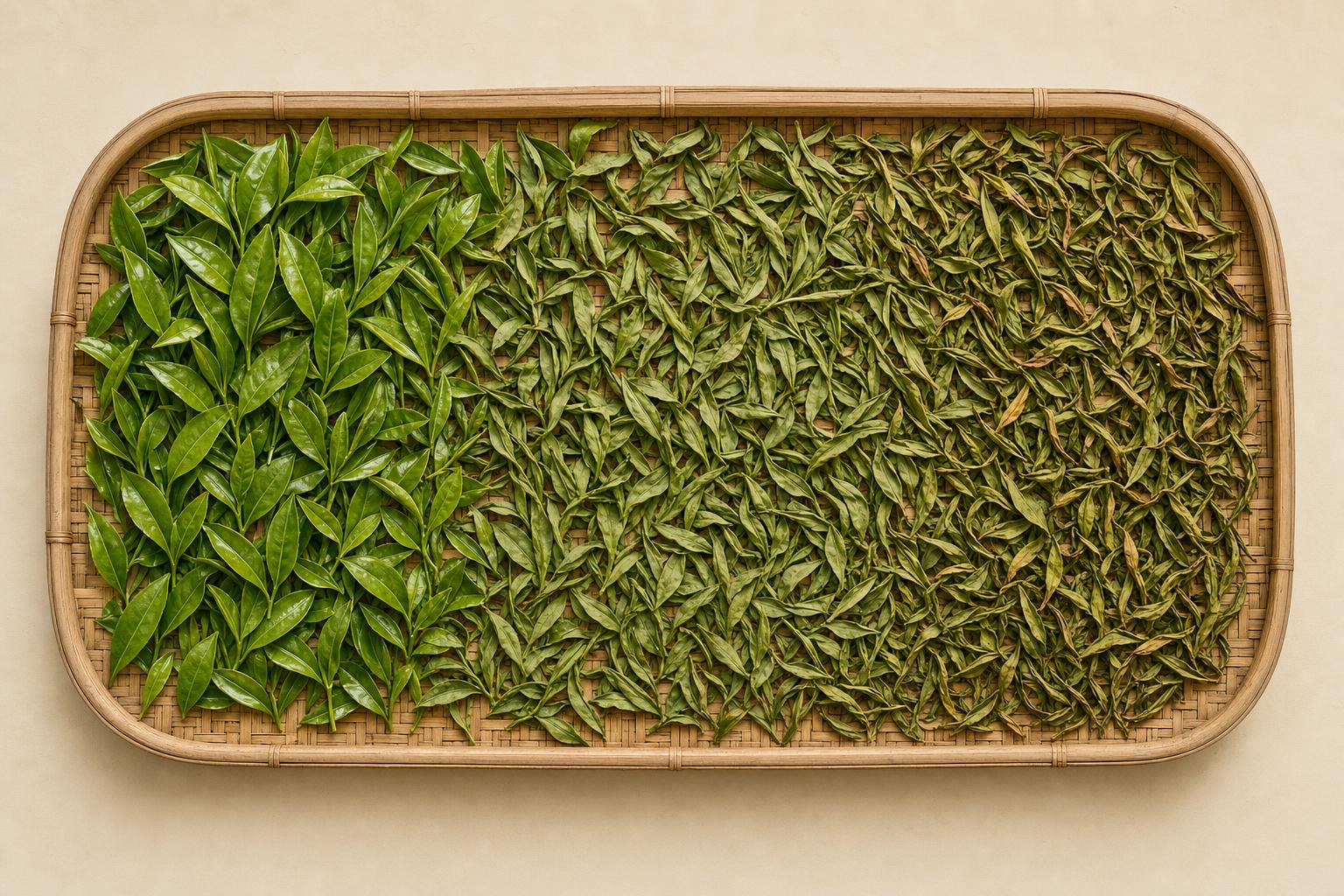
The first step in nearly all tea production is withering — the controlled loss of moisture from freshly plucked leaves. Laid out on bamboo trays, mesh racks, or withering troughs, the leaves are allowed to lose between 20% and 70% of their water content over a period that may last a few hours to an entire day (Wikipedia Contributors, 2025). The process seems passive, even boring. It is neither.
As water evaporates, cell membranes weaken and become more permeable. Volatile aroma compounds begin to develop. The leaf, once turgid and snappy, becomes soft, pliant, and slightly fragrant. More subtly, enzymatic activity begins stirring: low-level oxidation starts at the margins of damaged cells, and amino acids begin interacting with sugars in early Maillard-type reactions. For the tea maker, withering is a judgment call. Under-withered leaves resist rolling and yield harsh, grassy flavors. Over-withered leaves lose vitality and can produce flat, lifeless tea (Heiss & Heiss, 2010).
The degree of withering also sets the stage for what follows. Black teas are typically withered heavily — sometimes losing over half their moisture — to prepare the leaves for vigorous rolling. Delicate white teas are withered gently and for extended periods, with minimal physical manipulation afterward. In Japanese green tea production, withering is often skipped entirely; leaves go almost straight from the field to the steaming apparatus, preserving every ounce of their fresh, vegetal energy.
Rolling and Shaping: Breaking Open the Cells
Rolling is where the chemistry is physically unleashed. Whether done by hand on bamboo mats or by machine between ridged metal plates, rolling bruises and ruptures the leaf's cellular structure. Cell walls crack open. Vacuolar contents spill into the cytoplasm. PPO meets catechins. Oxygen rushes in. The oxidation engine has been started.
But rolling serves a dual purpose. It also shapes the leaf: tight pearls for gunpowder green, twisted strips for orthodox black, long curled needles for certain oolongs. The tightness of the roll matters chemically. A tightly rolled leaf oxidizes more slowly after rolling because less surface area is exposed to air. A loosely rolled or heavily macerated leaf (as in CTC — Crush, Tear, Curl — production for commercial black tea bags) oxidizes rapidly because more cell content is exposed to oxygen. The tea maker, in deciding how vigorously to roll, is also deciding how fast and how uniformly oxidation will proceed (Heiss & Heiss, 2010).
The Heart of the Matter: Enzymatic Oxidation
If withering is the prologue and rolling the inciting incident, then enzymatic oxidation is the central drama of tea processing. This is the process that separates a green tea from an oolong from a black tea, and understanding it is essential for making sense of the entire tea spectrum.
The Mechanism
Once PPO encounters catechins in the presence of oxygen, it catalyzes their oxidation. The first major products are theaflavins — bright, orange-gold dimers formed by the coupling of specific catechin pairs. Research has shown that theaflavin formation requires the pairing of a dihydroxy-B-ring catechin (like epicatechin) with a trihydroxy-B-ring catechin (like epigallocatechin); two catechins of the same type will not produce theaflavins (Kuhnert et al., 2014). The reaction likely proceeds through a quinone intermediate: PPO first oxidizes one catechin into its quinone form, which then reacts with a non-oxidized partner to form the theaflavin (Kuhnert et al., 2014).
Simultaneously, PPO generates hydrogen peroxide as a by-product. A second enzyme, peroxidase (POD), uses this peroxide to drive further oxidation of theaflavins into thearubigins — a vastly more complex family of polymeric compounds that are responsible for the deep brown-red color and full-bodied mouthfeel of black tea (Sang et al., 1999). Using advanced mass spectrometry, Kuhnert et al. (2010) identified an astonishing 5,000+ individual thearubigin components in a single black tea, ranging in molecular mass from 1,000 to 2,100 daltons. They proposed an "oxidative cascade hypothesis" in which thearubigins form through successive rounds of oxidative coupling — catechin dimers combining with other dimers and trimers in an ever-branching molecular tree.
What Changes as Oxidation Progresses
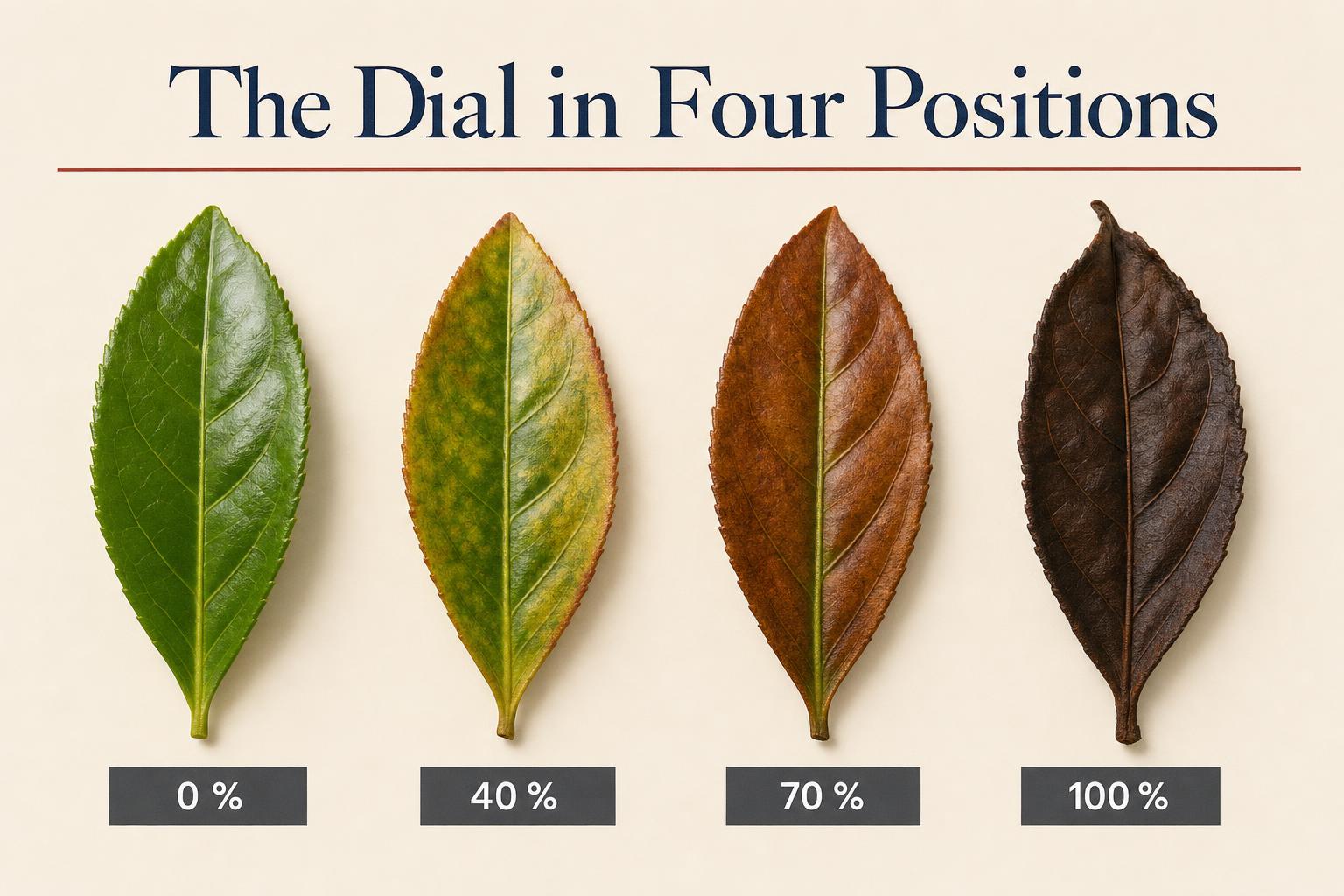
As oxidation advances, the leaf undergoes a visible metamorphosis. Green catechins — which are colorless to pale yellow in solution — give way to golden theaflavins and then dark-hued thearubigins. The aroma shifts too: fresh, grassy notes are replaced first by floral compounds, then by fruity esters, and finally by malty, biscuity Maillard reaction products as the chemical environment changes. The astringency of raw catechins mellows as they polymerize into smoother-tasting thearubigins. Thearubigins can constitute up to 60% of the dry weight of black tea extract, despite their chemical structures remaining only partially characterized (Abudureheman et al., 2022).
The degree of oxidation thus determines the tea type. Stopping oxidation near the beginning — say, at 5–15% — preserves most catechins and yields a tea with bright green character and grassy freshness. Allowing oxidation to run through the middle range — roughly 20–70% — produces the extraordinary diversity of oolong teas, from the barely-oxidized, floral Baozhong to the deeply-oxidized, roasty Da Hong Pao. Letting oxidation run to near completion produces black tea (called hong cha, "red tea," in Chinese for the color of its liquor), with its characteristic copper-brown leaf, amber infusion, and malty richness.
Kill-Green: Arresting the Transformation
If oxidation is the engine, then kill-green (sha qing, 杀青) is the brake. This critical step applies heat to the leaves to denature PPO and POD, permanently halting enzymatic oxidation. The timing of kill-green is what fixes the tea at its intended point on the oxidation spectrum.
Two dominant traditions exist for kill-green, and each leaves an unmistakable flavor signature. Pan-firing, the Chinese method, involves tumbling leaves in a heated wok or rotating drum at temperatures around 200–280°C. The brief contact with dry, intense heat produces a characteristic toasty, nutty note — think of the chestnut sweetness in a Longjing (Dragon Well). Steaming, the Japanese method, blankets the leaves in steam for 15–45 seconds, denaturing enzymes without adding any roasted character. The result preserves a vivid marine-green color, a vegetal aroma, and an umami-rich sweetness entirely distinct from pan-fired teas (Wikipedia Contributors, 2025).
For green teas, kill-green comes before rolling, locking in the fresh-leaf chemistry. For oolongs, kill-green comes after the desired level of oxidation is reached — sometimes through multiple rounds of alternating rolling and resting. For black teas, kill-green is typically not applied at all; instead, the fully oxidized leaves are dried at high temperature, which incidentally halts remaining enzyme activity. That distinction — whether and when heat is applied — is one of the most consequential decisions in all of tea making.
Drying: Sealing the Transformation
The final universal step is drying — reducing the leaf's moisture content to around 2–5% to render it shelf-stable and prevent microbial growth. Drying can be accomplished through oven-drying, charcoal roasting, sun-drying, or hot-air tumbling. Like every other step, it is not chemically neutral: the heat of drying drives Maillard reactions between amino acids and sugars, producing additional flavor compounds. A charcoal-roasted Wuyi oolong owes much of its caramel-rock complexity to the drying stage, not just to oxidation.
Microbial Fermentation: The Other Transformation
Here we must pause and address one of the most persistent sources of confusion in the tea world: the word "fermentation." In casual tea parlance, black tea is routinely described as "fermented." This is, strictly speaking, incorrect. Black tea undergoes enzymatic oxidation — a reaction driven by the leaf's own enzymes in the presence of oxygen. No microorganisms are involved.
True microbial fermentation occurs in the production of dark teas (hei cha), most famously pu-erh. In this process, tea leaves that have already been heat-treated and dried are deliberately exposed to communities of bacteria and fungi — Aspergillus niger, Eurotium species, Blastobotrys, among others — that colonize the leaf and metabolize its compounds over weeks, months, or even decades (Zhang et al., 2016; Lv et al., 2013).
Shou vs. Sheng: Two Paths to Pu-erh
Traditional sheng (raw) pu-erh involves pressing dried, minimally processed tea into cakes and allowing it to age naturally. Microbial communities slowly colonize the compressed leaves over years and decades, gradually transforming catechins and other polyphenols into new compounds. The flavor evolves from sharp and astringent into something smooth, earthy, and complex — a patience-dependent alchemy.
Shou (ripe) pu-erh, developed in the 1970s to simulate aged sheng, accelerates this process through pile fermentation (wo dui). Large quantities of sun-dried tea are piled together, moistened, and covered. The heat and humidity trigger explosive microbial growth. Zhang et al. (2016) found that while fungal diversity drops during pile fermentation, bacterial diversity rises dramatically — the microbial ecology is actively reshaped. Over 45–60 days, the tea develops its signature dark liquor, earthy aroma, and smooth, almost chocolatey character.
The distinction is chemically fundamental. Enzymatic oxidation is an aerobic reaction catalyzed by the plant's own enzymes, producing theaflavins and thearubigins. Microbial fermentation involves living organisms breaking down and resynthesizing organic compounds, producing an entirely different suite of metabolites. Conflating the two is like confusing caramelization with composting — both transform organic matter, but through utterly different mechanisms (Lv et al., 2013).
The Tea Maker's Craft: Where Science Meets Art
Listing the processing steps — wither, roll, oxidize, kill-green, dry — can make tea production sound like following a recipe. It is not. Each step involves a cascade of sensory judgments that cannot be fully captured in a manual. As Heiss and Heiss (2010) emphasize, master tea makers rely on sight, smell, touch, and even hearing to guide their decisions. They feel the leaf between their fingers to judge withering progress. They watch the color of the bruised edges to gauge oxidation. They listen to the sound of leaves hitting the wok to calibrate kill-green temperature. They smell constantly — evaluating the shift from cut-grass to floral to fruity — to determine the exact moment to apply heat.
"No two batches of even the 'same' tea are ever exactly alike, because the raw material changes daily with the weather, and the maker's response must change with it."
Heiss & Heiss, 2010
This is why the same cultivar, grown in the same garden, processed in the same shed, can yield strikingly different teas when handled by different makers. One may wither slightly longer, sensing that the morning's harvest was more turgid than yesterday's due to overnight rain. Another may roll more gently, adjusting for a particularly tender spring flush. These are not factory settings toggled by computer — they are embodied knowledge, learned through years of apprenticeship and thousands of batches.
Terroir Revisited: Nature Meets Craft
The interplay between raw material and processing is the great theme of this course. A high-altitude leaf rich in catechins (but with a lower ratio of the most astringent forms like EGCG) can handle longer oxidation because it has abundant substrate for theaflavin production without tipping into excessive bitterness (Li et al., 2022). A lowland leaf with a higher polyphenol-to-amino acid ratio may need more careful management — shorter oxidation, tighter rolling — to avoid harsh astringency. The tea maker reads the leaf and responds. Nature proposes; the artisan disposes.
Key Takeaways
- All tea types come from the same species, Camellia sinensis; the differences between green, oolong, black, and dark teas are created by processing, not by different plants.
- Enzymatic oxidation — catalyzed by the leaf's own polyphenol oxidase — converts catechins first into theaflavins (golden, brisk) and then into thearubigins (dark, smooth), progressively shifting color, flavor, and mouthfeel.
- Kill-green (sha qing) halts oxidation by denaturing enzymes with heat; its timing determines where on the green–oolong–black spectrum a tea falls.
- Steaming (Japanese) and pan-firing (Chinese) are two kill-green methods that produce distinctly different flavor profiles even when applied at the same oxidation level.
- Microbial fermentation (as in pu-erh) is a biologically distinct process from enzymatic oxidation — it involves living microorganisms transforming the leaf over weeks to decades.
- Tea making is an artisanal craft: the tea maker's sensory judgments at every stage interact powerfully with the terroir-driven chemistry of the raw leaf.
- Processing choices and growing conditions are inseparable — a high-altitude leaf responds differently to oxidation than a lowland leaf, and skilled makers adjust accordingly.
Now that we can trace any tea from fresh leaf to finished product, Chapter 3 invites us to explore the major tea families one by one — green, white, yellow, oolong, black, and dark — tasting exemplary teas from each category and mapping their flavor profiles to the chemical and processing principles we've just learned. We'll begin to build a personal tasting vocabulary and discover how regional traditions have shaped each family's identity over centuries. Bring your cups; we're about to drink our way through the spectrum.
References
Abudureheman, B., Yu, X. C., Fang, D. D., & Zhang, H. H. (2022). Enzymatic oxidation of tea catechins and its mechanism. Molecules, 27(3), 942.
Heiss, M. L., & Heiss, R. J. (2010). The tea enthusiast's handbook: A guide to enjoying the world's best teas. Ten Speed Press.
Kuhnert, N., Drynan, J. W., Obuchowicz, J., Clifford, M. N., & Sherrill, M. (2010). Mass spectrometric characterization of black tea thearubigins leading to an oxidative cascade hypothesis for thearubigin formation. Rapid Communications in Mass Spectrometry, 24(23), 3387–3404.
Kuhnert, N., Dairpoosh, F., Yassin, G., Golon, A., & Jaiswal, R. (2014). Investigation of processes in black tea manufacture through model fermentation (oxidation) experiments. Journal of Agricultural and Food Chemistry, 62(31), 7730–7740.
Li, J., Yang, Y., Sun, K., Chen, Y., Chen, X., & Li, X. (2022). Effects of temperature and light on quality-related metabolites in tea [Camellia sinensis (L.) Kuntze] leaves. Food Research International, 161, 111959.
Lv, H. P., Zhang, Y., Shi, J., & Lin, Z. (2013). Processing and chemical constituents of pu-erh tea: A review. Food Research International, 53(2), 608–618.
Sang, S., Tian, S., Wang, H., Stark, R. E., Rosen, R. T., Yang, C. S., & Ho, C. T. (1999). Role of polyphenol oxidase and peroxidase in the generation of black tea theaflavins. Journal of Agricultural and Food Chemistry, 51(25), 7570–7578.
Wikipedia contributors. (2025). Tea processing. In Wikipedia, The Free Encyclopedia.
Zhang, Y., Skaar, I., Sulyok, M., Liu, X., Rao, M., & Taylor, J. W. (2016). The microbiome and metabolites in fermented pu-erh tea as revealed by high-throughput sequencing and quantitative multiplex metabolite analysis. PLoS ONE, 11(6), e0157847.