Water Is the Other Ingredient
A great tea badly brewed is a waste. An ordinary tea brewed with understanding can be a revelation. Everything between those two cups is chemistry.
Imagine two cups of tea brewed from the same pouch of competition-grade Taiwanese Li Shan oolong — leaves that cost roughly $40 per ounce. The first cup is brewed gongfu style: 6 grams of leaf in a 100-milliliter gaiwan, 90°C water, steeped for 45 seconds. The liquor is luminous gold, intensely floral, with a long, buttery sweetness that seems to coat the inside of your mouth. The second cup uses the same leaf, but someone has tossed 3 grams into a 350-milliliter mug, poured in furiously boiling water, and left it for seven minutes while checking email. The result is cloudy amber, aggressively bitter, and astringent enough to make your tongue feel like sandpaper.
Same leaf. Same day. Radically different cups. The difference is entirely in the brewing — and that means the difference is entirely in the chemistry of extraction. This chapter is about understanding that chemistry so well that you can make any tea sing, and diagnose what went wrong when it doesn't.
The Extraction Equation
Tea brewing is, at its core, a selective dissolution problem. A processed tea leaf contains hundreds of water-soluble compounds — amino acids, alkaloids, polyphenols, sugars, organic acids, volatile aromatics — and the brewer's job is to coax the desirable ones into the water while leaving the unpleasant ones behind, or at least keeping them in balance. The three variables you control are water temperature, steeping time, and the leaf-to-water ratio. Change any one of them, and you change the cup.
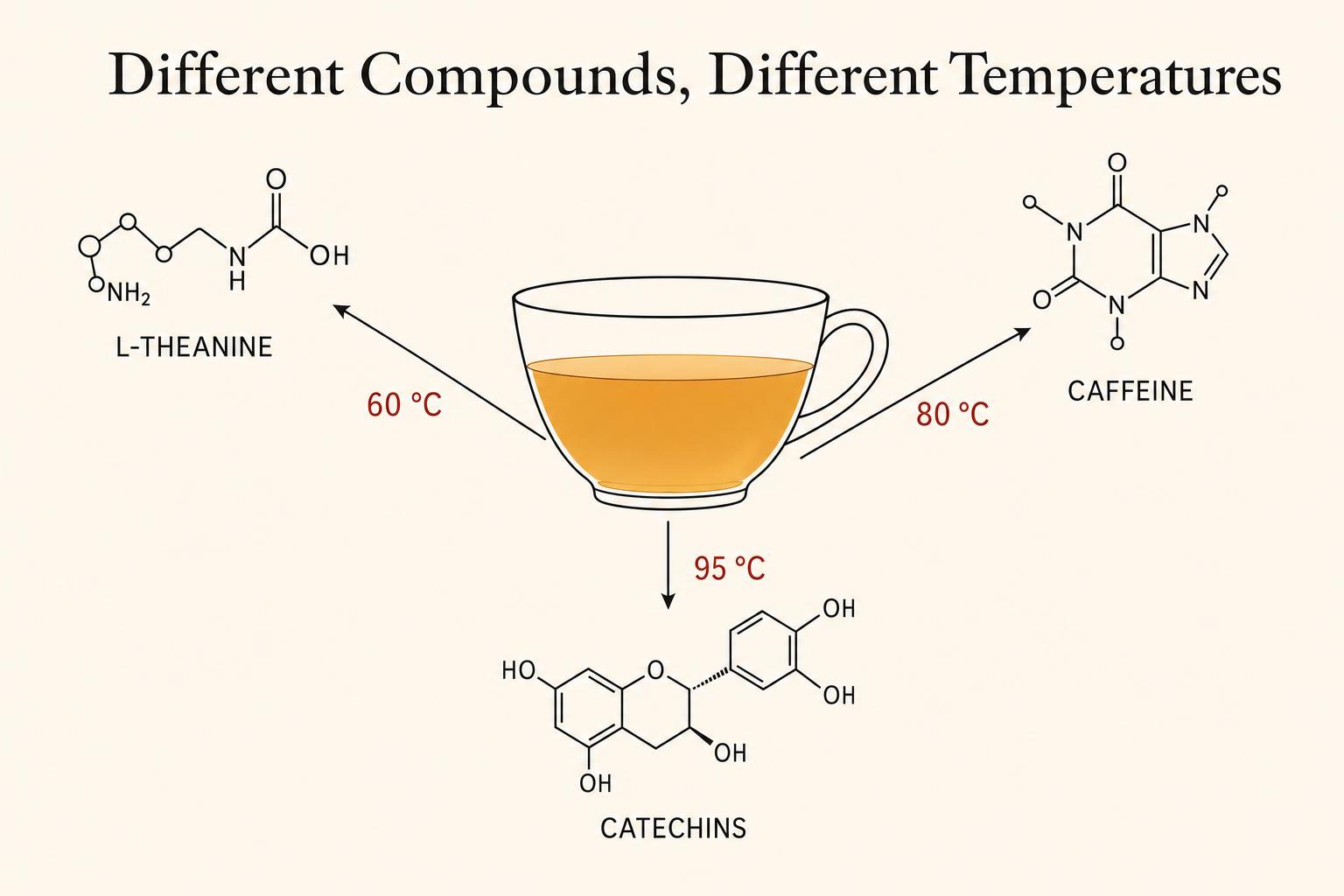
But here is the crucial insight that separates informed brewing from guesswork: different compounds dissolve at different rates and respond differently to temperature. This is what scientists call differential solubility, and it is the single most important concept in practical tea brewing.
The Three Key Players
Let's focus on three families of compounds that dominate the flavor of any cup of tea:
- L-theanine — An amino acid nearly unique to Camellia sinensis. It contributes sweetness, umami richness, and a sensation the Japanese call kokumi — a sort of full-bodied depth. L-theanine is highly soluble and dissolves readily even in relatively cool water. Research by Koláčková et al. (2024) showed that brewing temperature did not significantly affect L-theanine content; the amino acid dissolved primarily within the first five minutes regardless of whether the water was 80°C or 100°C, and its structure remained stable across the 60–100°C range.
- Caffeine — The alkaloid responsible for tea's stimulating effect and a contributor to perceived bitterness. Caffeine occupies a middle ground: it extracts relatively quickly — Lantano et al. (2015) found it released within the first few minutes of black tea brewing — but its solubility is meaningfully temperature-dependent. Hotter water pulls more caffeine. Koláčková et al. (2024) confirmed that caffeine showed significantly higher extraction at 100°C compared to 80°C across all six tea types studied.
- Catechins — The major polyphenols in tea, responsible for bitterness, astringency, and the health-promoting antioxidant activity you've likely heard about. The catechin family is large, and its members behave differently. Labbé et al. (2006) made a landmark distinction: some catechins (EGC, EC) are primarily time-dependent, dissolving steadily over longer steep periods, while others (EGCG, ECG, GCG) are time-and-temperature-dependent, requiring both heat and duration to extract fully. This is why a brief steep at moderate temperature yields sweetness without excessive bitterness: you've extracted the theanine and some caffeine, but left much of the catechin payload behind.
Şahin Nadeem et al. (2015) captured this dynamic beautifully in their study of Turkish green tea: brewing at 85°C for three minutes yielded the highest EGCG content (50.69 mg/100ml) and the highest sensory scores. Brew the same tea at 95°C for 45 minutes, and EGCG yield increases — but the panel found the tea unacceptably bitter. The chemistry is doing exactly what the math predicts; the question is what the drinker actually wants in the cup.
Temperature: The Master Variable
Of the three brewing variables, temperature has the most dramatic effect on extraction chemistry. This is because of a principle from physical chemistry: the rate of dissolution roughly doubles for every 10°C increase in temperature. For a compound like EGCG, which Labbé et al. (2006) classified as time-and-temperature-dependent, the difference between 70°C and 90°C is not a gentle nudge — it is a roughly fourfold increase in extraction rate.
This is why temperature recommendations vary so widely across tea types. A delicate white tea or shade-grown Japanese green, loaded with L-theanine and low in catechins from its processing history, brews beautifully at 60–75°C: the amino acids dissolve freely, caffeine comes along gently, and the catechins remain largely in the leaf. A heavily roasted Wuyi Da Hong Pao, by contrast, has had many of its more volatile compounds transformed by fire (as Chapter 2 explored). Its remaining flavor compounds — caramelized sugars, deeper phenolics, mineral-like notes — need the kinetic energy of near-boiling water to unlock. Brew it at 70°C and it will taste thin and muted; brew it at 95°C and it roars to life.
Time: The Slow Reveal
If temperature is the accelerator, time is the distance traveled. Lantano et al. (2015) identified two distinct phases in black tea extraction: a rapid initial release (the first 1–2 minutes, when caffeine, gallic acid, and some catechins flood into solution) and a slower secondary phase (2–8 minutes, during which total polyphenols and flavonoids gradually climb). Most brewing traditions implicitly navigate these two phases. A 30-second gongfu infusion captures the bright, aromatic first phase. A five-minute Western steep lets the second phase develop, building body and tannic structure.
Ratio: Concentration and Contact
The leaf-to-water ratio determines both the concentration of the resulting liquor and the physical dynamics of extraction. More leaf in less water means each gram of leaf has less solvent available, so the solution saturates faster — producing an intense but shorter extraction. Less leaf in more water creates a dilute environment where extraction can continue longer before reaching equilibrium. Khokhar and Magnusdottir (2002) demonstrated that the tea-to-water ratio, along with infusion time and agitation, was among the most significant preparation variables affecting final caffeine and polyphenol content in the cup.
This is the key to understanding why gongfu brewing uses a dramatically higher leaf ratio (often 5–8 grams per 100ml) but very short steeps: the concentrated environment extracts flavor quickly and intensely, and the brewer controls the process by limiting time. Western-style brewing inverts this logic — a lighter ratio (roughly 2 grams per 200ml) and a longer steep, letting the dilute solution gradually accumulate flavor compounds.
The Forgotten Variable: Water Itself
Tea is roughly 99% water. Yet most discussions about brewing obsess over leaf quality and technique while treating water as a neutral carrier. It is not. The mineral content of your brewing water is one of the most powerful — and most overlooked — influences on the final cup.
The legendary eighth-century Chinese tea sage Lu Yu devoted an entire section of his Cha Jing (Classic of Tea) to ranking water sources, placing mountain spring water first and well water last. This was not mysticism. The springs near great tea-growing regions — the Wuyi Mountains, the hills around West Lake in Hangzhou — happen to have mineral profiles that are chemically well-suited to tea extraction. Modern science has caught up to Lu Yu's intuition.
Minerals and Their Effects
Franks et al. (2019) conducted a pivotal study comparing green and black tea brewed with tap water, bottled water, and deionized water. The results were striking: brewing green tea with high-mineral tap water produced infusions with roughly half the EGCG content of the same tea brewed with deionized or bottled water. The mineral content — particularly calcium — was binding with catechins and precipitating them out of solution, literally removing them from the drink. Paradoxically, this made the tap-water green tea taste less bitter and somewhat sweeter, because the compounds responsible for bitterness were no longer in the liquid. The chemistry was worse; the flavor, for some drinkers, was arguably better.
Three minerals matter most:
- Calcium (Ca²⁺) — At moderate levels (10–40 ppm), calcium can enhance perceived body and mouthfeel. At high levels (above 80–100 ppm), it complexes with polyphenols, forming insoluble precipitates that cloud the liquor and strip out flavor complexity (Franks et al., 2019). Very hard water — London tap water, for instance, often exceeds 200 ppm calcium — can make delicate teas taste flat and muddy.
- Magnesium (Mg²⁺) — Magnesium tends to brighten acidity and enhance perceived crispness. Bai et al. (2023) found that mineral content and pH were the primary factors affecting volatile compound extraction, and magnesium's contribution to slightly lower pH environments may explain why certain mineral waters produce more aromatic cups.
- Bicarbonates (HCO₃⁻) — Bicarbonates raise pH (making water more alkaline) and have a pronounced dulling effect on aromatics. High-bicarbonate water tends to produce tea that tastes "flat" and one-dimensional, suppressing the bright, lifted notes that make great tea exciting. Bai et al. (2023) concluded that water with a pH of 6–7 and lower mineral content was most conducive to brewing green tea with full aromatic expression.
The practical takeaway is that the ideal brewing water occupies a Goldilocks zone: enough minerals to give the tea body and dimension, but not so many that they interfere with extraction or mute aromatics. For most teas, this means a total dissolved solids (TDS) level of roughly 50–150 ppm, a pH near neutral (6.5–7.5), and relatively low bicarbonate content. Many dedicated tea drinkers in cities with hard tap water use filtered or lightly remineralized water for exactly this reason.
Four Ways to Solve the Same Puzzle
Every brewing method is, at bottom, a strategy for managing the extraction variables we've discussed. The world's tea traditions have arrived at strikingly different solutions — not because some cultures are "right" and others "wrong," but because they are optimizing for different leaf types, different flavor goals, and different social contexts. Let's examine four major approaches.
Gongfu Brewing
Originating in the Chaozhou region of Guangdong province and refined across southeast China and Taiwan, gongfu brewing ("brewing with skill") uses a high leaf-to-water ratio (typically 5–8g per 100ml), small vessels (gaiwans or Yixing clay pots), near-boiling water, and very short steep times — often 10–30 seconds for the first infusions, increasing gradually over many successive steeps. This approach is optimized for oolong and pu-erh teas, whose complex processing creates layers of flavor that reveal themselves sequentially across multiple infusions. Each steep extracts a slightly different balance of compounds as the leaf opens progressively.
Western-Style Brewing
The European tradition uses a lower leaf ratio (roughly 2–3g per 200ml), larger vessels (teapots, mugs), and a single steep of 3–5 minutes. This method aims to extract a complete, balanced cup in one go. It works well for CTC black teas and robust broken-leaf styles designed for exactly this kind of extraction, but can easily over-extract delicate whole-leaf teas if the brewer isn't careful with temperature and time.
Cold Brewing
By removing heat from the equation entirely, cold brewing radically reshapes the extraction profile. Chen and Yen (2014) demonstrated that cold-brewed green tea had significantly lower caffeine, EGCG, and EGC content compared to hot-brewed versions — the cold water simply lacks the kinetic energy to dissolve these compounds efficiently. The result is a tea that is notably less bitter and less astringent, with a clean, sweet, and often surprisingly aromatic character. Cold brewing is not a lesser method; it is a different optimization that privileges smoothness and accessibility, making it ideal for teas with high inherent bitterness.
Grandpa Style
Perhaps the most unpretentious method of all: grandpa-style brewing involves placing a small amount of leaf directly into a tall glass, adding hot water, and drinking continuously — topping up with hot water as the level drops. The leaves sit in the liquid the entire time, creating a continuously evolving extraction. The first sips are light and aromatic; the middle is rich and full; as the leaf exhausts its soluble compounds, the later refills become gentle and sweet. It works best with teas that are forgiving of long steeping — many Chinese green teas, light oolongs, and white teas. It fails spectacularly with heavily catechin-rich teas that turn brutally bitter with continuous contact.
The key insight is that a tea's origin (Chapter 1) and processing (Chapter 2) determine which method will best reveal its character. A heavily roasted Wuyi Da Hong Pao, with its deep, fire-transformed compounds, is built for gongfu: the sequential short steeps peel back layer after layer of mineral, caramel, and stone-fruit notes. The same method applied to a delicate Darjeeling first flush would overwhelm the leaf's muscatel brightness with excessive concentration. Conversely, cold brewing a shou pu-erh — a tea whose earthy depth depends on compounds that need heat to dissolve — would produce little more than faintly brown water.

Diagnosing the Cup: A Brewer's Troubleshooting Guide
Armed with an understanding of extraction kinetics, you can now work backwards from a problem in the cup to its cause — and its fix.
Too bitter? You've extracted too many catechins. The most likely culprits are water that was too hot, a steep that was too long, or both. Lower your temperature by 5–10°C, shorten your steep, or both. If you're using very hard water, the bitterness might actually be lower than it should be (calcium is precipitating catechins), which means the remaining bitterness is from caffeine — in which case, reduce temperature specifically.
Too thin or watery? You haven't extracted enough soluble material. Increase your leaf-to-water ratio first (the simplest fix), then consider raising temperature or extending time. If you're using very soft or distilled water, the lack of mineral content may be producing a "flat" character that reads as thin — try water with moderate mineral content (Bai et al., 2023).
Great aroma but no body? Volatile aromatics are often the first compounds released, while body-building polyphenols and sugars need more time and heat. Let the steep go slightly longer, or raise the temperature by 5°C. You may also be under-leafing.
Cloudy or murky? This often signals high calcium content in the water reacting with tea polyphenols to form insoluble complexes (Franks et al., 2019). Switch to filtered or lower-mineral water. Cloudiness can also result from cooling — a phenomenon called "cream down" in black tea, where caffeine-tannin complexes precipitate as the liquid cools. This is cosmetic, not a flavor defect.
"The mastery is not in following a recipe. The mastery is in tasting the result, understanding what happened, and knowing which variable to adjust."
A working tea-brewer's maxim
Bringing It All Together
The terroir of a tea (Chapter 1) shapes its raw chemical composition. Processing (Chapter 2) transforms that composition through oxidation, heating, and shaping. Brewing — this chapter — is the final act: the moment when a brewer's choices about water, temperature, time, and ratio determine which of those chemicals actually end up in the cup. A great tea badly brewed is a waste. An ordinary tea brewed with understanding and care can be a revelation.
The variables are not independent. A tea grown at high altitude, rich in L-theanine from cool growing conditions and minimal oxidation, calls for lower temperatures and shorter times to preserve its sweetness — and moderate-mineral water that won't suppress its delicate aromatics. A fully fermented shou pu-erh, its compounds already deeply transformed by microbial activity, demands near-boiling water and sequential gongfu steeps to unlock its layered earthiness. The brewing parameters are not arbitrary; they are logical consequences of the leaf's history.
As Khokhar and Magnusdottir (2002) concluded in their comprehensive survey, the preparation method — more than the tea variety, more than the grade — is the dominant determinant of what ends up in the final beverage. The leaf provides the potential. The water and the brewer realize it.
Key Takeaways
- Tea compounds extract at different rates and temperatures: L-theanine dissolves quickly at low temperatures; catechins require more heat and time; caffeine sits between the two. This differential solubility is the foundation of all brewing strategy.
- Temperature is the most powerful brewing variable, roughly doubling extraction rate for every 10°C increase — which is why delicate teas need cooler water and roasted teas need hotter water.
- The leaf-to-water ratio determines concentration and extraction dynamics; gongfu brewing (high ratio, short time) and Western brewing (low ratio, long time) are inverse strategies for the same chemical puzzle.
- Water mineral content profoundly affects extraction: calcium can precipitate polyphenols, magnesium brightens acidity, and bicarbonates dull aromatics. The ideal brewing water sits in a moderate mineral range (50–150 ppm TDS).
- Every brewing method — gongfu, Western, cold brew, grandpa style — is a specific solution to the extraction equation, optimized for different leaf types and desired outcomes.
- Brewing problems (bitterness, thinness, cloudiness) can be diagnosed and fixed by understanding which extraction variable is out of balance.
You now understand how to control extraction and optimize the cup. But what exactly are you tasting when you take that first sip? In Chapter 4, we turn to the science of sensory evaluation — how your tongue, nose, and brain collaborate to construct the experience of flavor, and how to develop a systematic vocabulary for describing what you perceive. You'll learn why aroma matters more than taste, what "mouthfeel" really is, and how to taste tea with the precision of a professional.
References
Bai, J., Zhang, Y., Chen, Y., et al. (2023). The types of brewing water affect tea infusion flavor by changing the tea mineral dissolution. Food Chemistry: X, 18, 100693.
Chen, Y.-R., & Yen, T.-M. (2014). Effect of different brewing methods on quality of green tea. Journal of Food Processing and Preservation, 39(6), 2199–2207.
Franks, M., Lawrence, P., Abbaspourrad, A., et al. (2019). The influence of water composition on flavor and nutrient extraction in green and black tea. Nutrients, 11(1), 80.
Khokhar, S., & Magnusdottir, S. G. M. (2002). Factors affecting the caffeine and polyphenol contents of black and green tea infusions. Journal of Agricultural and Food Chemistry, 50(20), 5722–5726.
Koláčková, S., Kolofiková, L., Sytařová, J., et al. (2024). Determination of L-theanine and caffeine contents in tea infusions with different fermentation degrees and brewing conditions. Foods, 13(24), 4037.
Labbé, D., Araya-Farias, M., Tremblay, A., & Bazinet, L. (2006). Effect of brewing temperature and duration on green tea catechin solubilization. Separation and Purification Technology, 49(1), 1–9.
Lantano, A. M. T., Baroni, M. T., Noratto, D., et al. (2015). Extraction kinetics of phytochemicals and antioxidant activity during black tea (Camellia sinensis L.) brewing. Journal of Food Science and Technology, 52(5), 2797–2805.
Şahin Nadeem, M., Yılmaz, F. M., Barka, M. T., & Kadakal, C. (2015). Effects of different brewing conditions on catechin content and sensory acceptance in Turkish green tea infusions. Journal of Food Science and Technology, 52(10), 6639–6646.