Leaves That Moved Empires
A leaf's chemistry shaped an empire's trade, which shaped a colony's fury, which shaped a nation's birth. Tea has always been more than a beverage.
On the night of December 16, 1773, a group of colonists disguised as Mohawk warriors boarded three ships in Boston Harbor and dumped 342 chests of tea into the water. The act was symbolic, defiant, and — viewed through the lens of this course — quietly revealing. The chests contained black tea, not green. Why? Because fully oxidized black tea, with its stable theaflavins and thearubigins, could survive the months-long sea voyage from Canton without spoiling. A leaf's chemistry shaped an empire's trade, which shaped a colony's fury, which shaped a nation's birth. Tea has always been more than a beverage.
This chapter steps back from the cup to ask a larger question: How did the leaves of Camellia sinensis become one of the most powerful agents of change in human history? The answer is not a single, tidy story. It is many stories, unfolding in parallel across continents and centuries, each shaped by the cultures that encountered this plant — and, in ways we can now appreciate, by the plant's own chemistry.
From the Mountains of Yunnan: Tea's Deep Origins
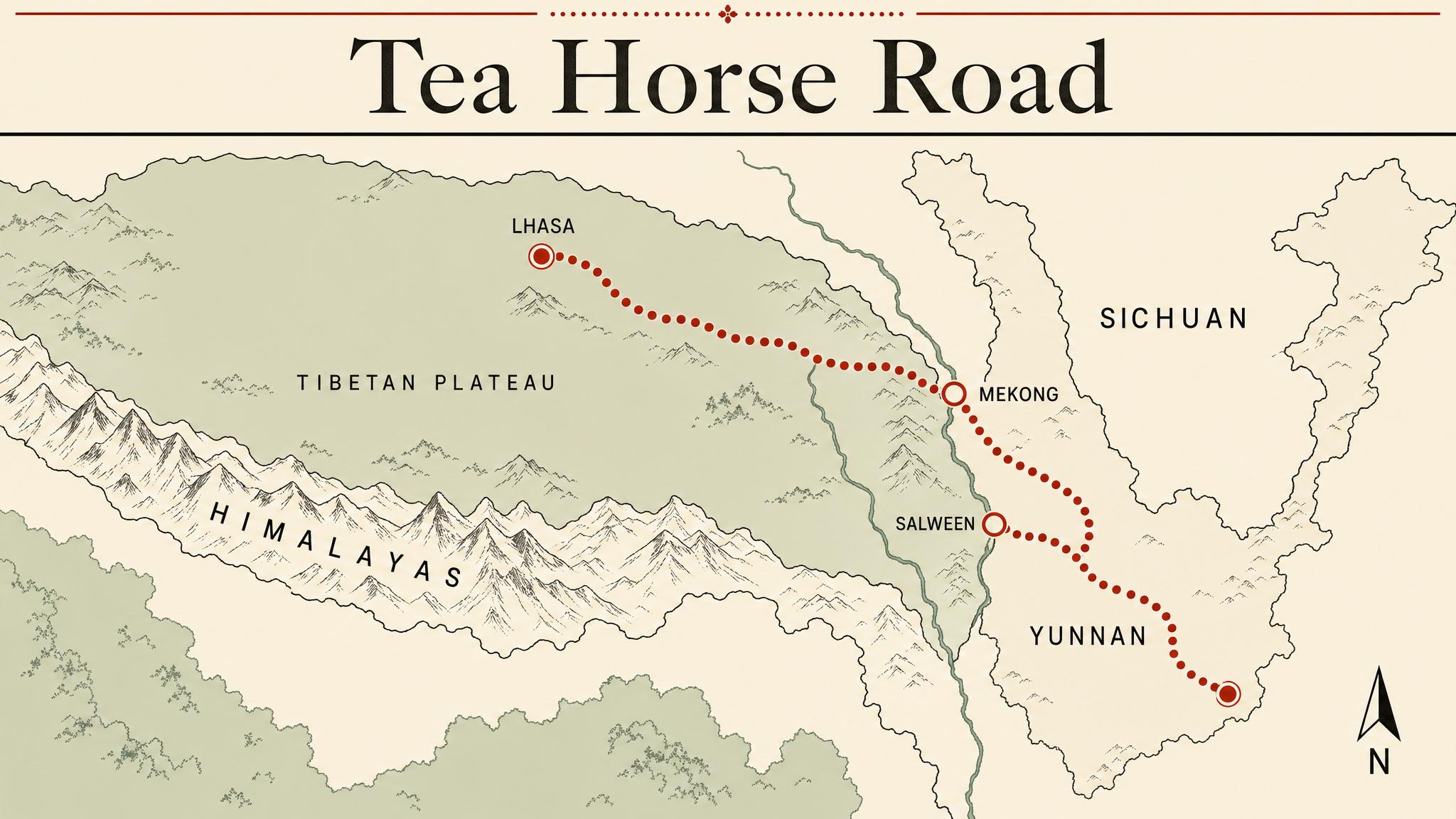
Every cup of tea traces its lineage to the misty highlands of southwestern China. The oldest wild tea trees still growing in Yunnan province are estimated to be over a thousand years old, their gnarled trunks testament to a relationship between humans and Camellia sinensis that stretches back millennia. Archaeological evidence now pushes this relationship far earlier than once thought: phytolith analysis of residues from tombs in both the Han dynasty capital of Chang'an and from sites in western Tibet has confirmed the presence of tea dating to approximately 200 CE (Lu et al., 2016). This is remarkable — it means tea was already being traded across the Tibetan Plateau two centuries into the Common Era, centuries before the first written references to the Tea Horse Road.
The Tea Horse Road was not a single path but a network of trading routes connecting Yunnan's tea-producing regions to Tibet, and from there into Central Asia and beyond. The trade was literal: compressed bricks and cakes of tea moved west and north on the backs of porters and mules, while Tibetan warhorses moved east into Chinese hands. This was no casual exchange. For Tibetan communities living at altitude on a diet rich in yak butter and barley, tea provided essential micronutrients and, critically, aided digestion — the polyphenols and caffeine in tea became dietary necessities (UNESCO Silk Roads Programme, 2023). The tea itself was typically a dark, heavily processed variety — often what we would now classify as heicha (dark tea), a predecessor to modern pu'er. Recall from Chapter 2 that these post-fermented teas undergo microbial transformation, which both preserves the leaf for long journeys and creates a smooth, earthy flavor profile that pairs naturally with the rich fats of Tibetan butter tea.
The Tea Horse Road reminds us that the history of tea is inseparable from geography and processing. Tea didn't spread randomly — it moved along routes where its particular chemistry made it valuable, and it was processed in ways that made such journeys possible. Compression into bricks and cakes wasn't merely convenient for transport; it slowed oxidation and created conditions for the beneficial microbial fermentation that defined heicha's character. The terroir of Yunnan's ancient tea forests — the elevation, the biodiversity of the soil microbiome, the large-leaf var. assamica cultivars — produced leaves with the robust polyphenol content necessary to withstand these transformations (Ma, 2023).
The Classical Chinese Cup: From Medicine to Art
While tea traveled outward along trade routes, it was simultaneously undergoing a profound cultural transformation within China itself. Early references treated tea as medicinal — a bitter tonic. But by the Tang dynasty (618–907 CE), tea had become something altogether more complex: a subject of philosophy, a medium of artistic expression, and a marker of civilized life.
The pivotal figure is Lu Yu, whose Cha Jing (Classic of Tea), completed around 760 CE, remains one of the most influential texts in tea history. Lu Yu didn't simply describe how to prepare tea — he codified an entire aesthetic and ethical framework. He specified the ideal water sources, the correct vessels, and the proper mental state for tea preparation. His preferred method involved grinding compressed tea cakes into powder and whisking them into hot water — a method that would later profoundly influence Japanese practice.
By the Song dynasty (960–1279 CE), tea culture had evolved further. Song-era tea competitions, known as doucha, judged the quality of whisked tea foam — an activity that required not only skill but also an understanding of how leaf processing affected the tea's ability to produce a stable, creamy froth. Think back to our discussions of leaf chemistry in Chapters 2 and 4: the amino acid content (particularly L-theanine), the presence of saponins, and the particle size of the ground tea all contribute to foam stability. Song dynasty tea masters were empirical sensory scientists centuries before the formal discipline existed.
The Song dynasty also saw the refinement of gongfu tea preparation — literally, tea made with skill and care — which persists today, particularly in Fujian and Guangdong provinces and in Taiwan. Gongfu cha uses small vessels (a gaiwan or a Yixing clay teapot), a high leaf-to-water ratio, and multiple short infusions. This is not mere ritual for its own sake. As we explored in Chapter 3, multiple short steeps extract different compounds sequentially: the first infusion is rich in rapidly soluble amino acids and caffeine, while later infusions draw out deeper polyphenol and polysaccharide layers. The gongfu method was, and remains, an optimized extraction protocol disguised as ceremony.
The Way of Tea: Chanoyu and Its Roots
When the Japanese monk Eisai returned from Song dynasty China in 1191, he brought with him tea seeds and the whisked-powder preparation method. But what grew from those seeds on Japanese soil was something entirely new. Over the following centuries, Japanese tea culture diverged from its Chinese origins to become chanoyu — the Way of Tea — a practice inseparable from Zen Buddhism, architecture, ceramics, and a philosophical commitment to finding beauty in imperfection (Varley & Kumakura, 1989).
The central figure in chanoyu's mature form is Sen no Rikyū (1522–1591), who radically simplified the tea ceremony to embody wabi — an aesthetic of rustic simplicity and quiet depth. Rikyū stripped away ornate Chinese-style tea rooms in favor of small, humble spaces. He championed rough, asymmetrical Korean-style tea bowls over perfect Chinese porcelain. He articulated principles — harmony (wa), respect (kei), purity (sei), and tranquility (jaku) — that elevated tea preparation into a spiritual discipline (Pitelka, 2003).
But here is where our course's interdisciplinary approach proves its worth: chanoyu's choice of matcha as its medium is not arbitrary. Matcha is made from tencha leaves — tea plants that are shade-covered for approximately three weeks before harvest. As we learned in Chapter 1, shading reduces photosynthesis, which slows the conversion of L-theanine into catechins. The result is a leaf with an unusually high amino acid content, producing the deep umami sweetness that defines fine matcha (Graham, 1992). After harvest, the leaves are steamed, dried, and stone-milled into a fine powder. When whisked with hot water, the entire leaf is consumed — not just the soluble fraction, as with steeped tea. This means the drinker ingests the full complement of lipid-soluble compounds, chlorophyll, and fiber that would otherwise remain trapped in a discarded leaf. The intensity of this experience — its vivid green color, its creamy texture, its profound umami flavor — is inseparable from the meditative focus that chanoyu demands.
Tea and Empire: The European Encounter
Tea arrived in Europe through Portuguese and Dutch traders in the early seventeenth century. The Dutch East India Company (VOC) began regular imports from China by the 1610s, and by the mid-1600s, tea was fashionable in Dutch, Portuguese, and soon British aristocratic circles (UNESCO Silk Roads Programme, 2023). But it was Britain that would build an empire around this leaf.
The British obsession with tea created an enormous economic problem. China produced virtually all the world's tea, and China wanted payment in silver. The resulting trade deficit was ruinous for Britain, which led the East India Company to a catastrophic solution: smuggling opium grown in colonial India into China to balance the books. When the Qing dynasty tried to stop this poison trade, Britain responded with military force. The First Opium War (1839–1842) ended with the Treaty of Nanking, which ceded Hong Kong to Britain and forced open Chinese ports to foreign trade (National Archives UK, n.d.). The Second Opium War (1856–1860) brought further humiliation and territorial concessions. It is essential to name what this was: a series of wars fought, at their root, because one nation's appetite for a beverage created economic pressures that led to industrial-scale drug trafficking and military aggression.
Britain simultaneously pursued another strategy to break China's monopoly: botanical espionage. In 1848, the Scottish botanist Robert Fortune was dispatched by the East India Company into China's closely guarded tea-growing regions, disguised as a Chinese merchant. He smuggled out tea plants, seeds, and — crucially — the manufacturing expertise of experienced Chinese tea workers, whom he recruited under questionable pretenses. These plants and workers were transported to the colonial plantations of Darjeeling and Assam in India, and later to Ceylon (Sri Lanka), establishing the colonial tea industry that would eventually surpass China's output (Rose, 2010).
The chemistry matters here too. Indian plantation tea was overwhelmingly black tea. Why? Partly because the Camellia sinensis var. assamica plants native to Assam, with their larger leaves and higher polyphenol content, were well-suited to full oxidation. But there were also practical reasons rooted in what you learned in Chapter 2: fully oxidized black tea is chemically more stable than green tea. The catechins in green tea are susceptible to degradation from heat, light, and moisture during long sea voyages. The theaflavins and thearubigins formed during oxidation are more resilient compounds (Stodt et al., 2014; Wong et al., 2022). Black tea arrived in London tasting the way it was supposed to. Green tea often did not. Consumer preference and chemistry co-evolved: the British came to love black tea in part because black tea was what survived the journey.
Resistance, Independence, and Tea on Its Own Terms
It would be a distortion to tell tea's story only through the lens of European empires. Tea has been a vehicle for cultural expression and political resistance in every region it has touched.
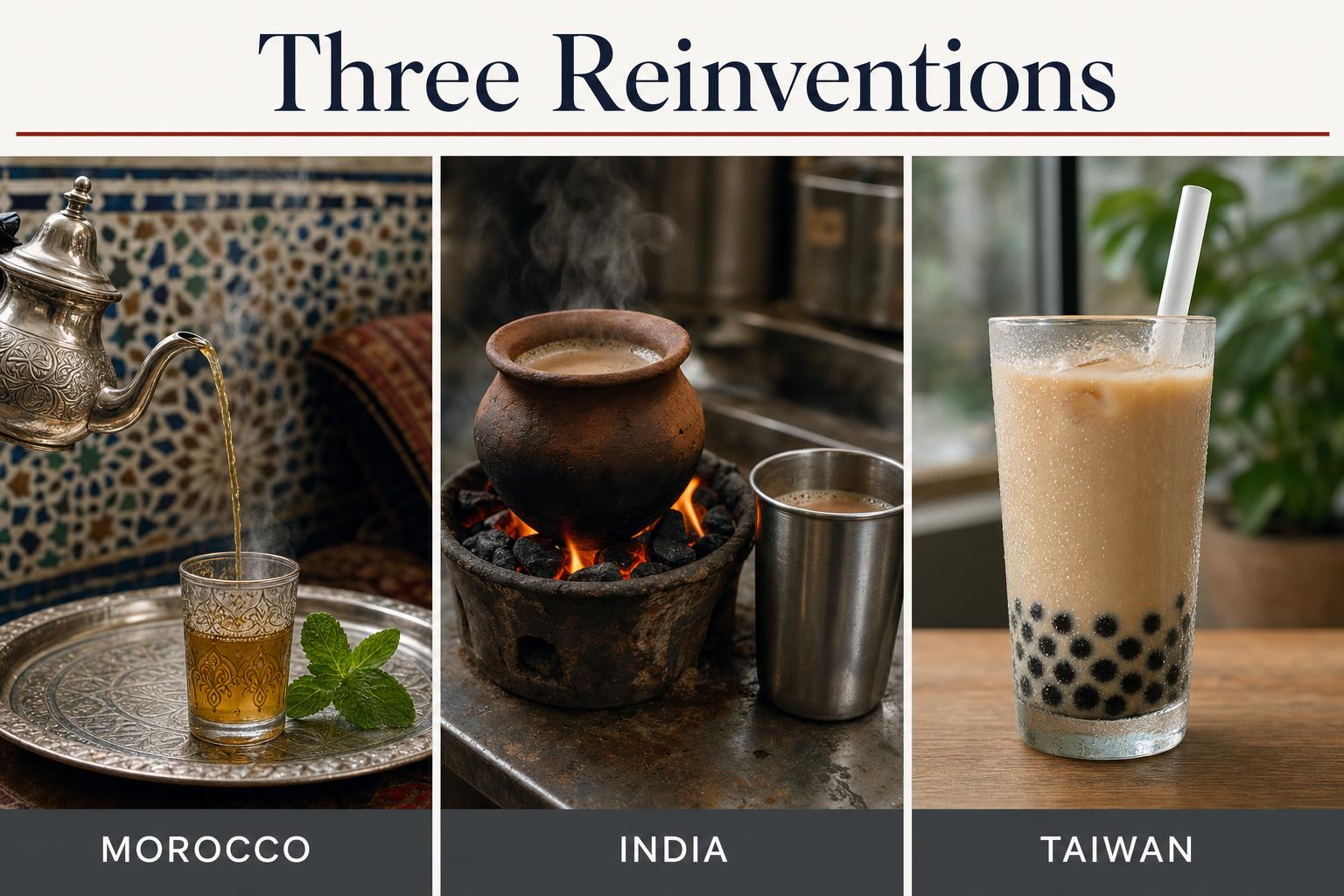
In India, the nationalist movement of the early twentieth century grappled with a painful irony: tea was both a symbol of colonial exploitation (plantation workers labored under brutal conditions) and an increasingly central part of Indian daily life. After independence in 1947, the Indian Tea Board actively promoted chai — strong black tea boiled with milk, sugar, and spices like cardamom, ginger, and cinnamon — as a national drink, transforming a colonial commodity into an expression of Indian identity. The science of chai is the science of decoction rather than infusion: boiling the tea with milk allows casein proteins to bind with tannins, reducing astringency and creating the smooth, rich body that characterizes a well-made cup (Graham, 1992). The spices contribute their own volatile aromatic compounds, which interact with the tea's flavor matrix in ways that Chapter 4's discussion of retronasal olfaction helps us understand.
In Morocco, Moroccan mint tea (atay) became central to hospitality and social life after Chinese gunpowder green tea was introduced through British trade in the eighteenth century. The preparation is specific and purposeful: the tea is brewed strong, sweetened heavily with sugar, and combined with large bunches of fresh spearmint. The tea is poured from a height into small glasses — a gesture that aerates the liquid, enhancing its aroma and creating a light froth. From an extraction standpoint (Chapter 3), the high water temperature and long steeping time extract significant catechins and caffeine from the tightly rolled gunpowder leaves, while the sugar modulates perceived bitterness and the menthol from mint activates cooling receptors on the tongue (TRPM8), creating a complex sensory experience that is chemically engineered by tradition (UNESCO Silk Roads Programme, 2023).
In Taiwan, the invention of bubble tea (boba) in the 1980s represents one of the most significant tea innovations of the modern era. Though its exact origins are debated between two Taichung tea shops, bubble tea took the traditional Taiwanese practice of shaking iced tea with milk and added chewy tapioca pearls, creating a textural experience unlike any previous tea tradition. What began as a local novelty has become a global phenomenon and a powerful marker of Taiwanese cultural identity — and, for Asian diaspora communities, a touchstone of heritage and belonging. Bubble tea's success reminds us that tea history is not finished. Innovation continues.
Parallel Histories: Seeing the Whole Map
The temptation in telling tea's story is to create a single timeline — origin in China, spread to Japan, discovery by Europe, colonial exploitation, modern globalization. But this linear narrative erases the agency and creativity of cultures that were developing their own relationships with tea independently and simultaneously. While the British were fighting the Opium Wars, the Japanese tea ceremony was entering a period of revival and democratization. While Indian plantation workers were harvesting tea under colonial management, Central Asian cultures along the old Silk Road maintained tea traditions thousands of years old. While Moroccan families were perfecting their mint tea ritual, Taiwanese tea farmers were developing the exquisite oolong processing techniques that would later inspire bubble tea's base.
Why the Science Matters to the Story
Throughout this chapter, we have seen how cultural choices about tea — which varieties to grow, how to process them, how to prepare them, how to trade them — are deeply entangled with the plant's chemistry. This is the central argument of this course: science and culture are not separate lenses for understanding tea. They are two aspects of a single, integrated reality.
The Japanese tea master who shade-grows tencha is manipulating the same L-theanine-to-catechin ratio that a food chemist measures in a laboratory. The Tibetan trader who chose compressed dark tea for the mountain crossing was intuitively selecting for microbial stability and shelf life. The British merchant who preferred black tea for the long voyage to London was, without knowing it, banking on the chemical resilience of theaflavins. The Moroccan host who pours tea from a height is aerating volatile aromatics just as a sommelier swirls a glass of wine. And the sensory experience that Ma (2023) describes among Pu'er tea traders in Yunnan — where taste vocabulary becomes a site of cultural power and negotiation — reminds us that even the act of perceiving flavor is never purely biological. It is always cultural too.
"Tea is not a thing that happened once and then was over. It is a relationship — between a plant and the many peoples who have chosen to make it part of their lives — that continues to evolve."
Reflection on tea's living history
Understanding this relationship requires both the vocabulary of Chapter 2's processing science and the humility to listen to what each culture's tea tradition means on its own terms. We resist romanticization — afternoon tea is charming, but it was funded by opium and colonial labor. We resist exoticization — chanoyu is profound, but it is also a living, evolving practice, not a museum piece. We resist simplification — bubble tea is playful, but it carries the weight of Taiwanese identity and diaspora longing. Every cup holds multitudes.
Key Takeaways
- Tea's spread from Yunnan across the globe followed routes determined by geography, politics, and the plant's own chemistry — compressed dark teas survived mountain crossings; oxidized black teas survived sea voyages.
- Classical Chinese tea culture, from Lu Yu's Cha Jing to Song dynasty tea competitions to gongfu cha, developed sophisticated preparation methods that optimized extraction centuries before modern food science.
- Japanese chanoyu transformed Chinese tea practices into a Zen-influenced spiritual discipline, with matcha's unique sensory profile (high L-theanine, full-leaf consumption) essential to the experience.
- British demand for tea drove the Opium Wars, botanical espionage, and the establishment of colonial plantations — a history of injustice inseparable from the story of black tea's global dominance.
- Modern tea cultures — from Indian chai to Moroccan mint tea to Taiwanese bubble tea — represent ongoing innovation, each analyzable through the sensory and chemical frameworks of earlier chapters.
- Tea's history is not a single linear narrative but many parallel stories; understanding each tradition on its own terms, while connecting cultural practices to scientific principles, yields the richest understanding.
Now that we understand both the science within the cup and the history that brought it to our hands, we are ready to turn our attention to the living present. In the next chapter, we will explore the contemporary tea industry — from farm to shelf — examining how modern agriculture, climate change, fair trade movements, and evolving consumer tastes are shaping the future of Camellia sinensis and the people who cultivate it.
References
Graham, H. N. (1992). Green tea composition, consumption, and polyphenol chemistry. Preventive Medicine, 21(3), 334–350.
Lu, H. Y., Zhang, J. P., Liu, K. B., et al. (2016). Earliest tea as evidence for one branch of the Silk Road across the Tibetan Plateau. Scientific Reports, 6, 18955.
Ma, Z. (2023). Making 'senses': The qualia of Pu'er tea and sensorial encounters between tea producers and traders in southwest China. Ethnography, 24(2), 258–279.
National Archives UK. (n.d.). Hong Kong and the Opium Wars.
Pitelka, M. (Ed.). (2003). Japanese tea culture: Art, history, and practice. Routledge.
Rose, S. (2010). For all the tea in China: How England stole the world's favorite drink and changed history. Viking.
Stodt, U. W., Blauth, N., Niemann, S., et al. (2014). Investigation of processes in black tea manufacture through model fermentation (oxidation) experiments. Journal of Agricultural and Food Chemistry, 62(31), 7854–7861.
UNESCO Silk Roads Programme. (2023). Cultural selection: The diffusion of tea and tea culture along the Silk Roads.
Varley, H. P., & Kumakura, I. (Eds.). (1989). Tea in Japan: Essays on the history of chanoyu. University of Hawai'i Press.
Wong, F. C., Chai, T. T., Tan, S. L., & Yong, A. L. (2022). Phytochemical profile of differently processed tea: A review. Journal of Food Science, 87(5), 1818–1837.