Your Cup, Your Way
Bringing it all together — evaluation, sourcing, storage, and the lifelong practice of tea drinking on your own terms.
Imagine you're standing in a specialty tea shop you've never visited before. Floor-to-ceiling shelves hold hundreds of canisters, each labeled with names that range from the poetic ("Moonlight White") to the cryptic ("SFTGFOP1 CL TIPPY"). The vendor places three teas before you and invites you to taste. Six weeks ago, you might have smiled politely, sipped, and said "nice." Today, you notice the wiry, silver-tipped leaves of the first sample and recall what you know about bud-heavy plucks and their amino acid profiles. You observe the pale gold liquor, inhale vegetal sweetness layered with stone fruit, and feel a silky viscosity that signals L-theanine concentration. You're not guessing anymore — you're reading.
This final chapter is about making that scenario real. We've built a foundation across five chapters: the living plant and its terroir, the transformative chemistry of processing, the physics and chemistry of extraction, the neuroscience of taste and aroma, and the cultural traditions that give tea its meaning. Now we synthesize it all into a practical framework for evaluating, sourcing, storing, and enjoying tea on your own terms. The goal isn't to turn you into a tea snob — it's to make you a confident, curious, lifelong tea learner.
The Art of Systematic Evaluation
Professional tea evaluation is one of the oldest forms of sensory analysis still practiced at industrial scale. Every day, in tasting rooms from Kolkata to Mombasa to Shizuoka, trained assessors cup hundreds of teas using standardized protocols, making purchasing decisions worth millions of dollars. What's remarkable is that despite advances in analytical chemistry — HPLC for catechin profiling, GC-MS for volatile identification, even electronic noses and tongues — sensory evaluation by trained humans remains the gold standard (Multiple authors, 2024). Machines can quantify individual compounds, but they still can't reliably integrate the totality of a tea experience the way a skilled palate can.
That said, sensory evaluation is only as good as its method. The Chinese Traditional Sensory Evaluation Method (CTSEM), documented by Liu et al. (2025), follows a precise five-stage protocol: assessment of dry leaf appearance, liquor color, aroma, taste, and infused (wet) leaf. Each stage has specific environmental requirements — controlled lighting at 3500–4000 K, room temperature between 22–25°C, humidity below 70% — because these factors materially affect perception. The evaluation room should be free of strong odors, and assessors should avoid perfume, spicy food, and smoking before tasting (Liu et al., 2025). You may not replicate laboratory conditions at home, but understanding why these controls exist deepens your awareness of how environment shapes your experience of tea.
The Five Dimensions of Evaluation
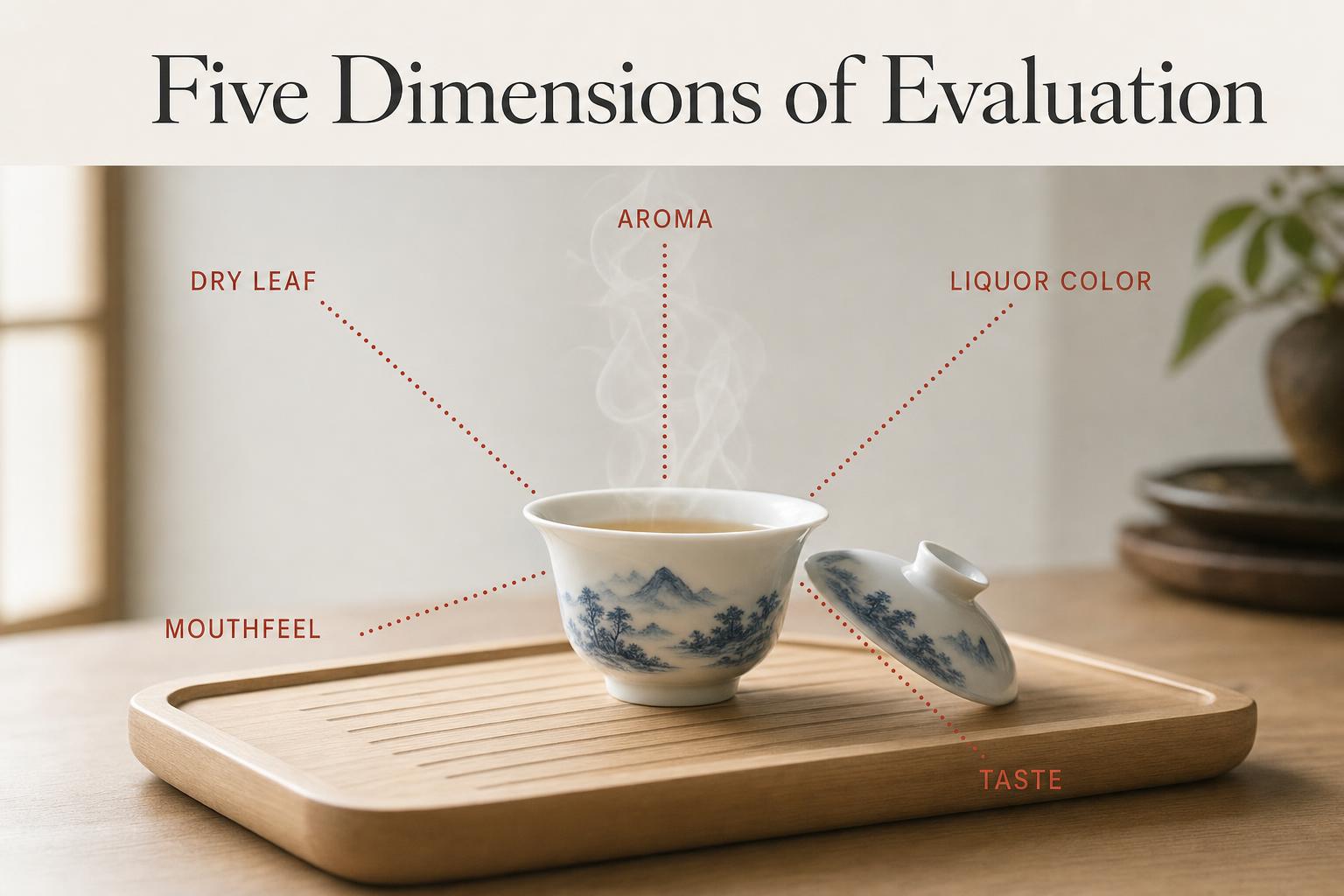
Let's walk through the five dimensions systematically, connecting each to the knowledge you've built across this course.
1. Dry Leaf Appearance. Before water ever touches the leaves, you're already gathering data. Look at the size, shape, color, and uniformity of the dry leaf. Tightly rolled oolongs tell you about the mechanical processing that shapes volatile retention (Chapter 2). Silver tips indicate young buds rich in amino acids and caffeine (Chapter 1). Broken or fannings-grade leaf signals either CTC processing or lower-grade sorting — and predicts a faster, more astringent extraction (Chapter 3). The dry leaf is a record of every decision made from garden to shelf.
2. Aroma. Aroma assessment happens at multiple points: the dry leaf, the warmed empty vessel after pouring (called lid aroma or gai xiang in Chinese practice), and the liquor itself. Each stage reveals different volatile compounds based on their boiling points and concentrations. Remember from Chapter 4 that we detect aroma both orthonasally (sniffing) and retronasally (during swallowing), and that our olfactory system can distinguish thousands of odorants. When you detect "orchid" in a Tieguanyin or "muscatel" in a Darjeeling second flush, you're identifying specific volatile compound families — terpenoids, aldehydes, linalool oxides — that were shaped by cultivar genetics, terroir, and processing.
3. Liquor Color. The color of the brewed tea is a direct window into its oxidation chemistry. The progression from pale green (minimal oxidation) through gold, amber, and copper to deep reddish-brown tracks the conversion of catechins to theaflavins and thearubigins (Chapter 2). Clarity matters too: a bright, translucent liquor typically indicates clean processing, while cloudiness can signal either a desirable "cream down" effect (theaflavin-caffeine complexes forming as the liquor cools) or problematic over-extraction.
4. Taste Profile. Here you apply the full sensory framework from Chapter 4. Sweetness from free amino acids and soluble sugars. Astringency from catechins and their polymerized forms. Bitterness from caffeine and certain flavonoids. Umami from L-theanine. Professional evaluators also attend to what the Chinese tradition calls huigan (returning sweetness) — a pleasant sweet aftertaste that lingers after an initially bitter or astringent sip, indicating high-quality leaf with balanced compound ratios.
5. Mouthfeel and Body. Beyond taste, attend to the tactile sensations. Is the tea thin and watery or thick and coating? Does it feel silky, velvety, or rough? Mouthfeel is shaped by polysaccharides, protein-tannin interactions, and the overall concentration of dissolved solids — all factors you can influence through your brewing parameters (Chapter 3).
The critical insight is that evaluation isn't about memorizing the "right" descriptors — it's about building a personal vocabulary that's consistent and meaningful to you. The Chinese and Western tasting traditions use different terminology, but both aim at the same goal: reliable, reproducible assessment that connects sensory experience to leaf quality (Liu et al., 2025). Over time, your evaluations become more precise not because you learn the "correct" answer, but because you accumulate reference points. Your hundredth Darjeeling gives you context your first one couldn't.
Decoding Labels: Sourcing Tea with Confidence
A tea's label is your first and often only source of information before purchase. Learning to read it critically is one of the most practical skills you can develop. Some labels overflow with meaningful detail; others are masterclasses in vague marketing. Knowing the difference protects both your palate and your wallet.
Grading Systems: What the Alphabet Soup Actually Means
If you've ever encountered a tea labeled FTGFOP1 and felt your eyes glaze over, you're not alone. This is the Western orthodox grading system, primarily used for black teas from India and Sri Lanka. The base grade is Orange Pekoe (OP) — not a flavor description but a leaf size standard indicating whole leaves of a certain maturity. From there, prefixes add specificity: F (Flowery, indicating some bud content), G (Golden, indicating golden-tipped buds), T (Tippy, meaning abundant tips), S (Special or Finest), and the trailing 1 (indicating the highest sub-grade). So FTGFOP1 = Finest Tippy Golden Flowery Orange Pekoe, Grade 1 (Multiple sources, 2025).
Here's the crucial caveat: grading tells you about leaf appearance, not necessarily flavor quality. A beautifully graded FTGFOP from a mediocre garden may produce a less compelling cup than a lower-graded tea from an exceptional terroir. Grading is a useful first filter — whole leaf generally extracts more gradually and complexly than broken leaf or fannings — but it's one data point among many (Multiple sources, 2025).
Chinese, Japanese, and Taiwanese teas use entirely different classification systems, often based on processing method, harvest season, and specific cultivar rather than leaf size. A label reading "Alishan High Mountain Oolong, Qing Xin cultivar, Spring 2024, 1400m elevation" tells you far more about what to expect in the cup than any letter grade could.
Red Flags and Green Flags
When evaluating a tea vendor or label, look for these green flags: specific garden or estate name, harvest date or season (flush), cultivar identification, elevation or growing region, processing details, and clear origin (not just "China" but "Wuyishan, Fujian Province"). Red flags include vague origin claims ("Oriental blend"), absence of harvest dates, superlative marketing language without specifics ("the finest tea in the world"), health claims not supported by evidence, and the word "premium" used as if it were a grade.
The distinction between single-origin and blended teas matters here too. Single-origin teas, like single-estate Darjeelings or specific mountain oolongs, offer traceability and terroir expression. Blended teas — including most English Breakfast, Earl Grey, and chai formulations — prioritize consistency across seasons and batches. Neither is inherently superior; they serve different purposes. But you should know which you're buying and why.
Storage, Aging, and the Modern Tea Landscape
Once you've sourced good tea, how you store it determines how long it stays good — or, in some cases, whether it gets even better. The science of tea storage connects directly to the oxidation and fermentation chemistry we explored in Chapter 2, but now applied over months and years rather than hours.
The Chemistry of Aging
Most teas are best consumed fresh. Green teas, with their minimal oxidation, are particularly vulnerable to degradation: exposure to oxygen, light, heat, and moisture accelerates the breakdown of catechins and the loss of delicate volatile compounds. Within months of production, an improperly stored green tea can taste flat and stale (Multiple researchers, 2020–2023).
But certain teas are designed to age. Pu-erh (both sheng and shou), some white teas, and heavily roasted oolongs can transform remarkably over years and even decades. Research on aging white tea has demonstrated that over a 5–13 year period, levels of theabrownins, soluble sugars, and specific flavonoids increase significantly through a combination of slow oxidative degradation of catechins and microbial bioconversion (Multiple authors, 2021). Polysaccharide decomposition releases simple sugars, contributing to the increasingly mellow sweetness that aged white tea enthusiasts prize. The aroma profile shifts too, as fresh floral volatiles give way to deeper, woodier, honey-like compounds.
For storage, the key variables are the same ones that govern all chemical kinetics: oxygen exposure, temperature, humidity, light, and odor contamination. Fresh teas should be sealed in opaque, airtight containers and consumed within months of opening. Aging teas require more nuanced conditions — some air exchange for microbial activity, moderate humidity (60–75% for pu-erh), stable temperatures, and absolute isolation from foreign odors. Your tin of pu-erh should never sit next to your spice rack.
The Third Wave and Beyond
The contemporary tea landscape is undergoing a transformation that closely mirrors what happened in coffee over the past two decades. The specialty tea movement — sometimes called "third-wave tea" — emphasizes single-origin sourcing, artisanal processing, transparency in the supply chain, and a shift from quantity and convenience toward freshness and quality (Multiple industry sources, 2017–2025). Where first-wave tea was commodity-grade bags in every supermarket and second-wave introduced premium brands and flavored blends, third-wave tea asks you to care about the specific garden, the specific season, the specific cultivar, and the specific person who made your tea.
This movement has opened extraordinary access. Twenty years ago, sourcing a single-garden Wuyi yancha or a competition-grade Taiwanese high-mountain oolong required personal connections and physical travel. Today, online vendors connect consumers directly with small producers worldwide. But access alone isn't enough — it creates a new responsibility to evaluate claims critically, which is why the label-reading skills above matter so much.
Sustainability and Labor
No honest discussion of the modern tea landscape can ignore the human cost of production. Tea remains one of the most labor-intensive agricultural products in the world, and conditions in many producing regions are troubling. Van der Wal's (2008) comparative analysis across six major producing countries documented persistently low wages for tea pickers — often below living-wage thresholds — along with job insecurity, gender discrimination, inadequate protective gear against pesticide exposure, and limited union representation. Smallholder farmers frequently receive prices below their cost of production.
As informed consumers, we face a genuine tension. The specialty tea movement's emphasis on direct trade and transparency can channel more revenue to producers — but only if we actively seek out vendors who demonstrate verifiable commitments to fair compensation and sustainable agriculture, rather than simply printing "ethical" on their packaging. Certifications like Fair Trade, Rainforest Alliance, and organic designations are imperfect tools, but they provide a starting framework. The best approach combines certification awareness with direct engagement: ask vendors where their tea comes from, who picked it, and what relationship they maintain with producers.
Building Your Personal Tea Practice
A tea practice isn't a rigid routine — it's an intentional relationship with tea that evolves as you learn. It encompasses how you source, store, prepare, taste, and reflect on tea over time. Let's build one from the ground up.
Choosing Your Vessels
Equipment shapes experience. The core choice is between Western-style brewing (larger vessel, single longer infusion) and gongfu-style brewing (smaller vessel, multiple short infusions), each revealing different aspects of the same tea. A 150ml gaiwan or small Yixing teapot is the most versatile starting point for exploring the full range of Chinese and Taiwanese teas. A good-quality glass or ceramic mug with an infuser basket handles everything else. Start simple. The vessel doesn't make the tea — your attention does.
The Tasting Journal
Of all the tools in a tea practice, the tasting journal may be the most powerful. It transforms passive drinking into active learning. A useful entry includes: the tea's name, origin, and vendor; brewing parameters (water temperature, leaf-to-water ratio, steep times); and systematic notes on each of the five evaluation dimensions. Over weeks and months, your journal becomes a personal reference library — a record of your evolving palate, your preferences, and the patterns you've noticed.
Don't chase objectivity. Record what you perceive, even if it seems idiosyncratic. If a Longjing reminds you of fresh-cut grass and buttered toast, write that down. Your personal associations are valid sensory data, and they'll become more precise and communicable with practice. The structured tasting framework from Chapter 4, enriched by everything you now know about why a tea tastes the way it does, gives your journal entries depth that pure description alone cannot.
Blending as Creative Practice
Once you've developed confidence in evaluating single-origin teas, blending opens a creative dimension. The foundational principle is the 40-30-20-10 ratio: approximately 40% base tea (providing the body and primary character), 30% supporting tea (complementing and deepening the base), 20% accent (adding a distinctive note), and 10% catalyst — a small addition that transforms the whole, like a pinch of smoked lapsang souchong in an otherwise straightforward black blend (Multiple expert sources, 2023–2025).
Successful blending draws on everything you've learned. You understand that high-oxidation teas contribute theaflavins and body, while less-oxidized teas offer brightness and floral complexity (Chapter 2). You know that extraction rates differ by leaf size and cell structure, so you select components that brew compatibly at the same parameters (Chapter 3). You can anticipate how bitter and sweet compounds interact on the palate (Chapter 4). Blending isn't random mixing — it's applied tea science.
Bringing It All Together: The Integration Challenge
Throughout this course, we've treated each dimension of tea — botany, chemistry, physics, neuroscience, culture — as a distinct lens. The real magic happens when these lenses converge on a single cup. When you taste a high-elevation Taiwanese oolong, you're simultaneously experiencing the effects of UV stress on polyphenol production (Chapter 1), partial oxidation followed by skilled roasting (Chapter 2), your specific water chemistry and brewing parameters (Chapter 3), the neural processing of hundreds of volatile compounds hitting your olfactory receptors (Chapter 4), and a cultural tradition of mountain tea appreciation stretching back centuries (Chapter 5). No single chapter explains that cup. All of them together begin to.
This integrative thinking is what separates a knowledgeable tea drinker from someone who merely knows facts about tea. Facts are inert; frameworks are generative. When you encounter a tea you've never tried before — and the tea world guarantees you will, again and again — your frameworks let you ask the right questions, form testable hypotheses, and refine your understanding with each sip.
The Lifelong Learner's Toolkit
No six-chapter course can encompass the tea world. We haven't touched Japanese matcha cultivation, Korean tea ceremony, the wild tea trees of Yunnan's ancient forests, the emerging tea industries of Nepal and Georgia, or the biochemistry of shade-growing. What we have built are the mental models that let you engage with any of these topics meaningfully when you encounter them.
Your toolkit now includes: a botanical understanding of what Camellia sinensis is and how terroir shapes its chemistry; a processing framework that explains how the same leaf becomes green, white, oolong, black, or pu-erh tea; extraction principles that put you in control of your brewing; a sensory vocabulary grounded in neuroscience; cultural awareness that respects tradition while thinking critically; and now, a practical framework for evaluation, sourcing, storage, and practice.
"The best cup of tea is the one you make with understanding and drink with attention. Everything else is just hot leaf water."
A practising tea-drinker's maxim
Go make your cup. Make it informed, intentional, and entirely your own.
Key Takeaways
- Systematic tea evaluation follows five dimensions — dry leaf, aroma, liquor color, taste, and mouthfeel — each connected to the botany, processing, and extraction science of earlier chapters.
- Grading systems like FTGFOP describe leaf appearance and size but do not guarantee flavor quality; terroir, processing, and storage are equally important determinants.
- Critical label reading — looking for specific origins, harvest dates, cultivar names, and processing details — is one of the most practical skills for sourcing good tea.
- Most teas should be consumed fresh and stored in airtight, opaque containers; certain teas (pu-erh, white tea, roasted oolongs) can improve with age through ongoing oxidative and microbial transformations.
- The specialty tea movement parallels third-wave coffee in emphasizing single-origin sourcing, transparency, and quality, but consumers must evaluate sustainability and labor claims as critically as flavor claims.
- A personal tea practice built around intentional brewing, systematic evaluation, journaling, and creative blending transforms tea drinking from habit into lifelong learning.
- The most valuable outcome of this course is not knowledge of specific teas, but the integrative frameworks that let you engage meaningfully with any tea you encounter.
This is the final chapter of our course, but it is the first chapter of your personal tea journey. The frameworks, vocabulary, and critical thinking skills you've developed are tools for exploration, not endpoints. Seek out teas from regions we haven't discussed, attend tastings, visit tea gardens if you can, start that journal, and keep asking questions. The tea world rewards curiosity endlessly — one leaf, ten thousand cups, and every single one teaches you something new.
References
Liu, S., et al. (2025). Guidelines for sensory evaluation of tea: Traditional Chinese method and quantitative descriptive analysis. Agriculture & Food.
Multiple authors. (2024). Tea quality: An overview of the analytical methods and sensory analyses used in the most recent studies. Foods, 13(22), 3580.
Multiple authors. (2021). Macro-composition quantification combined with metabolomics analysis uncovered key dynamic chemical changes of aging white tea. Food Chemistry, 366, 130622.
Multiple expert sources. (2023–2025). Tea blending principles and flavor profile theory.
Multiple industry sources. (2017–2025). Third-wave tea movement and specialty coffee parallels.
Multiple sources (industry standards). (2025). Tea leaf grading.
van der Wal, S. (2008). Sustainability issues in the tea sector: A comparative analysis of six leading producing countries. SOMO.