You Don't Have to Love Running Yet
A myth about who real runners are, the biology of why your body was built for distance, and the first tool you'll need: a one-to-ten scale that fits in your pocket.
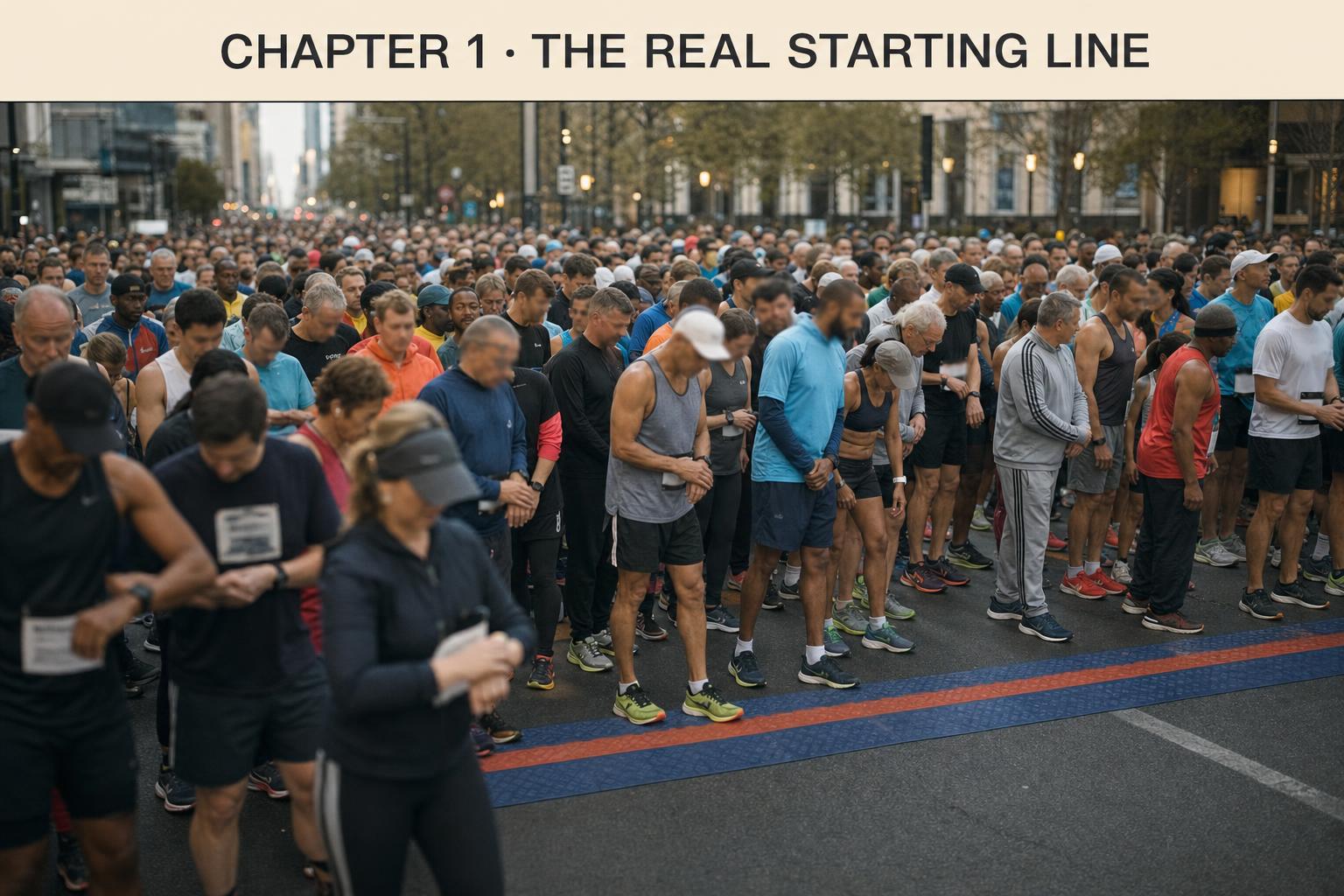
Picture the starting corral of any big-city marathon — say, the New York City Marathon on a cold November morning. There are fifty thousand runners packed behind the starting line. Some are lean, focused, and wearing racing flats that cost more than your textbook. But most of them? Most of them look like your neighbour, your coworker, your aunt. There's a 58-year-old postal worker running her sixth marathon. A grad student who started jogging eight months ago and can still barely believe he's here. A father of three who hasn't exercised regularly since college. They're nervous. Some are terrified. And by late afternoon, an overwhelming majority of them will cross the finish line.
If a voice in your head is already whispering, "yeah, but those people are different from me," this chapter is specifically for you. That voice is the single biggest barrier between you and 26.2 miles — not your lungs, not your knees, and definitely not your pace.
The "Real Runner" Myth
Before we talk about physiology, training plans, or shoe selection, we need to address the elephant in the room: identity. Many people who sign up for something like this course carry a quiet, deeply held belief that they are not — and perhaps cannot be — a "real runner." Real runners are thin. Real runners were on the cross-country team. Real runners don't walk during races. Real runners certainly don't stop to take selfies at mile eighteen.
This belief isn't trivial. Research in exercise psychology shows that exercise identity — the degree to which you see physical activity as part of who you are — is one of the strongest predictors of whether you'll actually stick with a training program (Rhodes et al., 2016). If you believe running is something other people do, you've already built a wall between yourself and consistency. Every hard workout becomes evidence that you don't belong instead of evidence that you're getting stronger.
Here's the truth the data reveals: the "real runner" archetype is a fiction that doesn't match the marathon's actual population. A worldwide analysis of 19.6 million marathon results found that the average finishing time was 4 hours 29 minutes — a pace of roughly 10 minutes and 17 seconds per mile (RunRepeat, 2019). That's a comfortable jog for many people, barely faster than a brisk walk for some. The most common age group on the starting line is 30–40, and the field has been getting slower over the past decade — not because people are getting worse at running, but because more everyday, non-elite humans are choosing to do it.
Marathon running has been democratised. And that democratisation isn't a watering-down of the achievement. It's a return to what the human body was designed for in the first place.
Your Body Was Built for This
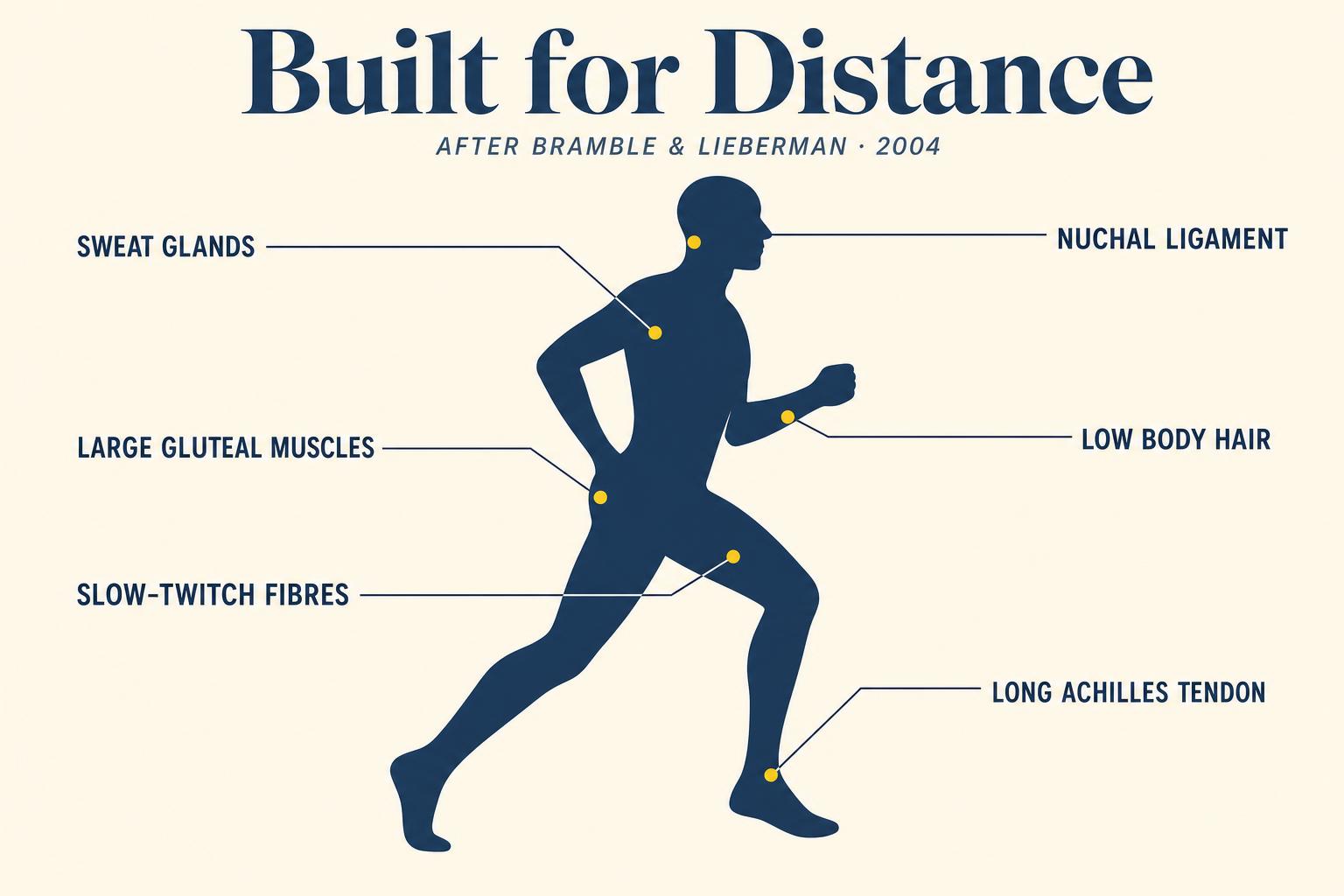
In 2004, biologists Dennis Bramble and Daniel Lieberman published a landmark paper in Nature that reshaped our understanding of what the human body is for. Their endurance running hypothesis argues that Homo sapiens didn't evolve to be the fastest animal — we evolved to be the animal that never stops (Bramble & Lieberman, 2004).
Think about what makes humans physiologically unusual compared to other mammals. We have very little body hair and an extraordinary number of sweat glands — roughly 2–4 million of them — giving us the most efficient cooling system in the animal kingdom. We have a nuchal ligament at the back of the skull that stabilises our head during running; most primates lack this. We have long Achilles tendons that act as springs, storing and releasing elastic energy with each stride. We have large gluteal muscles — your glutes are essentially running muscles — and a specific arrangement of slow-twitch muscle fibres optimised for sustained effort.
These features make no sense for walking. They only make sense for running long distances. Bramble and Lieberman proposed that early humans used persistence hunting — chasing prey across the African savanna for hours in the midday heat until the animal, unable to cool itself through panting while galloping, collapsed from hyperthermia. We didn't need to be fast. We just needed to keep going. And we could, because we sweat.
The point isn't that you need to go chase an antelope. The point is this: your body is not betraying you when it struggles through the first mile of a jog. Your body is a distance-running machine that's been sitting idle. The engine is there. It just needs to be turned on gradually — which is exactly what a training plan does.
What Happens When You Start Running
Understanding the basics of aerobic physiology isn't just academic — it will change how you train and how you feel about hard days.
The moment you start running, your heart rate increases to pump more blood to your working muscles. At rest, your heart pushes about 5 litres of blood per minute. During vigorous exercise, this cardiac output can increase to 20–25 litres per minute in a trained individual (StatPearls, 2024). Your body also performs an elegant trick called blood-flow redistribution: it diverts blood away from your digestive organs and toward your skeletal muscles, skin (for cooling), and heart. This is why running right after a large meal feels terrible — your body is trying to send blood in two directions at once.
Over weeks and months of training, your heart undergoes remarkable adaptations. The left ventricle — the chamber that pumps oxygenated blood to your body — literally gets larger and stronger. Each beat pushes out more blood, called stroke volume, which means your heart doesn't have to beat as fast to deliver the same amount of oxygen. This is why resting heart rate drops as you get fitter — it's one of the earliest, most measurable signs that training is working (Hellsten & Nyberg, 2016).
Why "the Wall" Hits at Mile 20
Your muscles run on a molecule called adenosine triphosphate (ATP), but you only store enough of it for a few seconds of effort. For sustained running, your body generates ATP primarily through aerobic metabolism — a process that uses oxygen to break down carbohydrates and fats in the mitochondria of your muscle cells. The more mitochondria you have, and the better they function, the more efficiently you produce energy. Training increases both the number and the efficiency of these mitochondria.
Here's the key insight: at easy paces, your body primarily burns fat for fuel. As intensity increases, you shift toward burning glycogen (stored carbohydrate). Glycogen is a faster but more limited fuel source. The average person stores about 2,000 calories of glycogen — enough for roughly 18–20 miles of running. This is why the marathon's infamous "wall" typically hits around mile twenty. It's not willpower failure. It's glycogen depletion. And it's a problem with a solution — one we'll explore in depth in later chapters on fueling.
The Most Important Tool: Rate of Perceived Exertion
Forget about pace per mile for now. Forget about heart rate zones. The single most important self-regulation tool you will use throughout this course is the Rate of Perceived Exertion (RPE) — a subjective scale that asks a simple question: how hard does this feel?
Developed by Swedish psychologist Gunnar Borg, the RPE scale has been validated across dozens of studies as a reliable measure of exercise intensity. A meta-analysis by Chen, Fan, and Moe (2002) found that RPE correlates meaningfully with heart rate, oxygen consumption, and breathing rate across different populations, fitness levels, and types of exercise. In plain language: your body is remarkably good at telling you how hard it's working — if you learn to listen.
We'll use a simplified 1–10 scale throughout this course. Effective marathon training happens primarily at RPE 3–4. It should feel easy. This is where your aerobic system develops most efficiently, where mitochondria multiply, where your heart grows stronger without accumulating excessive fatigue. The single most common mistake new runners make is running too hard on easy days. RPE is your antidote.
The Time This Actually Takes
Let's talk honestly about what marathon training requires. Not to scare you, but because realistic expectations are the foundation of self-efficacy — your belief in your ability to succeed. Research by Samson (2011) found that for distance runners, self-efficacy is built primarily through two mechanisms: successful performance accomplishments (completing workouts and seeing progress) and physiological information (learning to interpret your body's signals). Both depend on having a plan that actually matches your life.
A standard marathon training plan runs 16–20 weeks. The peak time commitment — six to nine hours per week — is roughly the equivalent of watching a season of a streaming show. It's significant, but not impossible. Most weekday runs are 30–60 minutes. The long run is one day per week, and it builds gradually. Nobody is asking you to run for three hours next Tuesday.
Finishing Is the Goal
This course operates on a single guiding philosophy: finishing is the goal. Not finishing fast. Not finishing without walking. Not finishing with a specific time. Crossing the line.
This isn't a participation-trophy mindset — it's a scientifically grounded approach to motivation and performance. Self-Determination Theory, one of the most well-supported frameworks in motivation research, identifies three innate psychological needs that drive sustained engagement: autonomy (feeling that you have choice and ownership); competence (feeling that you're improving and capable); and relatedness (feeling connected to others in the pursuit). When these needs are met, people develop intrinsic motivation — they do the thing because it matters to them, not because someone is watching (Ryan & Deci, 2000).
A process-oriented approach supports all three needs. You choose your runs (autonomy). You build gradually and feel yourself getting stronger (competence). You can share the journey with others on the same path (relatedness). An outcome-obsessed approach — fixating on a finishing time, comparing yourself to faster runners, defining success narrowly — undermines all three, especially for beginners. It transforms every run into a test you might fail rather than a step in a process you're committed to.
We train to complete. We let performance outcomes emerge naturally from consistent, intelligent preparation.
The argument of this course
Why Do You Want to Run a Marathon?
We close this first chapter with the most important question you'll answer in this entire course — and it has nothing to do with physiology or training plans. Why do you want to run a marathon?
This isn't a soft question. Your answer to it is a prediction of your behaviour over the next several months. Research on self-efficacy in distance runners shows that the runners who persist through the inevitable hard patches — the rainy Tuesday when you don't want to go out, the long run where your legs feel like concrete, the week where life gets complicated — are the ones with clear, personally meaningful reasons for doing this (Samson, 2011).
Your "why" doesn't have to be profound. "I want to prove to myself that I can do something I never thought possible." Or "My mother was diagnosed with cancer and I'm running to raise money for research." Or "I'm turning forty and I want to enter this decade doing something extraordinary." Or "Honestly? My friend bet me I couldn't do it." All of these are valid.
According to Self-Determination Theory, autonomous motivation — doing something because you genuinely value it — produces markedly more persistent behaviour than controlled motivation — doing something because you feel pressured or obligated (Ryan & Deci, 2000).
Key Takeaways
- The "real runner" identity is a myth — the average marathon finisher runs a 4:29 marathon (RunRepeat, 2019), and the field is overwhelmingly composed of everyday people with jobs, families, and imperfect bodies.
- Humans evolved specifically for endurance running (Bramble & Lieberman, 2004) — sweat glands, Achilles tendons, gluteal muscles, and a nuchal ligament are anatomical evidence that long-distance movement is your biological birthright.
- Aerobic training triggers measurable cardiovascular, muscular, and metabolic adaptations — increased cardiac output, stroke volume, mitochondrial density, and fat utilisation (Hellsten & Nyberg, 2016; StatPearls, 2024).
- The "wall" at mile 20 is glycogen depletion, not willpower failure — and it has fueling and pacing solutions we'll build across this course.
- Rate of Perceived Exertion (RPE) is a validated tool for regulating training intensity (Chen, Fan, & Moe, 2002) — most of your training should feel surprisingly easy, at RPE 3–4.
- Marathon training requires 16–20 weeks and peaks at roughly 6–9 hours per week, distributed across 4–5 days.
- A process-oriented "finishing is the goal" approach is supported by Self-Determination Theory (Ryan & Deci, 2000) — autonomy, competence, and relatedness fuel intrinsic motivation far better than fixating on outcome metrics.
- Your personal "why" is the single most important motivational anchor you have — write it down and make it specific.
In Chapter 2 we lace up and take the first literal steps — how to structure a run-walk program, why walking is not cheating (it's a strategy seasoned ultramarathoners use), and how to choose shoes that work for your feet. You'll also learn the 10% rule for building mileage safely and start mapping out your first week of training. Bring your calendar.
References
Bramble, D. M., & Lieberman, D. E. (2004). Endurance running and the evolution of Homo. Nature, 432(7015), 345–352.
Chen, M. J., Fan, X., & Moe, S. T. (2002). Criterion-related validity of the Borg ratings of perceived exertion scale in healthy individuals: A meta-analysis. Journal of Sports Sciences, 20(11), 873–899.
Hellsten, Y., & Nyberg, M. (2016). Cardiovascular adaptations to exercise training. Comprehensive Physiology, 6(1), 1–32.
Rhodes, R. E., Kaushal, N., & Quinlan, A. (2016). Is physical activity a part of who I am? A review and meta-analysis of identity, schema and physical activity. Health Psychology Review, 10(2), 204–225.
RunRepeat & IAAF. (2019). Marathon performance report: 1986–2018, 19.6 million race results.
Ryan, R. M., & Deci, E. L. (2000). Self-determination theory and the facilitation of intrinsic motivation, social development, and well-being. American Psychologist, 55(1), 68–78.
Samson, A. (2011). The effects of self-efficacy on running performance: An exploratory study. Journal of Sport Behavior, 34(4), 408–428.
StatPearls. (2024). Cardiovascular response to exercise.