The Magic of Slow
A tale of two runners, the eighty-twenty rule of elite endurance training, and the quiet biology that turns easy miles into a marathon-ready body.
Picture two runners starting a marathon training program on the same Monday morning. Runner A charges out the door at a pace that feels right, fast enough to feel like a real workout, breathing hard, legs burning after fifteen minutes. She's proud of her effort. Runner B shuffles along so slowly that a speed-walker nearly passes her. She can chat easily with her running partner, and honestly, she feels a little embarrassed by how slow she's going. Fast-forward sixteen weeks: Runner A dropped out of the program in week six with shin splints, frustrated and defeated. Runner B crossed her first marathon finish line, teary-eyed and strong.
This is not a fable. It is the single most common story in beginner marathon training, and it contains the most important lesson you'll learn in this entire course: to run far, you must first learn to run slowly.
Beginners Run Too Fast
If there is one universal truth in running coaching, it's this: beginners run too fast. Not on race day, on every day. They run their easy days too fast, their long runs too fast, and their recovery runs too fast. The reason is completely understandable. When you're new to running, a slow jog already feels hard. Your brain tells you that if something feels hard, you must be doing it right. And besides, running slowly in public can feel embarrassing. Surely real runners go faster than this?
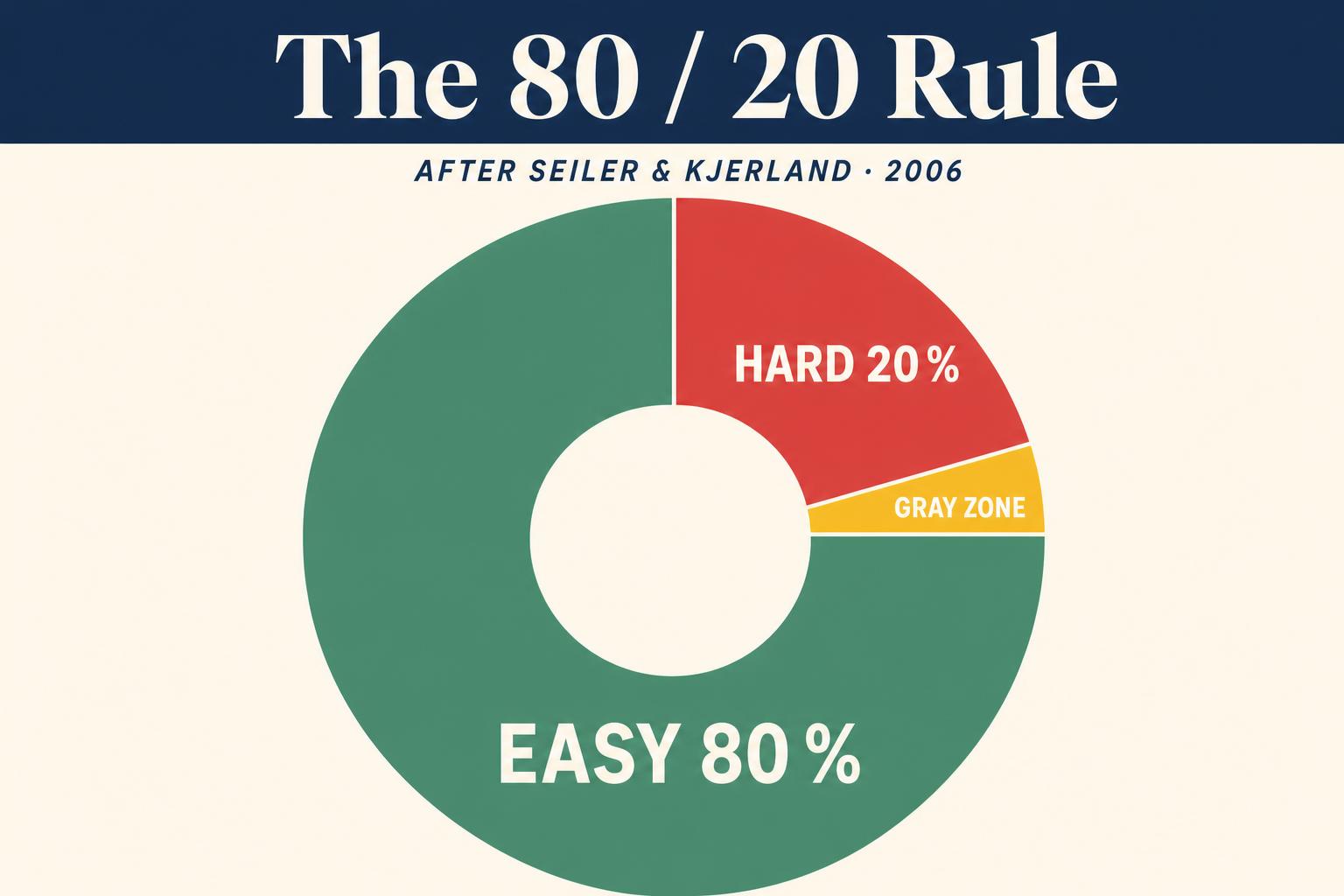
But here's the paradox that exercise science has confirmed again and again: the world's best endurance athletes spend the vast majority of their training at paces that would shock you with their slowness. Kenyan marathon champions jog so easily on most days that they're laughing and telling stories. Norwegian cross-country skiers, arguably the fittest athletes on earth, do most of their training at intensities so gentle that a moderately fit person could keep up. And when researcher Stephen Seiler analyzed the training logs of elite endurance athletes across multiple sports, he found a remarkably consistent pattern: roughly eighty percent of training at low intensity and only about twenty percent at high intensity, with surprisingly little time spent in the moderate gray zone between, as he and Kjerland reported in 2006.
This distribution has become known as the eighty-twenty principle of endurance training, and it's not just an elite luxury. A study of recreational runners found that those who followed a polarized training approach, eighty percent easy, roughly fifteen percent hard, and very little in between, improved their ten-kilometer times significantly more than runners who spent most of their time at moderate effort, as Muñoz and colleagues demonstrated in 2013. In other words, running easy most of the time doesn't just prevent injury. It actually makes you faster.
Two Engines Inside You
To understand why slow running is so powerful, you need to know about the two primary energy systems your body uses during exercise. Think of them as two different engines inside your body, each designed for different jobs.
Your aerobic system is your diesel engine. It burns fuel, carbohydrates and fats, using oxygen, and it can run for hours. It's efficient, sustainable, and, critically for marathon runners, it powers roughly ninety-nine percent of your race effort. When you're jogging at a comfortable pace, chatting with a friend, breathing rhythmically, you are running almost entirely on your aerobic system.
Your anaerobic system is your turbo booster. It kicks in when you need bursts of power, sprinting for a bus, surging up a steep hill, or running faster than your aerobic system can support. It generates energy quickly but produces metabolic byproducts, most notably lactate and hydrogen ions, that cause that familiar burning sensation in your muscles. It's powerful but unsustainable. You can run anaerobically for minutes, not hours.
Here's the crucial insight for marathon training: a marathon is an overwhelmingly aerobic event. Even elite runners who finish in just over two hours are operating at or near their aerobic threshold for virtually the entire race, as Predel reported in 2014. For a first-time marathoner who might be on the course for five or six hours, the aerobic system is doing nearly all the work. So the question becomes: how do you build the biggest, most efficient aerobic engine possible?
The answer, supported by decades of research and coaching wisdom, is simple: you run slowly.
The Invisible Adaptations
Easy running triggers a cascade of physiological adaptations that transform you from a non-runner into an endurance athlete. These changes are invisible. You won't feel them happening. But they're the reason your first marathon becomes possible.
Mitochondria — Your Power Plants
Mitochondria are the tiny power plants inside your muscle cells that convert fuel into usable energy. The more mitochondria you have, and the more efficient they become, the more aerobic energy you can produce. A comprehensive meta-analysis of three hundred forty-five studies found that endurance training significantly increases mitochondrial content in skeletal muscle, and, encouragingly for beginners, the greatest relative gains occur in people with lower initial fitness, according to Mølmen and colleagues in 2024. Your untrained muscles are primed for dramatic improvement.
Capillaries — The Delivery Network
Capillaries are the tiny blood vessels that deliver oxygen to your working muscles and carry waste products away. Easy running stimulates angiogenesis, the growth of new capillaries, through the mechanical shear stress that increased blood flow creates along vessel walls. Research shows that aerobic exercise can increase capillary density by approximately twenty percent within just eight weeks of consistent training, according to StatPearls in 2023. More capillaries mean more oxygen reaching your muscles, which means more aerobic power.
The Heart Itself
Your heart is a muscle, and like any muscle, it adapts to the demands placed upon it. Regular easy running causes your heart's left ventricle to enlarge slightly, allowing it to pump more blood with each beat, a phenomenon known as increased stroke volume. Your body also increases its total blood volume, producing more red blood cells to carry oxygen. Over time, your resting heart rate drops as your heart becomes more efficient, a classic sign of aerobic fitness improvement.
All of these adaptations happen most effectively at easy, aerobic intensities. When you run too hard too often, you shift the training stimulus toward anaerobic pathways. You're training your turbo booster instead of building your diesel engine, and for a marathon, that's like putting racing slicks on a minivan. It looks fast, but it misses the point entirely.
The Adaptation Gap
There's another critical reason to keep things slow in the early weeks, and it has nothing to do with your cardiovascular system. It has to do with a mismatch that causes more beginner injuries than any other single factor.
Your cardiovascular system, heart, lungs, blood, adapts to exercise relatively quickly. Within two to three weeks of consistent training, most beginners notice that the same run feels noticeably easier. Their heart rate is lower, their breathing is calmer, and they feel ready to do more. This is real progress, and it feels great.
But your musculoskeletal system, tendons, ligaments, bones, and cartilage, adapts on a much slower timeline. These tissues have less blood supply than your heart and muscles, and they remodel through a gradual process of stress, micro-damage, and repair that takes weeks to months, as noted in StatPearls in 2023. When your cardiovascular fitness races ahead and your tendons haven't caught up, you feel like you can do more, and you're right, cardiovascularly. But your Achilles tendon, your knee cartilage, and your shin bones are not ready.
This mismatch is the primary driver of overuse injuries in beginning runners. A systematic review of running-related injuries found an overall injury incidence of approximately forty percent, with most injuries classified as overuse, repetitive microtrauma accumulating over time, primarily in the knee, ankle, and lower leg, as Kakouris and colleagues found in 2021. The runners most at risk are those who increase training load faster than their connective tissue can adapt.
Running slowly gives your musculoskeletal system time to catch up to your cardiovascular system. It reduces the impact forces on every stride, decreases the total mechanical stress per session, and still provides the stimulus your tendons and bones need to strengthen. Patience in weeks one through six prevents the shin splints, stress fractures, and tendinopathies that derail training in weeks eight through twelve.
Three Tools for Going Slow Enough
So if slow is the secret, how do you know you're actually going slow enough? You have three practical tools, ranked from simplest to most technical.
1. The Talk Test
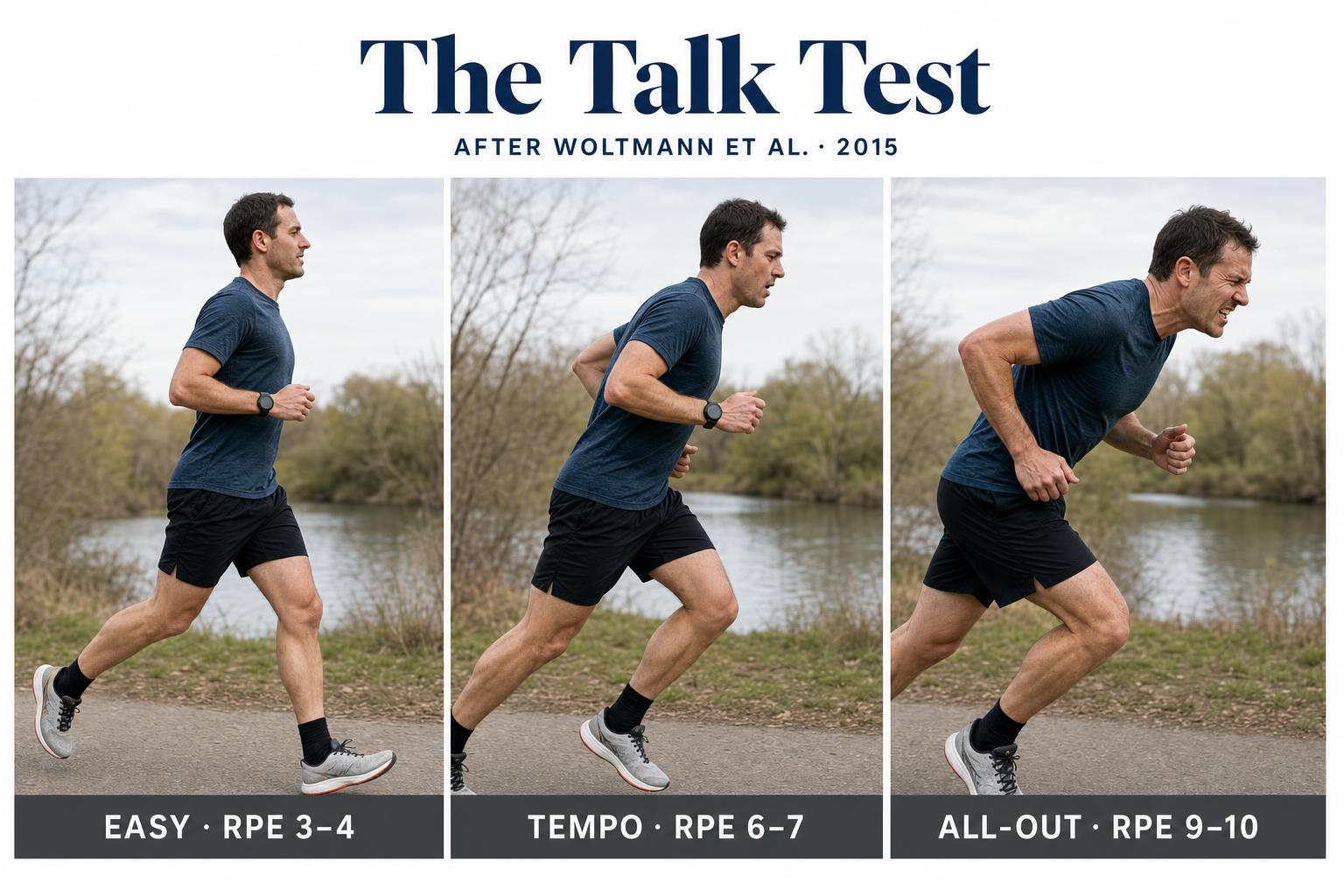
The talk test is exactly what it sounds like: if you can speak in full sentences while running, you're in the right zone. Research has validated this deceptively simple tool against sophisticated laboratory measurements, finding that the ability to maintain comfortable speech correlates reliably with exercise intensity below the ventilatory threshold, precisely where easy running should live, as research by Woltmann and colleagues in 2015 confirmed. A separate study found that the talk test is a useful and accurate method for monitoring aerobic exercise intensity across healthy populations, matching well with physiological markers like heart rate and oxygen consumption, according to research published in 2023.
Here's the practical version: while running, try reciting the Pledge of Allegiance, singing Happy Birthday, or simply narrating what you see around you. If you can do so without gasping between words, you're at the right pace. If you need to pause for breath mid-sentence, slow down. If you can only manage a few words at a time, slow down a lot, or walk.
2. Rate of Perceived Exertion
The second tool is Rate of Perceived Exertion, or R-P-E. You met this concept in the first chapter as a self-assessment tool. Now it becomes your primary pacing instrument. On a one to ten scale, easy running should feel like a three to four, light effort, rhythmic breathing, a pace you genuinely believe you could sustain for over an hour. Most beginners are stunned by how slow this feels. That discomfort with slowness is exactly the instinct you need to override.
3. Heart Rate (with a Caveat)
The third tool is heart rate monitoring. Heart rate zones offer a more objective measure of intensity, and many beginners invest in heart rate capable watches. A rough guideline places easy running at sixty to seventy-five percent of your maximum heart rate. However, a word of honest caution: wrist-based optical heart rate monitors, while improving, can be significantly inaccurate during exercise, especially during running, where wrist motion creates noise in the signal. They tend to be most unreliable at precisely the moments you're checking them. If you use heart rate data, treat it as a secondary confirmation of what the talk test and R-P-E are already telling you, not as your primary guide.
If Your Conversational Pace Is a Walk
For many beginners, the talk test reveals an uncomfortable truth: their conversational pace is a walk. Or at best, a very slow shuffle interspersed with walking. This can feel deflating. You signed up to run a marathon, after all.
But here's where we need to reframe the entire conversation. The walk-run method, popularized by Olympic athlete and coach Jeff Galloway, is not a beginner's crutch. It is a legitimate, research-supported race strategy used by thousands of marathoners, including many who finish with impressive times.
A study comparing walk-run and continuous running strategies in marathon completion found that walk-run participants finished with remarkably similar times to continuous runners, averaging four hours fourteen minutes versus four hours eight minutes, while reporting significantly less muscle discomfort and pain, according to Hottenrott and colleagues in 2016. The walk breaks serve as micro-recovery periods: they briefly reduce mechanical stress on muscles and joints, allow heart rate to settle slightly, and help maintain more consistent pacing over the full twenty-six point two miles. Many continuous runners start too fast and slow dramatically in the second half; walk-run participants tend to maintain steadier overall pacing.
The method works through structured intervals. A common starting ratio might be run one minute, walk two minutes. As fitness builds, the running intervals lengthen and the walking intervals shorten: run three, walk one. Run five, walk one. Some experienced walk-runners eventually progress to run nine, walk one, and this is the ratio many marathon veterans use on race day by choice, not necessity.
The run-walk method is not about giving up. It's about being smart enough to respect the distance.
Jeff Galloway
For this course, the walk-run method is the recommended approach for all beginning runners, and an encouraged option for everyone else. There is no shame in walking. There is only the wisdom of matching your strategy to the science.
An Old Idea Confirmed by New Science
The science behind slow running might feel modern, but the practice has deep roots. In the nineteen sixties, New Zealand coach Arthur Lydiard revolutionized distance running by building his athletes' training on a foundation of high-volume, low-intensity running. His runners, including multiple Olympic gold medalists, spent months doing long, easy aerobic runs before incorporating any speed work. The approach was radical at the time. Most coaches favored intense interval training. But Lydiard's results spoke for themselves.
Seiler's research decades later, in 2010, essentially confirmed what Lydiard discovered through coaching intuition: elite endurance athletes across sports converge on a training distribution of approximately eighty percent low-intensity volume, with only about twenty percent of sessions performed at or near maximal effort. This isn't a coincidence or tradition. It appears to be the distribution that maximizes adaptation while managing the cumulative stress of high training volumes. The body simply cannot recover from hard effort every day, but it can absorb and adapt to enormous volumes of easy effort.
For you as a beginning marathoner, the ratios are even more tilted toward easy. In the first several weeks of training, all of your running should be at conversational pace. You have no aerobic base yet, and your musculoskeletal system is brand new to the demands of running. The eighty-twenty principle is a guideline for experienced athletes who have built that base. Your current job is to build it.
Translating the Science into Action
Let's translate the science into action. Here are the concrete principles for your training over the coming weeks:
Every run is conversational.
If you can't talk, slow down. If you can't talk while jogging slowly, walk. If you can talk while walking briskly, that's your current training pace, and it's perfect.
Use walk-run intervals.
Based on your fitness assessment from the first chapter, select a starting ratio. Stick with it for at least two weeks before progressing.
Target R-P-E three to four.
Revisit the rate of perceived exertion scale from the first chapter frequently. Easy should feel genuinely easy, suspiciously easy. Am I even exercising? That's the right feeling.
Trust the process.
The adaptations are invisible for weeks. Your mitochondria are multiplying, your capillaries are growing, your heart is strengthening, but you won't feel faster right away. You will feel it by week six, and dramatically by week twelve.
Protect the gap.
Remember the adaptation mismatch. Even when your heart says more, your tendons need time. Increase weekly volume by no more than ten percent, and build in a reduced-volume recovery week every three to four weeks.
The Hardest Part Is Psychological
We'd be dishonest if we pretended the hardest part of running slowly is physiological. It's not. The hardest part is psychological. You will be passed by other runners. You may be passed by walkers. Your G-P-S watch will display pace numbers that feel embarrassing. Friends who run might express surprise, or worse, pity, at how slowly you're training.
None of that matters. What matters is that you are systematically building the aerobic machinery that will carry you twenty-six point two miles. Every elite marathoner in the world has easy days that would look slow to outsiders. They understand something that takes most beginners months to learn: easy running is not junk training. It is the training. The hard sessions, which we'll introduce later in the course, are the seasoning. The slow miles are the meal.
Over the next two weeks, your assignment is simple: go out three to four times, use your walk-run ratio, keep it conversational, and practice the radical act of patience. Your body will do the rest.
Key Takeaways
- Roughly eighty percent of endurance training should occur at easy, conversational pace — true for elite athletes and beginners alike, based on decades of research by Stephen Seiler and others (Seiler & Kjerland, 2006; Seiler, 2010).
- Polarized training (~80% easy / ~20% hard) outperforms moderate-effort-heavy training even for recreational runners, improving 10 km times significantly (Muñoz et al., 2013).
- Easy running builds your aerobic engine: more mitochondria, denser capillary networks, a stronger heart, and greater blood volume — all essential for marathon performance (Mølmen et al., 2024; StatPearls, 2023).
- Your cardiovascular system adapts faster than your musculoskeletal system. Running too hard too soon creates a dangerous mismatch that leads to overuse injuries (Kakouris et al., 2021).
- The talk test is a validated, practical tool for gauging easy pace: if you can speak in full sentences, you're in the right zone (Woltmann et al., 2015). RPE 3–4 confirms it.
- The walk-run method produces marathon finish times similar to continuous running (4:14 vs. 4:08), with less muscle damage and lower injury risk (Hottenrott et al., 2016).
- If your conversational pace is currently a walk, that is your training pace, and it is exactly where you should be. Patience now builds the foundation for everything that follows.
In Chapter 3, The Architecture of a Training Plan, we'll take what you now know about easy pace and build the week around it. You'll meet the long run — the single most important workout in marathon training — and learn how recovery weeks, the 10% rule, and the build-and-recover rhythm of periodization turn slow miles into a marathon-ready body. Bring your calendar.
References
Hottenrott, K., Ludyga, S., Schulze, S., Gronwald, T., & Jäger, F. S. (2016). Does a run/walk strategy decrease cardiac stress during a marathon in non-elite runners? Journal of Science and Medicine in Sport, 19(1), 64–68.
Kakouris, N., Yener, N., & Fong, D. T. P. (2021). A systematic review of running-related musculoskeletal injuries in runners. Journal of Sport and Health Science, 10(5), 513–522.
Mølmen, K. S., Almquist, N. W., & Skattebo, Ø. (2024). Effects of exercise training on mitochondrial and capillary growth in human skeletal muscle: A systematic review and meta-regression of 345 studies. Sports Medicine (advance online publication).
Muñoz, I., Seiler, S., Bautista, J., España, J., Larumbe, E., & Esteve-Lanao, J. (2013). Does polarized training improve performance in recreational runners? International Journal of Sports Physiology and Performance, 9(2), 265–272.
Predel, H.-G. (2014). Marathon run: Cardiovascular adaptation and cardiovascular risk. European Heart Journal, 35(44), 3091–3098.
Seiler, S., & Kjerland, G. Ø. (2006). Quantifying training intensity distribution in elite endurance athletes: Is there evidence for an "optimal" distribution? Scandinavian Journal of Medicine & Science in Sports, 16(1), 49–56.
Seiler, S. (2010). What is best practice for training intensity and duration distribution in endurance athletes? International Journal of Sports Physiology and Performance, 5(3), 276–291.
StatPearls. (2023). Physiology, exercise.
Woltmann, M. L., Foster, C., Porcari, J. P., Camic, C. L., Dodge, C., Haible, S., & Mikat, R. P. (2015). Evidence that the talk test can be used to regulate exercise intensity. Journal of Strength and Conditioning Research, 29(5), 1248–1254.