The Architecture of a Training Plan
Why the weeks aren't all the same, why rest is the workout, and how to pick a plan you can actually finish — drawn straight from the blueprints of Higdon, Galloway, and the Hanson brothers.
Imagine two friends, Sarah and Marcus, both signing up for the same October marathon in late May. Sarah finds a plan online and starts running every day, adding a mile each week because she feels strong. By August, she's limping through runs with a throbbing shin. Marcus, meanwhile, has weeks where he actually runs less than the week before, and some days he doesn't run at all. His friends tease him about his "lazy" recovery days. But come race morning, Marcus is healthy, confident, and ready. Sarah is watching from the sidelines with a stress fracture.
The difference between them wasn't talent or toughness. It was architecture. Marcus had a well-structured training plan, one built on decades of sports science, and Sarah had enthusiasm without a blueprint. This chapter is about understanding that blueprint: why a training plan looks the way it does, and how to choose one that will carry you to the finish line intact.
The Architecture of Time
If you've glanced at any marathon training plan, you've probably noticed something curious: the weeks aren't all the same. Mileage climbs for a few weeks, then drops. Some days are marked "easy," and the weekend long run gets progressively longer before occasionally shrinking. This isn't random. It's a principle called periodization, and it is the single most important concept in training plan design.
Periodization is the systematic organization of training into cycles of varying stress and recovery. The idea emerged from the work of Soviet sports scientists in the mid-twentieth century, but its roots are deeply biological. As we explored in Chapter Two, your body adapts to stress, but only if you give it time to rebuild. Periodization formalizes this principle into a structure you can actually follow on a calendar, as Bompa and Haff described in 2009.
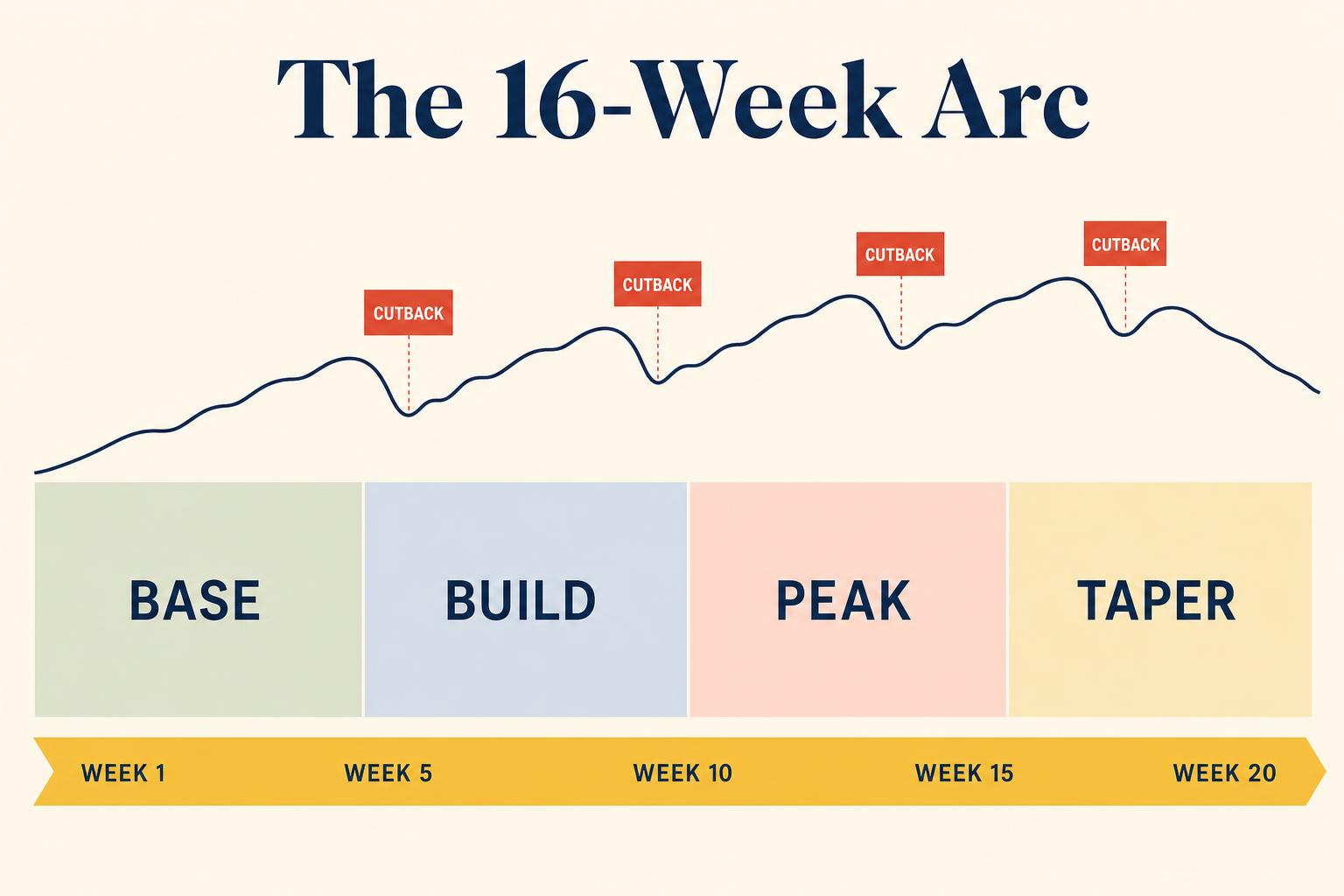
In the language of training science, your entire marathon preparation is a macrocycle, typically sixteen to twenty weeks. Within that macrocycle, you'll find mesocycles of roughly three to four weeks each, and each week is a microcycle. The mesocycle is where the magic happens: you build stress for two or three weeks, then deliberately pull back for one week. Build, build, recover. Build, build, build, recover. This rhythm is the heartbeat of every good training plan.
Progressive Overload — and the 10% Rule
Paired with periodization is the principle of progressive overload, the gradual, systematic increase of training stress over time. Your body is remarkably efficient: it adapts to exactly the demands you place on it, and no more. If you run the same three miles at the same pace every day for six months, you'll become very good at running three miles, but you won't be prepared for twenty-six point two. To stimulate new adaptation, you must progressively increase the challenge.
For marathon beginners, progressive overload primarily means increasing volume, how far you run each week, rather than intensity, how fast you run. This is consistent with findings from Seiler in 2010, who showed that even elite endurance athletes spend approximately eighty percent of their training time at low intensity. If the world's best runners are keeping most of their miles easy, you certainly should too. Research from Haugen and colleagues in 2022 confirmed that highly trained distance runners typically follow traditional periodization with hard-easy day patterns and a pyramidal distribution where the vast majority of training occurs in low-intensity zones.
The practical question is: how much should you increase each week? The most commonly cited guideline is the ten percent rule: don't increase weekly mileage by more than ten percent from one week to the next. Nielsen and colleagues in 2014 studied eight hundred seventy-four novice runners and found that those who kept two-week mileage increases below ten percent had the lowest injury rates for common running injuries like patellofemoral pain and I-T band syndrome. However, the ten percent rule has limitations. If you're running only five miles per week, a ten percent increase is half a mile, almost trivially small. If you're running forty miles per week, a ten percent increase is four miles, which might be too much for newer runners. Use the rule as a guardrail, not a commandment.
Recall the adaptation rate mismatch from Chapter Two: your cardiovascular system adapts in days to weeks, while tendons and bones take weeks to months. This mismatch explains why conservative mileage progression matters even when your heart and lungs feel ready for more.
Supercompensation: Why Rest Is the Workout
The concept is called supercompensation, and it describes a four-step biological process. First, a training stimulus, your run, disrupts homeostasis. It depletes glycogen stores, creates micro-damage in muscle fibers, and stresses tendons and bones. Second, during the recovery phase, your body repairs this damage. Third, and this is the critical part, your body doesn't just restore itself to baseline. It rebuilds slightly beyond where it was before, anticipating that the same stress will come again. This adaptive overshoot is supercompensation, as Gambetta described in 2007. Fourth, if no further stimulus arrives, the gains slowly fade back to baseline.
The timing is everything. Apply the next training stress during the supercompensation window, and you build fitness on top of fitness. Apply it too soon, before recovery is complete, and you dig yourself into a hole. Apply it too late, and you've lost the window. This is why training plans don't just tell you when to run; they tell you when to rest.
The Cutback Week
Every three to four weeks, a well-designed marathon plan includes a recovery week, sometimes called a "cutback week" or "down week," where total mileage drops by twenty to forty percent. New runners often resist these weeks. They feel like backsliding. But recovery weeks serve multiple critical functions.
First, musculoskeletal healing: bones, tendons, and connective tissue need extended recovery periods to complete their remodeling cycles. Remember from Chapter Two that bone adaptation takes eight to twelve weeks. Recovery weeks give these slower-adapting tissues a chance to consolidate gains. Second, glycogen restoration: during build weeks, your glycogen stores may never fully replenish between sessions. Recovery weeks allow complete refueling. Third, psychological reset: the mental fatigue of progressively harder weeks is real. A lighter week restores motivation and prevents the staleness that leads to skipped runs. And fourth, injury prevention: Kemler and colleagues in 2018 found a twofold greater injury incidence in novice runners compared to experienced runners, making these protective recovery periods especially vital for beginners.
Think of recovery weeks as scaffolding in construction. They don't add height to the building, but without them, the whole structure collapses.
The cutback-week principle
The Three Building Blocks
A marathon training plan can look overwhelmingly detailed, but for beginners, almost every plan is built from just three core workout types. Understanding these building blocks is more important than memorizing any specific schedule.
Easy Runs — the Foundation
Easy runs are the bread and butter of marathon training. They make up the majority of your weekly running, and they should feel, well, easy. You should be able to hold a conversation throughout. If you're gasping for breath, you're going too fast. Seiler in 2010 demonstrated that elite endurance athletes spend roughly eighty percent of training below their first lactate threshold. For a beginner, this means running at a pace that feels almost embarrassingly slow.
Easy runs build your aerobic engine: they increase capillary density in your muscles, improve your body's ability to burn fat as fuel, and strengthen the cardiovascular system, all without creating excessive musculoskeletal stress. They are the foundation upon which everything else is built.
The Long Run — the Cornerstone
If easy runs are the foundation, the long run is the cornerstone of marathon preparation. Typically performed once per week, usually on a weekend, the long run progressively extends the duration your body can sustain continuous movement. It teaches your muscles to burn fat more efficiently, conditions your joints and connective tissue for prolonged impact, and perhaps most importantly, builds the mental resilience to keep going when your body wants to stop.
The long run is where your body learns what a marathon will actually ask of it. Lewicka-Potocka and colleagues in 2024 emphasize that physiological strain correlates directly with training volume, experience, and recovery strategies. The long run is where you build all three. Most beginner plans peak with a long run of eighteen to twenty-two miles, typically three weeks before race day. You don't need to run the full twenty-six point two in training; the taper and race-day adrenaline will carry you the rest of the way.
Critically, long runs should be performed at an easy, conversational pace, or even with planned walk breaks. This is not the day to chase speed. It's the day to teach your body endurance.
Rest & Cross-Training — the Hidden Workout
Rest days are not empty space in your schedule. They are training days where the workout is recovery. On rest days, the supercompensation process does its work. Your muscles repair, your glycogen refills, your bones remodel.
Cross-training days, swimming, cycling, yoga, walking, provide an active recovery option. They maintain cardiovascular fitness while giving your running-specific muscles and joints a break from impact forces. For many beginners, especially those coming from other sports, cross-training days satisfy the itch to "do something" without adding running stress.
Arranging the Week
Understanding the three pillars is one thing; arranging them into an actual week is another. The placement of workouts matters almost as much as the workouts themselves. Two key principles guide weekly structure.
First, buffer the long run with easier days. Place a rest day or easy cross-training day before and after your long run. Your legs need to be relatively fresh going in and need recovery time coming out.
Second, avoid stacking hard efforts. Don't place your two longest or hardest runs on consecutive days. Spread your running days across the week with recovery days in between.
Ramskov and colleagues in 2018 found in a study of five thousand two hundred five runners that single-session distance spikes, running more than ten percent beyond your longest run in the past thirty days, were more strongly associated with injury than week-to-week mileage changes. Even a small spike of ten to thirty percent beyond your recent longest run raised injury risk by sixty-four percent. This underscores why both the weekly pattern and the gradual progression of the long run matter so much.
The Long Run, Up Close
No single workout matters more in marathon preparation than the weekly long run. It is the session where nearly every physiological adaptation specific to marathon running converges: fat oxidation efficiency, glycogen storage capacity, musculoskeletal durability, mental fortitude, and practiced pacing.
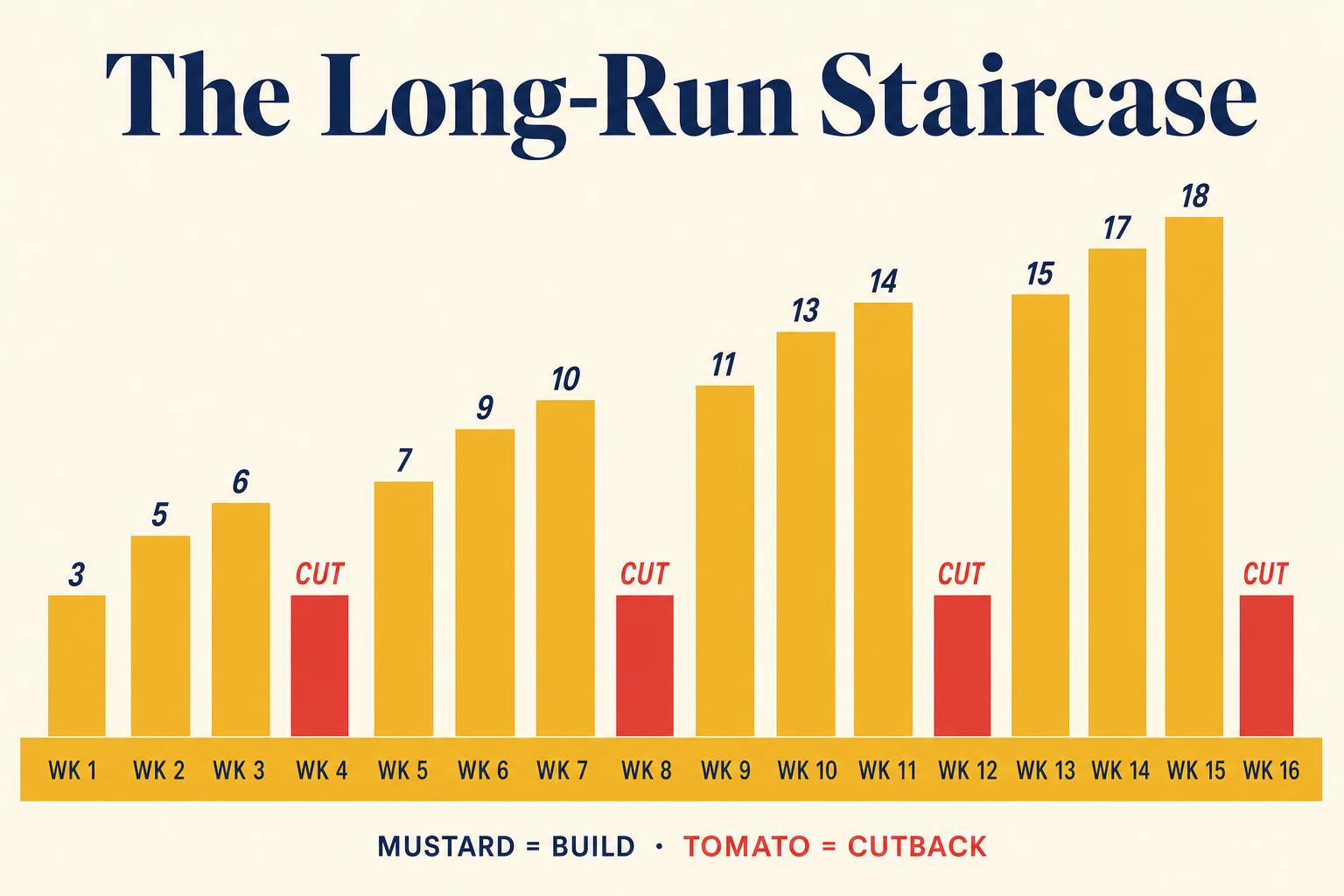
Long run progression follows the same build-and-recover rhythm as your overall plan. A typical pattern is to increase the long run distance for three weeks, then drop it back during the recovery week. For example: six miles, then seven miles, then eight miles, then five miles for recovery, then nine miles, then ten miles, then twelve miles, then seven miles for recovery. Notice how the recovery week's long run is still longer than where you started. The trajectory is upward, but with built-in dips.
The pace of long runs should be firmly in the "conversational" zone, typically sixty to ninety seconds per mile slower than your goal marathon pace, or even slower. For walk-run participants, this means maintaining your planned walk-run intervals throughout. The goal is time on your feet, not speed. Jeff Galloway, one of the pioneers of the run-walk-run method, has coached tens of thousands of first-time marathoners to the finish line with walk breaks built into every long run.
Training Age — the Humbling Concept
Here's a concept that humbles even the fittest newcomers to running: training age. Your training age is not your biological age or your fitness level. It's how long you've been consistently running. A twenty-five-year-old former college swimmer who just started running has a training age of zero, even if their cardiovascular fitness is exceptional.
Training age matters because of the adaptation rate mismatch we discussed in Chapter Two. That swimmer's heart and lungs can handle impressive workloads, but their Achilles tendons, shin bones, and hip joints have never experienced the repetitive impact of running. Kemler and colleagues in 2018 found that novice runners, defined as those who had been running for less than twelve months, had double the injury rate of experienced runners, regardless of other fitness markers. Your cardiovascular system may feel ready for a ten-mile run after just a few weeks of training, but your connective tissue emphatically is not.
This is precisely why even very fit beginners should start with conservative training plans. The plan isn't respecting your lungs; it's protecting your bones.
Three Plans, Three Legitimate Paths
There is no single "correct" marathon training plan. The best plan is the one you can consistently follow, the one that fits your schedule, respects your starting point, and keeps you healthy. Let's examine three legitimate approaches, each supported by coaches who have guided thousands of runners to finish lines.
The Walk-Run Plan — Galloway Style
The walk-run plan, in the style of Jeff Galloway, is best for complete beginners, those returning from injury, or anyone who wants to minimize injury risk. It typically includes three to four days per week of walk-run sessions with a progressive long run that includes scheduled walk breaks, for example, run four minutes, walk one minute. The long run builds slowly and may peak at twenty-three to twenty-six miles because the walk breaks reduce overall stress. Peak weekly volume: fifteen to twenty-five miles.
The Four-Day Minimal Plan — Higdon Novice
The four-day minimal plan, in the style of Hal Higdon Novice, is best for busy adults with limited training time, parents, or people who want a structured but manageable approach. Three short runs plus one long run per week, with cross-training and rest on the other days. This plan respects the reality that many people can't, or shouldn't, run five or six days per week. Peak weekly volume: twenty-five to thirty-five miles.
The Five-Day Moderate Plan — Hanson Style
The five-day moderate plan, in the Hanson style, is best for those with some running background, a training age of six months or more, people who enjoy daily running, or those looking to run the full marathon distance without walk breaks. Five running days including easy runs, one tempo or pace run, and a long run that peaks at sixteen to eighteen miles, shorter than other plans because cumulative fatigue from higher weekly mileage simulates race conditions. Peak weekly volume: thirty-five to fifty miles.
The goal of training is to be on the starting line healthy, well-rested, and eager to run. Every plan that accomplishes this is a good plan.
Adapted from Higdon, Galloway & the Hanson brothers
Matching the Plan to Your Life
Here's something no training plan spreadsheet can fully convey: every plan requires flexibility. Life happens. You'll get sick, work will explode, your child will bring home a cold from daycare, or you'll simply have a day where your legs feel like concrete. The question isn't whether you'll miss a run, you will, but how you respond.
The most important rule is this: missing a single run is never a crisis. Never. Your fitness doesn't evaporate overnight. What is dangerous is trying to "make up" missed runs by cramming extra miles into remaining days. That's how you create the session-distance spikes that Ramskov and colleagues in 2018 identified as the strongest predictor of injury, far more dangerous than missing the run in the first place.
If you miss a short easy run, skip it and move on. If you miss a long run, see if you can do it the next day at a slightly reduced distance. If you miss a full week to illness, back up your plan by one week. The plan serves you; you don't serve the plan.
Lewicka-Potocka and colleagues in 2024 emphasize that individualized approaches to training and recovery are essential to maximizing benefits while minimizing risks. No plan written for thousands of people can perfectly fit your unique body, schedule, and life. The best runners aren't the ones who follow every workout perfectly. They're the ones who adapt intelligently when reality intervenes.
Key Takeaways
- Periodization, the systematic cycling of stress and recovery, is the foundation of every effective training plan — organised into macrocycles, mesocycles, and microcycles (Bompa & Haff, 2009).
- Supercompensation means your body rebuilds slightly stronger after training stress, but only if you allow adequate recovery (Gambetta, 2007) — rest is a physiological necessity, not laziness.
- Recovery weeks every three to four weeks, reducing volume by 20–40%, protect slower-adapting tissues like bones and tendons from overuse injury (Kemler et al., 2018).
- The long run is the single most important workout in marathon training, building endurance through progressive, patient increases in time on your feet at an easy pace.
- The 10% rule (Nielsen et al., 2014) is a useful guideline for weekly mileage increases, but single-session distance spikes are an even stronger injury predictor than week-to-week changes (Ramskov et al., 2018).
- Roughly 80% of training should sit at low intensity (Seiler, 2010; Haugen et al., 2022) — pyramidal distribution and hard-easy day patterns are the norm even among elite distance runners.
- Training age — how long you've been consistently running — matters as much as fitness level, because connective tissue adaptation lags behind cardiovascular adaptation.
- Three legitimate plan structures (walk-run, four-day, five-day) suit different lives; the best one is the one that fits your life, respects your starting point, and you can follow consistently.
- Missing a single run is never a crisis. Trying to make up missed runs by cramming extra mileage is far more dangerous than the missed run itself.
In Chapter 4 — Your Body Is Talking — Learn to Listen — we move from the architecture of the plan to the architecture of the runner. How do you tell the normal discomfort of adaptation apart from the warning signal of a developing injury? We'll meet the five most common beginner injuries, build a personal risk profile, and learn the strength routine that quietly does more to protect you than any shoe ever will.
References
Bompa, T. O., & Haff, G. G. (2009). Periodization: Theory and Methodology of Training (5th ed.). Human Kinetics.
Gambetta, V. (2007). Athletic Development: The Art & Science of Functional Sports Conditioning. Human Kinetics.
Haugen, T., Sandbakk, Ø., Seiler, S., & Tønnessen, E. (2022). The training characteristics of world-class distance runners: An integration of scientific literature and results-proven practice. Sports Medicine — Open, 8(1), 46.
Kemler, E., Blokland, D., Backx, F., & Huisstede, B. (2018). Differences in injury risk and characteristics of injuries between novice and experienced runners. Journal of Science and Medicine in Sport, 21(5), 462–467.
Lewicka-Potocka, Z., Kaleta-Duss, A. M., Lewicka, E., & Dąbrowska-Kufel, A. (2024). The "marathon runner's heart" — physiological strain, recovery, and individualised training. Sports Medicine Reviews.
Nielsen, R. O., Parner, E. T., Nohr, E. A., Sørensen, H., Lind, M., & Rasmussen, S. (2014). Excessive progression in weekly running distance and risk of running-related injuries: An association which varies according to type of injury. Journal of Orthopaedic & Sports Physical Therapy, 44(10), 739–747.
Ramskov, D., Rasmussen, S., Sørensen, H., Parner, E. T., Lind, M., & Nielsen, R. O. (2018). Run-related injury occurrence and the change in running distance, running pace, and running frequency. British Journal of Sports Medicine, 52(20), 1331–1337.
Seiler, S. (2010). What is best practice for training intensity and duration distribution in endurance athletes? International Journal of Sports Physiology and Performance, 5(3), 276–291.