The Miles Between Your Ears
Mental skills for the long run and the marathon — perception of effort, segmenting, mantras, and the moment at mile nineteen when the voice in your head starts making its case.
It's mile nineteen. You've trained for this for four months. Your nutrition plan is dialed in, you hit your fueling window at every aid station, and your legs have logged hundreds of miles in preparation. But right now, none of that seems to matter. A voice in your head — quiet at mile five, a murmur at mile fourteen — is now screaming: You can't do this. You're going to have to walk. Everyone is passing you. Your quads ache, your feet feel like they're bruising with every step, and the finish line is still seven point two miles away. The question that will determine how the next hour unfolds has nothing to do with your VO2 max or your glycogen stores. The question is: what have you trained your mind to do in this moment?
Most first-time marathoners prepare their bodies meticulously and leave their minds to chance. This chapter is about making sure that doesn't happen to you.
The Brain Is the Final Gatekeeper
By now, you have the physiological knowledge, the structured training plan, the injury prevention toolkit, and the fueling strategy. You understand what your muscles, tendons, and metabolic systems need to carry you twenty-six point two miles. But here is an uncomfortable truth that research has confirmed repeatedly: the marathon is decided as much between your ears as it is in your legs.
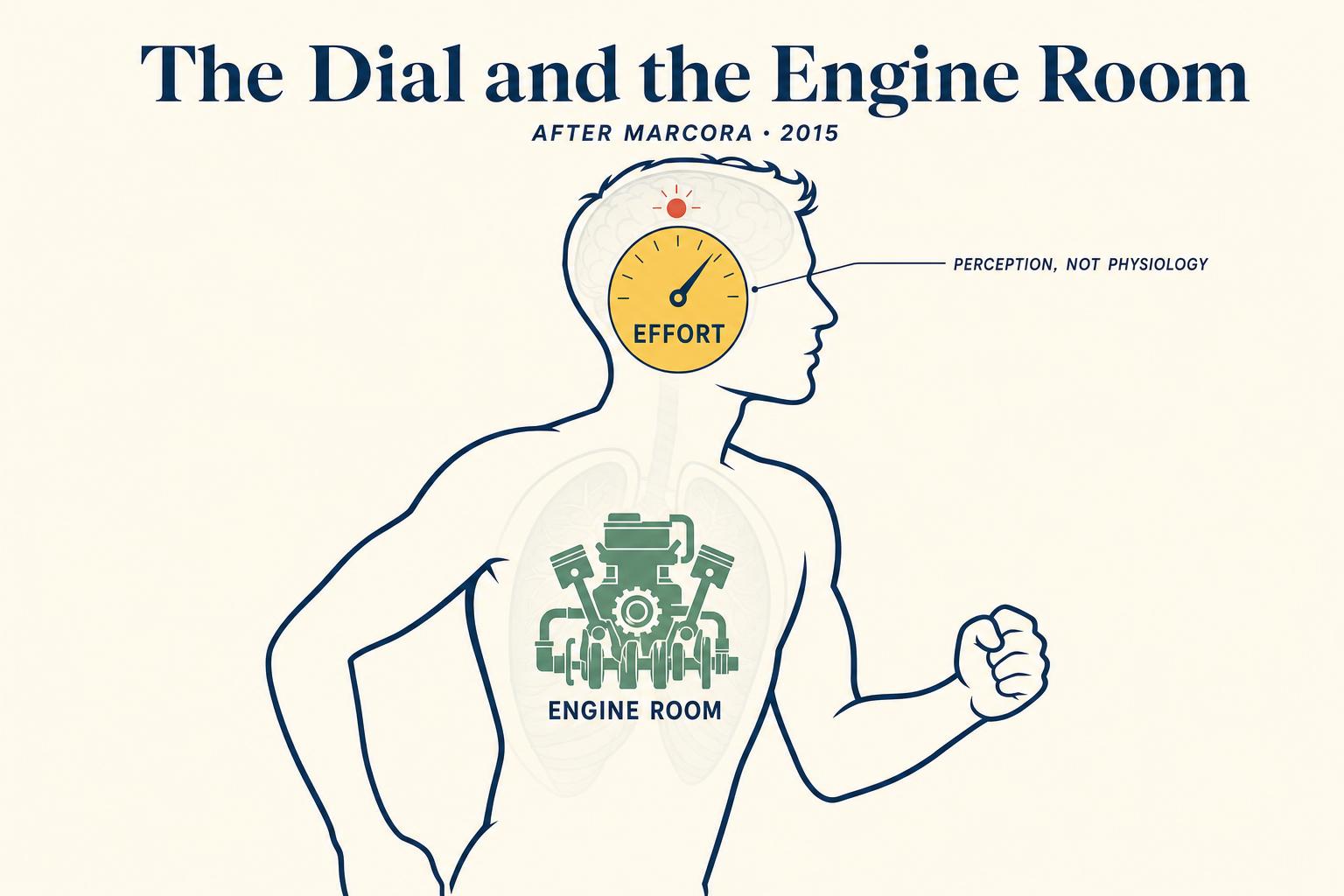
Samuele Marcora's psychobiological model of endurance performance argues that exercise terminates not when the body truly fails, but when the perception of effort becomes so high that continuing feels intolerable — or when motivation to continue drops below the effort required (Marcora, 2015). In other words, your brain is the final gatekeeper. Marcora and colleagues found that psychological interventions — including imagery, self-talk, and goal setting — consistently improved endurance performance by altering how athletes perceived and responded to effort. Mental fatigue, on the other hand, undermined it, even when the body was physiologically capable of continuing.
This doesn't mean the marathon is "all in your head." The glycogen depletion we explored in Chapter five is real. The cumulative musculoskeletal fatigue is real. But how you experience and respond to those physical realities is profoundly shaped by psychological factors — factors you can train just like you train your cardiovascular system.
What's Actually Driving You
Before we build mental race-day strategies, we need to understand what's sustaining you through sixteen to twenty weeks of training in the first place. Motivation isn't a single switch you flip on or off. It's a complex, shifting landscape — and understanding your particular terrain matters.
Robert Vallerand's hierarchical model of motivation, grounded in self-determination theory, describes motivation as a spectrum (Vallerand, 2007). At one end sits intrinsic motivation — running because the act itself is satisfying, because you love how it feels to move, because you're curious about what your body can do. At the other end is extrinsic motivation — running for a medal, a social media post, or to prove something to someone else. In the middle are various shades of internalized motivation: running because you value health, because you identify as a runner, because the discipline matters to you as a person.
Research consistently shows that intrinsic motivation leads to better long-term persistence, greater enjoyment, and ultimately stronger performance in endurance sports (Vallerand, 2007). This doesn't mean external motivators are useless — signing up for a race and paying a registration fee is an extrinsic motivator that gets a lot of people off the couch. But relying solely on extrinsic drivers creates fragile motivation. When the race is still ten weeks away and it's cold and dark at six a.m., "I want to post my finish line photo" may not be enough to get your shoes on.
Process Over Outcome
Remember the founding philosophy we discussed in Chapter one — that this course is about the process of becoming a marathoner, not just crossing a finish line? That philosophy has strong scientific backing. A systematic review and meta-analysis of goal setting in sport found that process goals — goals focused on specific actions and behaviors you can control, for example "I will maintain an even breathing pattern during my tempo run" — enhance self-efficacy far more effectively than outcome goals like "I will finish in under four hours thirty" (Swann et al., 2022). Process goals give you an increased perception of control, and because they can be achieved frequently, they build confidence incrementally.
Outcome goals based on interpersonal comparison — "I want to beat my coworker's time" — were associated with reduced engagement and increased anxiety (Swann et al., 2022). That's a critical insight for first-time marathoners who are surrounded by experienced runners posting impressive training paces online. Your marathon is yours alone. The goal that will serve you best is not a time but a process: run each training session with intention, fuel consistently, rest when the plan says rest.
The Training Valley
Every training plan has a psychological architecture that mirrors its physical one. Understanding that architecture — knowing what's coming mentally — is half the battle.
The first few weeks of a training plan carry the intoxicating energy of novelty. Everything feels fresh: the new shoes, the training log, the sense of embarking on something meaningful. The final weeks carry the gravitational pull of the approaching race — excitement, nervous energy, and the momentum of "I've come this far." But between weeks eight and fourteen, you enter what experienced runners sometimes call the training valley: the novelty has worn off, the race is still abstract and distant, your body is chronically tired from accumulated mileage, and the whole enterprise can start to feel pointless.
This is predictable. Knowing it's predictable is powerful. The training valley is not a sign that you've lost motivation or chosen the wrong goal. It's the psychological equivalent of the metabolic demands we discussed in Chapter five — a natural cost of the process. The key is to have strategies in place before you arrive at the valley.
The Wall, and Why It Hurts So Much
If the training valley is a slow fade, the race-day wall is a collision. Research by Buman and colleagues (2008) found that forty-three to fifty-three percent of recreational marathon runners experience hitting the wall — a phenomenon characterized by generalized fatigue, unintentional slowing, an overwhelming desire to walk, and a cognitive shift toward pure survival. Rapoport's (2010) computational modeling confirmed the physiological basis: glycogen depletion typically strikes between miles eighteen and twenty-two depending on pace, muscle mass, and pre-race fueling.
But here's what makes the wall so devastating: it's not purely physical. Buman and colleagues (2008) found that the wall has distinct psychological origins alongside the physiological ones. The physical sensation of declining glycogen triggers a cascade of negative thoughts, which amplify the perception of effort, which makes the physical sensation feel worse, which produces more negative thoughts. It's a feedback loop — and breaking that loop requires mental tools you've practiced in advance.
The Voice in Your Head Is Not Neutral
Sport psychology isn't about positive thinking or pretending pain doesn't exist. It's about having specific, practiced techniques for managing attention, reframing experience, and maintaining engagement when your brain is looking for an exit ramp. Let's build your toolkit.
The voice in your head is not neutral. It's actively shaping your performance. A meta-analysis by Hatzigeorgiadis and colleagues (2011) of thirty-two studies on self-talk in sport found a clear, moderate effect: deliberate self-talk interventions improve performance. What you say to yourself matters — and you can change what you say.
The research distinguishes two types of self-talk, each useful for different purposes. Instructional self-talk focuses attention on technical execution: "Relax your shoulders," "Short quick steps," "Breathe from the belly." It's most effective for tasks requiring coordination and form — like maintaining your running mechanics when fatigue degrades them in the late miles. Motivational self-talk bolsters effort and confidence: "You are strong," "One mile at a time," "You've done this in training." For endurance tasks requiring sustained effort, motivational self-talk showed particular benefit (Hatzigeorgiadis et al., 2011).
The critical insight is that effective self-talk must feel authentic. A mantra that sounds hollow to you won't work under pressure. This is why you need to develop and test your self-talk during training, not invent it on race morning.
Where to Point Your Attention
Where you direct your attention during a run profoundly affects your experience. Masters and Ogles' (1998) comprehensive review of twenty years of research identified two fundamental attentional strategies. Association means directing attention inward — monitoring your breathing, checking your form, tuning into your pace and heart rate. Dissociation means directing attention outward or away from the body — listening to music, enjoying the scenery, doing mental math, daydreaming.
The findings are nuanced and important. Association is linked to faster performance — elite runners tend to monitor bodily sensations closely, making constant micro-adjustments to pace and form. But dissociation is associated with lower perceived exertion and possibly greater endurance. And here's the key practical finding: most runners naturally drift between the two styles during the same run. The skill isn't choosing one forever; it's knowing when to deploy each one.
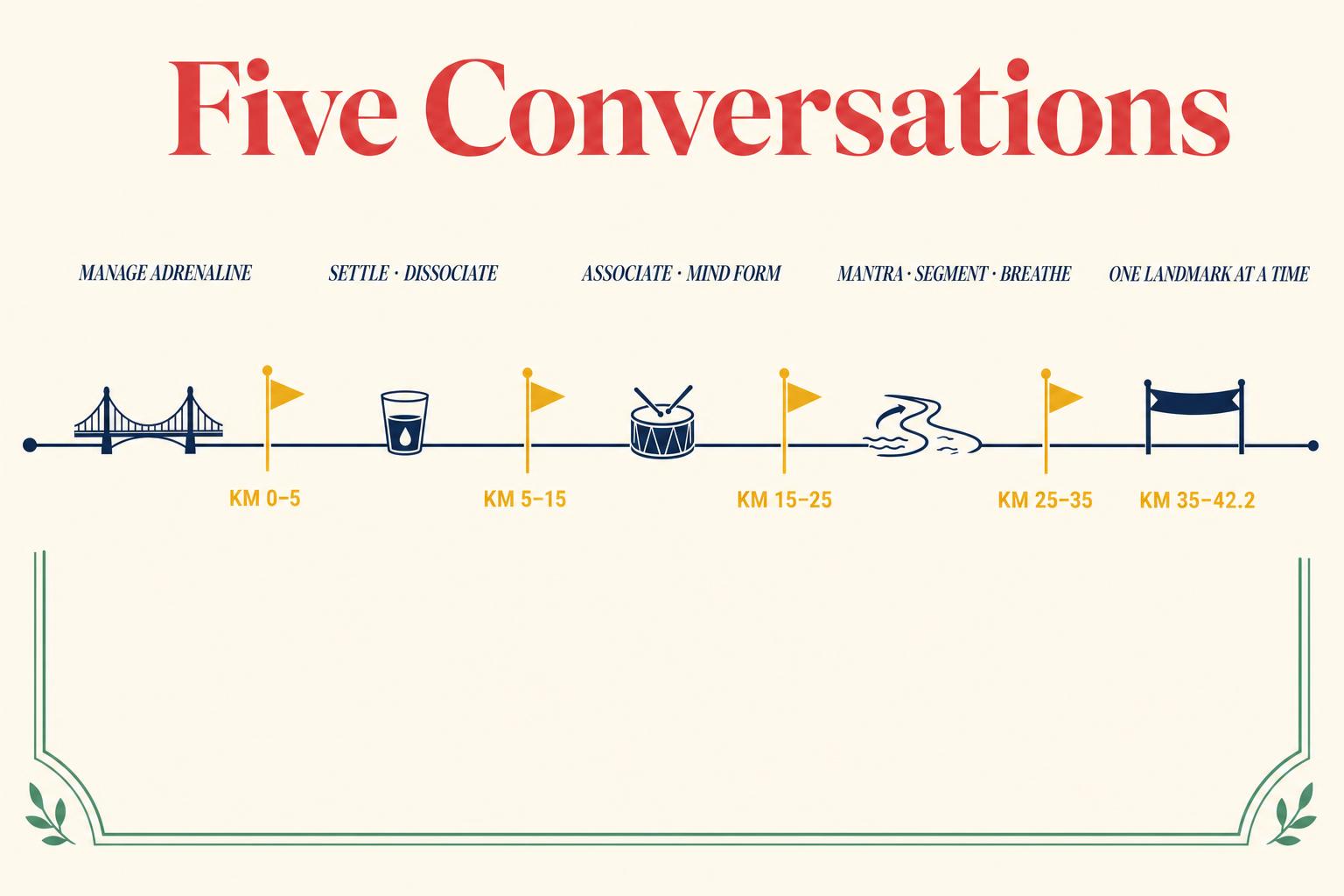
Early in the race, when effort is low and you're managing adrenaline, dissociation can help you relax and avoid going out too fast. In the dark middle miles, sixteen through twenty-two, a shift toward association helps you maintain form and respond to your body's genuine signals. But sustained pure association is mentally exhausting — so strategic moments of dissociation, even brief ones like focusing on a spectator's funny sign or counting blue shirts ahead of you, provide cognitive rest.
Cut the Distance Into Pieces
Twenty-six miles is overwhelming. Two miles is manageable. Segmenting — breaking the race into smaller, psychologically digestible chunks — is one of the most commonly reported coping strategies among marathoners (Buman et al., 2008). You can segment by aid stations: "just get to the next water table." By landmarks: "run to that bridge." By miles: "just this mile, nothing else." Or by time: "ten more minutes of effort."
Segmenting works because it transforms an abstract, daunting goal into a series of concrete, achievable process goals — exactly the kind that research shows enhance self-efficacy (Swann et al., 2022). Each completed segment produces a small psychological victory, which generates momentum for the next one.
Marcora (2015) found that verbal encouragement and head-to-head competition both improved endurance performance. On race day, this translates to practical tactics: finding a pace buddy in the crowd, drawing energy from spectators, thanking volunteers — which shifts your attention outward and gives you a brief mood boost — or dedicating specific miles to people who supported your training.
The Bad Run
Let's address something every runner experiences and few training plans acknowledge: the bad run. The day when your legs feel like bags of wet sand, your pace is embarrassingly slow, every step is a negotiation, and the voice in your head isn't whispering doubt — it's making a convincing legal case for why you should abandon this entire marathon project.
Bad runs are not optional. They're built into the process. They happen because of accumulated fatigue, poor sleep, stress at work, dehydration, heat, or simply the statistical certainty that not every run can feel good. The danger isn't the bad run itself — it's the narrative you build around it.
A single bad run becomes toxic when you catastrophize: "If I can't handle eight miles today, how will I ever run twenty-six?" This is a cognitive distortion — taking one data point and projecting it across the entire future. The antidote is what psychologists call cognitive defusion: observing the thought without accepting it as truth. Instead of "I can't do this," try: "I'm having the thought that I can't do this. That's my brain doing what brains do when they're tired. I'll note it and keep moving."
The paradox of bad runs is that surviving them builds more psychological resilience than good runs do. Every bad run you complete — even slowly, even grumpily — is evidence you can bank for race day: I have felt this bad before, and I kept going.
The marathon doesn't really begin until mile twenty. Everything before that is just the preface.
Running wisdom
Pain, Discomfort, and Engaged Acceptance
In Chapter four, we introduced the critical distinction between pain — a signal of tissue damage requiring attention — and discomfort — the expected sensation of sustained physical effort. Now we revisit that framework through a psychological lens, because how you interpret physical sensations during a marathon profoundly shapes your behavior.
Research by Talia, Nirit, and Defrin (2019) found that endurance athletes — compared to strength athletes and non-athletes — demonstrated higher pain tolerance, stronger conditioned pain modulation, and lower fear of pain. This isn't because endurance athletes are tougher or more stoic in some innate way. It's because repeated exposure to sustained physical discomfort during training recalibrates the brain's relationship with that discomfort. You learn, through experience, that discomfort is information rather than an emergency.
This recalibration is precisely what your training is building. Every long run teaches your brain that burning quads, heavy legs, and elevated heart rate are safe and temporary. But — and this is crucial — this psychological adaptation must not override genuine injury signals. The framework from Chapter four still applies: sharp, localized, sudden, or worsening pain is a signal to stop and assess. Diffuse, symmetrical, gradually building discomfort is the normal cost of running a marathon.
The mental skill here is engaged acceptance: fully acknowledging that you're uncomfortable, choosing not to fight or panic about it, and directing your attention to what you can control — form, breathing, the next segment. This is fundamentally different from dissociating or ignoring your body. It's a middle path — present, aware, and choosing to continue.
Building Your Mental Race Plan
Just as you wouldn't show up on race day without a pacing plan or a fueling schedule, you shouldn't show up without a mental race plan. This isn't a rigid script — race day will surprise you, and flexibility matters. But having a framework for what you'll do with your mind at different stages of the race gives you something to fall back on when the wheels start wobbling.
A good mental race plan matches your psychological strategy to the predictable demands of each race segment. It accounts for the fact that mental energy is finite — just as glycogen depletes, so does your capacity for intense cognitive focus. Spending all your mental energy on association and self-monitoring in the first ten miles leaves you cognitively depleted when you need those tools most in the final six.
Think of your mental race plan as the mental equivalent of the fueling plan from Chapter five — strategic, practiced, and personalized.
Rehearse, Don't Improvise
Mental strategies that haven't been rehearsed won't work under pressure. In the weeks ahead, use your long runs as mental dress rehearsals. Practice your self-talk during the last three miles of a long run, when fatigue makes the voice louder. Experiment with shifting between association and dissociation. Test your segmenting approach on a sixteen-miler: can you stay present for one mile at a time without jumping ahead to the finish? The mental race plan you build today should be refined, tested, and personalized through every remaining training run.
Marcora's (2015) research underscores this: the psychological interventions that most reliably improved endurance performance were those that had been practiced, not merely understood. Knowing about self-talk is step one. Using self-talk when you're fatigued, uncomfortable, and doubting yourself — that's the skill. And like any skill, it develops through repetition.
Key Takeaways
- The marathon is governed as much by perception of effort and motivation as by pure physiology — your mind needs a training plan too (Marcora, 2015).
- Intrinsic motivation and process goals sustain engagement more effectively than extrinsic motivation and outcome goals, especially during the training valley of weeks eight through fourteen (Vallerand, 2007; Swann et al., 2022).
- Deliberate self-talk — both instructional and motivational — improves endurance performance with a moderate effect size. The key is developing self-talk that feels authentic and practicing it during training runs (Hatzigeorgiadis et al., 2011).
- Association (internal focus) and dissociation (external focus) are both valuable attentional strategies. The skill is knowing when to deploy each one across different race segments (Masters & Ogles, 1998).
- Segmenting the race into smaller psychological chunks transforms an overwhelming distance into a series of achievable process goals, building momentum through repeated small victories (Buman et al., 2008).
- Bad runs are inevitable and build resilience. The danger isn't the bad run itself, but the catastrophic narrative you construct around it.
- Engaged acceptance of physical discomfort — acknowledging it without fighting or panicking — is the psychological middle path between ignoring your body and being overwhelmed by it (Talia et al., 2019).
- A mental race plan, like a fueling plan, should be built in advance, rehearsed during training, and flexible enough to adapt on race day.
Next: The Art of Doing Less — Taper, Gear, and Race-Week Mastery. We bring everything together as we turn to the taper period and race-week logistics — the final psychological, practical, and physiological preparation for the day itself. We'll address the unique anxiety of tapering, why running less feels so unsettling, race-morning routines, and how to combine every tool from Chapters one through six into a coherent race-day plan.
References
Buman, M. P., Omli, J. W., Giacobbi, P. R., Jr., & Brewer, B. W. (2008). Experiences and coping responses of "hitting the wall" for recreational marathon runners. Journal of Applied Sport Psychology, 20(3), 282–300.
Hatzigeorgiadis, A., Zourbanos, N., Galanis, E., & Theodorakis, Y. (2011). Self-talk and sports performance: A meta-analysis. Perspectives on Psychological Science, 6(4), 348–356.
Marcora, S. M., Staiano, W., & Manning, V. (2015). Psychological determinants of whole-body endurance performance. Sports Medicine, 45(7), 997–1015.
Masters, K. S., & Ogles, B. M. (1998). Associative and dissociative cognitive strategies in exercise and running: 20 years later, what do we know? The Sport Psychologist, 12(3), 253–270.
Rapoport, B. I. (2010). Metabolic factors limiting performance in marathon runners. PLoS Computational Biology, 6(10), e1000960.
Swann, C., Rosenbaum, S., Lawrence, A., Vella, S. A., McEwan, D., & Ekkekakis, P. (2022). The performance and psychological effects of goal setting in sport: A systematic review and meta-analysis. International Review of Sport and Exercise Psychology.
Talia, A., Nirit, G., & Defrin, R. (2019). The type of sport matters: Pain perception of endurance athletes versus strength athletes. European Journal of Pain, 23(4), 686–696.
Vallerand, R. J. (2007). Intrinsic and extrinsic motivation in sport and physical activity: A review and a look at the future. In G. Tenenbaum & R. C. Eklund (Eds.), Handbook of sport psychology (3rd ed., pp. 59–83). Wiley.