The Art of Doing Less: Taper, Gear, and Race-Week Mastery
Why the final fortnight asks you to trust the work — the science of the taper, the night-before checklist, and the one unbreakable rule of race day.
It's two weeks before your marathon. You've logged more miles in the past four months than you ever imagined possible. Your long runs have crept past twenty miles. Your legs know the feeling of sustained effort. And now your training plan says something that feels like a cruel joke: run less. Significantly less. Your longest run this week might be eight miles — half of what you did two weeks ago. You feel sluggish, anxious, maybe a little panicky. Your calves ache in a way they didn't during peak training. You're convinced you're losing fitness by the hour. A voice in your head whispers: maybe just one more long run, just to be sure.
Welcome to the TAPER. It is the most evidence-supported phase of your entire training plan — and for most runners, it is the hardest to trust. This chapter will show you why doing less is the final piece of doing your best, and then walk you through every practical decision between now and the starting line.
The Two Accounts
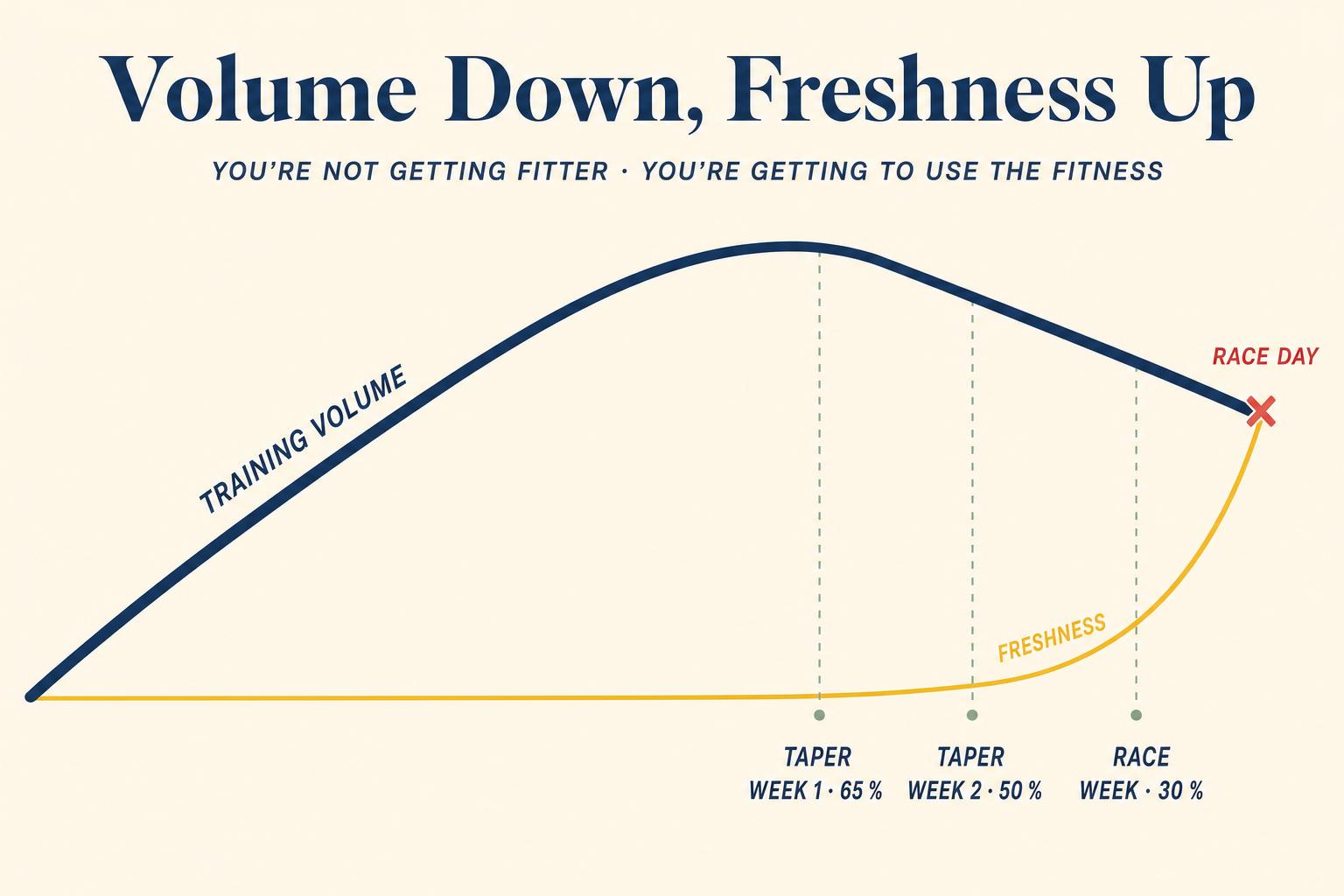
A taper is a progressive, nonlinear reduction of training load in the final days before a goal race, designed to reduce the accumulated fatigue of training while preserving — or even enhancing — the fitness you've built. This was documented by Mujika and Padilla in 2003. Think of it this way: throughout training, you've been making deposits into two accounts simultaneously. One is your fitness account — cardiovascular capacity, muscular endurance, metabolic efficiency. The other is your fatigue account — microtrauma in muscle tissue, depleted glycogen stores, accumulated hormonal stress. During normal training, fatigue masks fitness. The taper allows fatigue to dissipate while fitness remains essentially intact.
The numbers are striking. Mujika and Padilla's seminal review in 2003 found that a well-executed taper improves performance by approximately three percent, with a range of zero point five percent to six percent. For a four-hour marathoner, three percent translates to roughly seven minutes — the difference between a triumphant finish and a desperate shuffle. A large-scale analysis of over one hundred fifty-eight thousand recreational marathon runners, conducted by Smyth and Lawlor in 2021, confirmed that strict three-week tapers were associated with a median time savings of five minutes and thirty-two seconds, or about two point six percent improvement.
Four Quiet Recoveries
The physiological changes during a taper are remarkable in their breadth. As training volume drops, several systems simultaneously recover and optimize.
First, GLYCOGEN SUPERCOMPENSATION. Your muscles replenish and then exceed their normal glycogen stores. As we discussed in Chapter 5, glycogen is your primary fuel source at marathon intensity. With reduced training demand and adequate carbohydrate intake, your muscles can store up to one point seven nine times their baseline glycogen levels — and those supercompensated levels persist for at least three days afterward, as Bussau and colleagues demonstrated in 1997.
Second, tissue repair. The microdamage accumulated in tendons, connective tissue, and muscle fibers over months of progressive loading finally gets time to heal completely. Inflammation markers decrease. Structural proteins are rebuilt.
Third, neuromuscular freshening. The communication between your nervous system and your muscles sharpens. You recruit muscle fibers more efficiently, and the subjective sense of "bounce" or "snap" in your legs returns — often dramatically in the final days before the race.
And fourth, hormonal recovery. Cortisol levels, which are elevated during heavy training, decrease, while testosterone and growth hormone ratios normalize. Your immune system strengthens — critical, since the last thing you need is a cold the week before your marathon.
A recent meta-analysis from 2023 confirmed that these performance gains come primarily from fatigue reduction rather than fitness improvements — your V-O-two-max and running economy don't significantly change during the taper. You're not getting fitter. You're finally getting to use the fitness you already have.
Three Rules for Doing Less Well
Research converges on three key principles for structuring your taper, as documented by Mujika and Padilla in 2003 and confirmed in the 2023 meta-analysis.
First, reduce volume substantially. Cut total weekly mileage by forty to sixty percent overall, spread across two to three weeks. A progressive, nonlinear reduction is superior to a sudden "step" drop.
Second, maintain intensity. This is the counterintuitive part. You still include some tempo or marathon-pace work — just far less of it. Intensity preserves neuromuscular adaptations and cardiovascular fitness. Easy jogging alone during the taper can actually lead to slight detraining.
Third, slightly reduce frequency. Drop no more than twenty percent of your training sessions. If you normally run five days a week, run four. Keeping your running schedule mostly intact provides psychological stability and maintains the movement pattern.
Taper Madness
If the physiology of tapering is straightforward, the psychology is anything but. Up to seventy-eight percent of marathon runners experience significant anxiety during their taper, a phenomenon so universal that runners have given it a name: TAPER MADNESS. This research comes from Runners Connect in 2025. Symptoms include restlessness, irritability, difficulty sleeping, sudden conviction that you've lost all fitness, and — perhaps most insidious — phantom pains. A 2019 study tracking one hundred fifty-six marathoners found that sixty-seven percent reported new aches or pains during their taper that weren't actual injuries but rather a hyperawareness of normal sensations.
This makes psychological sense. For months, your training routine has provided structure, stress relief, and daily evidence that you're becoming ready. Suddenly, that evidence stream dries up. Research by Carla Meijen has documented what she calls training volume dependence — a psychological reliance on high training loads as proof of preparedness. When the volume drops by more than thirty percent, endurance athletes experience a roughly forty percent increase in anxiety. Your brain interprets reduced activity as a threat, not a strategy.
Managing taper madness starts with expecting it. If you know that anxiety, phantom pains, and restlessness are normal — experienced by the vast majority of runners — they lose much of their power. Beyond normalization, practical strategies include maintaining your running schedule, just at lower volume, replacing some running time with gentle walking or yoga, keeping a brief journal of your emotional state — naming the anxiety reduces its grip — and reminding yourself repeatedly that the science is unambiguous: the taper works.
Your brain interprets reduced activity as a threat, not a strategy.
after Meijen — training volume dependence
The Pasta-Dinner Myth
If there's one piece of marathon folklore that everyone knows, it's the pre-race pasta dinner. The idea has calcified into ritual: the night before the marathon, you eat an enormous plate of spaghetti, and somehow those noodles transform into twenty-six point two miles of fuel. The reality is both more nuanced and more useful.
Carbohydrate loading — or glycogen supercompensation through dietary manipulation — genuinely works. But it's not a single meal; it's a multi-day process. Burke, in 2007, established that well-trained runners can achieve muscle glycogen supercompensation by tapering exercise over the final days before the marathon while consuming ten to twelve grams of carbohydrate per kilogram of body weight per day over the thirty-six to forty-eight hours prior to the race. For a seventy-kilogram runner, that's seven hundred to eight hundred forty grams of carbohydrates per day — far more than a single dinner of pasta can provide.
The old-school approach involved a "depletion phase" — several days of very low carbohydrate intake followed by aggressive loading. Modern research has abandoned this entirely. Burke in 2007 found no evidence that a depletion phase provides any benefit, and it carries real risks of irritability, poor sleep, and compromised immunity in the days when you can least afford them. As Solem, Clauss, and Jensen confirmed in 2025, effective glycogen supercompensation depends on three factors: your baseline glycogen levels, post-exercise glycogen content, and the relative carbohydrate content of your diet — not on prior depletion.
What to actually do
Starting approximately three days before the race, coinciding with your taper's most reduced volume, gradually increase carbohydrate intake to that ten to twelve grams per kilogram target. This doesn't mean gorging on enormous meals — it means making carbohydrates the dominant macronutrient at every eating opportunity: oatmeal and fruit at breakfast, rice and bread at lunch, pasta or potatoes at dinner, with simple carbohydrate snacks like pretzels, fruit juice, and sports drinks between meals. Crucially, Bussau and colleagues in 1997 demonstrated that supercompensated glycogen levels persist for at least three days when you subsequently consume a moderate-carbohydrate diet, around sixty percent of calories. This means you don't need to cram everything in the night before — in fact, you probably shouldn't. A familiar, moderately sized dinner the evening before the race, heavy on carbohydrates but not uncomfortably large, is the evidence-based approach.
Nothing New on Race Day
Of all the principles in this course, this one may be the simplest to state and the hardest to follow: NOTHING NEW ON RACE DAY. Every piece of clothing, every fuel source, every piece of technology you use in the marathon should have been tested in training — ideally during a long run of fifteen-plus miles, in conditions as close as possible to what you'll face on race morning.
The reason is that the marathon amplifies everything. A sock seam you never noticed on a five-mile run becomes a bleeding blister at mile eighteen. A new energy gel that seemed fine on a short run causes gastrointestinal distress when your gut is already under stress at race pace. A fresh pair of shoes — even the same model — with stiff, un-molded insoles can create friction points that never had time to develop in shorter distances. The race expo, with its shiny vendor booths and free samples, is designed to tempt you into exactly these mistakes.
This principle extends beyond gear to behavior. If you've never taken caffeine before a run, race morning is not the time to start. If you always eat a bagel with peanut butter two hours before your long runs, eat a bagel with peanut butter two hours before the marathon. If you've been using a specific brand of sports drink at aid stations during training, find out what the race course provides — and if it's different, carry your own.

The Surge at the Gun
You are standing in your corral. The gun fires. Thousands of runners surge forward. Adrenaline floods your system. Your planned nine-minute per mile pace feels absurdly easy — your legs want to fly. You click off mile one in eight minutes fifteen seconds and feel fantastic. Mile two: eight minutes ten seconds. You think, Maybe I've been underestimating myself this whole time.
This is how most first marathons fall apart.
The research on pacing strategy is unambiguous, and it connects directly to the glycogen physiology we explored in Chapter 5. Starting too fast increases glycogen breakdown through anaerobic glycolysis, leading to premature depletion and the accumulation of fatigue-inducing metabolites. This was documented in 2025 by multiple researchers. At paces even slightly above your aerobic threshold, you shift the proportion of fuel sourced from glycogen dramatically upward — burning through those precious stores at a rate your body can't sustain for twenty-six point two miles. This is the physiological mechanism behind "the wall," and it is almost entirely avoidable through disciplined pacing.
Splits, and the cost of going out hot
A negative split means running the second half of the race faster than the first. An even split means maintaining roughly the same pace throughout. A positive split — the most common pattern among beginners — means starting faster and fading. Analysis of world-class marathon performances shows that record-breaking races almost universally follow even or slight negative split profiles, as research from 2025 demonstrates.
The physiological advantages of conservative early pacing are comprehensive. Starting slowly preserves glycogen by keeping you in a primarily aerobic zone, reduces early lactate accumulation, delays central nervous system fatigue, minimizes cardiovascular drift — that's the progressive increase in heart rate at a fixed pace as the body overheats and dehydrates — and allows better thermoregulatory control. In practical terms: running fifteen to twenty seconds per mile slower than your goal pace for the first three to five miles costs you about one to two minutes but can save you ten to fifteen minutes later in the race.
Smyth and Lawlor, in their 2021 study, found a fascinating gender difference in their analysis of one hundred fifty-eight thousand runners: male runners tend to make sub-optimal pacing decisions, starting faster and pacing less evenly than women, forgoing an average of four point four nine minutes compared to a more conservative strategy. The implication is clear — and it applies to everyone, regardless of gender: the urge to start fast is powerful, and giving in to it is costly.
Race-Week Logistics
With your taper planned, nutrition dialed in, and pacing strategy committed to memory, a handful of logistical details deserve attention in the final days.
Most runners fixate on the night before the race, but research consistently shows that it's the sleep two and three nights before an event that matters most for performance. Expect to sleep poorly the night before — pre-race excitement and early alarm times make it nearly inevitable. Bank your sleep earlier in the week. Aim for eight or more hours on Wednesday and Thursday nights before a Sunday race.
If you're running a destination race, arrive at least two days before the marathon. This allows time to adjust to the time zone, walk — don't run — the final miles of the course if possible, attend the expo without time pressure, and troubleshoot any logistical surprises. At the expo, pick up your bib, buy the commemorative shirt if you want, and leave. Your feet will thank you. Hours of walking on concrete expo floors the day before a marathon is a surprisingly common mistake.
Race morning, backwards from the gun
Build your race morning backward from the gun time. If the race starts at seven A-M: wake up at four-thirty A-M. This gives your body time to fully wake and your digestive system time to process breakfast. At five A-M, eat your pre-race meal — the same meal you've practiced before long runs. Typically three hundred to five hundred calories of easily digested carbohydrates with minimal fat and fiber. At six A-M, arrive at the start area. Use the restroom — the lines will be long. Apply anti-chafe products. Do a light dynamic warm-up of five to ten minutes. At six-forty A-M, enter your corral. Drop your warm-up clothes for bag check. At seven A-M, the gun fires. You start conservatively. You trust the taper. You trust the plan.
The Single Filter
The final week before your marathon is not about fitness — that ship has sailed. It's about optimization: arriving at the start line rested, fueled, organized, and mentally calm. Every decision this week should pass through a simple filter: Does this help me run well on Sunday, or does it satisfy my anxiety right now? The taper handles the physiology. Carb loading handles the fuel. The "nothing new" principle handles the gear. Conservative pacing handles the race strategy. All that's left is trusting the process you've built across the six chapters that preceded this one.
You've done the work. Now let it work for you.
The argument of this chapter
Key Takeaways
- A taper is a progressive, nonlinear reduction in training load that lets fatigue dissipate while fitness remains intact (Mujika & Padilla, 2003) — performance improves roughly 0.5–6%.
- Volume drops about 40–60% over 2–3 weeks; intensity is preserved; frequency falls by no more than ~20%. Easy jogging alone risks slight detraining.
- Taper madness is the norm, not a warning — up to 78% of runners experience anxiety, restlessness, and phantom pains (Runners Connect, 2025; 156-runner study, 2019). Naming it reduces its grip.
- Carb-loading is a multi-day process, not a single dinner: 10–12 g·kg⁻¹·day⁻¹ over the final 36–48 h (Burke, 2007). Supercompensated glycogen persists ~3 days (Bussau et al., 1997). No depletion phase needed (Solem et al., 2025).
- Nothing new on race day — gear, fuel, caffeine, sports drink, technology. The marathon amplifies every untested decision.
- Conservative early pacing preserves glycogen and avoids the wall; even or slight negative splits dominate world-class races (2025). Going 15–20 s/mi slower for miles 1–5 can save 10–15 min later (Smyth & Lawlor, 2021).
- Bank sleep on the Wednesday and Thursday before a Sunday race; the night before will likely be poor and that is fine. Arrive at destination races at least two days early. Leave the expo quickly.
- Build race morning backward from the gun — wake 2.5 h before, eat at −2 h, arrive at −1 h, corral at −20 min, start slow, trust the taper, trust the plan.
In Chapter 8, 26.2: Race Day and the Runner You've Become, the whole course converges. We walk through race day chronologically — from the four-thirty alarm to the corral, the early miles, the middle miles, the dark miles, and the final push — and then through the days that follow. Every concept you've built across seven chapters gets to do its job. And at the end, we ask the question we opened with: who are you now?
References
Burke, L. M. (2007). Nutrition strategies for the marathon: Fuel for training and racing. Sports Medicine, 37(4–5), 344–347.
Bussau, V. A., Fairchild, T. J., Rao, A., Steele, P., & Fournier, P. A. (1997). Persistence of supercompensated muscle glycogen in trained subjects after carbohydrate loading. Journal of Applied Physiology, 82(1), 342–347.
Mujika, I., & Padilla, S. (2003). Scientific bases for precompetition tapering strategies. Medicine & Science in Sports & Exercise, 35(7), 1182–1187.
Multiple authors. (2023). Effects of tapering on performance in endurance athletes: A systematic review and meta-analysis. PLoS ONE, 18(4), e0282838.
Multiple authors. (2025). The physiology and psychology of negative splits: Insights into optimal marathon pacing strategies. PMC.
Runners Connect. (2025). Marathon taper anxiety: Research on psychological phenomena.
Smyth, B., & Lawlor, P. (2021). Longer disciplined tapers improve marathon performance for recreational runners. Frontiers in Sports and Active Living, 3, 735220.
Solem, K., Clauss, M., & Jensen, J. (2025). Glycogen supercompensation in skeletal muscle after cycling or running followed by a high carbohydrate intake: A systematic review and meta-analysis. Frontiers in Physiology, 16, 1620943.