Your Internal Clock
The 24-Hour Rhythm You Never Chose
A grain of rice behind your eyes runs a 24.2-hour metronome — and almost nothing about your sleep makes sense until you understand it.
It's 2 a.m. on a Tuesday, and you're wide awake. Your roommate, who went to bed at 10:30, is sleeping soundly. You've tried everything — putting the phone away, counting breaths, lying still in the dark — but your body simply refuses to feel tired. Meanwhile, that same roommate will spring out of bed at 6:15 without an alarm, chipper and alert, while you'll drag yourself to your 9 a.m. lecture feeling like you're moving through wet concrete. Is something wrong with you? Are you lazy? Do you lack discipline?
The answer, as it turns out, has almost nothing to do with willpower. You are running a biological clock — one you never chose, never set, and cannot simply override by wishing it so. In this chapter, we'll open the case of that clock, examine the machinery inside, and discover why understanding it may be one of the most practically useful things you learn in college.
The Master Clock — 20,000 Neurons Above Your Eyes
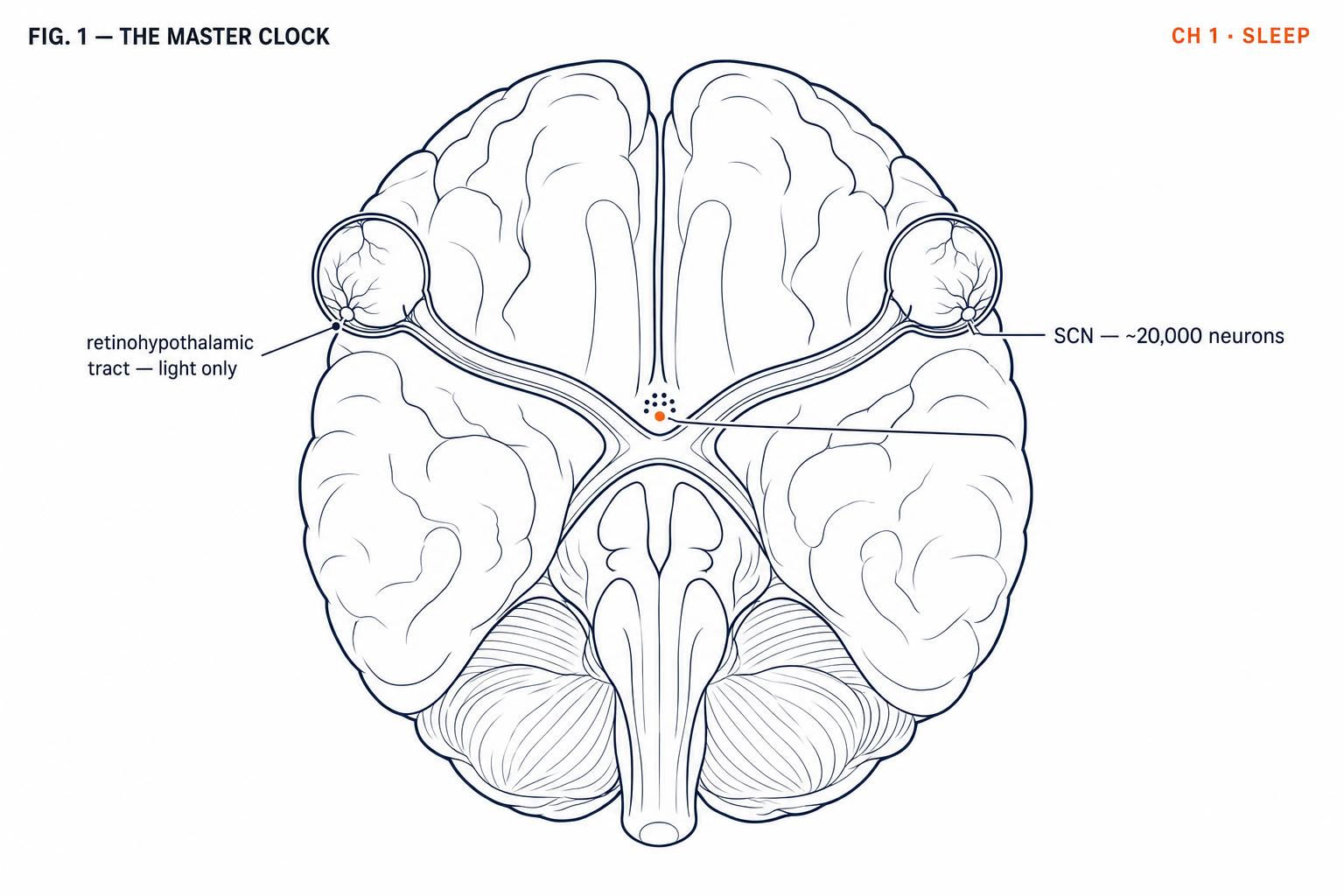
Deep inside your brain, just above the point where your optic nerves cross on their way from your eyes to your visual cortex, sits a structure smaller than a grain of rice. It's called the suprachiasmatic nucleus (SCN), and it contains roughly twenty thousand neurons — a vanishingly small fraction of the brain's 86 billion, yet arguably among the most influential. These neurons are your master circadian clock, the biological pacemaker that orchestrates a 24-hour rhythm of wakefulness, sleepiness, body temperature, hormone secretion, and dozens of other physiological processes (Hastings et al., 2018).
The word circadian comes from Latin: circa, "about", and diem, "day". That "about" is critical. In carefully controlled laboratory conditions where people live without clocks, windows, or any sense of external time, the human circadian cycle averages approximately 24.2 hours — slightly longer than a full day. Left entirely to its own devices, your internal clock would gradually drift later and later, like a watch that runs a few minutes slow. You'd fall asleep a little later each night, wake a little later each morning, and slowly rotate around the clock over the course of weeks (Hastings et al., 2018).
This doesn't happen in normal life, of course, because each day your SCN receives corrective signals from the environment that reset it to exactly 24 hours. Think of it like nudging that slow watch back to the correct time every morning. These environmental corrective signals have a wonderfully evocative German name: zeitgebers — "time givers".
Light is the Master Zeitgeber
The SCN's position above the optic chiasm is not an accident of anatomy — it's the architecture of a system designed around light. A specialised subset of retinal cells called intrinsically photosensitive retinal ganglion cells don't contribute to vision in the way rods and cones do. Instead, they detect the overall brightness and blue-wavelength content of ambient light and send that information directly to the SCN via a dedicated neural highway called the retinohypothalamic tract. This is how your clock knows whether it's day or night — not because you've looked at a clock on the wall, but because photons from the environment are physically reaching these cells and signalling to the SCN (Hastings et al., 2018).
When bright light hits the SCN during the biological morning, it advances the clock slightly, correcting for that natural tendency to run slow. When light hits the SCN in the biological evening, it can delay it. This daily resetting process is called entrainment — the synchronisation of an internal oscillator to an external cycle. Light is the most powerful zeitgeber, but it is not the only one.
The Non-Photic Zeitgebers
While light dominates the entrainment hierarchy, your circadian system also responds to several non-photic zeitgebers — cues that have nothing to do with brightness. Quante et al. (2019) assessed the relative influence of meal timing, physical activity, and light exposure on rest-activity patterns using wrist actigraphy and smartphone tracking. Their findings confirmed what decades of animal research had suggested: the timing of meals, bouts of physical activity, and even social interactions all contribute to synchronising your biological clock with the external world.
Consider what this means practically. When you eat breakfast at the same time each morning, your digestive system "expects" that meal, pre-releasing enzymes and priming insulin sensitivity. When you exercise at a consistent hour, your cardiovascular system anticipates the demand. When you regularly encounter other people — chatting with a barista, attending a lecture, meeting friends for dinner — those social rhythms reinforce the temporal structure of your day. Each of these is a zeitgeber, each a gentle nudge telling your SCN: it's this time of day.
The Two-Process Model — Why You Get a Second Wind
Understanding that you have a circadian clock is a good start, but it doesn't fully explain when you feel sleepy. After all, you've probably experienced being exhausted at 3 p.m. but catching a second wind by 6 p.m. — even though you didn't nap. If sleepiness were purely a matter of how long you'd been awake, that second wind would make no sense. Something else is going on.
In 1982, the Swiss sleep researcher Alexander Borbély proposed an elegant framework that remains the dominant model of sleep regulation four decades later: the two-process model. It explains sleepiness — and alertness — as the interaction of two independent processes operating simultaneously in your brain.
Process S — Sleep Pressure That Builds With Wakefulness
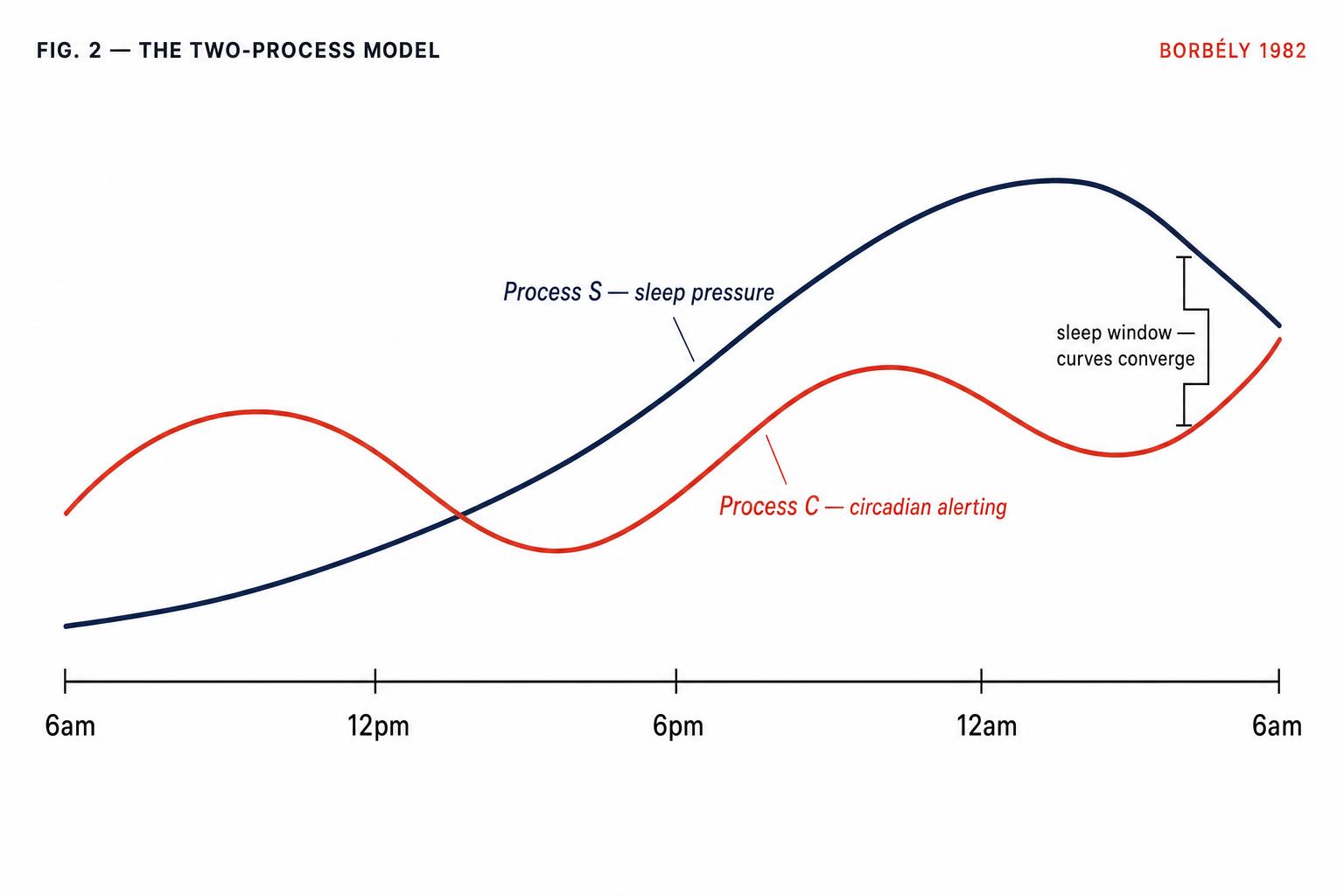
Process S (S for "sleep-dependent") is your homeostatic sleep pressure. From the moment you wake up, a chemical called adenosine begins accumulating in your brain as a byproduct of neural metabolism. The longer you stay awake, the more adenosine builds up, and the greater your pressure to sleep becomes. Think of Process S as a slowly rising wave: it starts low when you wake, climbs steadily throughout the day, and reaches its peak after about sixteen hours of continuous wakefulness. When you finally sleep, adenosine is cleared, and Process S drops back down — exponentially at first, then more gradually — resetting the cycle (Borbély et al., 2016).
If you pull an all-nighter, Process S doesn't plateau — it keeps climbing. That groggy, disoriented, almost painful feeling you experience at 4 a.m. after a night without sleep? That's Process S screaming at you. The pressure has risen far beyond its normal peak, and your brain is increasingly desperate for the restorative clearance that only sleep provides (Borbély, 2022).
Process C — A Circadian Alerting Signal That Oscillates Independently
Process C (C for "circadian") is the oscillating alerting signal generated by your SCN. Unlike Process S, which is driven by how long you've been awake, Process C follows its own independent 24-hour rhythm regardless of your behaviour. It can be roughly modelled as a sine wave: alerting drive is low in the early morning, rises through the day, dips slightly in the early-to-mid afternoon (that post-lunch sleepiness isn't just about the sandwich), peaks in the early evening, and then drops dramatically as night approaches (Borbély et al., 2016).
Here is the crucial insight: Process S and Process C work in opposition during the day and in concert at night. During your waking hours, the rising sleep pressure of Process S is counteracted by the rising alerting signal of Process C. That's why you don't feel progressively sleepier every single hour — the circadian system is actively propping you up, especially in the late afternoon and early evening. This is also why you can feel a "second wind" around 7 or 8 p.m.; Process C is near its peak alerting force, temporarily masking the high sleep pressure that has accumulated. Then, as evening progresses and Process C plummets, the accumulated Process S pressure is suddenly unopposed. The two curves converge, and you feel powerfully sleepy (Borbély, 2022).
Chronotype — Not Everyone's Clock Is Set to the Same Time
You now know that the circadian clock runs on roughly a 24-hour cycle and that zeitgebers lock it to the external day. But here's a question: is everyone's clock set to the same time? The answer is a definitive no. Just as people vary in height or shoe size, they vary in the timing of their circadian rhythm. This individual variation in preferred sleep-wake timing is called chronotype.
Roenneberg, Wirz-Justice, and Merrow (2003) developed the Munich Chrono-Type Questionnaire, which measures chronotype by asking a deceptively simple question: on free days — when you have no alarm, no obligations, no reason to be anywhere — what time do you naturally fall asleep, and what time do you naturally wake up? The midpoint of that free-day sleep window — say, 4 a.m. for someone sleeping midnight to 8 a.m. — is your chronotype score. Across tens of thousands of respondents, Roenneberg's team found that chronotype follows a near-Gaussian distribution: most people cluster in the middle, with progressively fewer people at the extreme "lark" (early) and "owl" (late) ends.
Chronotype is not merely a preference or a lifestyle choice. It has a strong genetic basis, linked to variations in core clock genes like PER2, PER3, and CRY1. It also shifts dramatically across the lifespan. Children tend to be early types. During adolescence, chronotype delays sharply — teenagers genuinely become more owl-like, not because of poor habits but because of changes in their circadian physiology, including what appears to be a lengthening of the intrinsic circadian period. Chronotype reaches its latest point around age twenty, then gradually shifts earlier for the rest of adulthood (Roenneberg et al., 2003). This means that when a fifty-five-year-old parent tells their nineteen-year-old child to "just go to bed earlier," they are asking that child to override a biological timing system that is fundamentally different from their own.
Social Jetlag — The Permanent Time-Zone You Can't Fly Out Of
Wittmann, Dinich, Merrow, and Roenneberg (2006) coined the term social jetlag to describe the chronic misalignment between a person's biological clock and the schedule imposed by society. It's calculated simply: the difference between your sleep midpoint on free days and your sleep midpoint on work or school days. If your body naturally sleeps from 1 a.m. to 9 a.m. (midpoint: 5 a.m.) but your alarm forces you up at 6:30 a.m. on weekdays (midpoint: roughly 3:45 a.m.), you carry about 75 minutes of social jetlag. That's the equivalent of flying one time zone west every Friday night and one time zone east every Monday morning, week after week, all semester long.
The consequences are not trivial. Wittmann et al. (2006) found that social jetlag was associated with greater stimulant consumption — particularly caffeine and nicotine — lower psychological well-being, and increased depressive symptoms. The strongest effects appeared in late chronotypes — the owls — because modern school and work schedules overwhelmingly favour early timing. Late types suffer the most misalignment, accumulate the most sleep debt, and show the most pronounced downstream effects.
What Happens When Schedules Bend to Biology
If chronotype and social jetlag are real biological phenomena with real consequences, then a prediction follows: changing social schedules to better align with students' biology should produce measurable improvements. In 2018, researchers put this prediction to the test.
Dunster et al. (2018) studied high school students in Seattle before and after the school district delayed start times from 7:50 a.m. to 8:45 a.m. Using wrist-worn actigraphy — objective movement sensors — rather than self-report, they measured students' actual sleep-wake cycles. The results were striking: students gained a median of 34 minutes of daily sleep. Crucially, bedtimes did not shift later — students did not simply stay up later to "use" the extra time. Instead, they woke later, sleeping into what their circadian biology was already calling for. The additional sleep was associated with a 4.5% increase in median grades and improved attendance.
This study matters for two reasons. First, it demonstrates that circadian biology has real-world consequences that show up in measurable outcomes like grades and attendance. Second, it illustrates a principle we'll return to throughout this course: sometimes the most powerful intervention is not training people to fight their biology but redesigning schedules to work with it. A 55-minute schedule delay translated to 34 more minutes of sleep, better grades, and improved attendance — without any change in bedtimes.
An Aside on Reading Sleep Claims
As you develop your understanding of sleep science throughout this course, you will encounter bold claims — some well-supported, some overstated. Developing the ability to distinguish between them is a skill this course takes seriously.
Consider a frequently cited claim from Matthew Walker's popular book Why We Sleep: that sleeping fewer than six hours per night increases your risk of a heart attack by 200%. This statistic has been repeated in media coverage, TED talks, and social media posts millions of times. But what does the underlying evidence actually show? When researchers examine the relevant meta-analyses, the relative risk increase for short sleep and cardiovascular events is real but considerably more modest — typically in the range of 20–48% increased relative risk, depending on the study and the specific outcome measured. And relative risk increases can be misleading without knowing the baseline risk. If your baseline annual risk of a cardiovascular event is 1%, a 40% relative increase raises it to 1.4% — meaningful at a population level, but quite different from what "200% increase" implies to a lay reader.
None of this means sleep doesn't matter for cardiovascular health — it clearly does. The point is that scientific literacy requires attending to effect sizes, study designs, and the difference between relative and absolute risk. Throughout this course, when we encounter a claim, we will look at the actual data. This is not skepticism for its own sake — it's the foundation of genuine understanding.
Why might exaggerated health claims about sleep actually backfire? Consider a student who sleeps six hours a night, reads that this "doubles their heart attack risk", and feels overwhelmed and anxious. How might that anxiety itself affect their sleep?
A field-note for the rest of this course
Key Takeaways
- Your suprachiasmatic nucleus (SCN) — a cluster of ~20,000 neurons above the optic chiasm — is the master circadian clock orchestrating 24-hour rhythms in temperature, hormones, alertness, and sleep.
- The two-process model explains sleepiness as the interaction of Process S (homeostatic sleep pressure that builds with wakefulness) and Process C (a circadian alerting signal that oscillates independently on a ~24-hour cycle).
- Zeitgebers — especially light, but also meal timing, exercise, and social cues — entrain your slightly-longer-than-24-hour internal clock to the external day.
- Chronotype is your genetically influenced tendency toward morningness or eveningness. It shifts across the lifespan and follows a normal distribution.
- Social jetlag — the mismatch between your biological clock and your social schedule — is associated with sleep debt, lower well-being, and increased stimulant use, particularly in late chronotypes.
- When school schedules were shifted to align with adolescent biology (Dunster et al., 2018), students gained 34 minutes of sleep and showed improved grades and attendance.
- Good sleep science requires reading claims critically — attend to effect sizes, study designs, and the difference between relative and absolute risk.
Now that you have the conceptual scaffold — the SCN, Process S, Process C, zeitgebers, and chronotype — we're ready to look at what actually happens when you fall asleep. In the next chapter we descend into the architecture of a single night: the repeating cycles of light sleep, deep slow-wave sleep, and REM, each with distinct neural signatures and distinct biological purposes.
References
Borbély, A. A., Daan, S., Wirz-Justice, A., & Deboer, T. (2016). The two-process model of sleep regulation: A reappraisal. Journal of Sleep Research, 25(2), 131–143.
Borbély, A. A. (2022). The two-process model of sleep regulation: Beginnings and outlook. Journal of Sleep Research, 31(4), e13598.
Dunster, G. P., de la Iglesia, L., Ben-Hamo, M., Nave, C., Fleischer, J. G., Panda, S., & de la Iglesia, H. O. (2018). Sleepmore in Seattle: Later school start times are associated with more sleep and better performance in high school students. Science Advances, 4(12), eaau6200.
Hastings, M. H., Maywood, E. S., & Brancaccio, M. (2018). Generation of circadian rhythms in the suprachiasmatic nucleus. Nature Reviews Neuroscience, 19(8), 453–469.
Quante, M., Mariani, S., Weng, J., Marinac, C. R., Kaplan, E. R., Rueschman, M., Mitchell, J. A., et al. (2019). Zeitgebers and their association with rest-activity patterns. Chronobiology International, 36(2), 203–213.
Roenneberg, T., Wirz-Justice, A., & Merrow, M. (2003). Life between clocks: Daily temporal patterns of human chronotypes. Journal of Biological Rhythms, 18(1), 80–90.
Wittmann, M., Dinich, J., Merrow, M., & Roenneberg, T. (2006). Social jetlag: Misalignment of biological and social time. Chronobiology International, 23(1–2), 497–509.