Light as a Drug
The Most Powerful Button on Your Clock
Eight campers, seven days in the Colorado Rockies, no electric light — and every internal clock in the group shifted two hours earlier. The cheapest, strongest sleep drug ever discovered is photons.
In 2013, Kenneth Wright took eight volunteers camping in the Colorado Rockies for a week. No flashlights. No phones. No electric light of any kind. After just seven days under natural skies, something remarkable happened: every participant's internal clock shifted roughly two hours earlier, their melatonin began rising right at sunset, and perhaps most striking, the large differences in sleep timing that had separated night owls from morning larks shrank dramatically. This finding, reported by Wright and colleagues in 2013, came from a simple intervention. The campers hadn't taken a sleeping pill, adopted a mindfulness practice, or forced themselves into bed earlier. They had simply changed their light environment.
That experiment crystallizes the central lesson of this chapter. If Chapter 1 introduced your circadian clock and Chapter 2 showed you what that clock orchestrates during sleep, this chapter reveals the single most powerful input to that clock: light. Not light as you experience it visually — not color, not images, not beauty — but light as a raw signal of time, measured by cells in your eye that you never knew you had.
The Hidden Photoreceptors in Your Eye
Ask most people how many types of light-detecting cells exist in the human eye, and you'll hear two: rods for dim-light vision and cones for color and detail. Until the early two-thousands, textbooks agreed. But a series of elegant experiments revealed a third class of photoreceptor hiding in plain sight — intrinsically photosensitive retinal ganglion cells, or ipRGCs, as Schmidt, Hattar, and Berson described in 2019.
These cells are rare, making up only about 1–2% of all retinal ganglion cells, and they look nothing like rods or cones. They sit in the ganglion cell layer — the layer closest to the front of the eye — and extend long, branching dendrites that form a wide net across the retina, perfectly designed to catch light from a broad area rather than focusing on fine detail. Most importantly, they contain their own photopigment: melanopsin.
Melanopsin — Not About Seeing, But About Timing
Melanopsin is an ancient molecule, more closely related to the photopigments of invertebrate eyes than to the rhodopsin in your rods. When photons strike melanopsin, the ipRGC depolarizes — slowly. While a rod or cone can respond to a flash of light in milliseconds, an ipRGC takes seconds to fully activate and can remain firing for minutes after the light disappears. As Schmidt, Hattar, and Berson explained in 2019, this sluggishness is a feature, not a bug. The ipRGC doesn't care about the flicker of a candle or the flash of a passing headlight. It integrates light over long durations, effectively asking a single question: how bright is the world right now?
The answer to that question travels along a dedicated neural highway — the retinohypothalamic tract — directly to the suprachiasmatic nucleus, or SCN, the master clock you met in Chapter 1. This is a monosynaptic connection: one cell, one synapse, one destination. It is among the most direct sensory pathways in the entire brain, and its purpose is simple and singular: to synchronize your internal clock to the external light-dark cycle.
Not All Light Is Equal — Lux, Spectrum, and the Thresholds That Matter
Understanding that a specialized system detects light for your clock is only half the story. The next question is: how much light does this system need? The answer turns out to be surprisingly specific, and it exposes a critical mismatch between the modern indoor environment and the world our circadian systems evolved to expect.
The Lux Scale — You Probably Aren't Getting Enough
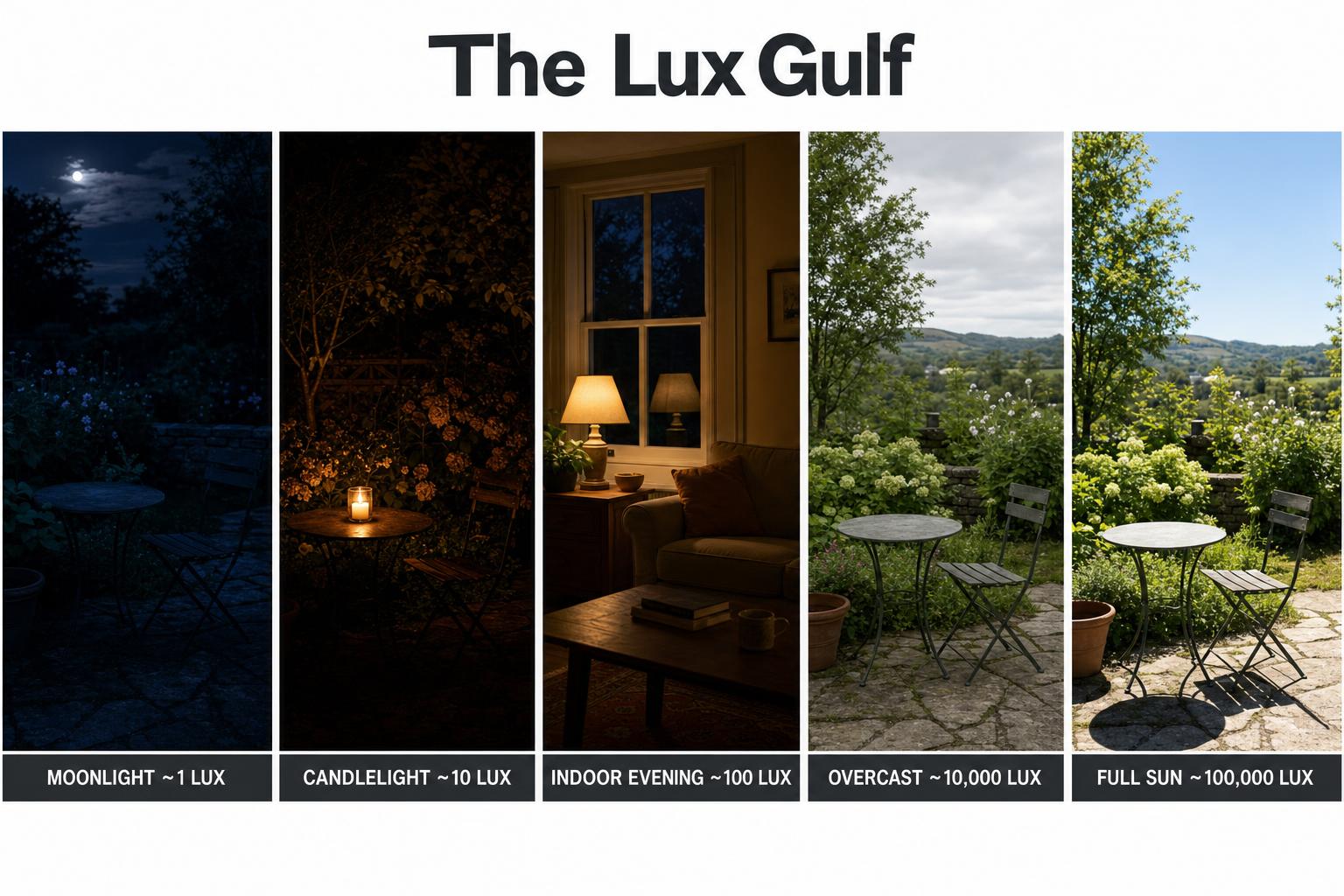
Light intensity is measured in lux — the amount of luminous flux per square meter striking a surface. Here is where intuition fails most people. A brightly lit office feels, subjectively, very bright. But in terms of the lux values that matter to your ipRGCs, it's barely a whisper. Candlelight provides around 10 lux. A typical living room, 50–150 lux. A bright office or classroom, 200–500 lux. An overcast outdoor day, 2,000–10,000 lux. Direct sunlight, 30,000–100,000 lux.
Notice the scale. Even an overcast day delivers ten to fifty times more light than a well-lit office. The landmark study by Zeitzer, Dijk, Kronauer, Brown, and Czeisler in 2000 established that the human circadian system follows a non-linear illuminance-response curve. The half-maximum response for melatonin suppression occurs at roughly 100–120 lux — meaning ordinary room light can affect the system — but the response saturates around 200 lux for suppression and approximately 550 lux for phase shifting. This means that going from 100 lux, a dim room, to 500 lux, a bright office, has a much larger circadian impact than going from 500 lux to 5,000 lux. But here's the catch: to get a strong, reliable entrainment signal — the kind that shifts the clock consistently — researchers typically use 2,500 lux or more, and natural daylight effortlessly delivers this.
As Wright and colleagues reported in 2013, their camping participants received roughly thirteen times more daytime light exposure than they did during normal electrical-lighting conditions. This enormous gap is the norm, not the exception. Research by Dunster and colleagues in 2023, tracking over five hundred university students across all four seasons in Seattle, found that each additional hour of daytime light exposure above 50 lux advanced students' chronotype by approximately 30 minutes. Daytime light was a stronger predictor of sleep timing than evening light exposure.
Spectral Sensitivity — The Blue-Light Story Is More Complicated Than You Think
Melanopsin's peak sensitivity falls at approximately 480 nanometers — squarely in the blue portion of the visible spectrum, as Schmidt, Hattar, and Berson noted in 2019. This is the origin of the now-ubiquitous blue-light warnings about screens and LED bulbs. But recent research has complicated this simple narrative considerably.
According to St. Hilaire and colleagues in 2022, who exposed one hundred participants to monochromatic light of different wavelengths, spectral sensitivity changes dynamically over time. During the first minutes of light exposure, the short-wavelength-sensitive S-cones contribute significantly to circadian responses. As exposure continues over hours, melanopsin — with its sluggish, sustained response — dominates. In other words, the system is broadly responsive across wavelengths, especially at higher intensities and longer durations. Blue light isn't magic; bright light is what matters most.
The Phase-Response Curve — When You See Light Changes Everything
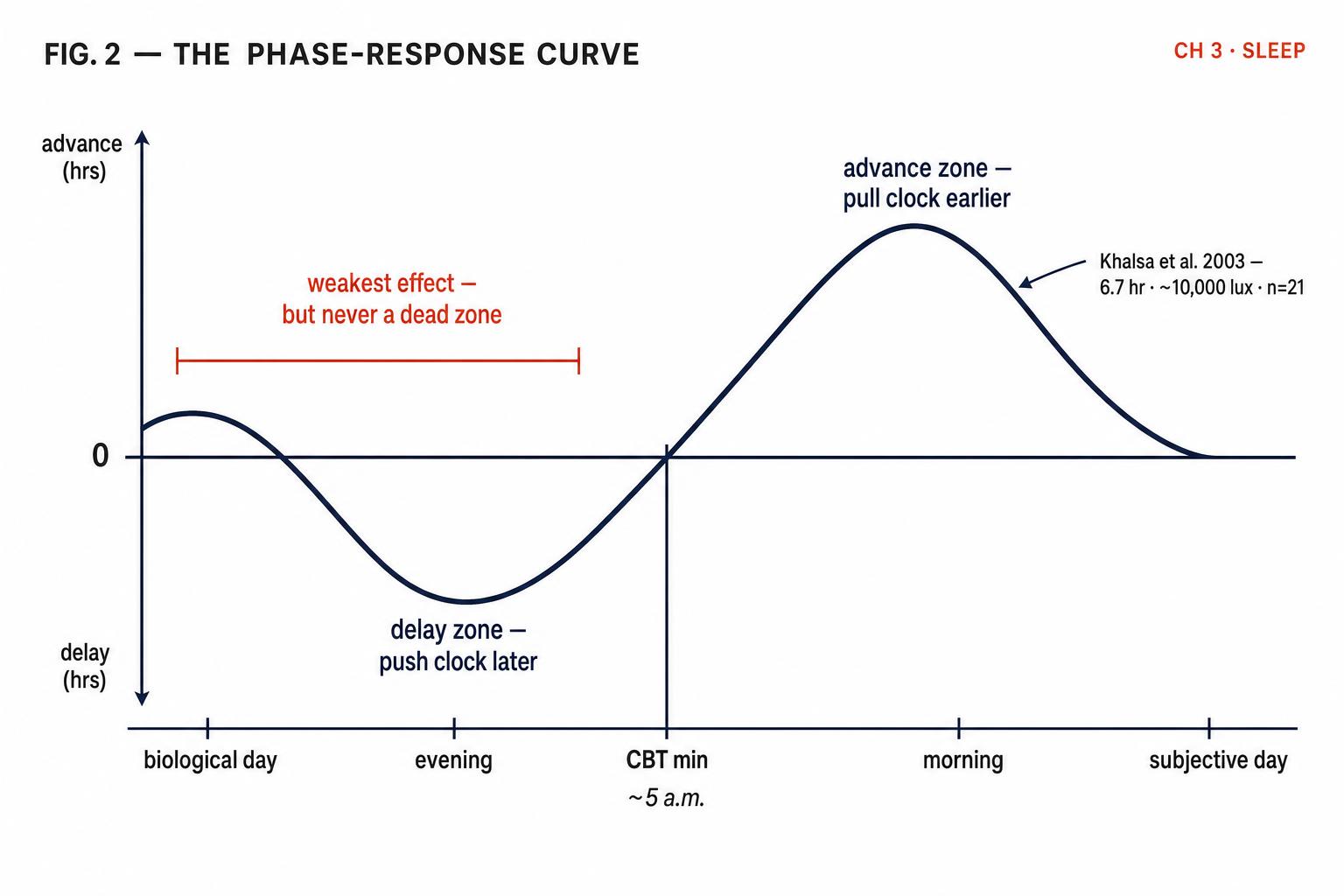
So light is the primary input to your circadian clock, and brighter is generally stronger. But here is the truly consequential insight: the same light stimulus can push your clock in completely opposite directions depending on when it arrives. This relationship is captured in one of the most important graphs in circadian biology: the phase-response curve, or PRC.
The definitive human phase-response curve was established by Khalsa, Jewett, Cajochen, and Czeisler in 2003, who exposed twenty-one participants to 6.7-hour pulses of bright light at approximately 10,000 lux at different circadian phases. The results were strikingly clear.
Light before the core body temperature minimum, or CBTmin — which typically occurs one to two hours before your natural wake time — causes phase delays: your clock shifts later. Light after the CBTmin causes phase advances: your clock shifts earlier. The strongest effects occur in the hours immediately surrounding the CBTmin, with the total range spanning over five hours of possible shift. Contrary to earlier assumptions, there is no extended dead zone during the subjective day — light at all times has some effect, though it is weakest during the afternoon.
This means that for a typical person waking at 7 a.m., with a CBTmin around 5 a.m., bright light at 6–8 a.m. will advance the clock — making you naturally sleepy and wakeful earlier the next day. But bright light at 3–5 a.m., say, from a bathroom trip with the lights blazing, will delay the clock, pushing everything later. Same light, opposite effects, separated by just a couple of hours.
Morning Light — Your Most Powerful Circadian Tool
With the phase-response curve in mind, the practical implications become clear. For the vast majority of people — especially those who struggle to wake up in the morning or whose sleep timing has drifted later than desired — bright morning light is the single most effective circadian intervention available.
Crowley and Eastman tested this directly in 2015. They exposed adults to morning bright light at approximately 5,000 lux for varying durations combined with afternoon melatonin. Even just 30 minutes of morning bright light produced a 1.8-hour phase advance — roughly 75% of the maximum effect achieved with a full two-hour exposure. The message is encouraging: you don't need to spend hours outdoors. A focused fifteen-to-thirty-minute exposure to bright light shortly after waking can produce meaningful shifts.
The Morning Light Protocol
A practical morning light strategy involves three elements. First, timing: within the first one to two hours after your natural wake time. This places the light squarely in the phase-advance zone, after your CBTmin. Second, intensity: aim for at least 2,000 lux. Outdoor light, even on an overcast day, easily exceeds this. If you cannot get outdoors, a 10,000-lux light therapy box positioned 12–16 inches from your face achieves comparable levels. Third, duration: 15–30 minutes is a practical minimum; longer is better but with diminishing returns after about 60 minutes.
The beauty of this approach is its simplicity. Walking to class, eating breakfast near a window, or spending the first twenty minutes of a study session outdoors can all serve as effective light exposure — no specialized equipment required.
Evening Light — Protecting Your Melatonin Onset
The other side of the phase-response curve tells an equally important story. Light in the hours before and around your CBTmin — roughly from the evening through the early night — falls in the phase-delay zone. Bright light during this window pushes your clock later and suppresses the rising tide of melatonin that signals your body to prepare for sleep.
As Zeitzer and colleagues showed in 2000, melatonin suppression saturates at surprisingly low intensities — around 200 lux. This means that very bright indoor environments in the evening, like well-lit kitchens or fluorescent-lit study spaces, can meaningfully affect your circadian timing. The practical protocol here is straightforward.
First, dim your environment in the two to three hours before your target bedtime. This doesn't require sitting in darkness — 50 lux or below, roughly equivalent to a few dim lamps, is a reasonable target. Second, avoid bright overhead lighting. Overhead lights are particularly effective at reaching the lower retina, where ipRGC dendrites are dense. Table lamps and floor lamps positioned below eye level deliver less circadian stimulation. Third, prioritize morning light to compensate. As Dunster and colleagues found in 2023, each additional hour of daytime light advanced chronotype by 30 minutes, while each additional hour of post-dusk light delayed it by only 15 minutes. Strong daytime exposure partially buffers against evening exposure.
A Necessary Nuance About Screens
This is where we must be honest about the limits of the evidence. Yes, screens emit light with a blue spectral component. Yes, melanopsin is sensitive to blue wavelengths. But a phone held at arm's length typically delivers only 30–80 lux to the eye — far below the approximately 200-lux saturation point for melatonin suppression. The circadian effect of a dim screen is real but modest, especially compared to the effect of overhead room lighting or bright bathroom lights. We will explore the complex relationship between screens and sleep in much greater depth in Chapter 6. For now, the key point is this: the biggest light-related mistake most people make is not that they look at their phones at night — it's that they don't go outside in the morning.
Light Meets Chronotype — Personalizing the Signal
In Chapter 1, you identified your chronotype — the genetically influenced tendency to prefer earlier or later sleep timing. Now we can add a crucial layer: chronotype sets the baseline, but light exposure shapes where that baseline actually lands.
Consider two students. One is a natural owl with an MSFsc — midpoint of sleep on free days corrected — of 5:30 a.m., a late midpoint of sleep. The other is a lark with an MSFsc of 2:30 a.m. The phase-response curve operates identically in both, but because their CBTmin occurs at different clock times, the same environmental light hits them at different circadian phases. For the owl whose CBTmin might be at 8 a.m., light at 7 a.m. actually falls in the delay zone — making things worse. This same owl needs light after 8 a.m. to get an advance signal, which is exactly when they'd naturally be waking up if their schedule allowed it.
This reframes the Dunster Seattle school start-time study from Chapter 1, conducted in 2018. When school start times shifted from 7:50 to 8:45 a.m., students gained 34 minutes of sleep — but the mechanism may be more nuanced than simply more time in bed. The later start allowed many students, particularly owls, to receive their first bright light exposure at a circadian phase that fell after their CBTmin rather than before it. The light they were getting shifted from the delay zone to the advance zone — amplifying rather than fighting their biology. Morning light exposure patterns did shift in the study, as Dunster and colleagues reported in 2018, consistent with this interpretation.
The same morning light hits larks and owls at different circadian phases. An owl forced to wake early may receive light in the delay zone, inadvertently pushing their clock even later. The practical lesson is that a one-size-fits-all morning light prescription misses this individual variation. If you're an extreme owl, your optimal light-exposure window is later in the morning — but you may need to start with light at whatever time you do wake up and gradually shift earlier as your clock moves. Think of it as meeting your biology where it is, then using light to nudge it in the direction you want.
Putting It All Together — Light as a Lifestyle Variable
The core message of this chapter can be distilled into a simple hierarchy. The most impactful light-related change most people can make is getting more bright light during the day, particularly in the morning. The second most impactful change is dimming the environment in the evening. The third — and often the one that gets the most attention — is managing screen light, which matters but much less than the first two.
This hierarchy aligns beautifully with the data. As Dunster and colleagues found in 2023, daytime light was twice as powerful as evening light in predicting sleep timing among university students. Wright and colleagues demonstrated in 2013 that natural light alone could compress chronotype differences and advance the clock by two hours in a week. And Crowley and Eastman showed in 2015 that even 30 minutes of bright morning light can produce clinically meaningful phase advances.
The most effective sleep intervention available to most people costs nothing, requires no prescription, and takes less than thirty minutes: step outside in the morning.
A field-note for the rest of this course
Of course, the real world isn't a research protocol. Winters at high latitudes mean sparse morning light. Shift workers face impossible schedules. Students cramming in windowless libraries miss daylight entirely. These complications are real, and we'll return to them in later chapters. But the underlying biology is now clear: your circadian clock runs on light, and the modern indoor lifestyle starves it of the signal it needs most.
Key Takeaways
- A specialized class of retinal cells — ipRGCs containing melanopsin — detects ambient light levels and signals the SCN directly, independent of conscious vision.
- Melanopsin peaks at approximately 480 nm, in the blue range, but is broadly responsive; bright light of any color is more important than spectral composition alone.
- Indoor environments at 100–500 lux are dramatically dimmer than outdoor daylight at 2,000–100,000 lux, creating a chronic circadian signal deficit for people who spend most of their time indoors.
- The phase-response curve determines whether light advances or delays your clock: light after the core body temperature minimum, roughly after natural wake time, advances the clock; light before it delays the clock.
- Morning bright light for 15–30+ minutes at 2,000 lux or more is the single most effective tool for advancing the circadian clock and stabilizing sleep timing.
- Evening light dimming protects melatonin onset, but daytime light has approximately twice the predictive power for sleep timing as evening light (Dunster et al., 2023).
- The same environmental light hits different chronotypes at different circadian phases — personalized light timing matters.
- Screen light at arm's length (30–80 lux) has a real but modest circadian effect compared to room lighting and especially outdoor light.
You now understand the most powerful external input to your circadian clock. In Chapter 4 — The Caffeine Equation — we'll turn to the internal partner: sleep pressure and the homeostatic drive. While light sets the timing of sleep, adenosine accumulation sets its urgency. Together, these two forces — the circadian rhythm and the sleep homeostat — form the two-process model that explains not just when you sleep, but why you sometimes can't stay awake. We'll also explore the molecule that blocks adenosine's signal: caffeine — and why its timing matters more than its dose.
References
Crowley, S. J., & Eastman, C. I. (2015). Phase advancing human circadian rhythms with morning bright light, afternoon melatonin, and gradually shifted sleep: Can we reduce morning bright-light duration? Sleep Medicine, 16(2), 288–297.
Dunster, G. P., Hua, I., Grahe, A., Fleischer, J. G., Panda, S., Wright, K. P., Vetter, C., Doherty, J. H., & de la Iglesia, H. O. (2023). Daytime light exposure is a strong predictor of seasonal variation in sleep and circadian timing of university students. Journal of Pineal Research, 74(2), e12843.
Dunster, G. P., de la Iglesia, L., Ben-Hamo, M., Nave, C., Fleischer, J. G., Panda, S., & de la Iglesia, H. O. (2018). Sleepmore in Seattle: Later school start times are associated with more sleep and better performance in high school students. Science Advances, 4(12), eaau6200.
Khalsa, S. B. S., Jewett, M. E., Cajochen, C., & Czeisler, C. A. (2003). A phase response curve to single bright light pulses in human subjects. The Journal of Physiology, 549(3), 945–952.
Schmidt, T. M., Hattar, S., & Berson, D. M. (2019). The intrinsically photosensitive retinal ganglion cells: From discovery to clinical insights. (Review in the ipRGC literature, summarising melanopsin photoreception and circadian projection.)
St. Hilaire, M. A., Ámundadóttir, M. L., Rahman, S. A., Rajaratnam, S. M. W., Rüger, M., Brainard, G. C., Czeisler, C. A., Andersen, M., Gooley, J. J., & Lockley, S. W. (2022). The spectral sensitivity of human circadian phase resetting and melatonin suppression to light changes dynamically with light duration. Proceedings of the National Academy of Sciences, 119(51), e2205301119.
Wright, K. P., McHill, A. W., Birks, B. R., Griffin, B. R., Rusterholz, T., & Chinoy, E. D. (2013). Entrainment of the human circadian clock to the natural light-dark cycle. Current Biology, 23(16), 1554–1558.
Zeitzer, J. M., Dijk, D.-J., Kronauer, R. E., Brown, E. N., & Czeisler, C. A. (2000). Sensitivity of the human circadian pacemaker to nocturnal light: Melatonin phase resetting and suppression. The Journal of Physiology, 526(3), 695–702.