Moving to Sleep
Exercise, Body Temperature, and the Gate to Slumber
It is not warmth that puts you to sleep — it is losing warmth. A circadian thermostat, a vasodilation valve, and a much-misunderstood gym timer.
Picture a winter evening. You've just stepped out of a hot bath, skin flushed and radiating warmth. Within twenty minutes, you feel an almost irresistible heaviness in your eyelids. Or consider the opposite scenario: it's a sweltering August night, your apartment has no air conditioning, and you're lying in bed wide awake at 1 a.m., sheets kicked off, too hot to sleep. You know intuitively that temperature and sleep are connected, but the relationship is the opposite of what most people assume. It's not warmth that puts you to sleep. It's losing warmth.
Now add a second puzzle. Your friend tells you she went for a run at 8 p.m. and slept like a rock. A fitness blog insists that exercising within four hours of bedtime will ruin your sleep. Who's right? As you'll discover in this chapter, the answer lies in understanding a single elegant mechanism: the rise and fall of your core body temperature, and how both your circadian clock and your behaviour — including exercise, baths, and even what you wear on your feet — can shape that curve to open or close what researchers call the temperature gate to sleep.
The Hidden Thermostat — Your Core Body Temperature Rhythm
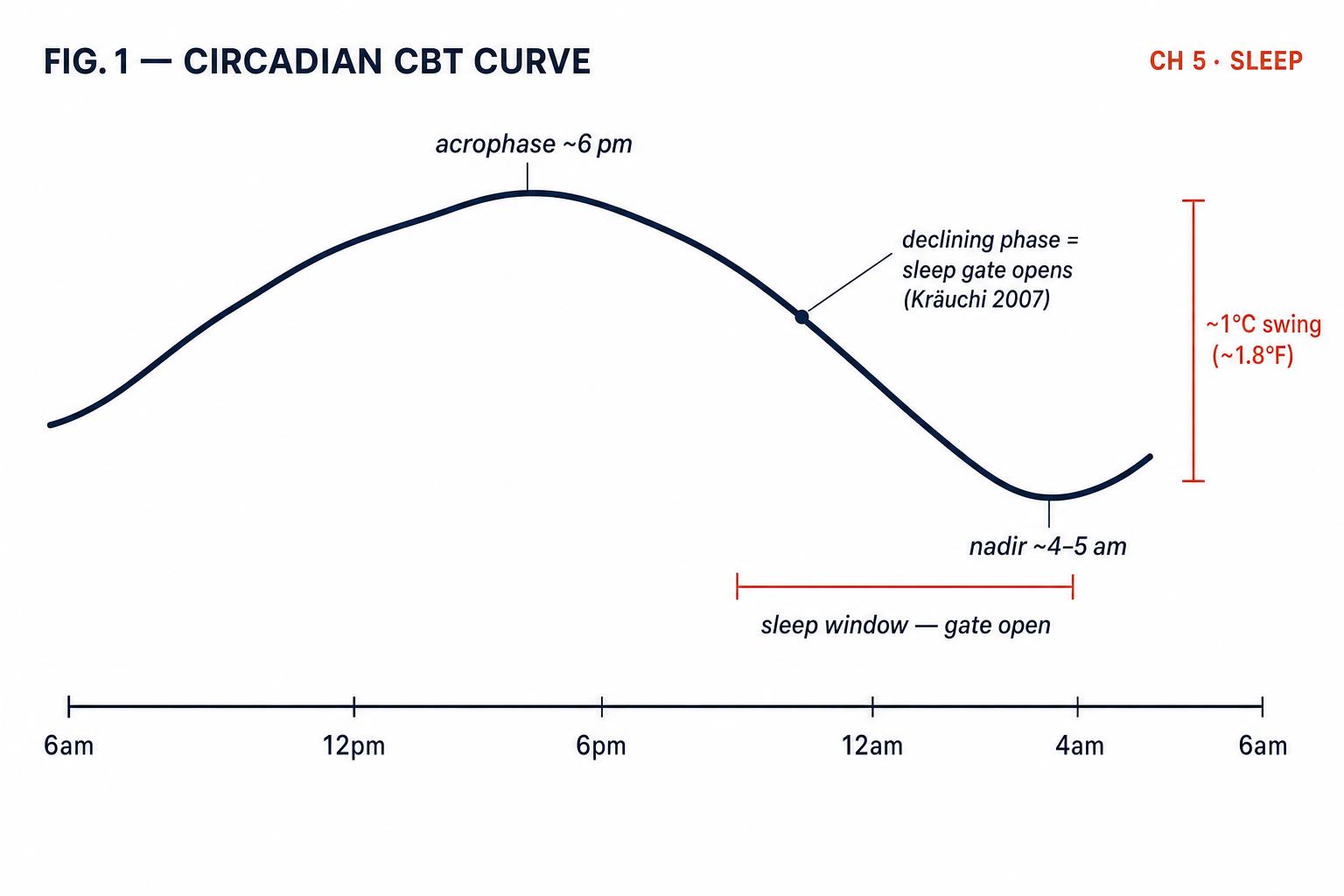
In Chapter 1, we introduced the suprachiasmatic nucleus, or SCN, as the master circadian clock. We focused then on its role in timing alertness and melatonin release. But the SCN orchestrates another rhythm that you can literally feel if you pay attention: a daily oscillation in core body temperature (CBT) that spans roughly one degree Celsius — about 1.8°F — across the 24-hour day.
This oscillation follows a remarkably consistent pattern. Core body temperature begins rising in the early morning hours, typically reaching its peak — the acrophase — in the late afternoon, usually between 5 and 7 p.m. for most adults. After this peak, temperature begins a gradual decline that continues through the evening and into the night, reaching its lowest point — the nadir — in the early morning hours, roughly between 3 and 5 a.m. As Harding and colleagues found in 2019, this isn't a response to sleeping; it's a proactive signal. Under controlled laboratory conditions where participants stay awake continuously, called a constant routine protocol, the temperature curve persists with the same shape, confirming it's driven by the circadian clock rather than by behaviour.
What makes this rhythm so important for sleep is not just correlation — it's causation. The declining phase of the temperature curve is one of the most potent biological triggers for sleep onset. As Kräuchi demonstrated in 2007, sleepiness doesn't simply happen to coincide with cooling; the process of heat loss itself appears to be mechanistically involved in initiating sleep.
Warm Hands, Cool Core — The Vasodilation Mechanism
If the declining temperature curve opens the gate to sleep, what mechanism actually drives that decline? The answer is elegantly simple: your body dumps core heat through your skin, especially through the skin of your hands and feet.
In a landmark study, Kräuchi, Cajochen, Werth, and Wirz-Justice in 2000 measured multiple physiological variables simultaneously under constant-routine conditions and tested which was the best predictor of how quickly a person fell asleep. They examined core body temperature, heart rate, melatonin onset, subjective sleepiness ratings, and something called the distal-proximal skin temperature gradient (DPG) — the difference in temperature between the extremities (hands and feet) and the trunk. The result was striking: the DPG was the single strongest predictor of sleep-onset latency, outperforming every other variable.
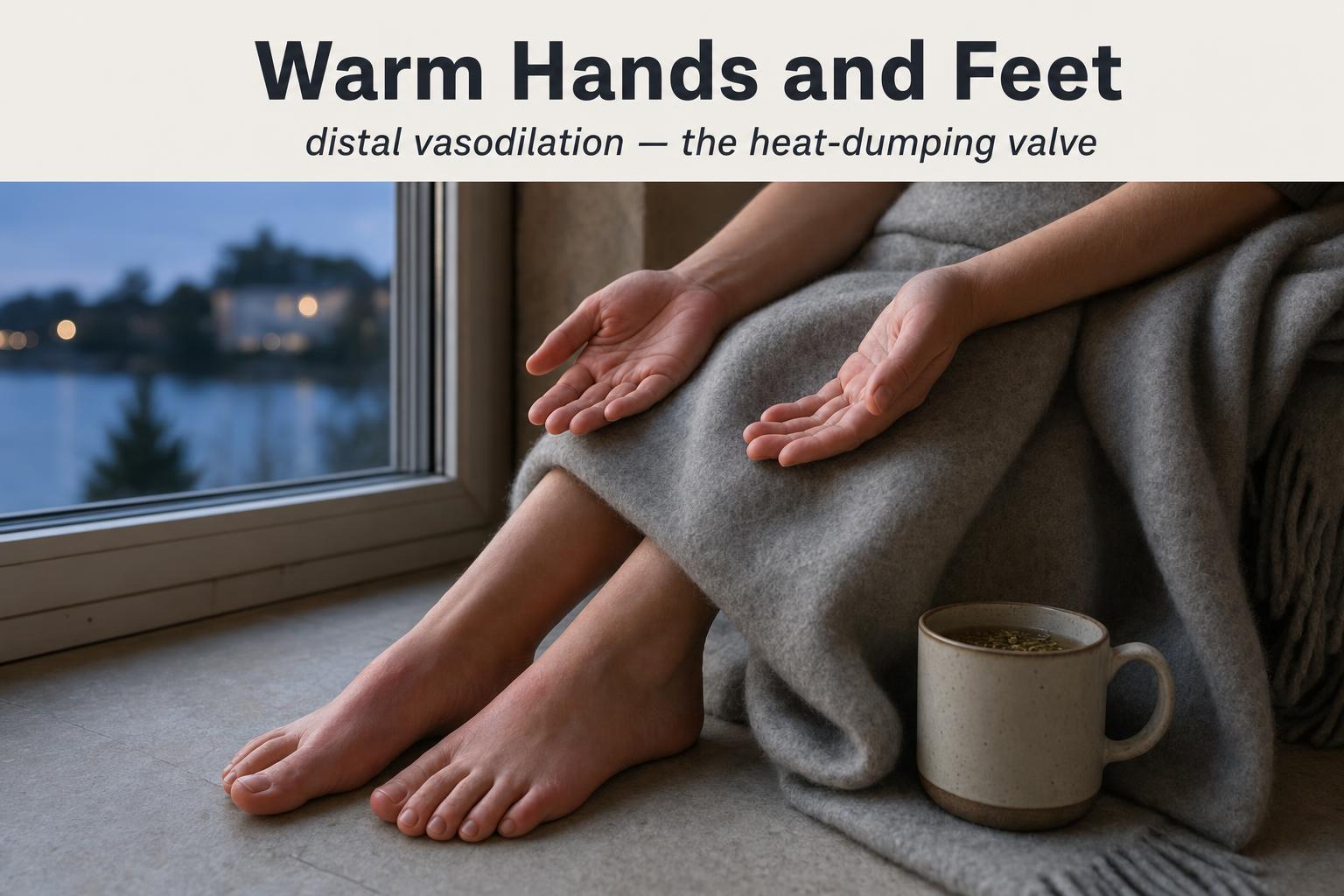
Here's what's happening physiologically. In the hours before sleep, the SCN signals a process called peripheral vasodilation. The blood vessels in your hands, feet, and face dilate, flooding these extremities with warm blood. You can feel this: your hands and feet get warmer in the evening. This warmth at the surface isn't keeping heat in; it's radiating heat out, like opening the vents on an overheated engine. As heat pours off your extremities, your core temperature drops. The greater this distal vasodilation — the warmer your hands and feet relative to your trunk — the faster you fall asleep, as Kräuchi and colleagues found in 2000.
This process begins approximately one to two hours before habitual sleep onset, as Harding and colleagues reported in 2019, which means your body is actively preparing for sleep well before you feel subjectively drowsy. It also means that anything interfering with this heat dissipation — cold feet constricting blood vessels, a room that's too warm preventing the core-to-surface gradient — can delay sleep onset even if you're otherwise tired.
This vasodilation mechanism also explains a folk remedy that turns out to be scientifically sound: wearing socks to bed. A Swiss study found that warming the feet accelerated vasodilation and shortened sleep-onset latency. It's not the warmth itself that matters — it's that warm feet mean dilated blood vessels, which means faster core heat loss, which means the temperature gate opens sooner.
The Warm Bath Paradox — Heat In, Sleep Out
With the temperature-gate model established, we can now solve a genuine puzzle: why does a warm bath or shower before bed help people fall asleep faster? At first glance, it seems contradictory. If cooling promotes sleep, why would adding heat help?
The answer is that a warm bath doesn't just add heat — it strategically redistributes it. When you immerse yourself in warm water — 40 to 42.5°C, or 104 to 108.5°F — blood rushes to the surface of your skin throughout your body, dramatically increasing peripheral vasodilation. When you step out of the bath, all of those dilated blood vessels are now exposed to cooler ambient air, creating a rapid and exaggerated core temperature drop — steeper than what would have occurred naturally, as Haghayegh and colleagues found in 2019.
Haghayegh and colleagues in 2019 conducted a systematic review and meta-analysis of seventeen studies and found that passive body heating scheduled one to two hours before bedtime significantly shortened sleep-onset latency by an average of about ten minutes and improved both sleep efficiency and subjective sleep quality. The optimal timing — one to two hours before bed — aligns perfectly with the temperature-gate model: the bath amplifies the vasodilation that the SCN is already initiating, supercharging the natural cooling process.
It is the rate of heat loss, not warmth itself, that the sleeping brain responds to. The warm bath is a delivery mechanism for rapid cooling — a physiological trick that hijacks the circadian thermoregulatory system.
Adapted from Kräuchi, 2007
Exercise and Sleep — What the Evidence Actually Shows
Now we arrive at one of the most powerful — and most misunderstood — tools for improving sleep: physical exercise. The popular health message is simple: exercise helps you sleep. And broadly speaking, this is true. But the details matter enormously, and the oft-repeated warning to never exercise in the evening turns out to be far more nuanced than most people realize.
The Big Picture — Exercise Improves Sleep Architecture
Kredlow, Capozzoli, Hearon, Calkins, and Otto in 2015 conducted a comprehensive meta-analysis of sixty-six studies examining the relationship between physical activity and sleep. Their findings were clear: regular exercise produces moderate beneficial effects on overall sleep quality. Specifically, regular exercisers showed improvements in sleep-onset latency, total sleep time, sleep efficiency, and — notably — N3 slow-wave sleep, the deep restorative stage we discussed in Chapter 2.
Yamanaka and colleagues in 2021 added important mechanistic detail, showing that vigorous exercise — 60 minutes at 60% VO₂-max — significantly increased delta power during N3 sleep and improved slow-wave stability, as measured by EEG (electroencephalography). In other words, exercise doesn't just give you more deep sleep; it gives you better quality deep sleep, with larger, more stable slow waves.
Why Exercise Improves Sleep — Three Converging Mechanisms
Exercise improves sleep through at least three mechanisms, each connecting back to concepts we've already explored:
First, the temperature pathway. Exercise raises core body temperature by 1 to 2°C. In the hours following exercise, CBT drops, often overshooting slightly below baseline. This post-exercise cooling mimics and amplifies the circadian temperature decline, potentially opening the temperature gate to sleep in the same way a warm bath does, as Harding and colleagues found in 2019.
Second, the adenosine pathway, or Process S. Remember from Chapter 4 that adenosine accumulates in the brain during wakefulness, building homeostatic sleep pressure. Dworak, McCarley, Kim, Kalinchuk, and Basheer in 2007 demonstrated in animal studies that intense exercise increases brain adenosine concentrations to 229% of resting levels — essentially turbocharging Process S. This may be one reason why people who exercise regularly report feeling more genuinely tired at bedtime rather than the wired-but-exhausted state of sedentary individuals.
Third, the circadian pathway. When exercise occurs outdoors, it delivers bright-light exposure — the single most powerful zeitgeber we discussed in Chapter 3. A morning jog, therefore, is doing double duty: elevating core temperature (which will later decline) and delivering the light signal that anchors your circadian clock. This is why morning outdoor exercise may be the single most potent behavioural intervention for sleep health.
The Evening Exercise Myth — What the Evidence Really Says
Now for the part that surprises most students. The widespread advice to avoid exercise in the evening — typically framed as no exercise within three to four hours of bedtime — is substantially more nuanced than popular health media suggests. The critical study here is the systematic review and meta-analysis by Stutz, Eiholzer, and Spengler in 2019, which examined twenty-three studies on evening exercise and sleep.
Their findings challenge the blanket prohibition:
First, evening exercise does not harm sleep for most people. Across studies, evening exercise actually increased slow-wave sleep and decreased light stage 1 sleep compared to no-exercise controls — meaning it improved sleep depth.
Second, the exception is narrow and specific. Sleep-onset latency, total sleep time, and sleep efficiency were impaired only after vigorous-intensity exercise ending less than one hour before bedtime. Moderate-intensity evening exercise, and vigorous exercise ending two or more hours before bed, showed no negative effects.
Third, for many people, evening exercise is beneficial. The post-exercise temperature drop, occurring 60 to 90 minutes after a workout, can actually facilitate the natural temperature decline and open the sleep gate.
The practical implication is important: if the only time you can exercise is in the evening, do it. The sleep benefits of regular exercise almost certainly outweigh any small risk from timing. The one scenario to approach cautiously is an all-out sprint session or high-intensity interval workout finishing right at bedtime — and even then, individual variation is significant. Some people sleep beautifully after intense evening exercise; others don't. Your own body's response matters more than a generic rule.
Putting It All Together — Exercise Timing and Your Circadian Window
Rather than memorizing rigid rules about when to exercise, the more powerful approach is to understand the underlying mechanisms and apply them to your own life. Here's a framework for thinking about exercise timing relative to the circadian signals we've discussed:
Morning Exercise · 6–10 a.m.
Morning exercise, especially outdoors, is a circadian powerhouse. It delivers bright-light exposure that strengthens SCN entrainment (as we learned in Chapter 3), elevates core temperature early in the day (reinforcing the natural temperature rise), and generates adenosine that will compound with the day's normal accumulation (as discussed in Chapter 4). For people who struggle with sleep-onset timing or who have delayed circadian tendencies, morning exercise is arguably the single best behavioural intervention available.
Afternoon Exercise · 2–5 p.m.
Exercise in the mid-to-late afternoon coincides with the peak of the temperature curve. Vigorous exercise at this time produces the largest absolute temperature elevation, and the subsequent post-exercise cooling aligns naturally with the evening temperature decline. Many studies show that afternoon exercise produces the greatest improvements in N3 deep sleep, as Kredlow and colleagues found in 2015.
Evening Exercise · 6–9 p.m.
Moderate evening exercise is safe and beneficial for the vast majority of people. The post-exercise temperature drop, occurring roughly 60 to 90 minutes later, may actually facilitate sleep onset by amplifying the natural circadian cooling. The key exception: vigorous exercise ending less than one hour before your intended bedtime may delay sleep onset for some individuals, likely due to elevated sympathetic nervous system activation and a still-elevated core temperature that hasn't had time to decline, as Stutz and colleagues reported in 2019.
The Integrated View — Building Your Sleep-Promoting Day
By now you've accumulated an impressive toolkit of behavioural levers that affect sleep. From Chapter 3 you understand how light exposure entrains your circadian clock. From Chapter 4 you know how caffeine blocks adenosine and how timing your last cup of coffee matters. And from this chapter, you've learned how exercise and temperature regulation interact with both Process C and Process S.
The most powerful insight is that these interventions don't operate in isolation — they compound. A morning outdoor jog delivers light exposure and temperature elevation and adenosine generation simultaneously. Conversely, negative behaviours can compound too: caffeine at 5 p.m. blocks the adenosine signal, bright screen light at 10 p.m. suppresses melatonin and delays the circadian temperature decline, and a vigorous gym session at 10:30 p.m. elevates core temperature right when it should be falling. Each alone might be manageable; together, they can create a perfect storm of insomnia.
The goal isn't to follow a rigid protocol — it's to understand the principles well enough to make informed choices that fit your life. A student who can only exercise at 8 p.m. isn't doomed to bad sleep. But that student might choose moderate intensity over high intensity, might cut caffeine by early afternoon, and might take a warm shower 90 minutes before bed to maximise the temperature drop. Understanding the mechanisms turns rigid rules into flexible strategies.
Key Takeaways
- Core body temperature follows a circadian rhythm, peaking in the late afternoon and reaching its nadir in the early morning — and the declining phase of this curve is a potent biological trigger for sleep onset.
- Sleep onset is best predicted by the distal-proximal skin temperature gradient: warm hands and feet (vasodilation) radiate heat outward, cooling the core and opening the temperature gate to sleep (Kräuchi et al., 2000).
- A warm bath one to two hours before bed works not because of the warmth, but because it amplifies peripheral vasodilation and accelerates the subsequent core temperature drop (Haghayegh et al., 2019).
- Regular exercise improves sleep quality, increases N3 deep sleep, and reduces sleep-onset latency through three converging mechanisms: post-exercise cooling, increased adenosine accumulation, and (when outdoors) circadian light exposure.
- The blanket advice to avoid evening exercise is overstated. Evening exercise is neutral or beneficial for most people; only vigorous exercise ending less than one hour before bedtime shows potential to delay sleep onset (Stutz et al., 2019).
- Morning outdoor exercise may be the most powerful single behavioural intervention for sleep health, delivering simultaneous benefits through the temperature, adenosine, and circadian pathways.
- Sleep interventions compound — positively and negatively. Understanding the mechanisms lets you combine light, caffeine timing, and exercise strategically rather than following rigid rules.
You now understand three major levers for sleep: light, caffeine, and exercise-temperature. In Chapter 6 — Screens, Stimulation, and Wind-Down — we'll turn to the dimension of sleep that most directly affects your nightly experience: the sleep environment, the cognitive arousal of screens, and the wake-to-sleep transition. We'll explore the surprising science of bedroom temperature (hint: it connects directly to the vasodilation mechanisms from today), why certain sounds disrupt sleep architecture even when you don't wake up, and how to engineer your sleeping space for optimal recovery. Your bedroom is either working for your sleep or against it — and most students' bedrooms are working against them.
References
Dworak, M., McCarley, R. W., Kim, T., Kalinchuk, A. V., & Basheer, R. (2007). Sleep and brain energy levels: ATP changes during sleep. Journal of Neuroscience, 27(40), 10803–10810.
Haghayegh, S., Khoshnevis, S., Smolensky, M. H., Diller, K. R., & Castriotta, R. J. (2019). Before-bedtime passive body heating by warm shower or bath to improve sleep: A systematic review and meta-analysis. Sleep Medicine Reviews, 46, 124–135.
Harding, E. C., Franks, N. P., & Wisden, W. (2019). The temperature dependence of sleep. Frontiers in Neuroscience, 13, 336.
Kräuchi, K. (2007). The thermophysiological cascade leading to sleep initiation in relation to phase of entrainment. Sleep Medicine Reviews, 11(6), 439–451.
Kräuchi, K., Cajochen, C., Werth, E., & Wirz-Justice, A. (2000). Functional link between distal vasodilation and sleep-onset latency? American Journal of Physiology — Regulatory, Integrative and Comparative Physiology, 278(3), R741–R748.
Kredlow, M. A., Capozzoli, M. C., Hearon, B. A., Calkins, A. W., & Otto, M. W. (2015). The effects of physical activity on sleep: A meta-analytic review. Journal of Behavioral Medicine, 38(3), 427–449.
Stutz, J., Eiholzer, R., & Spengler, C. M. (2019). Effects of evening exercise on sleep in healthy participants: A systematic review and meta-analysis. Sports Medicine, 49(2), 269–287.
Yamanaka, Y., Hashimoto, S., Takasu, N. N., Tanahashi, Y., Nishide, S., Honma, S., & Honma, K. (2021). Effects of vigorous evening exercise on EEG sleep architecture and delta power. Journal of Sleep Research, 30(3), e13266.