Screens, Stimulation, and Wind-Down
Why Your Bedtime Routine Matters More Than Your Mattress
The orange tint on your screen is addressing the smaller problem — the real reason your brain won't shut up has almost nothing to do with wavelengths of light.
It's 11:23 PM. You told yourself you'd be asleep by eleven. Your phone is in your hand — you're not sure exactly when you picked it up, but you're three articles deep into a news rabbit hole, your heart rate is slightly elevated from a comment section argument you almost joined, and the blue-light-filtering app you installed last month is dutifully tinting your screen orange. You're doing the "right" thing about the light. So why do you feel more awake now than you did an hour ago?
Here's the uncomfortable truth that most sleep advice glosses over: the orange tint on your screen is addressing the smaller problem. The real reason your brain won't shut up has almost nothing to do with wavelengths of light — and almost everything to do with what's happening between your ears. This chapter will recalibrate what you think you know about screens and sleep, and replace vague guilt with a precise, evidence-based strategy.
The Blue-Light Story — Real, But Overstated
If you've encountered any sleep advice in the last decade, you've almost certainly heard some version of this claim: the blue light from your phone suppresses melatonin and ruins your sleep. It's become one of the most widely repeated pieces of health advice in modern culture. It sells blue-light-blocking glasses, night-mode software, and amber screen protectors. And it's not entirely wrong — but it's dramatically overstated.
Let's revisit what we learned earlier. Melanopsin, the photopigment in your intrinsically photosensitive retinal ganglion cells, is indeed most sensitive to light in the short-wavelength "blue" range, peaking around 480 nanometers. When melanopsin detects sufficient light, it sends signals to the suprachiasmatic nucleus that suppress melatonin production. Screens do emit light in this melanopsin-sensitive range. All of that is accurate.
The critical question, however, is one of dose. How much light are we actually talking about?
What 200 Lux Looks Like — and What a Phone Looks Like
The landmark study by Gooley and colleagues in 2011 demonstrated that exposure to room light of approximately 200 lux before bedtime suppressed melatonin onset in 99% of participants and shortened melatonin duration by roughly 90 minutes. This study is frequently cited as evidence against screen use — but notice the exposure level. Two hundred lux is the illumination of a moderately well-lit living room, not a phone screen at arm's length.
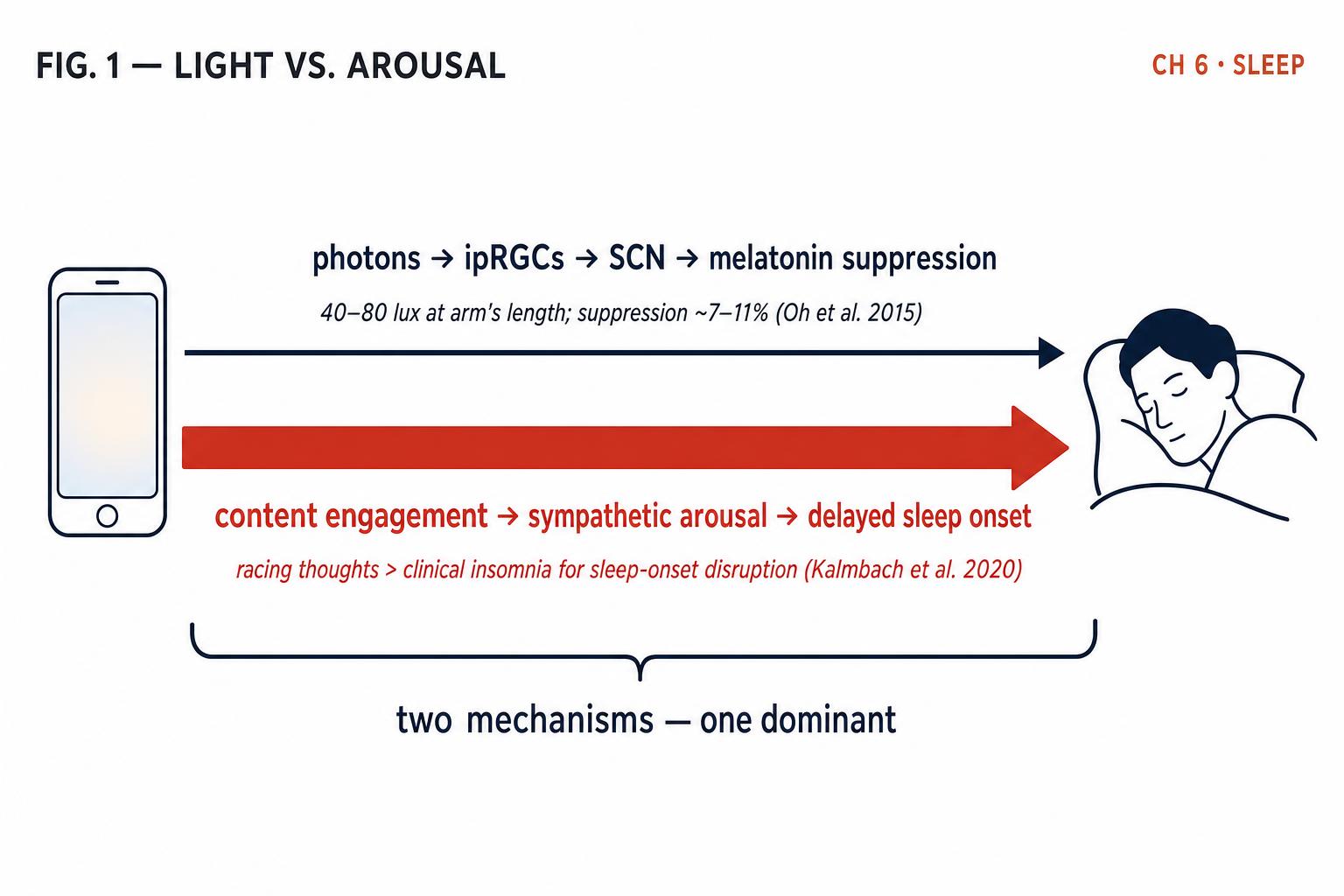
What does your phone actually produce? Technical analyses have consistently found that a smartphone at typical viewing distance, approximately 30 to 40 centimeters, delivers between 20 and 80 lux at eye level, depending on brightness settings and ambient conditions, as Oh and colleagues reported in 2015, and as Huiberts and colleagues confirmed in 2022. Oh and colleagues measured melatonin suppression values of only 7 to 11 percent for typical smartphone use in a dark room — a far cry from the near-total suppression found at 200+ lux. Spitschan and colleagues in 2023 confirmed this dose-dependent relationship in a controlled study of 72 participants, showing that while smartphone-level light at around 20 lux did produce measurable effects on sleep latency, the magnitude increased substantially with higher melanopic irradiance levels characteristic of tablets at around 40 lux and computer screens at around 80 lux.
The systematic review by Shechter and colleagues in 2020 reinforced this picture: the studies showing robust melatonin suppression predominantly used light exposures at or above 200 lux. Below that threshold, effects were present but considerably more modest. Huiberts and colleagues noted in their field study that screen illuminance at eye level in typical seated positions usually remains below 50 lux — well below the levels where dramatic melatonin suppression has been consistently documented.
To be clear, this is not permission to blast yourself with screen light until midnight. The effects at lower lux levels are real — they're just more modest than the cultural narrative suggests. A phone screen in a dark room at full brightness is not nothing. But framing blue light as the primary mechanism by which screens disrupt sleep is, as the evidence stands, a significant overstatement. There is a larger, more potent mechanism at work.
The Bigger Lever — Cognitive and Emotional Arousal
If you've ever tried to fall asleep after a heated text exchange, an anxiety-inducing news scroll, or a tense final round in an online game, you already have intuitive evidence for what the research now strongly supports: the content on your screen matters far more than the light coming off of it.
Kalmbach and colleagues in 2020 conducted polysomnographic recordings of 52 adults across multiple nights and found that nocturnal cognitive arousal — the racing, ruminative mental activity that keeps your mind churning — was consistently and robustly associated with objective sleep disturbance. Crucially, cognitive arousal was more strongly linked to difficulty falling asleep than clinical insomnia diagnosis, depression, or even somatic — that is, body-based — arousal. Your mind racing is, in measurable physiological terms, more disruptive to sleep onset than your body being tense.
Exelmans and Van den Bulck in 2017 explored this in the specific context of screen use, studying 423 young adults and their binge-viewing habits. Their finding was telling: binge-watching before bed negatively affected sleep quality, and the mechanism was not light exposure but increased cognitive pre-sleep arousal. The engagement with narrative content — the suspense, the emotional investment, the "just one more episode" pull — was what kept the brain activated.
Hale and Guan in 2015 synthesized the broader literature and identified three distinct pathways through which screens disrupt sleep: time displacement, where screens simply replace sleep time, light exposure effects, and psychological and physiological arousal from content. Their review concluded that arousal may be the most important pathway, mediating sleep problems even with non-violent, seemingly innocuous media use.
The National Sleep Foundation's consensus statement, as reported by Bartel and colleagues in 2024, affirmed this multi-pathway model, noting that screen content evokes psychological consequences — fear, anxiety, excitement, social comparison — that drive cognitive arousal, which then interacts with light emission to delay and disrupt sleep. The panel specifically noted that the arousal pathway applies across all ages and is not limited to obviously stimulating content.
The Nervous System Has to Make a Transition
When we say screens cause "arousal," we're not using the word loosely. The sympathetic nervous system — your fight-or-flight infrastructure — activates in response to stimulating content. Heart rate increases slightly. Cortisol, which should be declining in the evening, gets a nudge. The prefrontal cortex remains engaged in evaluative processing. The default mode network, which normally begins to quiet during the transition toward sleep, stays active as you mentally compose responses, evaluate social comparisons, or anticipate what happens next in a show.
This brings us to a fundamental requirement of falling asleep that most people never think about explicitly: your nervous system must make a transition.
Falling asleep is not like flipping a switch. It's more like slowly easing a car from highway speed down to a stop — and it requires specific physiological shifts that take time and the right conditions.
Bonnet and Arand in 2010 demonstrated that the transition from wakefulness to sleep is characterized by a progressive shift from sympathetic to parasympathetic nervous system dominance. In normal sleepers, this shift happens gradually: heart rate slows, blood pressure drops, muscle tension decreases, core body temperature falls, and cortisol levels decline. Participants with insomnia in their study showed a revealing pattern — constant sympathetic hyperactivation that persisted even after sleep onset, resulting in lighter, less restorative sleep.
Research on autonomic activity during sleep, as described by Okon-Singer and colleagues in 2020, has confirmed that successful sleep transition requires the withdrawal of sympathetic activity and increasing predominance of parasympathetic activity. When you're scrolling through content that triggers emotional reactions — outrage at a news article, anxiety about a work email, competitive intensity from a game — you are actively opposing this necessary transition. You're pressing the accelerator while trying to brake.
Not All Screen Use Is Equivalent
This understanding leads to a crucial distinction that blanket "no screens before bed" advice misses entirely. Consider these two scenarios:
Scenario A: You're reading a familiar novel on a Kindle set to low brightness with warm-tone backlighting, in a dimly lit room. Your breathing is slow. You're feeling pleasantly drowsy.
Scenario B: You're scrolling Twitter on your phone at medium brightness, encountering a series of posts about a political controversy. Your jaw is slightly clenched. You've composed and deleted two replies.
Two evenings, two nervous systems
Both involve "screen time." Both emit some light in the melanopsin-sensitive range. But the physiological states they produce are vastly different. Scenario A involves minimal cognitive arousal and modest light exposure. Scenario B involves significant sympathetic activation, cortisol elevation, and sustained prefrontal engagement — all of which actively oppose the sleep transition, regardless of what night mode your phone is in.
This is the reframing this chapter offers: the question is not simply "are you using a screen?" but "is this activity moving your nervous system toward sleep or away from it?"
The Wind-Down Buffer Zone
If the brain needs time to shift from sympathetic to parasympathetic dominance, the practical implication is clear: you need a wind-down buffer zone — a period of progressively declining stimulation in the 60 to 90 minutes before your intended sleep time.
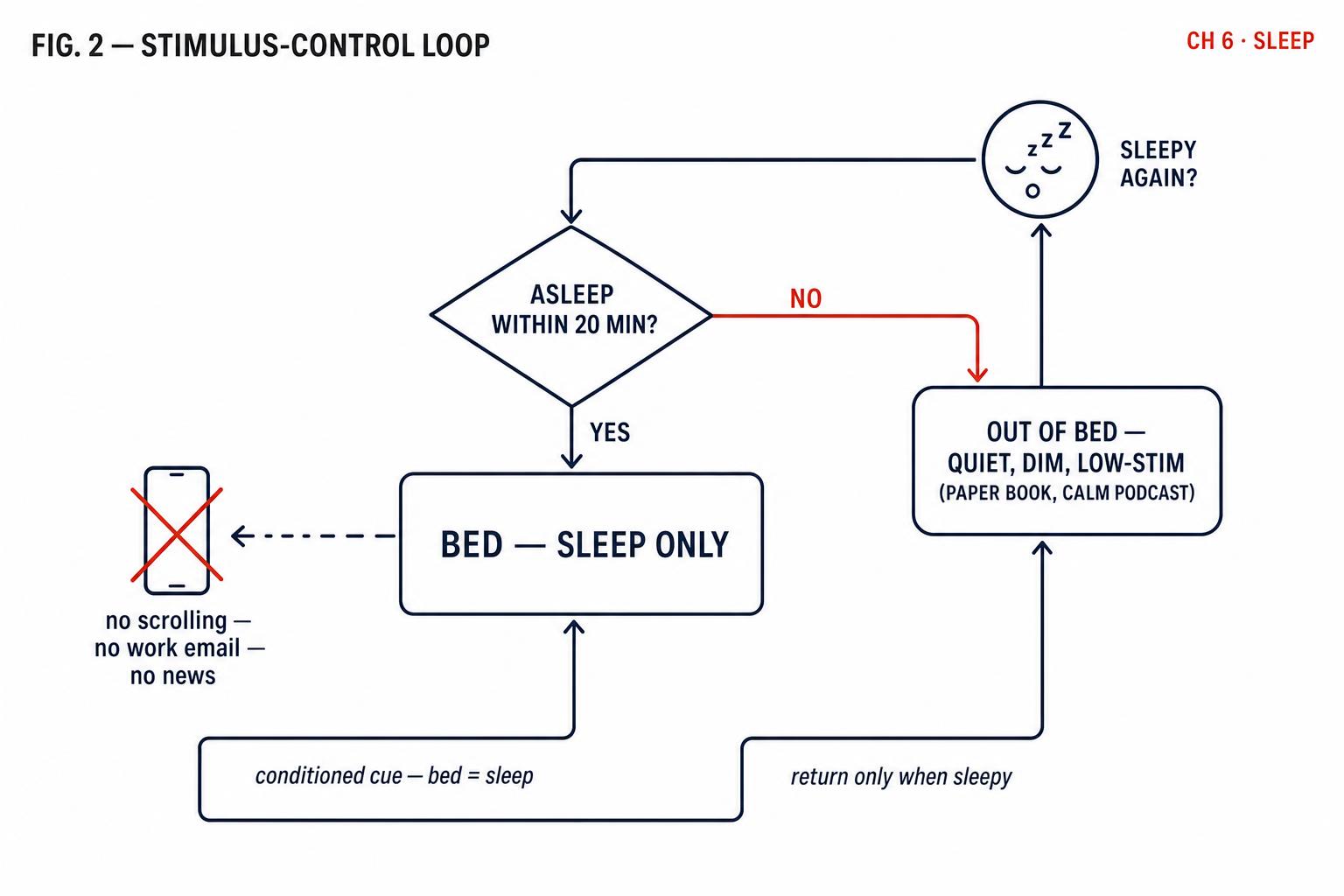
Irish and colleagues in 2015 reviewed behavioral strategies for addressing insomnia and recommended establishing a bedtime routine 30 to 45 minutes before sleep to help transition the brain by "winding down and slowing central nervous system activity." Their review emphasized that consistency matters: when the same sequence of low-stimulation activities precedes sleep night after night, the brain begins to treat that sequence as a conditioned cue — a signal that the sleep transition should begin. Think of it like Pavlov's dogs, but instead of a bell triggering salivation, a consistent wind-down routine triggers the neurochemical cascade that precedes sleep.
The structure of an effective wind-down buffer zone follows a simple principle: progressive de-escalation. Arousal should trend downward across the period. Light exposure should decline. Cognitive demands should decrease. Physical activity should shift from active to restful. This doesn't require rigid rules or complete abstinence from all stimulation — it requires a direction of travel.
Elements of a Practical Wind-Down Protocol
A practical wind-down protocol addresses both the moderate light concern and the more significant arousal concern. Consider these evidence-based elements:
Light management — moderate priority: Dim overhead lights. If using screens, reduce brightness and use warm-tone settings — not because this eliminates the light effect, but because it reduces it meaningfully at minimal effort.
Arousal management — high priority: Transition from high-engagement activities to low-engagement ones. Replace stimulating content with calming content. Avoid emotional triggers — work email, news, social media arguments.
Routine consistency — high priority: Perform the same sequence of activities in the same order. This builds conditioned associations between these behaviors and sleep onset.
Body temperature: A warm bath or shower 60 to 90 minutes before bed accelerates the core body temperature drop that accompanies sleep onset.
Cognitive offloading: Journaling or a brief to-do list for tomorrow can reduce the cognitive intrusions that fuel pre-sleep rumination.
Why Willpower Fails at 11 PM
If you've ever felt frustrated at yourself for failing to stop scrolling when you know you should be sleeping, here's something important: it's not a character flaw. It's neurochemistry working exactly as predicted.
Recall that adenosine accumulates across the day as part of Process S, the homeostatic sleep drive. By late evening, adenosine levels are high, creating the pressure that makes you feel sleepy. But adenosine doesn't just make you drowsy — it also impairs the brain region most responsible for impulse control, planning, and resisting temptation: the prefrontal cortex.
The prefrontal cortex is disproportionately sensitive to fatigue. When adenosine levels are high and Process S pressure is strong, the very brain region you need to make the decision to put the phone down is operating at reduced capacity. You are, in effect, relying on the weakest version of your willpower to resist some of the most compelling stimulation modern technology has ever produced. Social media platforms, news sites, and video streaming services are explicitly engineered by teams of designers to maximize engagement — to make "one more scroll" or "one more episode" feel irresistible. Pitting a fatigued prefrontal cortex against billion-dollar engagement algorithms is not a fair fight.
Pre-Commitment Beats Willpower
The solution, consistent with decades of behavioral science, is pre-commitment — making the decision earlier in the day, when your prefrontal cortex is still functioning well, and designing your environment so that the desired behavior becomes the path of least resistance at night.
Effective pre-commitment strategies include:
Environmental design: Charging your phone in another room. If you use your phone as an alarm, buy a simple alarm clock — it may be the best ten pounds you ever spend on sleep.
Automated limits: Setting app timers that enforce breaks after a certain time. Many phones now include "bedtime mode" that greyscales the screen and limits notifications.
Friction engineering: Adding steps between you and the stimulating content. Logging out of social media apps so re-engaging requires deliberate effort. Removing the most tempting apps from your home screen after 9 PM.
Replacement, not removal: Having a specific, enjoyable, low-arousal alternative ready — a physical book on the nightstand, a calm podcast queued up — so that you're not left with a void that willpower must fill.
The logic is straightforward: don't fight adenosine. Plan around it.
The Synthesis — A Framework for Screens and Sleep
Let's synthesize what we've covered into a clear, evidence-based framework for thinking about screens and sleep.
Blue light from screens is a real but modest concern. At typical viewing distances, phones produce 20 to 80 lux — below the 200+ lux threshold for robust melatonin suppression. Dimming your screen and using warm-tone modes is sensible, easy, and worth doing. But it's not the main event.
Cognitive and emotional arousal is the dominant mechanism. Stimulating content activates the sympathetic nervous system, sustains cortical arousal, and directly opposes the parasympathetic shift necessary for sleep onset. This applies regardless of blue-light filters.
Not all screen use is equivalent. A calm podcast or an e-reader novel at low brightness is fundamentally different from competitive gaming or doomscrolling. The cognitive context matters more than the wavelength.
A wind-down buffer zone of 60 to 90 minutes is your most powerful tool. Use it to progressively decrease arousal, dim your environment, and perform consistent pre-sleep routines that become conditioned cues for the sleep transition.
Pre-commitment strategies outperform willpower. Design your environment earlier in the day when your prefrontal cortex can actually make good decisions.
This reframing is both scientifically honest and practically liberating. Rather than anxiously avoiding all screens — an increasingly unrealistic expectation in modern life — you can make informed decisions about which screen activities to avoid near bedtime and why. You can stop buying expensive blue-light-blocking glasses and invest that energy instead in redesigning your last 90 minutes. And perhaps most importantly, you can stop blaming yourself when willpower fails at 11 PM and start building systems that make the right choice the easy choice.
The goal is not to be anti-screen. The goal is to be pro-transition — to give your nervous system the declining gradient of stimulation it needs to shift from wakefulness into sleep.
Key Takeaways
- Blue light from phone and tablet screens at typical viewing distances — 20 to 80 lux — falls well below the 200+ lux threshold for robust melatonin suppression shown in controlled studies (Gooley et al., 2011; Oh et al., 2015; Shechter et al., 2020). The concern is real but overstated.
- Cognitive and emotional arousal from screen content — not the light itself — is the primary mechanism by which evening screen use disrupts sleep, activating the sympathetic nervous system and opposing the transition to sleep (Kalmbach et al., 2020; Hale & Guan, 2015).
- Not all screen use is equal: low-arousal screen activities like calm podcasts or e-readers at low brightness are fundamentally different from high-arousal ones like social media scrolling, news feeds, or competitive games in their sleep impact.
- A 60 to 90 minute wind-down buffer zone of progressively declining stimulation, dim lighting, and consistent pre-sleep routines creates conditioned cues that help the brain initiate the wake-to-sleep transition (Irish et al., 2015).
- High adenosine levels at bedtime impair the prefrontal cortex, making willpower-based decisions to stop scrolling unreliable — pre-commitment strategies and environmental design are more effective than relying on tired decision-making.
- The sympathetic-to-parasympathetic nervous system shift is a necessary precondition for sleep onset (Bonnet & Arand, 2010); any activity that sustains sympathetic activation — regardless of its light properties — will oppose this transition.
Now that you understand how to manage the final hours before sleep, the next chapter — The Strategic Nap — Precision Rest in a Sleep-Deprived World — synthesises the entire course by applying every concept you've learned to a single, practical question: how do you nap well? We'll integrate circadian timing, sleep architecture, caffeine pharmacology, temperature physiology, and arousal management into a coherent strategy for precision rest.
References
Bartel, K., Williamson, P., van Maanen, A., Cassoff, J., Meijer, A. M., Oort, F., Knäuper, B., Gruber, R., & Gradisar, M. (2024). National Sleep Foundation consensus on screens and sleep: A multi-pathway model. Sleep Health.
Bonnet, M. H., & Arand, D. L. (2010). Hyperarousal and insomnia: State of the science. Sleep Medicine Reviews, 14(1), 9–15.
Exelmans, L., & Van den Bulck, J. (2017). Binge viewing, sleep, and the role of pre-sleep arousal. Journal of Clinical Sleep Medicine, 13(8), 1001–1008.
Gooley, J. J., Chamberlain, K., Smith, K. A., Khalsa, S. B. S., Rajaratnam, S. M. W., Van Reen, E., Zeitzer, J. M., Czeisler, C. A., & Lockley, S. W. (2011). Exposure to room light before bedtime suppresses melatonin onset and shortens melatonin duration in humans. Journal of Clinical Endocrinology & Metabolism, 96(3), E463–E472.
Hale, L., & Guan, S. (2015). Screen time and sleep among school-aged children and adolescents: A systematic literature review. Sleep Medicine Reviews, 21, 50–58.
Huiberts, L. M., Opperhuizen, A.-L., & Schlangen, L. J. M. (2022). Light exposure behaviour in everyday environments: A field study of screen illuminance at eye level. Lighting Research & Technology.
Irish, L. A., Kline, C. E., Gunn, H. E., Buysse, D. J., & Hall, M. H. (2015). The role of sleep hygiene in promoting public health: A review of empirical evidence. Sleep Medicine Reviews, 22, 23–36.
Kalmbach, D. A., Cuamatzi-Castelan, A. S., Tonnu, C. V., Tran, K. M., Anderson, J. R., Roth, T., & Drake, C. L. (2020). Hyperarousal and sleep reactivity in insomnia: Current insights. Nature and Science of Sleep, 12, 193–204.
Oh, J. H., Yoo, H., Park, H. K., & Do, Y. R. (2015). Analysis of circadian properties and healthy levels of blue light from smartphones at night. Scientific Reports, 5, 11325.
Okon-Singer, H., Hendler, T., Pessoa, L., & Shackman, A. J. (2020). The neurobiology of emotion-cognition interactions during sleep transition. Frontiers in Human Neuroscience.
Shechter, A., Quispe, K. A., Mizhquiri Barbecho, J. S., Slater, C., & Falzon, L. (2020). Interventions to reduce short-wavelength ("blue") light exposure at night and their effects on sleep: A systematic review and meta-analysis. Sleep Advances, 1(1).
Spitschan, M., Smolders, K., Vandendriessche, B., Bent, B., Bakker, J. P., Rodriguez-Chavez, I. R., & Vetter, C. (2023). Verification, analytical validation and clinical validation of wearable light loggers: Implications for circadian and sleep research. Digital Biomarkers.