The Strategic Nap
Precision Rest in a Sleep-Deprived World
A well-designed nap is a tiny masterclass in sleep science — every dial from the previous six chapters, turned at once.
It is 1:47pm on a Tuesday. You finished lunch thirty minutes ago and you are now staring at a paragraph you have read three times without absorbing a single word. Your eyelids are heavy. Your concentration has evaporated. You know, rationally, that you slept seven hours last night — not terrible — but something in your biology is pulling you toward unconsciousness with surprising force. You have forty-five minutes before your next obligation. Should you nap? And if so, for how long?
This question sounds simple. It is not. The difference between a nap that leaves you razor-sharp and one that leaves you disoriented and groggy for the next hour comes down to decisions about timing, duration, and context — decisions that draw on nearly every concept you have studied in this course. A well-designed nap is a tiny masterclass in sleep science. A poorly designed one is a case study in what happens when you ignore it. This final chapter brings everything together.
What Actually Happens When You Nap
To design a nap strategically, you first need to understand what your brain does during one. Not all naps are created equal, and their value depends entirely on which sleep stages you manage to reach — and which stage you are in when the alarm sounds.
Recall from Chapter Two that sleep unfolds in a predictable architectural sequence. When you close your eyes and drift off, you first enter Stage N1, a brief transitional phase lasting only a few minutes. You then descend into Stage N2, where the brain produces characteristic sleep spindles — short bursts of oscillatory activity that play a critical role in memory consolidation, particularly for motor skills and declarative facts. If you remain asleep long enough, you sink further into Stage N3, or slow-wave sleep, the deepest and most restorative phase. And if you sleep for roughly ninety minutes, you will typically complete a full cycle that includes REM sleep, the stage most strongly associated with creative problem-solving, emotional regulation, and the integration of new information with existing knowledge.
This architecture is not just academic trivia — it is the key to understanding why nap duration determines nap quality so dramatically.
The Power Nap — Ten to Twenty Minutes
A brief nap of ten to twenty minutes keeps you in N1 and N2. You capture sleep spindles, enjoy a modest reduction in adenosine — the homeostatic sleep pressure molecule you first encountered in Chapter One — and wake before the brain descends into the neurochemical quicksand of deep sleep. The result is a clean, crisp improvement in alertness and reaction time. The landmark NASA study by Rosekind and colleagues in 1995 demonstrated this beautifully: long-haul pilots given a forty-minute nap opportunity, during which they achieved an average of twenty-six minutes of actual sleep, showed a 54% improvement in physiological alertness and a 34% improvement in performance compared to a no-rest control group. These pilots were not sleeping for hours — they were capturing N1 and N2, and the payoff was immediate and substantial.
Similarly, Hayashi, Masuda, and Hori (2003) found that a twenty-minute afternoon nap was remarkably effective at restoring alertness against the mid-afternoon sleepiness trough, with effects that outperformed bright light exposure and face washing alone. The brevity is the point: you get in, you get the benefit, you get out before things get complicated.
The Full Cycle — Ninety Minutes
At the other end of the spectrum sits the ninety-minute nap — a complete sleep cycle that takes you through N1, N2, N3, and back up through REM. As Mednick, Nakayama, and Stickgold demonstrated in 2003, naps of sixty to ninety minutes containing both slow-wave sleep and REM produced learning benefits on perceptual tasks that were statistically indistinguishable from a full night of sleep. Read that again: a single afternoon nap rivaled eight hours of nocturnal sleep for certain types of learning. The slow-wave component handled memory consolidation, and the REM component enabled creative integration and insight.
The ninety-minute nap is powerful. But it requires time, planning, and an understanding of what happens if you wake up at the wrong moment — which brings us to the concept that makes nap design genuinely tricky.
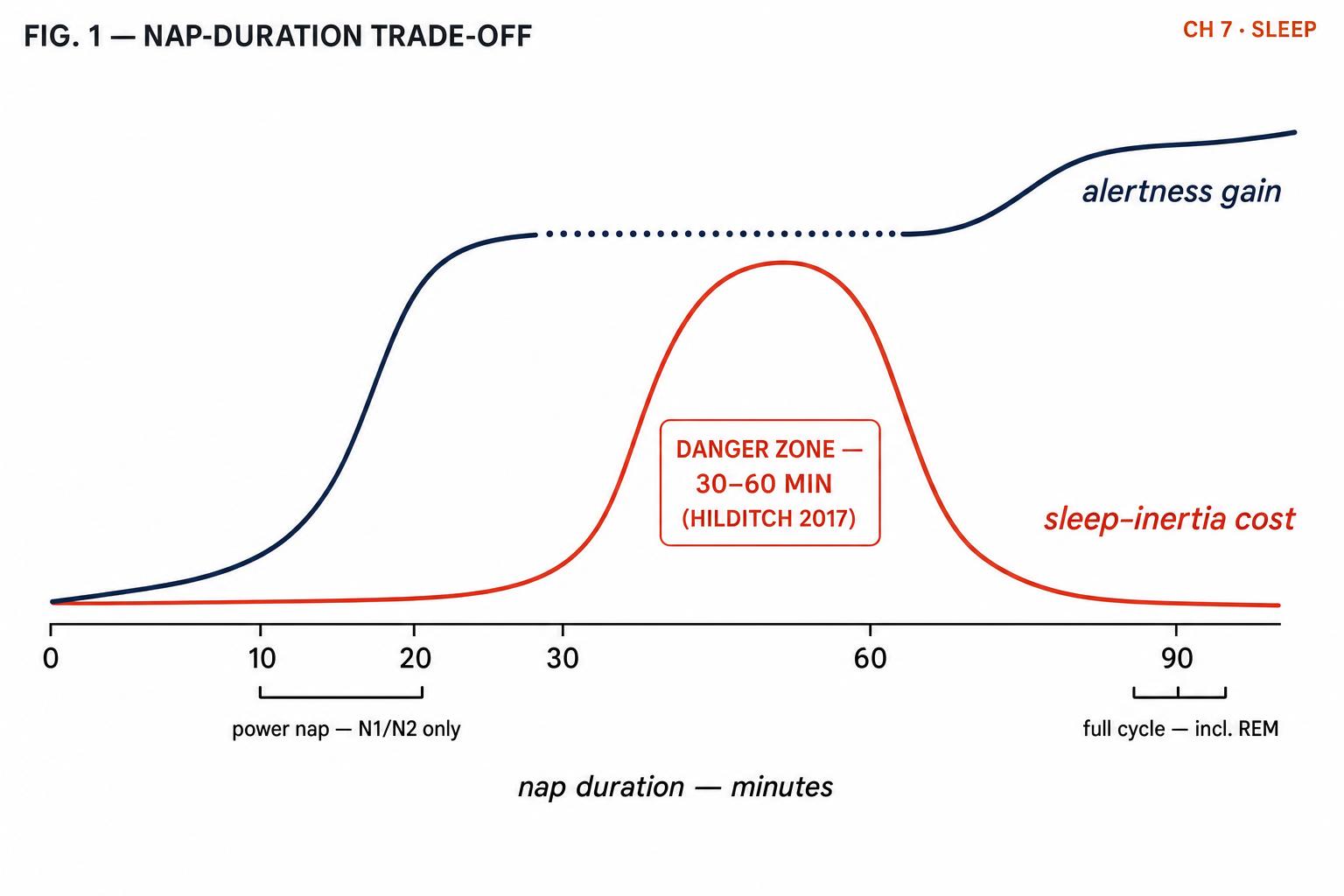
Sleep Inertia — The Danger Zone
Sleep inertia is the grogginess, confusion, and impaired performance you experience immediately after waking from sleep — particularly from deep sleep. It is not just feeling a bit drowsy. Sleep inertia involves measurable decrements in cognitive function, reaction time, and decision-making that can persist for fifteen to thirty minutes or, in severe cases, over an hour. If you have ever woken from an afternoon nap feeling worse than before you lay down, you have experienced sleep inertia firsthand.
The critical variable is which sleep stage you are in when the alarm fires. Waking from N1 or N2 produces minimal inertia — you feel refreshed almost immediately. Waking from N3, however, is like being pulled from the bottom of a deep pool. Your prefrontal cortex — the brain region responsible for executive function, judgment, and planning — is the last area to fully reboot after deep sleep arousal. This is why the thirty to sixty minute nap is often called the danger zone: it is long enough to descend into N3 but not long enough to complete the cycle and ascend back through lighter stages before waking.
According to Hilditch, Dorrian, and Banks in their comprehensive systematic review (2017), the pattern is clear. Naps shorter than approximately fifteen minutes rarely involved any slow-wave sleep and produced negligible inertia. Naps of around thirty minutes were unpredictable — some participants entered N3, some did not — making this duration a gamble. And naps of sixty minutes almost always involved substantial N3, meaning the sleeper was likely to be deep in slow-wave sleep when the alarm sounded. The review concluded that if your goal is a quick, clean alertness boost with minimal inertia risk, keep it under twenty minutes. If you have the luxury of time, extend to ninety minutes and allow the full cycle to complete naturally.
The practical takeaway is stark: there is no such thing as a medium nap. You either nap short, under twenty minutes, or nap long, approximately ninety minutes. Anything in between risks placing you squarely in the danger zone — awake, technically, but cognitively impaired and wishing you had never closed your eyes.
The Coffee Nap — Engineering a Double Hit
Now that you understand nap architecture and sleep inertia, you are ready for one of the most elegant applications of sleep science: the coffee nap, sometimes called the nappuccino. This strategy sounds almost too clever to work, but it exploits a precise pharmacological timing window that becomes obvious once you recall what you learned about caffeine in Chapter Four.
Here is the protocol: drink a cup of coffee — quickly, not sipped over twenty minutes — and immediately lie down for a twenty-minute nap. Then wake up.
Why does this work? Remember that caffeine does not give you energy. It blocks adenosine receptors, preventing the drowsiness signal from reaching your neurons. But caffeine takes approximately twenty to twenty-five minutes after ingestion to be absorbed through the small intestine, enter the bloodstream, and cross the blood-brain barrier in sufficient concentration to occupy those receptors effectively. During those twenty minutes, the caffeine is essentially in transit — it is not yet doing anything.
Meanwhile, your twenty-minute nap is doing something: sleep naturally clears adenosine. Not all of it — a brief nap only reduces adenosine modestly — but enough to partially lower the concentration of the very molecule that caffeine is about to start blocking. When you wake at the twenty-minute mark, two things happen simultaneously: the nap has reduced your adenosine levels, and the caffeine arrives at the receptors to block whatever adenosine remains. The result is a combined alertness boost that exceeds what either strategy produces alone.
As Hayashi and colleagues tested directly in 2003, caffeine consumed before a twenty-minute nap produced superior alertness restoration compared to a nap alone, caffeine alone, or other countermeasures like bright light exposure. The effect is not additive in a simple sense — it is synergistic, because the two mechanisms target the same system, adenosine signaling, from complementary angles.
There is an important constraint here: the coffee nap only works if you actually fall asleep. If you are not sleepy enough to drift off quickly, or if you spend fifteen minutes lying awake anxiously watching the clock, you lose the adenosine-clearing benefit of the nap while still absorbing the caffeine. The strategy works best during the post-lunch dip — the very window when your biology is most cooperative about letting you fall asleep quickly. Which brings us to the question of timing.
Circadian Nap Timing — Why the Afternoon Window Matters
You now know how long to nap and what to drink beforehand. The remaining question is when. And the answer has been sitting in your notes since Chapter One.
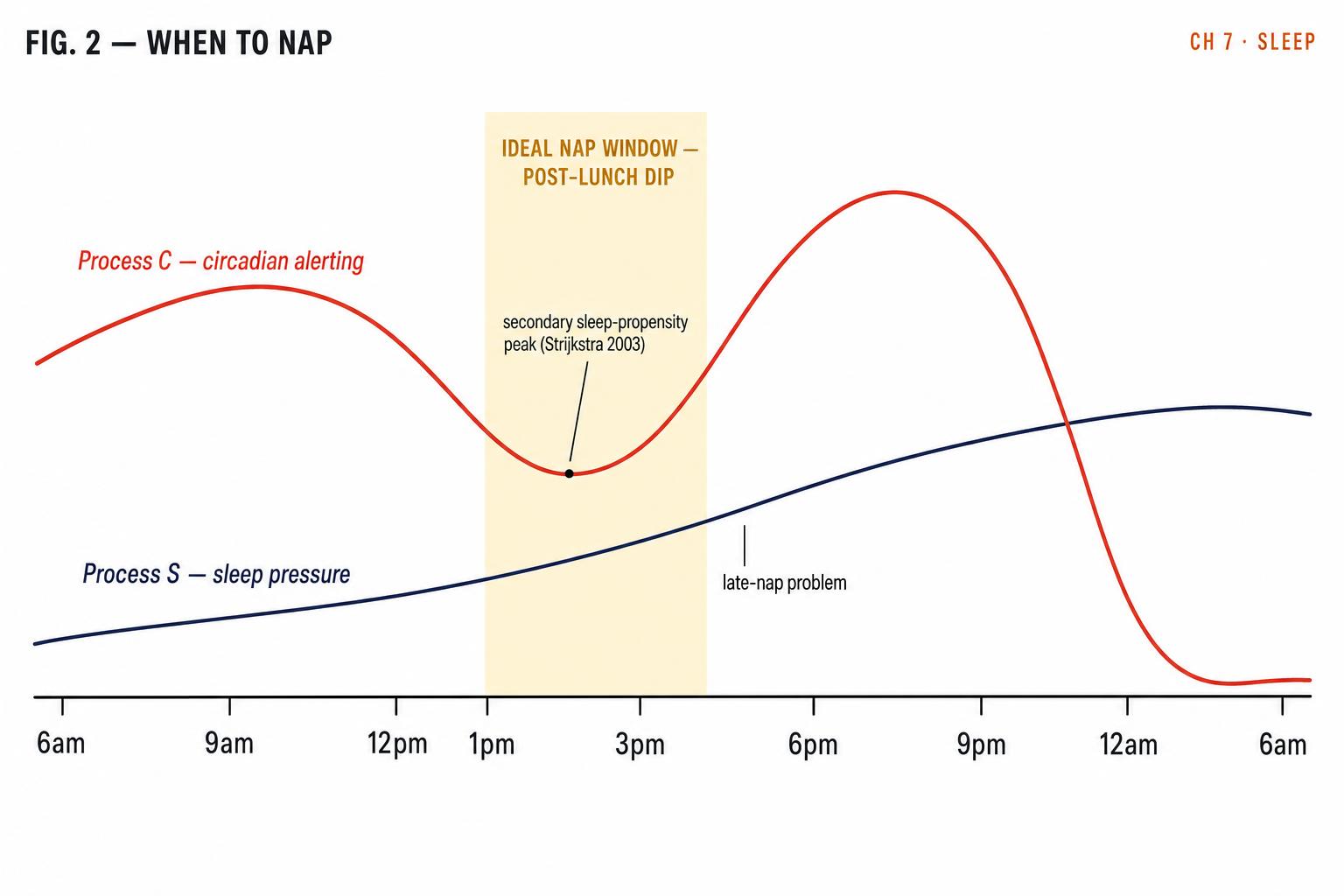
Recall the two-process model of sleep regulation: Process S, homeostatic sleep pressure driven by adenosine accumulation, rises steadily across waking hours, while Process C, the circadian alerting signal, oscillates on a roughly twenty-four-hour rhythm. During most of the day, Process C actively opposes Process S, keeping you alert even as adenosine accumulates. But there is a characteristic dip in the circadian alerting signal that typically occurs between approximately 1pm and 3pm — the post-lunch dip.
As Monk established in 2005, this afternoon trough in alertness and performance is fundamentally circadian in origin, not merely a consequence of having eaten lunch. People who skip lunch still experience the dip. It reflects a genuine secondary peak in sleep propensity — a brief window when Process C relaxes its opposition to Process S, and the accumulated adenosine from your morning hours gets a window of opportunity to express itself as drowsiness. Strijkstra and colleagues modeled this mathematically in 2003, demonstrating that the multiplicative interaction between homeostatic and circadian processes produces a characteristic double-peaked sleep propensity curve, with the secondary peak falling squarely in the early afternoon.
This is your optimal nap window. Napping during the post-lunch dip works with your biology rather than against it. You fall asleep faster, because both Process S and the circadian dip are cooperating. You are less likely to oversleep into problematic deep sleep during a short nap. And critically, you wake with enough remaining daylight hours to rebuild adequate sleep pressure before your nighttime sleep episode.
The Late Nap Problem
What happens if you nap at 5pm or 6pm instead? Here is where the course concepts converge in a cautionary way. A late-afternoon nap clears a significant portion of your accumulated adenosine just as your circadian system is preparing for its evening rise in alerting signal, before the subsequent decline toward the sleep gate around 10pm to 11pm. The result: when bedtime arrives, you do not have enough homeostatic sleep pressure to fall asleep easily. You lie awake. Your sleep onset is delayed. Your total sleep time is reduced. And the next morning, you are more tired than you would have been had you simply endured the afternoon sleepiness and gone to bed on time.
Think of it this way: a late nap mimics the disruptive effect of evening light exposure, which you studied in Chapter Three. Evening light shifts your circadian clock later, delaying the sleep gate. A late nap does something analogous from the homeostatic side — it depletes Process S at precisely the wrong time, creating a mismatch between your circadian rhythm, which expects you to be sleepy, and your homeostatic drive, which has been partially reset by the nap. The effect is the same: you cannot fall asleep at your normal time.
Importantly, however, well-timed naps do not carry this risk. As Boukhris and colleagues recently demonstrated in 2025, both twenty-five-minute and ninety-minute afternoon naps, when completed by 3pm, did not adversely affect subsequent nighttime sleep in student athletes. Total sleep time, sleep stage proportions, and wake-after-sleep-onset were all preserved. The key variable was not nap duration but nap timing: naps that ended within the post-lunch dip window left nighttime sleep architecture intact.
This interaction also explains a finding from Kurdziel, Duclos, and Spencer (2021): multiple naps spread across a twenty-four-hour period cannot fully substitute for consolidated nighttime sleep. Slow-wave energy — a marker of deep restorative sleep — accumulated across six naps was significantly lower than what a single baseline night produced. Naps are supplements, not replacements. They work best as precision tools deployed at the right circadian moment, not as a strategy for avoiding proper sleep.
Putting It All Together — Your Personalised Nap Strategy
You have now assembled every piece of the puzzle. A strategic nap requires you to integrate knowledge from across this entire course:
Circadian timing — Chapter 1
Nap during the post-lunch dip, adjusted for your chronotype.
Sleep architecture — Chapter 2
Choose either under twenty minutes, capturing N1 and N2 only, or approximately ninety minutes for a full cycle. Avoid the thirty to sixty minute danger zone.
Light management — Chapter 3
Dim your environment before napping to avoid alerting signals that inhibit sleep onset. After waking, seek bright light to accelerate the dissipation of sleep inertia.
Caffeine pharmacology — Chapter 4
If using a coffee nap, consume caffeine immediately before lying down. Ensure the dose and timing will not interfere with nighttime sleep. Account for the five to six hour half-life.
Temperature physiology — Chapter 5
A slightly cool environment facilitates sleep onset by supporting the core body temperature drop that accompanies the transition to sleep.
Arousal management — Chapter 6
Use a brief relaxation or cognitive deactivation technique to quiet the mind and accelerate sleep onset, maximizing actual sleep time within your nap window.
Each of these elements is a dial you can turn. Miss one — nap too late, choose the wrong duration, drink coffee at the wrong time, lie in a hot bright room while mentally rehearsing your to-do list — and the nap degrades from a precision tool into a source of frustration. Get them all right, and twenty minutes of afternoon rest can transform the cognitive quality of your entire remaining day.
A nap is not an escape from wakefulness. It is an investment in it — but only if you understand the terms of the investment.
Field-note for the rest of your life
Napping as Applied Sleep Science
There is something deeply satisfying about the fact that this course ends with napping — a behavior most people think of as simple, even lazy. But as you now understand, a well-designed nap is anything but simple. It requires an understanding of circadian biology, sleep-stage architecture, neurochemistry, pharmacology, thermoregulation, and psychological arousal management. It requires you to think about your body as a system with interacting processes operating on different timescales.
The broader lesson is this: sleep is not a passive state that happens to you. It is an active biological process that you can understand, respect, and — within limits — strategically manage. You cannot override your circadian rhythm any more than you can override gravity, but you can work with it. You cannot eliminate adenosine accumulation, but you can time its clearance intelligently. You cannot avoid sleep inertia if you wake from deep sleep, but you can avoid waking from deep sleep in the first place.
Throughout this course, you have built a conceptual toolkit — Process S and Process C, sleep spindles and slow waves, melanopsin and the SCN, adenosine receptors and caffeine half-lives, core body temperature curves, and the ascending arousal system. The strategic nap is simply the final exam for that toolkit: a single, practical problem that you can now solve with genuine understanding rather than guesswork.
Sleep well. And when the afternoon demands it, nap well too.
Key Takeaways
- Short naps of ten to twenty minutes capture N1 and N2 sleep stages, providing alertness and memory benefits with minimal sleep inertia risk.
- Full-cycle naps of approximately ninety minutes include N3 and REM, offering deep restoration and creative insight comparable to nocturnal sleep for some tasks (Mednick et al., 2003).
- The thirty to sixty minute range is the danger zone — long enough to enter deep N3 sleep but too short to complete the cycle, maximizing sleep inertia (Hilditch et al., 2017).
- Coffee naps exploit the approximately twenty-minute caffeine absorption window: drink coffee, nap for twenty minutes, and wake as caffeine arrives at adenosine receptors already partially cleared by sleep (Hayashi et al., 2003).
- The optimal nap window, typically 1pm to 3pm adjusted for chronotype, aligns with the post-lunch dip in the circadian alerting signal (Monk, 2005).
- Late naps after approximately 4pm reduce homeostatic sleep pressure at the wrong time, potentially disrupting nighttime sleep onset and architecture.
- Well-timed naps completed by 3pm do not adversely affect subsequent nighttime sleep quality or duration (Boukhris et al., 2025).
- A strategic nap integrates knowledge of circadian timing, sleep architecture, light, caffeine, temperature, and arousal — the complete toolkit of this course.
This chapter concludes the course, but your understanding of sleep science is just beginning. You now hold seven levers — circadian alignment, sleep-stage architecture, light, caffeine, body-temperature and movement, wind-down arousal management, and strategic napping. Combined, these are not seven isolated facts; they are an integrated personal sleep system, built one chapter at a time, the dials of which you can now turn with intention.
Every night you sleep and every afternoon you feel the pull of drowsiness, you now have a framework for understanding what your body is doing and why. The concepts from these seven chapters — circadian rhythms, sleep architecture, light sensitivity, caffeine dynamics, thermoregulation, arousal systems, and strategic napping — are not isolated facts. They are an integrated model of one of the most fundamental processes in human biology. Take it with you. Use it. Read the next paper that comes out. Track an effect size before you trust a headline.
Sleep is not a luxury to be minimized — it is the foundation on which every waking hour is built.
References
Boukhris, O., et al. (2025). Effects of afternoon napping durations on subsequent nighttime sleep in student athletes. Journal of Sleep Research.
Hayashi, M., Masuda, A., & Hori, T. (2003). The alerting effects of caffeine, bright light and face washing after a short daytime nap. Clinical Neurophysiology, 114(12), 2268–2278.
Hilditch, C. J., Dorrian, J., & Banks, S. (2017). A review of short naps and sleep inertia: Do naps of 30 min or less really avoid sleep inertia and slow-wave sleep? Sleep Medicine, 32, 176–190.
Kurdziel, L. B. F., Duclos, K., & Spencer, R. M. C. (2021). Slow-wave energy across naps and a baseline night. Sleep.
Mednick, S., Nakayama, K., & Stickgold, R. (2003). Sleep-dependent learning: A nap is as good as a night. Nature Neuroscience, 6(7), 697–698.
Monk, T. H. (2005). The post-lunch dip in performance. Clinics in Sports Medicine, 24(2), e15–e23.
Rosekind, M. R., Graeber, R. C., Dinges, D. F., Connell, L. J., Rountree, M. S., Spinweber, C. L., & Gillen, K. A. (1995). Crew factors in flight operations IX: Effects of planned cockpit rest on crew performance and alertness in long-haul operations. NASA Technical Memorandum 108839.
Strijkstra, A. M., Beersma, D. G. M., Drayer, B., Halbesma, N., & Daan, S. (2003). Subjective sleepiness correlates negatively with global alpha (8–12 Hz) and positively with central frontal theta (4–8 Hz) frequencies in the human resting awake electroencephalogram. Neuroscience Letters, 340(1), 17–20.