From Couch to Finish Line: The Science and Soul of Your First Marathon
This course is built on a simple, honest premise: anyone who can commit to a process can finish a marathon. Not anyone who believes hard enough, not anyone who's already athletic — anyone willing to show up consistently …
You Don't Have to Love Running (Yet)
This opening chapter confronts the biggest barrier to marathon training head-on: identity. Many students arrive believing that 'real runners' are lean, fast, and born to it — and that they are definitively not that. We…
Real talk: Do you actually consider yourself a 'runner'? Why or why not? (Most people say no, btw)
Quick poll
Hot take: Anyone who claims they LOVE running is lying to make themselves feel better. Agree or disagree?
Hot take
Would you run 3x a week for a month if someone paid you $500? What if it was $100?
Would you rather
Which sounds worse: running for 15 minutes or sitting in bumper-to-bumper traffic for 15 minutes?
Debate time
Have you ever decided 'I'm just not a runner'? What made you write yourself off like that?
Real talk
What's the longest you've ever run without stopping? No judgment — 30 seconds totally counts.
Confession time
Live RPE Calibration Challenge
12-15 minutesStudents do a progressive movement sequence right at their computers (marching in place, then faster, then adding arm movements). Instructor guides through 3 intensity levels. After each 60-second interval, students anonymously submit their RPE (1-10) via polling software. Results are displayed in real-time showing the wide variance in perceived exertion for the SAME activity. Students then join breakout rooms (4-5 people) to discuss: Why did we all experience that differently? What does this tell us about comparing ourselves to others? Groups report back one insight to main room.
Runner Identity Myth Smackdown
10-12 minutesInstructor presents 8 statements about runner identity (e.g., 'Real runners run every day,' 'You need to love running to be a runner,' 'Runners have a certain body type'). Students vote TRUE or FALSE via polling. After each vote, results are revealed, then instructor shares the evidence-based answer with a 30-second story or stat. Students use the chat to share their immediate reactions or personal experiences with each myth. This creates a rapid-fire, interactive format where students see their peers' beliefs shift in real-time.
Aerobic System Speed Dating
15-18 minutesAssign each breakout room ONE component of the aerobic system (heart, lungs, skeletal muscles, blood/circulation, mitochondria, or oxygen delivery). Groups have 5 minutes to become 'experts' on their component using a provided 1-page handout. Then, students are reshuffled into new 'teaching' breakout rooms (6 people max, one expert from each system). Each expert has 90 seconds to teach the others their component. Final 3 minutes: groups collaboratively draw/diagram how all components work together during a run using a shared whiteboard.
Training Timeline Reality Check
8-10 minutesPresent 4 fictional student profiles with different starting points and goals (e.g., 'Never run before, wants to run 5K in 3 weeks' vs 'Runs occasionally, wants to run 5K in 12 weeks'). Students go to breakout trios and must rank these timelines from most realistic to least realistic, then propose an adjusted timeline for the unrealistic ones. Each group submits their ranking and rationale via shared doc or chat. Instructor reveals evidence-based rankings and discusses the TOP misconception that emerged across groups.
The 'Not Yet' Wall of Solidarity
10-12 minutesStudents open a shared Padlet or Google Jamboard. Prompt: 'Share ONE thing about running (or exercise) you don't love YET—and one small thing that might make it 1% better.' Students post anonymously. After 3 minutes of posting, students go to breakout rooms (5-6 people) to review the wall together, clustering similar responses and choosing ONE that resonates most with their group. Groups return and each shares their chosen response plus WHY it resonated. This builds community around shared struggles and collectivizes solutions.
Effort vs. Outcome: The Graph Game
12-15 minutesStudents receive blank axes: X-axis is 'weeks of training' (0-12), Y-axis is 'fitness improvement' (0-100%). In breakout rooms of 4, they must collaboratively draw two graphs on a shared whiteboard: (1) What they WISH fitness improvement looked like, (2) What it ACTUALLY looks like based on aerobic adaptation science. Groups then compare their 'wish' vs. 'reality' graphs and discuss: What does this gap tell us about why people quit? How does RPE fit into this timeline? The instructor then reveals the science-backed graph and discusses adaptation timelines, connecting to the 'you don't have to love it yet' theme—love often follows competence, which takes time.
Transcript
Picture the starting corral of any big-city marathon, say, the New York City Marathon on a cold November morning. There are fifty thousand runners packed behind the starting line. Some are lean, focused, and wearing racing flats that cost more than your textbook. But most of them? Most of them look like your neighbor, your coworker, your aunt. There's a fifty-eight-year-old postal worker running her sixth marathon. A grad student who started jogging eight months ago and can still barely believe he's here. A father of three who hasn't exercised regularly since college. They're nervous. Some are terrified. And by late afternoon, an overwhelming majority of them will cross the finish line.
If a voice in your head is already whispering, "Yeah, but those people are different from me," this chapter is specifically for you. That voice is the single biggest barrier between you and twenty-six point two miles — not your lungs, not your knees, and definitely not your pace. Let's talk about why.
[short pause]
Before we talk about physiology, training plans, or shoe selection, we need to address the elephant in the room: IDENTITY. Many people who sign up for something like this course carry a quiet, deeply held belief that they are not — and perhaps cannot be — a "real runner." Real runners are thin. Real runners were on the cross-country team. Real runners don't walk during races. Real runners certainly don't stop to take selfies at mile eighteen.
This belief isn't trivial. Research in exercise psychology shows that EXERCISE IDENTITY — the degree to which you see physical activity as part of who you are — is one of the strongest predictors of whether you'll actually stick with a training program, as Rhodes and colleagues found in 2016. If you believe running is something other people do, you've already built a wall between yourself and consistency. Every hard workout becomes evidence that you don't belong instead of evidence that you're getting stronger.
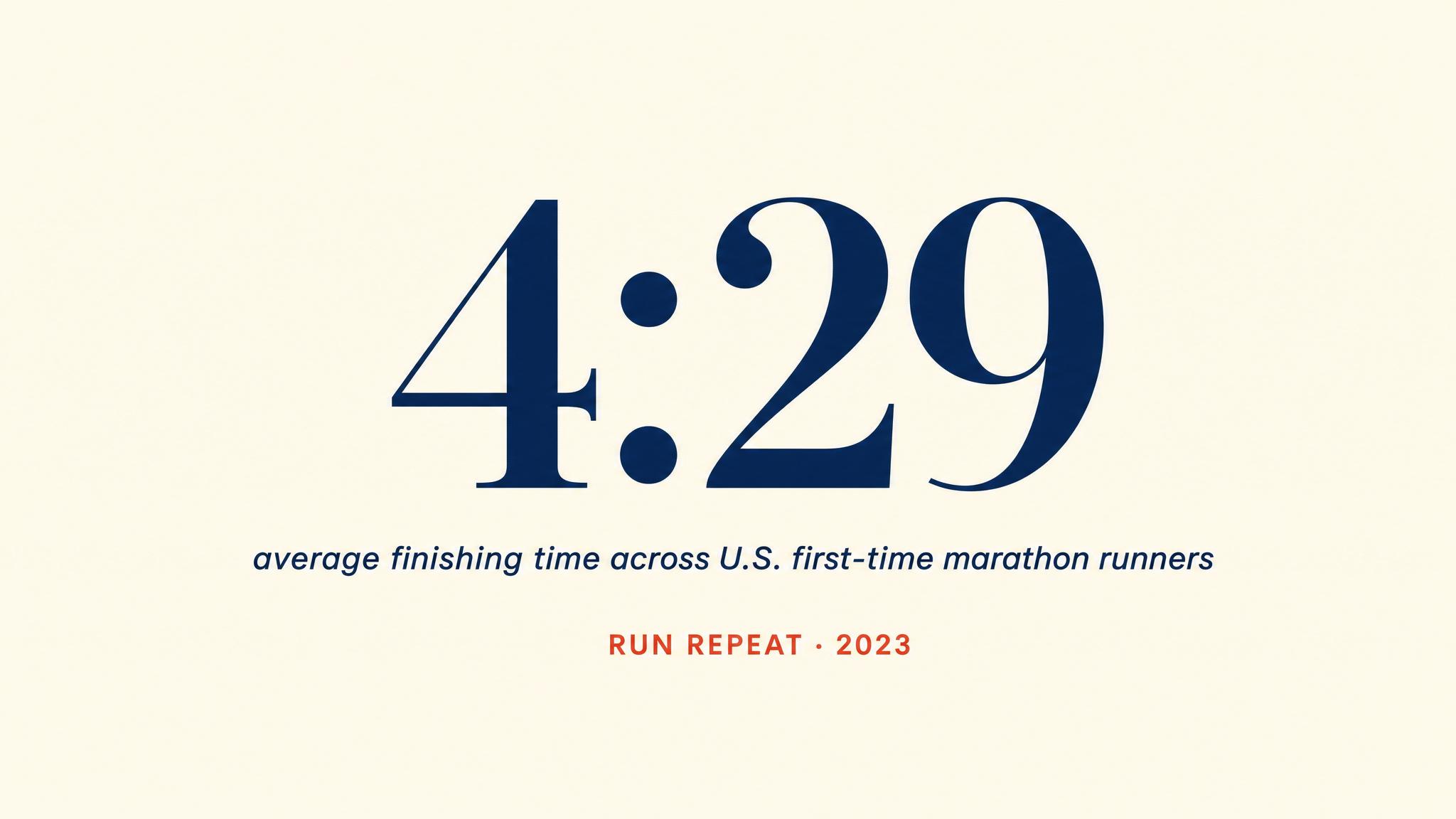
Here's the truth the data reveals: the "real runner" archetype is a fiction that doesn't match the marathon's actual population. A worldwide analysis of nineteen point six million marathon results found that the average finishing time was four hours and twenty-nine minutes — a pace of roughly ten minutes and seventeen seconds per mile, as reported by RunRepeat in 2019. That's a comfortable jog for many people, barely faster than a brisk walk for some. The most common age group on the starting line is thirty to forty, and the field has been getting slower over the past decade — not because people are getting worse at running, but because more everyday, non-elite humans are choosing to do it.
Marathon running has been democratized. And that democratization isn't a watering-down of the achievement. It's a return to what the human body was designed for in the first place.
[short pause]
When you picture a "marathon runner," what does that person look like? Be honest with yourself. Now ask: where did that image come from? Media coverage of elites? Nike ads? Consider how that mental image might be shaping your belief about whether you can do this.
[short pause]
In 2004, biologists Dennis Bramble and Daniel Lieberman published a landmark paper in Nature that reshaped our understanding of what the human body is for. Their ENDURANCE RUNNING HYPOTHESIS argues that Homo sapiens didn't evolve to be the fastest animal — we evolved to be the animal that never stops, according to Bramble and Lieberman in 2004.
Think about what makes humans physiologically unusual compared to other mammals. We have very little body hair and an extraordinary number of sweat glands — roughly two to four million of them — giving us the most efficient cooling system in the animal kingdom. We have a nuchal ligament at the back of the skull that stabilizes our head during running; most primates lack this. We have long Achilles tendons that act as springs, storing and releasing elastic energy with each stride. We have large gluteal muscles — your glutes are essentially running muscles — and a specific arrangement of slow-twitch muscle fibers optimized for sustained effort.
These features make no sense for walking. They only make sense for running long distances. Bramble and Lieberman proposed that early humans used PERSISTENCE HUNTING — chasing prey across the African savanna for hours in the midday heat until the animal, unable to cool itself through panting while galloping, collapsed from hyperthermia. We didn't need to be fast. We just needed to keep going. And we could, because we sweat.
The point isn't that you need to go chase an antelope. The point is this: your body is not betraying you when it struggles through the first mile of a jog. Your body is a distance-running machine that's been sitting idle. The engine is there. It just needs to be turned on gradually — which is exactly what a training plan does.
[short pause]
Understanding the basics of aerobic physiology isn't just academic — it will change how you train and how you feel about hard days. Let's walk through what's actually occurring in your body when you go for a run.
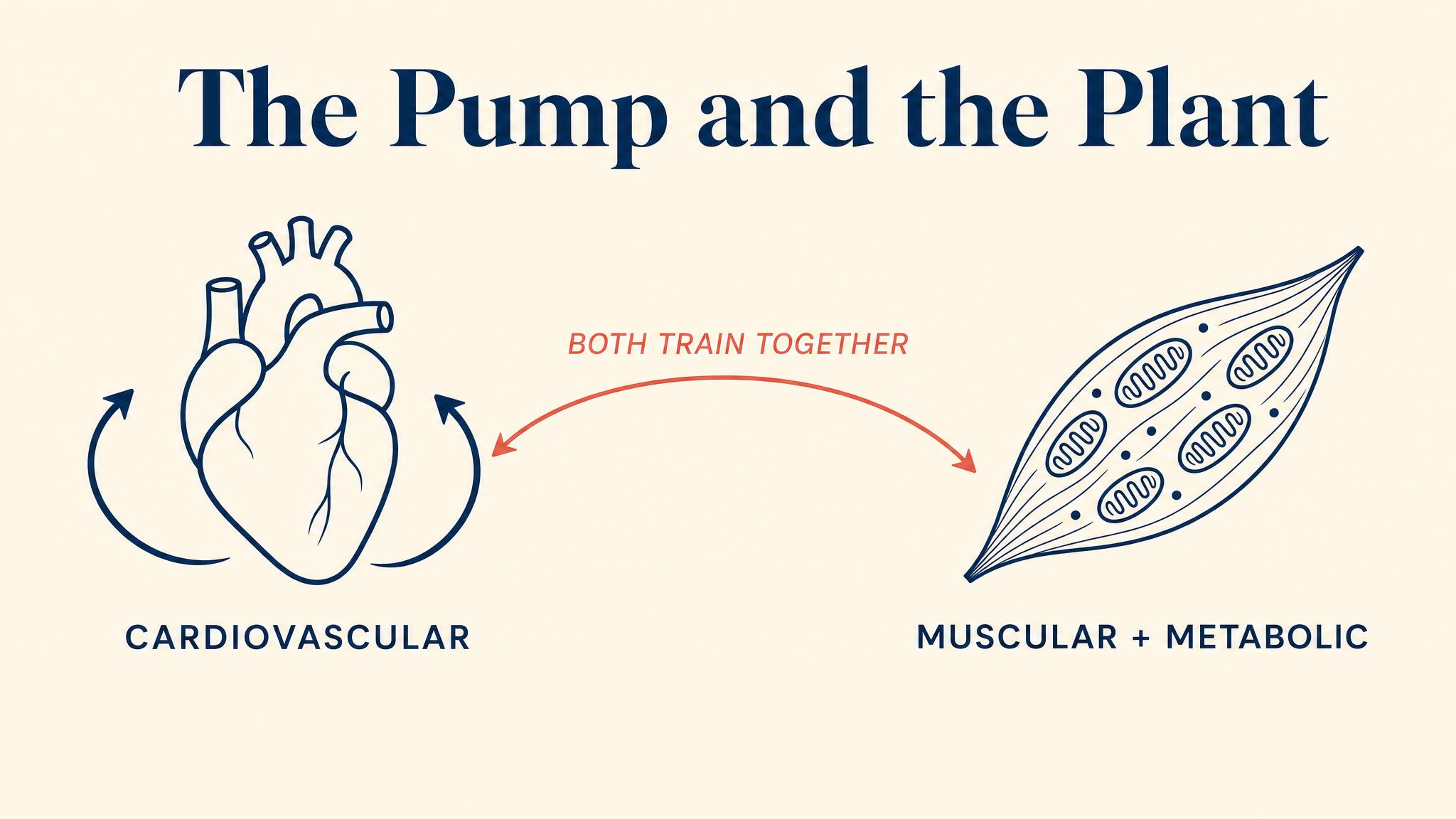
The moment you start running, your heart rate increases to pump more blood to your working muscles. At rest, your heart pushes about five liters of blood per minute. During vigorous exercise, this CARDIAC OUTPUT can increase to twenty to twenty-five liters per minute in a trained individual, as noted in StatPearls 2024. Your body also performs an elegant trick called blood flow redistribution: it diverts blood away from your digestive organs and toward your skeletal muscles, skin for cooling, and heart. This is why running right after a large meal feels terrible — your body is trying to send blood in two directions at once.
Over weeks and months of training, your heart undergoes remarkable adaptations. The left ventricle — the chamber that pumps oxygenated blood to your body — literally gets larger and stronger. Each beat pushes out more blood, which is called STROKE VOLUME, which means your heart doesn't have to beat as fast to deliver the same amount of oxygen. This is why resting heart rate drops as you get fitter — it's one of the earliest, most measurable signs that training is working, as Hellsten and Nyberg reported in 2016.
[short pause]
Your muscles run on a molecule called adenosine triphosphate, or A-T-P, but you only store enough of it for a few seconds of effort. For sustained running, your body generates A-T-P primarily through AEROBIC METABOLISM — a process that uses oxygen to break down carbohydrates and fats in the mitochondria of your muscle cells. The more mitochondria you have, and the better they function, the more efficiently you produce energy. Training increases both the number and the efficiency of these mitochondria.
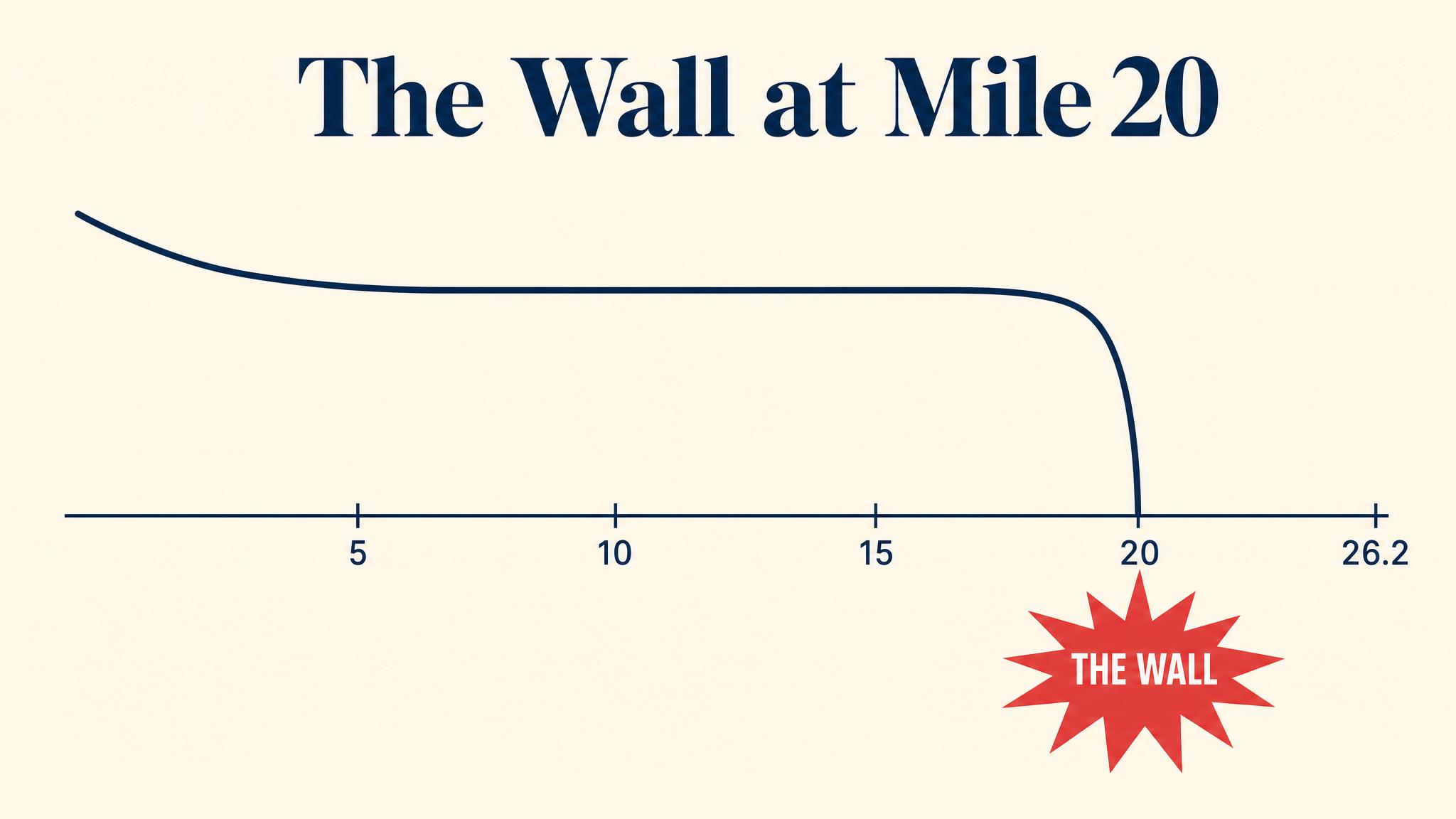
Here's the key insight: at easy paces, your body primarily burns fat for fuel. As intensity increases, you shift toward burning glycogen, which is stored carbohydrate. Glycogen is a faster but more limited fuel source. The average person stores about two thousand calories of glycogen — enough for roughly eighteen to twenty miles of running. This is why the marathon's infamous "wall" typically hits around mile twenty. It's not willpower failure. It's glycogen depletion. And it's a problem with a solution — one we'll explore in depth in later chapters on fueling.
[short pause]
Your breathing rate increases during running not because your lungs are "bad at their job," but because your muscles are demanding vastly more oxygen. At rest, you might breathe twelve to twenty times per minute. During a hard run, that can climb to forty to sixty breaths per minute. The sensation of being "out of breath" during your first few runs is largely your body recalibrating — learning to coordinate breathing with effort. Interestingly, for most runners, the lungs are not the limiting factor in endurance. Your cardiovascular system and muscles typically reach their limits before your lungs do, as noted in StatPearls 2024.
[short pause]
If the average person's glycogen stores run out around mile twenty, and a marathon is twenty-six point two miles, what strategies might runners use to handle those final six point two miles? Think about both fueling approaches and pacing strategies.
[short pause]
Forget about pace per mile for now. Forget about heart rate zones. The single most important self-regulation tool you will use throughout this course is the RATE OF PERCEIVED EXERTION — or R-P-E — a subjective scale that asks a simple question: How hard does this feel?
Developed by Swedish psychologist Gunnar Borg, the R-P-E scale has been validated across dozens of studies as a reliable measure of exercise intensity. A meta-analysis by Chen, Fan, and Moe in 2002 found that R-P-E correlates meaningfully with heart rate, oxygen consumption, and breathing rate across different populations, fitness levels, and types of exercise. In plain language: your body is remarkably good at telling you how hard it's working, if you learn to listen.
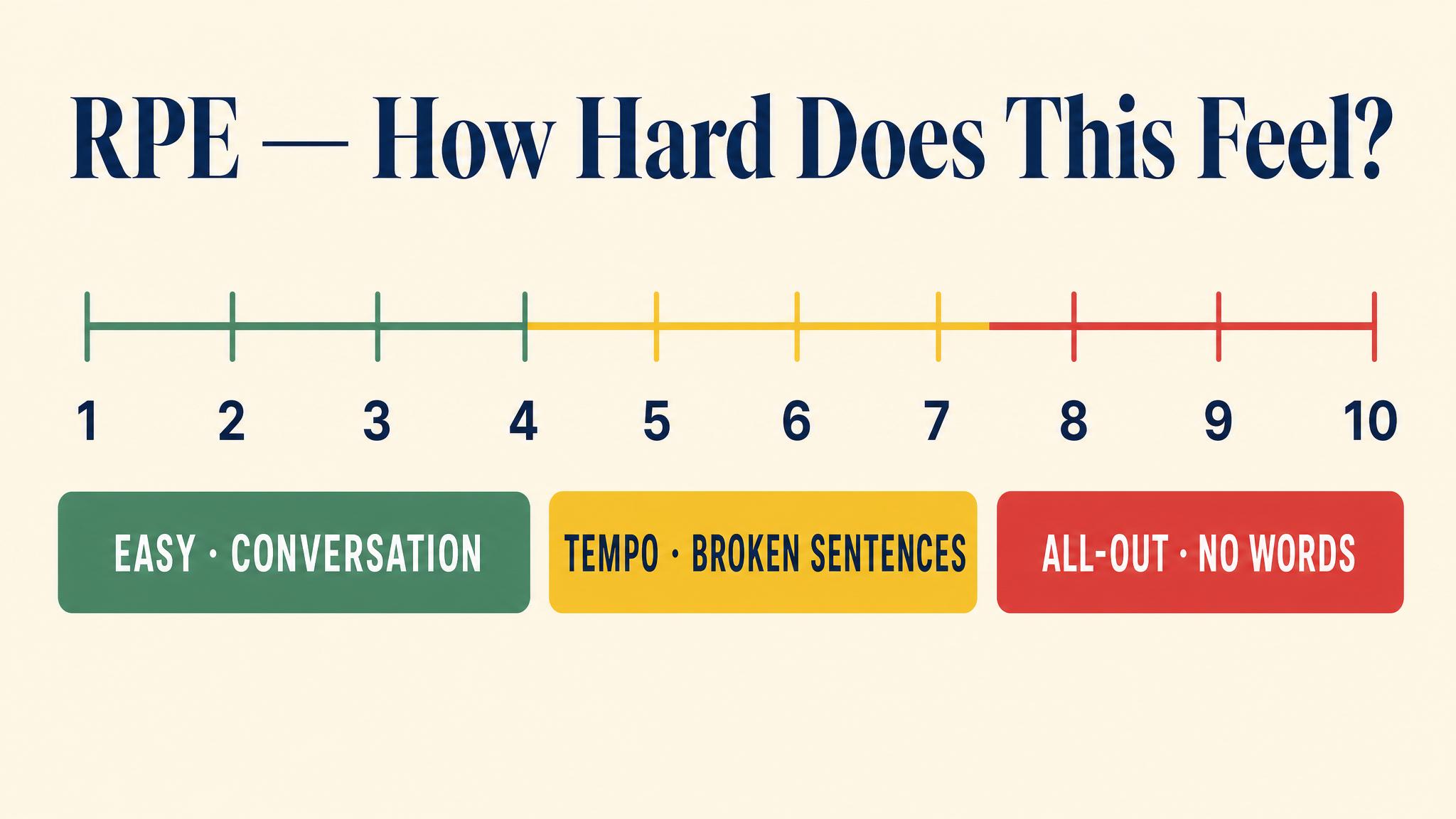
We'll use a simplified one to ten scale throughout this course. R-P-E one to two is barely moving, a slow stroll, where you could sing. R-P-E three to four is easy effort. You can hold a full conversation without pausing for breath. This is where the majority of your training will live. R-P-E five to six is moderate effort. You can talk in sentences but not paragraphs. Comfortably uncomfortable. R-P-E seven to eight is hard effort. Only a few words at a time. You're aware of your breathing. R-P-E nine to ten is all-out effort. Can't talk. Can't sustain this for more than a minute or two.
Here's what surprises most beginners: effective marathon training happens primarily at R-P-E three to four. It should feel easy. This is where your aerobic system develops most efficiently, where mitochondria multiply, where your heart grows stronger without accumulating excessive fatigue. The single most common mistake new runners make is running too hard on easy days. R-P-E is your antidote to that mistake, and we'll return to it in every chapter ahead.
[short pause]
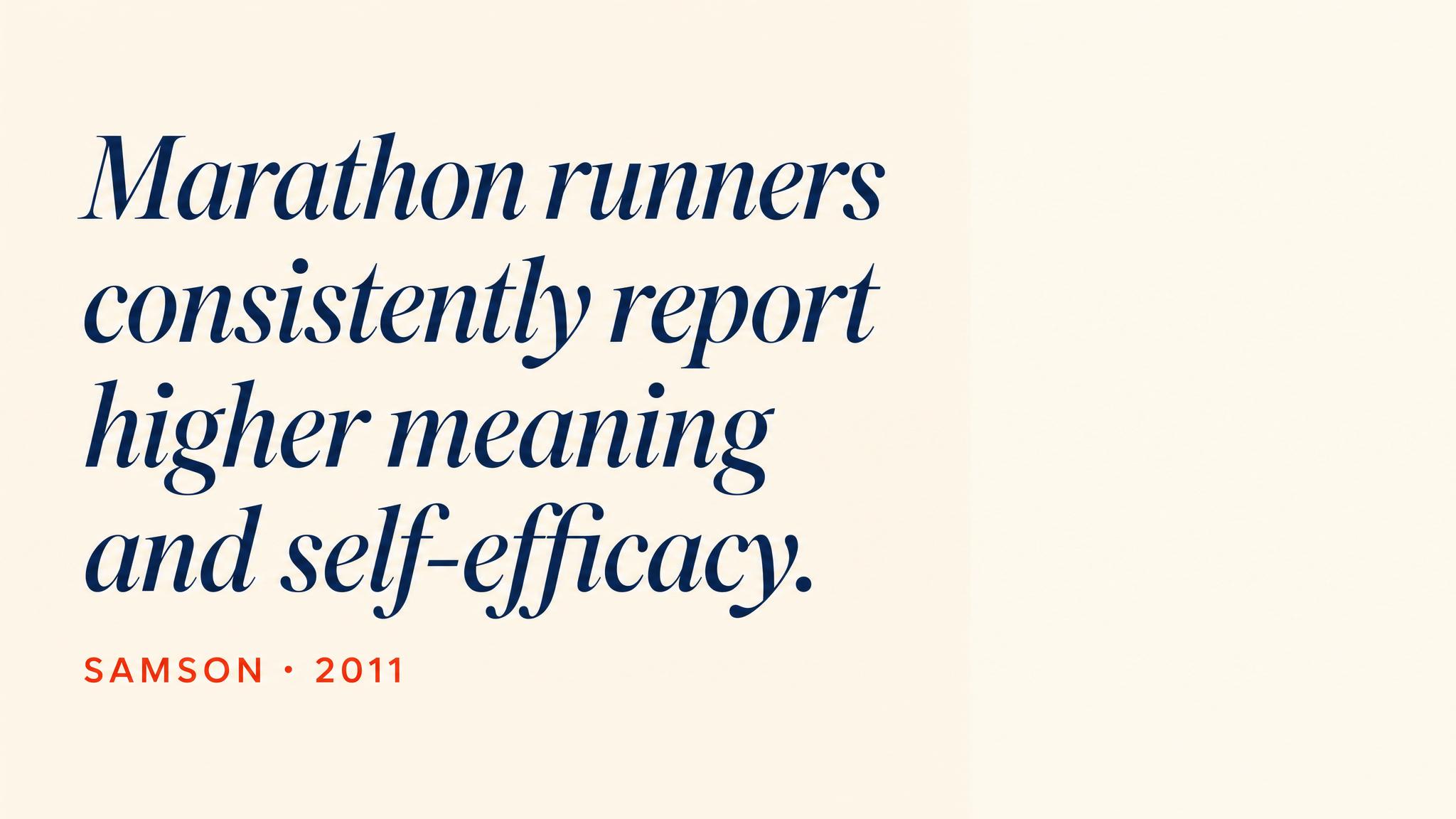
Let's talk honestly about what marathon training requires. Not to scare you, but because realistic expectations are the foundation of SELF-EFFICACY — your belief in your ability to succeed. Research by Samson in 2011 found that for distance runners, self-efficacy is built primarily through two mechanisms: successful performance accomplishments, that is completing workouts and seeing progress, and physiological information, which means learning to interpret your body's signals. Both of these depend on having a plan that actually matches your life.
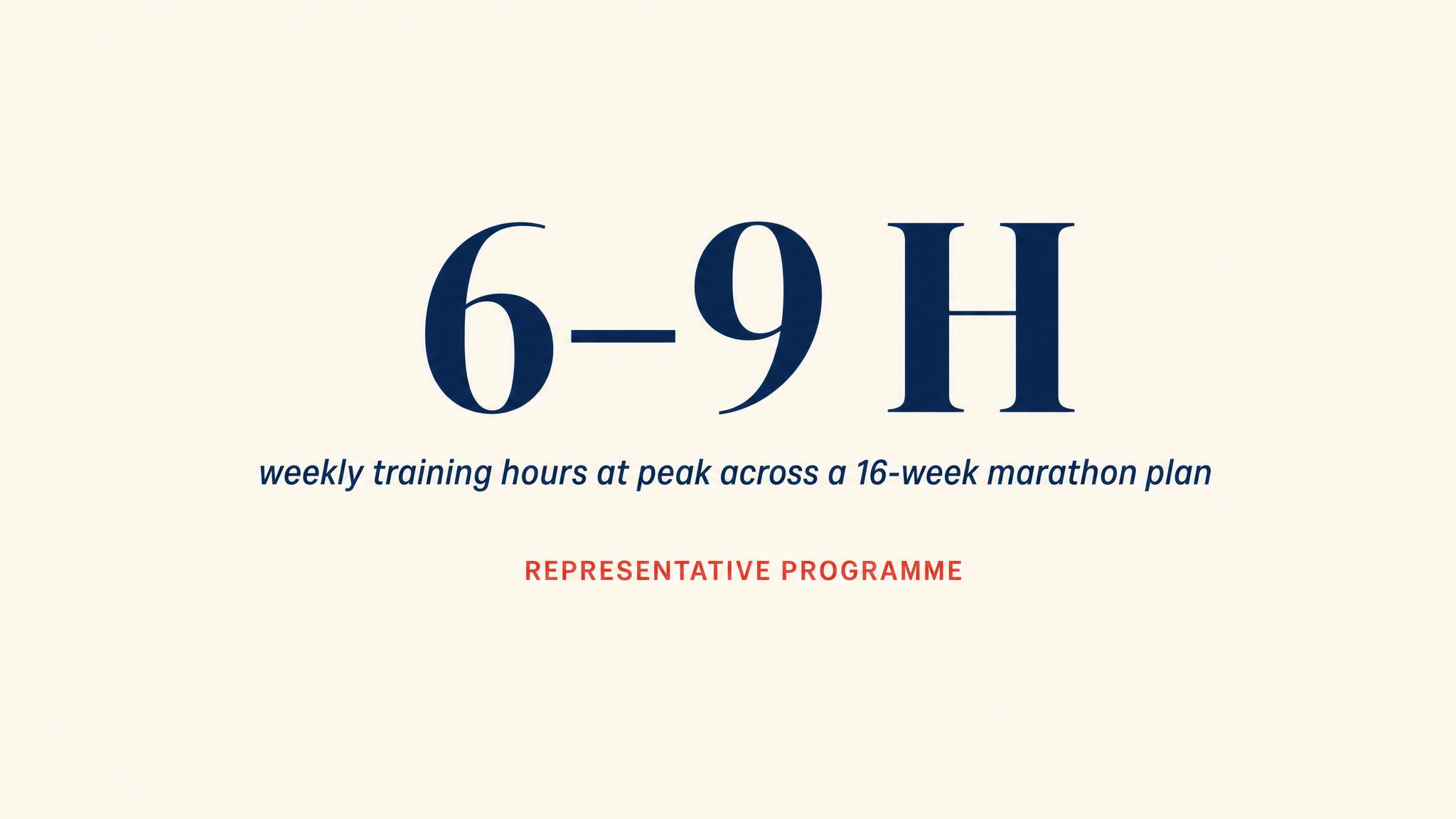
A standard marathon training plan runs sixteen to twenty weeks. Here's a realistic picture of the weekly time commitment across different phases. In the early weeks, weeks one through six, you'll have three to four days of running or walking, thirty to forty-five minutes each. Total: two to three hours per week plus some stretching and rest. During the building phase, weeks seven through twelve, you'll have four days of running, including one longer run on weekends reaching eight to twelve miles. Total: four to six hours per week. In the peak phase, weeks thirteen through seventeen, you'll have four to five days of running, with long runs reaching eighteen to twenty-two miles. Total: six to nine hours per week at the highest point. During the taper, the final two to three weeks, volume drops significantly to let your body recover and consolidate gains. Total: three to four hours per week.
Notice that the peak time commitment — six to nine hours per week — is roughly the equivalent of watching a season of a streaming show. It's significant but not impossible. The critical insight is that this time is distributed: most weekday runs are thirty to sixty minutes. The long run is one day per week, and it builds gradually. Nobody is asking you to run for three hours next Tuesday.
[short pause]
Look at your current weekly schedule. Where could you realistically fit three to four thirty to sixty minute sessions? Early morning before work? Lunch break? After the kids go to bed? Identifying specific time slots now — not vague intentions — is one of the strongest predictors of training adherence.
[short pause]
One of the most useful things you can do early in your training journey is demystify the marathon distance. Twenty-six point two miles sounds enormous — and it is — but it's also a distance that unfolds at a human pace over several hours. Most first-time marathoners will be on the course for somewhere between four and a half and six and a half hours. That's a long morning, not a whole day.
Even at a six-hour finishing time, you're still moving meaningfully faster than a walk. And the pace doesn't have to be perfectly even. In fact, in realistic scenarios, your pace will fluctuate throughout the race.
[short pause]
This course operates on a single guiding philosophy: FINISHING IS THE GOAL. Not finishing fast. Not finishing without walking. Not finishing with a specific time. Crossing the line.
This isn't a participation-trophy mindset — it's a scientifically grounded approach to motivation and performance. Self-Determination Theory, one of the most well-supported frameworks in motivation research, identifies three innate psychological needs that drive sustained engagement: AUTONOMY, which is feeling that you have choice and ownership; COMPETENCE, feeling that you're improving and capable; and RELATEDNESS, feeling connected to others in the pursuit. When these needs are met, people develop intrinsic motivation — they do the thing because it matters to them, not because someone is watching, according to Ryan and Deci in 2000.
A process-oriented approach supports all three needs. You choose your runs, which is autonomy. You build gradually and feel yourself getting stronger, which is competence. You can share the journey with others who are on the same path, which is relatedness. An outcome-obsessed approach — fixating on a finishing time, comparing yourself to faster runners, defining success narrowly — undermines all three, especially for beginners. It transforms every run into a test you might fail rather than a step in a process you're committed to.
This doesn't mean you can't have time goals. It means that for the purposes of this course, we train to complete, and we let performance outcomes emerge naturally from consistent, intelligent preparation.
[short pause]
Before we go further, let's clear the air on some common beliefs about running and marathon training. You've probably heard many of these. Some are true, some are nuanced, and some are flat wrong.
[short pause]
We close this first chapter with the most important question you'll answer in this entire course — and it has nothing to do with physiology or training plans.
Why do you want to run a marathon?
This isn't a soft question. Your answer to it is a prediction of your behavior over the next several months. Research on self-efficacy in distance runners shows that the runners who persist through the inevitable hard patches — the rainy Tuesday when you don't want to go out, the long run where your legs feel like concrete, the week where life gets complicated — are the ones with clear, personally meaningful reasons for doing this, as Samson reported in 2011.
Your "why" doesn't have to be profound. It can be: "I want to prove to myself that I can do something I never thought possible." Or "My mother was diagnosed with cancer and I'm running to raise money for research." Or "I'm turning forty and I want to enter this decade doing something extraordinary." Or "Honestly? My friend bet me I couldn't do it." Or simply "I just want to see what my body can do."
All of these are valid. What matters is that the reason is yours — not something you think sounds good, not someone else's goal grafted onto your life. According to Self-Determination Theory, autonomous motivation, that is doing something because you genuinely value it, produces markedly more persistent behavior than controlled motivation, which is doing something because you feel pressured or obligated, as Ryan and Deci noted in 2000.
Write it down. Put it somewhere you'll see it on the mornings when the alarm goes off at six a.m. and the bed is warm. Your "why" is the bridge between intention and action.
Take a moment — right now, before you move to the next chapter — and write down your reason. One sentence is enough. Tape it to your bathroom mirror if you want. You'll be glad you did around week twelve.
[short pause]
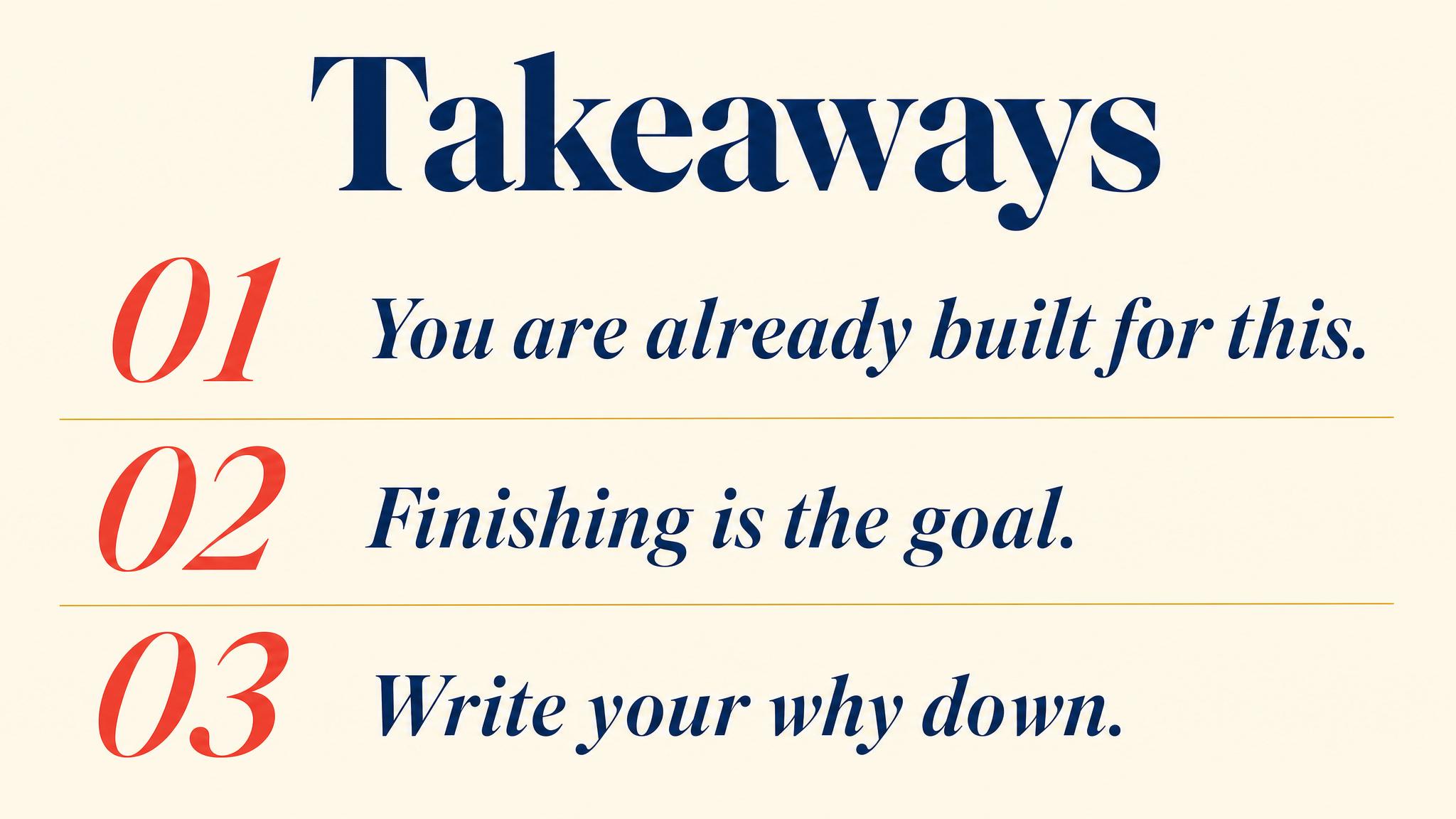
Let's review the key takeaways. The "real runner" identity is a myth: the average marathon finisher runs a four hour thirty minute pace, and the field is overwhelmingly composed of everyday people with jobs, families, and imperfect bodies. Humans evolved specifically for endurance running — your body has anatomical adaptations like sweating, Achilles tendons, and gluteal muscles that make long-distance movement your biological birthright. Aerobic training triggers measurable cardiovascular, muscular, and metabolic adaptations over a predictable timeline of weeks to months, including increased cardiac output, mitochondrial density, and fat utilization. Rate of Perceived Exertion, or R-P-E, is a validated, accessible tool for regulating training intensity — and most of your training should feel surprisingly easy, at R-P-E three to four. Marathon training requires sixteen to twenty weeks and peaks at roughly six to nine hours per week, distributed across four to five days with one longer weekend run. A process-oriented, "finishing is the goal" approach is supported by Self-Determination Theory — autonomy, competence, and relatedness fuel intrinsic motivation far better than fixating on outcome metrics. And finally, your personal "why" is the single most important motivational anchor you have — write it down and make it specific.
[short pause]
In Chapter Two, we'll lace up and take the first literal steps: how to structure a run-walk program, why walking is not cheating — it's a strategy used by seasoned ultramarathoners — and how to choose shoes that work for your feet. You'll also learn the ten percent rule for building mileage safely and start mapping out your first week of training. Bring your calendar.





The Magic of Slow
This chapter delivers perhaps the most counterintuitive and important lesson in endurance training: to run far, you must first learn to run slowly. Most beginners make the same mistake — they run too fast on every…
If you have to take walk breaks during a run, does it still count as 'running'? Or are you just... walking with delusions?
Debate time
Would you rather: Run so hard you're gasping and can't talk, or run easy enough to chat the whole time? Which one actually makes you fitter?
Would you rather
Someone you know posts about their 'easy run' on Strava. Do you think: A) They're being lazy, or B) They're smarter than people going hard every time?
Hot take
You're running and someone way slower than you passes you later because they kept going while you burned out. Does that count as 'beating' you?
Who actually won?
Have you ever felt embarrassed about going 'too slow' at the gym or on a run? Like people were judging you for not pushing harder?
Real talk
Is being able to run a really fast mile more impressive than being able to run for an hour without stopping? Which person would you say is 'in better shape'?
Quick poll
Rate My Run: The 80/20 Audit
12-15 minutesStudents work in breakout rooms of 4-5 to analyze anonymized training logs from real runners. Each log shows a week of workouts with paces, distances, and effort descriptions. Groups must: (1) Calculate what percentage was truly 'easy', (2) Identify red flags (too much hard running), (3) Propose one specific fix. Groups submit their analysis in a shared doc, then the instructor spotlights 3-4 contrasting responses for whole-class discussion. The twist: one log is from an injured runner, one from a PR-setting runner — can they spot the difference?
Energy System Speed Dating
8-10 minutesStudents rotate through 3 rounds in breakout pairs (2 minutes each). In each round, instructor posts a scenario in chat (e.g., 'Climbing 3 flights of stairs', 'Running an all-out 100m', 'Jogging while chatting with a friend'). Partners must debate: Which energy system is PRIMARY? Aerobic or anaerobic? They must justify their answer with physiological reasoning. After each 2-minute round, new pairs form automatically. Final 2 minutes: whole group votes on the most controversial scenario using live polls, instructor reveals the science.
The Conversational Pace Challenge
10-12 minutesInstructor demonstrates speaking at different exercise intensities via webcam (or has a volunteer do this): sits still and speaks (resting), walks in place while reciting a paragraph (easy), does jumping jacks while trying to speak (hard). Students observe breathing patterns and speech quality. Then breakout groups receive different 'runner personas' (beginner, returning from injury, experienced marathoner). Each group must design a 'talk test' protocol to help their persona find their easy pace, considering that cardiovascular fitness differs. Groups post protocols in shared doc. Class votes on which protocol is most practical and scientifically sound.
Adaptation Timeline Showdown
15-18 minutesDivide class into two debate teams via polling: Team Cardiovascular vs Team Musculoskeletal. Present a scenario: 'A runner doubles their weekly mileage over 2 weeks and feels great cardiovascularly but develops knee pain.' Each team gets 5 minutes in breakout rooms to prepare arguments about why THEIR system adapted (or didn't) at the rate it did. Teams designate spokespersons. Then conduct a structured debate in main room: Team Cardio argues why heart/lungs adapted quickly (2 min), Team Musculo argues why bones/tendons couldn't keep up (2 min), open floor for chat questions/challenges (3 min). Instructor synthesizes with the science: cardiovascular adaptations take 2-6 weeks, musculoskeletal takes 3-6+ months.
Walk/Run Protocol Design Lab
12-15 minutesStudents receive a case study of a specific individual (e.g., 'Sarah, 45, hasn't exercised in 5 years, wants to run a 5K in 3 months'). In breakout groups of 4-5, they must design a progressive 8-week walk/run protocol that respects both energy systems AND adaptation timelines. Protocol must specify: Week-by-week walk/run ratios, total time per session, frequency per week, one justification for pacing decisions. Groups submit via shared spreadsheet. Instructor displays 3-4 contrasting approaches on screen and facilitates discussion: Which is safest? Which respects musculoskeletal adaptation? Are any too aggressive?
Heart Rate Prediction Game
6-8 minutesInstructor (or volunteer) wears a visible heart rate monitor. Class observes resting heart rate displayed on screen. Then instructor performs 4 activities: (1) slow march in place, (2) moderate jumping jacks, (3) all-out burpees for 20 seconds, (4) recovery sitting. Before EACH activity, students submit predictions in chat or poll: 'Will this be aerobic or anaerobic? What HR range?' Immediately after each activity, reveal actual heart rate and discuss: Was it what they expected? How quickly did HR rise/fall? What does this tell us about energy systems and the importance of easy pace? Final question: 'Based on this demonstration, what % of your training should be at the 'marching in place' intensity level?' (Answer: 80%).
Transcript
Picture two runners starting a marathon training program on the same Monday morning. Runner A charges out the door at a pace that feels right, fast enough to feel like a real workout, breathing hard, legs burning after fifteen minutes. She's proud of her effort. Runner B shuffles along so slowly that a speed-walker nearly passes her. She can chat easily with her running partner, and honestly, she feels a little embarrassed by how slow she's going. Fast-forward sixteen weeks: Runner A dropped out of the program in week six with shin splints, frustrated and defeated. Runner B crossed her first marathon finish line, teary-eyed and strong.
This is not a fable. It is the single most common story in beginner marathon training, and it contains the most important lesson you'll learn in this entire course: to run far, you must first learn to run slowly.
[short pause]
If there is one universal truth in running coaching, it's this: beginners run too fast. Not on race day, on every day. They run their easy days too fast, their long runs too fast, and their recovery runs too fast. The reason is completely understandable. When you're new to running, a slow jog already feels hard. Your brain tells you that if something feels hard, you must be doing it right. And besides, running slowly in public can feel embarrassing. Surely real runners go faster than this?
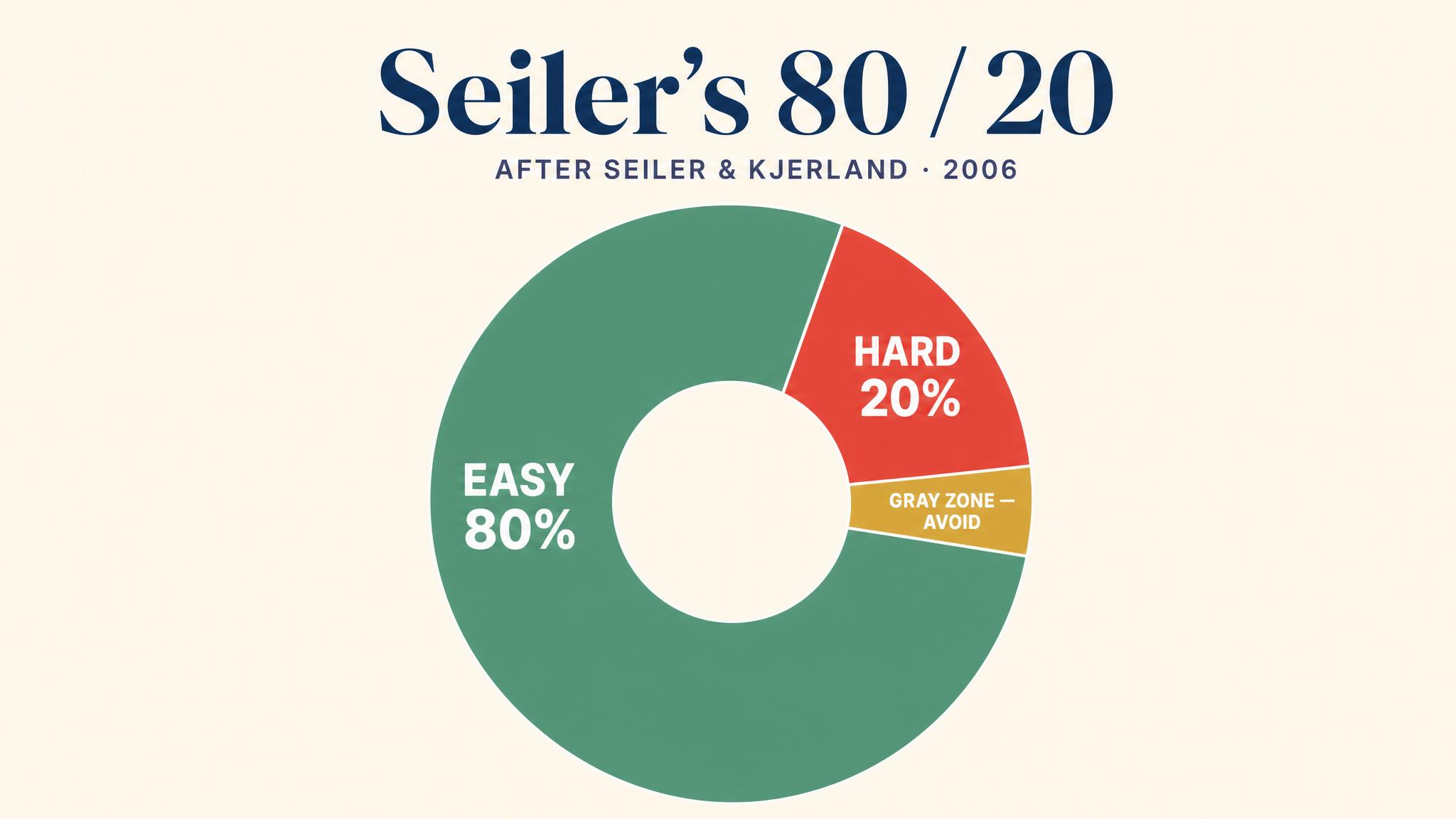
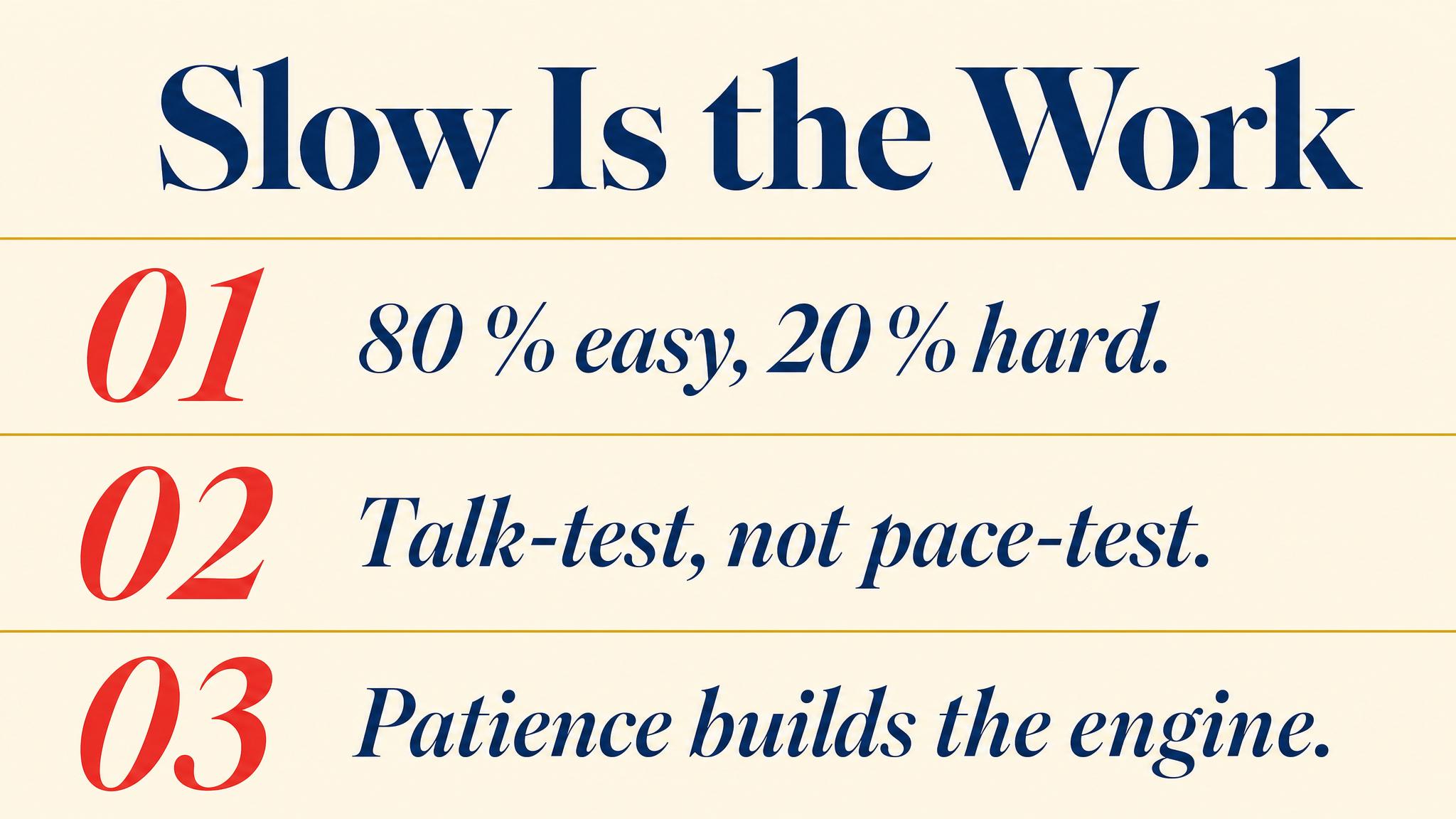
But here's the paradox that exercise science has confirmed again and again: the world's best endurance athletes spend the vast majority of their training at paces that would shock you with their slowness. Kenyan marathon champions jog so easily on most days that they're laughing and telling stories. Norwegian cross-country skiers, arguably the fittest athletes on earth, do most of their training at intensities so gentle that a moderately fit person could keep up. And when researcher Stephen Seiler analyzed the training logs of elite endurance athletes across multiple sports, he found a remarkably consistent pattern: roughly eighty percent of training at low intensity and only about twenty percent at high intensity, with surprisingly little time spent in the moderate gray zone between, as he and Kjerland reported in 2006.
This distribution has become known as the EIGHTY-TWENTY PRINCIPLE of endurance training, and it's not just an elite luxury. A study of recreational runners found that those who followed a polarized training approach, eighty percent easy, roughly fifteen percent hard, and very little in between, improved their ten-kilometer times significantly more than runners who spent most of their time at moderate effort, as Muñoz and colleagues demonstrated in 2013. In other words, running easy most of the time doesn't just prevent injury. It actually makes you faster.
[short pause]
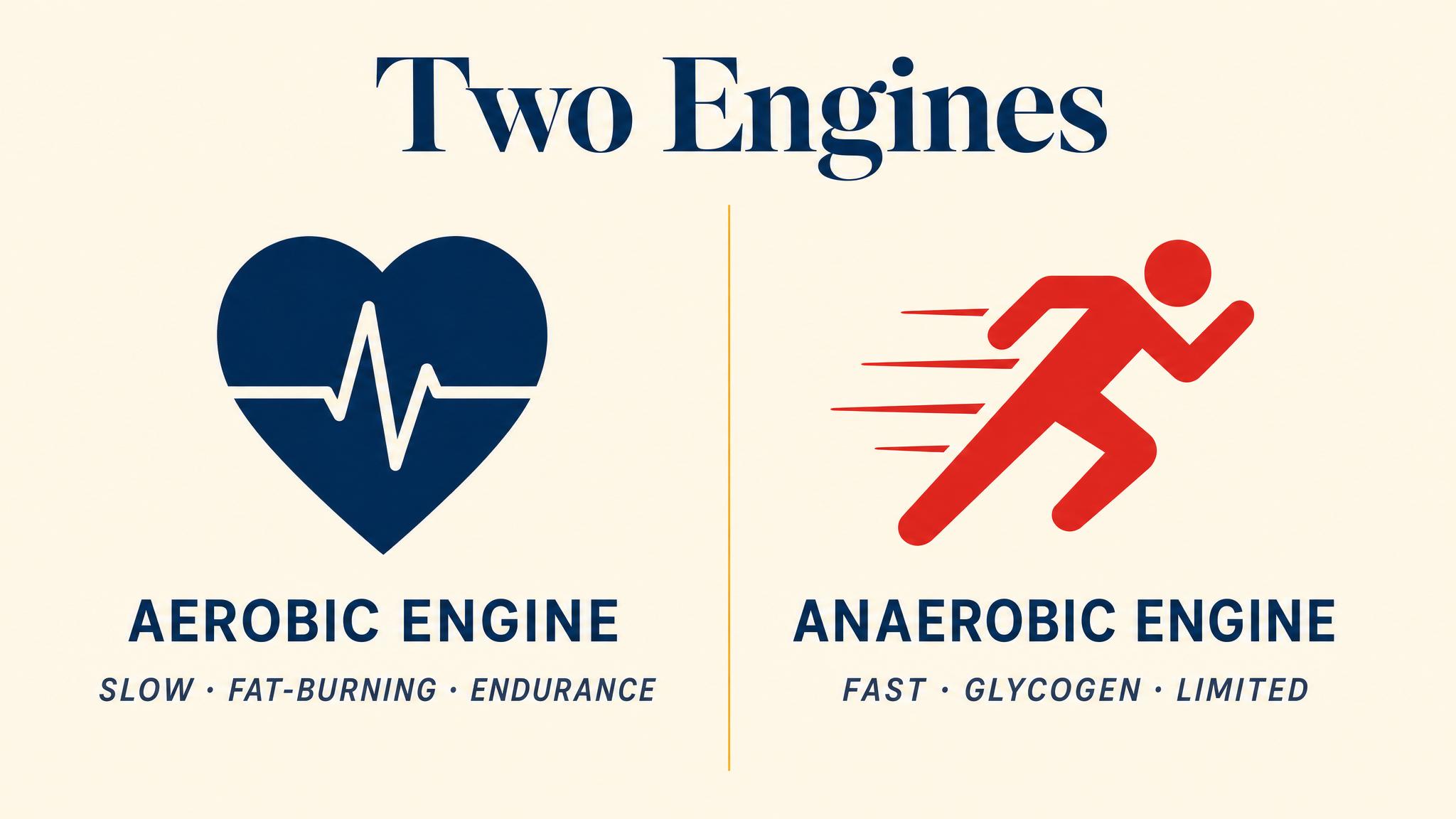
To understand why slow running is so powerful, you need to know about the two primary energy systems your body uses during exercise. Think of them as two different engines inside your body, each designed for different jobs.
Your AEROBIC SYSTEM is your diesel engine. It burns fuel, carbohydrates and fats, using oxygen, and it can run for hours. It's efficient, sustainable, and, critically for marathon runners, it powers roughly ninety-nine percent of your race effort. When you're jogging at a comfortable pace, chatting with a friend, breathing rhythmically, you are running almost entirely on your aerobic system.
Your ANAEROBIC SYSTEM is your turbo booster. It kicks in when you need bursts of power, sprinting for a bus, surging up a steep hill, or running faster than your aerobic system can support. It generates energy quickly but produces metabolic byproducts, most notably lactate and hydrogen ions, that cause that familiar burning sensation in your muscles. It's powerful but unsustainable. You can run anaerobically for minutes, not hours.
Here's the crucial insight for marathon training: a marathon is an overwhelmingly aerobic event. Even elite runners who finish in just over two hours are operating at or near their aerobic threshold for virtually the entire race, as Predel reported in 2014. For a first-time marathoner who might be on the course for five or six hours, the aerobic system is doing nearly all the work. So the question becomes: how do you build the biggest, most efficient aerobic engine possible?
The answer, supported by decades of research and coaching wisdom, is simple: you run slowly.
[short pause]
Easy running triggers a cascade of physiological adaptations that transform you from a non-runner into an endurance athlete. These changes are invisible. You won't feel them happening. But they're the reason your first marathon becomes possible.
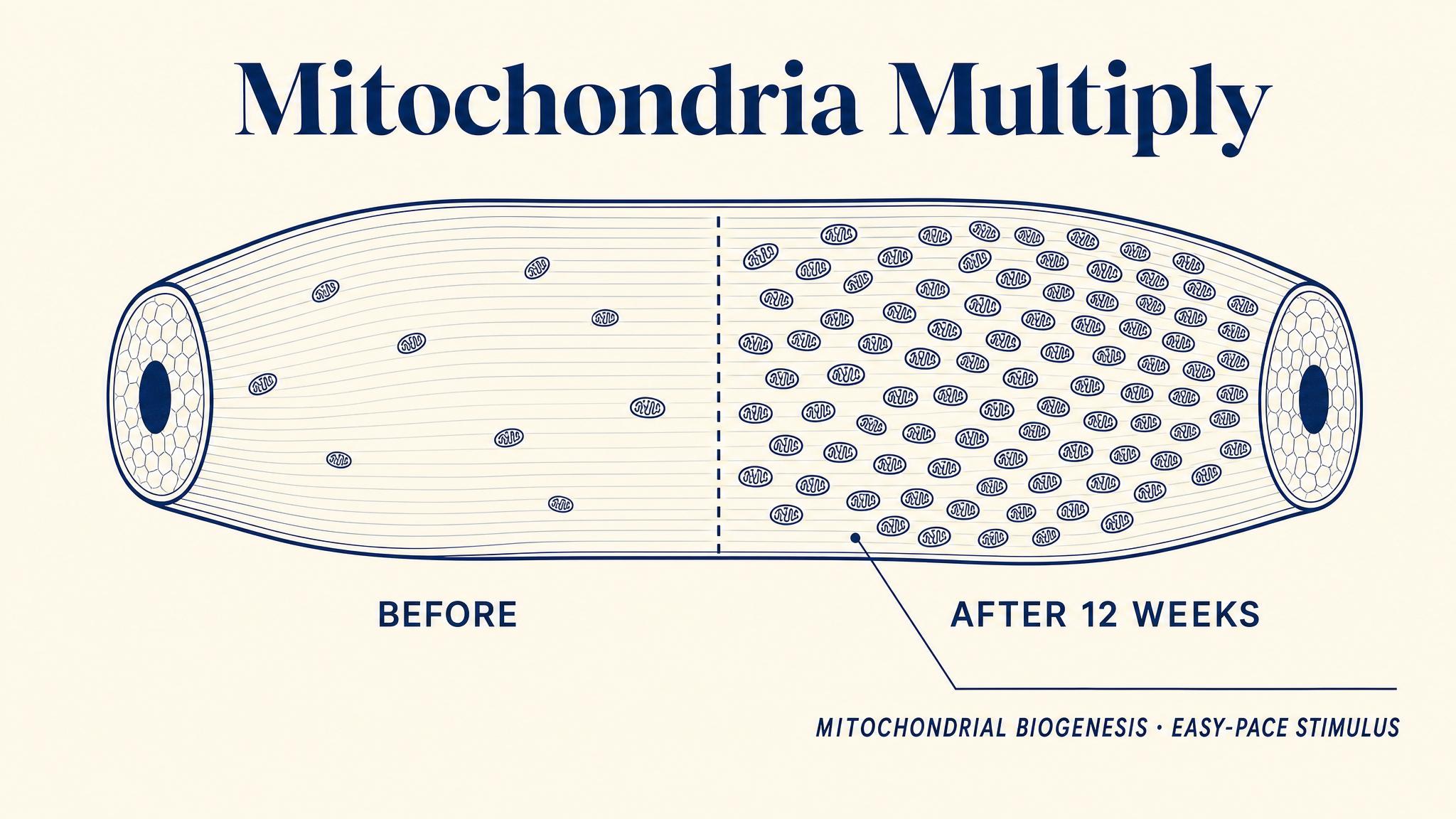
MITOCHONDRIA are the tiny power plants inside your muscle cells that convert fuel into usable energy. The more mitochondria you have, and the more efficient they become, the more aerobic energy you can produce. A comprehensive meta-analysis of three hundred forty-five studies found that endurance training significantly increases mitochondrial content in skeletal muscle, and, encouragingly for beginners, the greatest relative gains occur in people with lower initial fitness, according to Mølmen and colleagues in 2024. Your untrained muscles are primed for dramatic improvement.
CAPILLARIES are the tiny blood vessels that deliver oxygen to your working muscles and carry waste products away. Easy running stimulates angiogenesis, the growth of new capillaries, through the mechanical shear stress that increased blood flow creates along vessel walls. Research shows that aerobic exercise can increase capillary density by approximately twenty percent within just eight weeks of consistent training, according to StatPearls in 2023. More capillaries mean more oxygen reaching your muscles, which means more aerobic power.
Your heart is a muscle, and like any muscle, it adapts to the demands placed upon it. Regular easy running causes your heart's left ventricle to enlarge slightly, allowing it to pump more blood with each beat, a phenomenon known as increased STROKE VOLUME. Your body also increases its total blood volume, producing more red blood cells to carry oxygen. Over time, your resting heart rate drops as your heart becomes more efficient, a classic sign of aerobic fitness improvement.
All of these adaptations happen most effectively at easy, aerobic intensities. When you run too hard too often, you shift the training stimulus toward anaerobic pathways. You're training your turbo booster instead of building your diesel engine, and for a marathon, that's like putting racing slicks on a minivan. It looks fast, but it misses the point entirely.
[short pause]
There's another critical reason to keep things slow in the early weeks, and it has nothing to do with your cardiovascular system. It has to do with a mismatch that causes more beginner injuries than any other single factor.
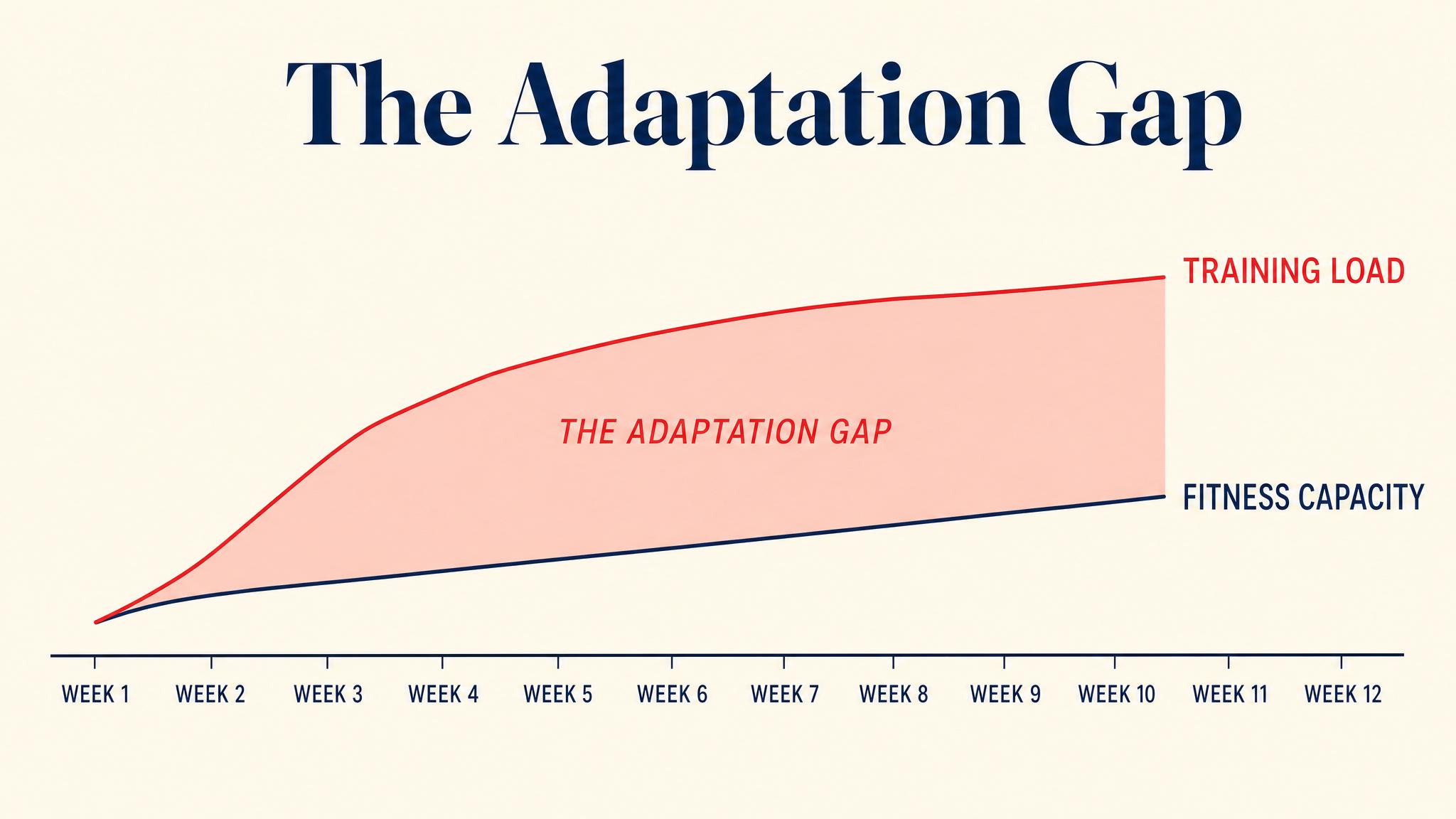
Your cardiovascular system, heart, lungs, blood, adapts to exercise relatively quickly. Within two to three weeks of consistent training, most beginners notice that the same run feels noticeably easier. Their heart rate is lower, their breathing is calmer, and they feel ready to do more. This is real progress, and it feels great.
But your MUSCULOSKELETAL SYSTEM, tendons, ligaments, bones, and cartilage, adapts on a much slower timeline. These tissues have less blood supply than your heart and muscles, and they remodel through a gradual process of stress, micro-damage, and repair that takes weeks to months, as noted in StatPearls in 2023. When your cardiovascular fitness races ahead and your tendons haven't caught up, you feel like you can do more, and you're right, cardiovascularly. But your Achilles tendon, your knee cartilage, and your shin bones are not ready.
This mismatch is the primary driver of overuse injuries in beginning runners. A systematic review of running-related injuries found an overall injury incidence of approximately forty percent, with most injuries classified as overuse, repetitive microtrauma accumulating over time, primarily in the knee, ankle, and lower leg, as Kakouris and colleagues found in 2021. The runners most at risk are those who increase training load faster than their connective tissue can adapt.
Running slowly gives your musculoskeletal system time to catch up to your cardiovascular system. It reduces the impact forces on every stride, decreases the total mechanical stress per session, and still provides the stimulus your tendons and bones need to strengthen. Patience in weeks one through six prevents the shin splints, stress fractures, and tendinopathies that derail training in weeks eight through twelve.
[short pause]
So if slow is the secret, how do you know you're actually going slow enough? You have three practical tools, ranked from simplest to most technical.
The TALK TEST is exactly what it sounds like: if you can speak in full sentences while running, you're in the right zone. Research has validated this deceptively simple tool against sophisticated laboratory measurements, finding that the ability to maintain comfortable speech correlates reliably with exercise intensity below the ventilatory threshold, precisely where easy running should live, as research by Woltmann and colleagues in 2015 confirmed. A separate study found that the talk test is a useful and accurate method for monitoring aerobic exercise intensity across healthy populations, matching well with physiological markers like heart rate and oxygen consumption, according to research published in 2023.
Here's the practical version: while running, try reciting the Pledge of Allegiance, singing Happy Birthday, or simply narrating what you see around you. If you can do so without gasping between words, you're at the right pace. If you need to pause for breath mid-sentence, slow down. If you can only manage a few words at a time, slow down a lot, or walk.
The second tool is RATE OF PERCEIVED EXERTION, or R-P-E. You met this concept in the first chapter as a self-assessment tool. Now it becomes your primary pacing instrument. On a one to ten scale, easy running should feel like a three to four, light effort, rhythmic breathing, a pace you genuinely believe you could sustain for over an hour. Most beginners are stunned by how slow this feels. That discomfort with slowness is exactly the instinct you need to override.
The third tool is heart rate monitoring. Heart rate zones offer a more objective measure of intensity, and many beginners invest in heart rate capable watches. A rough guideline places easy running at sixty to seventy-five percent of your maximum heart rate. However, a word of honest caution: wrist-based optical heart rate monitors, while improving, can be significantly inaccurate during exercise, especially during running, where wrist motion creates noise in the signal. They tend to be most unreliable at precisely the moments you're checking them. If you use heart rate data, treat it as a secondary confirmation of what the talk test and R-P-E are already telling you, not as your primary guide.
[short pause]
For many beginners, the talk test reveals an uncomfortable truth: their conversational pace is a walk. Or at best, a very slow shuffle interspersed with walking. This can feel deflating. You signed up to run a marathon, after all.
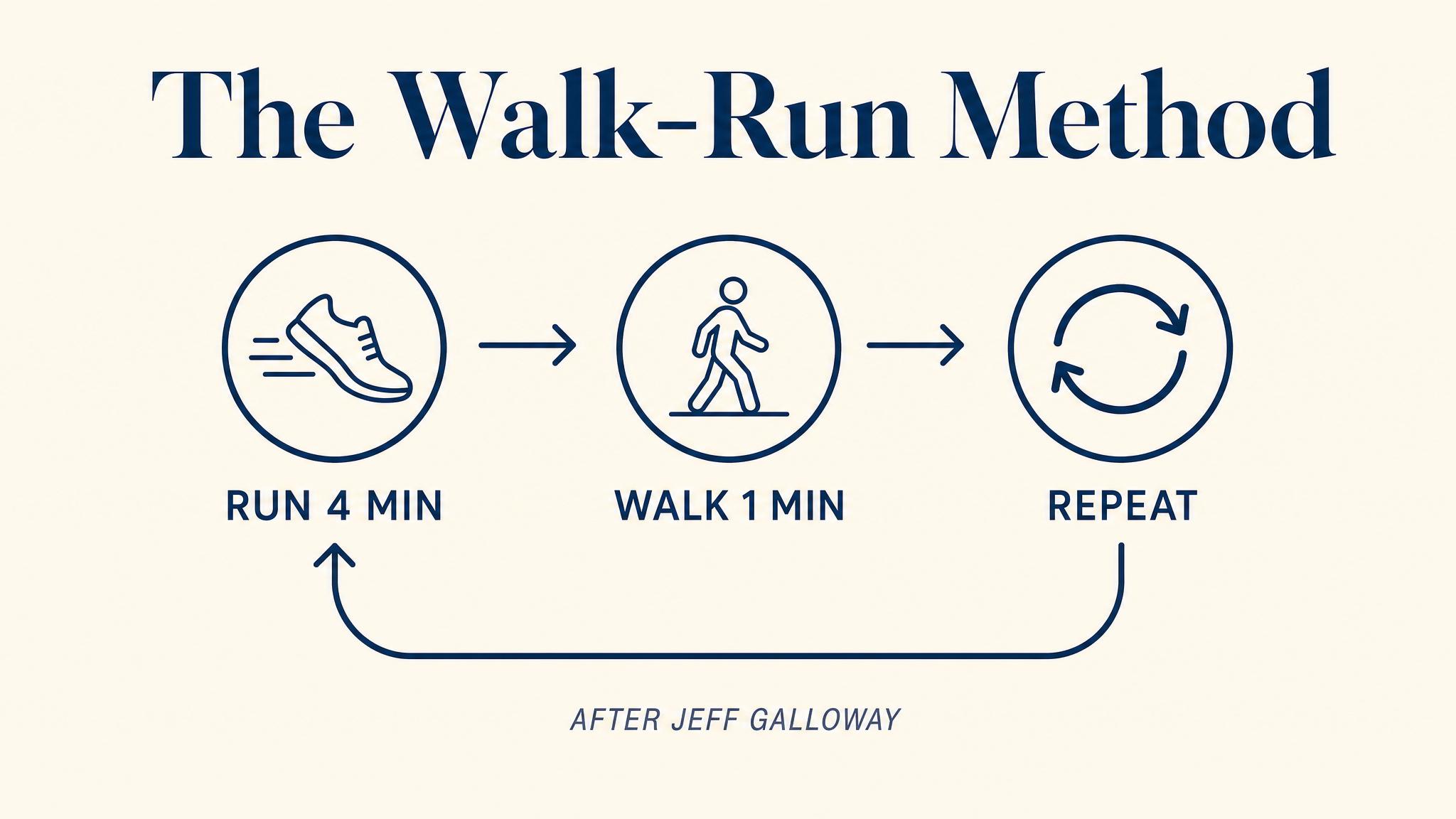
But here's where we need to reframe the entire conversation. The WALK-RUN METHOD, popularized by Olympic athlete and coach Jeff Galloway, is not a beginner's crutch. It is a legitimate, research-supported race strategy used by thousands of marathoners, including many who finish with impressive times.
A study comparing walk-run and continuous running strategies in marathon completion found that walk-run participants finished with remarkably similar times to continuous runners, averaging four hours fourteen minutes versus four hours eight minutes, while reporting significantly less muscle discomfort and pain, according to Hottenrott and colleagues in 2016. The walk breaks serve as micro-recovery periods: they briefly reduce mechanical stress on muscles and joints, allow heart rate to settle slightly, and help maintain more consistent pacing over the full twenty-six point two miles. Many continuous runners start too fast and slow dramatically in the second half; walk-run participants tend to maintain steadier overall pacing.
The method works through structured intervals. A common starting ratio might be run one minute, walk two minutes. As fitness builds, the running intervals lengthen and the walking intervals shorten: run three, walk one. Run five, walk one. Some experienced walk-runners eventually progress to run nine, walk one, and this is the ratio many marathon veterans use on race day by choice, not necessity.
As Jeff Galloway says, the run-walk method is not about giving up. It's about being smart enough to respect the distance.
For this course, the walk-run method is the recommended approach for all beginning runners, and an encouraged option for everyone else. There is no shame in walking. There is only the wisdom of matching your strategy to the science.
[short pause]
The science behind slow running might feel modern, but the practice has deep roots. In the nineteen sixties, New Zealand coach Arthur Lydiard revolutionized distance running by building his athletes' training on a foundation of high-volume, low-intensity running. His runners, including multiple Olympic gold medalists, spent months doing long, easy aerobic runs before incorporating any speed work. The approach was radical at the time. Most coaches favored intense interval training. But Lydiard's results spoke for themselves.
Seiler's research decades later, in 2010, essentially confirmed what Lydiard discovered through coaching intuition: elite endurance athletes across sports converge on a training distribution of approximately eighty percent low-intensity volume, with only about twenty percent of sessions performed at or near maximal effort. This isn't a coincidence or tradition. It appears to be the distribution that maximizes adaptation while managing the cumulative stress of high training volumes. The body simply cannot recover from hard effort every day, but it can absorb and adapt to enormous volumes of easy effort.
For you as a beginning marathoner, the ratios are even more tilted toward easy. In the first several weeks of training, all of your running should be at conversational pace. You have no aerobic base yet, and your musculoskeletal system is brand new to the demands of running. The eighty-twenty principle is a guideline for experienced athletes who have built that base. Your current job is to build it.
[short pause]
Let's translate the science into action. Here are the concrete principles for your training over the coming weeks:
Every run is conversational. If you can't talk, slow down. If you can't talk while jogging slowly, walk. If you can talk while walking briskly, that's your current training pace, and it's perfect.
Use walk-run intervals. Based on your fitness assessment from the first chapter, select a starting ratio. Stick with it for at least two weeks before progressing.
Target R-P-E three to four. Revisit the rate of perceived exertion scale from the first chapter frequently. Easy should feel genuinely easy, suspiciously easy. Am I even exercising? That's the right feeling.
Trust the process. The adaptations are invisible for weeks. Your mitochondria are multiplying, your capillaries are growing, your heart is strengthening, but you won't feel faster right away. You will feel it by week six, and dramatically by week twelve.
Protect the gap. Remember the adaptation mismatch. Even when your heart says more, your tendons need time. Increase weekly volume by no more than ten percent, and build in a reduced-volume recovery week every three to four weeks.
[short pause]
We'd be dishonest if we pretended the hardest part of running slowly is physiological. It's not. The hardest part is psychological. You will be passed by other runners. You may be passed by walkers. Your G-P-S watch will display pace numbers that feel embarrassing. Friends who run might express surprise, or worse, pity, at how slowly you're training.
None of that matters. What matters is that you are systematically building the aerobic machinery that will carry you twenty-six point two miles. Every elite marathoner in the world has easy days that would look slow to outsiders. They understand something that takes most beginners months to learn: easy running is not junk training. It is the training. The hard sessions, which we'll introduce later in the course, are the seasoning. The slow miles are the meal.
Over the next two weeks, your assignment is simple: go out three to four times, use your walk-run ratio, keep it conversational, and practice the radical act of patience. Your body will do the rest.
[short pause]
To summarize the key takeaways: roughly eighty percent of endurance training should occur at easy, conversational pace. This applies to elite athletes and beginners alike, based on decades of research by Stephen Seiler and others. Easy running builds your aerobic engine: more mitochondria, denser capillary networks, a stronger heart, and greater blood volume, all essential for marathon performance.
Your cardiovascular system adapts faster than your musculoskeletal system. Running too hard too soon creates a dangerous mismatch that leads to overuse injuries in tendons, bones, and joints.
The talk test is a validated, practical tool for gauging easy pace: if you can speak in full sentences, you're in the right zone. R-P-E of three to four on a ten-point scale confirms it.
The walk-run method is a legitimate, research-supported strategy that produces similar marathon finish times to continuous running, with less muscle damage and lower injury risk.
If your conversational pace is currently a walk, that is your training pace, and it is exactly where you should be. Patience now builds the foundation for everything that follows.
[short pause]
Now that you understand how to run, slowly, and why it works, the next chapter will address the practical architecture of training: how to structure your week, what a training plan actually looks like, and how to progress safely from where you are today to marathon-ready. We'll introduce the concept of the long run, the single most important workout in marathon training, and explain why it works best when combined with everything you've learned about easy pace.






The Architecture of a Training Plan
With the physiological foundation laid in Chapters 1 and 2, students are now ready to understand how a training plan is structured — not just what to do on a given day, but why the weeks are organized the way they are.…
You feel AMAZING on a scheduled rest day. Do you take it anyway, or do you go run because your body is clearly ready for more?
Real talk
Is running more miles always better training, or is that just how people end up injured and burnt out?
Debate time
Would you rather follow a training plan exactly even when it feels wrong, or trust your gut and customize as you go?
Would you rather
Have you ever started a training plan way too aggressive and been totally cooked by week 3? Or does that even happen?
Been there?
Hot take: The long run is more mental torture than actual physical training.
Hot take
Which is worse: following a plan that feels way too easy or one that's absolutely crushing you?
Which is worse
Training Plan Autopsy in Breakout Rooms
15-20 minutesStudents split into breakout rooms of 4-5. Each group receives a different real marathon training plan (PDF or link). They have 10 minutes to identify: (1) evidence of periodization phases, (2) how progressive overload is implemented, (3) the long run progression pattern, and (4) placement of recovery weeks. Groups then return to main room and each group reports one 'interesting finding' via chat or verbal share. Instructor synthesizes patterns across plans in real-time.
The Recovery Week Resistance Game
12-15 minutesRole-play exercise in breakout rooms of 3-4 students. One student plays an overtrained marathon runner who refuses to take a recovery week ('I'm losing fitness!'), others are coaches/training partners who must convince them using concepts of supercompensation and adaptation. After 8 minutes, roles rotate. Final 3 minutes: return to main room and instructor cold-calls 2-3 students to share their most convincing argument. Class votes via poll on best argument.
Progressive Overload Speed Dating
10-12 minutesStudents paired in breakout rooms for 3-minute 'speed debates.' Proposition: 'Weekly mileage should increase by exactly 10% each week.' One student argues FOR, one AGAINST, using course concepts. After 3 minutes, new random pairings with a new proposition (e.g., 'Long runs should always be done at easy pace' or 'You should never reduce mileage before race week'). Three rounds total. Concludes with instructor highlighting the nuance revealed through these debates.
Training Plan Triage Challenge
15-18 minutesCollaborative problem-solving using shared Google Doc or Miro board. Present 4 runner profiles (different experience levels, goals, life constraints). Each breakout room (5-6 students) is assigned ONE runner and must collaboratively select an appropriate training plan from provided options AND justify their choice based on: periodization structure, progressive overload approach, long run strategy, and recovery integration. Groups paste their recommendations into a shared doc visible to all. Final 5 minutes: class reviews all recommendations and instructor highlights decision-making frameworks.
The Flexibility Cascade Simulation
12-15 minutesReal-time simulation of training plan adaptation. Instructor presents a base 16-week marathon plan on screen. Then announces weekly 'life events' (illness in week 4, work travel in week 8, injury twinge in week 11). After each event, students have 90 seconds to submit via chat or poll: 'What adjustment would you make?' Instructor selects 2-3 responses to discuss, then reveals expert recommendation. This continues through 4-5 scenarios, showing cascading effects of plan modifications.
Periodization Pattern Recognition Race
8-10 minutesGamified learning using Kahoot or Mentimeter. Display 8-10 training plan graphs/charts showing different mileage patterns over 12-16 weeks. Students compete to identify: correct periodization phase labels (base, build, peak, taper), whether progressive overload is appropriate, and spot problems (too aggressive increases, missing recovery weeks). Leaderboard creates friendly competition. Top 3 finishers share their strategy for quick pattern recognition.
Transcript
Imagine two friends, Sarah and Marcus, both signing up for the same October marathon in late May. Sarah finds a plan online and starts running every day, adding a mile each week because she feels strong. By August, she's limping through runs with a throbbing shin. Marcus, meanwhile, has weeks where he actually runs less than the week before, and some days he doesn't run at all. His friends tease him about his "lazy" recovery days. But come race morning, Marcus is healthy, confident, and ready. Sarah is watching from the sidelines with a stress fracture.
[short pause]
The difference between them wasn't talent or toughness. It was architecture. Marcus had a well-structured training plan, one built on decades of sports science, and Sarah had enthusiasm without a blueprint. This chapter is about understanding that blueprint: why a training plan looks the way it does, and how to choose one that will carry you to the finish line intact.
[short pause]
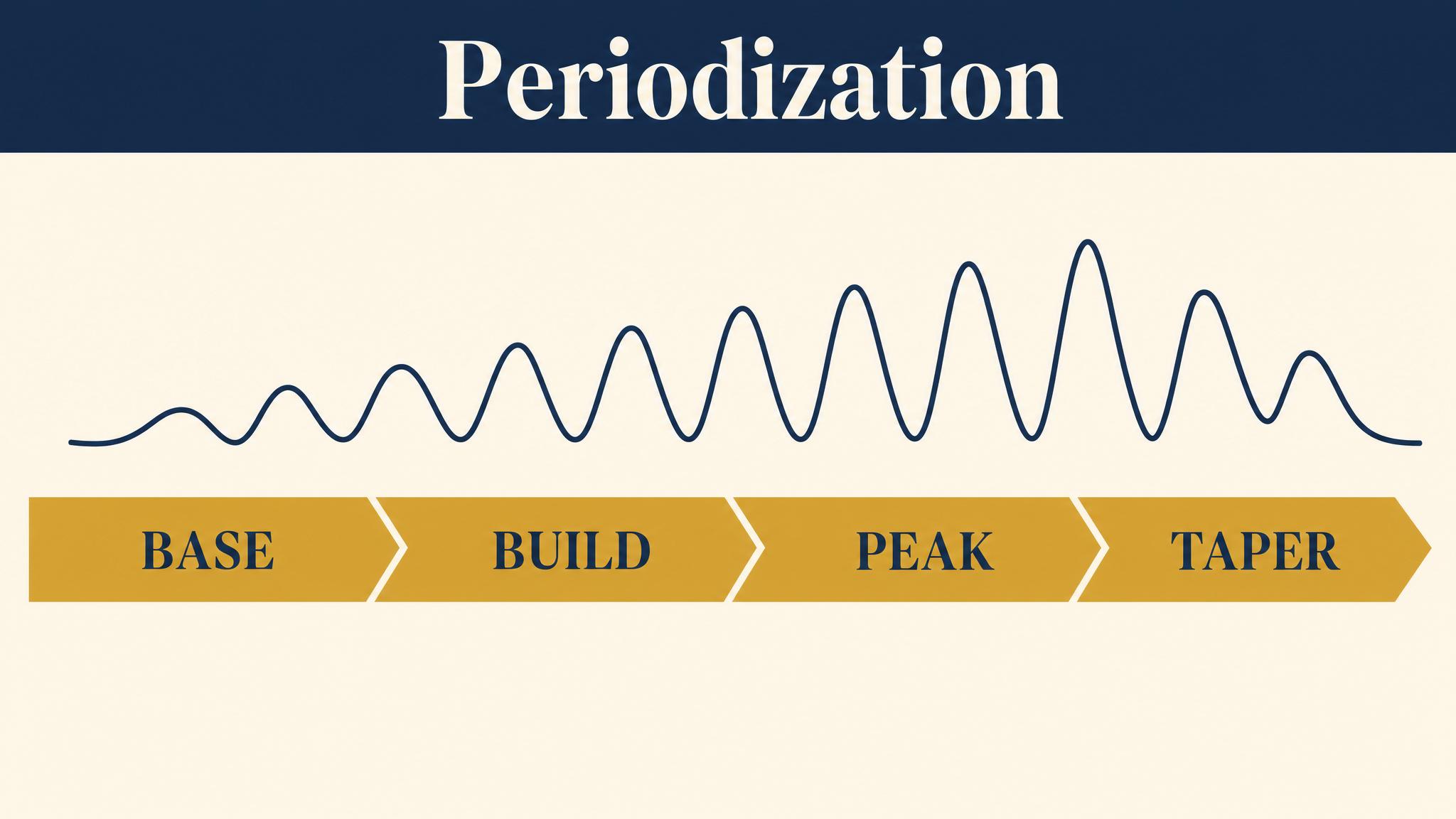
If you've glanced at any marathon training plan, you've probably noticed something curious: the weeks aren't all the same. Mileage climbs for a few weeks, then drops. Some days are marked "easy," and the weekend long run gets progressively longer before occasionally shrinking. This isn't random. It's a principle called PERIODIZATION, and it is the single most important concept in training plan design.
Periodization is the systematic organization of training into cycles of varying stress and recovery. The idea emerged from the work of Soviet sports scientists in the mid-twentieth century, but its roots are deeply biological. As we explored in Chapter Two, your body adapts to stress, but only if you give it time to rebuild. Periodization formalizes this principle into a structure you can actually follow on a calendar, as Bompa and Haff described in 2009.
[short pause]
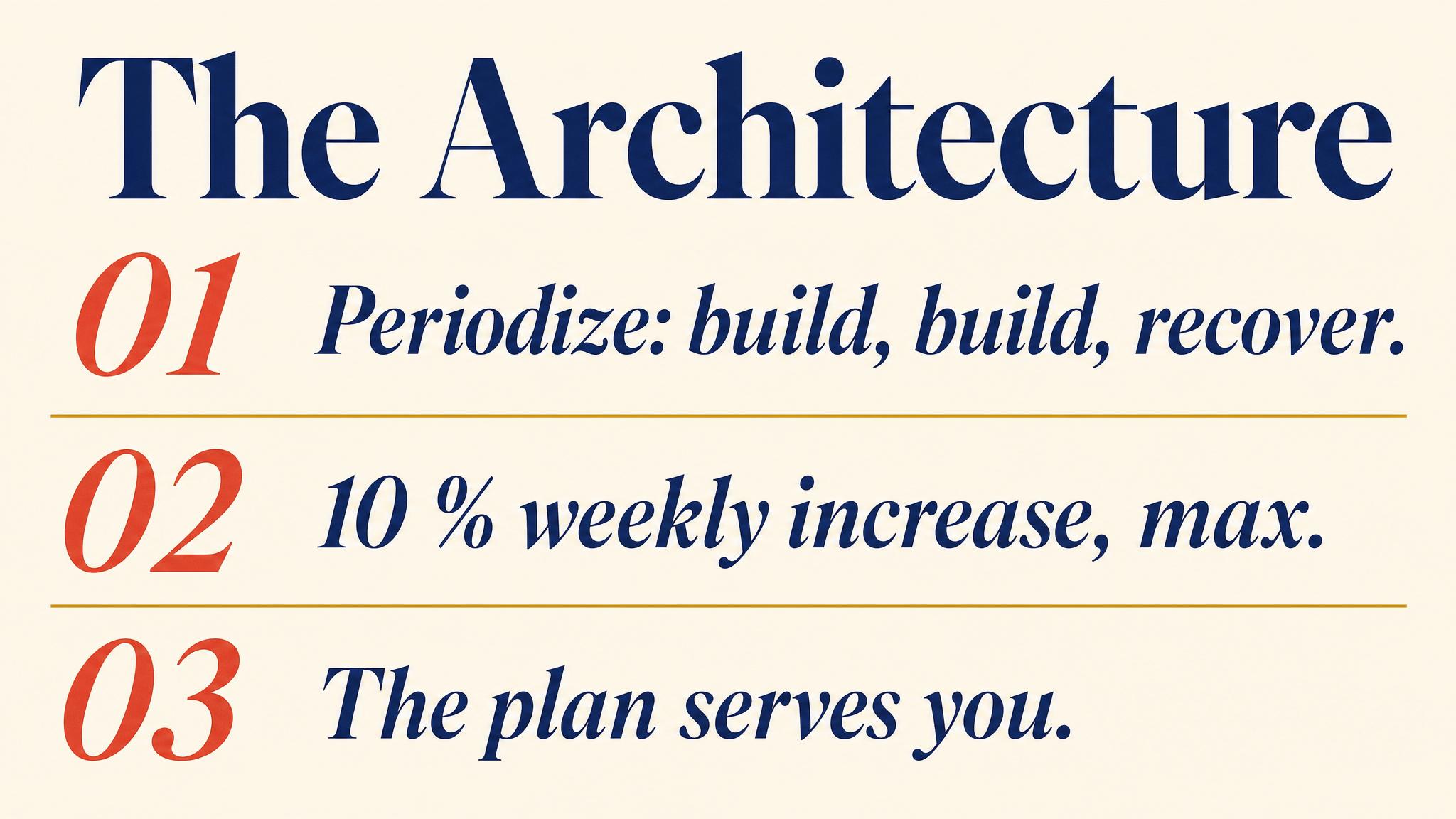
In the language of training science, your entire marathon preparation is a MACROCYCLE, typically sixteen to twenty weeks. Within that macrocycle, you'll find mesocycles of roughly three to four weeks each, and each week is a microcycle. The mesocycle is where the magic happens: you build stress for two or three weeks, then deliberately pull back for one week. Build, build, recover. Build, build, build, recover. This rhythm is the heartbeat of every good training plan.
[short pause]
Paired with periodization is the principle of PROGRESSIVE OVERLOAD, the gradual, systematic increase of training stress over time. Your body is remarkably efficient: it adapts to exactly the demands you place on it, and no more. If you run the same three miles at the same pace every day for six months, you'll become very good at running three miles, but you won't be prepared for twenty-six point two. To stimulate new adaptation, you must progressively increase the challenge.
For marathon beginners, progressive overload primarily means increasing volume, how far you run each week, rather than intensity, how fast you run. This is consistent with findings from Seiler in 2010, who showed that even elite endurance athletes spend approximately eighty percent of their training time at low intensity. If the world's best runners are keeping most of their miles easy, you certainly should too. Research from Haugen and colleagues in 2022 confirmed that highly trained distance runners typically follow traditional periodization with hard-easy day patterns and a pyramidal distribution where the vast majority of training occurs in low-intensity zones.
[short pause]
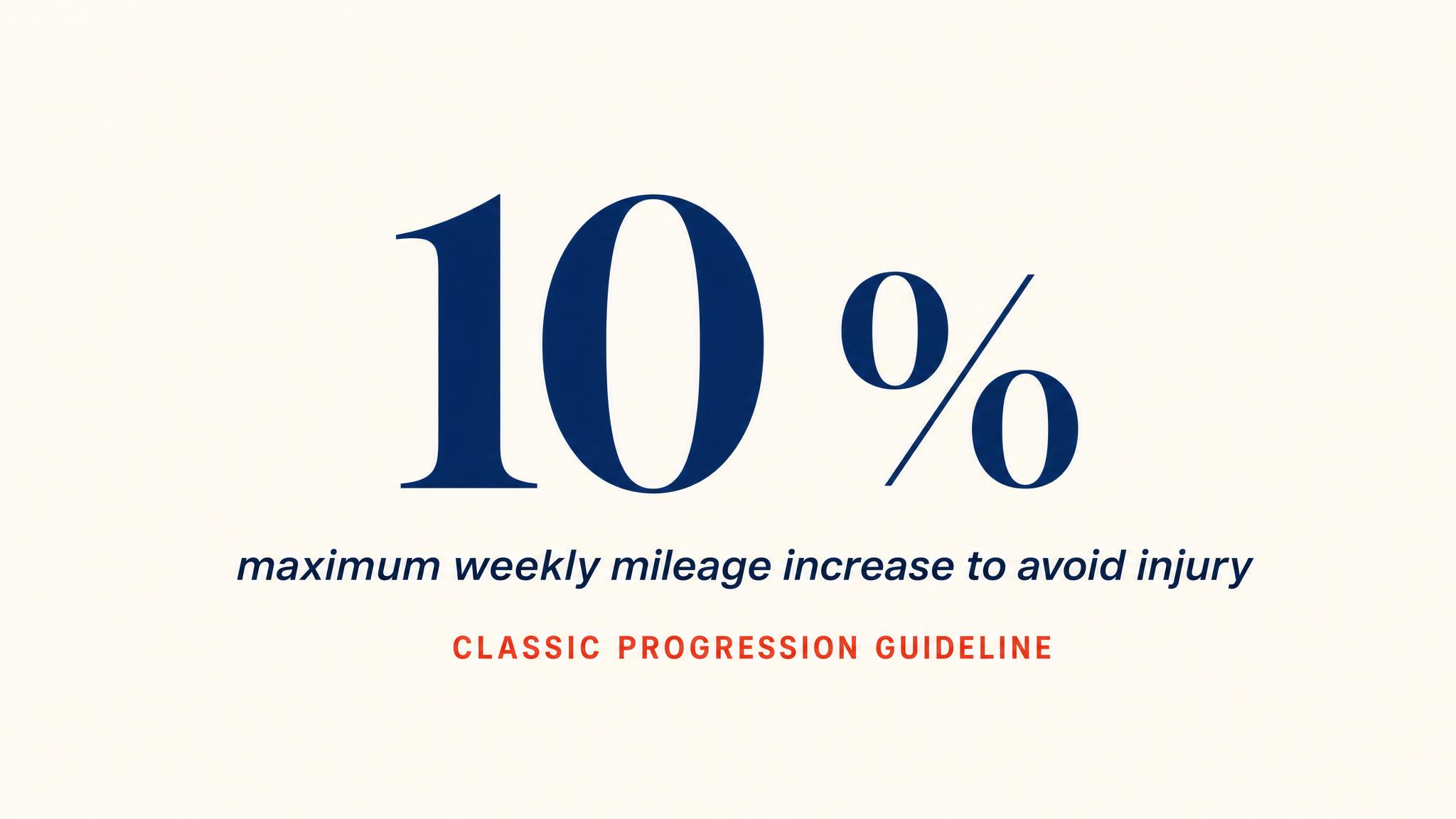
The practical question is: how much should you increase each week? The most commonly cited guideline is the TEN PERCENT RULE: don't increase weekly mileage by more than ten percent from one week to the next. Nielsen and colleagues in 2014 studied eight hundred seventy-four novice runners and found that those who kept two-week mileage increases below ten percent had the lowest injury rates for common running injuries like patellofemoral pain and I-T band syndrome. However, the ten percent rule has limitations. If you're running only five miles per week, a ten percent increase is half a mile, almost trivially small. If you're running forty miles per week, a ten percent increase is four miles, which might be too much for newer runners. Use the rule as a guardrail, not a commandment.
[short pause]
Recall the adaptation rate mismatch from Chapter Two: your cardiovascular system adapts in days to weeks, while tendons and bones take weeks to months. This mismatch explains why conservative mileage progression matters even when your heart and lungs feel ready for more.
[short pause]
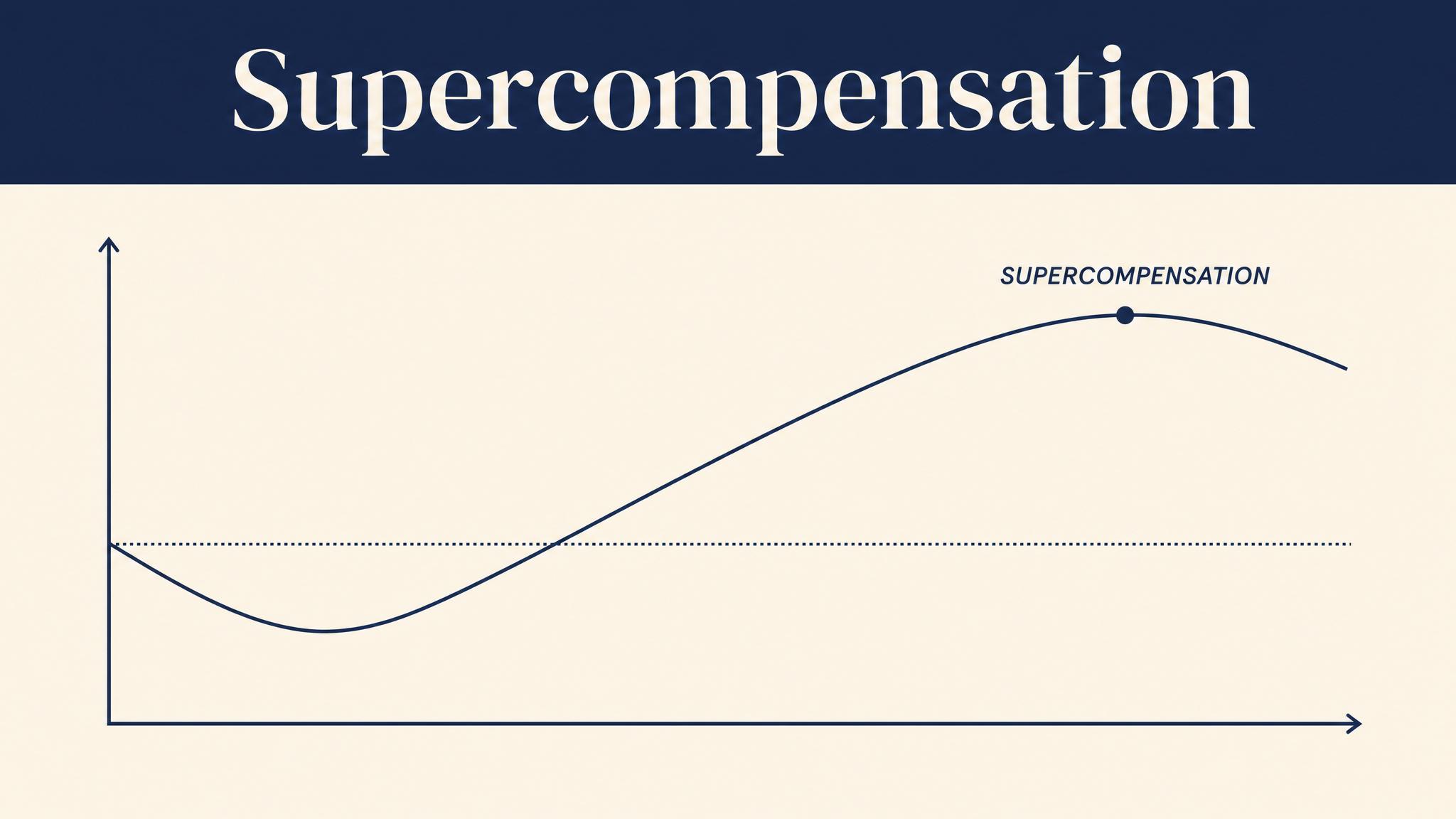
Here's the paradox that trips up nearly every new runner: you don't get fitter while you're running. You get fitter while you're recovering.
The concept is called SUPERCOMPENSATION, and it describes a four-step biological process. First, a training stimulus, your run, disrupts homeostasis. It depletes glycogen stores, creates micro-damage in muscle fibers, and stresses tendons and bones. Second, during the recovery phase, your body repairs this damage. Third, and this is the critical part, your body doesn't just restore itself to baseline. It rebuilds slightly beyond where it was before, anticipating that the same stress will come again. This adaptive overshoot is supercompensation, as Gambetta described in 2007. Fourth, if no further stimulus arrives, the gains slowly fade back to baseline.
[short pause]
The timing is everything. Apply the next training stress during the supercompensation window, and you build fitness on top of fitness. Apply it too soon, before recovery is complete, and you dig yourself into a hole. Apply it too late, and you've lost the window. This is why training plans don't just tell you when to run; they tell you when to rest.
[short pause]
Every three to four weeks, a well-designed marathon plan includes a recovery week, sometimes called a "cutback week" or "down week," where total mileage drops by twenty to forty percent. New runners often resist these weeks. They feel like backsliding. But recovery weeks serve multiple critical functions.
First, musculoskeletal healing: Bones, tendons, and connective tissue need extended recovery periods to complete their remodeling cycles. Remember from Chapter Two that bone adaptation takes eight to twelve weeks. Recovery weeks give these slower-adapting tissues a chance to consolidate gains.
Second, glycogen restoration: During build weeks, your glycogen stores may never fully replenish between sessions. Recovery weeks allow complete refueling.
Third, psychological reset: The mental fatigue of progressively harder weeks is real. A lighter week restores motivation and prevents the staleness that leads to skipped runs.
And fourth, injury prevention: Kemler and colleagues in 2018 found a twofold greater injury incidence in novice runners compared to experienced runners, making these protective recovery periods especially vital for beginners.
Think of recovery weeks as scaffolding in construction. They don't add height to the building, but without them, the whole structure collapses.
[short pause]
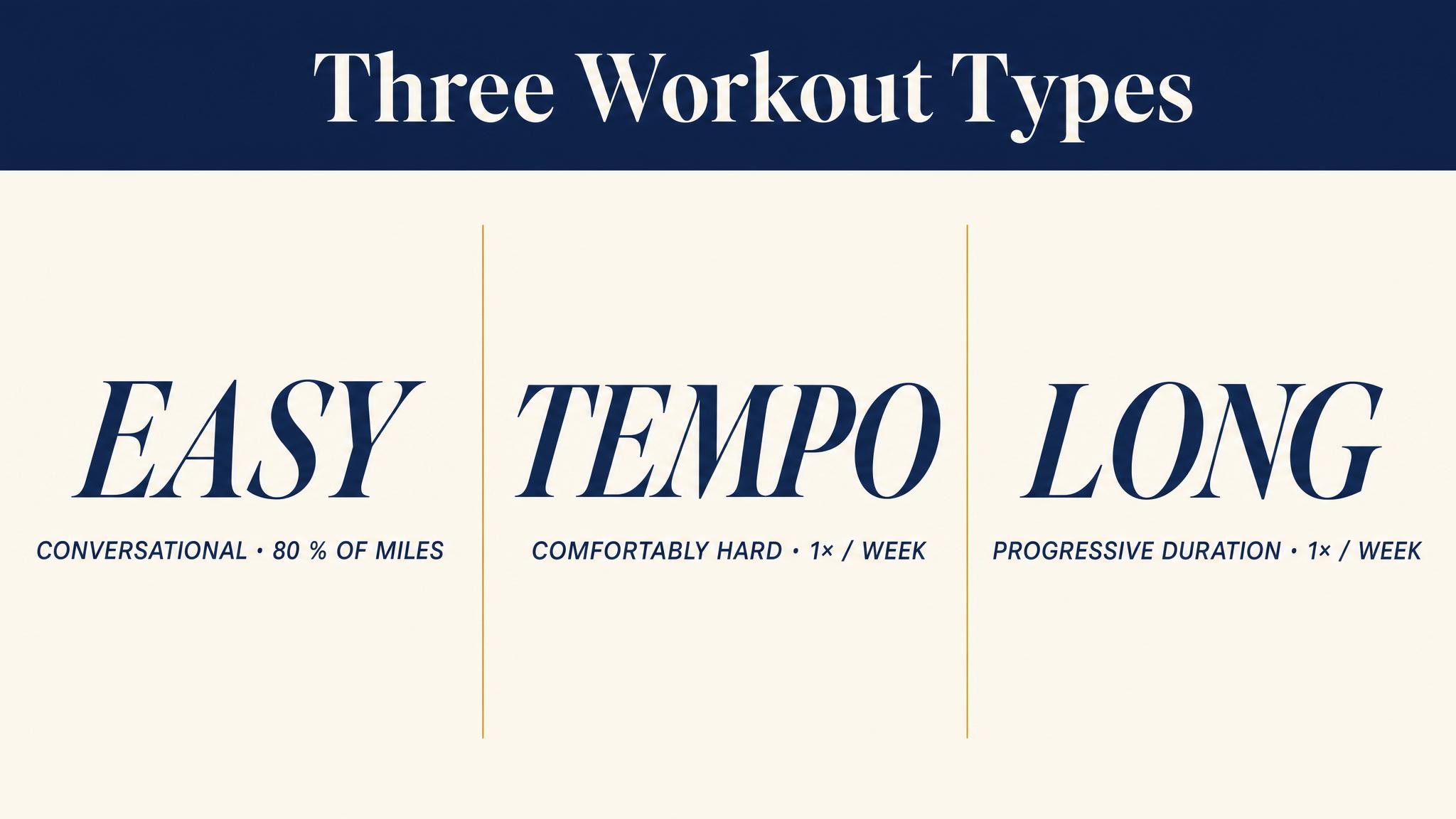
A marathon training plan can look overwhelmingly detailed, but for beginners, almost every plan is built from just three core workout types. Understanding these building blocks is more important than memorizing any specific schedule.
[short pause]
Easy runs are the bread and butter of marathon training. They make up the majority of your weekly running, and they should feel, well, easy. You should be able to hold a conversation throughout. If you're gasping for breath, you're going too fast. Seiler in 2010 demonstrated that elite endurance athletes spend roughly eighty percent of training below their first lactate threshold. For a beginner, this means running at a pace that feels almost embarrassingly slow.
Easy runs build your aerobic engine: they increase capillary density in your muscles, improve your body's ability to burn fat as fuel, and strengthen the cardiovascular system, all without creating excessive musculoskeletal stress. They are the foundation upon which everything else is built.
[short pause]
If easy runs are the foundation, the long run is the cornerstone of marathon preparation. Typically performed once per week, usually on a weekend, the long run progressively extends the duration your body can sustain continuous movement. It teaches your muscles to burn fat more efficiently, conditions your joints and connective tissue for prolonged impact, and perhaps most importantly, builds the mental resilience to keep going when your body wants to stop.
The long run is where your body learns what a marathon will actually ask of it. Lewicka-Potocka and colleagues in 2024 emphasize that physiological strain correlates directly with training volume, experience, and recovery strategies. The long run is where you build all three. Most beginner plans peak with a long run of eighteen to twenty-two miles, typically three weeks before race day. You don't need to run the full twenty-six point two in training; the taper and race-day adrenaline will carry you the rest of the way.
Critically, long runs should be performed at an easy, conversational pace, or even with planned walk breaks. This is not the day to chase speed. It's the day to teach your body endurance.
[short pause]
Rest days are not empty space in your schedule. They are training days where the workout is recovery. On rest days, the supercompensation process does its work. Your muscles repair, your glycogen refills, your bones remodel.
Cross-training days, swimming, cycling, yoga, walking, provide an active recovery option. They maintain cardiovascular fitness while giving your running-specific muscles and joints a break from impact forces. For many beginners, especially those coming from other sports, cross-training days satisfy the itch to "do something" without adding running stress.
[short pause]
Understanding the three pillars is one thing; arranging them into an actual week is another. The placement of workouts matters almost as much as the workouts themselves. Two key principles guide weekly structure.
First, buffer the long run with easier days. Place a rest day or easy cross-training day before and after your long run. Your legs need to be relatively fresh going in and need recovery time coming out.
Second, avoid stacking hard efforts. Don't place your two longest or hardest runs on consecutive days. Spread your running days across the week with recovery days in between.
[short pause]
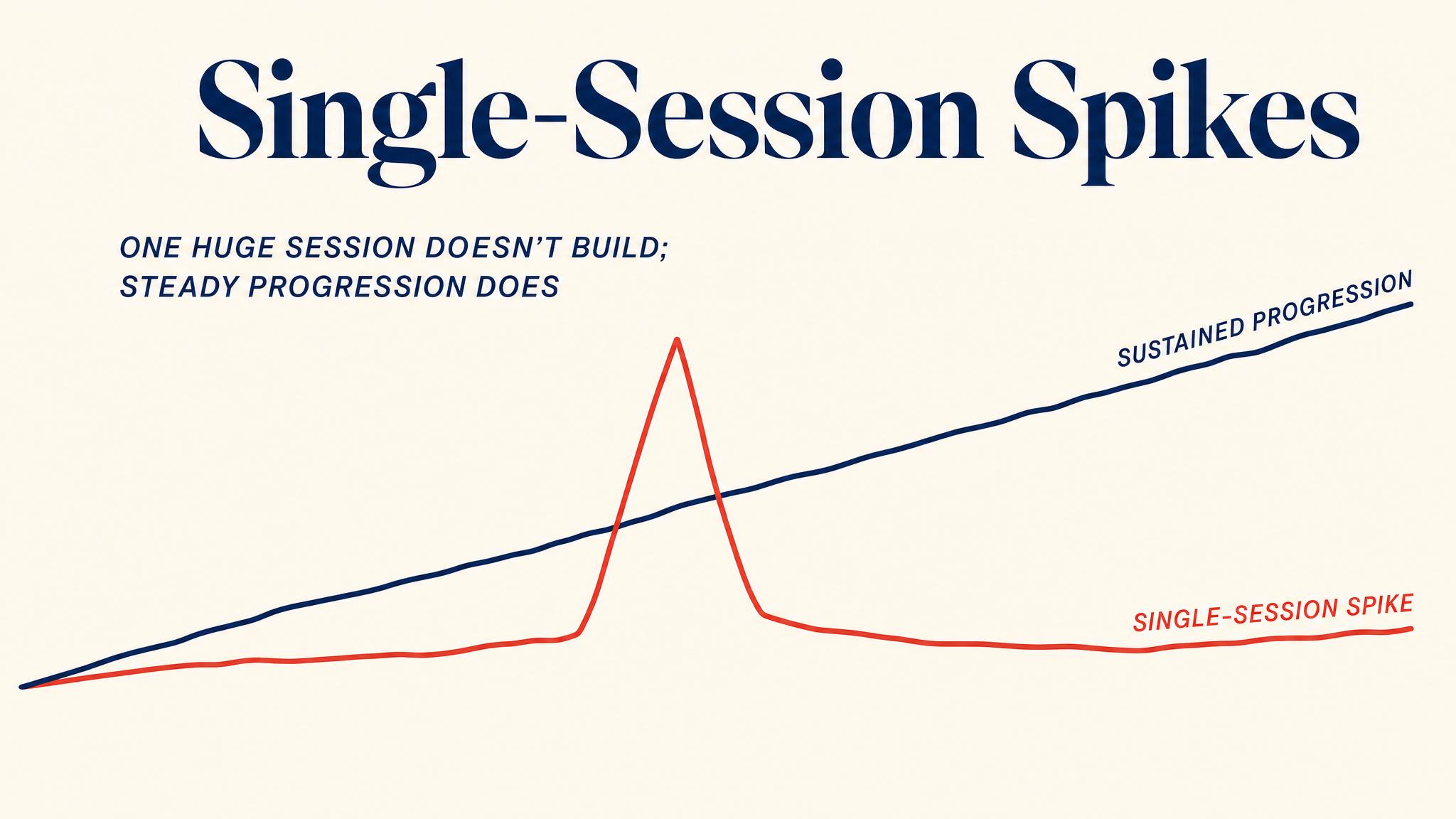
Ramskov and colleagues in 2018 found in a study of five thousand two hundred five runners that single-session distance spikes, running more than ten percent beyond your longest run in the past thirty days, were more strongly associated with injury than week-to-week mileage changes. Even a small spike of ten to thirty percent beyond your recent longest run raised injury risk by sixty-four percent. This underscores why both the weekly pattern and the gradual progression of the long run matter so much.
[short pause]
No single workout matters more in marathon preparation than the weekly long run. It is the session where nearly every physiological adaptation specific to marathon running converges: fat oxidation efficiency, glycogen storage capacity, musculoskeletal durability, mental fortitude, and practiced pacing.
Long run progression follows the same build-and-recover rhythm as your overall plan. A typical pattern is to increase the long run distance for three weeks, then drop it back during the recovery week. For example: six miles, then seven miles, then eight miles, then five miles for recovery, then nine miles, then ten miles, then twelve miles, then seven miles for recovery. Notice how the recovery week's long run is still longer than where you started. The trajectory is upward, but with built-in dips.
[short pause]
The pace of long runs should be firmly in the "conversational" zone, typically sixty to ninety seconds per mile slower than your goal marathon pace, or even slower. For walk-run participants, this means maintaining your planned walk-run intervals throughout. The goal is time on your feet, not speed. Jeff Galloway, one of the pioneers of the run-walk-run method, has coached tens of thousands of first-time marathoners to the finish line with walk breaks built into every long run.
[short pause]
Here's a concept that humbles even the fittest newcomers to running: TRAINING AGE. Your training age is not your biological age or your fitness level. It's how long you've been consistently running. A twenty-five-year-old former college swimmer who just started running has a training age of zero, even if their cardiovascular fitness is exceptional.
Training age matters because of the adaptation rate mismatch we discussed in Chapter Two. That swimmer's heart and lungs can handle impressive workloads, but their Achilles tendons, shin bones, and hip joints have never experienced the repetitive impact of running. Kemler and colleagues in 2018 found that novice runners, defined as those who had been running for less than twelve months, had double the injury rate of experienced runners, regardless of other fitness markers. Your cardiovascular system may feel ready for a ten-mile run after just a few weeks of training, but your connective tissue emphatically is not.
This is precisely why even very fit beginners should start with conservative training plans. The plan isn't respecting your lungs; it's protecting your bones.
[short pause]
There is no single "correct" marathon training plan. The best plan is the one you can consistently follow, the one that fits your schedule, respects your starting point, and keeps you healthy. Let's examine three legitimate approaches, each supported by coaches who have guided thousands of runners to finish lines.
[short pause]
The walk-run plan, in the style of Jeff Galloway, is best for complete beginners, those returning from injury, or anyone who wants to minimize injury risk. It typically includes three to four days per week of walk-run sessions with a progressive long run that includes scheduled walk breaks, for example, run four minutes, walk one minute. The long run builds slowly and may peak at twenty-three to twenty-six miles because the walk breaks reduce overall stress. Peak weekly volume: fifteen to twenty-five miles.
[short pause]
The four-day minimal plan, in the style of Hal Higdon Novice, is best for busy adults with limited training time, parents, or people who want a structured but manageable approach. Three short runs plus one long run per week, with cross-training and rest on the other days. This plan respects the reality that many people can't, or shouldn't, run five or six days per week. Peak weekly volume: twenty-five to thirty-five miles.
[short pause]
The five-day moderate plan, in the Hanson style, is best for those with some running background, a training age of six months or more, people who enjoy daily running, or those looking to run the full marathon distance without walk breaks. Five running days including easy runs, one tempo or pace run, and a long run that peaks at sixteen to eighteen miles, shorter than other plans because cumulative fatigue from higher weekly mileage simulates race conditions. Peak weekly volume: thirty-five to fifty miles.
[short pause]
As adapted from the coaching philosophy shared across Higdon, Galloway, and the Hanson brothers: "The goal of training is to be on the starting line healthy, well-rested, and eager to run. Every plan that accomplishes this is a good plan."
[short pause]
Here's something no training plan spreadsheet can fully convey: every plan requires flexibility. Life happens. You'll get sick, work will explode, your child will bring home a cold from daycare, or you'll simply have a day where your legs feel like concrete. The question isn't whether you'll miss a run, you will, but how you respond.
The most important rule is this: missing a single run is never a crisis. Never. Your fitness doesn't evaporate overnight. What is dangerous is trying to "make up" missed runs by cramming extra miles into remaining days. That's how you create the session-distance spikes that Ramskov and colleagues in 2018 identified as the strongest predictor of injury, far more dangerous than missing the run in the first place.
[short pause]
If you miss a short easy run, skip it and move on. If you miss a long run, see if you can do it the next day at a slightly reduced distance. If you miss a full week to illness, back up your plan by one week. The plan serves you; you don't serve the plan.
Lewicka-Potocka and colleagues in 2024 emphasize that individualized approaches to training and recovery are essential to maximizing benefits while minimizing risks. No plan written for thousands of people can perfectly fit your unique body, schedule, and life. The best runners aren't the ones who follow every workout perfectly. They're the ones who adapt intelligently when reality intervenes.
[short pause]
To summarize: Periodization, the systematic cycling of stress and recovery, is the foundation of every effective training plan, organized into macrocycles, mesocycles, and microcycles.
Supercompensation means your body rebuilds slightly stronger after training stress, but only if you allow adequate recovery. Rest is a physiological necessity, not laziness.
Recovery weeks every three to four weeks, reducing volume by twenty to forty percent, protect slower-adapting tissues like bones and tendons from overuse injury.
The long run is the single most important workout in marathon training, building endurance through progressive, patient increases in time on your feet at an easy pace.
The ten percent rule is a useful guideline for weekly mileage increases, but single-session distance spikes are an even stronger injury predictor than week-to-week changes.
Training age, how long you've been consistently running, matters as much as fitness level, because connective tissue adaptation lags behind cardiovascular adaptation.
There are multiple legitimate training plan structures, walk-run, four-day, five-day, and the best one is the one that fits your life, respects your starting point, and you can follow consistently.
And finally, missing a single run is never a crisis. Trying to make up missed runs by cramming extra mileage is far more dangerous than the missed run itself.
[short pause]
Now that you understand how a training plan is built, Chapter Four will zoom in on the run itself: the biomechanics of running form, what "good enough" technique looks like for beginners, and how to find a sustainable cadence and stride. We'll explore why overstriding is the most common form error in new runners, and what to do about it.






Your Body Is Talking — Learn to Listen
This is the chapter many students will need most and want least. Injury is the number-one reason people abandon marathon training, and the majority of running injuries are overuse injuries that announce themselves with…
Is 'no pain, no gain' actually good advice, or is it just how people justify bad decisions?
Hot take
Be honest: do you think people who modify exercises during class are being smart or just soft?
Unpopular opinion?
How many days would you work out with a sore knee before actually making a doctor's appointment instead of just Googling it?
Real talk
What's worse: taking too many rest days or not taking enough?
Quick poll
Have you ever pushed through pain during a workout and actually regretted it later, or did it turn out fine?
Story time
Would you rather work out with someone who never complains about anything hurting, or someone who actually listens to their body?
Would you rather
Pain vs. Discomfort Debate Arena
15-20 minutesStudents are assigned to breakout rooms of 5-6. Each room receives a different scenario (e.g., 'Sharp pain in knee during lunges,' 'Burning sensation in shoulders during overhead press,' 'Dull ache in lower back the day after deadlifts'). Groups have 5 minutes to debate: Is this pain or discomfort? Push through or stop? Then representatives present their consensus to the main room. Instructor reveals the 'correct' analysis and key warning signs, highlighting how different students interpreted the same scenario.
Body Mapping: Where Are We Hurting?
12-15 minutesUsing an anonymous polling tool (Mentimeter, Poll Everywhere), students click on a body diagram to indicate where they currently feel pain, discomfort, or past injuries. Results display in real-time as a heat map. In breakout rooms of 4-5, students discuss: What patterns do we see? What activities might be causing these hot spots? What prevention strategies could help? Rooms reconvene to share insights. Instructor connects patterns to overuse injuries covered in lecture.
The Modification Menu Challenge
15-18 minutesStudents receive a common exercise (e.g., push-ups, squats, running). In breakout rooms, they have 8 minutes to collaboratively create a 'modification menu' with 5 levels from easiest to most challenging, identifying when each level is appropriate and what warning signs would prompt moving down a level. Groups post their menus to a shared Jamboard/Miro board. Class votes on most comprehensive menu. Instructor adds expert refinements.
Injury Prevention Prescription Lab
18-20 minutesEach breakout room receives a 'patient profile' (e.g., runner with IT band issues, desk worker with shoulder pain, weightlifter with recurring lower back tweaks). Groups have 10 minutes to prescribe: (1) two strength training exercises for prevention, (2) one mobility drill, (3) red flags to watch for, (4) a rest/recovery protocol. Groups then rotate profiles with another room and evaluate each other's prescriptions, adding suggestions. Best prescriptions are shared with full class.
Red Flag Rapid Fire
10-12 minutesInstructor presents 10-12 quick scenarios via slides (5 seconds each): 'Knee clicks during squats,' 'Shoulder pain when reaching overhead,' 'Symmetric muscle soreness 24 hours post-workout,' etc. Students use emoji reactions or polling to vote: 🟢 Continue, 🟡 Modify, 🔴 Stop/Seek Help. After each vote, instructor reveals the correct answer with 30-second rationale. Chat explodes with reactions and questions. Track class accuracy and discuss common misconceptions.
The Body Dialogue Role-Play
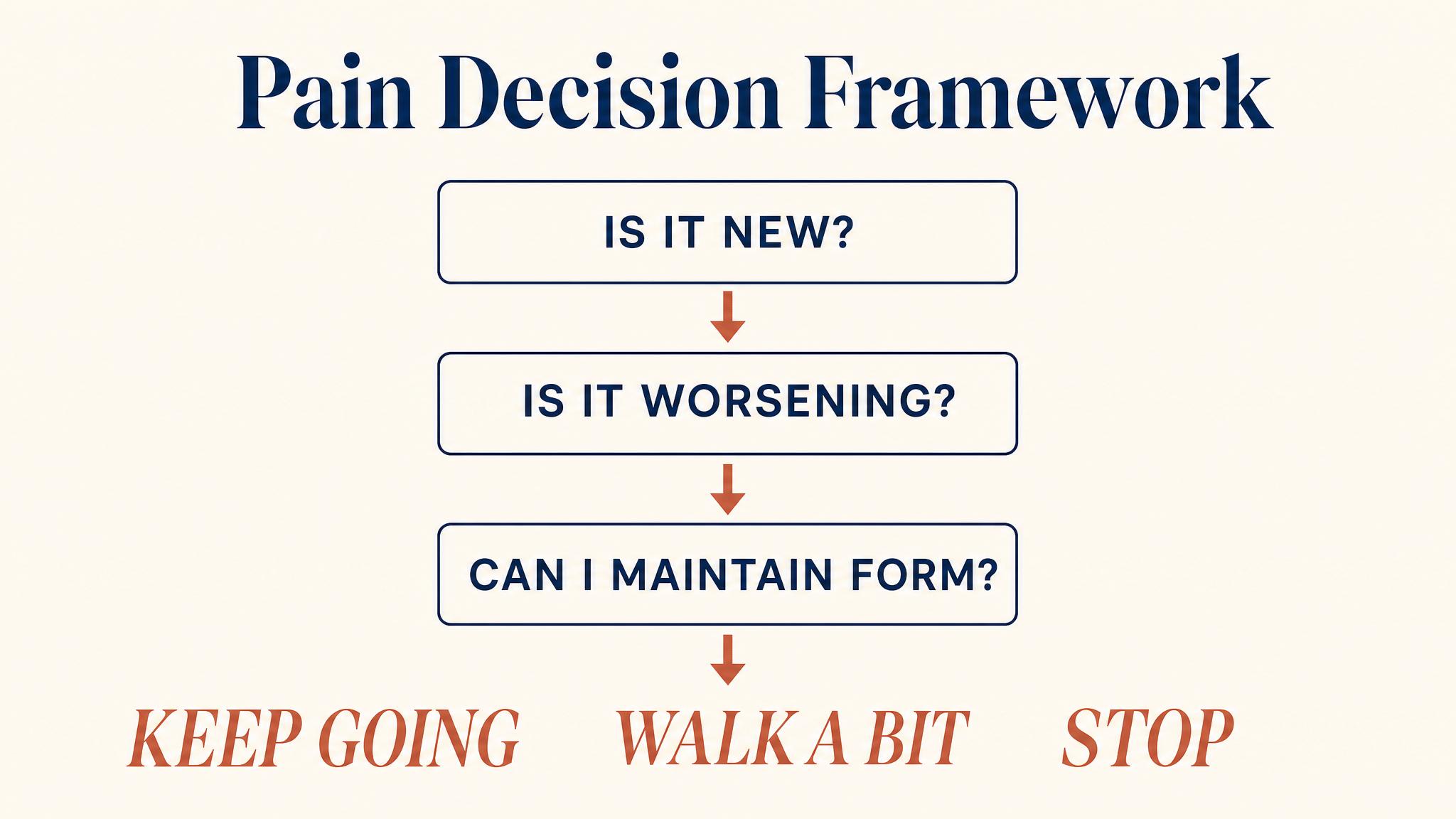
12-15 minutesIn pairs within breakout rooms (2-3 pairs per room), students role-play: One is 'The Body' experiencing a symptom, the other is 'The Brain' deciding what to do. The Body describes sensations without using pain/discomfort labels. The Brain asks diagnostic questions (sharp or dull? getting worse or stable? affecting form?). After 4 minutes, they switch roles with a new scenario. Rooms reconvene to discuss: What questions were most revealing? What was hardest to articulate? Instructor provides framework for self-assessment dialogue.
Transcript
It's week five of your training plan. You wake up on a Tuesday morning, swing your legs out of bed, and feel a dull ache along the inside of your right shin. You limp to the bathroom, but by the time you've showered it's barely noticeable. Your training schedule says four-mile easy run today. So what do you do?
If you're like most beginning runners, you face this kind of question at least once during training, and how you answer it will likely determine whether you make it to the start line. Injury is the number-one reason people abandon marathon training, and the cruel irony is that most of those injuries were preventable. They started as whispers. The runners who quit were the ones who didn't know how to hear them, or who heard them and chose not to listen.
[short pause]
Let's start with an uncomfortable truth: running injuries are staggeringly common. A systematic review of forty-two studies by Kakouris and colleagues in 2021 found an overall injury incidence of forty point two percent among runners, with a prevalence reaching forty-four point six percent. That means nearly half of all runners are dealing with an injury at any given time. Among the studies examining overuse injuries specifically, the numbers are even more striking. According to Taunton and colleagues in 2012, up to seventy percent of runners sustain an overuse injury annually.
But here's the number that should give you hope: the vast majority of these are OVERUSE INJURIES, not sudden accidents, not freak occurrences, but the accumulated result of repetitive stress exceeding your body's capacity to recover. And overuse injuries almost always announce themselves before they become serious. The shin that aches for a minute after a run. The knee that feels off going downstairs. The heel that's stiff for the first ten steps of the morning. These aren't random events. They're your body's early warning system, and this chapter is about learning to decode the messages.
[short pause]
In Chapter Two, we introduced a concept that becomes absolutely critical now: the CARDIOVASCULAR-MUSCULOSKELETAL ADAPTATION GAP. Your heart and lungs adapt to training stress relatively quickly. Within days to weeks, you'll notice that runs feel easier, your breathing is more controlled, and your resting heart rate drops. This cardiovascular fitness improvement feels wonderful, and it's dangerously seductive.
Your musculoskeletal system, bones, tendons, ligaments, cartilage, and the connective tissue wrapping your muscles, adapts on a completely different timeline. Tendons may take weeks to months to strengthen. Bone remodeling operates on a cycle of roughly three to four months. This means there's a window, often between weeks three and eight of a new training program, where your cardiovascular fitness outpaces your structural resilience. You feel ready to run farther and faster. Your bones and tendons are not.
Taunton and colleagues in 2012 identified this gap as a primary explanatory framework for why overuse injuries occur in runners. It's not that running is inherently dangerous. It's that runners consistently outrun their body's structural readiness, precisely because their cardio system is telling them they can. Understanding this gap is the single most important concept in injury prevention.
[short pause]
Marathon training is uncomfortable. That's not a flaw in the process, it IS the process. Your body adapts to stress by rebuilding stronger, and that rebuilding involves inflammation, micro-repair, and the general sensation of muscles that have been asked to do more than usual. Learning to tolerate this productive discomfort is a fundamental part of becoming a runner.
But, and this is the critical distinction, discomfort and pain are not the same thing. Discomfort is diffuse, bilateral on both sides, fades during activity, and resolves within hours. Pain is specific, often unilateral on one side, worsens during or after activity, and persists or returns. Confusing the two leads runners into one of two traps: either they stop at every minor sensation and never build fitness, or they push through genuine warning signs and end up injured.
Normal adaptation includes general muscle soreness that appears twenty-four to forty-eight hours after a harder effort, what we call delayed-onset muscle soreness, or D-O-M-S. It includes bilateral symptoms, both calves feel tight, both quads are heavy. This normal discomfort improves with gentle movement. The stiffness fades after a warm-up. It resolves within forty-eight to seventy-two hours without intervention, and crucially, it has no impact on your running form. You might be slower, but your gait feels normal.
[short pause]
The red flags of developing injury are very different. Sharp or localized pain where you can point to the exact spot. Unilateral, one side only. Pain that worsens during the run, especially if it changes your gait. Pain that's present at rest or first thing in the morning. Pain that persists across multiple days or gets progressively worse from session to session. And finally, swelling, warmth, or visible change at the site.
[short pause]
Research consistently identifies the same cluster of injuries in recreational runners. Kakouris and colleagues in 2021 found that five conditions account for the majority of running injuries in beginners. Knowing what they feel like, especially in their earliest stages, is your best defense. More than eighty percent of running injuries occur at or below the knee, as Taunton and colleagues noted in 2012, so that's where we'll focus.
First, RUNNER'S KNEE, also called patellofemoral pain syndrome. It feels like a dull, aching pain around or behind the kneecap, worst when going downstairs, sitting for long periods, or during the early miles of a run. The prevalence is fifteen point eight to sixteen point seven percent of all running injuries according to Kakouris and colleagues. It usually happens from a combination of weak hip stabilizers, especially the gluteus medius, and increased training load. When your hip drops during each stride, your knee compensates with poor tracking of the kneecap. The early warning is knee stiffness after sitting that resolves within a few steps, a vague sense that your knee doesn't feel right on descents.
Second, SHIN SPLINTS, medically called medial tibial stress syndrome. Pain along the inner edge of the shinbone, often over a broad area rather than one point. Prevalence is nine point one to nine point four percent. It happens because the tibial bone is remodeling in response to the new impact loads of running, but you're adding stress faster than remodeling can keep up. This is the adaptation gap in its purest form. The early warning is shin tenderness that appears after runs and disappears by the next day. If it starts appearing during runs or becomes point-specific, the situation is escalating.
Third, ACHILLES TENDINOPATHY. Stiffness and pain in the Achilles tendon, that thick cord at the back of your ankle, especially in the first few minutes of walking after rest. Prevalence is ten point three to thirteen point seven percent. Tendons adapt slowly to load, and the Achilles bears enormous force during running, up to six to eight times your body weight with each stride. Sudden increases in speed work or hill running are common triggers. Early warning includes morning stiffness in the tendon that resolves within the first five to ten minutes of movement, a creaky feeling at the start of runs.
Fourth, PLANTAR FASCIITIS. A sharp, stabbing pain under the heel or along the arch, worst with the first steps of the morning. Prevalence is six point one to seven point nine percent. The plantar fascia, a thick band of tissue on the bottom of your foot, becomes irritated from repetitive loading. Higher B-M-I, body mass index, tight calves, and rapid mileage increases are risk factors. The early warning is a mild ache in the heel at the end of longer runs, or slight stiffness in the arch first thing in the morning.
Fifth, I-T BAND SYNDROME, or iliotibial band syndrome. A sharp, burning pain on the outside of the knee, usually appearing at a specific point during a run, often around fifteen to twenty minutes in, and worsening until you stop. Prevalence is seven point nine percent. The iliotibial band, a thick strip of connective tissue running from hip to knee, compresses a fat pad on the outside of the knee during repetitive flexion and extension. Weak hip abductors and downhill running are common contributors. The early warning is a subtle tightness on the outer knee that resolves when you stop running, only to appear slightly earlier in your next run.
[short pause]
Notice that all five injuries share a common theme: they develop gradually and have recognizable early warning signs. The patterns across these injuries show that weak stabilizing muscles, rapid increases in training load, and the mismatch between cardiovascular fitness and structural readiness all play critical roles.
[short pause]
If there's one evidence-backed intervention that deserves your attention as a new runner, it's STRENGTH TRAINING, and not the kind you might be imagining. We're not talking about bodybuilding or heavy squats, though those aren't harmful. We're talking about targeted exercises for your glutes, hips, and core, the stabilizing muscles that control how your leg absorbs impact with every stride.
Blagrove and colleagues in 2022 conducted a comprehensive narrative review showing that lower-limb resistance exercise improves running economy and may help reduce injury risk. The mechanism is straightforward: stronger stabilizers mean better control of the knee and ankle during the repetitive motion of running, which reduces the abnormal loading patterns that cause overuse injuries. A combination of strength and plyometric training appears to offer the greatest benefit.
However, and this is an important nuance, a subsequent meta-analysis by Blagrove and colleagues in 2024 found that exercise-based prevention programs don't consistently reduce injury rates overall. The critical caveat? Supervised interventions showed significantly lower injury risk compared to controls. The exercises themselves work; the challenge is doing them correctly and consistently. This is why learning proper form matters, and why a few sessions with a physiotherapist or strength coach can be a worthwhile investment.
[short pause]
A basic runner's strength routine doesn't require a gym membership or an hour of your time. Fifteen to twenty minutes, two to three times per week, focusing on these movement patterns, will provide substantial benefit. Single-leg glute bridges target the gluteus maximus, the primary hip extensor in running. Clamshells or side-lying hip abduction strengthen the gluteus medius, preventing the hip drop that contributes to runner's knee and I-T band issues. Single-leg calf raises build Achilles tendon capacity and protect against Achilles tendinopathy and plantar fasciitis. Copenhagen planks or side planks address hip adductor strength and core stability. Step-downs or single-leg squats integrate hip and knee control in a functional movement pattern.
[short pause]
Now let's address three topics that generate enormous confusion among new runners. First, STRETCHING. The belief that stretching prevents running injuries is one of the most persistent myths in recreational fitness. While flexibility has its place, the research consistently fails to show that pre-run static stretching reduces injury risk. In fact, static stretching before a run can temporarily reduce muscle force production. Dynamic warm-ups, leg swings, walking lunges, high knees, are a better choice before running. Save static stretching for after your run if it feels good, but don't rely on it as injury prevention.
Second, FOAM ROLLING. Foam rolling has become ubiquitous in running culture, and the research tells a nuanced story. Wiewelhove and colleagues in 2019 conducted a meta-analysis of twenty-one studies and found that foam rolling has, quote, minor and partly negligible effects on performance and recovery. Post-exercise rolling slightly reduces muscle pain perception. Hendricks and colleagues in 2020 found it increases range of motion and may be useful for recovery from exercise-induced muscle damage, with no negative effects on performance.
The honest summary: foam rolling is not harmful, it modestly reduces soreness, and its primary mechanism appears to be neurological, changing pain perception, rather than mechanical, physically breaking up tissue. If it feels good and helps you recover mentally, keep doing it. But it's a complement to strength training, not a substitute for it.
Third, RUNNING SHOES. Perhaps no topic generates more anxiety for new runners than shoe selection. Should you get motion control shoes for overpronation? Maximum cushioning? Minimalist? The evidence may surprise you.
Malisoux and Theisen in 2020 concluded that, quote, the role of running shoe technology in injury prevention has been largely overrated. The traditional paradigm of prescribing shoes based on foot type or pronation pattern is not strongly supported by current research. Napier and Willy in 2022 found that heavily cushioned shoes don't consistently reduce ground reaction forces or injuries, and that controlling pronation doesn't reliably prevent injury either.
What does seem to matter? COMFORT. Malisoux and Theisen introduced the comfort filter paradigm: runners who select shoes based on how they feel, subjective comfort, tend to have fewer injuries than those prescribed shoes based on biomechanical assessments. The practical advice: try on several pairs, run in them briefly if the store allows it, and choose the ones that feel best. Replace them every four hundred to five hundred miles, and don't change shoe type dramatically in the middle of a training cycle.
[short pause]
Knowing the theory is one thing. Making decisions at six a.m. when your alarm goes off and something hurts is another. Here's a practical framework you can use every time you're uncertain.
Level One, monitor and proceed: Mild, diffuse soreness that's bilateral or that goes away within the first ten minutes of running. This is normal adaptation. Run your planned workout, but pay attention.
Level Two, modify your training: A specific ache that doesn't worsen during the run but doesn't fully disappear either. Run at reduced intensity, shorten the distance, or substitute a cross-training session. Add extra attention to the affected area in your strength routine.
Level Three, take active rest: Pain that causes you to alter your running form, that worsens as you run, or that's present when walking. Take two to three days off from running. Walking and cross-training are fine if pain-free. Then reassess. If it's improved, return at reduced volume. If it's unchanged, escalate.
Level Four, see a professional: Pain that's present at rest, that hasn't improved after three to five days of modified activity, that involves swelling or visible change, or that registers above a six on a zero to ten scale. See a sports medicine physician or physiotherapist. This is not failure, it's smart training.
[short pause]
When you experience discomfort during exercise, is your default tendency to push through it or to stop? Neither instinct is wrong, but both can become problematic if they're automatic rather than thoughtful. The key is to pause and genuinely assess before deciding.
[short pause]
Injury prevention isn't a single strategy, it's a system. And the most effective system is one tailored to your specific risk profile. The strongest predictor of a future running injury is a previous running injury, as Taunton and colleagues noted in 2012. After that, the most significant modifiable risk factors include training load errors, too much too soon, insufficient recovery, lack of strength training, poor sleep, and limited variety in running surfaces.
Being honest about your vulnerabilities allows you to focus your prevention efforts where they'll matter most. The research is clear that the best routine is one you'll actually do, and that means it needs to be short, targeted, and integrated into your existing training schedule. Fifteen minutes, two to three times per week, is enough to provide meaningful protection, as Blagrove and colleagues showed in 2022. Bodyweight exercises are highly effective, and many of the most important runner's strength movements require nothing more than a floor and a wall.
[short pause]
We'll return to the psychological dimensions of pain and discomfort in Chapter Six, where we'll explore how your mental relationship with suffering affects both your training and your race. And in Chapter Eight, we'll discuss the hardest version of this decision, whether to continue or stop during the marathon itself, when you've invested months of training and every emotional fiber wants to keep going.
For now, the most important takeaway is this: listening to your body is not weakness. It's a SKILL, arguably the most important skill in your marathon journey. The runners who make it to the finish line are not always the ones with the highest pain tolerance or the most aggressive training schedules. They're the ones who learned to distinguish between the voice that says this is hard and the voice that says something is wrong. They're the ones who were brave enough to back off when backing off was the right call.
The body achieves what the mind believes, but only if the tendons can keep up.
[short pause]
That shin that ached at the beginning of this chapter? If it's a diffuse soreness that fades by the time you're warmed up, lace up and go. If it's a sharp, point-specific pain on one side that showed up yesterday too, take the day off and do your strength routine instead. Both decisions are the right one, as long as you made them consciously rather than on autopilot.
[short pause]
Let's review the KEY TAKEAWAYS. Nearly half of all runners experience injuries, but the vast majority are overuse injuries with recognizable early warning signs. The cardiovascular-musculoskeletal adaptation gap, where your aerobic fitness outpaces your structural readiness, is the primary framework for understanding why overuse injuries occur in beginner runners. Pain and discomfort are different: discomfort is diffuse, bilateral, and resolves during or shortly after activity; pain is localized, unilateral, and worsens or persists.
The five most common beginner injuries, runner's knee, shin splints, Achilles tendinopathy, plantar fasciitis, and I-T band syndrome, all have early warning signs you can learn to recognize. Targeted strength training for glutes, hips, core, and calves is the most evidence-supported modifiable strategy for reducing injury risk, especially when performed with proper form.
Stretching, foam rolling, and running shoe selection are less impactful for injury prevention than most runners believe. Comfort in shoes matters more than correction. Use the four-level decision framework, monitor, modify, rest, or seek help, every time you're unsure whether to train through a symptom.
[short pause]
In Chapter Five, we turn to the fuel that powers all of this adaptation: nutrition and hydration. You'll learn why the popular advice about carbo-loading is mostly wrong, what your body actually needs during long training runs, and how to develop a fueling strategy that prevents the dreaded wall at mile twenty. Your muscles can't rebuild what they don't have the raw materials for, and what you eat during this training cycle matters more than you might expect.

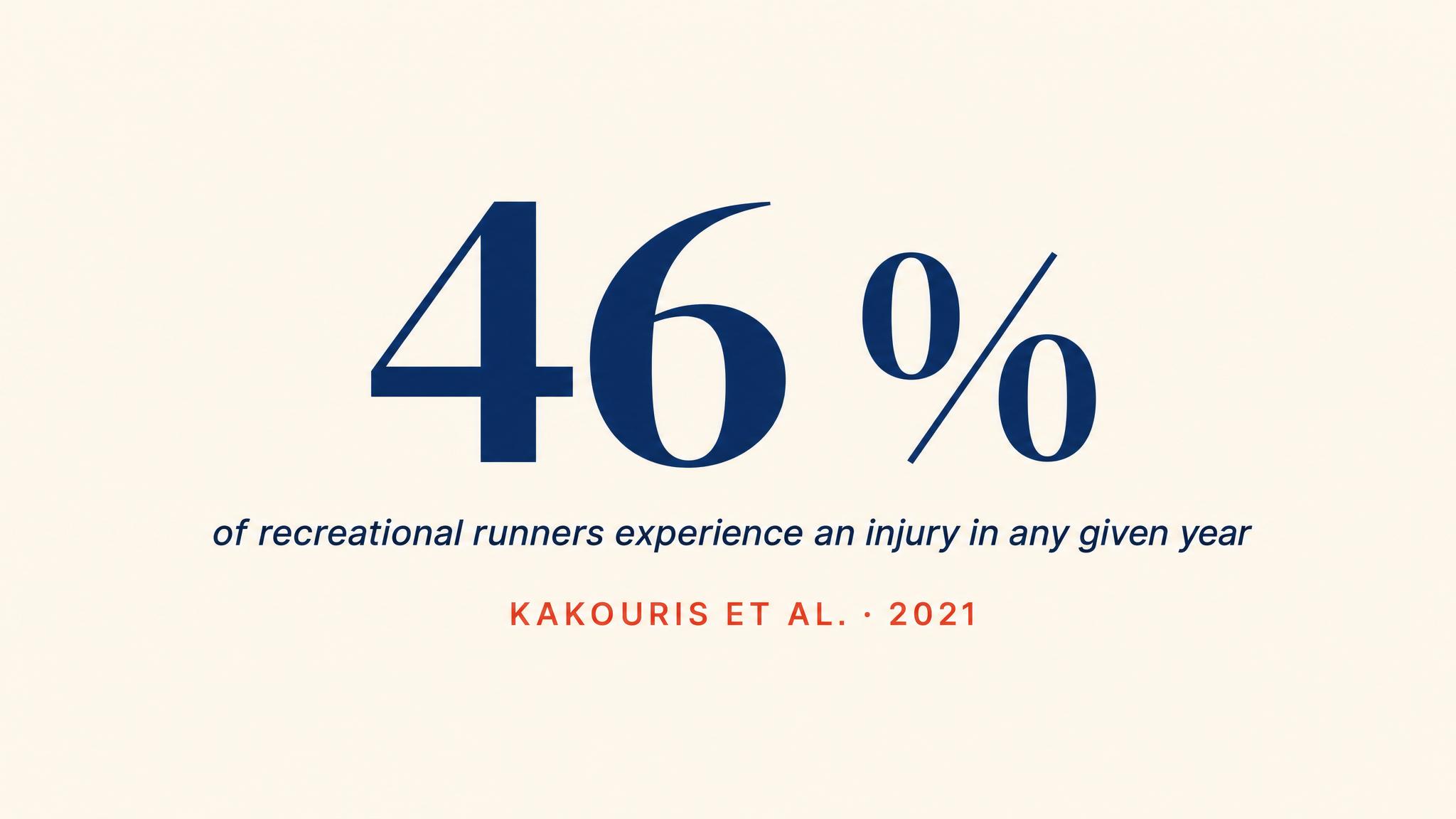

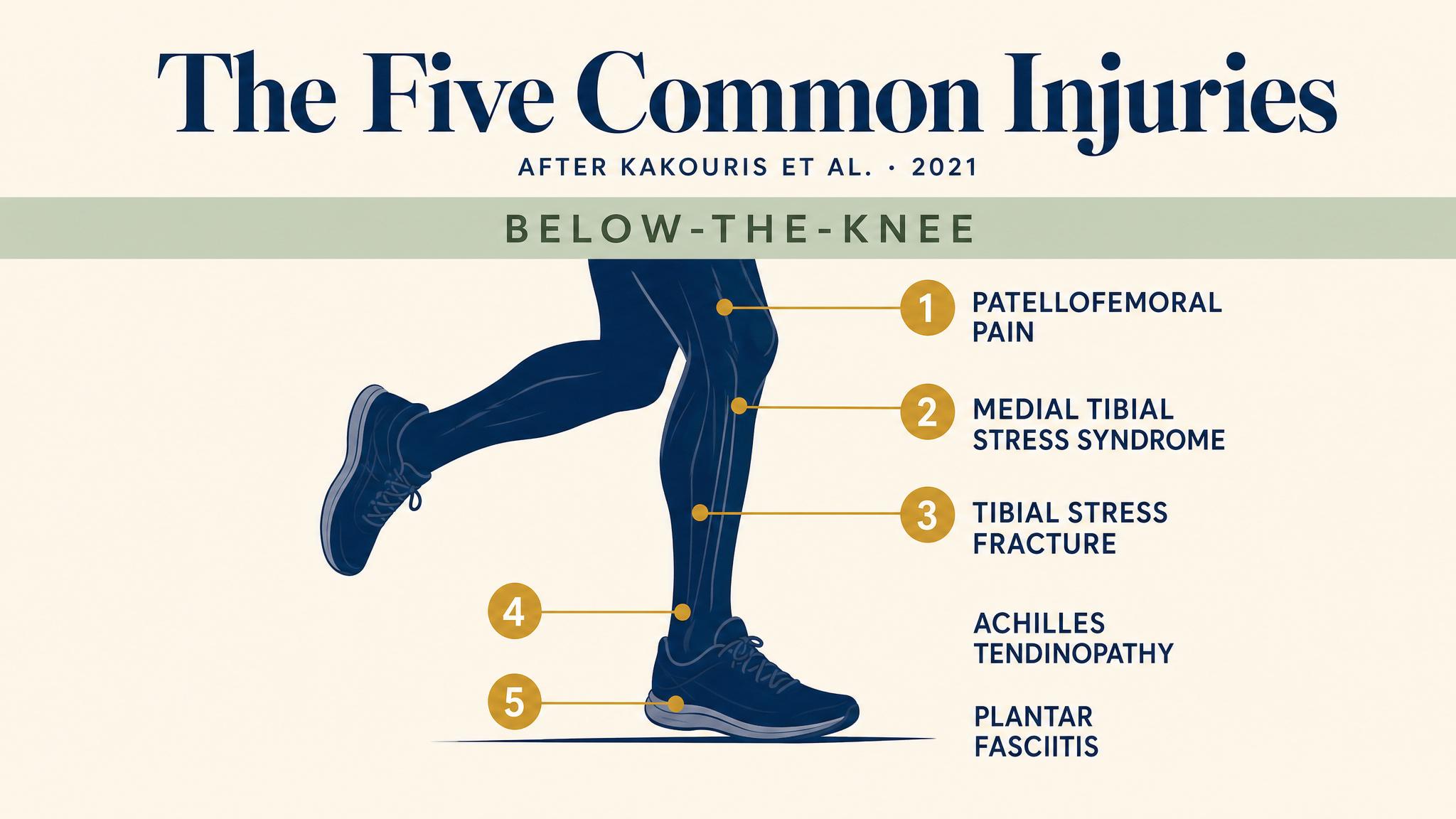
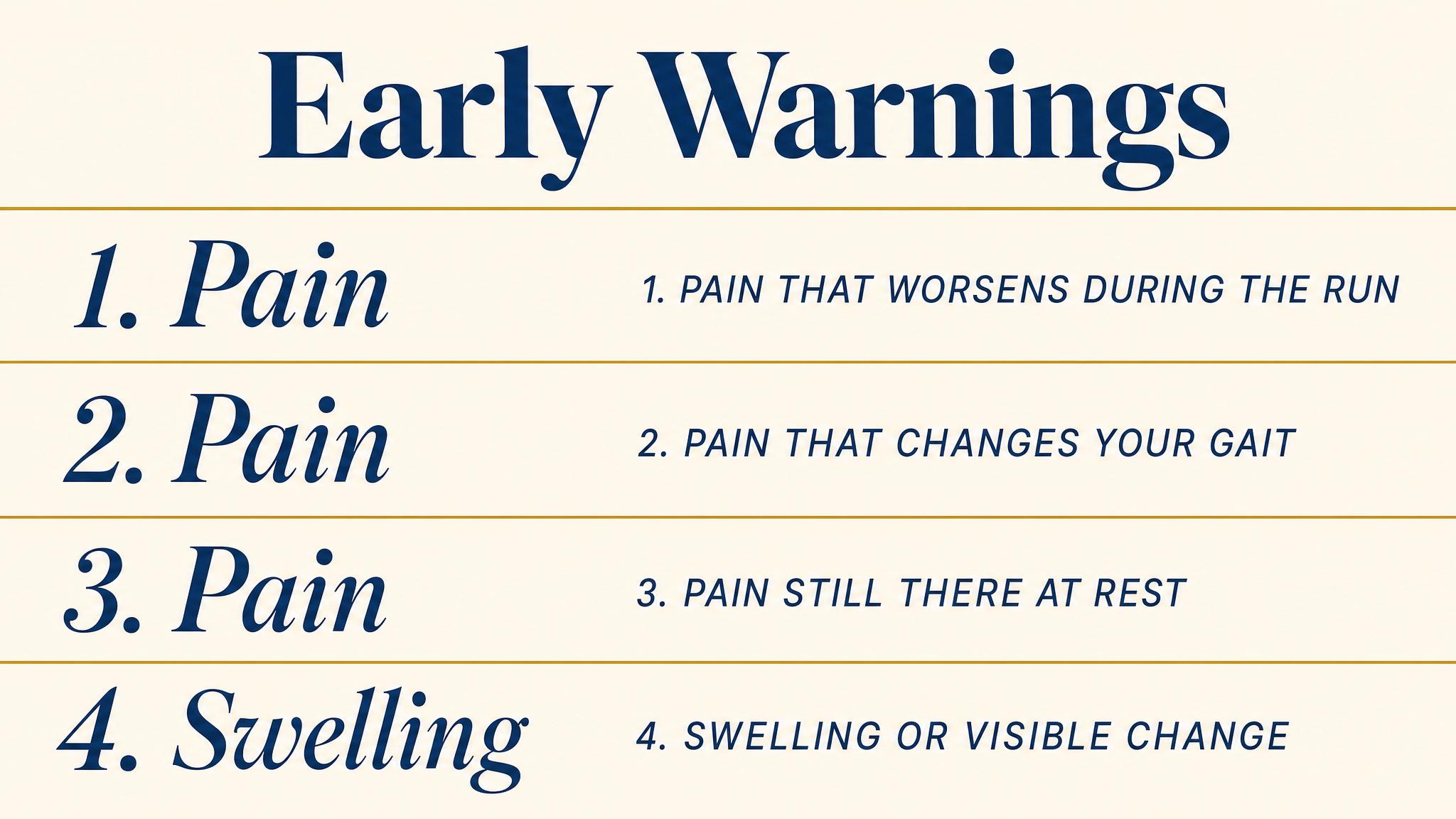




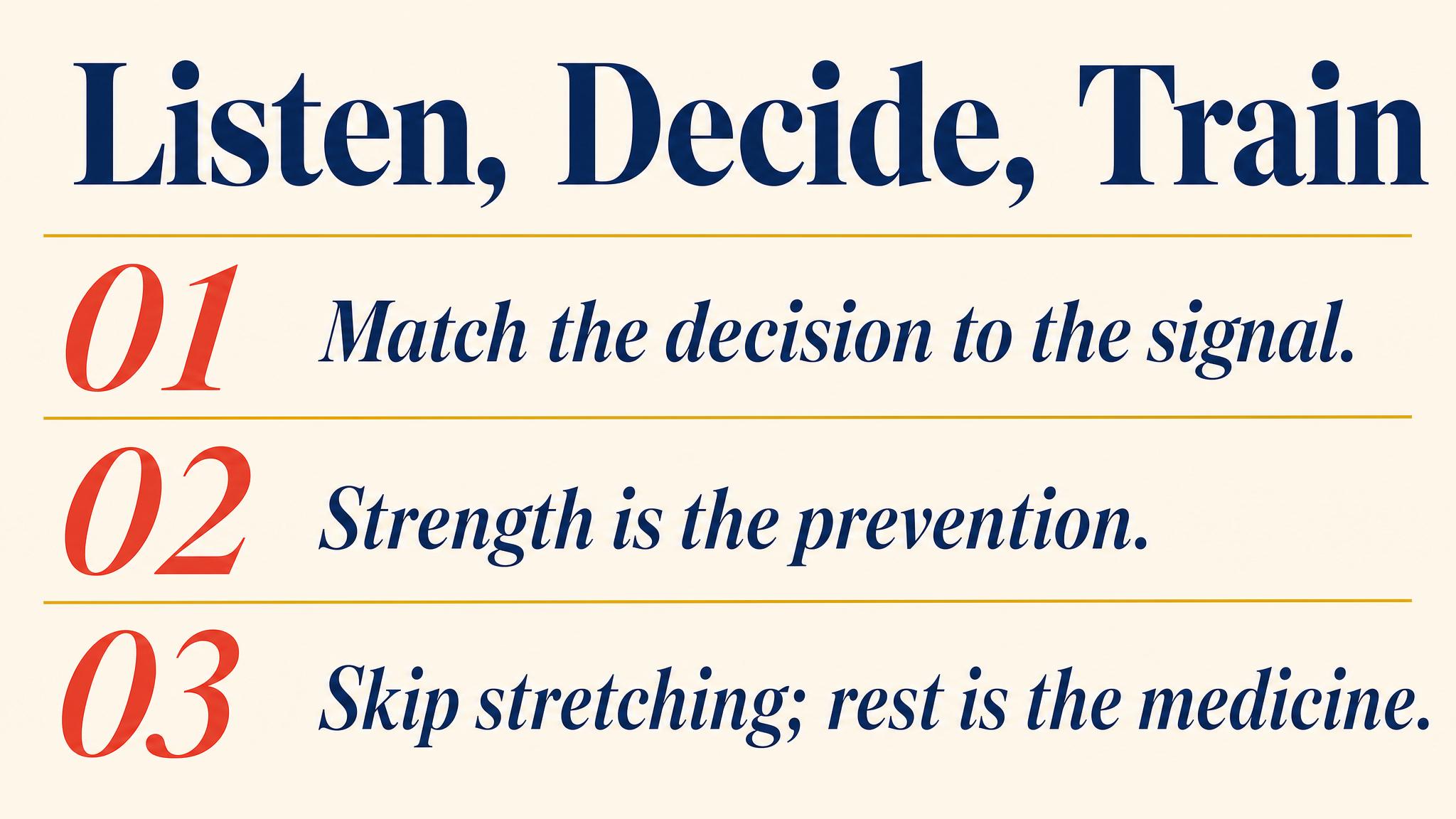

Fuel, Not Punishment: Eating and Drinking for the Long Run
Few topics in running are as surrounded by misinformation as nutrition, and few are as emotionally charged. This chapter approaches fueling with the same evidence-based directness as the rest of the course: your body is…
Would you rather carb-load like a marathon runner before every workout, or just eat whatever and risk bonking halfway through?
Would you rather
Have you ever felt your body completely shut down mid-workout? What did it feel like?
Real talk
Hot take: Sports drinks are just expensive sugar water and regular water works fine.
Hot take
What's the worst thing you've eaten right before working out? We want the full disaster story.
Disaster story time
Which is worse: stomach cramps from dehydration or having to stop and pee every 10 minutes because you drank too much?
Which is worse
Do you eat before early morning workouts or would you rather risk passing out than feel like you're gonna puke?
Morning workout dilemma
The Bonk Case Files: Diagnosis and Rescue
15-20 minutesStudents are split into breakout rooms of 4-5 people. Each group receives a case study of a runner who 'hit the wall' during training or racing (e.g., marathon at mile 20, long run crash, ultra fatigue). Groups must: 1) Diagnose what went wrong nutritionally (glycogen depletion timing, inadequate fueling, etc.), 2) Design a corrective fueling plan for their next attempt, 3) Calculate approximate carb needs based on effort duration. Groups return to main room and one representative from 3-4 groups presents their diagnosis and plan. Class votes on most scientifically sound approach.
Sweat Rate Detective Challenge
12-15 minutesInstructor provides 3-4 hypothetical runner profiles with data (pre/post-run weight, run duration, temperature, fluid consumed). In breakout rooms of 5-6, students race to: 1) Calculate sweat rate for their assigned runner, 2) Determine if current hydration strategy is adequate, 3) Make specific recommendations for fluid intake per hour. First group to correctly calculate AND justify their answer wins. Reconvene for instructor to reveal correct calculations and discuss how sweat rates vary by conditions, fitness, and individual biology.
Race Day Fuel Timeline Showdown
18-20 minutesGroups of 6-8 students collaborate in breakout rooms on a shared timeline (Google Slides or Miro board). Each group is assigned a race distance (5K, half-marathon, marathon, 50K ultra). Task: Create a minute-by-minute nutrition plan from 3 days before through race finish, including: pre-race carb-loading strategy, morning-of fueling, during-race intake with specific products/amounts, and post-race recovery. Groups must justify choices with glycogen science. Return to main room where 4 groups present (one per distance). Instructor and class provide feedback using annotation tools to highlight strong choices and misconceptions.
Fuel or Fail: Live Product Evaluation Arena
10-12 minutesInstructor screen-shares images of 5-6 popular running fuels (gels, chews, drinks, real food options) with nutrition labels visible. Students quickly move into breakout rooms of 4. Each room discusses: Which 2-3 products would you carry for a marathon and why? Groups must consider carb content, timing, digestibility, and personal preference. After 5 minutes, students return and use chat to simultaneously type their top choices. Instructor tallies results live and leads rapid-fire discussion on why certain products won, discussing trade-offs between convenience, cost, and gut tolerance.
Nutrition Myth Busting Tournament
15-18 minutesPre-assign student groups (8-10 per group) a common running nutrition myth (e.g., 'carbs make you fat,' 'you need protein immediately after every run,' 'electrolyte pills prevent all cramping,' 'fasted training is always better'). In breakout rooms, groups research their myth using provided scientific sources and prepare a 90-second 'bust or confirm' presentation with evidence. Return to main room where 5-6 groups present in quick succession. After each, class votes via poll: Busted, Confirmed, or It's Complicated. Instructor provides expert commentary and connects to course concepts.
The Long Run Prep Debate Battle
12-15 minutesClass is randomly divided into three camps (using Zoom's assign feature): Team Fasted Training, Team Fueled Training, and Team Strategic (mix of both). Each team enters a separate breakout room to build their case for why their approach to long training runs is superior, using glycogen science, adaptation benefits, and practical considerations. After 7 minutes of prep, teams return and each presents their 2-minute argument. Remaining time is open debate where teams can challenge each other via unmuting or chat. Instructor moderates and concludes by synthesizing the nuanced truth: different approaches for different goals and athletes.
Transcript
It's mile 21 of the Chicago Marathon. You've trained for months, your legs feel strong, your pacing has been disciplined. Then, over the span of a single mile, everything changes. Your legs turn to concrete. Your brain fills with fog. Runners who were behind you begin streaming past. You haven't injured anything. You haven't done anything wrong with your running form. You've simply run out of fuel — your glycogen stores are depleted, and your body is trying to run a high-performance engine on fumes.
This is THE WALL, and it is not a test of willpower. It is a predictable, physiological event with a straightforward cause and, crucially, a preventable one. Understanding why it happens, and what to do about it, starts with understanding your body as a fuel-burning machine.
[short pause]
When you run, your muscles draw on two primary fuel sources simultaneously: carbohydrates, stored as GLYCOGEN in your muscles and liver, and fat, stored abundantly throughout your body. Think of these as two fuel tanks of very different sizes. Your glycogen tank is small but powerful — the average trained runner stores roughly fifteen hundred to two thousand calories of glycogen. Your fat stores, even in a lean runner, contain fifty thousand or more calories. The math seems simple: just burn fat. But biology is more complicated than arithmetic.
Here's the critical concept: the crossover point. At low intensities — a gentle walk, an easy shuffle — your body burns mostly fat. As your effort increases, the fuel mix shifts toward a higher percentage of carbohydrates. At easy conversational pace, remember from the earlier discussion of pacing, you might be burning roughly fifty to sixty percent fat and forty to fifty percent carbohydrate. At marathon race pace for a newer runner, that ratio might shift to seventy to eighty percent carbohydrate. At a hard sprint, it's nearly all carbohydrate.
This is why pace matters so profoundly for marathon fueling. Running too fast doesn't just tire your legs — it drains your glycogen tank faster. And when that tank empties, your body is forced to rely almost entirely on fat oxidation, which simply cannot produce energy fast enough to maintain your pace. The result? You slow dramatically. That's the wall, as Rapoport described in 2010.
[short pause]
A large-scale analysis of over four million marathon race records found a consistent pattern: sustained pace collapse after mile 20, concentrated most heavily between miles 20 and 22. This research by Smyth and colleagues in 2021 shows this isn't coincidence. The mathematics of glycogen depletion predict it almost exactly. A runner burning approximately one hundred calories per mile — a reasonable estimate for a 150-pound runner — and deriving seventy percent of that energy from carbohydrate will burn through roughly eighteen hundred to two thousand calories of carbohydrate by mile 20. That's the entire glycogen tank.
Rapoport's computational model from 2010 demonstrated that more than two-fifths of marathon runners experience severe glycogen depletion. The model shows that exactly when you hit the wall depends on individual variables: your muscle mass, your glycogen storage density, your running speed relative to your aerobic capacity, and, critically, whether you take in carbohydrates during the race.
Consider this connection to the emphasis on easy pace from earlier: if running at easy pace burns fifty percent carbohydrate and running at race pace burns seventy-five percent carbohydrate, how much longer would your glycogen last at the slower pace? This is one more reason why going out too fast in a marathon is so devastating — it's not just about tired legs, it's about burning through your fuel too quickly.
[short pause]
Race-day nutrition gets all the attention, but what you eat in the weeks and months of training matters far more. Your body rebuilds itself — repairing muscle damage, strengthening bones, adapting cardiovascular capacity — between runs, and it cannot do that work without adequate raw materials. The single most common nutritional mistake among marathon trainees, particularly first-timers, is UNDER-FUELING.
This isn't about eating "clean" or "perfect." It's about eating enough. Marathon training at a recreational level adds roughly four hundred to eight hundred additional calories of expenditure per day, depending on your training volume that week. When runners don't compensate for this increased demand — whether deliberately, trying to lose weight while training, or inadvertently, not realizing how much more they need — the consequences cascade. A syndrome called Relative Energy Deficiency in Sport, or R-E-D-S, describes what happens when chronic low energy availability compromises the body's ability to function and adapt. This was documented by Mountjoy and colleagues in 2022.
R-E-D-S isn't just about elite athletes or eating disorders. It can affect any runner who consistently eats less than their training demands. The signs include persistent fatigue, poor recovery between sessions, increased injury frequency, hormonal disruption including menstrual irregularity in women, declining performance despite consistent training, and impaired bone health. If you found yourself in the earlier discussion of stress fractures thinking "that won't happen to me" — well, chronic under-fueling is one of the fastest routes to exactly that injury.
[short pause]
We need to address this directly, because the cultural noise around carbohydrates is deafening. Low-carb diets, keto for runners, carb cycling — there is no shortage of approaches that treat carbohydrates as something to minimize. For a marathon runner in training, this thinking is counterproductive and potentially harmful.
Burke and colleagues in 2011 provide comprehensive guidelines for carbohydrate intake in endurance athletes: on moderate training days, aim for five to seven grams of carbohydrate per kilogram of body weight per day. On heavy training days or long run days, that rises to seven to ten grams per kilogram per day. For a 150-pound, or 68-kilogram runner, moderate training days call for roughly 340 to 475 grams of carbohydrate. That's a substantial amount — think multiple servings of rice, pasta, bread, fruit, and starchy vegetables throughout the day.
Why so much? Because carbohydrate is the fuel your muscles preferentially burn during running, and because training with high carbohydrate availability actually improves your metabolic adaptations to training. Cox and colleagues in 2010 demonstrated that athletes who trained with high carbohydrate availability — both high daily intake and carbohydrate consumption during training sessions — showed greater improvements in their ability to oxidize exogenous carbohydrates during exercise. In plain language: practicing eating carbs during training makes your body better at using carbs during racing.
[short pause]
Carbohydrates get the spotlight, but a complete training diet also includes adequate protein for muscle repair and adaptation — roughly 1.2 to 1.6 grams per kilogram per day, spread across meals — and sufficient fat to support hormone production and absorb fat-soluble vitamins. Most runners who eat enough total calories from varied food sources will naturally meet their protein and fat needs without obsessive tracking.
The practical takeaway: eat regular meals built around a carbohydrate base like rice, pasta, potatoes, bread, or oats. Include a protein source such as eggs, chicken, fish, beans, tofu, or dairy. Add fruits and vegetables for micronutrients, don't fear fat, and eat enough. If you're hungry during marathon training, that's your body telling you something important. Listen to it.
Consider your eating patterns. On days when you ran, did you eat more than on rest days? Many new runners don't — they eat the same amount regardless of training load. If you ran 8 miles and burned an extra seven hundred plus calories, where did that energy deficit come from? This is how under-fueling happens gradually.
[short pause]
There is a toxic narrative that frames running as a way to "earn" food or "burn off" what you ate. You've encountered it: the gym poster equating a cookie to 30 minutes on a treadmill, the running app cheerfully noting you "burned off" your lunch. This framework turns food into punishment and exercise into penance. It is psychologically harmful and physiologically backwards.
You are not running to burn calories. You are eating to fuel running. The direction of the relationship matters enormously. Food is what allows your body to do the extraordinary work of covering 26.2 miles. Every adaptation discussed earlier — stronger muscles, denser capillary networks, more resilient connective tissue — is built from the food you eat. Under-fueling doesn't just hurt performance; it undermines the very adaptations that training is meant to create.
If you notice that marathon training is intensifying difficult feelings about food, body image, or eating, that's worth taking seriously. Talking to a sports dietitian or counselor who understands endurance athletes isn't a sign of weakness — it's the same kind of smart, proactive health management as seeing a physical therapist for a nagging knee.
[short pause]
Now let's talk about what to put in your body while you're actually running. For runs under about 60 to 75 minutes, water is typically sufficient. But once you're running longer than that — and in marathon training, your long runs will extend well beyond that threshold — you need to take in carbohydrates during the run to supplement your glycogen stores and delay or prevent depletion.
Current evidence-based guidelines, again from Burke and colleagues in 2011, recommend consuming 30 to 60 grams of carbohydrate per hour during prolonged endurance exercise. For most recreational marathon runners, aiming for 30 to 45 grams per hour is a practical starting point. What does that look like in practice?
One energy gel contains roughly 25 grams of carbohydrate and is absorbed quickly, but requires water. One pack of energy chews, that's four to six pieces, provides about 24 grams of carbohydrate and is easier to dose gradually. Eight ounces of sports drink gives you 14 grams of carbohydrate, combining hydration and fuel. One medium banana has 27 grams of carbohydrate and is gentle on the stomach for some runners. A few pretzel pieces or gummy bears offer variable amounts — these are real food options some runners prefer.
The key is not which fuel source you choose — it's that you choose one and practice with it extensively before race day. This principle cannot be overstated: NOTHING NEW ON RACE DAY. Your long training runs are rehearsals for race-day fueling.
[short pause]
One of the most compelling recent findings in sports nutrition is that the gut is trainable. Costa and colleagues in 2017 demonstrated this directly: runners who followed a two-week gut-training protocol — deliberately consuming carbohydrates during training runs — experienced a sixty to sixty-three percent reduction in gastrointestinal symptoms compared to their baseline. The runners who didn't practice? They continued to experience the same rates of nausea, cramping, and urgency.
This is why so many runners have terrible experiences with gels or sports drinks on race day. They've never practiced with them. Their gut hasn't adapted. Then, under the stress of racing — when blood flow is already being diverted away from the digestive system — they introduce a concentrated sugar solution and wonder why their stomach rebels.
Start practicing your fueling strategy during long runs at least eight to ten weeks before the marathon. Begin with small amounts and gradually increase. Try different products to find what your stomach tolerates. Note what works at different effort levels. By race day, your fueling plan should feel routine and boring. That's exactly what you want.
[short pause]
Hydration advice for runners has swung between two extremes over the past few decades. The older approach: "Drink as much as possible, stay ahead of thirst." The reactive backlash: "Just drink to thirst, your body knows." The evidence-based middle ground is more nuanced and more useful than either extreme.
The American College of Sports Medicine, in research by Sawka and colleagues from 2007, recommends a personalized fluid replacement plan based on individual sweat rates, with the goal of preventing more than two percent body weight loss from dehydration during exercise. That two percent threshold matters because research consistently shows performance begins to decline meaningfully around that point — cognitive function suffers, perceived effort increases, and thermoregulation becomes less efficient.
But here's what makes a one-size-fits-all recommendation impossible: sweat rates vary enormously between individuals. Casa and colleagues reported in 2021 that sweat rates in marathon runners range from 0.81 to 1.52 liters per hour depending on temperature and individual physiology. A runner sweating 0.8 liters per hour needs a very different hydration plan than one sweating 1.5 liters per hour. This is why calculating your personal sweat rate is so valuable.
[short pause]
The "drink as much as possible" approach created a real and dangerous problem: exercise-associated hyponatremia — dangerously low blood sodium caused by drinking too much water, diluting the blood. It's more common in slower runners who have more time to drink, and can be life-threatening. This is why drinking to a plan based on your actual sweat rate is safer than either ignoring thirst or drinking compulsively.
For practical hydration strategy: start your runs and the race well-hydrated but not overloaded — sipping fluids in the hours before, aiming for pale yellow urine color. During the run, drink at regular intervals based on your estimated sweat rate, not based on aid station availability or anxiety. For runs over 60 minutes, include electrolytes, particularly sodium, via sports drink or electrolyte tablets. And practice your hydration plan in training, just like your fueling plan.
[short pause]
If there's one meta-lesson from this discussion, it's this: your nutrition plan is part of your training plan. It's not an afterthought. It's not something you figure out at the race expo the day before. Every long run is an opportunity to rehearse what you'll eat, when you'll eat it, and how much you'll drink.
Start experimenting with fueling on your long runs beginning at least eight to ten weeks out from race day. Try different gel flavors. Test whether your stomach handles chews better than gels. Figure out if you can take fuel with sports drink or if that's too much sugar at once and you need plain water. Discover whether a gel at mile 5 sits differently than one at mile 15. All of this information is golden, and it's only available through practice.
The runners who have the best race-day nutrition experiences are the ones for whom race day feels routine. They've eaten their pre-race meal a dozen times. They've taken their gels at the same intervals for months. They know exactly how many sips of water they need at each aid station. None of it is new.
This connects directly to the overarching philosophy of this course: the marathon is not a test of suffering. It's a challenge you prepare for systematically, where knowledge and practice replace anxiety and guesswork. Fueling is one of the most controllable variables in marathon performance. Control it.
[short pause]
To summarize the key points: Your body runs on two fuel sources — carbohydrate, which is limited but powerful, and fat, which is abundant but slower — and the ratio shifts toward carbohydrate as intensity increases. The wall is a predictable physiological event caused by glycogen depletion, typically around miles 20 to 22, and it is preventable through pacing and fueling strategies. Day-to-day under-fueling is the most common nutritional mistake in marathon training, leading to fatigue, poor adaptation, increased injury risk, and potentially R-E-D-S.
Marathon runners need five to ten grams per kilogram per day of carbohydrate depending on training load — carbohydrates are your primary performance fuel, not something to restrict. During runs over 60 to 75 minutes, consume 30 to 60 grams of carbohydrate per hour from sources you've practiced with extensively in training. Your gut is trainable — systematic practice with race-day nutrition reduces gastrointestinal distress by sixty percent or more. Hydration needs are highly individual; calculating your personal sweat rate gives you an evidence-based plan rather than guesswork. And the golden rule: nothing new on race day. Practice your nutrition plan in training until it's boring.


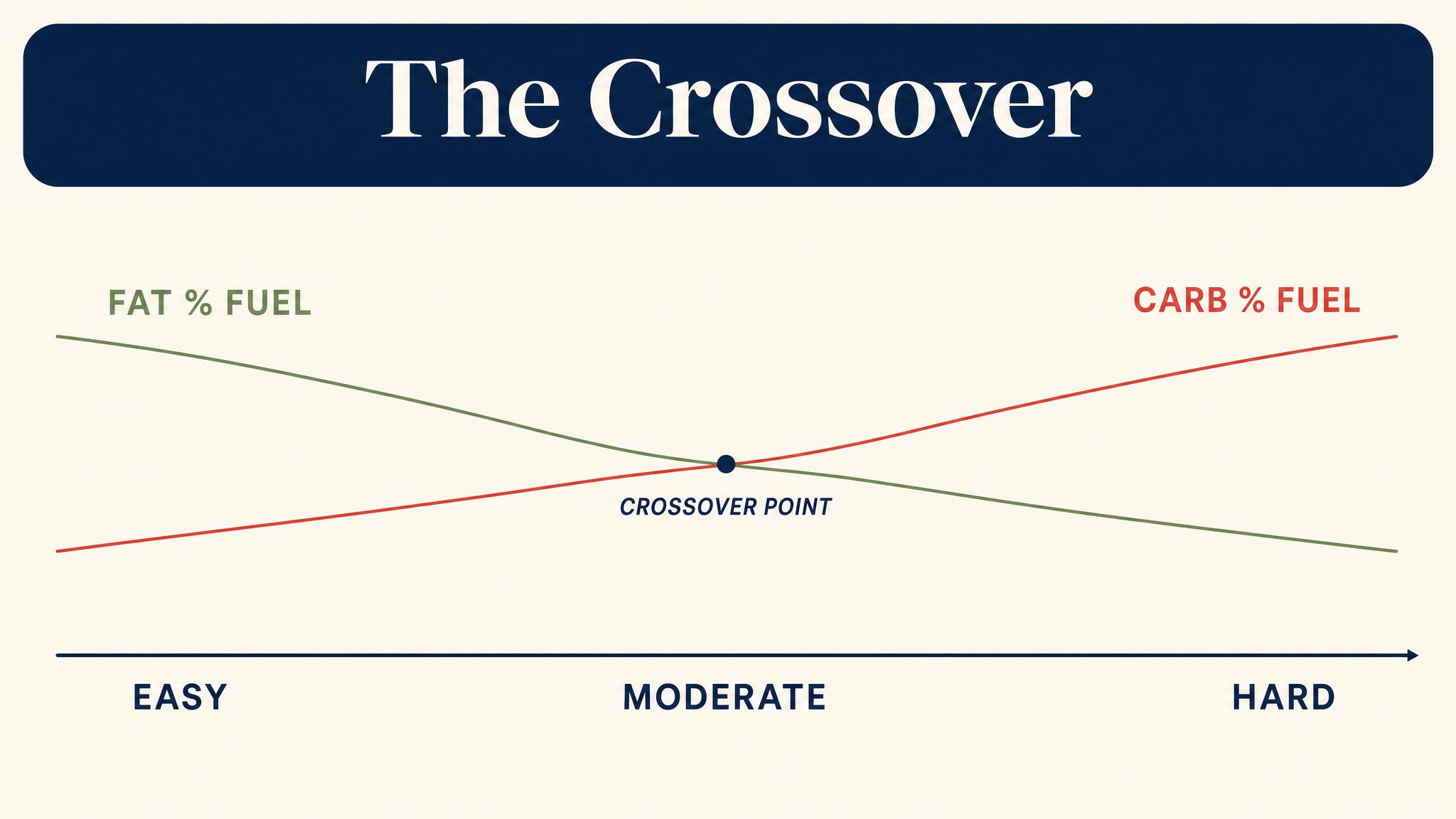
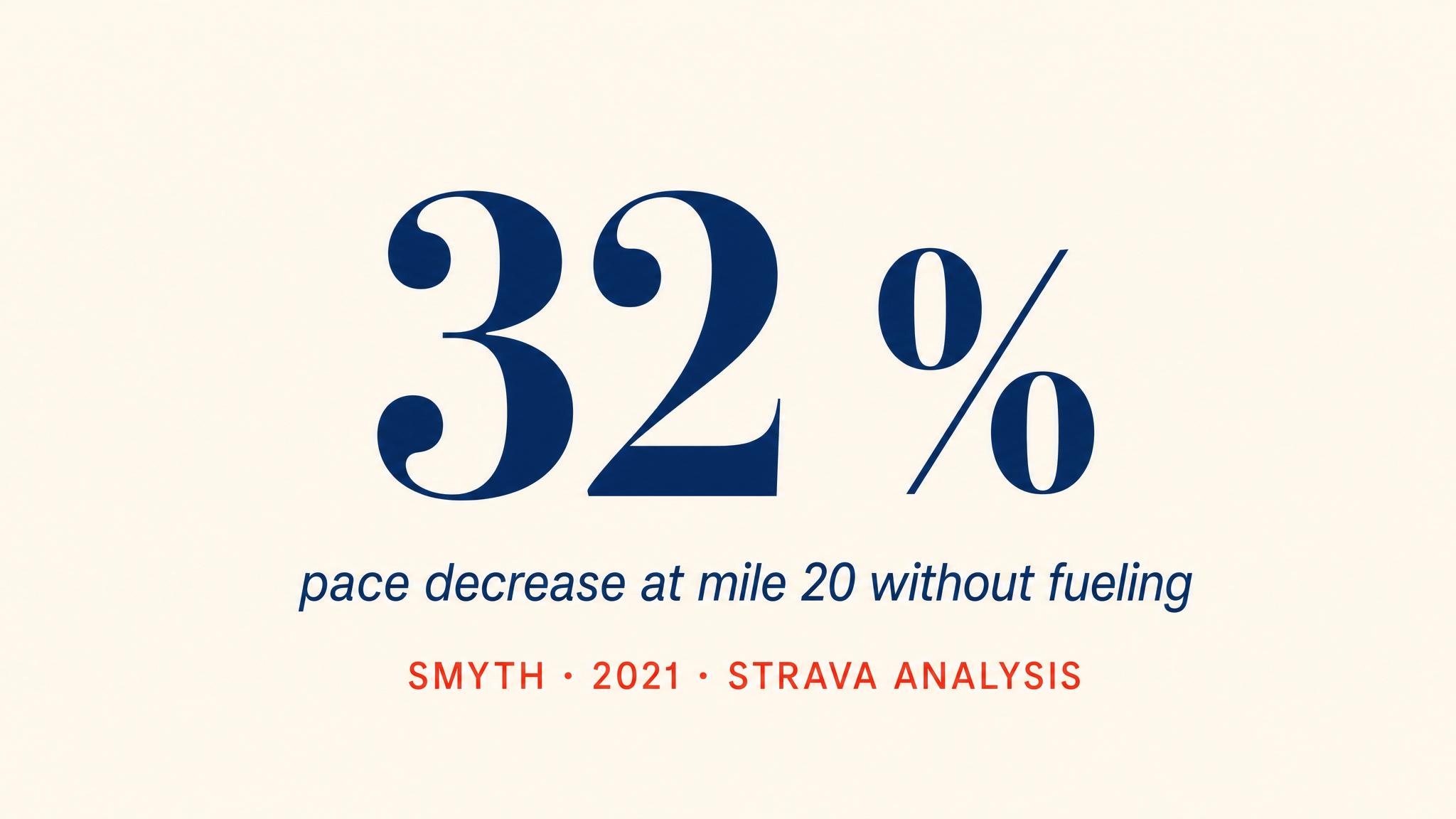
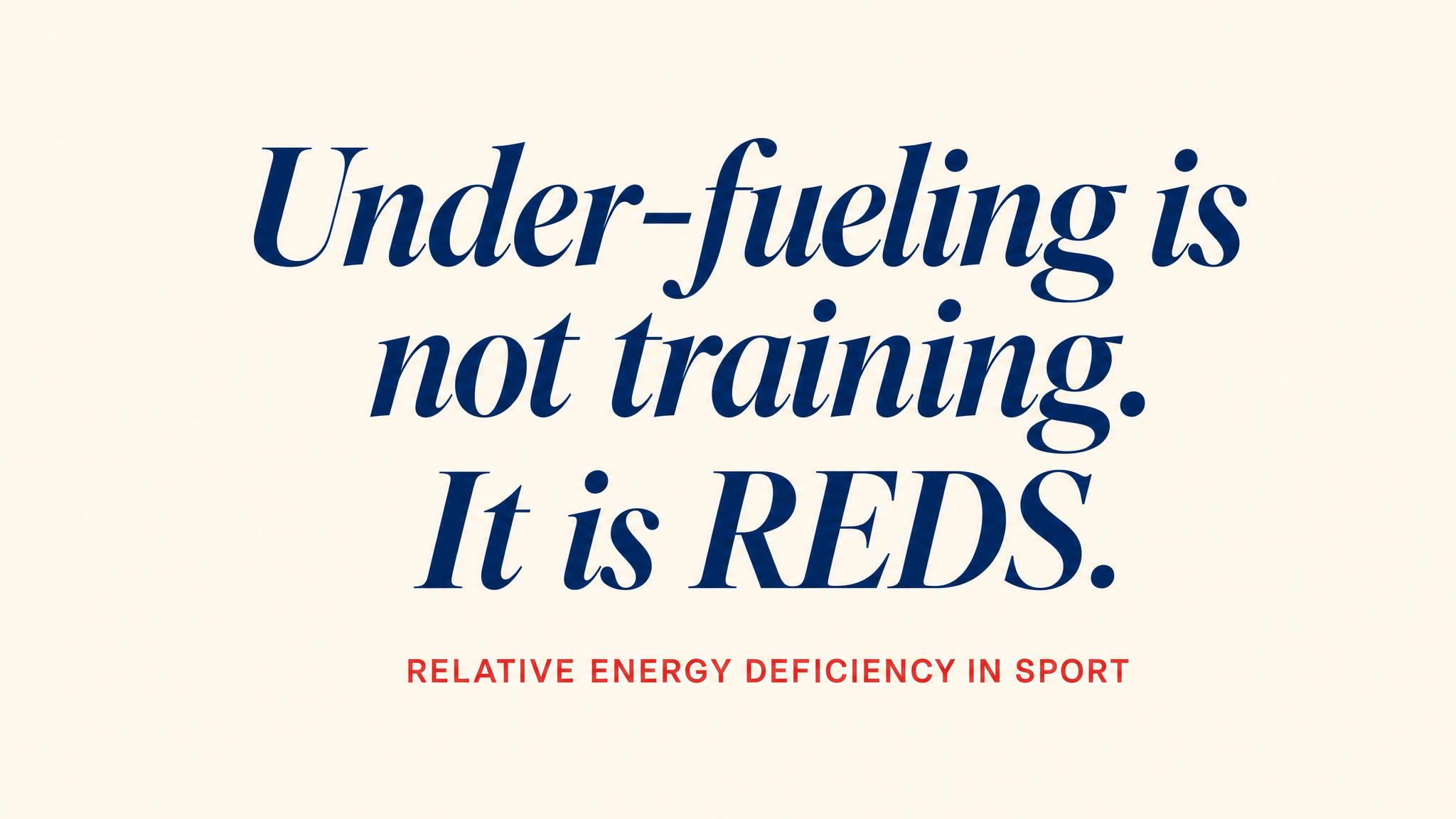
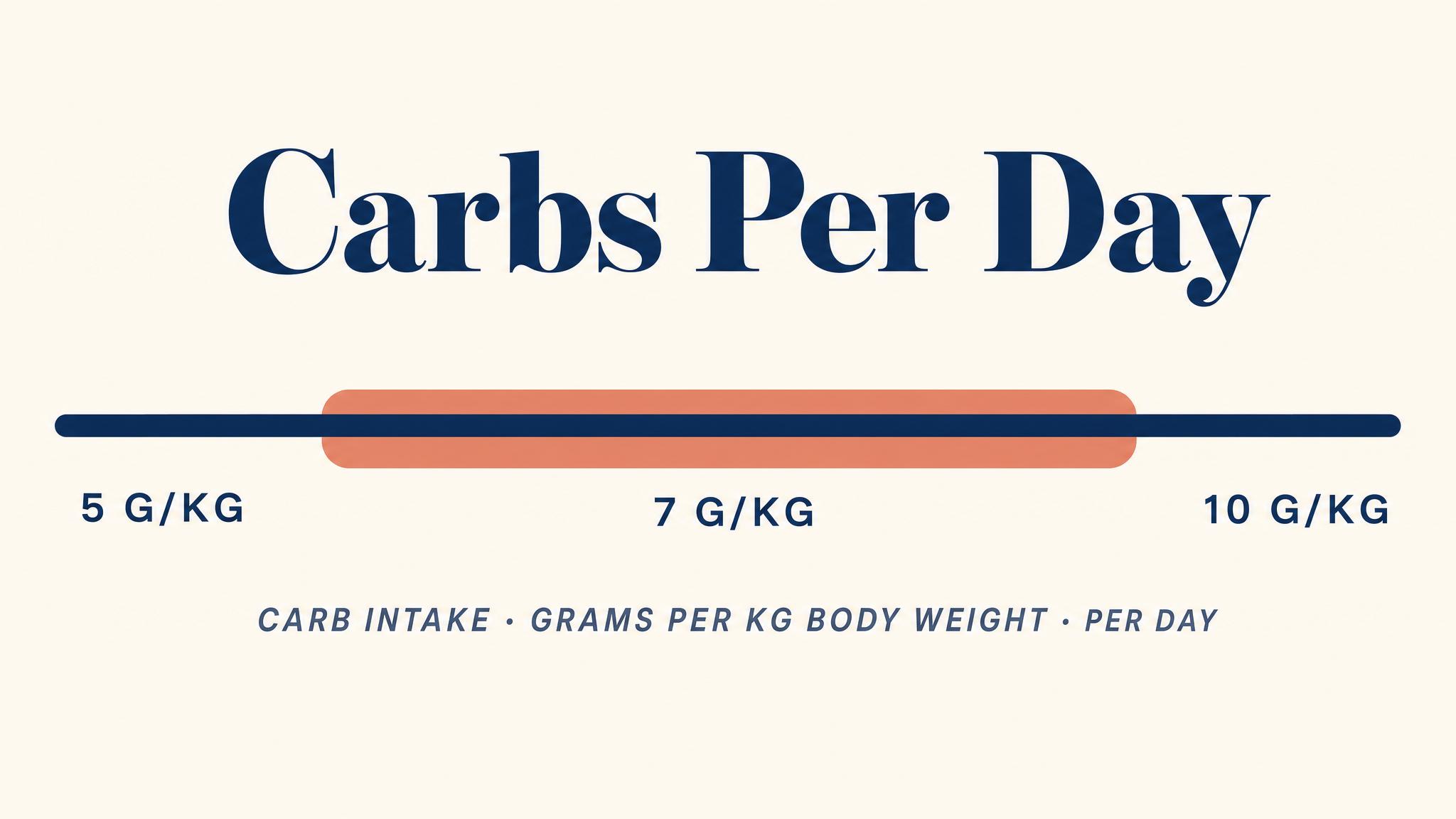




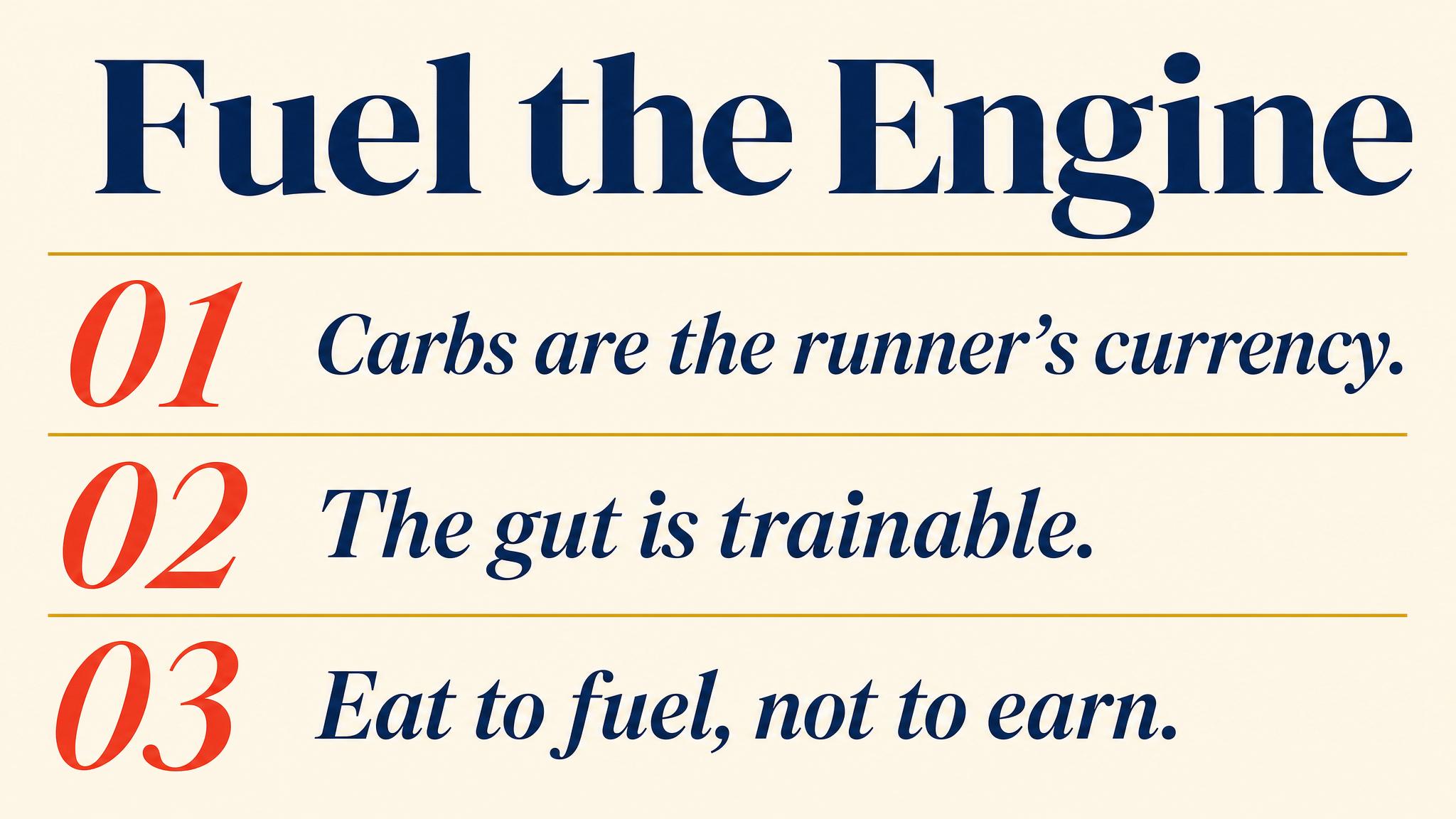

The Miles Between Your Ears
By Chapter 6, students have the physiological knowledge, the training plan, the injury prevention toolkit, and the fueling strategy. What they may not have yet is a plan for their own mind. This chapter addresses the…
You're halfway through something brutal (a run, a project, whatever) and you want to quit SO BAD but you're not actually injured. Is pushing through impressive or just stubborn and dumb?
Debate time
When things get hard, are you more likely to tell yourself 'You've got this!' or 'This sucks, why are you doing this to yourself?' Which one actually works better?
Real talk
Would you rather: Do something really hard that YOU decided to do, or something kinda easy that someone else is making you do?
Would you rather
Hot take: People who say 'pain is just weakness leaving the body' have never actually experienced real pain. Agree or disagree?
Hot take
What's worse: Doing something hard and failing, or never trying because you're afraid you'll fail?
Which is worse
Be honest: When you're working out or doing something physical, are you focused on what your body is doing or are you just trying to distract yourself until it's over?
Quick poll
Live Self-Talk Lab: The 5-Minute Challenge
15-20 minutesInstructor leads entire class through a mildly uncomfortable physical challenge (wall sit, plank hold, or arm raise) while students privately document their self-talk in a shared Google Doc template. After challenge ends, breakout rooms of 4-5 students analyze patterns: Did self-talk shift from positive to negative? When did bargaining start? Students identify associative vs. dissociative thoughts. Rooms report back one key insight to main room via chat. Instructor synthesizes themes live.
The Dark Miles Debate Arena
18-22 minutesPresent a scenario: 'Mile 18 of a marathon. Your goal pace is slipping. Your quads are screaming. What do you do?' Assign half the class to Team Association (focus inward on form, breathing, body) and half to Team Dissociation (distract with music, scenery, conversation). Give teams 5 minutes in breakout rooms to build their case with research-backed arguments. Return to main room for 8-minute structured debate using chat for voting/reactions. Instructor reveals research on when each strategy works best, creating 'aha' moment about context-dependence.
Motivation Archaeology Dig
12-15 minutesStudents enter breakout rooms of 3-4. Each shares their reason for their last completed endurance challenge (race, hard workout, hike). Group acts as 'archaeologists' asking probing questions: 'Why did that matter to you? What would have happened if you didn't do it? Who would have known?' Goal is to excavate down to intrinsic bedrock vs. extrinsic surface. Groups identify which motivations proved most durable when things got hard. One person from each room shares a surprising discovery in main room chat.
The Discomfort Menu: Categorize and Conquer
10-12 minutesUsing a collaborative tool like Jamboard or Miro, instructor posts 20 types of discomfort (burning lungs, mental boredom, social comparison anxiety, GI distress, existential dread, etc.). Students simultaneously drag items into categories: 'Can reframe cognitively,' 'Requires strategy adjustment,' 'Must accept/embrace,' or 'Warning sign to stop.' Creates real-time heat map of collective wisdom. Instructor facilitates brief discussion on disagreements—why did some students categorize differently? No single right answer; builds metacognitive awareness.
Process Goal Consulting Clinic
15-18 minutesStudents post outcome goals in chat (e.g., 'Finish 10K under 50 minutes' or 'Complete first marathon'). Instructor demonstrates converting one example to process goals. Breakout rooms of 3 become 'consulting firms' assigned to transform 3-4 outcome goals into specific, controllable process goals. Rooms compete to create the most actionable process goal set. After reconvening, instructor selects 3-4 to workshop live, with class voting via poll on which is most effective. Winning room gets virtual 'applause' reaction storm.
Attention Strategy Speed Testing
14-16 minutesInstructor plays 3 different 90-second audio scenarios (upbeat music, guided body scan, storytelling podcast excerpt). During each, students experience them while doing desk-based exercises (seated leg raises, calf raises, isometric holds). After each round, rapid breakout room rotation (new partners each time) to compare: Which strategy helped most? When might you use each? Final polling: students rank strategies by effectiveness for them personally. Instructor reveals data live showing individual differences—building insight that personalization matters.
Transcript
It's mile nineteen. You've trained for this for four months. Your nutrition plan is dialed in, you hit your fueling window at every aid station, and your legs have logged hundreds of miles in preparation. But right now, none of that seems to matter. A voice in your head — quiet at mile five, a murmur at mile fourteen — is now screaming: You can't do this. You're going to have to walk. Everyone is passing you. Your quads ache, your feet feel like they're bruising with every step, and the finish line is still seven point two miles away. The question that will determine how the next hour unfolds has nothing to do with your V-O-2 max or your glycogen stores. The question is: what have you trained your mind to do in this moment?
Most first-time marathoners prepare their bodies meticulously and leave their minds to chance. This chapter is about making sure that doesn't happen to you.
[short pause]
By now, you have the physiological knowledge, the structured training plan, the injury prevention toolkit, and the fueling strategy. You understand what your muscles, tendons, and metabolic systems need to carry you twenty-six point two miles. But here is an uncomfortable truth that research has confirmed repeatedly: the marathon is decided as much between your ears as it is in your legs.
Samuele Marcora's PSYCHOBIOLOGICAL MODEL of endurance performance argues that exercise terminates not when the body truly fails, but when the perception of effort becomes so high that continuing feels intolerable — or when motivation to continue drops below the effort required. This is according to Marcora in 2015. In other words, your brain is the final gatekeeper. Marcora and colleagues found that psychological interventions — including imagery, self-talk, and goal setting — consistently improved endurance performance by altering how athletes perceived and responded to effort. Mental fatigue, on the other hand, undermined it, even when the body was physiologically capable of continuing.
This doesn't mean the marathon is "all in your head." The glycogen depletion we explored in Chapter five is real. The cumulative musculoskeletal fatigue is real. But how you experience and respond to those physical realities is profoundly shaped by psychological factors — factors you can train just like you train your cardiovascular system.
[short pause]
Before we build mental race-day strategies, we need to understand what's sustaining you through sixteen to twenty weeks of training in the first place. Motivation isn't a single switch you flip on or off. It's a complex, shifting landscape — and understanding your particular terrain matters.
Robert Vallerand's hierarchical model of motivation, grounded in self-determination theory, describes motivation as a spectrum, as described by Vallerand in 2007. At one end sits INTRINSIC MOTIVATION — running because the act itself is satisfying, because you love how it feels to move, because you're curious about what your body can do. At the other end is EXTRINSIC MOTIVATION — running for a medal, a social media post, or to prove something to someone else. In the middle are various shades of internalized motivation: running because you value health, because you identify as a runner, because the discipline matters to you as a person.
Research consistently shows that intrinsic motivation leads to better long-term persistence, greater enjoyment, and ultimately stronger performance in endurance sports, as Vallerand noted in 2007. This doesn't mean external motivators are useless — signing up for a race and paying a registration fee is an extrinsic motivator that gets a lot of people off the couch. But relying solely on extrinsic drivers creates fragile motivation. When the race is still ten weeks away and it's cold and dark at six a.m., "I want to post my finish line photo" may not be enough to get your shoes on.
[short pause]
Remember the founding philosophy we discussed in Chapter one — that this course is about the process of becoming a marathoner, not just crossing a finish line? That philosophy has strong scientific backing. A systematic review and meta-analysis of goal setting in sport found that PROCESS GOALS — goals focused on specific actions and behaviors you can control, for example "I will maintain an even breathing pattern during my tempo run" — enhance self-efficacy far more effectively than outcome goals like "I will finish in under four hours thirty." This is according to Swann and colleagues in 2022. Process goals give you an increased perception of control, and because they can be achieved frequently, they build confidence incrementally.
Outcome goals based on interpersonal comparison — "I want to beat my coworker's time" — were associated with reduced engagement and increased anxiety, as Swann and colleagues found in 2022. That's a critical insight for first-time marathoners who are surrounded by experienced runners posting impressive training paces online. Your marathon is yours alone. The goal that will serve you best is not a time but a process: run each training session with intention, fuel consistently, rest when the plan says rest.
Take a moment to reflect on why you signed up for this marathon. Is your primary driver something external — proving something, earning a medal, social recognition — or internal — curiosity, love of movement, personal growth? Neither answer is wrong, but awareness of your motivational pattern will help you plan for the inevitable dips ahead.
[short pause]
Every training plan has a psychological architecture that mirrors its physical one. Understanding that architecture — knowing what's coming mentally — is half the battle.
The first few weeks of a training plan carry the intoxicating energy of novelty. Everything feels fresh: the new shoes, the training log, the sense of embarking on something meaningful. The final weeks carry the gravitational pull of the approaching race — excitement, nervous energy, and the momentum of "I've come this far." But between weeks eight and fourteen, you enter what experienced runners sometimes call the TRAINING VALLEY: the novelty has worn off, the race is still abstract and distant, your body is chronically tired from accumulated mileage, and the whole enterprise can start to feel pointless.
This is predictable. Knowing it's predictable is powerful. The training valley is not a sign that you've lost motivation or chosen the wrong goal. It's the psychological equivalent of the metabolic demands we discussed in Chapter five — a natural cost of the process. The key is to have strategies in place before you arrive at the valley.
[short pause]
If the training valley is a slow fade, the race-day wall is a collision. Research by Buman and colleagues in 2008 found that forty-three to fifty-three percent of recreational marathon runners experience HITTING THE WALL — a phenomenon characterized by generalized fatigue, unintentional slowing, an overwhelming desire to walk, and a cognitive shift toward pure survival. Rapoport's 2010 computational modeling confirmed the physiological basis: glycogen depletion typically strikes between miles eighteen and twenty-two depending on pace, muscle mass, and pre-race fueling.
But here's what makes the wall so devastating: it's not purely physical. Buman and colleagues in 2008 found that the wall has distinct psychological origins alongside the physiological ones. The physical sensation of declining glycogen triggers a cascade of negative thoughts, which amplify the perception of effort, which makes the physical sensation feel worse, which produces more negative thoughts. It's a feedback loop — and breaking that loop requires mental tools you've practiced in advance.
Consider a time in any area of your life when you hit a wall — a point where you wanted to give up. What got you through? Was it a specific thought, a person, a decision to just take the next small step? That instinct is the raw material we're going to refine into a deliberate mental strategy.
[short pause]
Sport psychology isn't about positive thinking or pretending pain doesn't exist. It's about having specific, practiced techniques for managing attention, reframing experience, and maintaining engagement when your brain is looking for an exit ramp. Let's build your toolkit.
The voice in your head is not neutral. It's actively shaping your performance. A meta-analysis by Hatzigeorgiadis and colleagues in 2011 of thirty-two studies on self-talk in sport found a clear, moderate effect: deliberate self-talk interventions improve performance. What you say to yourself matters — and you can change what you say.
The research distinguishes two types of self-talk, each useful for different purposes. INSTRUCTIONAL SELF-TALK focuses attention on technical execution: "Relax your shoulders," "Short quick steps," "Breathe from the belly." It's most effective for tasks requiring coordination and form — like maintaining your running mechanics when fatigue degrades them in the late miles. MOTIVATIONAL SELF-TALK bolsters effort and confidence: "You are strong," "One mile at a time," "You've done this in training." For endurance tasks requiring sustained effort, motivational self-talk showed particular benefit, as Hatzigeorgiadis and colleagues found in 2011.
The critical insight is that effective self-talk must feel authentic. A mantra that sounds hollow to you won't work under pressure. This is why you need to develop and test your self-talk during training, not invent it on race morning.
[short pause]
Where you direct your attention during a run profoundly affects your experience. Masters and Ogles' comprehensive 1998 review of twenty years of research identified two fundamental attentional strategies. ASSOCIATION means directing attention inward — monitoring your breathing, checking your form, tuning into your pace and heart rate. DISSOCIATION means directing attention outward or away from the body — listening to music, enjoying the scenery, doing mental math, daydreaming.
The findings are nuanced and important. Association is linked to faster performance — elite runners tend to monitor bodily sensations closely, making constant micro-adjustments to pace and form. But dissociation is associated with lower perceived exertion and possibly greater endurance. And here's the key practical finding: most runners naturally drift between the two styles during the same run. The skill isn't choosing one forever; it's knowing when to deploy each one.
Early in the race, when effort is low and you're managing adrenaline, dissociation can help you relax and avoid going out too fast. In the dark middle miles, sixteen through twenty-two, a shift toward association helps you maintain form and respond to your body's genuine signals. But sustained pure association is mentally exhausting — so strategic moments of dissociation, even brief ones like focusing on a spectator's funny sign or counting blue shirts ahead of you, provide cognitive rest.
[short pause]
Twenty-six miles is overwhelming. Two miles is manageable. SEGMENTING — breaking the race into smaller, psychologically digestible chunks — is one of the most commonly reported coping strategies among marathoners, as Buman and colleagues noted in 2008. You can segment by aid stations: "just get to the next water table." By landmarks: "run to that bridge." By miles: "just this mile, nothing else." Or by time: "ten more minutes of effort."
Segmenting works because it transforms an abstract, daunting goal into a series of concrete, achievable process goals — exactly the kind that research shows enhance self-efficacy, as Swann and colleagues found in 2022. Each completed segment produces a small psychological victory, which generates momentum for the next one.
[short pause]
Marcora in 2015 found that verbal encouragement and head-to-head competition both improved endurance performance. On race day, this translates to practical tactics: finding a pace buddy in the crowd, drawing energy from spectators, thanking volunteers — which shifts your attention outward and gives you a brief mood boost — or dedicating specific miles to people who supported your training.
[short pause]
Let's address something every runner experiences and few training plans acknowledge: the bad run. The day when your legs feel like bags of wet sand, your pace is embarrassingly slow, every step is a negotiation, and the voice in your head isn't whispering doubt — it's making a convincing legal case for why you should abandon this entire marathon project.
Bad runs are not optional. They're built into the process. They happen because of accumulated fatigue, poor sleep, stress at work, dehydration, heat, or simply the statistical certainty that not every run can feel good. The danger isn't the bad run itself — it's the narrative you build around it.
A single bad run becomes toxic when you catastrophize: "If I can't handle eight miles today, how will I ever run twenty-six?" This is a cognitive distortion — taking one data point and projecting it across the entire future. The antidote is what psychologists call COGNITIVE DEFUSION: observing the thought without accepting it as truth. Instead of "I can't do this," try: "I'm having the thought that I can't do this. That's my brain doing what brains do when they're tired. I'll note it and keep moving."
The paradox of bad runs is that surviving them builds more psychological resilience than good runs do. Every bad run you complete — even slowly, even grumpily — is evidence you can bank for race day: I have felt this bad before, and I kept going.
As running wisdom often reminds us: "The marathon doesn't really begin until mile twenty. Everything before that is just the preface." This speaks to the importance of preparing for difficulty, not hoping to avoid it.
[short pause]
In Chapter four, we introduced the critical distinction between pain — a signal of tissue damage requiring attention — and discomfort — the expected sensation of sustained physical effort. Now we revisit that framework through a psychological lens, because how you interpret physical sensations during a marathon profoundly shapes your behavior.
Research by Talia, Nirit, and Defrin in 2019 found that endurance athletes — compared to strength athletes and non-athletes — demonstrated higher pain tolerance, stronger conditioned pain modulation, and lower fear of pain. This isn't because endurance athletes are tougher or more stoic in some innate way. It's because repeated exposure to sustained physical discomfort during training recalibrates the brain's relationship with that discomfort. You learn, through experience, that discomfort is information rather than an emergency.
This recalibration is precisely what your training is building. Every long run teaches your brain that burning quads, heavy legs, and elevated heart rate are safe and temporary. But — and this is crucial — this psychological adaptation must not override genuine injury signals. The framework from Chapter four still applies: sharp, localized, sudden, or worsening pain is a signal to stop and assess. Diffuse, symmetrical, gradually building discomfort is the normal cost of running a marathon.
The mental skill here is ENGAGED ACCEPTANCE: fully acknowledging that you're uncomfortable, choosing not to fight or panic about it, and directing your attention to what you can control — form, breathing, the next segment. This is fundamentally different from dissociating or ignoring your body. It's a middle path — present, aware, and choosing to continue.
[short pause]
Just as you wouldn't show up on race day without a pacing plan or a fueling schedule, you shouldn't show up without a mental race plan. This isn't a rigid script — race day will surprise you, and flexibility matters. But having a framework for what you'll do with your mind at different stages of the race gives you something to fall back on when the wheels start wobbling.
A good mental race plan matches your psychological strategy to the predictable demands of each race segment. It accounts for the fact that mental energy is finite — just as glycogen depletes, so does your capacity for intense cognitive focus. Spending all your mental energy on association and self-monitoring in the first ten miles leaves you cognitively depleted when you need those tools most in the final six.
Think of your mental race plan as the mental equivalent of the fueling plan from Chapter five — strategic, practiced, and personalized.
[short pause]
Mental strategies that haven't been rehearsed won't work under pressure. In the weeks ahead, use your long runs as mental dress rehearsals. Practice your self-talk during the last three miles of a long run, when fatigue makes the voice louder. Experiment with shifting between association and dissociation. Test your segmenting approach on a sixteen-miler: can you stay present for one mile at a time without jumping ahead to the finish? The mental race plan you build today should be refined, tested, and personalized through every remaining training run.
Marcora's 2015 research underscores this: the psychological interventions that most reliably improved endurance performance were those that had been practiced, not merely understood. Knowing about self-talk is step one. Using self-talk when you're fatigued, uncomfortable, and doubting yourself — that's the skill. And like any skill, it develops through repetition.
[short pause]
Let's review the key insights from this chapter. The marathon is governed as much by perception of effort and motivation as by pure physiology — your mind needs a training plan too.
Intrinsic motivation and process goals sustain engagement more effectively than extrinsic motivation and outcome goals, especially during the training valley of weeks eight through fourteen.
Deliberate self-talk — both instructional and motivational — improves endurance performance with a moderate effect size. The key is developing self-talk that feels authentic and practicing it during training runs.
Association, with its internal focus, and dissociation, with its external focus, are both valuable attentional strategies. The skill is knowing when to deploy each one across different race segments.
Segmenting the race into smaller psychological chunks transforms an overwhelming distance into a series of achievable process goals, building momentum through repeated small victories.
Bad runs are inevitable and build resilience. The danger isn't the bad run itself, but the catastrophic narrative you construct around it.
Engaged acceptance of physical discomfort — acknowledging it without fighting or panicking — is the psychological middle path between ignoring your body and being overwhelmed by it.
A mental race plan, like a fueling plan, should be built in advance, rehearsed during training, and flexible enough to adapt on race day.
[short pause]
You now have the mental toolkit to complement your physical, nutritional, and injury-prevention preparations. In Chapter seven, we bring everything together as we turn to the taper period and race-week logistics — the final psychological, practical, and physiological preparation for the day itself. We'll address the unique anxiety of tapering, why running less feels so unsettling, race-morning routines, and how to combine every tool from Chapters one through six into a coherent race-day plan.


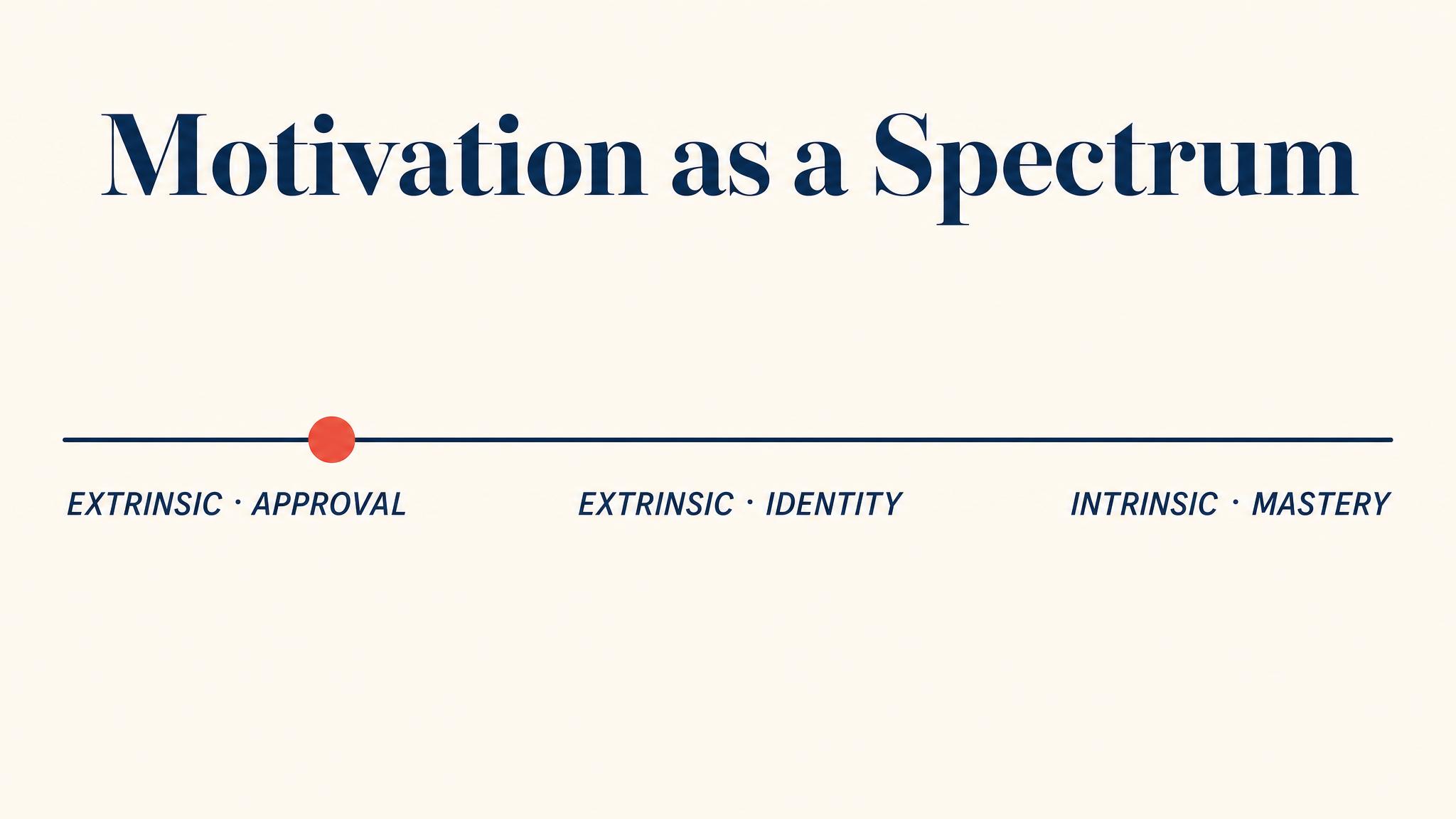
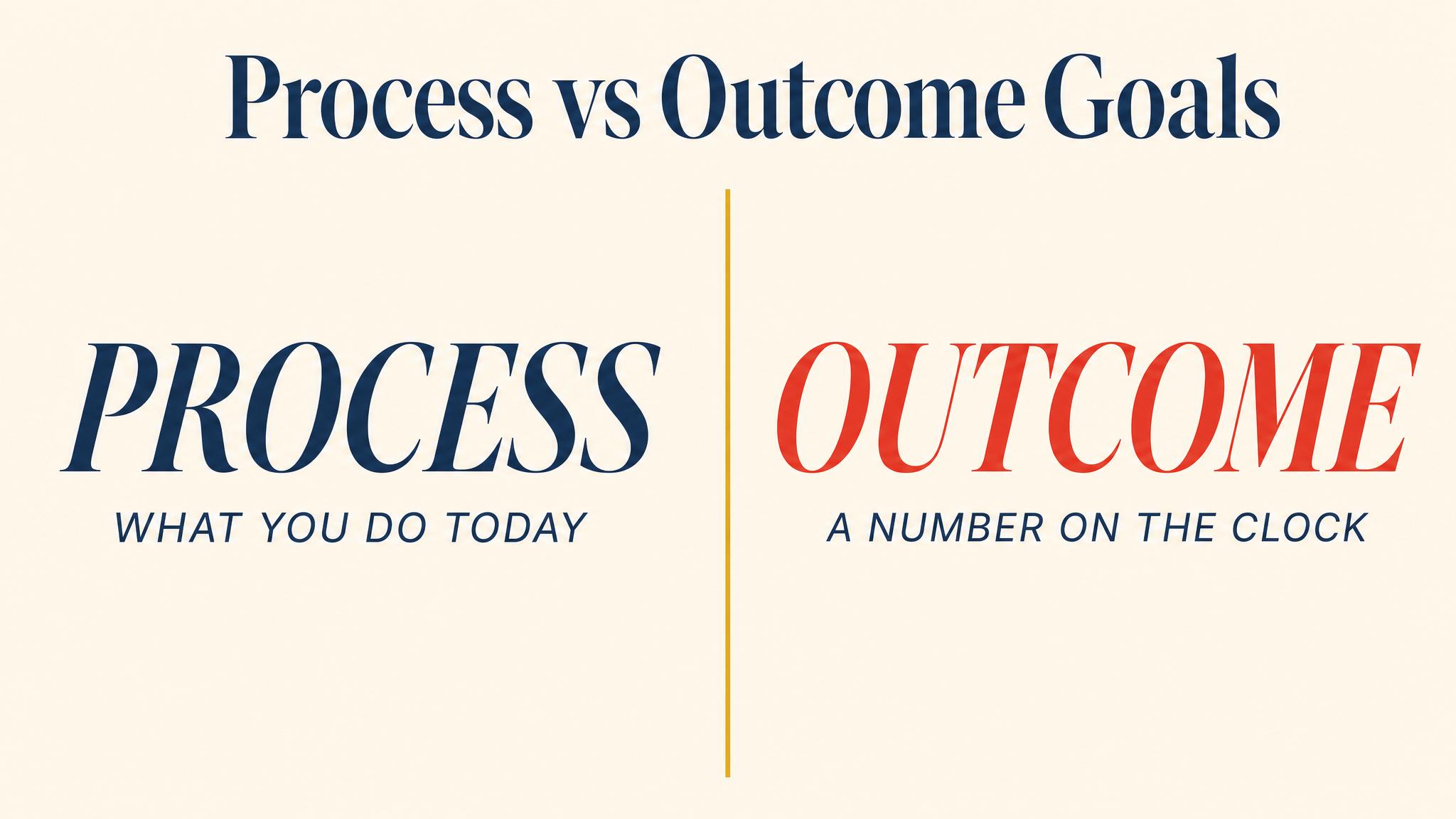
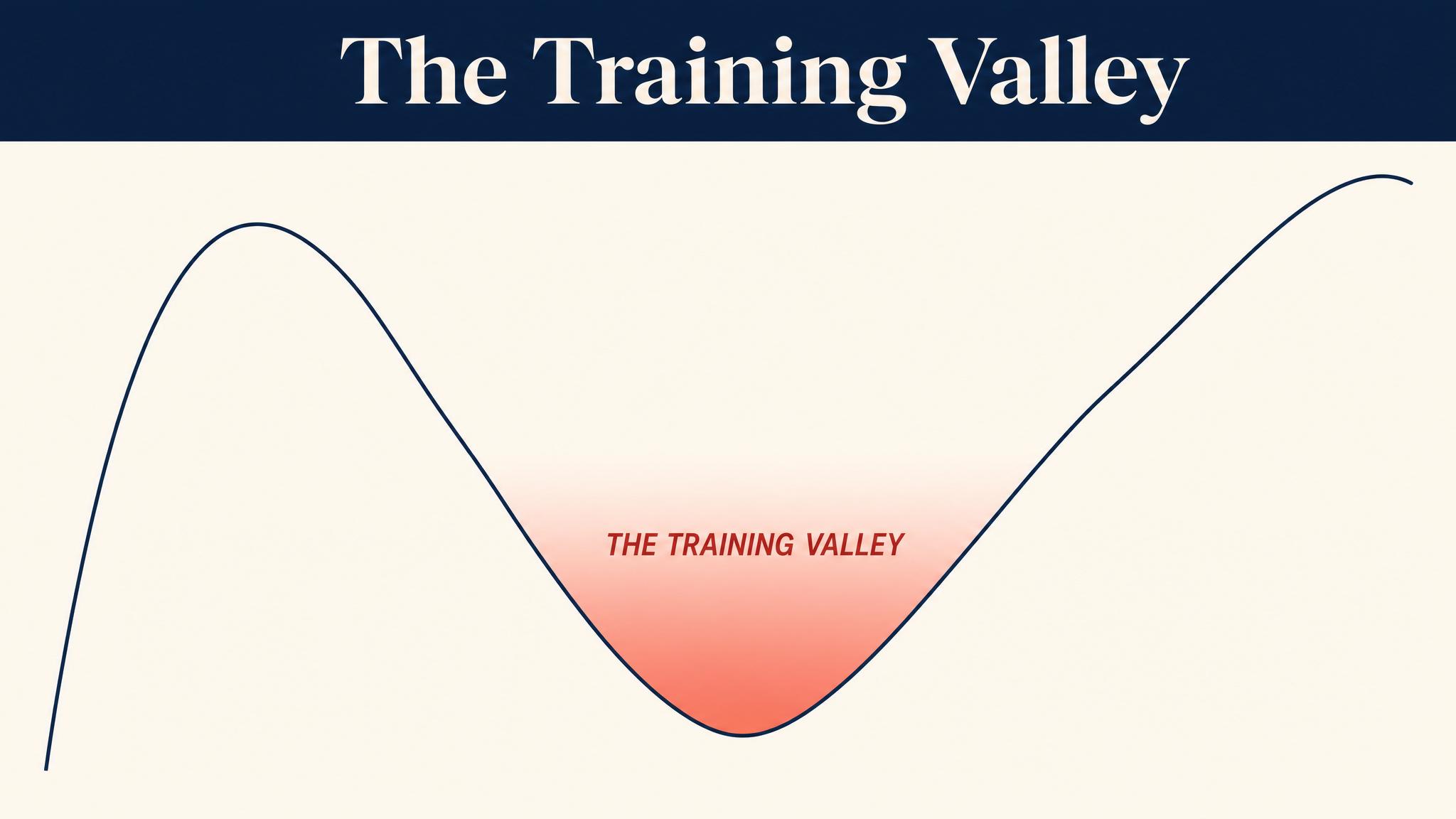

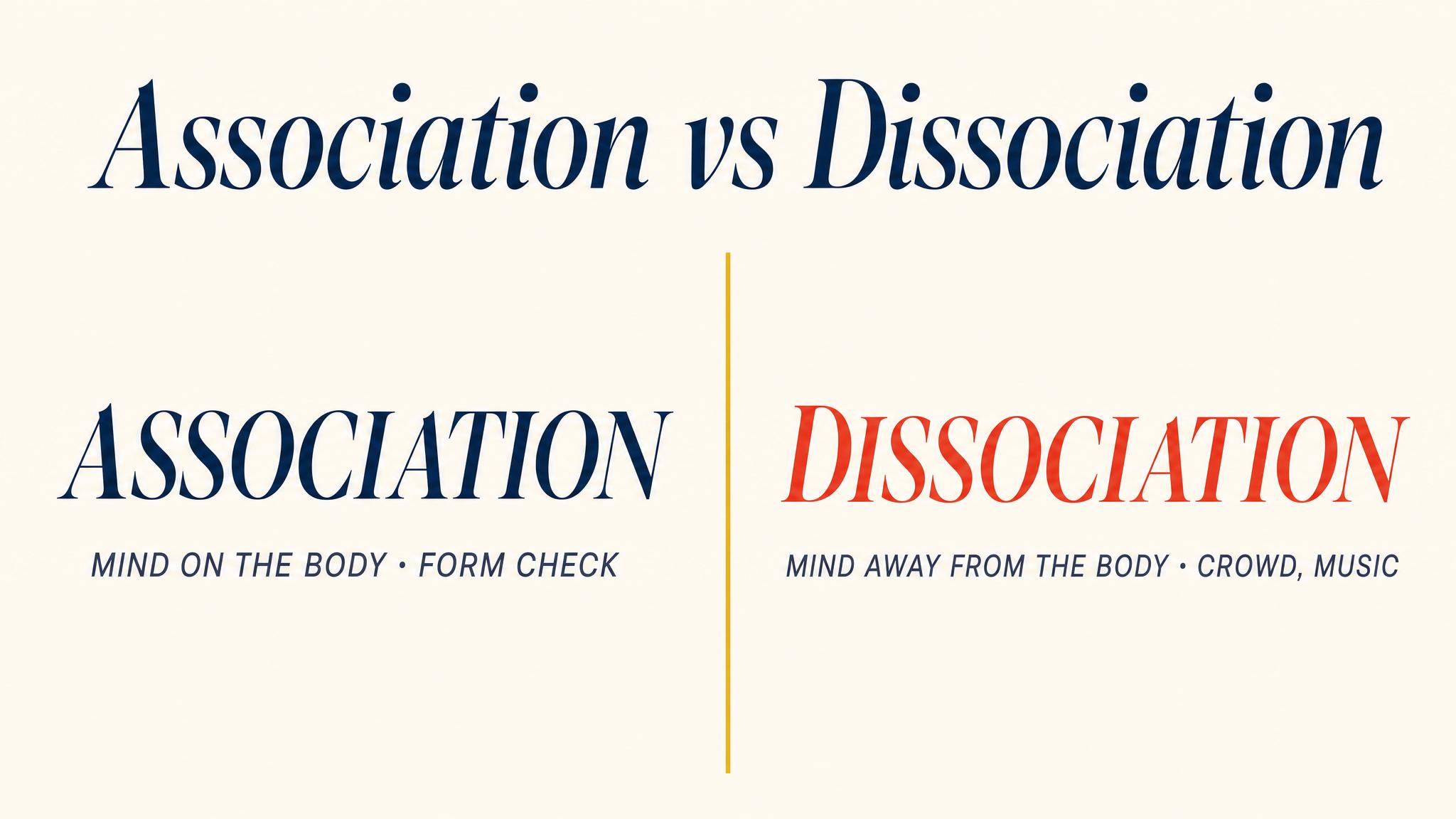
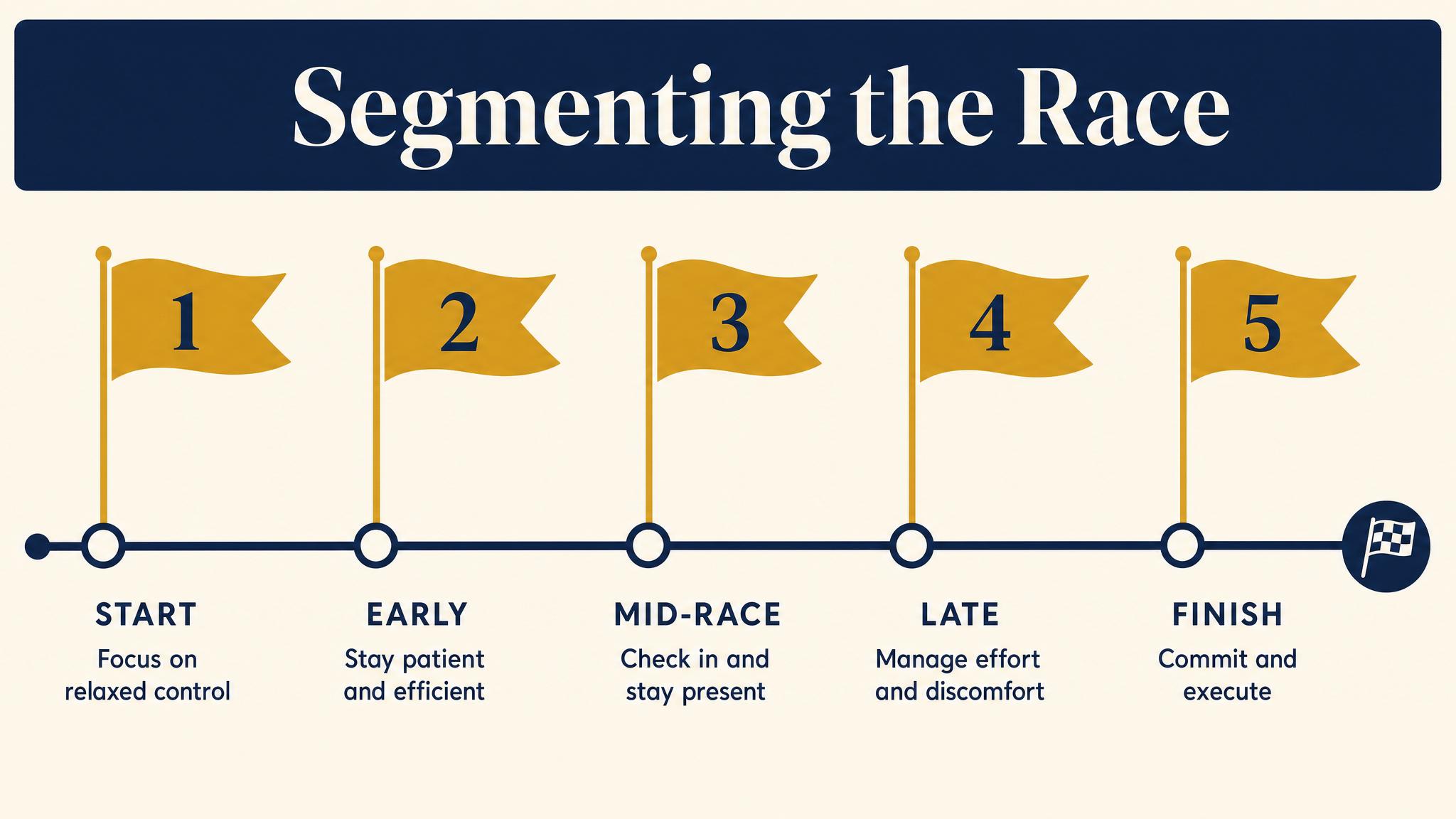

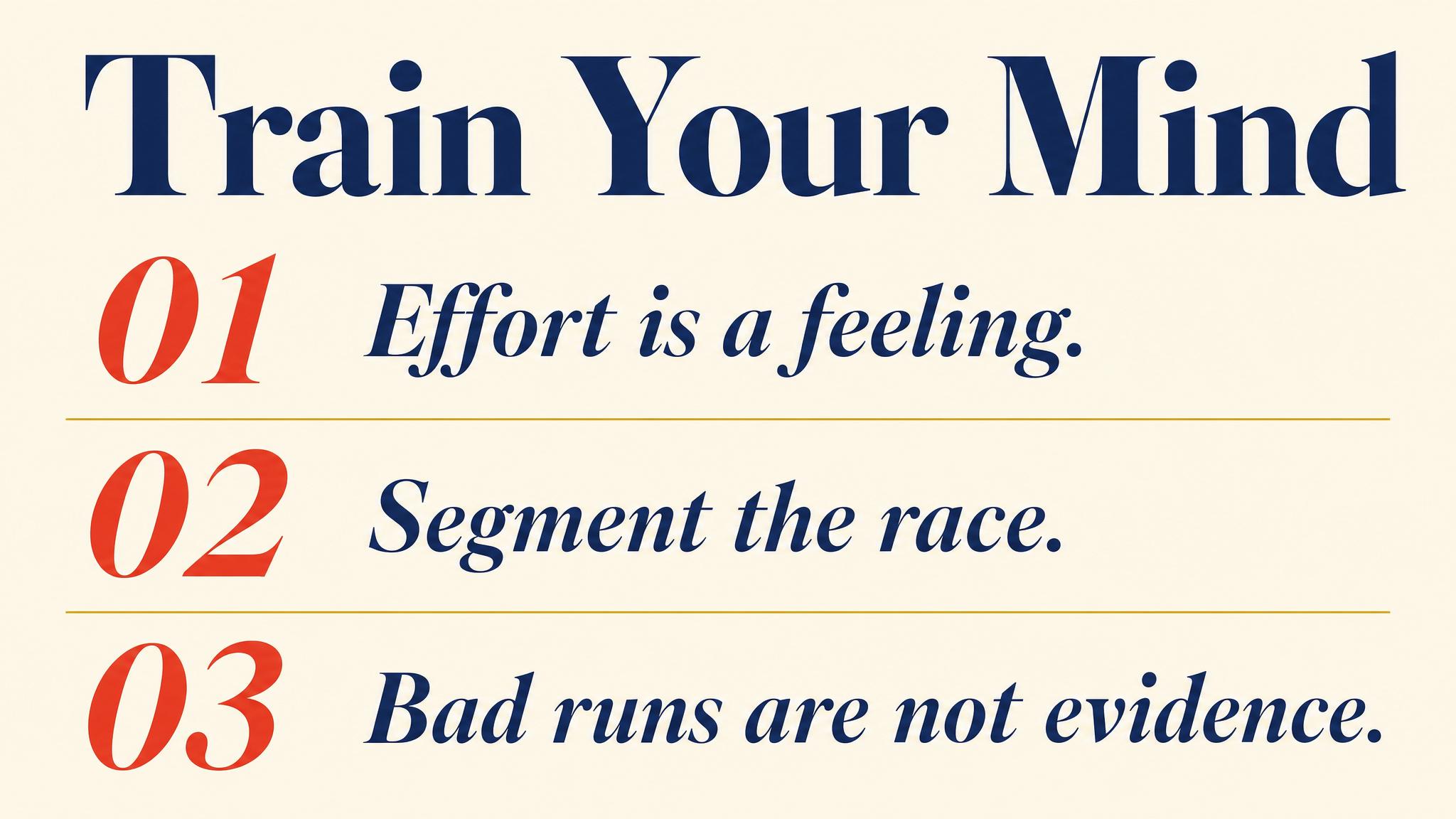

The Art of Doing Less: Taper, Gear, and Race-Week Mastery
This chapter covers the counterintuitive final phase of marathon preparation: the taper. After months of building fitness, students must now reduce their training volume to let their body consolidate its adaptations —…
Would you race in brand-new shoes that feel amazing or your beat-up lucky shoes?
Would you rather
Does resting the week before a big event make you feel ready or freak you out that you're losing your edge?
Real talk
Carb loading the night before: actual science or just a mental thing?
Myth or magic
Would you rather start fast and risk blowing up, or start slow and finish strong?
Pacing debate
What's worse: showing up undertrained or showing up overtrained and burnt out?
Which is worse
Ever tried new gear or strategy on game day? Did it save you or screw you over?
Risky moves
Race Day Disaster Stories: Diagnostic Challenge
15-20 minutesStudents are placed in breakout rooms of 4-5. Each room receives a real race day disaster scenario (e.g., 'Runner tried new energy gels at mile 18 and had GI distress', 'Cyclist wore brand new shoes on race day'). Groups must: (1) identify which principle was violated, (2) explain the physiological/psychological consequence, (3) propose what should have been done instead. Rooms reconvene and the instructor cold-calls groups to present their diagnosis. Other students vote on which diagnosis is most accurate using poll feature.
Taper Madness Debate: Scientists vs. Athletes
12-15 minutesSplit the class randomly into two camps: 'Team Science' argues for evidence-based taper protocols (reducing volume, maintaining intensity), while 'Team Athlete Psychology' argues that mental readiness matters more than perfect taper execution. Students use chat or collaborative doc to rapidly build arguments for their assigned side, citing course materials. After 5 minutes of prep in breakout rooms by team, conduct a structured 'rapid fire' debate where instructor poses scenarios and alternates between teams for 30-second responses. Students must defend their position even if they personally disagree. End with a nuanced synthesis poll: 'Where should the balance be?'
Carb Loading Protocol Design Competition
18-20 minutesBreakout groups of 5-6 receive identical athlete profiles (e.g., '32-year-old preparing for first marathon, race in 7 days'). Each group designs a race-week carbohydrate loading protocol using a shared spreadsheet template that calculates: days before race, carb grams/kg body weight, sample meals, rationale based on evidence. Groups must distinguish between evidence-supported practices and myths (e.g., 'pasta party the night before' vs. glycogen supercompensation timing). After creation, groups rotate through 3 other groups' spreadsheets, leaving comments on what's evidence-based vs. questionable. Instructor highlights the most evidence-based protocols and debunks common myths found in submissions.
Negative Split Pacing Simulator: The Math Challenge
10-12 minutesStudents work in pairs in breakout rooms. Each pair receives a target race time and distance (e.g., '4-hour marathon'). They must calculate: (1) even split pace, (2) a negative split strategy (first half 2-3% slower than second half), (3) predicted time difference between strategies. Then, pairs use a shared jamboard or whiteboard to sketch their energy expenditure curve and explain why negative splits work physiologically. Instructor uses a random selection tool to choose 3-4 pairs to share their calculations and curves, facilitating discussion about perceived exertion, glycogen depletion, and fatigue management.
Race Week Timeline: Crowdsourced Consensus Building
15 minutesUsing a collaborative timeline tool (Padlet, Miro, or shared doc), the entire class simultaneously builds a comprehensive race week timeline (7 days out to race morning). Each student adds 1-2 sticky notes with specific actions (e.g., 'Day 5: Last workout - short intervals at race pace', 'Day 1: Lay out all gear and check'). Students must tag their additions with which principle they support (taper, nothing new, carb loading, or pacing prep). As notes populate, students use commenting to challenge or support others' suggestions with evidence. Instructor moderates in real-time, moving evidence-based practices to a 'gold standard' column and controversial ones to a 'debate zone' for discussion.
Taper Physiology: The Recovery Metrics Game
10-12 minutesStudents receive a case study of an athlete with tracking data across a 2-week taper: training volume, HRV (heart rate variability), sleep quality, perceived fatigue, and performance markers. In breakout rooms of 4-5, groups analyze the data presented in graphs and must: (1) identify when the athlete is optimally tapered, (2) spot signs of overtraining or undertraining, (3) predict race-day readiness based on physiological markers. Groups submit their predictions via quiz/form. Instructor reveals the actual race outcome and which groups' predictions were most accurate, discussing which metrics were most predictive and why recovery indicators matter more than 'feeling ready'.
Transcript
It's two weeks before your marathon. You've logged more miles in the past four months than you ever imagined possible. Your long runs have crept past twenty miles. Your legs know the feeling of sustained effort. And now your training plan says something that feels like a cruel joke: run less. Significantly less. Your longest run this week might be eight miles — half of what you did two weeks ago. You feel sluggish, anxious, maybe a little panicky. Your calves ache in a way they didn't during peak training. You're convinced you're losing fitness by the hour. A voice in your head whispers: maybe just one more long run, just to be sure.
Welcome to the TAPER. It is the most evidence-supported phase of your entire training plan — and for most runners, it is the hardest to trust. This chapter will show you why doing less is the final piece of doing your best, and then walk you through every practical decision between now and the starting line.
[short pause]
A taper is a progressive, nonlinear reduction of training load in the final days before a goal race, designed to reduce the accumulated fatigue of training while preserving — or even enhancing — the fitness you've built. This was documented by Mujika and Padilla in 2003. Think of it this way: throughout training, you've been making deposits into two accounts simultaneously. One is your fitness account — cardiovascular capacity, muscular endurance, metabolic efficiency. The other is your fatigue account — microtrauma in muscle tissue, depleted glycogen stores, accumulated hormonal stress. During normal training, fatigue masks fitness. The taper allows fatigue to dissipate while fitness remains essentially intact.
The numbers are striking. Mujika and Padilla's seminal review in 2003 found that a well-executed taper improves performance by approximately three percent, with a range of zero point five percent to six percent. For a four-hour marathoner, three percent translates to roughly seven minutes — the difference between a triumphant finish and a desperate shuffle. A large-scale analysis of over one hundred fifty-eight thousand recreational marathon runners, conducted by Smyth and Lawlor in 2021, confirmed that strict three-week tapers were associated with a median time savings of five minutes and thirty-two seconds, or about two point six percent improvement.
[short pause]
The physiological changes during a taper are remarkable in their breadth. As training volume drops, several systems simultaneously recover and optimize.
First, GLYCOGEN SUPERCOMPENSATION. Your muscles replenish and then exceed their normal glycogen stores. As we discussed in Chapter 5, glycogen is your primary fuel source at marathon intensity. With reduced training demand and adequate carbohydrate intake, your muscles can store up to one point seven nine times their baseline glycogen levels — and those supercompensated levels persist for at least three days afterward, as Bussau and colleagues demonstrated in 1997.
Second, tissue repair. The microdamage accumulated in tendons, connective tissue, and muscle fibers over months of progressive loading finally gets time to heal completely. Inflammation markers decrease. Structural proteins are rebuilt.
Third, neuromuscular freshening. The communication between your nervous system and your muscles sharpens. You recruit muscle fibers more efficiently, and the subjective sense of "bounce" or "snap" in your legs returns — often dramatically in the final days before the race.
And fourth, hormonal recovery. Cortisol levels, which are elevated during heavy training, decrease, while testosterone and growth hormone ratios normalize. Your immune system strengthens — critical, since the last thing you need is a cold the week before your marathon.
A recent meta-analysis from 2023 confirmed that these performance gains come primarily from fatigue reduction rather than fitness improvements — your V-O-two-max and running economy don't significantly change during the taper. You're not getting fitter. You're finally getting to use the fitness you already have.
[short pause]
Research converges on three key principles for structuring your taper, as documented by Mujika and Padilla in 2003 and confirmed in the 2023 meta-analysis.
First, reduce volume substantially. Cut total weekly mileage by forty to sixty percent overall, spread across two to three weeks. A progressive, nonlinear reduction is superior to a sudden "step" drop.
Second, maintain intensity. This is the counterintuitive part. You still include some tempo or marathon-pace work — just far less of it. Intensity preserves neuromuscular adaptations and cardiovascular fitness. Easy jogging alone during the taper can actually lead to slight detraining.
Third, slightly reduce frequency. Drop no more than twenty percent of your training sessions. If you normally run five days a week, run four. Keeping your running schedule mostly intact provides psychological stability and maintains the movement pattern.
[short pause]
If the physiology of tapering is straightforward, the psychology is anything but. Up to seventy-eight percent of marathon runners experience significant anxiety during their taper, a phenomenon so universal that runners have given it a name: TAPER MADNESS. This research comes from Runners Connect in 2025. Symptoms include restlessness, irritability, difficulty sleeping, sudden conviction that you've lost all fitness, and — perhaps most insidious — phantom pains. A 2019 study tracking one hundred fifty-six marathoners found that sixty-seven percent reported new aches or pains during their taper that weren't actual injuries but rather a hyperawareness of normal sensations.
This makes psychological sense. For months, your training routine has provided structure, stress relief, and daily evidence that you're becoming ready. Suddenly, that evidence stream dries up. Research by Carla Meijen has documented what she calls training volume dependence — a psychological reliance on high training loads as proof of preparedness. When the volume drops by more than thirty percent, endurance athletes experience a roughly forty percent increase in anxiety. Your brain interprets reduced activity as a threat, not a strategy.
Managing taper madness starts with expecting it. If you know that anxiety, phantom pains, and restlessness are normal — experienced by the vast majority of runners — they lose much of their power. Beyond normalization, practical strategies include maintaining your running schedule, just at lower volume, replacing some running time with gentle walking or yoga, keeping a brief journal of your emotional state — naming the anxiety reduces its grip — and reminding yourself repeatedly that the science is unambiguous: the taper works.
[short pause]
If there's one piece of marathon folklore that everyone knows, it's the pre-race pasta dinner. The idea has calcified into ritual: the night before the marathon, you eat an enormous plate of spaghetti, and somehow those noodles transform into twenty-six point two miles of fuel. The reality is both more nuanced and more useful.
Carbohydrate loading — or glycogen supercompensation through dietary manipulation — genuinely works. But it's not a single meal; it's a multi-day process. Burke, in 2007, established that well-trained runners can achieve muscle glycogen supercompensation by tapering exercise over the final days before the marathon while consuming ten to twelve grams of carbohydrate per kilogram of body weight per day over the thirty-six to forty-eight hours prior to the race. For a seventy-kilogram runner, that's seven hundred to eight hundred forty grams of carbohydrates per day — far more than a single dinner of pasta can provide.
The old-school approach involved a "depletion phase" — several days of very low carbohydrate intake followed by aggressive loading. Modern research has abandoned this entirely. Burke in 2007 found no evidence that a depletion phase provides any benefit, and it carries real risks of irritability, poor sleep, and compromised immunity in the days when you can least afford them. As Solem, Clauss, and Jensen confirmed in 2025, effective glycogen supercompensation depends on three factors: your baseline glycogen levels, post-exercise glycogen content, and the relative carbohydrate content of your diet — not on prior depletion.
[short pause]
Starting approximately three days before the race, coinciding with your taper's most reduced volume, gradually increase carbohydrate intake to that ten to twelve grams per kilogram target. This doesn't mean gorging on enormous meals — it means making carbohydrates the dominant macronutrient at every eating opportunity: oatmeal and fruit at breakfast, rice and bread at lunch, pasta or potatoes at dinner, with simple carbohydrate snacks like pretzels, fruit juice, and sports drinks between meals. Crucially, Bussau and colleagues in 1997 demonstrated that supercompensated glycogen levels persist for at least three days when you subsequently consume a moderate-carbohydrate diet, around sixty percent of calories. This means you don't need to cram everything in the night before — in fact, you probably shouldn't. A familiar, moderately sized dinner the evening before the race, heavy on carbohydrates but not uncomfortably large, is the evidence-based approach.
[short pause]
Of all the principles in this course, this one may be the simplest to state and the hardest to follow: NOTHING NEW ON RACE DAY. Every piece of clothing, every fuel source, every piece of technology you use in the marathon should have been tested in training — ideally during a long run of fifteen-plus miles, in conditions as close as possible to what you'll face on race morning.
The reason is that the marathon amplifies everything. A sock seam you never noticed on a five-mile run becomes a bleeding blister at mile eighteen. A new energy gel that seemed fine on a short run causes gastrointestinal distress when your gut is already under stress at race pace. A fresh pair of shoes — even the same model — with stiff, un-molded insoles can create friction points that never had time to develop in shorter distances. The race expo, with its shiny vendor booths and free samples, is designed to tempt you into exactly these mistakes.
This principle extends beyond gear to behavior. If you've never taken caffeine before a run, race morning is not the time to start. If you always eat a bagel with peanut butter two hours before your long runs, eat a bagel with peanut butter two hours before the marathon. If you've been using a specific brand of sports drink at aid stations during training, find out what the race course provides — and if it's different, carry your own.
[short pause]
You are standing in your corral. The gun fires. Thousands of runners surge forward. Adrenaline floods your system. Your planned nine-minute per mile pace feels absurdly easy — your legs want to fly. You click off mile one in eight minutes fifteen seconds and feel fantastic. Mile two: eight minutes ten seconds. You think, Maybe I've been underestimating myself this whole time.
This is how most first marathons fall apart.
The research on pacing strategy is unambiguous, and it connects directly to the glycogen physiology we explored in Chapter 5. Starting too fast increases glycogen breakdown through anaerobic glycolysis, leading to premature depletion and the accumulation of fatigue-inducing metabolites. This was documented in 2025 by multiple researchers. At paces even slightly above your aerobic threshold, you shift the proportion of fuel sourced from glycogen dramatically upward — burning through those precious stores at a rate your body can't sustain for twenty-six point two miles. This is the physiological mechanism behind "the wall," and it is almost entirely avoidable through disciplined pacing.
[short pause]
A negative split means running the second half of the race faster than the first. An even split means maintaining roughly the same pace throughout. A positive split — the most common pattern among beginners — means starting faster and fading. Analysis of world-class marathon performances shows that record-breaking races almost universally follow even or slight negative split profiles, as research from 2025 demonstrates.
The physiological advantages of conservative early pacing are comprehensive. Starting slowly preserves glycogen by keeping you in a primarily aerobic zone, reduces early lactate accumulation, delays central nervous system fatigue, minimizes cardiovascular drift — that's the progressive increase in heart rate at a fixed pace as the body overheats and dehydrates — and allows better thermoregulatory control. In practical terms: running fifteen to twenty seconds per mile slower than your goal pace for the first three to five miles costs you about one to two minutes but can save you ten to fifteen minutes later in the race.
Smyth and Lawlor, in their 2021 study, found a fascinating gender difference in their analysis of one hundred fifty-eight thousand runners: male runners tend to make sub-optimal pacing decisions, starting faster and pacing less evenly than women, forgoing an average of four point four nine minutes compared to a more conservative strategy. The implication is clear — and it applies to everyone, regardless of gender: the urge to start fast is powerful, and giving in to it is costly.
[short pause]
With your taper planned, nutrition dialed in, and pacing strategy committed to memory, a handful of logistical details deserve attention in the final days.
Most runners fixate on the night before the race, but research consistently shows that it's the sleep two and three nights before an event that matters most for performance. Expect to sleep poorly the night before — pre-race excitement and early alarm times make it nearly inevitable. Bank your sleep earlier in the week. Aim for eight or more hours on Wednesday and Thursday nights before a Sunday race.
If you're running a destination race, arrive at least two days before the marathon. This allows time to adjust to the time zone, walk — don't run — the final miles of the course if possible, attend the expo without time pressure, and troubleshoot any logistical surprises. At the expo, pick up your bib, buy the commemorative shirt if you want, and leave. Your feet will thank you. Hours of walking on concrete expo floors the day before a marathon is a surprisingly common mistake.
[short pause]
Build your race morning backward from the gun time. If the race starts at seven A-M: wake up at four-thirty A-M. This gives your body time to fully wake and your digestive system time to process breakfast. At five A-M, eat your pre-race meal — the same meal you've practiced before long runs. Typically three hundred to five hundred calories of easily digested carbohydrates with minimal fat and fiber. At six A-M, arrive at the start area. Use the restroom — the lines will be long. Apply anti-chafe products. Do a light dynamic warm-up of five to ten minutes. At six-forty A-M, enter your corral. Drop your warm-up clothes for bag check. At seven A-M, the gun fires. You start conservatively. You trust the taper. You trust the plan.
[short pause]
The final week before your marathon is not about fitness — that ship has sailed. It's about optimization: arriving at the start line rested, fueled, organized, and mentally calm. Every decision this week should pass through a simple filter: Does this help me run well on Sunday, or does it satisfy my anxiety right now? The taper handles the physiology. Carb loading handles the fuel. The "nothing new" principle handles the gear. Conservative pacing handles the race strategy. All that's left is trusting the process you've built across the six chapters that preceded this one.
You've done the work. Now let it work for you.


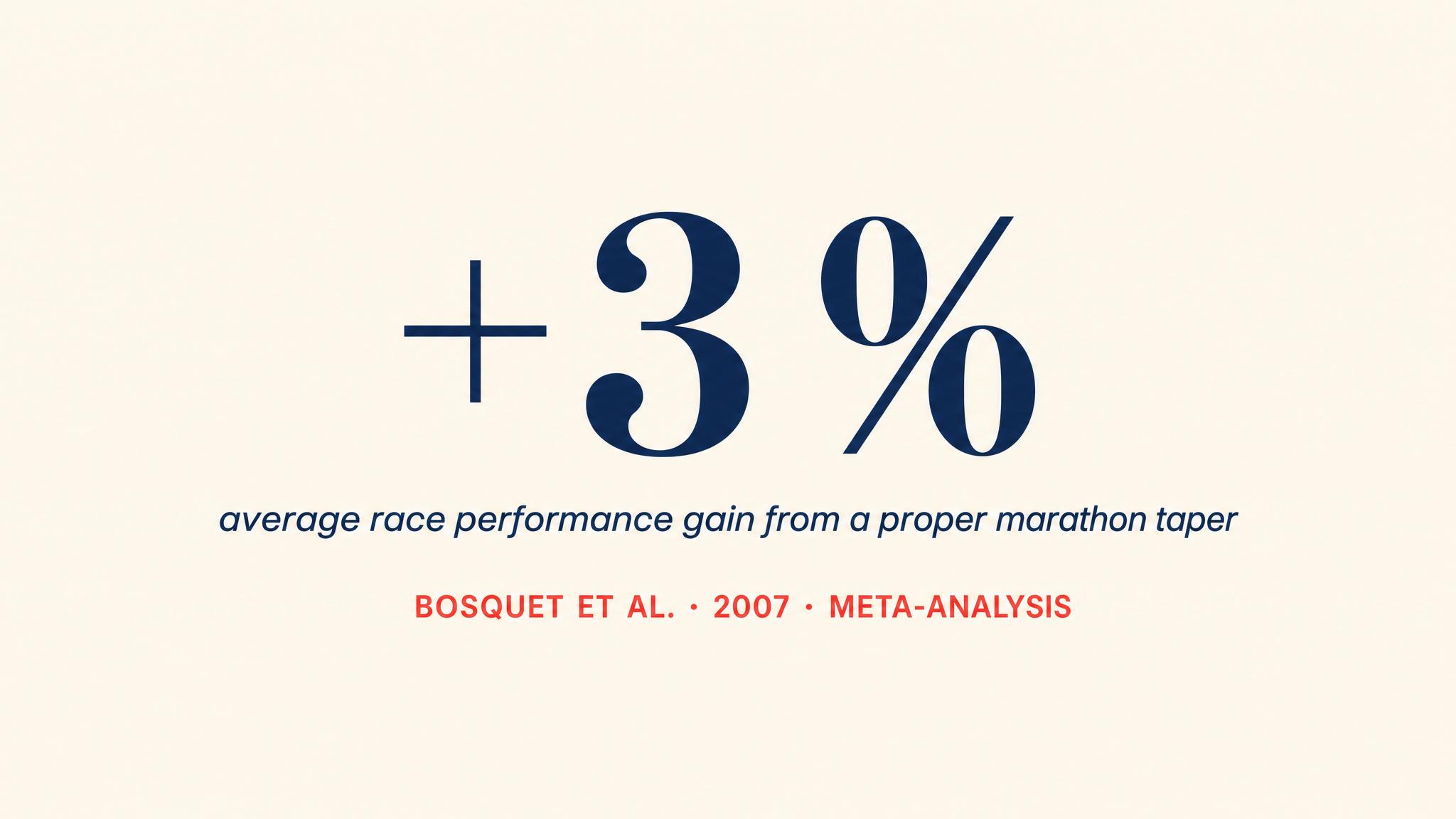
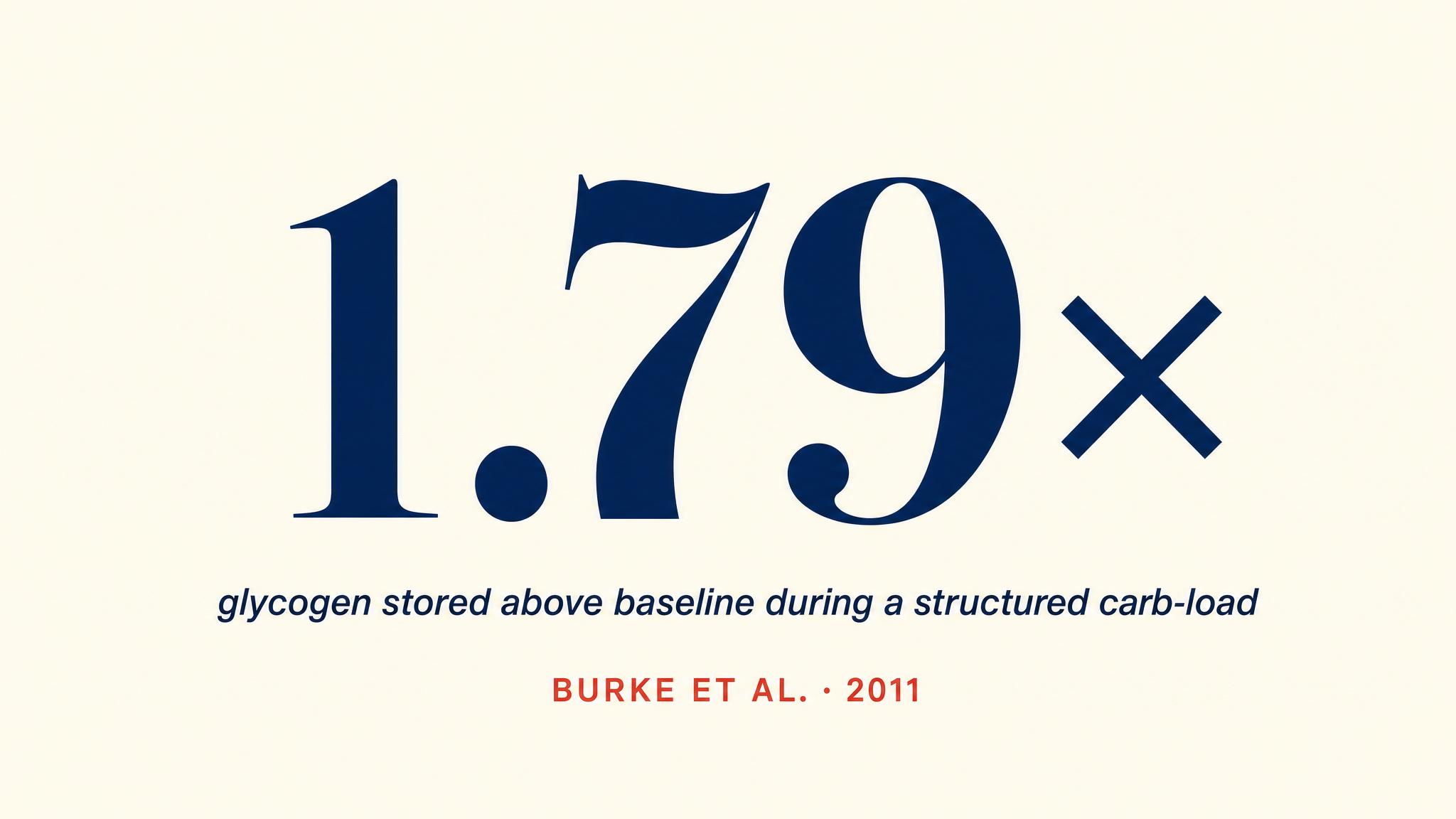
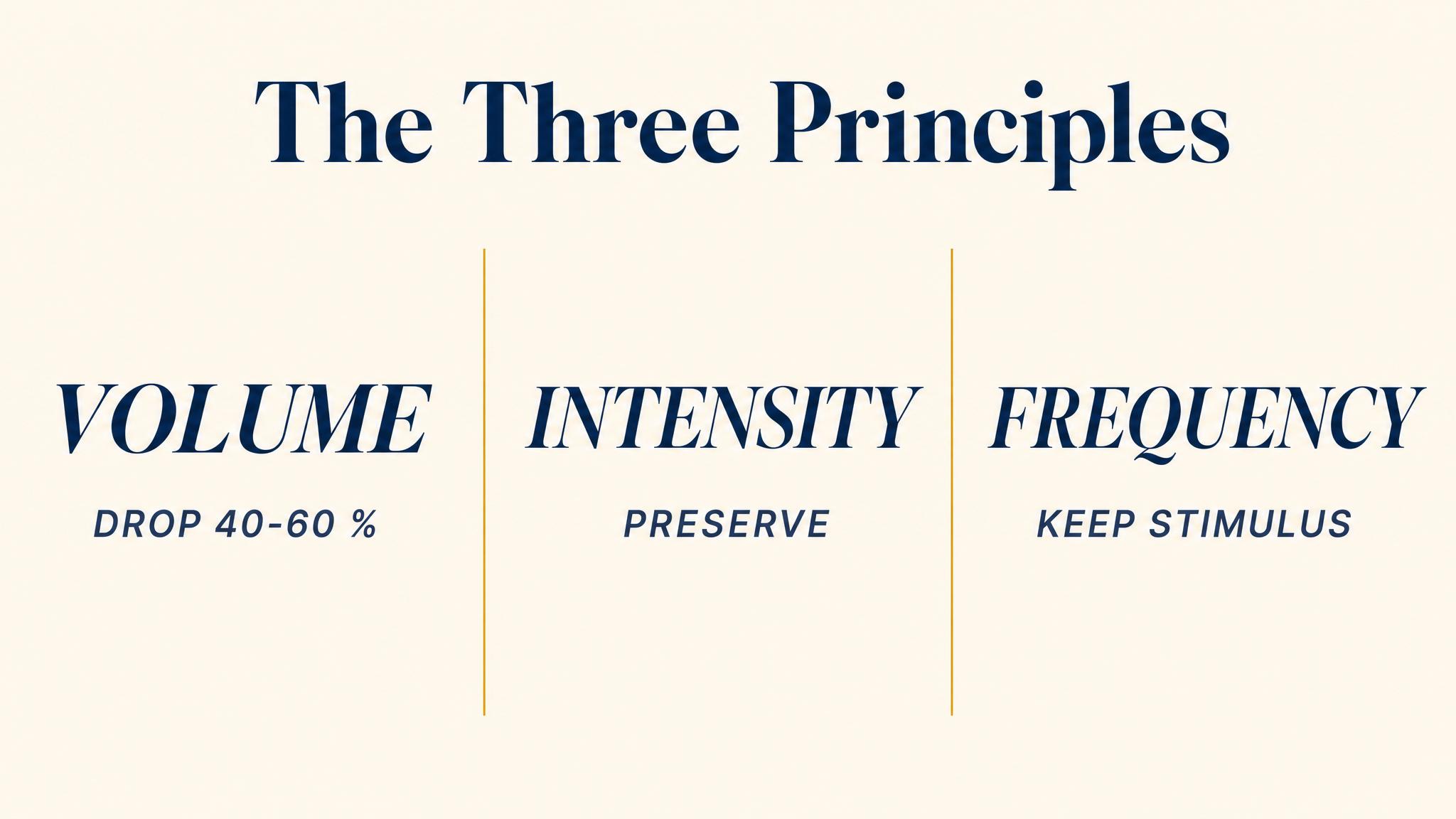

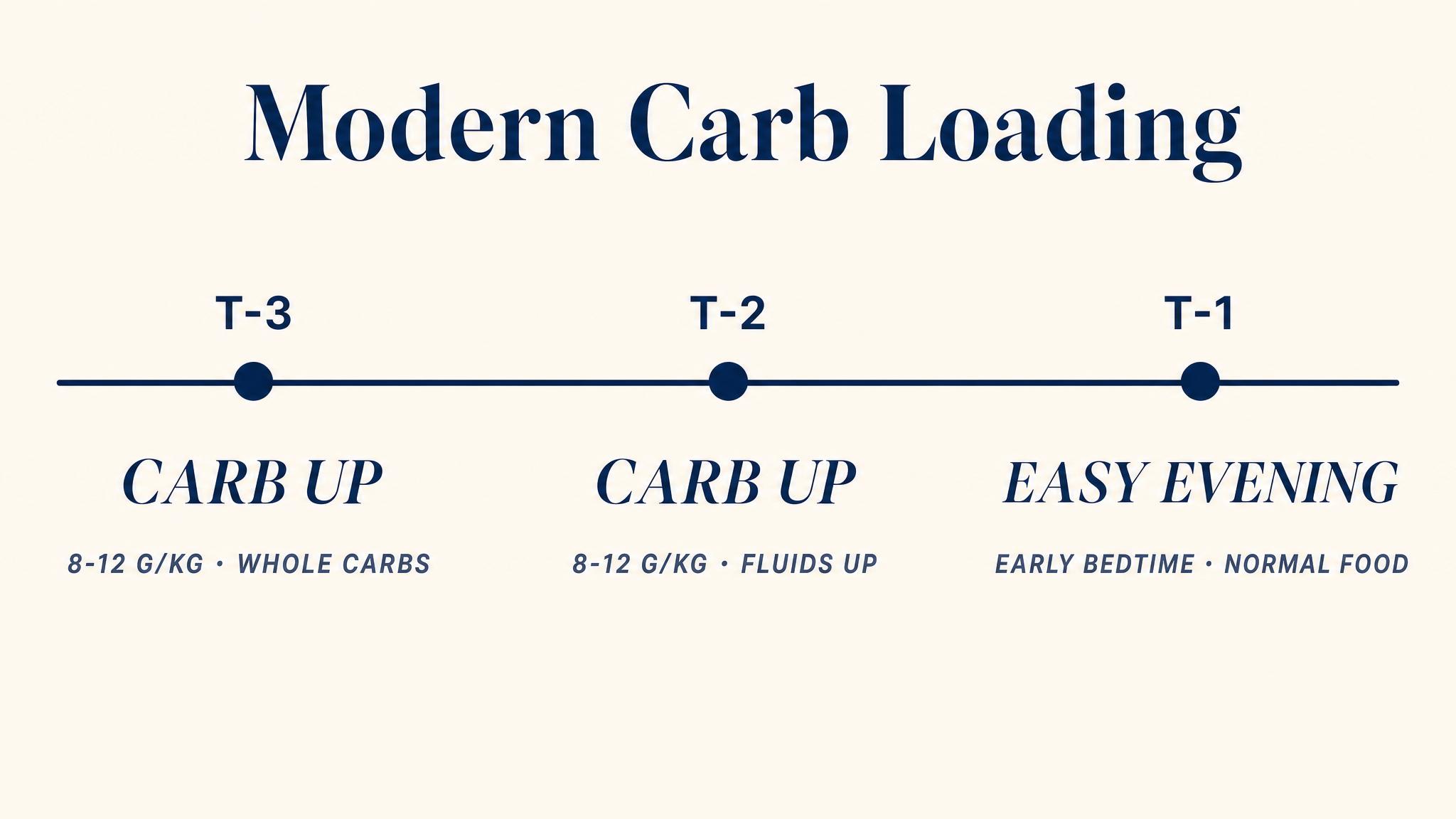

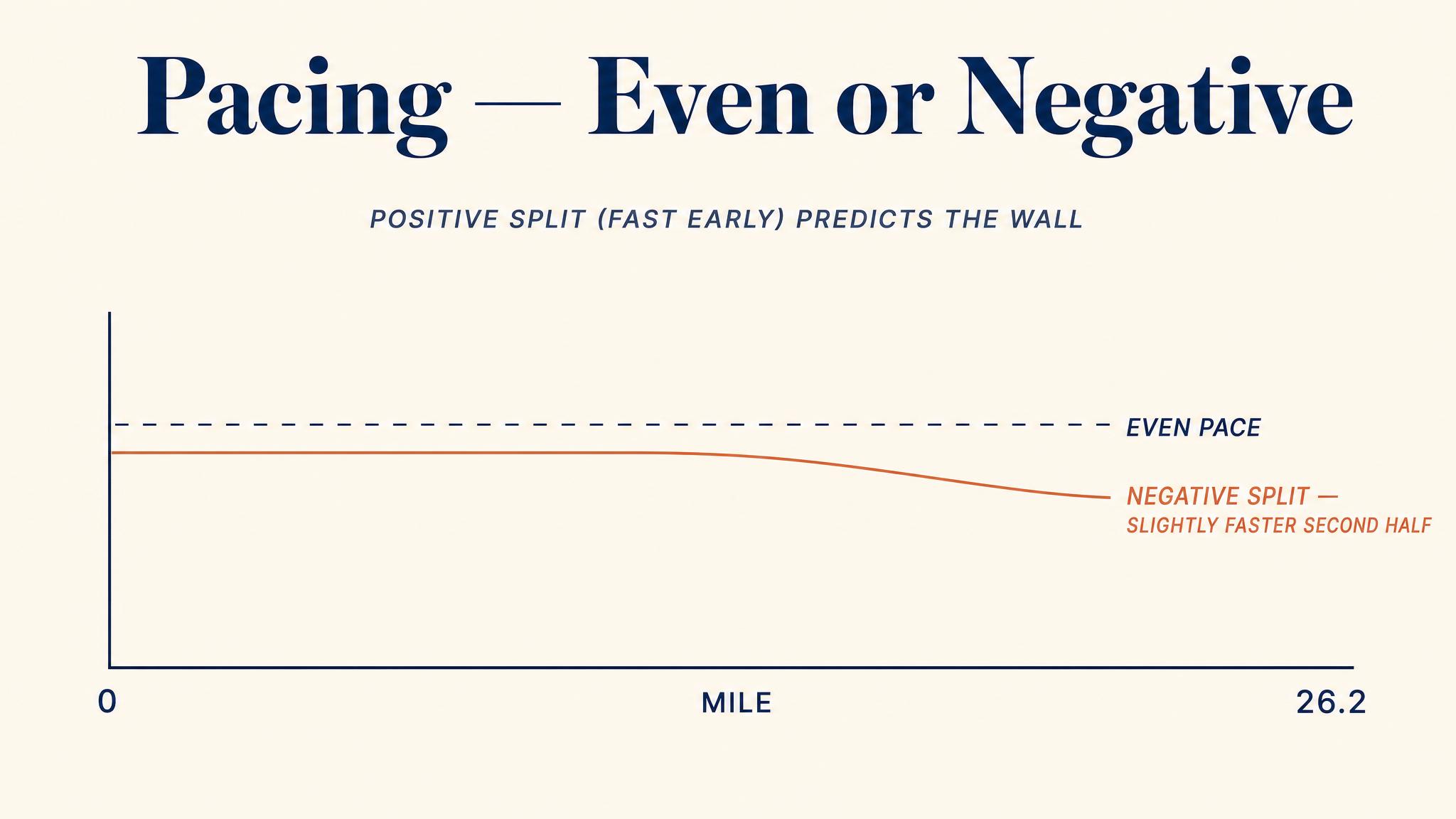

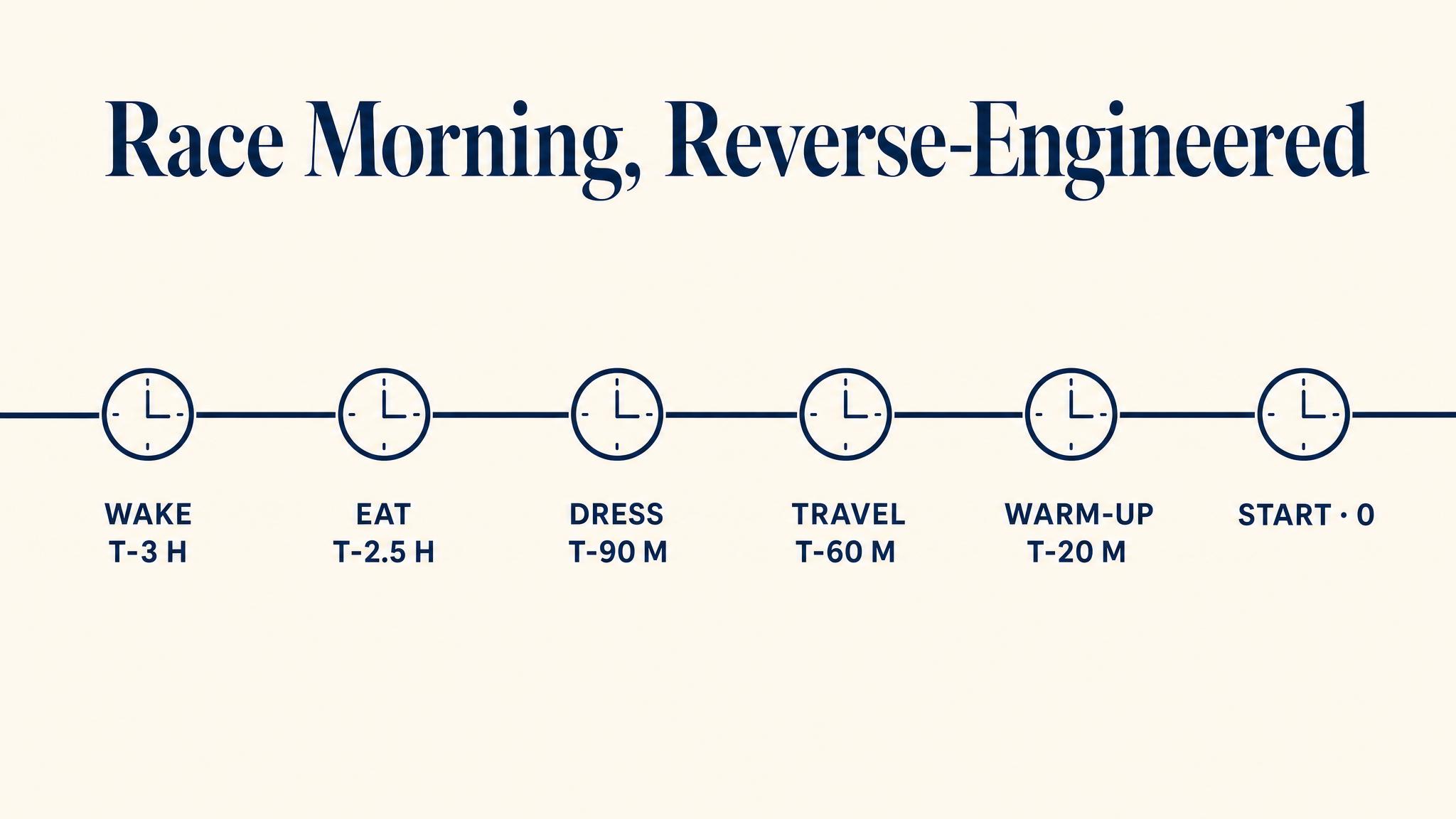

26.2: Race Day and the Runner You've Become
This is the chapter that brings everything together — literally. Students have spent seven chapters building knowledge about their bodies, their training, their nutrition, their minds, and their race plan. Now they walk…
When do you officially become 'a runner' — when you sign up for your first race, when you finish it, or just when you decide you are one?
Identity check
Would you rather race with legs that feel amazing but a brain that wants to quit, or a mind that's locked in but legs that are screaming?
Would you rather
Which would you pick: perfect race-day weather but you're undertrained, or terrible weather but you're in peak shape?
Tough choice
What ruins a race more: starting way too fast, or playing it too safe and finishing with gas left in the tank?
Debate time
Real talk: if you're struggling at mile 18 and could walk the rest without anyone you know seeing you, would you?
Honest moment
Which feels weirder after your first race: how destroyed your body is, or that you're already thinking about the next one?
Post-race feels
Race-Day Crisis War Room
15-20 minutesStudents join breakout rooms (4-5 per room). Each group receives a different mid-race crisis scenario via shared doc (e.g., 'Mile 18: stomach cramping, 10 min behind goal pace, 82°F'). Groups have 8 minutes to decide: push through, adjust pace, DNF, change fuel strategy? They document their decision rationale, then rooms rotate and critique another group's decision. Instructor debriefs common patterns and reveals 'what happened' for each scenario.
The Pacing Strategy Showdown
18-22 minutesDivide class into three camps via poll: Even Pace, Negative Split, or Banking Time Early. Students join breakout rooms with their 'team' (5-6 per room). Each team builds a case with evidence from course materials for why their strategy is superior for marathon success. Teams elect a spokesperson. Return to main room for structured debate (3 min per strategy, 2 min rebuttals). Live poll at end to see if anyone changed their mind.
Before & After: Runner Identity Gallery
12-15 minutesStudents individually complete a quick Jamboard/Padlet post with two contrasts: 'Before this training: I thought runners were...' vs. 'Now I am a runner who...' (2 min). Then in breakout trios, students share their transformations and identify common themes (6 min). Each trio nominates the most striking transformation story. Back in main room, selected students share (30 seconds each). Class identifies patterns in identity shift via chat reactions.
Build Your 7-Day Recovery Protocol
16-20 minutesIn breakout rooms of 4, students roleplay as a 'recovery team' for a hypothetical runner (bio provided: age, experience level, race result, goals). Groups create a detailed 7-day reverse taper plan covering: nutrition, sleep, active recovery, when to resume running, injury monitoring. They log this in a shared spreadsheet. Groups then visit one other group's spreadsheet and leave feedback comments. Instructor shares standout protocols and corrects dangerous misconceptions.
The Mental Strategy Arsenal Exchange
10-12 minutesStudents annotate a collaborative document with one mental strategy they've personally used or plan to use during tough race moments (e.g., 'counting steps to 100, mantra, visualization'). In breakout pairs, students speed-date style (3 min per round, 2 rounds): share when/why their strategy works and 'trade' by adopting one strategy from their partner to add to their own toolkit. Quick main room shareout: 'Who found a strategy they're stealing?' via chat flood.
Integrated Race Simulation: Mile-by-Mile
20-25 minutesInstructor advances through a virtual marathon mile-by-mile (3-5 key miles). At each mile, students receive conditions (temperature, how they feel, split times, fuel status) and make three quick decisions via individual form: pace adjustment, fuel/hydration intake, mental strategy to deploy. Results are aggregated live via dashboard. Breakout rooms of 5-6 discuss: 'What influenced your choices? What's the consequence of that decision by mile 20?' Instructor reveals outcome of common decision patterns.
Transcript
The alarm goes off at four fifteen a.m. and you are already awake. You've been staring at the ceiling for eleven minutes, running a race that hasn't started yet. Your stomach is doing something between hunger and nausea. Your legs feel simultaneously heavy and electric. You reach for your phone and check the weather for the fourth time since midnight: fifty-two degrees Fahrenheit, partly cloudy, light wind from the southwest. Good conditions. You know this because seven chapters ago, you didn't know what "good conditions" even meant for a marathon.
Today is the day. Not someday. Not eventually. Today. And here is the truth that will carry you through the next several hours: you are more prepared than you feel. The anxiety vibrating through your body right now is not evidence that something is wrong—it's your nervous system acknowledging that something extraordinary is about to happen. Everything you've learned about your physiology, your fueling, your pacing, and your mind is about to be tested in real time. Let's walk through exactly how this day unfolds.
[short pause]
Before the gun, the morning begins with crucial preparation. You eat three to four hours before your start time—not because you read it somewhere once, but because you understand why. Your body needs time to digest and shuttle those carbohydrates into accessible blood glucose without competing with your working muscles for blood flow. Your pre-race meal should be familiar, carbohydrate-rich, moderate in protein, and low in fat and fiber: a bagel with peanut butter and banana, oatmeal with honey, or whatever you tested during your long runs. According to Burke in 2007, you should consume one to four grams of carbohydrate per kilogram of body weight in this pre-race window, topping off the glycogen stores you carefully loaded over the past thirty-six to forty-eight hours.
This is not the morning for culinary adventure. If the hotel breakfast buffet has something exotic and appealing, admire it from a distance. Eat what you know. Drink what you know. Sip water or a sports drink steadily but don't overhydrate—your urine should be pale yellow, not clear.
Arrive at least sixty to ninety minutes before the gun. This buffer isn't luxury—it's logistics. You'll need time to check gear, use the portable toilets (the lines are legendary for a reason), do a gentle five to ten minute warm-up jog, and find your corral. Dress for how you'll feel at mile four, not how you feel standing still at the start. Many experienced marathoners wear old throwaway layers that they shed after the first mile.
In the corral, your heart rate will be elevated. The crowd energy is intoxicating—thousands of people vibrating with the same anxious excitement. This is where pre-race arousal regulation matters. Use the breathing techniques: a slow four-count inhale, a six-count exhale. You're not trying to eliminate the butterflies. You're organizing them into formation.
[short pause]
Recall the difference between ANXIETY, which impairs performance, and AROUSAL, which can enhance it. The physical sensations are nearly identical—elevated heart rate, quick breathing, muscle tension. What determines the effect is your interpretation. Try reframing right now: "I'm not nervous; I'm ready."
[short pause]
The gun fires. The crowd surges. Music blasts from speakers along the course. Spectators are cheering for you by name if it's on your bib. Adrenaline floods your system, and your legs feel impossibly light. You glance at your watch after the first mile and see a pace that is thirty to forty-five seconds per mile faster than your plan.
This is the single most important moment of your entire marathon. What you do right now—in the intoxicating ease of mile one—determines what happens at mile twenty-two.
A systematic review of marathon pacing by multiple researchers in 2024 tells us what happens to most runners: seventy-seven percent of studied marathon performances showed positive pacing—meaning the runner slowed in the second half, often dramatically. The runners who held pace or ran negative splits (faster second half) almost universally started conservatively. This isn't a coincidence. It's physiology.
Remember the GLYCOGEN DEPLETION MODEL: your muscles carry a finite fuel supply, and the rate of burn is exponentially tied to intensity. As Rapoport demonstrated in 2010, every minute you spend above your target pace in miles one through six is borrowed from miles twenty through twenty-six. The interest rate is brutal. A pace that feels "easy" right now, when your glycogen stores are full and your muscles are fresh, will feel impossible to maintain when those stores are depleted.
The first few miles of a marathon are not where races are won. They're where races are lost.
Your job in this segment is deceptively simple: run your planned pace. Use your watch. Let people pass you. It will feel like you're holding back—and you are. That's the point. The easy pace you learned earlier trained your body to be efficient at lower intensities. Now you're deploying that efficiency strategically: the opening-miles governor that saves your fuel for when you'll need it most.
Think of it this way: glycogen depletion and perceived effort both increase across twenty-six point two miles, but starting too fast accelerates both curves dramatically.
[short pause]
By mile seven, the adrenaline has burned off. The spectator crowds have thinned. The gap between runners has widened, and you've settled into something that feels less like a parade and more like work. Good. This is where you were always meant to be: in the groove.
Your breathing should be rhythmic and controlled. You should be able to speak in short sentences—not comfortably, but functionally. If you're gasping, you're too fast. If you could hold a phone conversation, you might be too slow. Your body is now in a steady state of AEROBIC METABOLISM, burning a mix of glycogen and fat, the proportions shifting based on your intensity—exactly the physiology you learned earlier.
This segment is where your fueling plan activates in earnest. According to Burke in 2007, you need sixty to ninety grams of carbohydrate per hour during the marathon, and Rapoport's computational model in 2010 confirms that inadequate fueling dramatically shortens the distance you can cover before hitting the wall. For most runners, this means consuming a gel, chew, or sports drink every thirty to forty-five minutes starting around mile five or six.
Take your fuel on schedule, not on feel. By the time you feel depleted, you're already in trouble—the sensation of glycogen depletion lags behind the actual metabolic reality. Pair gels with water, never sports drink—the combined sugar concentration can cause gastrointestinal distress. Walk through aid stations if you need to. The ten to fifteen seconds you "lose" are trivial compared to the fueling benefit.
Think about your planned fueling schedule. What product are you using, and at which mile markers will you take it? If you can't answer this instantly, you need to finalize it before race morning. The middle of a marathon is not the place to improvise nutrition strategy.
Miles seven through thirteen present a unique psychological challenge. The excitement of the start has faded, but the difficulty of the final miles hasn't arrived. You're in a no-man's-land of effort—working hard enough to be uncomfortable, but not hard enough to feel heroic. This is where mental fatigue begins to accumulate. Research from 2018 on mental fatigue in endurance sports shows that the cognitive demands of pacing, monitoring, and decision-making gradually deplete the same motivational resources you'll need later.
Deploy your low-intensity mental strategies here: association cues (focusing on form—relaxed hands, quick cadence, upright posture), chunking the course into smaller segments ("just get to the next aid station"), and positive self-talk mantras. Save the heavy psychological artillery for later. You'll need it.
[short pause]
Runners call miles fourteen through twenty the honest miles because it's where the race reveals who actually trained and who just hoped for the best. The half-marathon mark at thirteen point one is psychologically tricky—you're "halfway" by distance but nowhere near halfway by effort. The second half of a marathon is physiologically harder than the first even at identical pace, because your glycogen stores are lower, your muscles have accumulated more microtrauma, and your thermal load is higher.
This is where pacing discipline either pays dividends or collects debts. If you banked time in the early miles by running fast, you'll start paying now—your legs will feel the glycogen deficit as a heaviness that no amount of willpower can fully override. If you ran controlled, you should feel challenged but capable. Not comfortable. Capable.
Somewhere in miles fourteen through twenty, something will hurt that didn't hurt before. A knee twinge. A hip tightness. A blister announcing itself. This is where the PAIN DECISION FRAMEWORK becomes operational. Ask yourself three questions:
Is the pain sharp, localized, and worsening with each step? This suggests a structural issue. Slow down, alter your gait slightly, and reassess after a quarter mile. If it continues worsening, you may need to walk or stop.
Is the pain dull, diffuse, and stable? This is likely fatigue-related discomfort—the normal cost of running sixteen-plus miles. It's real, but it's not dangerous. Acknowledge it and keep moving.
Does the pain change when you change pace or form? If it disappears when you slow slightly or adjust your stride, it's mechanical and manageable. If it persists regardless, pay closer attention.
Most of the pain you'll experience in a marathon is the second category: real, unpleasant, and not a sign of injury. The psychobiological model of endurance performance, as described by Pageaux in 2014, tells us that PERCEIVED EFFORT—not actual physiological limits—is the primary determinant of whether you continue or stop. Your brain is constantly calculating whether the effort is "worth it." Your job is to keep the answer yes.
[short pause]
Welcome to the part of the marathon that makes it a marathon. Everything before mile twenty was a prologue.
The physiological reality is stark. For many runners, glycogen stores are critically low by mile twenty. As Rapoport demonstrated in 2010 through computational modeling, a runner's "distance to the wall" depends on starting glycogen, pace, and mid-race fueling—and that even with optimal nutrition, the final ten-K is a fundamentally different metabolic experience. Your body is now relying more heavily on fat oxidation, which produces energy more slowly than glycogen metabolism. The same pace that felt sustainable at mile ten now requires dramatically more perceived effort.
And this is precisely where the psychobiological model becomes your most important framework. As Pageaux argued in 2014, you don't stop because your muscles literally cannot contract—you stop because your brain decides the effort exceeds your motivation to continue. The question isn't "Can my body keep going?" It almost certainly can. The question is "Will I choose to keep going despite how this feels?"
Now is when you reach for every tool in your mental toolkit. As Blanchfield and colleagues demonstrated in 2014, MOTIVATIONAL SELF-TALK reduced perceived exertion and improved endurance performance by eighteen percent compared to controls. Not two percent. Eighteen percent. The phrases you practiced during training—"I am strong," "Keep pushing," "This is what I trained for"—are not sentimental. They are performance interventions with experimental evidence behind them.
Combine self-talk with these strategies:
Chunking: Don't think about the remaining distance. Think about the next mile. The next aid station. The next lamppost. Make the task small enough to be manageable.
Dissociation and reassociation: Toggle between external focus (crowd, music, scenery) when the effort feels crushing, and internal focus (form check, breathing rhythm) when you need to troubleshoot mechanics.
Identity anchoring: Remember your "why" from the beginning. Not the abstract version—the visceral, specific, personal one. The person you're running for. The version of yourself you're becoming. Hold onto it.
Counting: Count your steps in sets of one hundred. It gives your brain a task that isn't calculating suffering.
[short pause]
Something strange happens in the final two miles. For many runners, the worst of the suffering actually eases slightly—not because the body is recovering, but because the brain recognizes that the end is achievable. The motivational calculation shifts: the reward (finishing) is now so close that the effort-to-reward ratio tips favorably. You may find something in the tank you didn't know was there. This is not mystical. This is the psychobiological model in action—your "potential motivation" was always higher than your mid-race brain was willing to access.
If you have anything left, the final mile is where you spend it. Not recklessly—but with the understanding that you don't need to save anything for mile twenty-seven. Pick up your cadence. Lift your eyes. Find the finish banner. This is yours.
[short pause]
You will cross the finish line. Maybe running. Maybe shuffling. Maybe weeping. Possibly all three simultaneously. A volunteer will put a medal around your neck, and for a moment the world will be very loud and very bright and very good.
Then, within about ninety seconds, your legs will inform you that standing is going to be a significant project for the foreseeable future.
Here's what to do immediately:
Keep walking. Don't sit down or lie down for at least ten to fifteen minutes. Your cardiovascular system needs to gradually redistribute blood flow from your working muscles. Stopping abruptly can cause blood pooling and dizziness.
Begin refueling. Within thirty minutes, consume carbohydrates and protein—a recovery drink, chocolate milk, a banana with a protein bar. Your muscles are maximally receptive to glycogen replenishment right now, as Burke noted in 2007.
Hydrate. Drink to thirst. You've been fueling for hours, so you're likely not as dehydrated as you feel, but steady fluid intake helps with recovery.
Feel what you feel. Many first-time marathoners experience an unexpected emotional wave at the finish—sometimes joy, sometimes relief, sometimes a surprising sadness that it's over. All of it is valid. You just asked your body and mind to do something extraordinary. Give yourself permission to be human about it.
[short pause]
The marathon causes substantial physiological disruption. Muscle fiber damage, elevated inflammatory markers, depleted glycogen stores, and compromised immune function persist for three to seven days post-race, according to recent research. The general guideline is one day of recovery for every mile raced—roughly twenty-six days before you should be back to full training volume. This isn't weakness. It's biology honoring the magnitude of what you've done.
The REVERSE TAPER mirrors the taper you used before the race, but in reverse: complete rest or gentle walking for days one through three, light cross-training (swimming, cycling) during days four through seven, very easy short runs beginning in week two, and gradual return to normal volume over three to four weeks. The temptation to "test" your fitness while the marathon high is still fresh is real—and it's a direct path to injury. Respect the recovery.
Something nobody warns you about: many marathoners experience a period of emotional flatness or mild depression in the one to two weeks following the race. You've spent months building toward a single, specific goal. Now it's done. The structure, the purpose, the daily sense of progress—all of it vanishes overnight. This is normal, it's well-documented anecdotally across the running community, and it passes.
The antidote is twofold. First, reflect intentionally on what you've accomplished. Second, begin thinking—not training, just thinking—about what's next. Another race? A different distance? Simply maintaining a running practice? The goal is not to immediately fill the void, but to recognize that the identity you've built doesn't expire when you cross one finish line.
[short pause]
Let's look at where you started. How far have you ever run? What do you know about how your body produces energy? What's your relationship with the word "runner"? For many of you, the answers were some version of: not far, not much, and complicated.
Look at you now.
You understand aerobic metabolism and lactate threshold. You know why easy runs build your aerobic base and why they should feel almost too slow. You can explain the difference between fatigue and injury, between glycogen and fat oxidation, between anxiety and arousal. You've built a fueling plan grounded in metabolic science, a pacing strategy informed by systematic research, and a mental toolkit backed by experimental evidence. You've run distances that would have seemed impossible chapters ago.
This isn't just knowledge acquisition. It's IDENTITY TRANSFORMATION. As Beauchamp and colleagues describe in 2017 through social identity theory: when people begin to categorize themselves as members of an active group—as runners—this self-categorization becomes a powerful determinant of future behavior. You don't run because you're motivated on any particular Tuesday morning. You run because that's what runners do, and you are one.
The marathon didn't make you a runner. The training did. The race just made it official.
The transformation isn't only physical. It's the knowledge that you can commit to something hard, learn the science behind it, make a plan, adapt when that plan inevitably meets reality, suffer through the difficult middle, and finish. That capacity doesn't expire. It transfers to everything else you'll ever attempt.
[short pause]
Revisit your "why" from the beginning. Has it changed? Deepened? Surprised you? The reason you started this journey and the reason you'll cross the finish line may not be the same reason—and that's one of the most valuable things a marathon teaches you.
[short pause]
Race morning logistics matter: eat three to four hours before the start, arrive early, dress for mile four not mile zero, and use breathing techniques to regulate pre-race arousal.
The most critical pacing decision happens in miles one through three: start at or slightly slower than your planned pace. The seventy-seven percent of marathoners who slow down in the second half almost all started too fast.
Execute your fueling plan on schedule, not on feel — glycogen depletion perception lags behind metabolic reality, and inadequate fueling dramatically accelerates the wall.
Use the pain decision framework to distinguish fatigue (dull, diffuse, stable) from injury (sharp, localized, worsening) in real time without panicking.
The dark miles (twenty through twenty-six) are where mental strategies earn their keep: motivational self-talk can reduce perceived exertion by up to eighteen percent, and chunking makes the impossible manageable.
The reverse taper is as important as the taper: allow roughly one recovery day per mile raced, with structured return to training over three to four weeks.
Completing a marathon isn't just an athletic achievement — it's an identity shift. When you categorize yourself as a runner, that self-concept drives future behavior far more reliably than motivation alone.
[short pause]
There is no next chapter. There's just the road, and you on it. The course you've completed here — from couch to finish line, through physiology and psychology and nutrition science — was never really about one race. It was about giving you the knowledge to own your running life going forward. Every future training cycle, every new distance, every next starting line: you have the framework. Now go run.