Puppy School: An Evidence-Based Guide to Raising a Happy, Healthy Dog
This course is built on a single reassuring truth: nobody is born knowing how to raise a puppy, and almost every new puppy owner feels overwhelmed at some point. You are not failing — you are learning. Designed specifica…
Before They Arrive — Setting Up for Success (Not Perfection)
This chapter begins before the puppy does — and that's entirely deliberate. The decisions you make in the days and weeks before your puppy arrives will shape the first months of your life together. We start by exploring…
Your mate just bought a puppy off Gumtree for $500 cash — do you say something or mind your own business?
Real talk
Puppy sleeps in your bed the first night home — helicopter parent move or totally reasonable?
Hot take
Would you rather spend $1000 on puppy prep stuff or show up with $200 worth of basics and wing it?
Quick poll
Which is worse: the person who baby-gates every room in the house or the person who does zero puppy-proofing and just 'keeps an eye on them'?
Which is worse
Rescue puppy with an unknown backstory vs. registered breeder with health guarantees — which would you choose and why?
Would you rather
You're crashing on someone's couch but you find your dream puppy available right now — do you go for it?
Debate time
Spot the Hazard Challenge
12-15 minutesDisplay 4-5 photos of rooms/yards on screen. Students have 2 minutes to discuss with their immediate neighbors and write down every puppy hazard they can spot. Then, go through each photo—call on different sections of the theatre to contribute one hazard at a time. Keep a running tally on screen of which section spots the most. Reveal any commonly missed dangers at the end (electrical cords behind furniture, toxic plants, small gaps under fences).
Essential vs. Marketing Hype
10 minutesDisplay 12-15 dog products on screen (mix of truly essential items like food bowls and marketing gimmicks like puppy perfume or booties for indoor use). Students discuss with neighbors for 90 seconds, then vote by section: left side votes 'Essential,' right side votes 'Marketing Hype,' middle section is tiebreaker. Reveal correct answer and brief rationale after each vote. Track which side wins most rounds.
Body Language Speed Read
15 minutesShow 6-8 short video clips (10-20 seconds each) of dogs displaying different body language signals (play bow, stress signals, arousal, fear). After each clip, students discuss with neighbors for 45 seconds: What is this dog feeling? What signals tell you that? Then conduct a whole-class poll for most common interpretation. Instructor reveals correct answer with explanation of key signals (tail position, ear position, body tension, eye contact).
The Legal Requirements Rapid-Fire
8-10 minutesFast-paced quiz on Australian dog ownership legal requirements. Divide theatre into 4 quadrants. Display a statement (e.g., 'Microchipping is mandatory in all Australian states' or 'You must register your puppy by 12 weeks'). Quadrants have 10 seconds to confer, then hold up colored cards (or use hand signals): green for TRUE, red for FALSE. Award points for correct answers. Include 8-10 questions covering microchipping, registration, dangerous dog laws, breeding regulations, council requirements.
Case Study Debate: What Would YOU Do?
15-18 minutesPresent 2-3 realistic scenarios new puppy owners face (e.g., 'Your puppy is biting constantly during play. Your friend says to yelp loudly and leave. Your breeder says to pin the puppy down. What do you do and why?'). For each scenario: (1) Students discuss with neighbors for 2 minutes, (2) Left side of theatre argues for one approach, right side argues for another (2 minutes each side), (3) Middle section acts as judges and explains which argument was more aligned with positive reinforcement principles (2 minutes). Instructor provides expert resolution afterward.
Puppy Prep Priority Matrix
12 minutesStudents work in rows (natural groupings in tiered seating). Each row receives the same scenario: 'You're bringing home your puppy in one week. You have $300 to spend and 6 hours to prepare. Here are 20 tasks/purchases—rank your top 8 priorities.' Display the 20 items on screen (mix of equipment purchases, puppy-proofing tasks, training research, vet visits, etc.). Rows discuss and write down their prioritized list. After 7 minutes, collect responses and display a word cloud or tally of most common choices. Discuss why some 'urgent-feeling' tasks (like buying a fancy bed) might be less critical than boring ones (like removing hazards or finding a vet).
Transcript
It's nine pm on a Thursday. You're sitting on the couch scrolling through photos of eight-week-old puppies, and your heart is doing that thing where rational thought takes a back seat. One of them is looking directly at the camera with its head tilted slightly to the left, and you're already mentally naming it. By Friday morning you've messaged the seller. By Saturday afternoon, you're standing in a car park somewhere in outer Melbourne, handing over three thousand five hundred dollars in cash to a stranger while a trembling puppy urinates on your passenger seat.
This is how a surprising number of Australians acquire their dogs. And while many of these stories end perfectly well, the puppy grows up happy, the family bonds beautifully, just as many begin a spiral of veterinary bills, behavioural challenges, and regret that could have been avoided with a week of preparation. This chapter is that week. It won't make everything perfect, but it will make the first days dramatically less chaotic, and it will help you avoid mistakes that are expensive, stressful, or both.
[short pause]
Where Your Puppy Comes From Matters More Than You Think.
Let's start with the decision most people make on emotion and justify with logic afterward: where to get your puppy. Research consistently shows that prospective dog owners underestimate the time, effort, and financial cost of dog ownership, and that this mismatch between expectations and reality is one of the most frequent reasons dogs are surrendered to shelters, as Packer and colleagues found in 2021. The acquisition decision, where you get your puppy and how you choose, sets the trajectory for everything that follows.
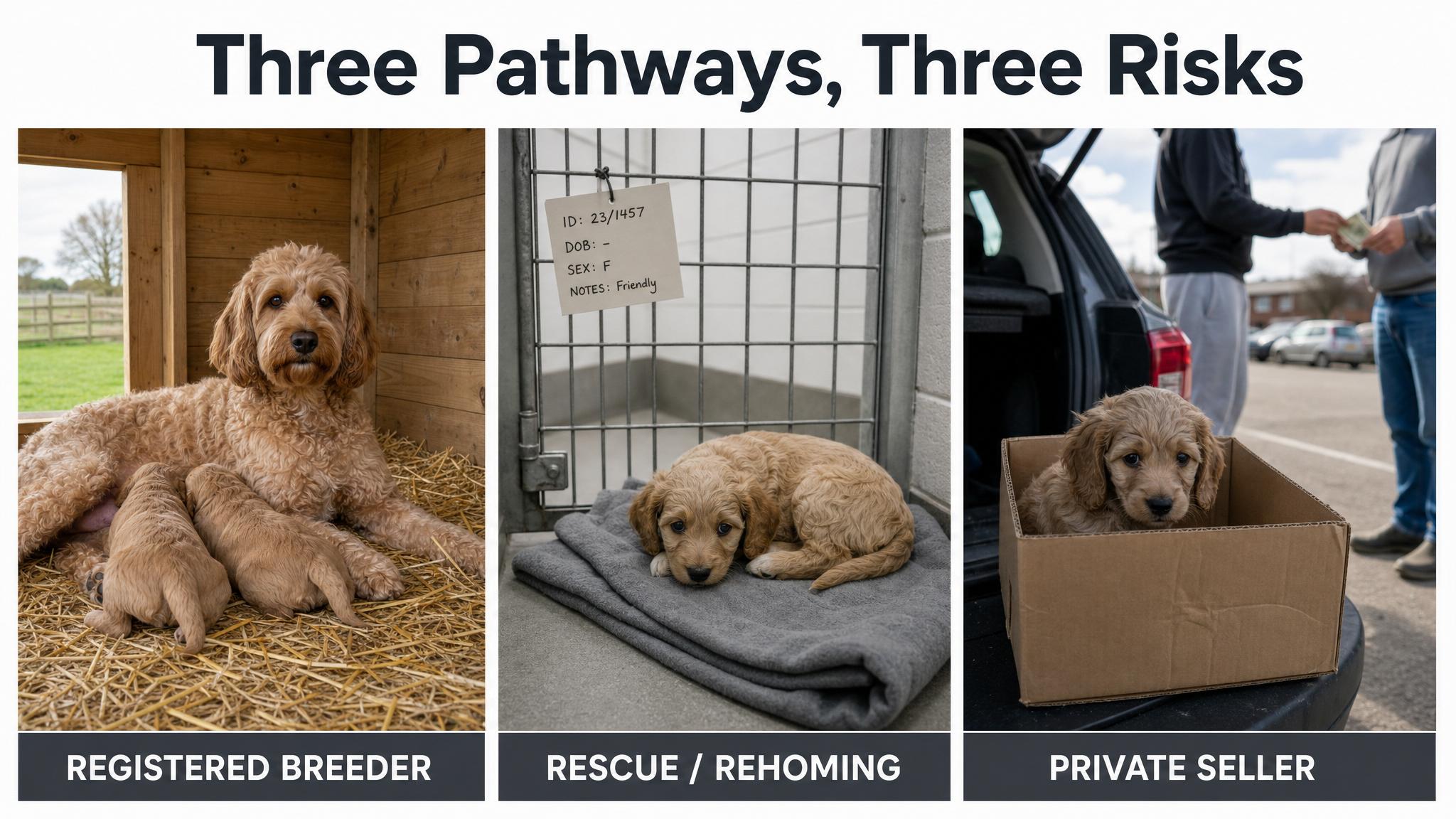
In Australia, your main pathways are: a REGISTERED BREEDER, registered with your state's canine body such as Dogs Victoria, Dogs NSW, or Dogs Queensland, a rescue or rehoming organisation, or a private seller, which includes online platforms like Gumtree, Facebook Marketplace, and dedicated pet sales sites. Each comes with different levels of transparency, different protections, and different risks.
[short pause]
Registered Breeders.
A registered breeder is required to meet breeding standards set by their state's canine body, including health testing for breed-specific conditions, limiting the number of litters per breeding dog, and providing documented lineage. They should welcome your questions, invite you to meet the puppy's parents, at minimum the mother, and provide a contract that includes a health guarantee. Good breeders will also ask you questions about your living situation, your experience with dogs, your work schedule. If a breeder seems more interested in your payment method than your lifestyle, that's a red flag.
What to ask: Can I see the health testing results for both parents? What socialisation experiences have the puppies had so far? What's your return policy if things don't work out? That last question matters enormously. Responsible breeders will always take a dog back rather than see it end up in rescue. It's one of the clearest markers of someone who breeds with integrity.
[short pause]
Rescue and Rehoming Organisations.
Adopting through a reputable rescue is a wonderful option, and one that often comes with unexpected advantages. Many rescue puppies have already received initial vaccinations, desexing, and MICROCHIPPING, all included in the adoption fee. Rescue organisations typically conduct behavioural assessments and can give you honest information about a puppy's temperament. Be aware that rescue puppies may come with unknown histories, which isn't necessarily a problem. It just means you'll need to observe carefully and be patient as they settle in.
[short pause]
The Online Marketplace: Proceed with Caution.
Private sales through online platforms account for a significant and growing proportion of dog acquisitions. Research from the UK and US shows that friends, relatives, and private sellers collectively account for as many puppy acquisitions as breeders and shelters combined, according to Packer and colleagues in 2021. The challenge here is the complete absence of oversight. There is no requirement for health testing, no breeding standards, and no contract. The puppy you meet in a car park could be a well-raised litter from a family whose pet had an accidental mating, or it could be the product of a puppy farm where the mother lives in a cage and produces litter after litter until she is discarded.
Red flags include: the seller wanting to meet somewhere other than where the puppies were raised, multiple breeds available from the same seller, no opportunity to meet the mother, vague or evasive answers about veterinary care, and high-pressure sales tactics. The cheapest puppy is rarely the most affordable one. Puppies from unscreened parents can carry genetic conditions that cost thousands in veterinary treatment, and puppies raised without early socialisation can develop behavioural problems that are far more expensive, in money, time, and heartbreak, than the purchase price you saved.
[short pause]
Before reading on, consider: if you were acquiring a puppy tomorrow, what three questions would you ask the breeder or rescue organisation? How would you verify their answers? There are no trick questions here, just notice what comes to mind naturally, and we'll build on that instinct throughout the course.
[short pause]
Legal Responsibilities: Microchipping and Registration.
Owning a dog in Australia comes with legal obligations that vary slightly by state and territory but share common foundations. Understanding these before your puppy arrives means you won't be scrambling to figure them out during week one, when you'll have quite enough on your plate.
Microchipping is mandatory across all Australian states and territories. In most states, puppies must be microchipped by twelve weeks of age, and breeders are typically required to microchip before sale. A microchip is a rice-grain-sized transponder injected under the skin between the shoulder blades. It does not contain GPS. It's a unique identification number linked to your contact details in a national database. It only works if your details are current. Every year, thousands of lost dogs are scanned at shelters and veterinary clinics, and a heartbreaking proportion cannot be returned because the microchip details haven't been updated after the owner moved house or changed phone numbers.
Council registration is also mandatory in most jurisdictions and must usually be completed within a set period of your puppy arriving home, often by three to six months of age, depending on your state. Registration involves a fee that is significantly reduced if your dog is desexed. This is deliberate policy designed to encourage responsible ownership. Contact your local council before your puppy arrives to understand your specific requirements, including any breed-specific legislation that may apply in your area.
[short pause]
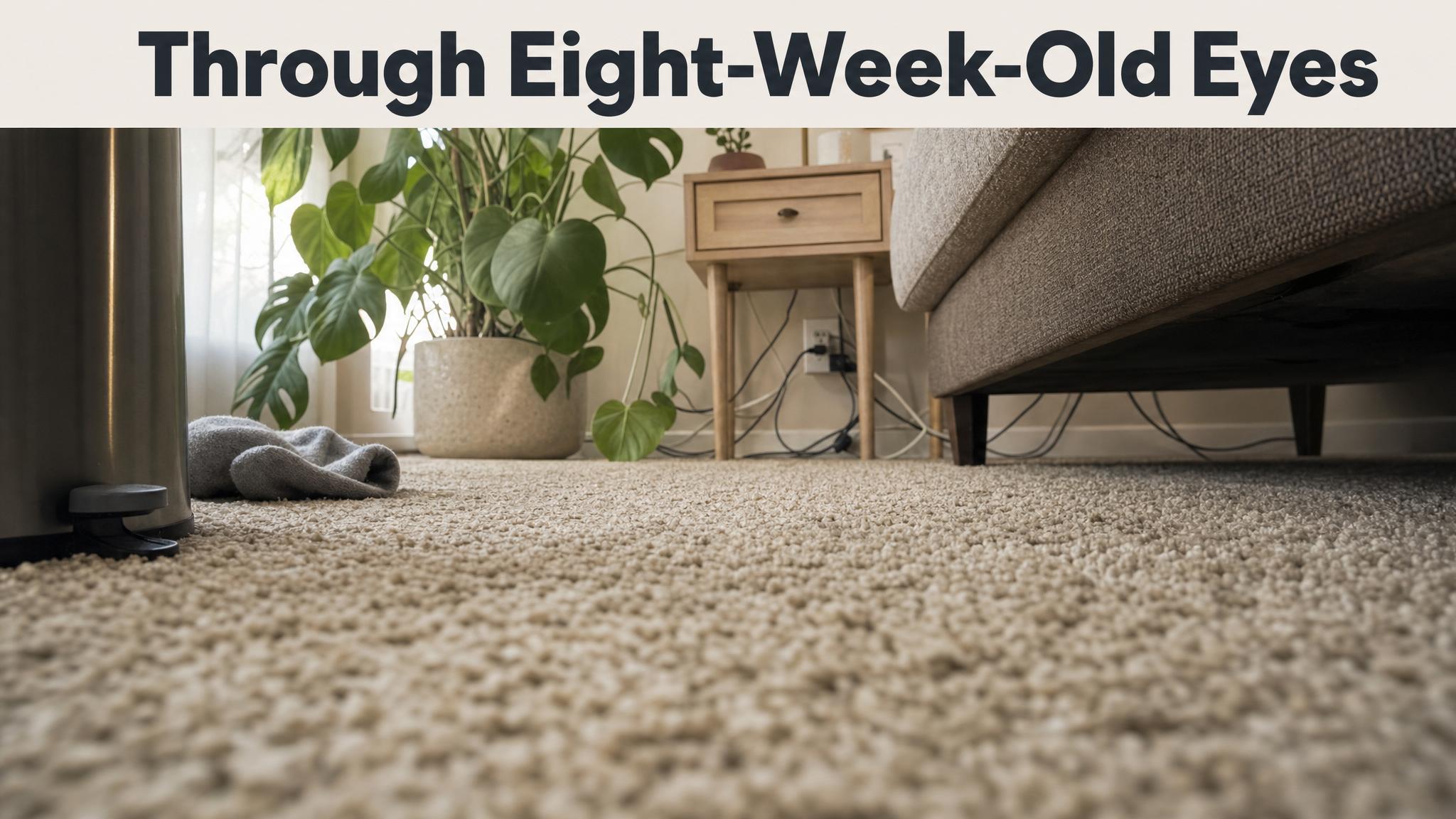
Puppy-Proofing: Seeing Your Home Through Eight-Week-Old Eyes.
Here's something that surprises most new puppy owners: an eight-week-old puppy experiences the world primarily through its mouth. Everything gets tasted, chewed, and tested. Your job in the days before arrival isn't to create a sterile environment. It's to remove the things that could genuinely harm your puppy while accepting that some of your possessions will probably sustain minor damage anyway.
Think of PUPPY-PROOFING as an exercise in ENVIRONMENTAL MANAGEMENT: setting up your surroundings to encourage safe behaviour and reduce the opportunity for dangerous or destructive ones, as noted by Management and Environmental Control in 2024. This is not about controlling your dog. It's about controlling the environment so your dog can succeed.
[short pause]
Inside the House.
Start at ground level, literally get on your hands and knees and look at each room from puppy height. Electrical cords are the most immediately dangerous household item: a chewed power cord can cause fatal electrocution or severe burns. Secure cords behind furniture, use cord covers, or unplug items when not in use. Accessible rubbish bins are puppy magnets. Switch to lidded bins or move them behind closed doors. Common houseplants including lilies, sago palms, pothos, and dieffenbachia are toxic to dogs. If in doubt about a plant, move it to a high shelf or remove it entirely. You can always bring it back later.
Medications, including paracetamol which is lethal to dogs in small doses, chocolate, grapes, raisins, xylitol-containing products often found in sugar-free gum and peanut butter, and macadamia nuts should all be stored well out of reach. Small objects like children's toys, hair ties, and socks are swallowing hazards. A baby gate across the entrance to rooms you can't fully puppy-proof is one of the best investments you'll make.
[short pause]
The Australian Backyard.
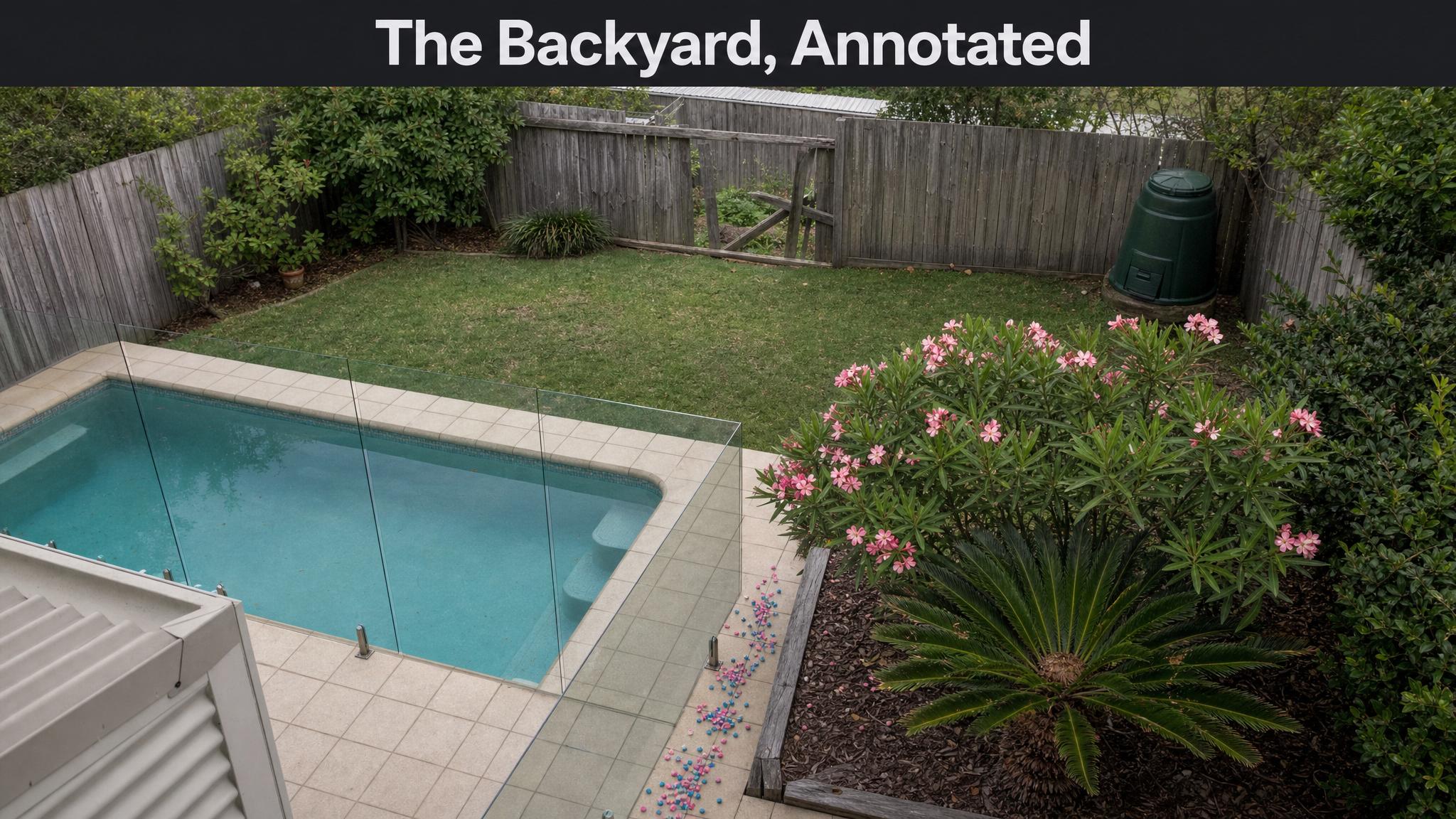
Your backyard presents a different set of challenges, many of them uniquely Australian. Pool fencing is legally required in every state and territory, but check that your pool gate is self-closing and self-latching and that the gaps are too small for a puppy to squeeze through. Many standard pool fences meet regulations for children but leave gaps that a small puppy could fit through.
Check your perimeter fencing carefully. Puppies are remarkably skilled at finding gaps, digging under, and squeezing through spaces you'd never think possible. Pay particular attention to shared fencing with neighbours. You're generally not entitled to modify your neighbour's side, so any reinforcement needs to happen on yours. Common toxic garden plants in Australian yards include yesterday-today-and-tomorrow, also known as Brunfelsia, oleander, cycads, and many mushrooms that appear after rain. If you use snail bait, switch to a pet-safe iron-based formula. Metaldehyde-based snail bait is one of the most common causes of dog poisoning in Australia.
Key hazards to watch for include: electrical cords, toxic plants such as lilies, sago palms, and oleander, accessible bins, pool areas, chocolate, medications, and snail bait.
[short pause]
Your Equipment List: What You Actually Need.
Walk into any pet store before bringing home a puppy and you'll walk out having spent five hundred dollars on things you don't need and forgotten at least one thing you do. The pet industry is very good at selling anxiety. Let's cut through that.
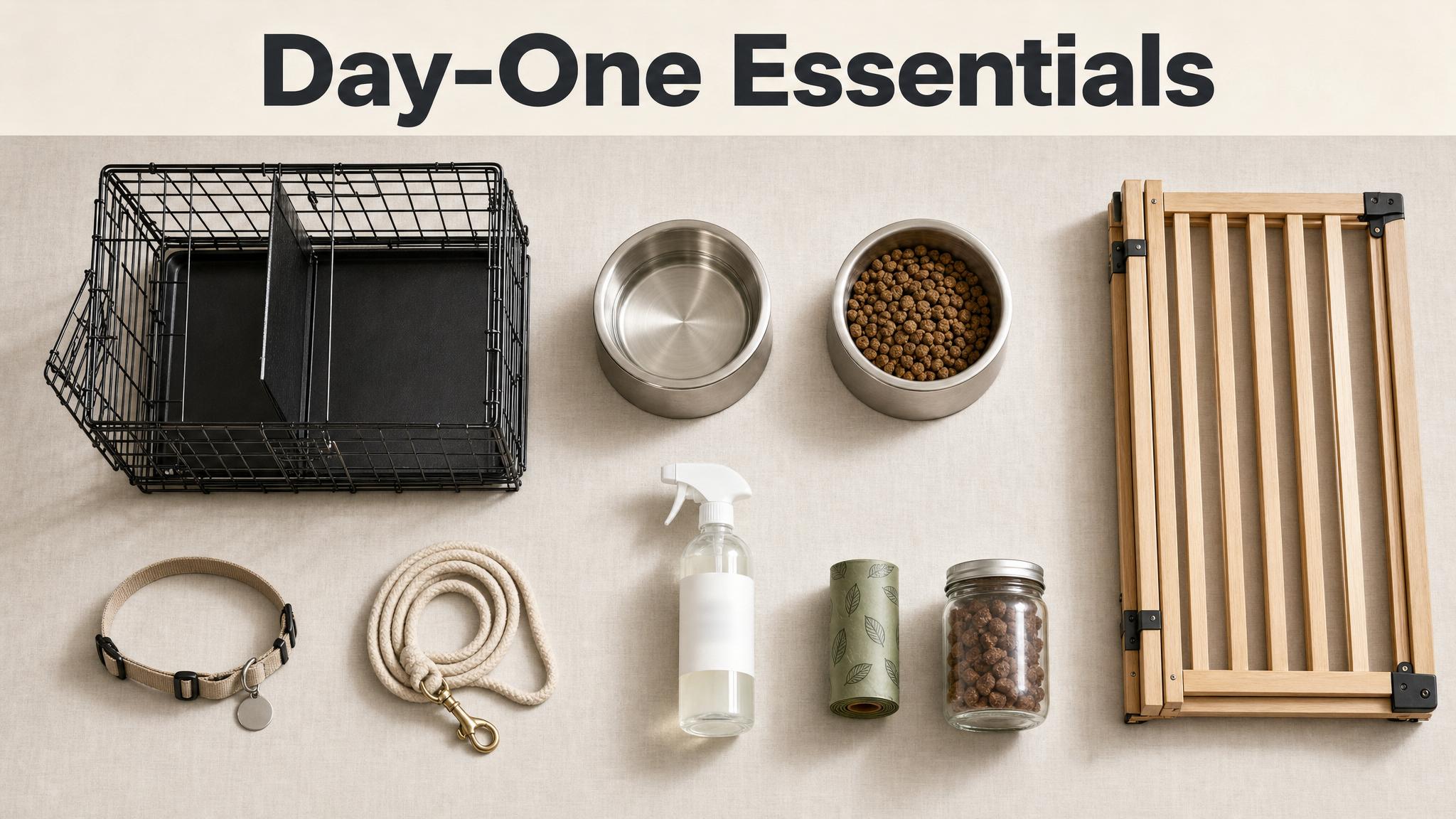
Your genuine essentials, the things you need before your puppy walks through the door, are fewer than you think. You need: an appropriately sized CRATE, more on why in a moment, a stainless steel water bowl and food bowl, a flat collar with an ID tag, a fixed-length lead, not retractable, we'll explain why, enzymatic cleaner for accidents, poo bags, small soft training treats, and a baby gate or two. That's it for day one.
[short pause]
Why a Crate Isn't a Cage.
The crate deserves special mention because it's the item that generates the most emotional resistance, and it's also one of the most important management tools you'll use. A crate, properly introduced, becomes your puppy's den, a safe, enclosed space where they can rest without being overstimulated and where they can't rehearse unwanted behaviours while you're not supervising. Crate training is not about confinement. It's about giving your puppy a space that is unambiguously theirs. We'll cover crate training in detail in later chapters, but for now, choose a crate large enough for your puppy to stand, turn around, and lie down in at their expected adult size, with a divider panel to make it smaller while they're young.
[short pause]
What to Skip, For Now or Forever.
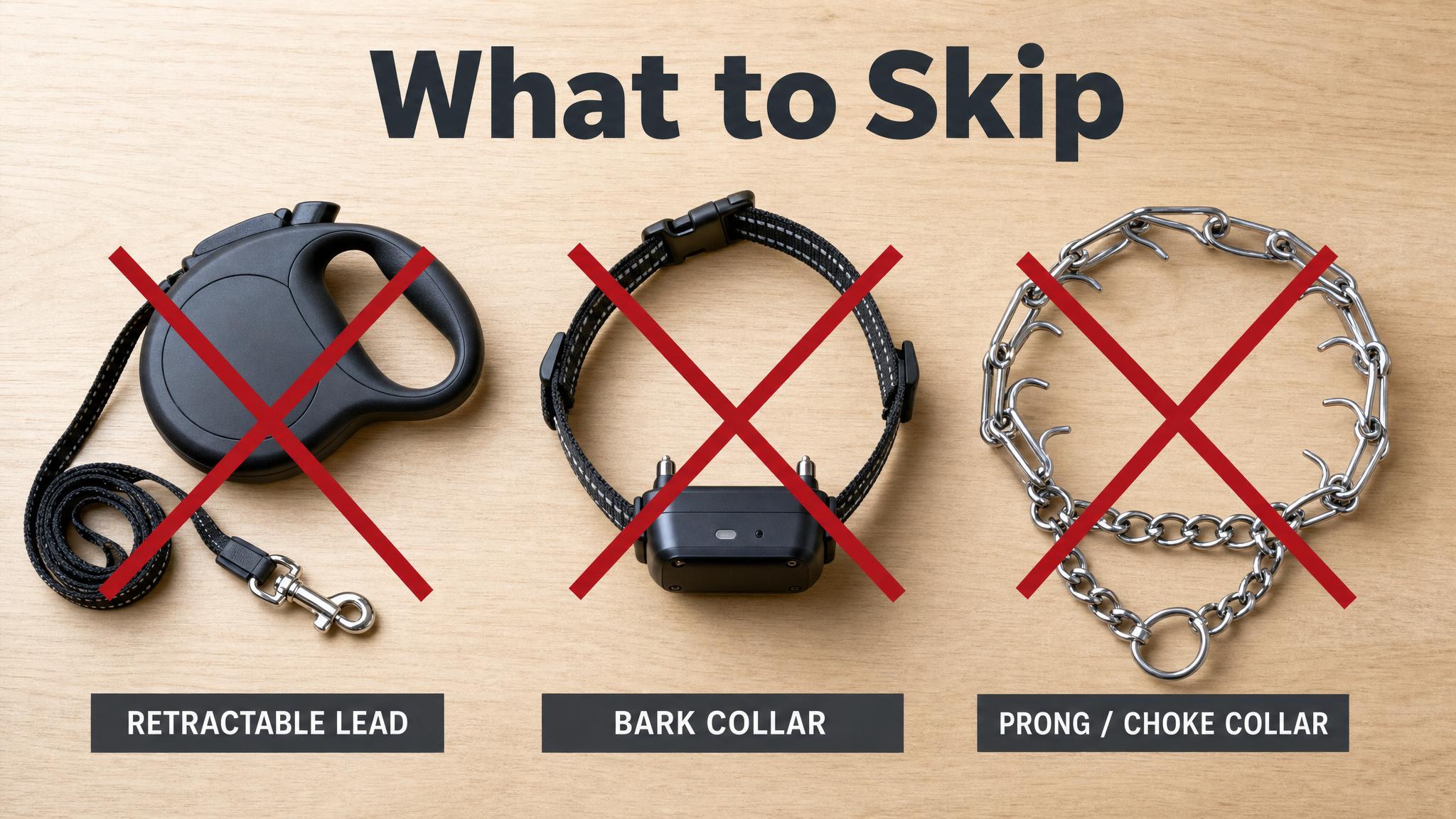
Retractable leads teach puppies to pull. The mechanism only releases more line when the puppy applies pressure, which is the opposite of what you want. A standard one point eight metre fixed lead gives you control and starts building loose-lead walking habits from day one. Bark collars, prong collars, and choke chains have no place in evidence-based puppy raising. Research consistently demonstrates that aversive training methods are associated with increased aggression and fear in dogs, while reward-based methods are associated with fewer behavioural problems, as Blackwell and colleagues found in 2008 and Herron and colleagues confirmed in 2009. There is no training problem you will encounter with a puppy that requires pain or intimidation to solve.
Puppy pads are a grey area: useful in apartments or for very young puppies in the first week, but they can delay toilet training by teaching your puppy that going inside is acceptable. If you have access to outdoor space, you're usually better off skipping them entirely.
Your essential equipment includes: a crate, enzymatic cleaner, flat collar, fixed lead, water bowl, food bowl, training treats, poo bags, and baby gate. Items to skip include: bark collars, retractable leads, and prong or choke collars.
[short pause]
Management Versus Training: Your Most Powerful Early Tool.
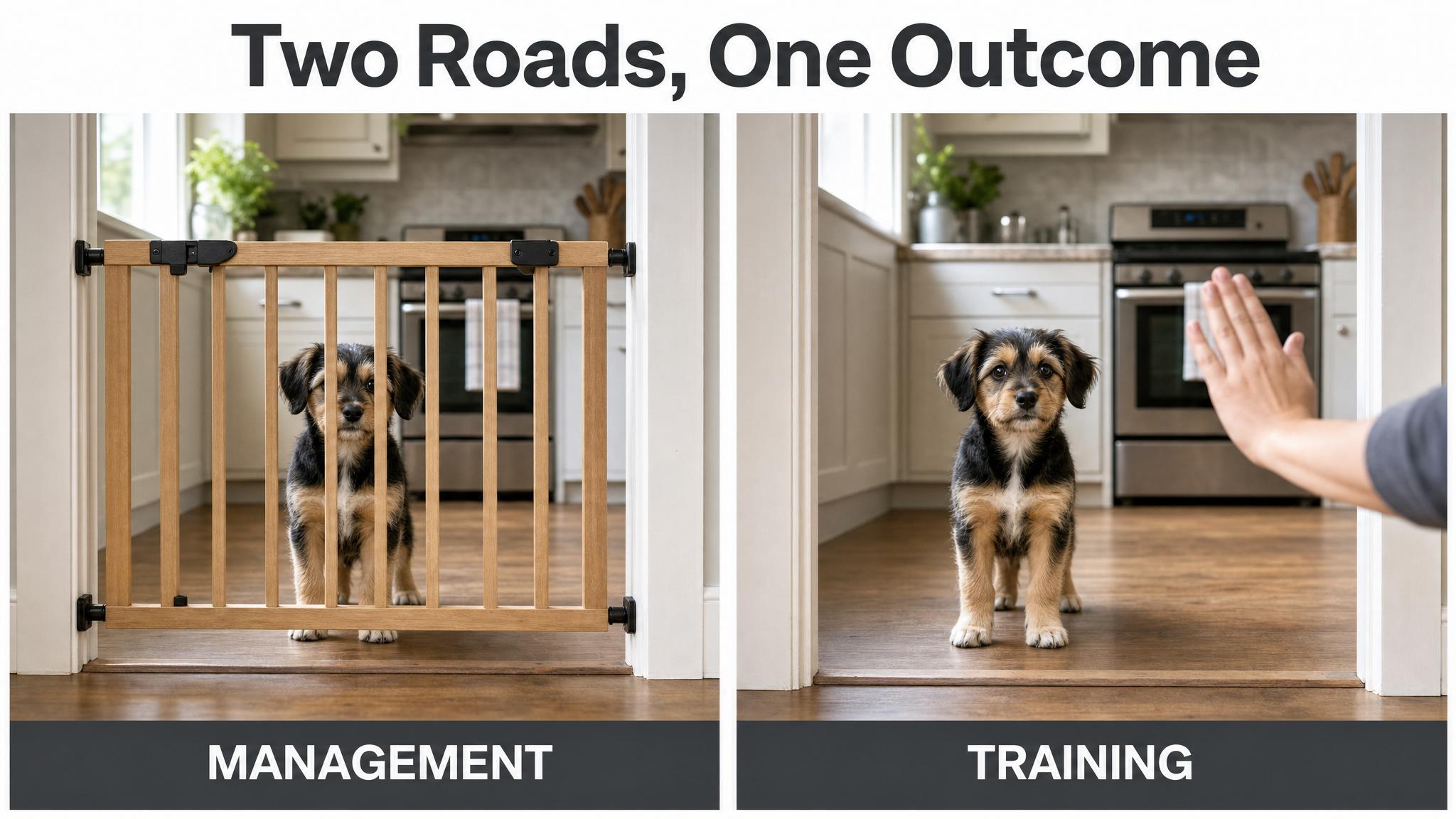
Here's a concept that will save you enormous frustration: MANAGEMENT and TRAINING are both valid approaches to behaviour, and in the first weeks of puppy ownership, management is often more effective and more important.
Training means teaching your puppy to make good choices: sit instead of jump, chew a toy instead of a shoe, come when called. Management means arranging the environment so the wrong choice isn't available in the first place. Evidence-based practice confirms that environmental control involves setting up surroundings to encourage positive behaviours and reduce the opportunity for undesirable ones proactively, preventing unwanted actions before they start, as noted by Management and Environmental Control in 2024.
A baby gate across the kitchen doorway is management. Teaching your puppy a rock-solid stay so they never enter the kitchen is training. Both achieve the same outcome, but one works with an eight-week-old puppy today, and the other requires weeks or months of practice. When people tell you their puppy is naughty for chewing shoes, the real question is: why did the puppy have access to shoes? That's not a training failure. It's a management gap.
The best puppy training plan in the world means nothing if your environment keeps setting your puppy up to fail. Manage first, train as you go.
This isn't about never training. You'll start simple training exercises almost immediately. But in those first chaotic days, management through crates, baby gates, closed doors, and putting your shoes in the cupboard does the heavy lifting while your puppy learns the household rules at a pace their developing brain can handle.
[short pause]
Three Foundations You'll Build On.
Every chapter in this course rests on three foundational concepts. We're not going to teach them fully here. That would be overwhelming and premature. Instead, think of this section as planting seeds. You'll see these ideas grow more detailed and more practical as we move through the course. For now, we just want you to know they exist and why they matter.
[short pause]
Foundation One: Reading Canine Body Language.
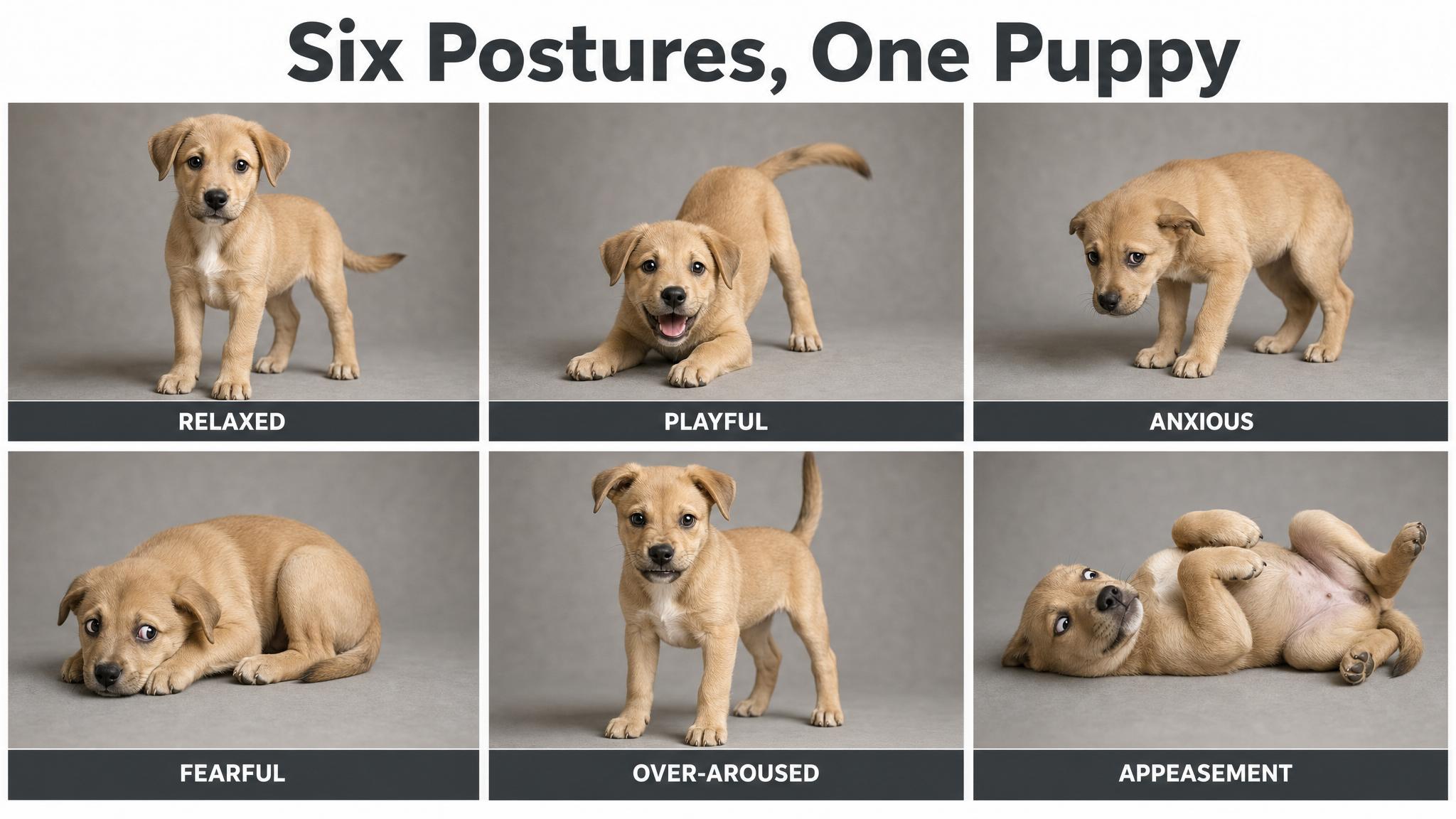
Most people believe they're good at reading dogs. Most people are wrong. Research has demonstrated that specific body language patterns, including eye shape, ear position, tail carriage, and weight distribution, reliably predict a dog's emotional state and learning readiness, according to Hasegawa and colleagues in 2015. The problem is that humans tend to project human emotions onto dog behaviour. A dog showing its teeth isn't smiling. A wagging tail doesn't always mean happiness. A dog that rolls onto its back isn't always asking for a belly rub. It may be displaying APPEASEMENT BEHAVIOUR, signalling that it's overwhelmed and wants the interaction to stop.
Learning to read your puppy accurately is the single most impactful skill you'll develop in this course. It affects everything: how you socialise them, how you train them, when you push them gently forward and when you give them space. We'll build this skill systematically, starting with the basics.
Key emotional states to learn include: relaxed, with a soft body and neutral tail, playful, often shown through a play bow, anxious, with lip licking and whale eye, fearful, with a tucked tail and cowering posture, over-aroused, with a stiff forward-leaning body, and appeasement, often shown by rolling over and avoiding eye contact.
[short pause]
Foundation Two: Positive Reinforcement, The Science Not the Sentiment.
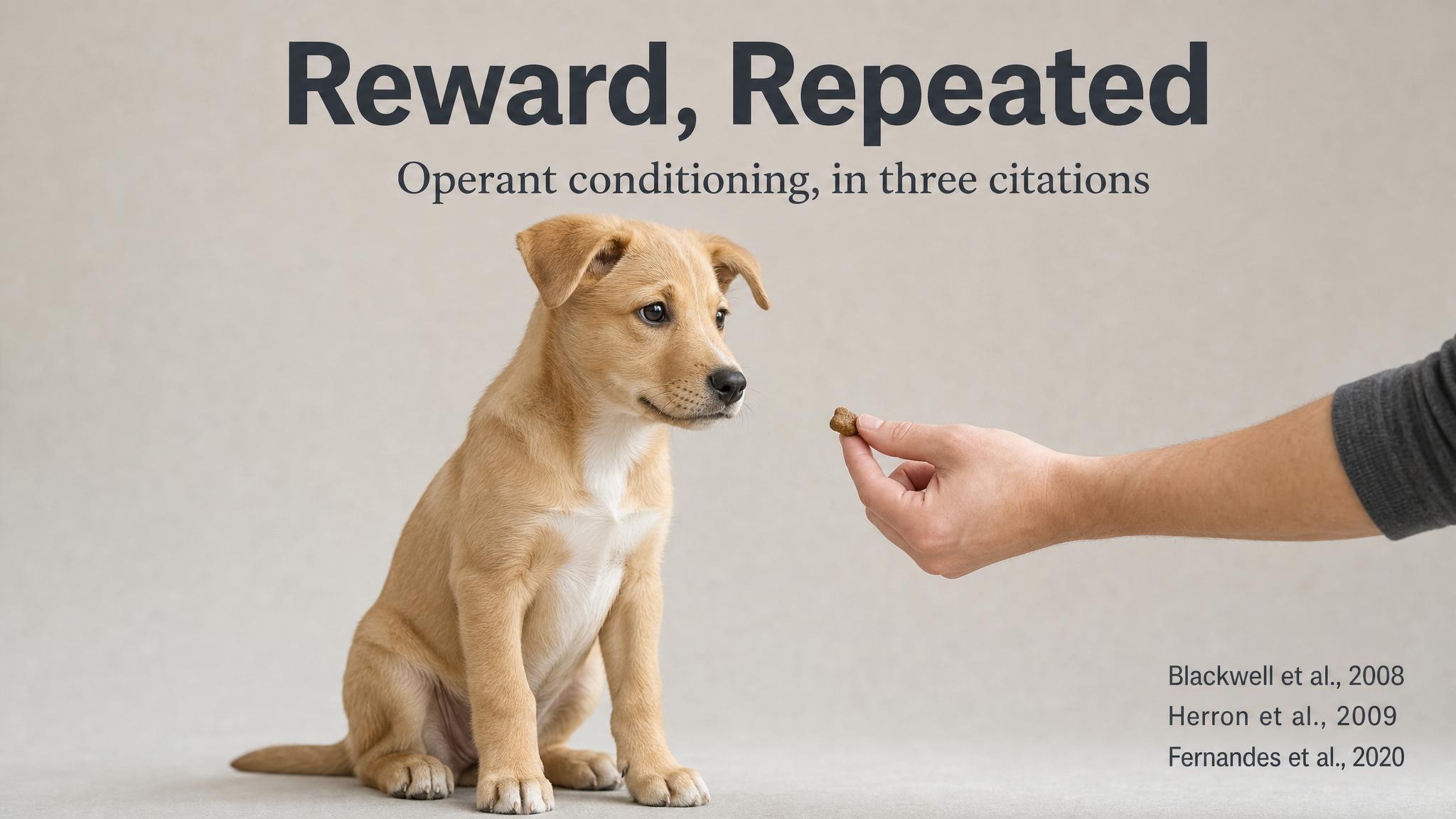
POSITIVE REINFORCEMENT is not a philosophy. It's not a lifestyle choice or a soft approach to training. It is a principle of learning theory, specifically operant conditioning, which states that behaviours followed by pleasant consequences are more likely to be repeated. When your puppy sits and receives a treat, sitting becomes more likely in the future. It's that simple, and it's that powerful.
The evidence base here is substantial and consistent. Blackwell and colleagues in 2008 found that dogs trained using only positive reinforcement showed significantly less aggression and fear than those trained with punishment-based methods. Herron and colleagues in 2009 documented that confrontational training techniques, alpha rolls, stare-downs, and physical corrections, elicited aggressive responses in twenty-five to thirty-one percent of dogs tested. More recent work continues to confirm that reward-based methods are not only safer but comparably or more effective than aversive methods, as Fernandes and colleagues found in 2020.
Throughout this course, every training technique you learn will be grounded in positive reinforcement and, when needed, negative punishment, the removal of something desirable, like turning away when a puppy jumps. You will never be asked to use pain, fear, or intimidation. Not because we're sentimental about dogs, because the science is clear.
[short pause]
Foundation Three: The Power of Routine.
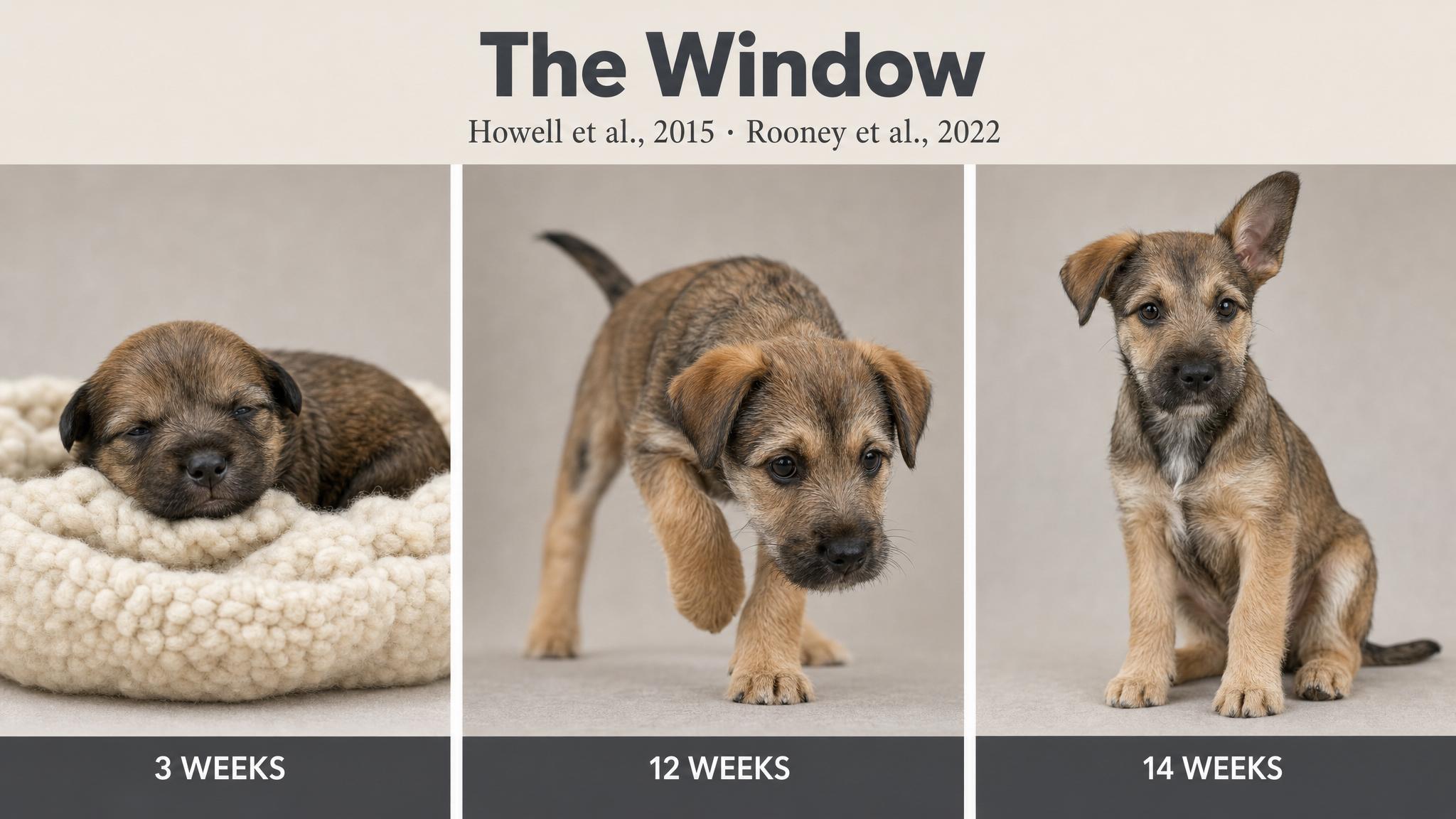
Puppies are learning machines, but their developing brains operate best within predictable structures. The SOCIALISATION PERIOD, roughly three to twelve weeks of age, with some researchers extending it to fourteen weeks as Howell and colleagues noted in 2015, is the window during which puppies are most receptive to new experiences and most capable of forming positive associations. This period will be the focus of our next chapter, but it's worth noting now that research demonstrates early, structured exposure to novel stimuli produces puppies that are bolder, less reactive, and faster problem-solvers, according to Rooney and colleagues in 2022.
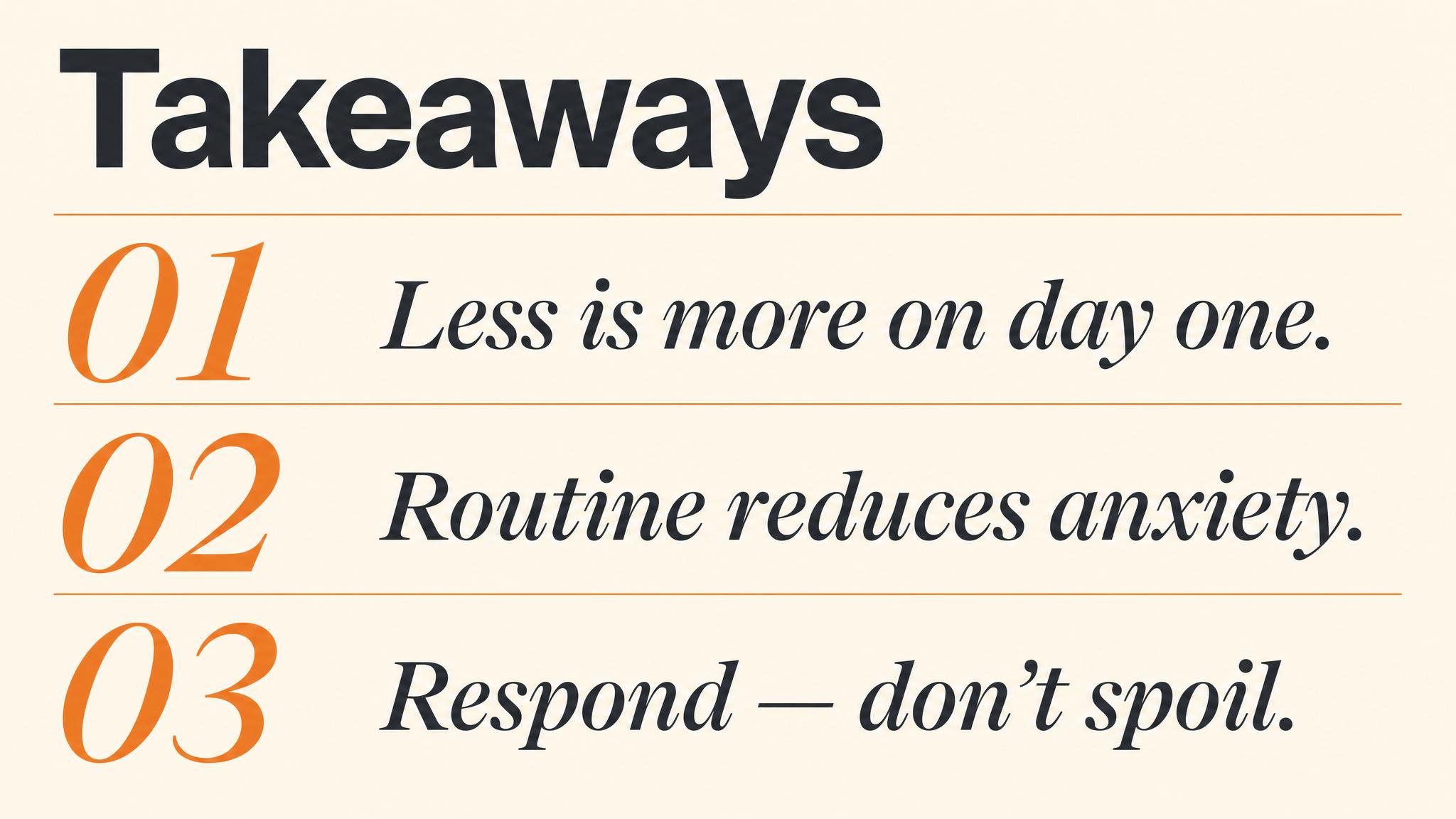
Routine provides the scaffolding for this learning. Consistent mealtimes, regular toilet breaks, predictable sleep schedules, and a reliable daily rhythm don't just make your life easier. They reduce your puppy's baseline stress, making them better able to engage with new learning. A puppy who knows what comes next is a puppy who can relax. And a relaxed puppy learns faster, sleeps better, and has fewer accidents.
[short pause]
Consider your current daily routine: when you wake up, when you leave for work, when you eat dinner. How might you need to adjust this for a puppy that needs a toilet break every one to two hours during the day? What's one realistic change you could make, and one that would be genuinely difficult? Being honest about this now is more useful than being optimistic.
A sample daily routine for a new puppy should balance sleep, toilet breaks, meals, play, and training throughout the day.
[short pause]
Good Enough Is Genuinely Good Enough.
If you've read this far and you're feeling a mixture of motivation and mild panic, that's completely normal. The goal of this chapter is not perfection. It's preparation. You don't need to have identified every toxic plant in your suburb or memorised the six canine emotional states before your puppy arrives. You need a safe home, the right basic equipment, and a willingness to learn.
The families who struggle most with new puppies are rarely the ones who didn't prepare enough. They're the ones who didn't know what they didn't know, who assumed that loving a puppy would be enough, or who acquired a puppy impulsively without understanding the commitment. By reading this chapter, you've already done something the research suggests is critically protective: you've engaged with preventive education before the puppy arrived, as noted by Packer and colleagues in 2021. You've thought about where your puppy is coming from, what legal obligations you're taking on, how to make your home safe, what equipment you actually need, and how management can carry you through the early days while training catches up.
That's a strong start. And in the next chapter, we'll build on it by diving into the most important developmental window in your puppy's life.
[short pause]
Key Takeaways.
Where you acquire your puppy matters. Research the source, ask hard questions, and be wary of red flags in private sales and online marketplaces.
Microchipping and council registration are legal requirements in Australia. Understand your obligations before your puppy arrives and keep details updated.
Puppy-proofing is environmental management. Remove genuine dangers like electrical cords, toxic plants, and accessible chemicals, and use baby gates and crates to limit access.
Your essential equipment list is shorter than you think. A crate, flat collar, fixed lead, bowls, enzymatic cleaner, treats, poo bags, and baby gates cover day one.
Avoid retractable leads, bark collars, and any aversive training tools. The evidence consistently shows these are ineffective at best and harmful at worst.
Management, controlling the environment, is just as valid as training, teaching behaviours, and is often more effective in the first weeks.
Positive reinforcement is a principle of learning science, not a soft option. It produces fewer behavioural problems and safer outcomes than punishment-based methods.
Learning to read canine body language accurately will be the most important skill you develop in this course.
Routine reduces puppy stress and creates the scaffolding for effective learning during the critical socialisation period.
[short pause]
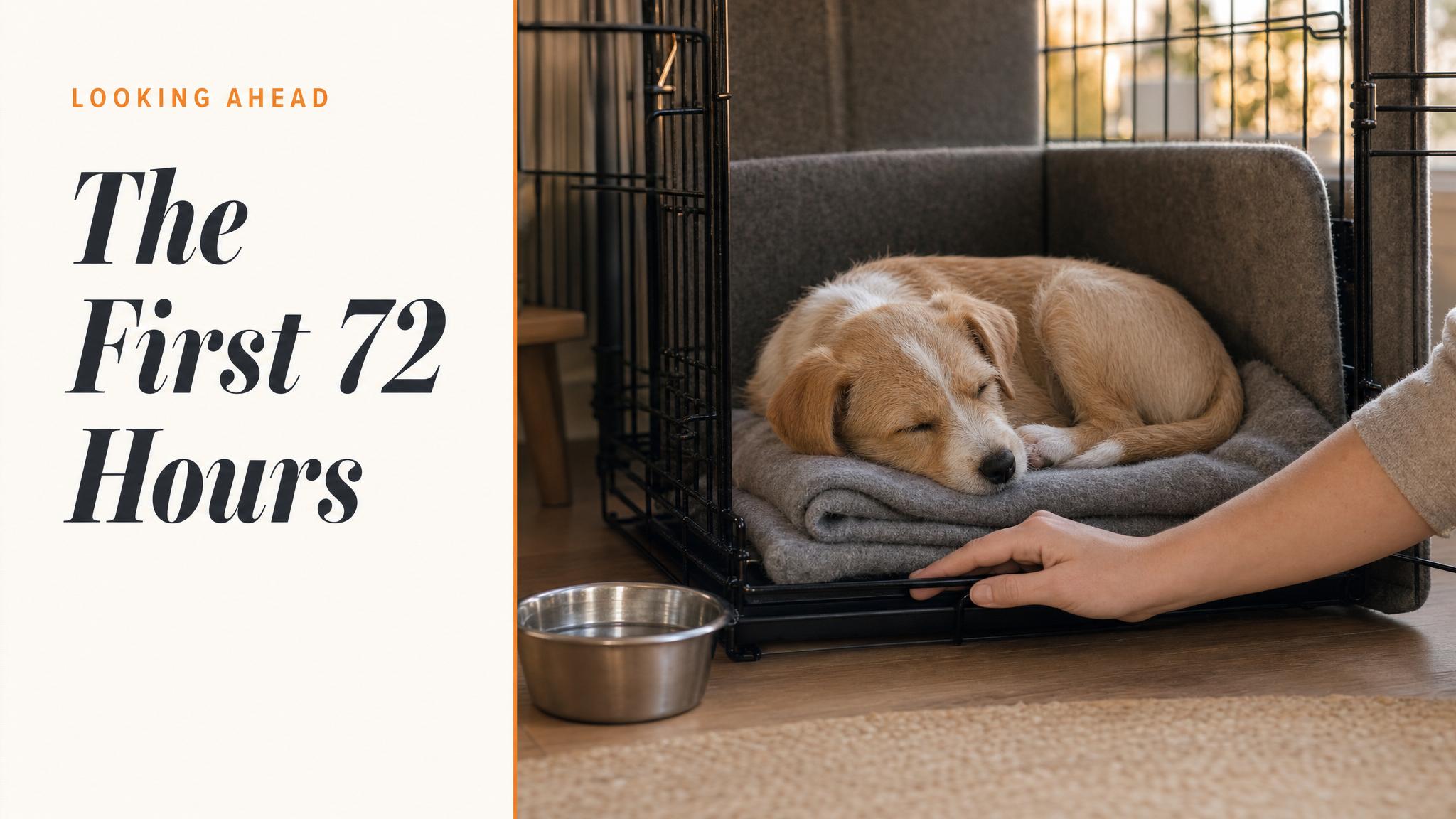
Looking Ahead.
In Class Two, we dive into the socialisation window, the most important developmental period in your puppy's life, and the one with the tightest deadline. You'll learn what socialisation actually means, it's not just meeting other dogs, how to create a structured socialisation plan, and why the quality of early experiences matters far more than the quantity. If you've just brought your puppy home, Class Two is time-sensitive. This window doesn't stay open forever.

The First 72 Hours — Surviving the Beautiful Chaos
The puppy is here. It's smaller than you expected, or larger. It's already weed on the floor, and it's been eleven minutes. Welcome to the most intense, exhausting, and joyful seventy-two hours of your recent life. This…
Be honest: Would you let your new puppy sleep in your bed the first night, or are you strong enough to make them sleep alone?
Debate time
Your puppy is screaming like they're dying but you KNOW they're fine. How long do you last before you cave and check on them?
Real talk
Hot take: Crates are basically dog jail and anyone who uses them is cruel.
Fight me
Would you rather: One week of zero sleep because of puppy crying, or one week of coming home to destroyed furniture?
Would you rather
What's more terrifying on day 2: A puppy who won't stop barking, or a puppy who's suddenly way too quiet?
Quick poll
Have you ever been 100% convinced your pet was having an emergency and it turned out they just wanted attention?
Story time
Puppy Distress Detective
12-15 minutesInstructor plays 3-4 short video clips (10-20 seconds each) of puppies in various states of distress/calm. After each clip, students have 60 seconds to discuss with their immediate seat neighbors what body language signals they observed. Then instructor cold-calls on different sections of the theater to share observations. Build a collective list on screen of stress signals (whale eye, tucked tail, yawning, panting, etc.) versus calm signals.
First Night Survival Forum
15-18 minutesPresent a controversial scenario: 'Your puppy is crying in the crate on Night 1. Should you let them cry it out or comfort them?' Divide the theater by seating section into 3 camps: Team Comfort (left), Team Consistency (right), Team Hybrid (middle). Give 3 minutes for neighbors to discuss their reasoning. Then have a structured debate where sections defend their approach. Instructor guides discussion to reveal research-backed best practices and nuance.
Body Language Speed Read
10 minutesRapid-fire activity: Instructor shows 8-10 photos of puppies on screen (5-7 seconds each). Students use hand signals to vote: thumbs up (calm/happy), thumbs down (stressed/fearful), sideways (uncertain/mixed signals). After each image, pause briefly for neighbors to compare answers and whisper why they chose what they did. After all images, review 2-3 of the most contested ones as a full group.
72-Hour Routine Builder Challenge
15 minutesStudents work in pairs/trios with immediate neighbors. Challenge: Design an hour-by-hour schedule for the first 72 hours that balances potty breaks, sleep, play, feeding, and crate time for an 8-week-old puppy. Provide constraints: puppy can hold bladder for 2 hours max, needs 18-20 hours sleep, owner works from home. After 8 minutes of building their schedule, instructor polls the room: 'Who scheduled a potty break within 10 minutes of waking?' (hands up), 'Who has crate time exceeding 2 hours?' (hands up), etc. Discuss which approaches best serve puppy needs.
Crate Myths Showdown
10-12 minutesInstructor presents 6-8 common statements about crates (mix of myths and truths): 'Crates are like cages and cruel,' 'Puppies naturally love enclosed spaces,' 'Never use the crate for punishment,' 'A puppy should be crated 8+ hours at night immediately.' Students discuss with neighbors for 30 seconds each, then vote as a section: MYTH or TRUTH (hands up). After each vote, instructor reveals answer and explains the nuance. Track which section gets most correct for friendly competition.
What Would You Do? Case Cascade
12-15 minutesPresent 3 escalating real-world scenarios on screen (e.g., Scenario 1: Puppy whimpering in crate after 10 minutes; Scenario 2: Puppy screaming for 45 minutes; Scenario 3: Puppy has eliminated in crate). For each scenario, students have 90 seconds to discuss response strategy with neighbors. Then use a 'cascade' technique: start with back row sharing their approach, then middle rows can agree or offer alternatives, front rows give final take. Instructor synthesizes and provides expert guidance.
Transcript
It's eleven forty-seven PM on a Tuesday. You're sitting on the kitchen floor in your pajamas, one hand resting on the wire door of a crate where a ten-week-old puppy is crying with a conviction that suggests genuine existential despair. Your partner is googling "is it normal for a puppy to cry this much" and getting contradictory answers. The puppy pauses, makes eye contact with you through the crate bars, and lets out a sound that is somewhere between a whimper and a howl. Every instinct in your body says pick them up. The internet says don't or you'll create a monster. You've had this dog for six hours.
If this is you, or if this will be you soon, this chapter is designed to sit right beside you on that kitchen floor. We're going to walk through the first seventy-two hours with a new puppy: what to expect, what to do, and, critically, why the "tough love" advice you'll find on forums is not what the science actually says.
[short pause]
The Journey Home: It Starts in the Car.
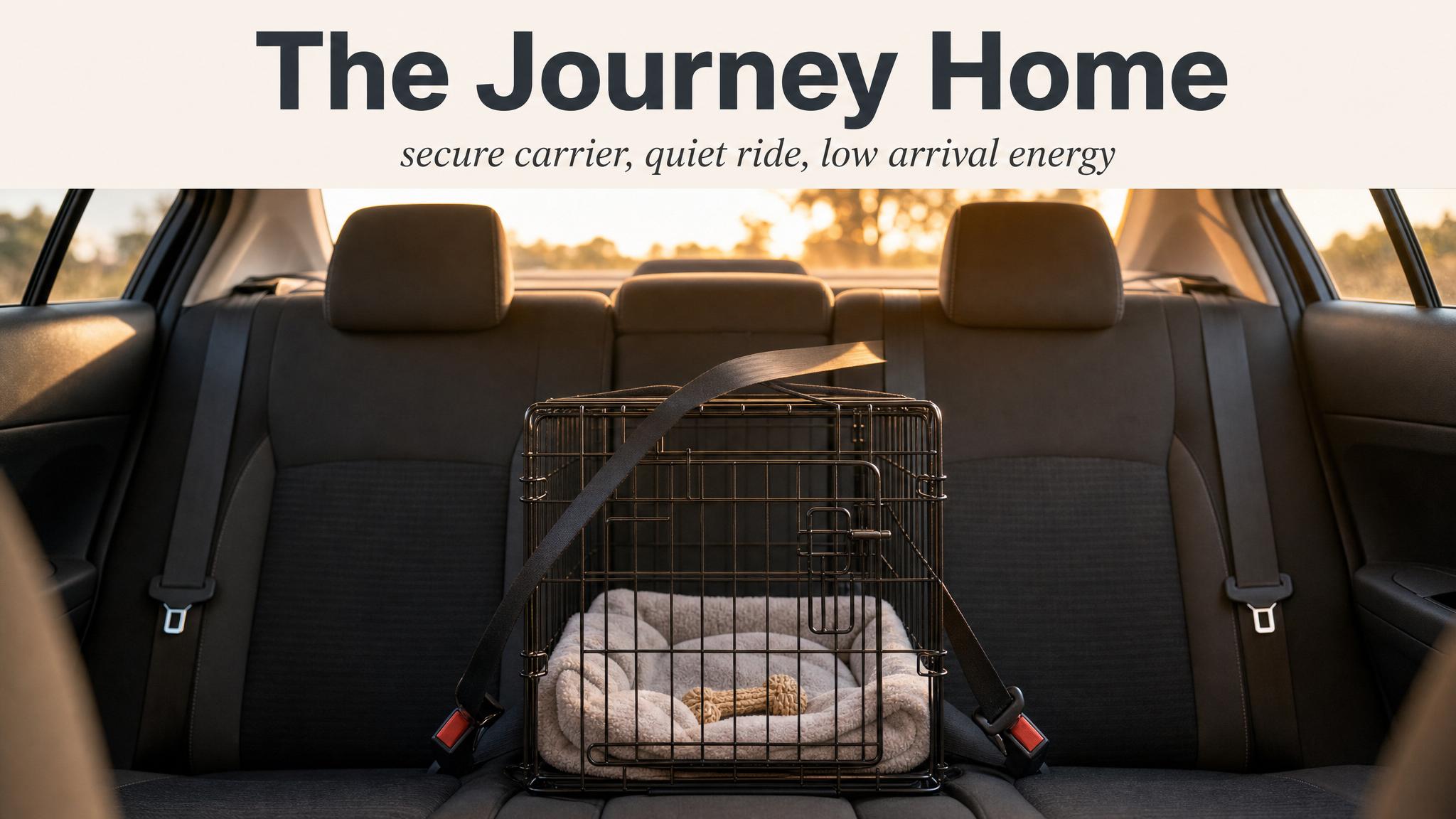
The first thing most people get wrong is the car ride home. You're elated. The breeder has handed over a warm, wriggling creature that smells like milk and straw, and your immediate impulse is to hold it on your lap for the drive. Resist this impulse, not because it's emotionally harmful, but because it's physically dangerous. An unrestrained puppy in a car is a projectile in the event of sudden braking, and an anxious puppy on a driver's lap is a genuine road hazard.
The ideal setup is a small, secure crate or carrier in the back seat, lined with a towel or blanket that carries the scent of the puppy's littermates. Many breeders will give you a cloth that has been with the litter. This is gold. If yours doesn't offer, ask. Place the carrier where a passenger can sit beside it, offering a calm hand and quiet voice. This is, for most puppies, the first time they have ever been in a vehicle, and it is simultaneously the first time they have been separated from their mother and siblings. That's two enormous stressors at once. Your job is not to make it fun. Your job is to make it survivable.
Keep the drive calm: no loud music, no excited chatter, no passing the puppy around. If the puppy vomits, and many do because motion sickness is extremely common in young dogs, pull over, clean up quietly, and carry on. This is not a sign that something is wrong. It is a sign that a baby animal is having a big day.
[short pause]
Arriving Home: Less Is More.
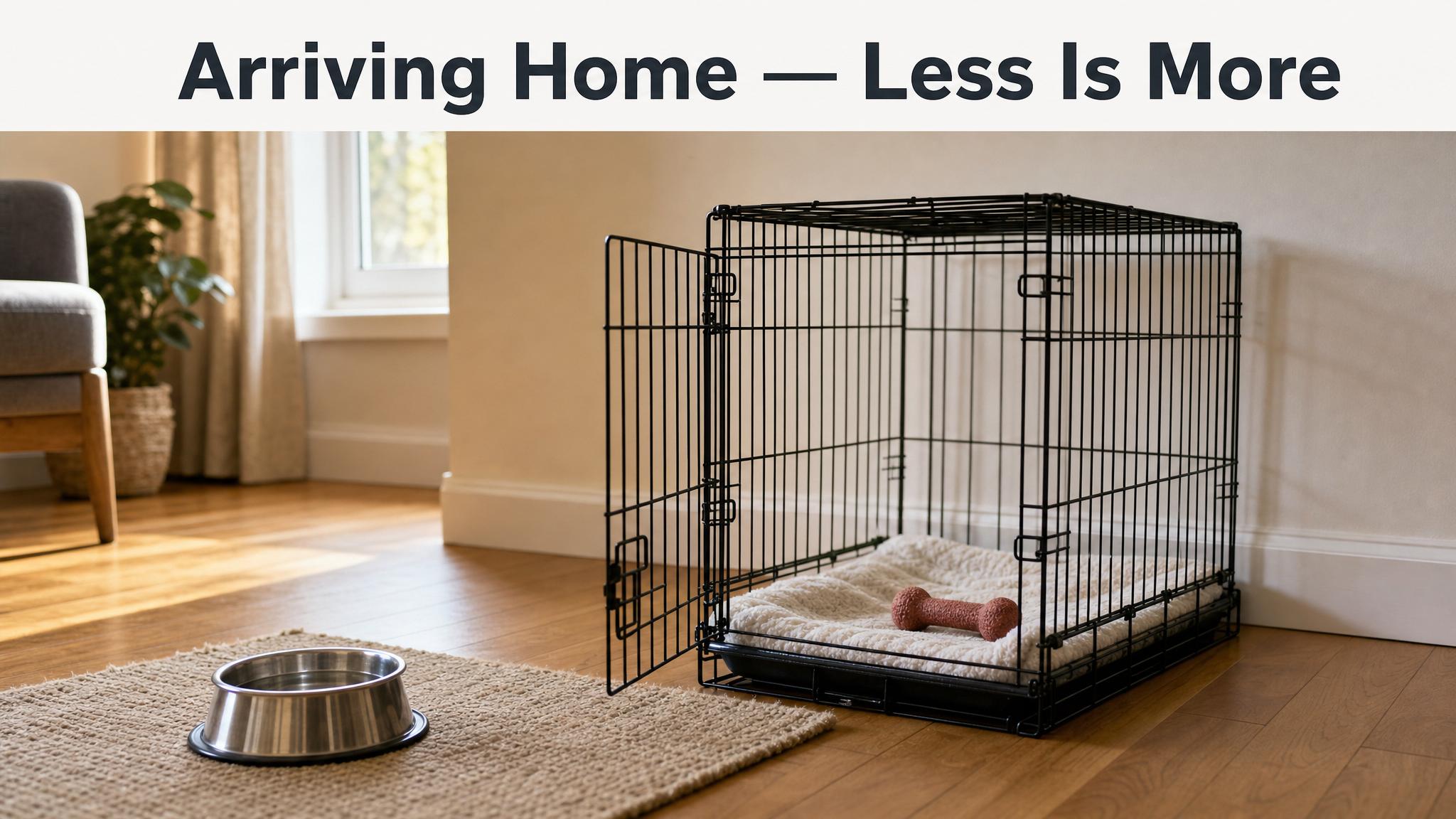
When you walk through your front door, the temptation is to introduce the puppy to everything: the whole house, the garden, the children, the neighbors who've been waiting for this moment. Don't. Remember what we learned about the SENSITIVE SOCIALIZATION PERIOD in Chapter One: controlled, positive exposure is what builds confidence. Overwhelming exposure does the opposite.
Start small. Take the puppy directly to the spot you've designated as their toilet area, outside if you have a garden, on a puppy pad if you don't. Wait. If they go, quiet praise. If they don't, that's fine too. Their world just turned upside down and their bladder is not their top priority. Then bring them into one room, just one, where their crate, water bowl, and a few safe toys are already set up. Let them sniff. Let them explore at their own pace. Sit on the floor and let the puppy come to you rather than pursuing them. This is your first act of building SECURE ATTACHMENT: being available without being overwhelming, as Topál and colleagues described in their attachment research spanning twenty seventeen to twenty twenty-five.
Consider the puppy's perspective: twelve hours ago, they were surrounded by siblings, their mother's scent, and familiar sounds. Now everything, every surface, every smell, every face, is completely new. How would you want to be introduced to an entirely unfamiliar world?
[short pause]
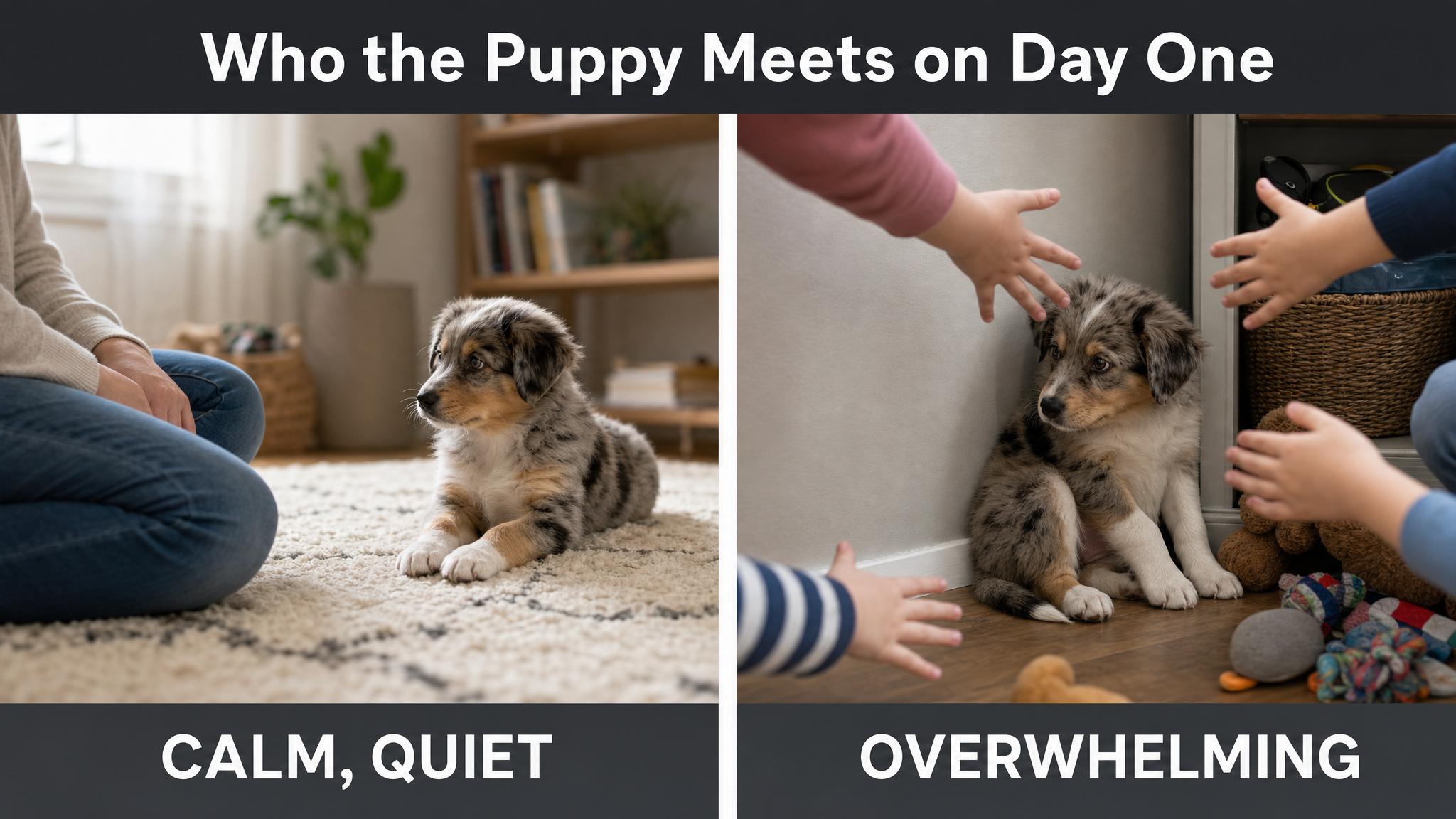
Who Should the Puppy Meet on Day One?
Household members only. That's it. Not the neighbors. Not your mum. Not your best friend who "just wants a quick cuddle." Each new person is a stimulus the puppy has to process, and they are already processing at maximum capacity. The visitors can come on Day Three or Four, one or two at a time, calmly and briefly. Research on early socialization, including work by Vaterlaws-Whiteside and Hartmann in twenty twenty-two, confirms that quality of exposure matters far more than quantity. Controlled, positive introductions during the sensitive period produce better stress-coping outcomes than flooding.
If you have children, prepare them in advance: sit quietly, let the puppy approach, no picking the puppy up, no squealing. A child's natural enthusiasm is beautiful but physiologically indistinguishable from a threat to an already overwhelmed puppy. Supervision during every child-puppy interaction in these early days is non-negotiable.
[short pause]
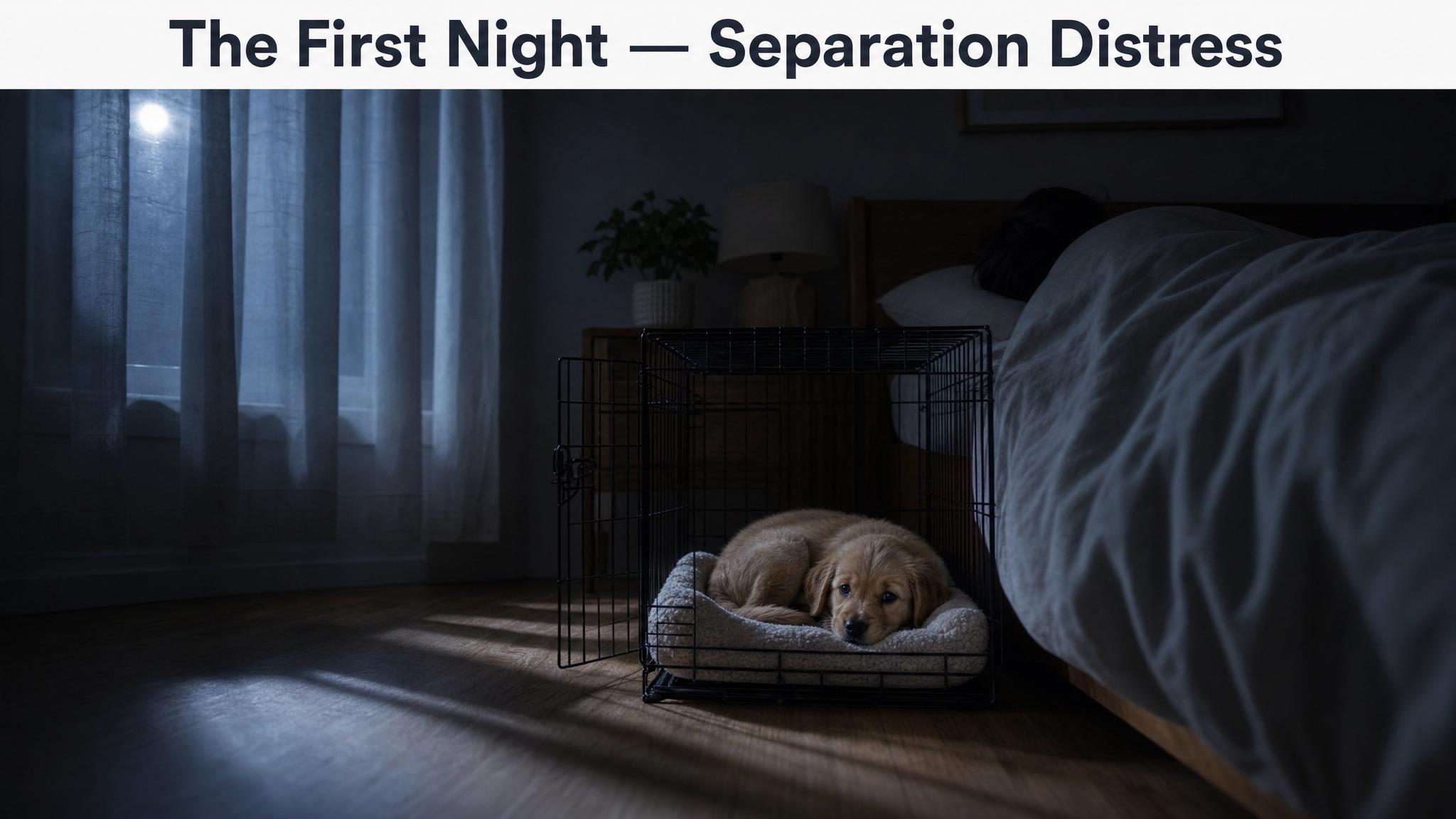
The First Night: The Emotional Heart of It All.
Let's be direct: the first night will probably be hard. Not because you're doing it wrong, but because the biology of the situation makes it hard. Your puppy has spent every night of their life sleeping in a warm pile of siblings, with the sound and smell of their mother nearby. Tonight, for the first time in their entire existence, they are alone. The whimpering, crying, and sometimes howling that follows is not manipulation. It is SEPARATION DISTRESS, a hardwired survival response in social mammals that says, "I am alone and I am vulnerable and I need my group," as described by Sargisson in twenty fourteen.
Where Should the Puppy Sleep?
There are several options, and the evidence points in a clear direction. The safest choice for the puppy's emotional wellbeing is a crate or secure sleeping area in your bedroom, right next to your bed. Not downstairs. Not in the laundry. Not in a separate room where you can't hear them and they can't sense you.
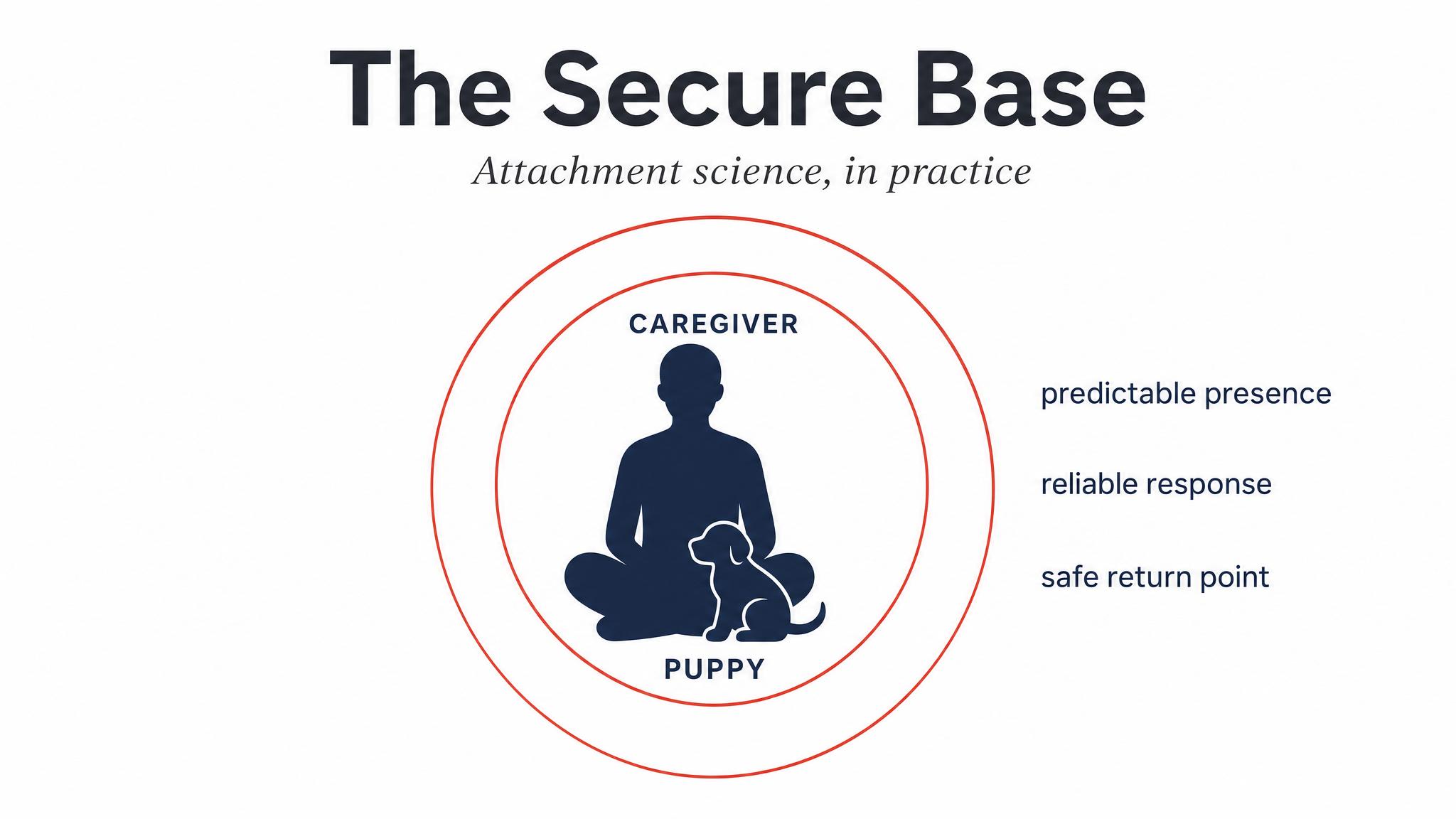
Here's why: attachment research in dogs has demonstrated that puppies, like human infants, use their caregiver as a secure base, a safe point from which to explore and to which they return when stressed, according to Topál and colleagues' work between twenty seventeen and twenty twenty-five. On the first night, you are the only familiar social presence in this new world. Your proximity, your scent, the sound of your breathing, is a genuine physiological regulator of the puppy's stress. A longitudinal study tracking one hundred forty-five puppies, the Generation Pup study from twenty twenty-four, found that appropriate overnight sleeping arrangements in the first sixteen weeks were associated with lower rates of separation-related behaviors later in life.
This doesn't mean the puppy sleeps in your bed forever, or even beyond the first week. It means that right now, proximity is medicine. You can gradually move the crate farther from your bed over subsequent nights and weeks, a few inches at a time, once the puppy has learned that this new world is safe and that you reliably come back.
[short pause]
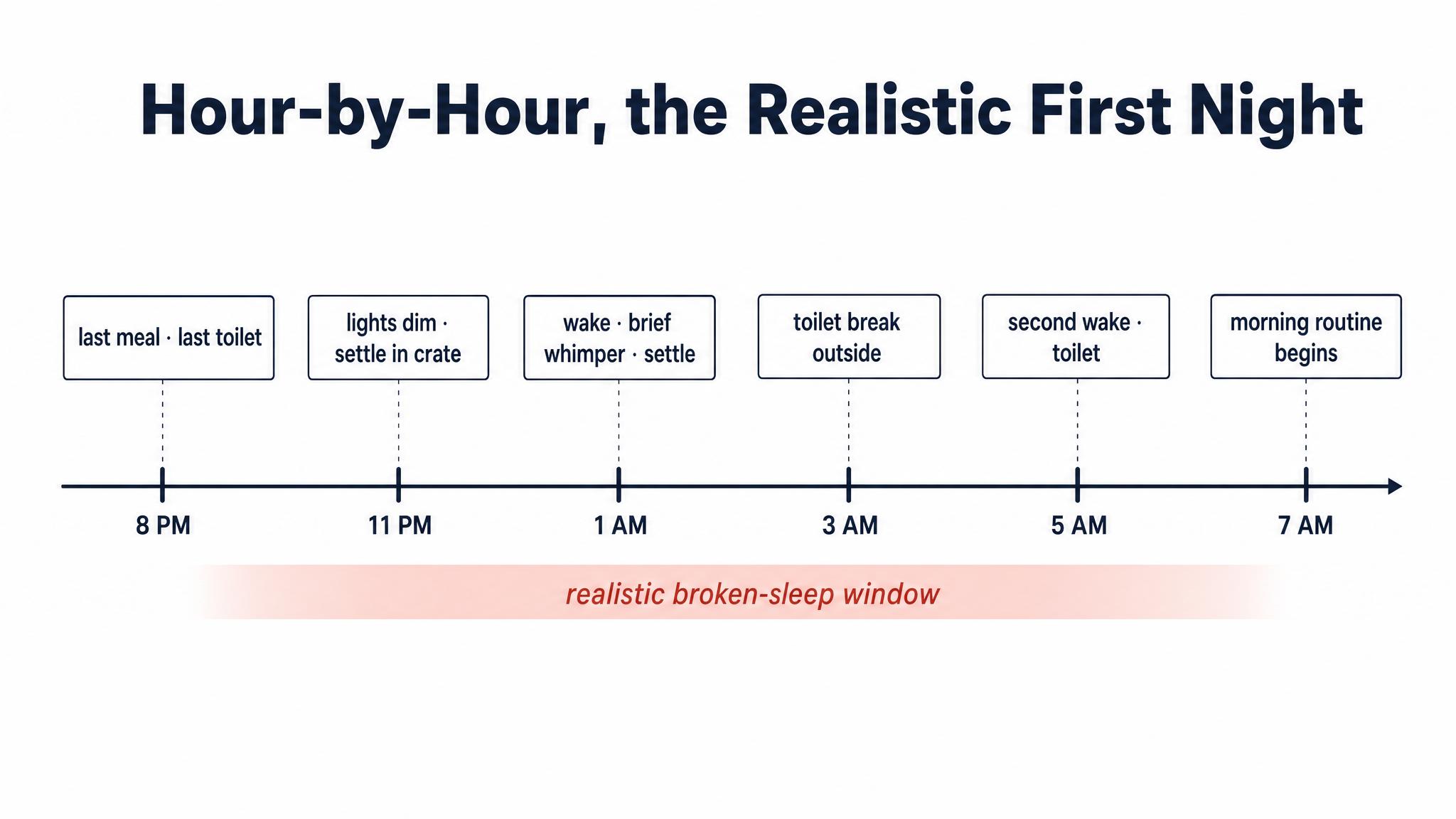
The Hour-by-Hour Plan.
Here is what a realistic first night looks like.
Eight to nine PM: Last feeding of the day, at least two hours before the final toilet trip. Calm play only, nothing that gets the puppy revved up. Begin winding down the energy in the room.
Nine thirty PM: Final toilet trip outside or to the pad. Wait until the puppy goes, even if it takes ten minutes of standing in the dark. Praise quietly when they do.
Ten PM: Into the crate with a Kong or chew, a scent cloth from the litter if you have one, and a warm, not hot, water bottle wrapped in a towel to mimic body warmth. A ticking clock nearby can also help. Lights out. Stay nearby.
Eleven PM to midnight: The puppy will likely wake and cry. This is normal. An eight-week-old puppy's bladder can hold urine for approximately two to three hours, with slightly longer stretches overnight due to reduced metabolic rate, according to veterinary bladder development research from twenty twenty-one to twenty twenty-five. Take them out for a toilet break: no talking, no play, no lights on if you can manage it. Toilet, quiet praise, back in the crate.
Two to three AM: Another wake-up. Same protocol. Toilet, back to bed. You are tired. This is temporary.
Five to six AM: The puppy may wake for the day, or may need one more toilet trip and then settle. Either way, this is roughly when the day begins for the next few weeks.
Many popular guides advise "letting the puppy cry it out." What does the attachment research suggest might happen if a young puppy's distress signals are consistently ignored in the first days? How might that affect the foundation of your relationship?
[short pause]
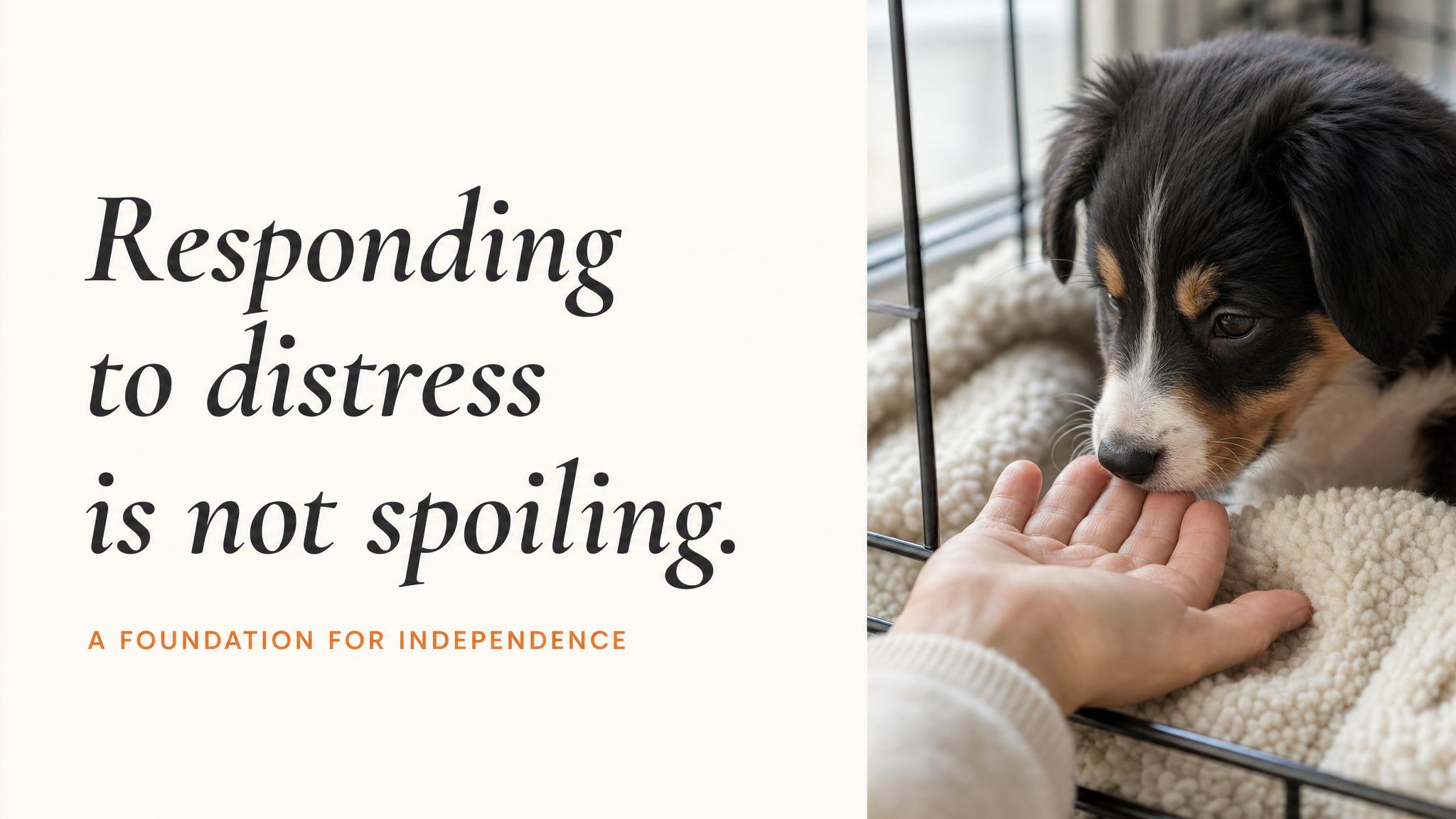
Responding to Distress Is Not "Spoiling."
This is perhaps the most important paragraph in this chapter. There is a persistent myth in dog training culture that responding to a crying puppy "teaches them that crying works" and creates a spoiled, demanding dog. The behavioral science tells a different story entirely.
Research on attachment in dogs, including the work of Topál and colleagues between twenty seventeen and twenty twenty-five, shows that consistent, attuned responsiveness from the caregiver produces secure attachment: dogs that are actually more independent, more confident, and better able to cope with being alone, because they have learned that their person is reliable. It is the inconsistently responded-to dogs, and the ignored dogs, that develop anxious attachment styles and are more prone to separation anxiety later, as Sargisson found in twenty fourteen. Avoidant caregiving styles, the "let them figure it out" approach, are correlated with increased separation-related disorders.
This does not mean you must hold the puppy every time they whimper for the rest of their life. It means that in these first days, when the puppy has no evidence yet that you are trustworthy, you build that evidence by showing up. Responding to distress now is what makes independence possible later. Think of it as making a deposit in a trust account you'll draw on for years.
[short pause]
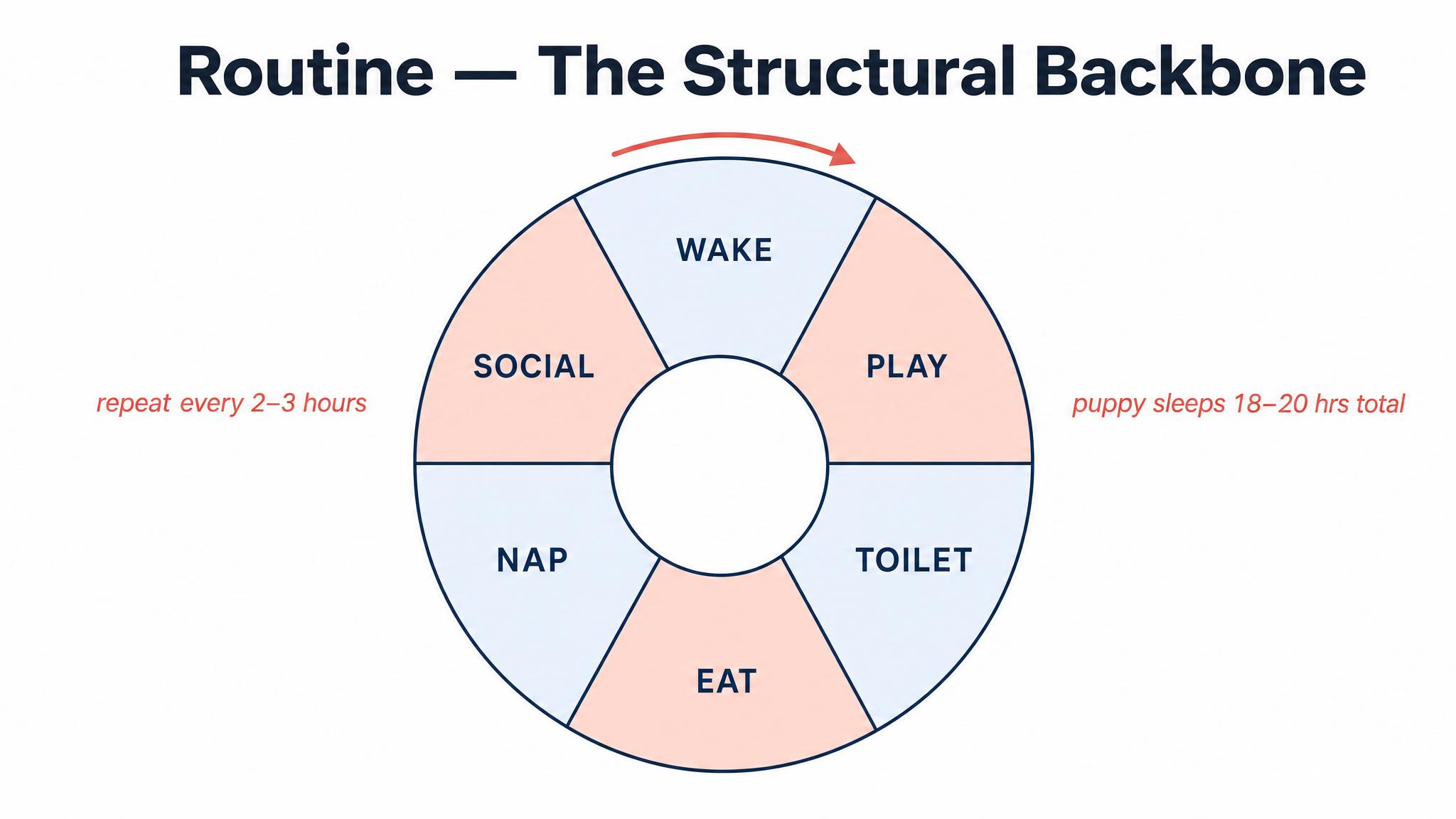
Establishing Routines: Your Most Powerful Tool.
If the first night is the emotional heart of the first seventy-two hours, then routine is the structural backbone. Research, including work from Cornell Veterinary Medicine and various behavioral research sources between twenty fourteen and twenty twenty-five, consistently shows that PREDICTABILITY reduces anxiety in dogs, significantly. When a puppy can begin to anticipate what happens next, "after eating, we go outside; after playing, we rest," their stress levels drop measurably. One body of research suggests dogs raised with predictable routines show up to seventy percent more reliable behavior compared to those in chaotic environments.
This isn't about rigidity. You don't need to feed the puppy at exactly seven twelve AM every morning for the rest of your life. It's about establishing patterns, recognizable sequences of events that the puppy can learn to predict. In the first seventy-two hours, those patterns are simple:
Wake up, toilet trip, breakfast, play, nap. Wake from nap, toilet trip, short play or training, nap. Late afternoon, dinner, play, wind down, final toilet trip, bed.
That's it. That cycle, repeated with gentle consistency, is the scaffolding on which everything else, house training, crate training, socialization, gets built.
[short pause]
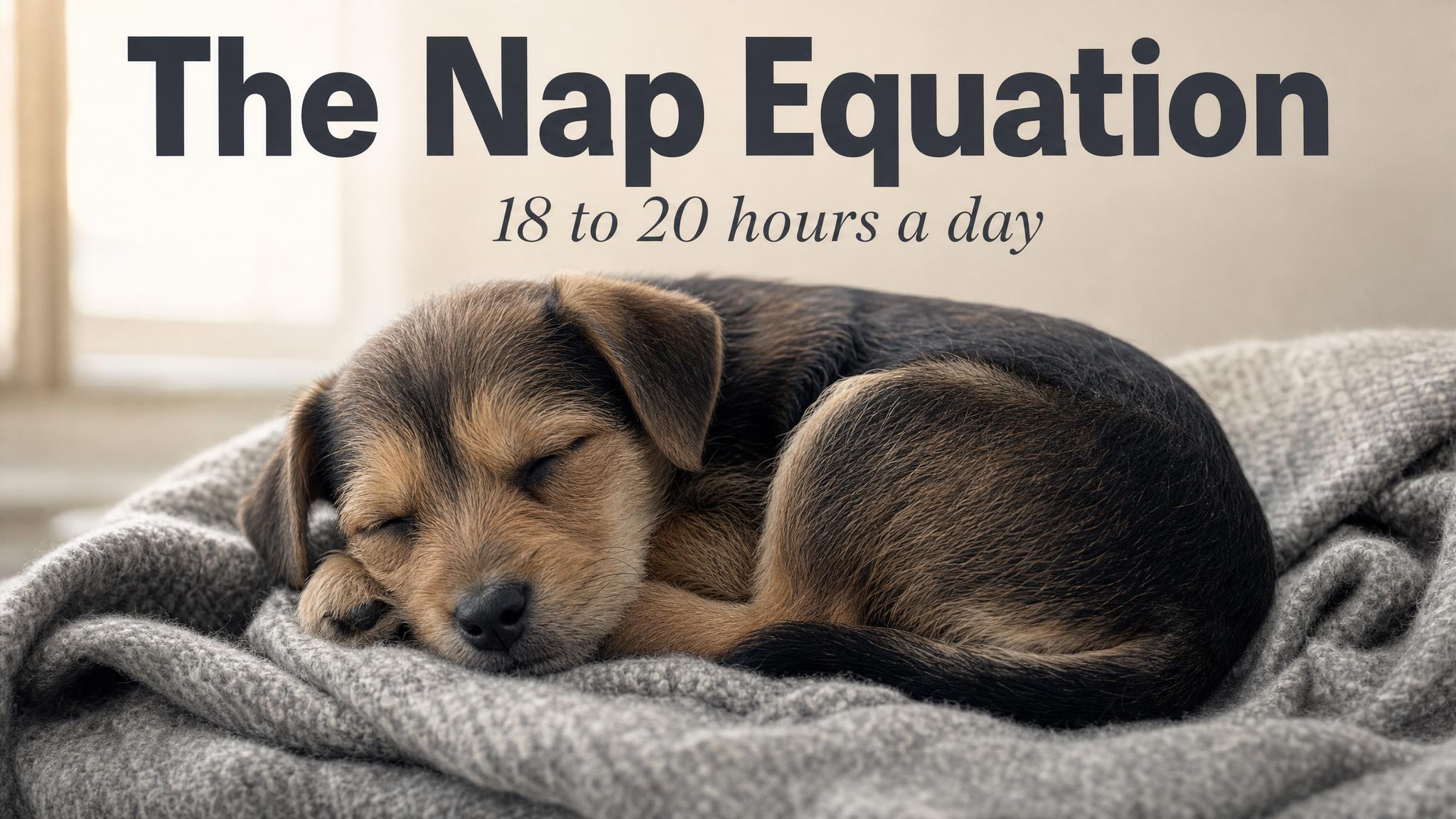
The Nap Equation Most People Get Wrong.
New puppy owners almost universally underestimate how much sleep a puppy needs. An eight-to-ten-week-old puppy needs eighteen to twenty hours of sleep per day. That is not a typo. They need substantially more sleep than they need waking activity, and many of the behavioral problems people report in the first week, biting, hyperactivity, inability to settle, are symptoms of an overtired puppy, not a "bad" one.
Think of a toddler who has missed their nap and is now screaming in the supermarket. That toddler doesn't need discipline. That toddler needs to sleep. The same is true of the puppy who is suddenly zooming around biting your ankles at seven PM. They have been awake too long. Enforced naps, gently placed in the crate with something to chew, are an act of care, not confinement.
[short pause]
Reading Your New Puppy: Body Language Under Stress.
In Chapter One, we introduced the foundations of canine body language. Now we need to apply that knowledge in real time, with a puppy who is navigating the most disorienting experience of their young life. The signals are the same, but the context changes everything.
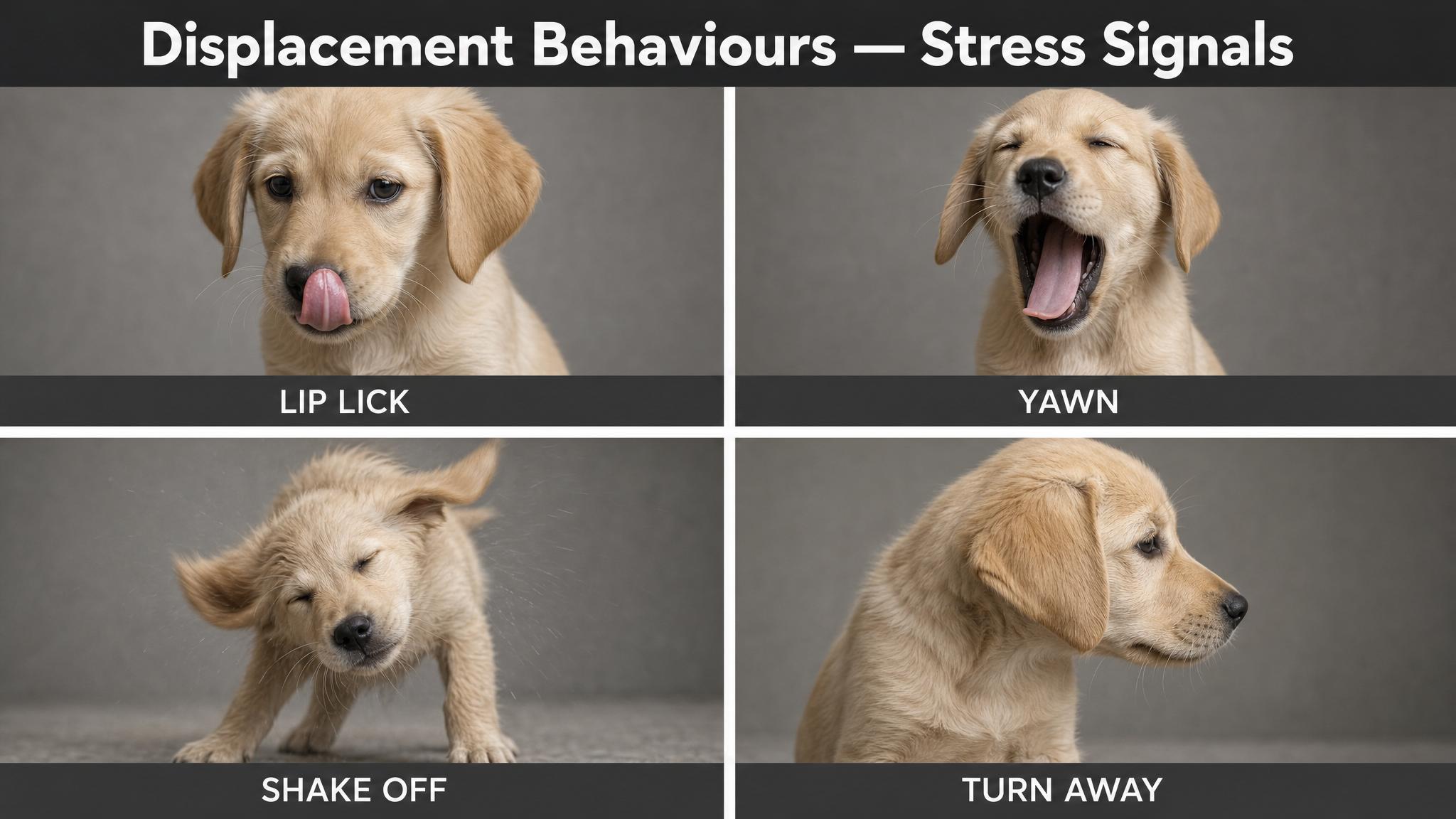
In the first seventy-two hours, you will likely see a constellation of DISPLACEMENT BEHAVIORS, actions that occur out of context and signal internal conflict or stress, as documented by V-C-A Animal Hospitals and Best Friends between twenty nineteen and twenty twenty-five. A puppy who suddenly starts sniffing the floor intensely in a new room may not be tracking a fascinating scent. They may be using sniffing as a coping mechanism, a way to self-soothe when overwhelmed. A puppy who yawns repeatedly isn't sleepy, or isn't only sleepy. Yawning is one of the most common canine stress signals. Lip-licking when no food is present, scratching when not itchy, sudden shaking off as if wet when dry, these are all displacement behaviors worth recognizing.
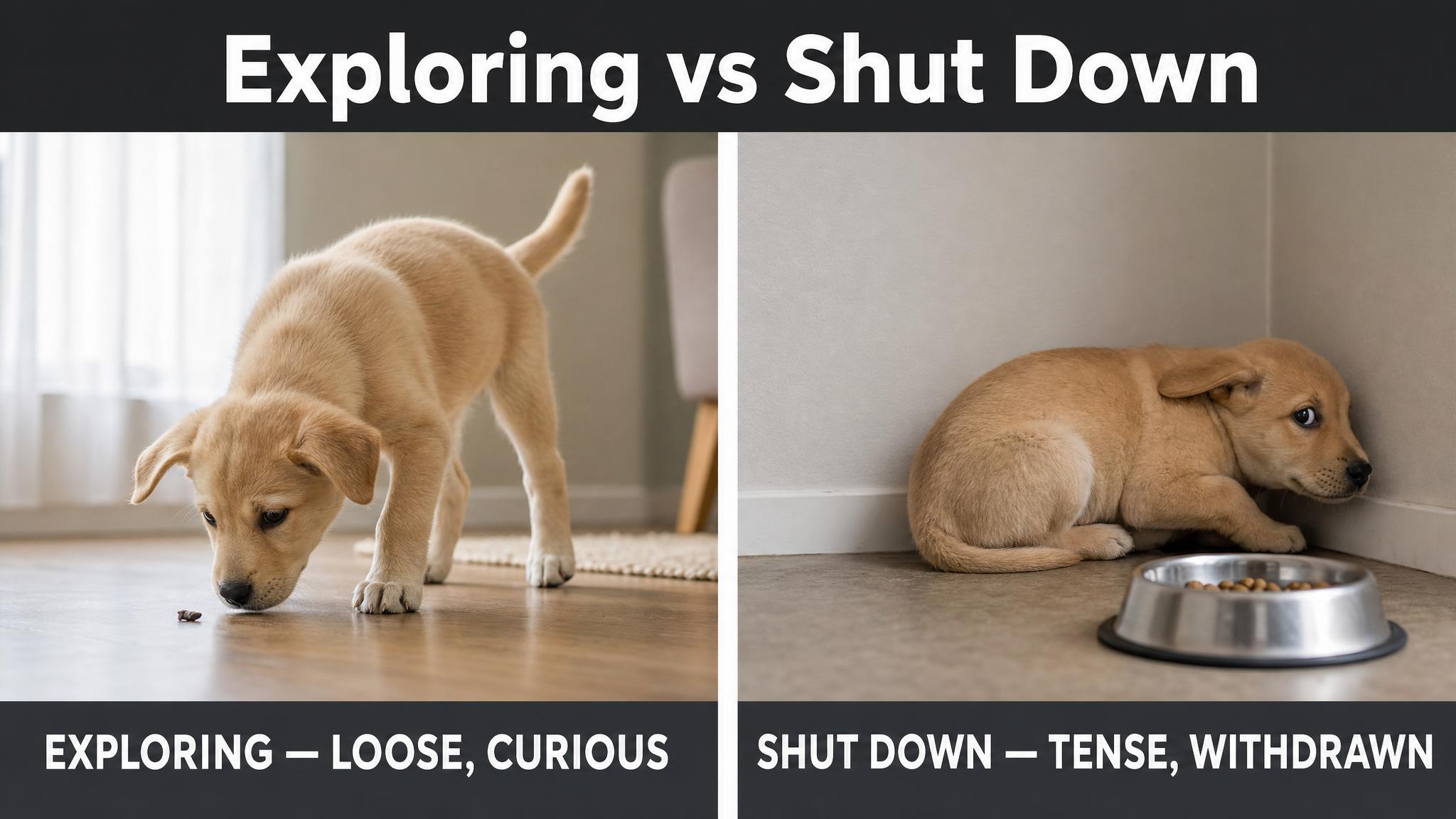
Exploring versus Shut Down: A Critical Distinction.
There is an important difference between a puppy who is calmly exploring and a puppy who has shut down. Both may appear quiet, which is why people miss it. A puppy who is exploring moves with a loose body, a slightly wagging tail held at mid-height, and approaches objects with curiosity: sniffing, pawing, sometimes startling but recovering quickly. Their ears are relaxed or pricked forward with interest.
A puppy who has shut down is also quiet, but the quality of that quiet is entirely different. They may be still, with a tense body. Their tail may be tucked or motionless. They may refuse food, a significant indicator in a puppy, since healthy puppies are almost universally food-motivated. They may avoid eye contact, turn their head away, a "cut-off" signal, or press themselves into a corner or under furniture. This puppy is not "being good" or "settling in nicely." This puppy is overwhelmed and has run out of active coping strategies.
If you see shut-down behavior, the answer is not more stimulation or forced interaction. The answer is to reduce the input: fewer people, quieter room, a covered crate where they can retreat. Recovery comes from feeling safe, and safety comes from having control over the pace of engagement, as research by Vieira de Castro and colleagues found in twenty twenty.
You bring your new puppy home and they sit quietly in their crate for three hours without making a sound. Is this a "good" puppy or a worried one? What body language cues would help you tell the difference?
[short pause]
Planting Seeds: The Crate and the First Steps of House Training.
We will devote significant attention to both crate training and house training in later chapters. But their foundations are laid in the first seventy-two hours, so let's plant the seeds now.
The Crate as a Safe Space.
A crate is not a cage. That distinction is not semantic, it's functional, and it depends entirely on how you introduce it. A crate used as punishment, or as a place to stuff a puppy for eight hours while you go to work, is a cage. A crate introduced gradually, associated with good things like treats, chews, meals, naps after play, and respected as the puppy's private retreat is a safe space, the canine equivalent of a bedroom with the door closed, according to guidance from the American Kennel Club and various animal welfare organizations between twenty nineteen and twenty twenty-five.
In the first seventy-two hours, your goals with the crate are modest: the puppy eats meals in or near the crate, takes naps in the crate with the door initially open, and sleeps in the crate at night near you. That's it. No extended confinement. No shutting the door while they scream. A ten-minute nap with the door closed and you sitting right there is a success. Build from that. Dogs have a natural denning instinct, a preference for small, enclosed sleeping areas, but that instinct only expresses itself if the crate has been associated with safety, not with isolation or distress.
House Training Logic: It's About Physiology, Not Morality.
Your puppy will have accidents. This is not a training failure. It is a physiological inevitability. At eight weeks, a puppy lacks full bladder muscle development and can hold urine for approximately thirty to sixty minutes during active waking hours, and slightly longer stretches, perhaps four to five hours, overnight when their metabolism slows, according to veterinary development sources from twenty twenty-one to twenty twenty-five. They have no concept of "indoors" versus "outdoors" as meaningful categories. They just know they need to go, and they need to go now.
The entire logic of house training rests on two principles: maximize the chance of success, take the puppy to the right spot frequently enough that they mostly go there, and never punish failure. The puppy cannot connect your anger to something they did minutes or even seconds ago, and punishment is strongly associated with increased anxiety and behavioral problems, as Vieira de Castro and colleagues documented in twenty twenty. If you catch the puppy mid-accident, calmly interrupt and carry them to the toilet area. If you find an accident after the fact, clean it up and adjust your timing. That's it. We'll build a comprehensive house training system in Chapter Four.
[short pause]
Permission to Feel Overwhelmed.
Let's close with something that no puppy training manual talks about enough: your feelings. There is a phenomenon so common it has its own informal name, the "puppy blues," in which new puppy owners experience a wave of regret, anxiety, and overwhelm in the first days and weeks. It feels like you've made a terrible mistake. Your house is chaos. You haven't slept. The puppy has bitten you forty times today and has urinated on the rug again and you are wondering, with genuine sincerity, whether you are cut out for this.
You are. This is normal. The first seventy-two hours are a crash-landing into a new reality, and they are not representative of what life with this dog will be. The sleep deprivation alone is enough to distort your perception of everything. Be kind to yourself with the same patience you're extending to the puppy. Lower the bar. If everyone is fed, nobody is injured, and the puppy has slept in a safe place, you are succeeding.
The goal of the first seventy-two hours is not to begin training a perfect dog. It is to begin building a relationship in which a perfect dog becomes possible.
[short pause]
Key Takeaways.
The journey home and first introductions should be calm, controlled, and limited to household members only. Overwhelming the puppy on Day One undermines the socialization process.
The puppy should sleep in a crate near your bed on the first night. Proximity is a physiological stress-regulator and builds the secure attachment that makes later independence possible.
Responding to a crying puppy is not spoiling them, it is building trust. Attachment research shows that consistent responsiveness produces more independent, confident dogs.
Routine and predictability are your most powerful tools: feeding, toileting, play, and nap cycles reduce anxiety for both puppy and owner.
Puppies need eighteen to twenty hours of sleep per day. Most "problem behaviors" in the first week are symptoms of overtiredness, not defiance.
Learn to distinguish between a puppy who is calmly exploring, loose body, curiosity, and one who has shut down: tense, avoidant, refusing food. Both can look "quiet."
The crate is a safe space when introduced positively. House training is about physiology and timing, never punishment.
The puppy blues are real and normal. Lower the bar for yourself. If everyone is safe and fed, you are doing well.
[short pause]
Looking Ahead.
In Chapter Three, we'll explore socialization in depth, what it really means, hint: it's not just "meeting lots of people," the critical windows during which it happens, and how to create a structured socialization plan that builds your puppy's confidence without overwhelming them. You'll learn the difference between exposure and flooding, and we'll give you a practical socialization checklist calibrated to your puppy's age and temperament.

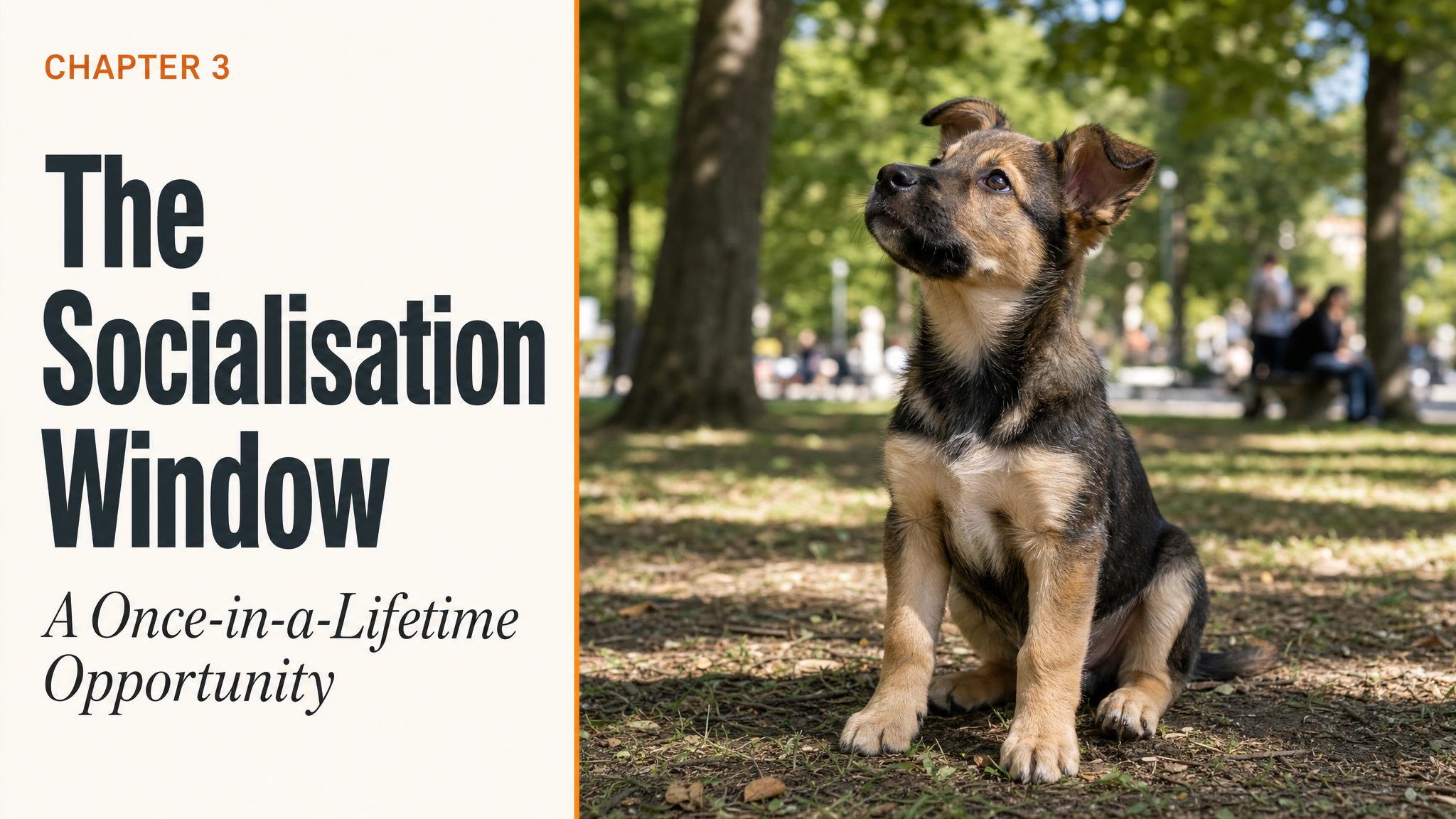
The Socialisation Window — A Once-in-a-Lifetime Opportunity
If there is one chapter in this course where the timing truly matters, it's this one. The socialisation window — roughly three to sixteen weeks of age — is a neurologically unique period when a puppy's brain is primed…
Would you rather risk your puppy catching a disease from early socializing, or risk them having anxiety issues for life from staying home?
Would you rather
Hot take: Most people think their dog is 'just being dramatic' when it's actually terrified. Agree or disagree?
Hot take
Have you ever seen someone push their dog into a situation when it clearly wanted out? Did you say anything or stay quiet?
Real talk
Which is worse: taking an unvaccinated puppy to a dog park, or keeping a puppy isolated at home until they're 4 months old?
Which is worse
If your friend's puppy was clearly freaking out during an interaction, would you speak up or mind your own business?
What would you do
Do you think you could tell the difference between a happy dog and a stressed dog just by watching their body language?
Quick poll
Exposure vs. Flooding: Video Verdict
12-15 minutesInstructor shows 4-5 short video clips (30-60 seconds each) of puppies in various socialization scenarios. After each clip, students turn to their immediate neighbors (groups of 2-3) and have 60 seconds to decide: Is this appropriate exposure or flooding/overwhelming? What body language signals support their verdict? Instructor then polls the room (show of hands or polling app) and facilitates a quick debate between opposing views before revealing expert analysis. Include at least one controversial borderline case to spark genuine disagreement.
Body Language Bingo: Stress Signal Spotting
10 minutesStudents receive a 'bingo card' (digital or paper) with 9 different canine stress signals (whale eye, lip licking, yawning, tucked tail, etc.). Instructor rapidly shows 15-20 images of puppies in various situations. Students mark off signals they spot and shout 'BINGO' when they get three in a row. First 3 students to get bingo share which signals they identified and where. Instructor validates and discusses any subtle signals the class missed. Competitive but educational.
The 4-Week Challenge: Socialization Planning
15-18 minutesStudents work with their row neighbors (groups of 3-4) on a realistic scenario: 'Your client has a 9-week-old puppy. First vaccine was at 8 weeks, second at 12 weeks. Create a socialization plan for weeks 9-12 that maximizes critical period exposure while managing disease risk.' Groups have 8 minutes to draft their plan on paper/device. Instructor then cold-calls 4-5 groups to share one creative socialization strategy from their plan. Class votes on most innovative/safe approach. Instructor highlights how the winning approaches balance risk and opportunity.
Fear Period Emergency: What Would You Do?
8-10 minutesInstructor presents a vivid scenario: 'A client is at a puppy socialization outing at a park. Their 11-week-old puppy suddenly freezes when a child on a skateboard zooms by. The puppy is clearly frightened. The client picks up their phone to video-call YOU for advice. You have 60 seconds to tell them what to do RIGHT NOW.' Students turn to their neighbor and role-play: one is the panicked client, one is the professional giving advice. After 90 seconds, switch roles with a slightly different fear trigger. Instructor then solicits answers from the room and discusses the neuroscience of fear periods and why immediate responses matter.
Myth Busters: Socialization Edition
10-12 minutesInstructor presents 6-8 common socialization myths (e.g., 'Wait until all vaccines are complete before taking puppy anywhere public,' 'A fearful puppy needs to be forced to approach the scary thing,' 'Puppy classes are too risky before 16 weeks'). For each myth, students discuss with neighbors for 30 seconds, then vote: TRUE or FALSE (hand raise or stand/sit if physically able). Instructor reveals the answer with neuroscience backing and explains WHY the myth persists and how to educate clients. Keeps a tally of which rows/sections get most correct for friendly competition.
Red Flag Rapid Response
8 minutesInstructor rapidly describes 10 short socialization scenarios (20-30 seconds each). Students hold up a colored card, hand signal, or use polling app to indicate: GREEN (safe/appropriate), YELLOW (caution/needs modification), or RED (stop/harmful). After each scenario, instructor immediately shows the class distribution of responses and asks 1-2 students from the minority opinion to defend their choice, creating spontaneous debate. Focus on controversial scenarios where the answer isn't obvious (e.g., 'Puppy is reluctant but tolerating having stranger's hands near food bowl').
Transcript
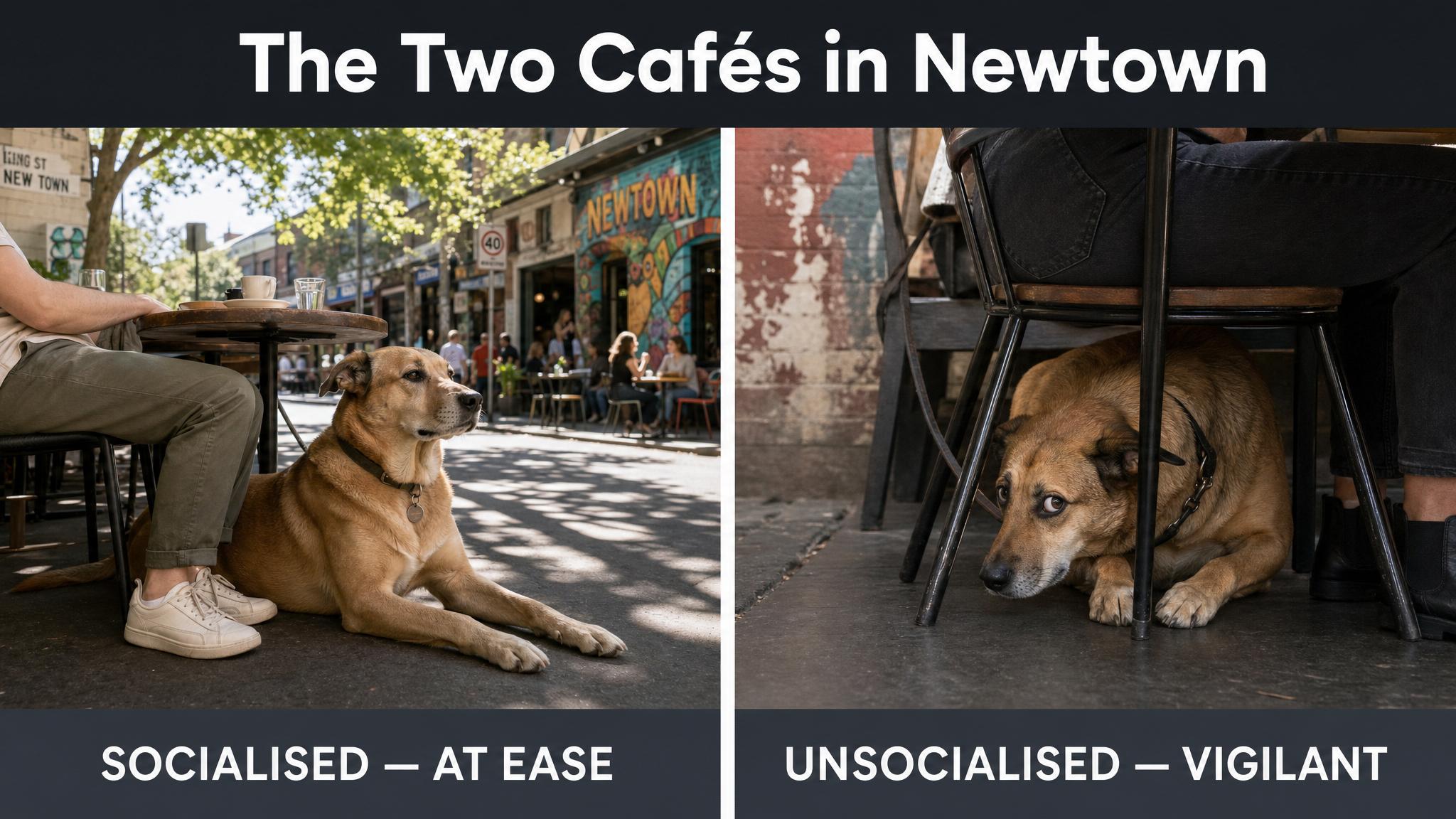
It's Saturday morning at a busy café in Newtown. At one table, a twelve-week-old Golden Retriever lies calmly under a chair, tail gently swishing as a toddler toddles past. She glances at the hissing espresso machine, looks back at her owner, and accepts a piece of chicken. Three suburbs away, a dog of the same breed, same age, same genetics from a related litter, cowers behind the couch every time someone knocks on the front door. She has never been to a café. She has never met a child. The espresso machine sound would send her into a panic spiral that lasts twenty minutes.
The difference between these two dogs is not temperament, not breed, and not luck. It's what happened, or didn't happen, between the ages of three and sixteen weeks. You are reading this during the most consequential developmental period your puppy will ever experience. Let's make it count.
[short pause]
What Socialisation Actually Means
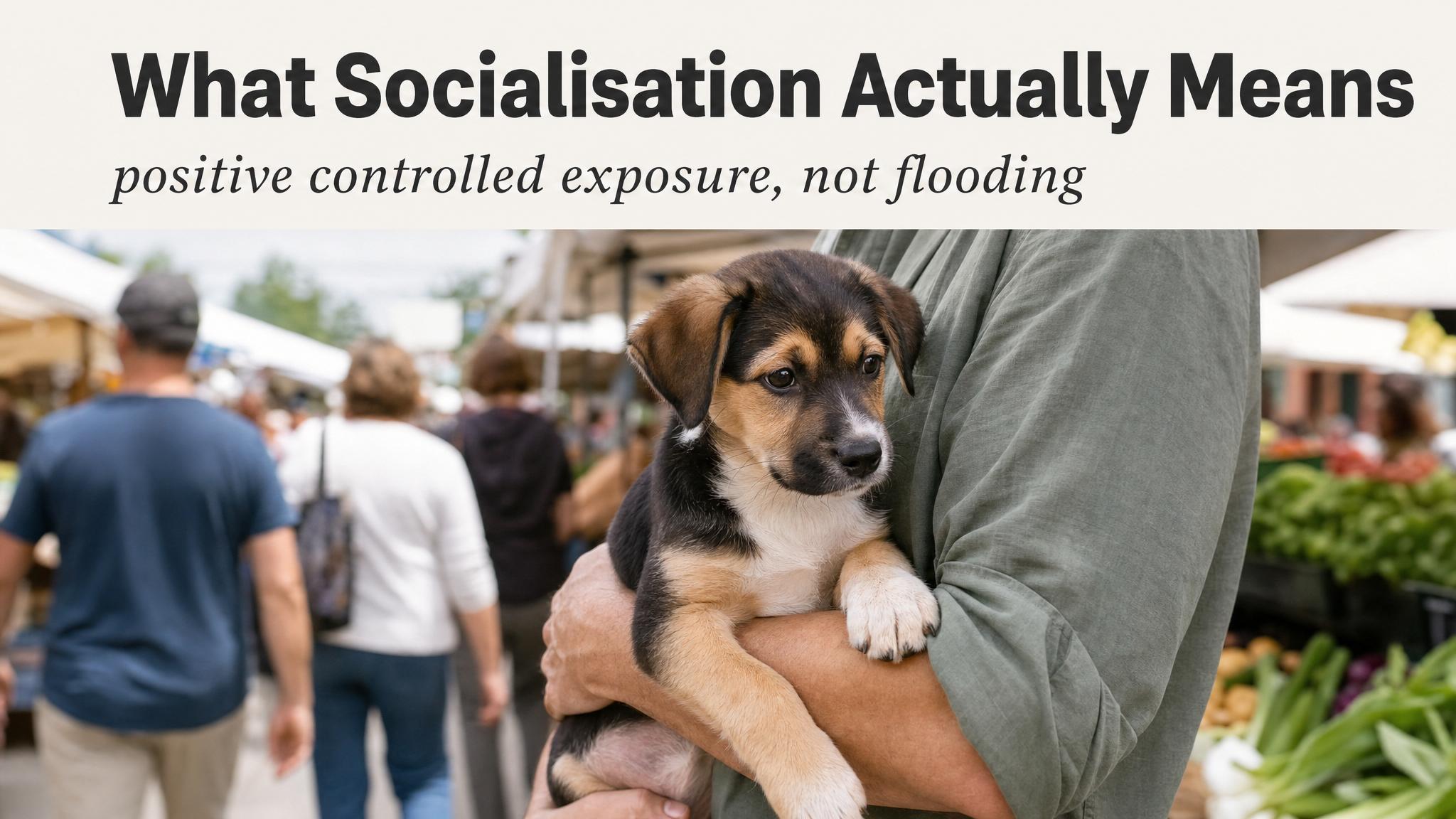
When most people hear "socialisation," they picture a puppy playing with other puppies. That's a small fraction of the picture. SOCIALISATION is the process by which a young animal learns to accept and feel comfortable with the full range of stimuli it will encounter throughout its life: people of all ages and appearances, other animals, sounds, surfaces, environments, handling, and transport. It is the systematic, positive introduction of a puppy to the world.
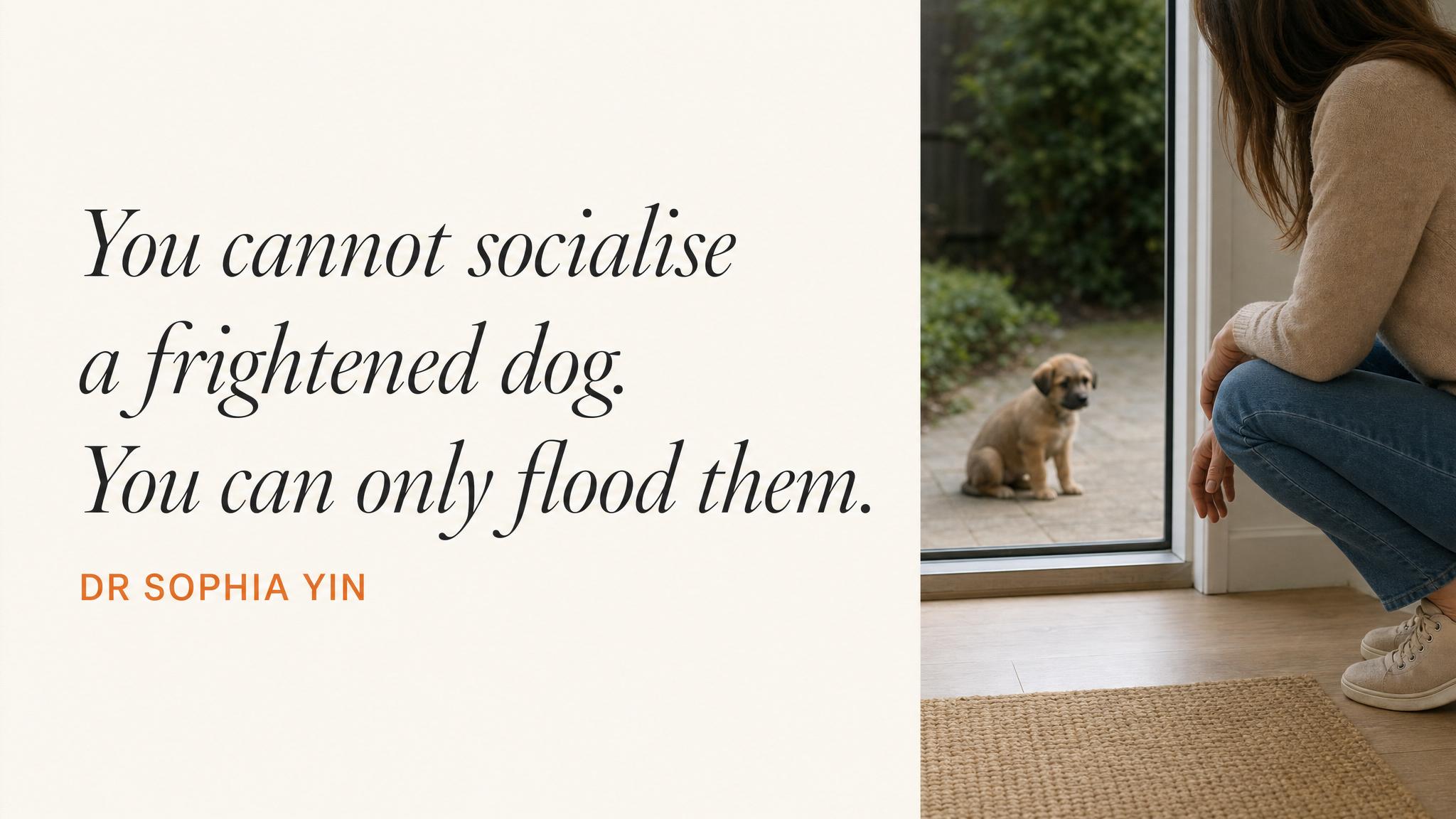
Doctor Sophia Yin, one of the most influential veterinary behaviourists of the modern era, put it simply in 2011: the goal is not just exposure but POSITIVE exposure. A puppy who meets thirty people but is frightened by twenty-five of them has not been socialised, they've been traumatised. The quality of each experience matters infinitely more than the quantity. We'll return to this principle throughout the chapter because it is the single most common mistake new puppy owners make.
[short pause]
The Seven Domains of Socialisation
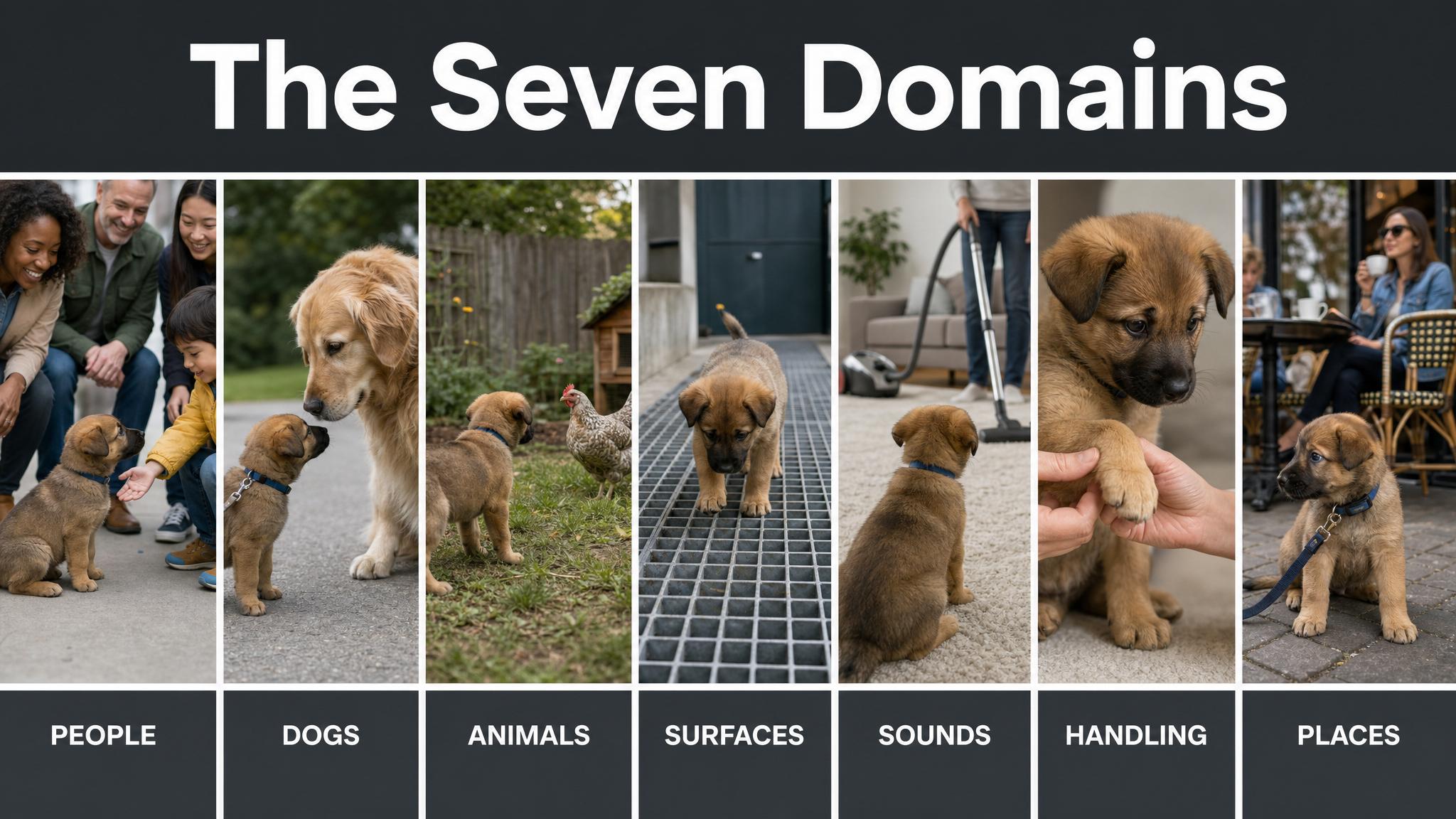
A thorough socialisation programme covers seven key domains. First, PEOPLE: children, elderly people, people with mobility aids, hats, sunglasses, high-visibility clothing, helmets, beards, different skin tones, different body sizes, and delivery drivers. Second, ANIMALS: calm adult dogs, cats, birds, livestock if relevant, and dogs of very different sizes. Third, SURFACES AND TEXTURES: grass, concrete, sand, metal grates, wet surfaces, wooden decking, gravel, bubble wrap, and wobble boards. Fourth, SOUNDS: vacuum cleaner, thunder recordings, bin trucks every Monday night in your suburb, magpie calls, fireworks recordings, hairdryer, lawn mower, and school bells. Fifth, ENVIRONMENTS: vet clinic for a happy visit, cafés, Bunnings, the beach, busy streets, school pick-up zones, car parks, and parks with joggers and cyclists. Sixth, HANDLING AND RESTRAINT: paw handling, ear inspection, mouth opening, nail trimming position, gentle restraint, brushing, and towel drying. And seventh, TRANSPORT: car travel both short and long, crate in the car, different seating positions, stopping and starting.
Notice that playing with other puppies is just one item in one of seven categories. If your socialisation plan consists only of puppy play dates, you're covering roughly five percent of the territory.
[short pause]
The Neuroscience: Why Timing Is Everything
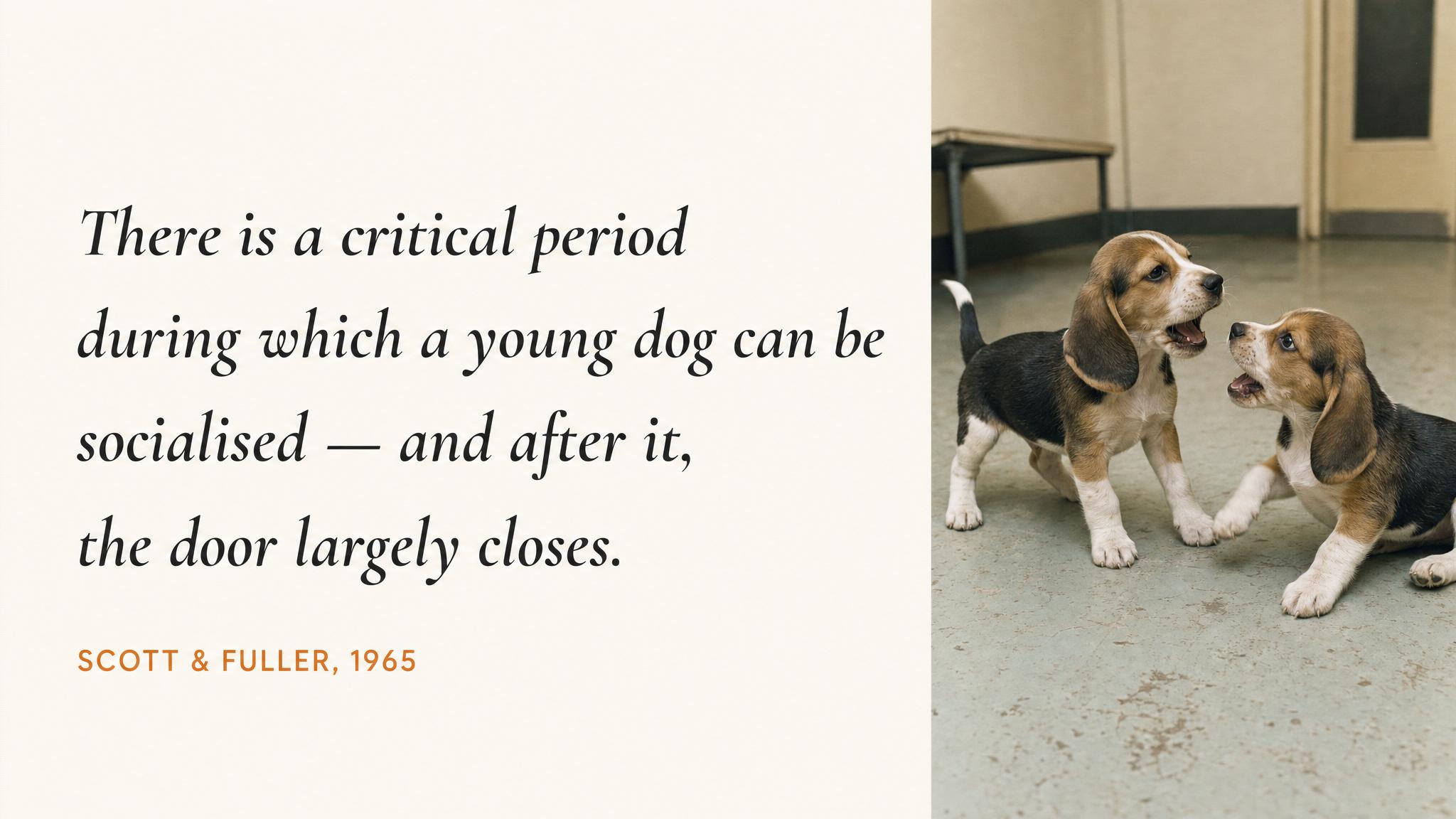
The concept of a CRITICAL PERIOD in canine development was established by Scott and Fuller's landmark twenty-year study at the Jackson Laboratory, published in 1965. Their research, meticulous, multi-breed, and experimental, showed that puppies between approximately three and twelve weeks of age were uniquely receptive to forming social bonds and accepting novel stimuli. Freedman, King, and Elliot in 1961 further demonstrated that puppies not exposed to humans before fourteen weeks of age developed intense withdrawal reactions that proved essentially irreversible, even with extensive later handling.
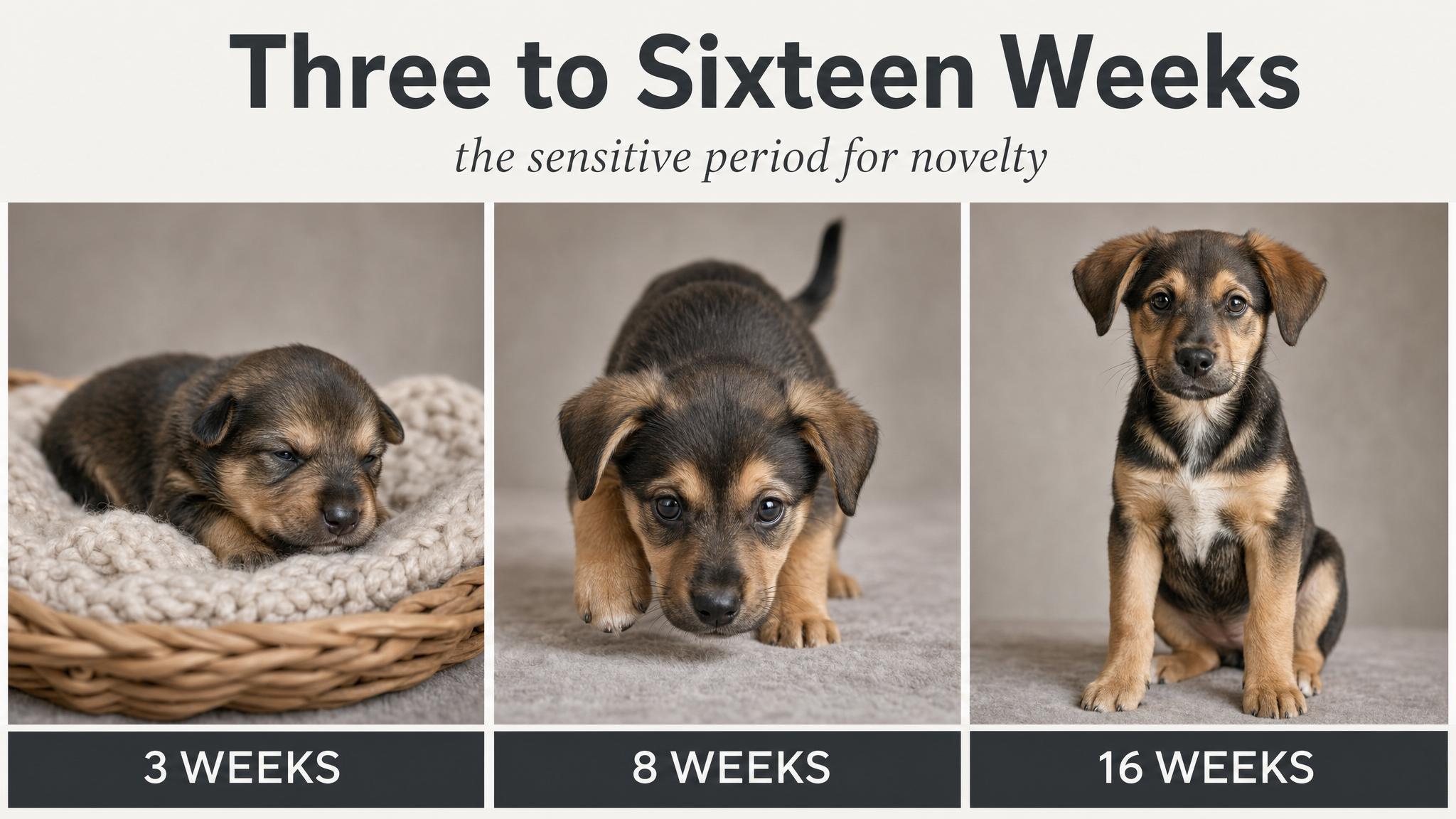
Modern researchers have refined the terminology from critical period to SENSITIVE PERIOD, recognising that the window doesn't slam shut at a precise moment but rather gradually closes, as Baqueiro-Espinosa and colleagues noted in 2022. Think of it less as a door that locks and more as wet cement that slowly hardens. Early on, impressions form quickly and permanently. As the weeks pass, each new impression requires more effort to make, and the default response to unfamiliar stimuli shifts from curiosity to caution.
The neurological mechanism involves shifts in the autonomic nervous system. Between three and five weeks, parasympathetic dominance means puppies are physiologically primed to approach novel stimuli. From around five weeks onward, sympathetic activation increases, and puppies begin developing fear responses, as Battaglia described in 2009. By around five weeks, a puppy can first identify something as novel, which means they must already have a mental template of normal to compare it against. Anything missing from that template after the sensitive period closes is, by default, potentially threatening.
As Scott and Fuller wrote in 1965, a small amount of experience during a critical period will produce a great effect on later behaviour. This is why the work you do in these few weeks is so disproportionately powerful. Five minutes of calm, treat-paired exposure to a person in a wheelchair at eight weeks of age does more than five hours of remedial counter-conditioning at eight months. You are literally shaping neural architecture.
[short pause]
Safe Socialisation Before Vaccination Is Complete
Here is where many new puppy owners receive dangerously conflicting advice. Some veterinarians, operating from an infectious disease perspective, advise keeping puppies isolated until two weeks after their final vaccination, typically around sixteen weeks of age. This advice, while well-intentioned, effectively tells you to lock the door on socialisation just as the sensitive period closes.
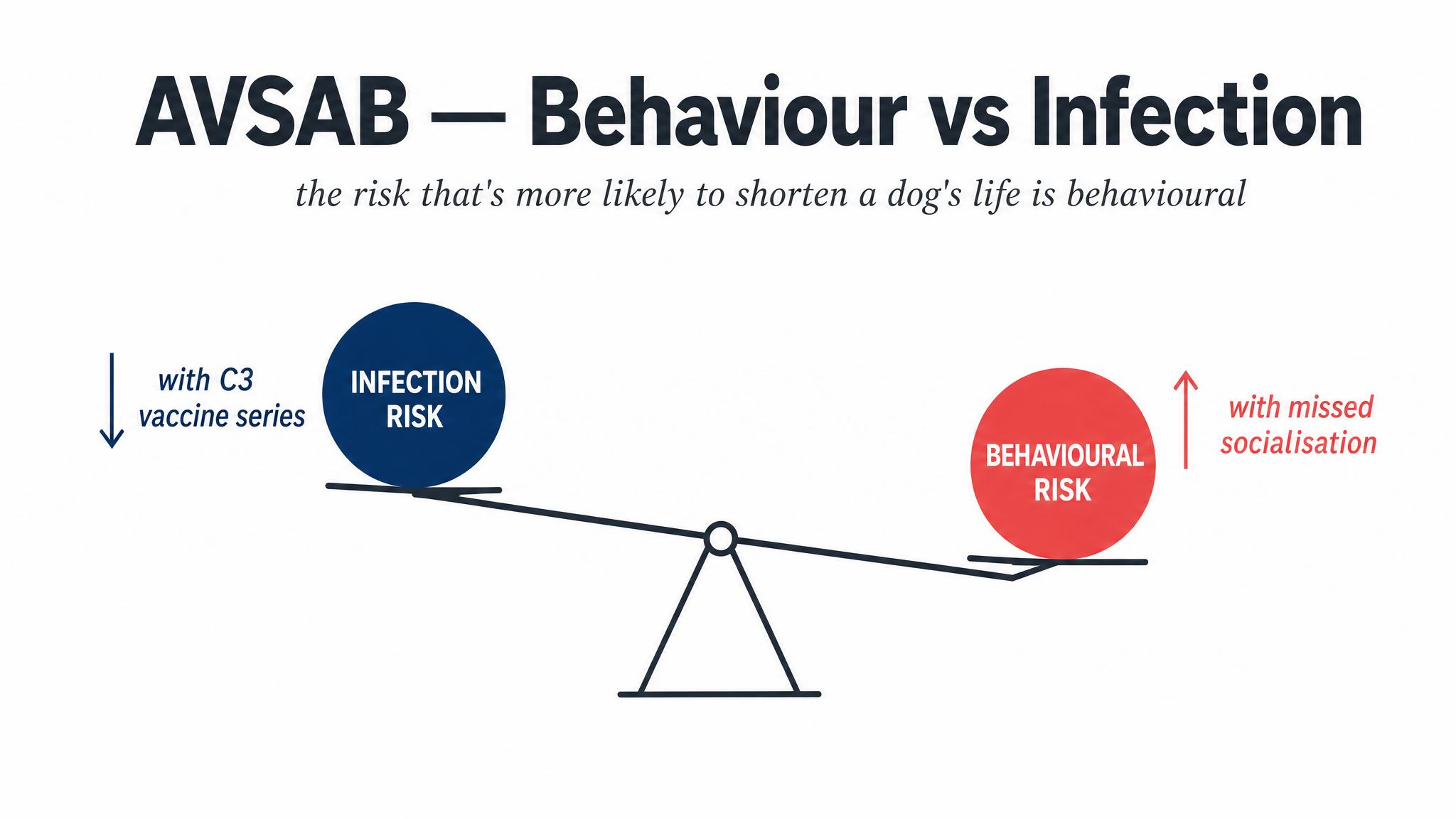
The American Veterinary Society of Animal Behavior, or AVSAB, addressed this conflict directly in their position statement from 2008, revised in 2014: The primary and most important time for puppy socialization is the first three months of life. Puppies should receive appropriate socialization before the vaccination series is complete. Their reasoning is stark: behavioural problems are the number one cause of death for dogs under three years of age, far exceeding infectious disease. Dogs are surrendered and euthanised for fear-based aggression, anxiety, and reactivity, conditions rooted in inadequate socialisation.
[short pause]
Practical Strategies for Safe Socialisation
Safe socialisation before full vaccination is not about throwing caution to the wind. It's about smart risk management. First, carry, don't walk. In high-traffic dog areas where parvovirus risk is elevated, carry your puppy or use a stroller or trolley. They can still see, hear, and smell the world. Second, choose low-risk environments. A friend's fully vaccinated dog's backyard is low risk. The local off-lead dog park where vaccination status is unknown is high risk. Third, use controlled settings. Well-run puppy classes that require proof of first vaccination and maintain clean surfaces are recommended from seven to eight weeks of age, as the AVSAB noted in their 2014 statement. Fourth, socialise at home. Invite people over. Play sound recordings. Introduce surfaces in your backyard. Most of socialisation doesn't require a park. Fifth, visit Bunnings. The concrete floors are regularly cleaned, the risk of parvovirus contamination is low, and the sensory environment, trolley wheels, P-A announcements, forklifts beeping, strangers wanting to pat your puppy, is socialisation gold. Sixth, visit your vet for happy visits. Sit in the waiting room, accept treats, get weighed, and leave. No needles. This is pure counter-conditioning for future veterinary experiences.
The AVSAB's position is clear: the risk of a puppy developing permanent behavioural problems from insufficient socialisation is far greater than the risk of contracting infectious disease in controlled environments with minimum first vaccination, as Seksel and colleagues confirmed in 2018.
[short pause]
Reading Your Puppy During Socialisation
In earlier chapters, you learned to read canine body language, the ladder of aggression, calming signals, and stress indicators. Now we apply those skills in a new context: real-time assessment during socialisation outings. Your ability to read your puppy in the moment is what separates positive socialisation from flooding.
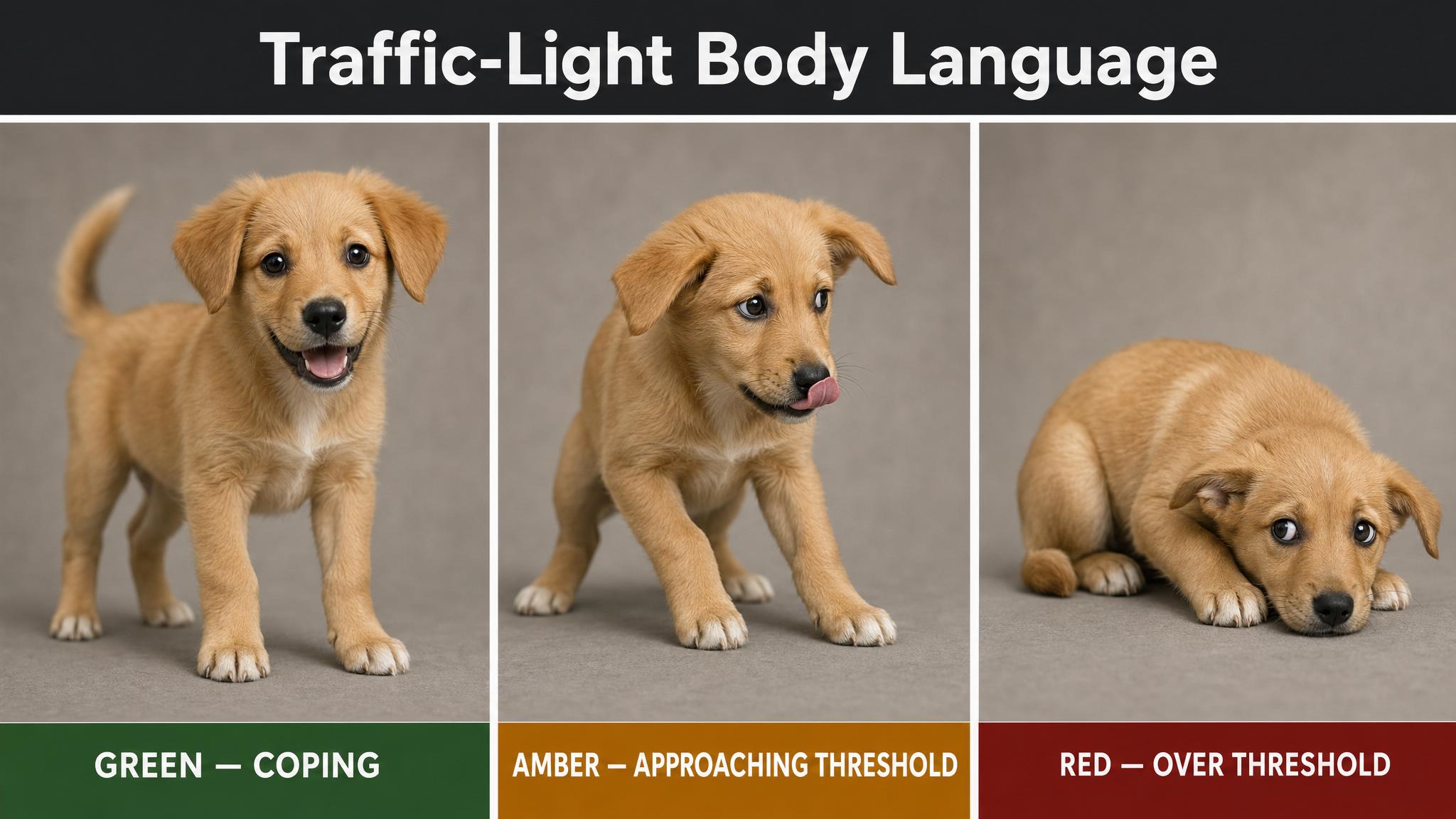
GREEN LIGHT SIGNALS tell you to continue. These include a loose, wiggly body with relaxed tail, soft, slightly squinty eyes, voluntarily approaching the new stimulus, play bows and soft open mouth, and taking treats easily and enthusiastically.
AMBER LIGHT SIGNALS tell you to pause and assess. Watch for lip licking or yawning, which are displacement behaviours, turning head away in avoidance, ears pinned back, refusing treats because stress suppresses appetite, and stillness or freezing, which is often misread as being good.
RED LIGHT SIGNALS mean remove immediately. These include whale eye, showing whites of eyes, tucked tail and crouched body, trembling, attempting to flee or hide behind you, and vocalising, whimpering, or barking in a high pitch.
The amber zone is where most learning happens, and where most mistakes are made. A puppy who is slightly uncertain but coping, paired with high-value treats and the freedom to retreat, is learning that unfamiliar things predict good outcomes. A puppy who is forced to remain in a situation they're signalling discomfort about is being FLOODED, and that experience may create a lasting negative association rather than a positive one.
[short pause]
Fear Periods: When the Window Gets Wobbly
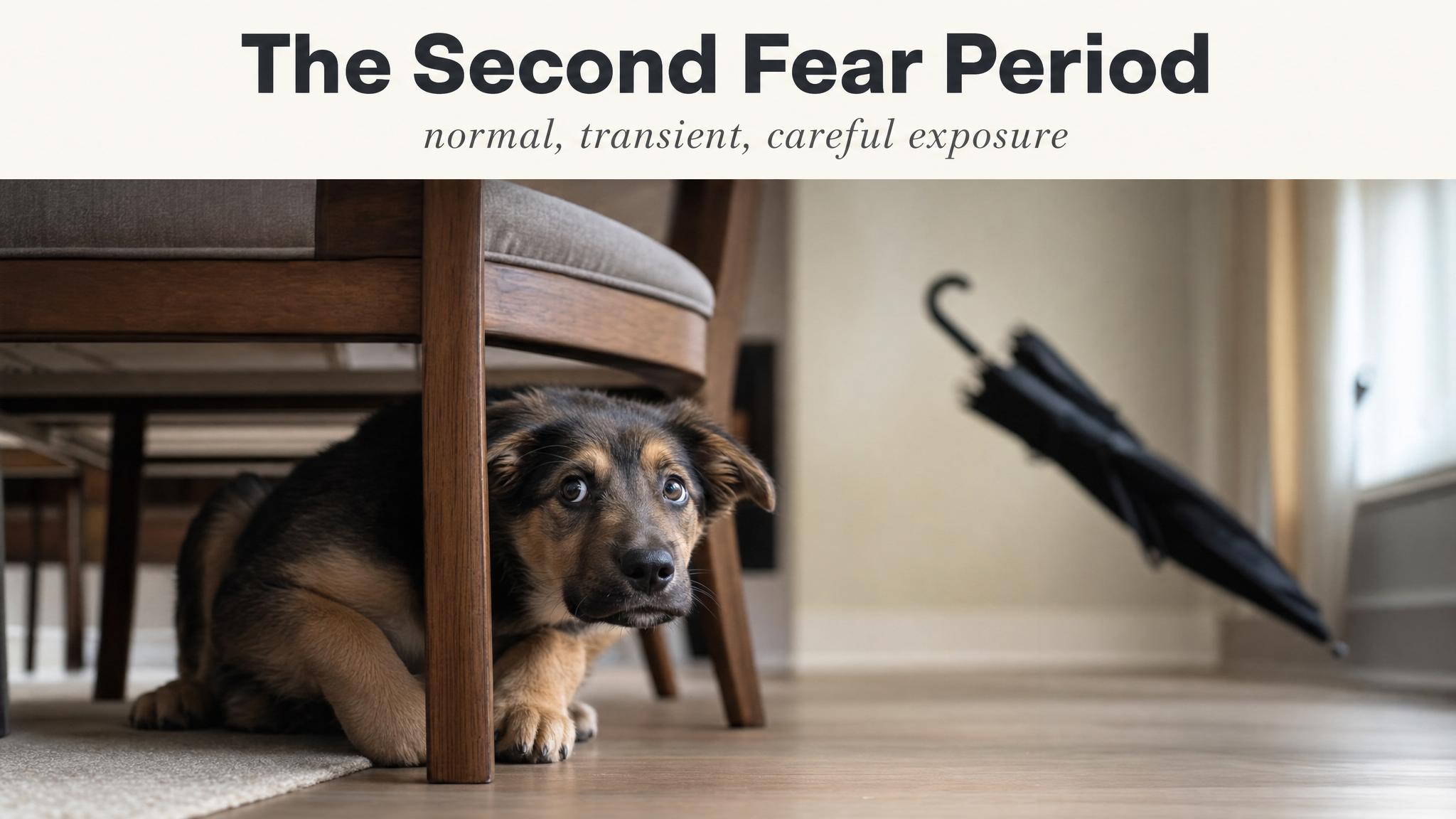
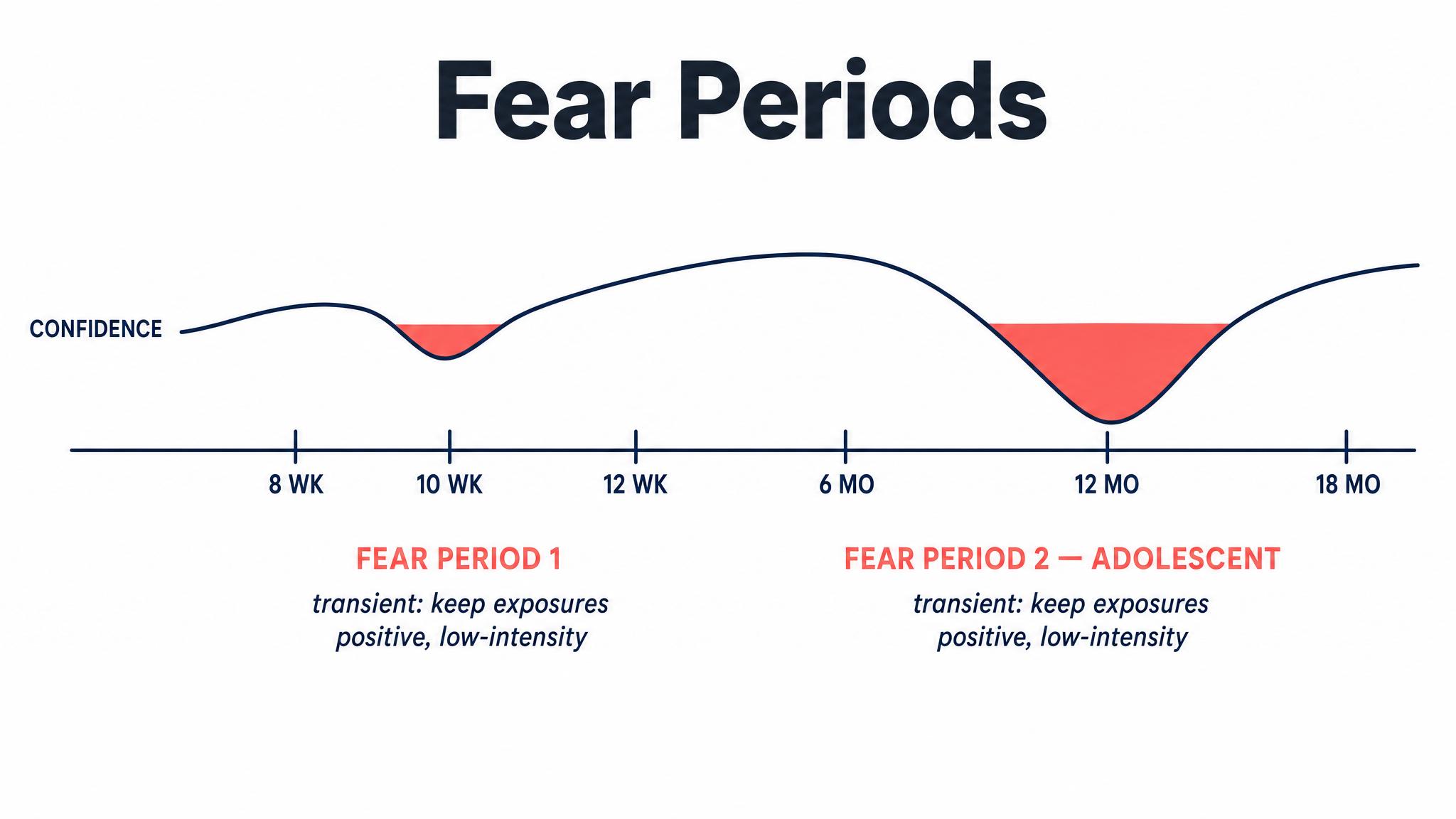
Within the broader sensitive period, puppies experience FEAR PERIODS, short developmental phases where they are particularly susceptible to forming fearful associations. The first fear period typically occurs around eight to ten weeks of age, and a second often appears around six to fourteen months, as Battaglia noted in 2009 and Seksel and colleagues confirmed in 2018.
During a fear period, a single frightening experience can create a disproportionately strong and lasting negative association. A puppy who has happily tolerated traffic noise for weeks may suddenly startle at a truck backfiring during a fear period and develop a lasting sound sensitivity. This doesn't mean you should stop socialisation during fear periods, but it means you should reduce intensity, increase distance from stimuli, increase treat value, and watch body language with extra vigilance.
[short pause]
Exposure versus Flooding: The Critical Distinction
EXPOSURE means presenting a stimulus at an intensity the puppy can process while maintaining a generally positive emotional state. FLOODING means overwhelming the puppy with a stimulus they cannot escape, past their coping threshold. The difference is not in the stimulus itself but in the puppy's emotional experience of it.
Consider the sound of fireworks. Playing a fireworks recording at low volume in the background while your puppy eats dinner is exposure. Taking your puppy to a New Year's Eve fireworks display is flooding. Same stimulus, vastly different emotional experience, vastly different outcomes.
As Yin wrote in 2011, the goal is not to expose puppies to the most stimuli possible, but to ensure that all exposures are positive.
[short pause]
Introducing Counter-Conditioning
COUNTER-CONDITIONING is the process of changing an emotional response by pairing a previously neutral or mildly scary stimulus with something the puppy loves, usually food. Puppy sees a person in a hat, puppy gets roast chicken. After repetitions, the sight of a hat-wearing person triggers not wariness but happy anticipation. This technique will become central in later chapters on redirecting mouthing and creating positive veterinary experiences, but you begin using it now during every socialisation outing.
The protocol is simple: new thing appears at comfortable distance, treat arrives, puppy processes, repeat, gradually reducing distance only when the puppy shows green-light body language. If at any point your puppy shows amber signals, increase distance. If they show red signals, leave and try again another day at lower intensity.
[short pause]
Building Your Socialisation Plan: The Australian Context
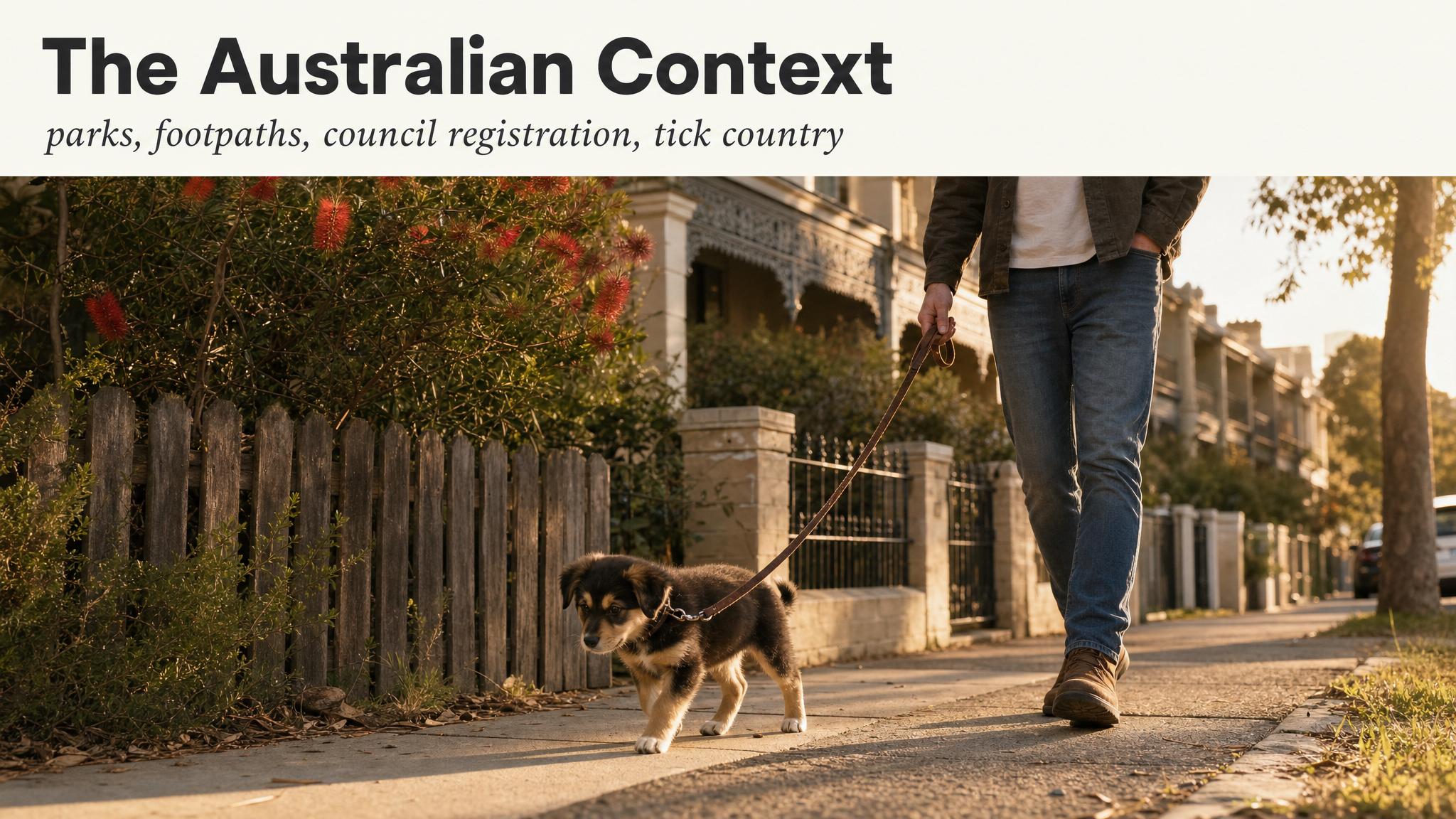
Socialisation plans should be locally relevant. Your Australian puppy will encounter specific stimuli that a puppy in Minnesota will not, and vice versa. Here are context-specific experiences worth prioritising.
First, BIN NIGHT. The weekly thunderous roll of wheelie bins on concrete and the rumble of the truck at six A-M. Start with wheeling your own bin while treating your puppy, then progress to the bin truck from a distance. Second, MAGPIE SEASON. If your puppy's socialisation window falls between August and November, the swooping season is real. Expose your puppy to magpie calls, recordings first, and walk near magpie territory at low-risk times while counter-conditioning. Third, THE BUNNINGS RUN. Rolling trolleys, beeping forklifts, P-A announcements, timber being dropped, and every second person asking to pat your puppy. A goldmine, but manage the duration. Fifteen minutes is plenty. Fourth, SCHOOL PICK-UP. Screaming children, scooters, bikes, car doors slamming, high-pitched excitement. Start from across the road and work closer over days. Fifth, OFF-LEAD DOGS AT THE PARK. This is a socialisation challenge unique to Australia's strong off-lead dog culture. Your un-vaccinated or partially vaccinated puppy should not be on the ground at an off-lead park, but they can observe from your arms or a car with the boot open. Sixth, THE BEACH. Sand, waves, wind, seagulls, wet sandy dogs shaking. After first vaccination, a quiet beach at a low-traffic time is wonderful. Don't start with Bondi on a summer Saturday.
[short pause]
Putting It All Together: Quality Over Quantity
Research consistently supports the principle that well-managed socialisation predicts better behavioural outcomes in adult dogs. Seksel and colleagues in 2018 found that appropriately socialised puppies were significantly less likely to develop aggression and fearfulness, and engaged more positively with humans throughout life. Baqueiro-Espinosa and colleagues in 2022 note in their systematic review that while we still lack precise data on the minimum dose of socialisation needed, the consensus is overwhelming that positive early exposure produces lasting benefits.
Your aim across the sensitive period is not to tick every box in a single frenzied week. It is to provide a steady, varied, positive stream of new experiences: two to three new things per day, interspersed with rest, sleep, and consolidation. Puppies need sixteen to twenty hours of sleep per day. An overtired puppy is a puppy more likely to have a negative socialisation experience, because fatigue lowers their coping threshold. Balance exposure with recovery.
Remember: you're not training your puppy to do anything during socialisation outings. You're training their brain to file new experiences under safe and normal rather than unknown and threatening. Every positive encounter is a deposit in a lifelong emotional bank account. Every flooding experience is a withdrawal. Make more deposits than withdrawals, and you're building a resilient, confident adult dog.
[short pause]
Key Takeaways
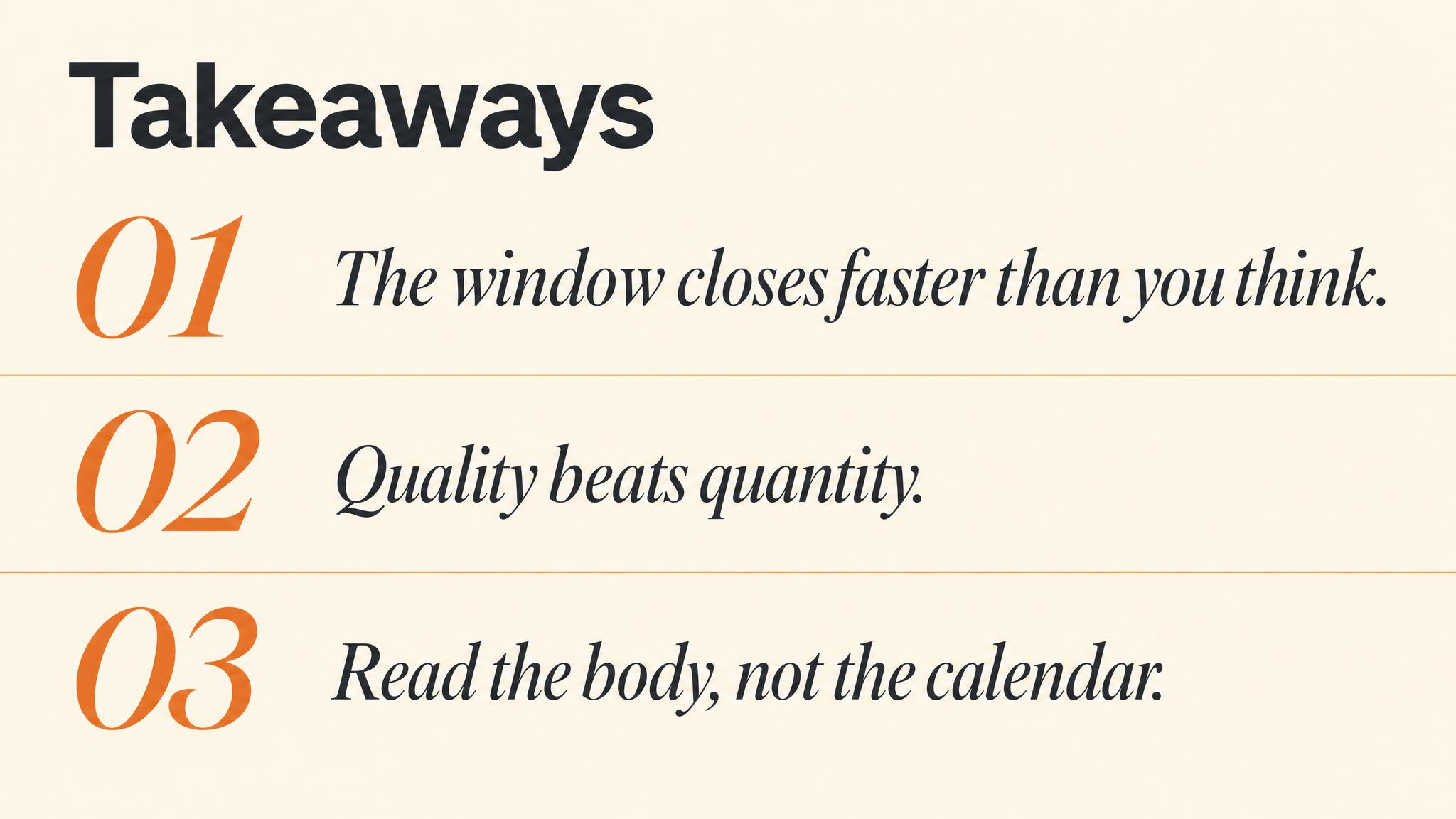
The SENSITIVE PERIOD for socialisation, roughly three to sixteen weeks, is a neurologically unique window when your puppy's brain is primed to accept new experiences as normal, and it gradually closes. Socialisation means positive exposure across seven domains: people, animals, surfaces, sounds, environments, handling, and transport, not just meeting other dogs. Quality always trumps quantity: one positive experience is worth more than ten neutral or negative ones. Pair new stimuli with high-value treats through counter-conditioning. Veterinary behaviourists recommend starting socialisation before the vaccination course is complete, using smart risk management. The behavioural risk of missing the window far outweighs the infectious disease risk in controlled settings. Use the traffic light system, green, amber, and red body language signals, to monitor your puppy's emotional state during every outing and adjust in real time. Fear periods, especially eight to ten weeks, are normal. Reduce intensity during these phases but don't stop socialising altogether. Balance is essential: two to three new experiences per day, plenty of rest, and at least one recovery day per week.
[short pause]
Looking Ahead
In the next chapter, we tackle one of the most common and painful puppy challenges: mouthing and biting. You'll learn why your puppy isn't being aggressive, they're learning BITE INHIBITION, and how to use the counter-conditioning principles introduced in this chapter to redirect their mouthy enthusiasm toward appropriate outlets. The body language reading skills you're building now will help you distinguish between playful mouthing, overstimulated nipping, and genuine fear-based behaviour.
Bite Inhibition & Mouthing — Why Your Puppy Is Not a Tiny Shark (But Feels Like One)
Let's address the elephant in the room — or rather, the piranha on your ankle. Puppy mouthing is the number one reason new owners contact trainers, question their life choices, and search 'is my puppy aggressive' at…
Your grandma swears you should bop a puppy on the nose when it bites. Your friend who watches dog training TikToks says that's terrible. Who's right?
Family drama
Would you rather: a puppy that bites HARD but grows out of it in 2 weeks, OR one that gently mouths constantly for 3 months?
Would you rather
Real talk: Have you ever actually bled from a puppy bite, or is everyone being a little dramatic?
Quick poll
Is it fair to call a mouthy 8-week-old puppy 'aggressive' or are people throwing that word around too easily?
Hot take
What's the WORST advice you've heard for stopping puppy biting? Bonus points if a relative gave it to you.
Bad advice stories
Your new puppy keeps chomping your hands. Three people suggest three things: yelp like a puppy would, redirect to a toy, or walk away and ignore. Which actually works?
Debate time
Puppy Triage: Emergency Mouthing Scenarios
12-15 minutesProject 4 different puppy mouthing scenarios on screen (varying severity, context, and puppy arousal levels). Students discuss with their immediate neighbors (2-3 people) to diagnose the likely cause (overtired? overstimulated? normal play? insufficient bite inhibition learning?) and propose an evidence-based intervention. Instructor cold-calls on different sections of the theatre to share their diagnosis and rationale. Class votes on best intervention using raised hands or a polling app.
The Pressure Gradient Challenge
8-10 minutesInstructor demonstrates graduated pressure technique using their own hands/arms. Students then practice with their neighbor: one person places their hand flat on their own thigh, the other uses their fingertips to demonstrate what a 'Level 1 puppy mouth' feels like versus 'Level 5 shark attack.' Partners switch roles. Then discuss: How would you shape this from Level 5 to Level 1 over time? Instructor debriefs by calling on pairs to share their shaping plans, connecting to operant conditioning principles.
Stand If You've Heard This: Myth-Busting Debate
10-12 minutesInstructor reads common puppy training myths/advice (e.g., 'Scruff your puppy when they bite,' 'Bite them back to show dominance,' 'Yelping always works'). Students stand if they've heard this advice OR sit if they haven't. Once standing, instructor asks: 'Who believes this works?' (stay standing) vs. 'Who thinks this is harmful?' (sit down). Facilitates quick debate between standing/sitting groups, referencing AVSAB position statement. Repeat for 3-4 myths.
Arousal Level Video Detective
10-12 minutesShow 3 short video clips (30-60 seconds each) of puppies in different arousal states: calm play, escalating arousal, overtired/overstimulated. Students use a hand signal rating system (fist = low arousal, open hand = high arousal) to rate each puppy in real-time. Pause after each clip and students discuss with neighbors: What body language cues did you see? When would you intervene? What redirection technique would you use? Instructor synthesizes answers and highlights commonly missed cues.
Row Wars: Redirection Tournament
15-18 minutesDivide theatre into 4-5 row-based teams. Each team gets a challenging scenario (e.g., 'Puppy mouths every time 6-year-old approaches' or 'Puppy only mouths at 8pm, never during day'). Teams have 5 minutes to develop a multi-step training plan using approved redirection techniques. One representative from each row presents their 60-second plan. Class votes on most comprehensive/evidence-based plan. Instructor provides expert feedback on each, highlighting what was done well and what was missed.
The Overtired Puppy Checklist Race
8-10 minutesInstructor describes a detailed scenario of a puppy's full day (wake time, activities, meals, play sessions). Students work with neighbors to create a checklist: identify ALL the signs that this puppy is overtired by evening (when mouthing is worst). After 4 minutes, instructor starts listing signs on screen—students earn points for each one their pair identified. Debrief focuses on how many students missed the connection between inadequate naps/rest and evening 'shark attacks.' Emphasize: bite inhibition training fails when puppy is exhausted.
Transcript
It's six forty-seven PM. You've just sat down after a long day, and your twelve-week-old Labrador has decided that your ankle is the most fascinating object in the known universe. She's latched on with those impossibly sharp teeth, shaking her head with the gleeful intensity of a predator taking down a wildebeest, except she weighs four kilograms, and the wildebeest is your favourite pair of joggers. You pull away, and she lunges right back. You say "no," and she seems to bite harder. You search your phone one-handed while fending her off with the other: "Is my puppy aggressive?"
She isn't. And you're not doing anything wrong. What you're experiencing is one of the most normal, most important, and most misunderstood behaviours in puppy development. Those needle teeth are not a design flaw, they are a feature. And the next few weeks represent a critical window for teaching one of the most valuable skills your dog will ever learn: the ability to control the force of her jaws. Let's talk about why mouthing happens, why it matters, and exactly how to shape it, without force, fear, or frustration.
[short pause]
Puppies explore the world with their mouths the way human infants explore it with their hands. They mouth objects, surfaces, other dogs, and yes, your skin, not out of malice, dominance, or aggression, but because it is their primary sensory tool. Mouthing is how puppies gather information about texture, resistance, and social boundaries. It is as natural as breathing, and suppressing it entirely during the critical socialisation window, roughly three to sixteen weeks, can actually prevent your puppy from learning the very skill you most want them to develop.
That skill is called BITE INHIBITION, the learned ability to control the force of a bite. Veterinarian and animal behaviourist Doctor Ian Dunbar has described bite inhibition, according to his work in two thousand seven, as "the single most important thing your puppy can learn," more important than sit, stay, or recall. His reasoning is straightforward: a dog who has learned to moderate jaw pressure is a dog who, even if startled or frightened later in life, is unlikely to cause serious injury. A dog who never learned this skill is a ticking time bomb, regardless of how obedient they are in every other respect.
[short pause]
Puppy teeth are sharp for a reason. In the litter, when one puppy bites another too hard during play, the bitten puppy yelps, stops playing, and moves away. The biting puppy learns: that level of force ends the fun. Over repeated interactions, puppies calibrate their jaw pressure downward. The sharpness of puppy teeth amplifies feedback, a relatively gentle bite from needle teeth still produces a strong reaction, teaching the lesson at low force levels. By the time adult teeth come in, around four to six months, the dog should have already internalised the principle that gentler mouths keep social interactions going.
This is why puppies who are removed from their litters too early, before seven to eight weeks, often have more severe mouthing problems. They missed critical weeks of peer feedback. It's also why, as Moeller noted in twenty twenty-one in a thoughtful analysis of the bite inhibition literature, much of this capacity appears to be partly innate. Puppies come pre-equipped with the potential for bite inhibition, and social experience activates and refines it. Your job as the puppy's new social partner is to continue the education that the litter started.
[short pause]
If bite inhibition is primarily learned through social feedback during play, consider why a puppy who is isolated or only receives punishment for mouthing might be more dangerous as an adult, not less. The answer lies in what they failed to learn during this critical window.
[short pause]
The approach endorsed by Doctor Sophia Yin, Doctor Ian Dunbar, and the American Veterinary Society of Animal Behavior, or A-V-S-A-B, in their twenty twenty-one position statement, is not to eliminate mouthing overnight. Instead, you teach bite inhibition in two deliberate phases, a method known as GRADUATED PRESSURE REDUCTION.
In phase one, you reduce the force. In this phase, you allow mouthing to continue but teach the puppy that hard bites end good things. When your puppy bites down with noticeable pressure, you respond with a brief, high-pitched "ouch" or yelp, immediately withdraw your hand, and turn away for five to ten seconds. If the puppy escalates, you calmly stand up and step behind a baby gate or out of the puppy's space for fifteen to thirty seconds. You are not punishing. You are delivering the same social consequence the puppy's littermates would have delivered: too hard, game over.
Crucially, during this phase, you do not react to gentle mouthing. Soft contact is permitted. This distinction is essential. If you penalise all mouth contact from day one, the puppy never gets the feedback loops needed to learn pressure calibration, as Dunbar explained in two thousand seven. You are shaping behaviour, not suppressing it. Over one to three weeks, most puppies noticeably soften their bite.
In phase two, you reduce the frequency. Once your puppy consistently mouths gently, you can feel teeth but there is no pressure, you raise the bar. Now, even gentle mouthing leads to a brief withdrawal of attention. You redirect to a toy, reward the puppy for taking the toy instead, and gradually build toward the rule: no teeth on human skin at all. Doctor Yin recommended in twenty ten pairing this with a simple hand-targeting exercise, teaching the puppy to touch your open palm with their nose for a treat, which gives them an incompatible behaviour that earns reinforcement.
[short pause]
Redirection is one of the most useful tools in your kit, but it works best when done proactively rather than reactively. Keep appropriate chew toys within arm's reach at all times. When you see your puppy approaching with that familiar gleam in their eyes, before teeth make contact, offer a rope toy, a rubber chew, or a stuffed Kong. When the puppy takes it, praise warmly. You are not bribing, you are teaching them what is appropriate to bite.
What about when redirection doesn't work? When a puppy ignores the toy and goes straight for your hand? That is usually a signal that something else is going on, and the answer is almost always one of two things: the puppy is over-aroused, or the puppy is overtired. We'll address both shortly.
[short pause]
Think about why the graduated approach, first reducing pressure, then reducing frequency, works better than trying to eliminate all mouthing at once. Consider how you'd teach any complex skill to a learner who doesn't speak your language.
[short pause]
If you've searched for puppy biting advice online, you've encountered some version of the following: hold the puppy's mouth shut, scruff shake them, flip them on their back, the so-called "alpha roll," spray them with water, yell "NO" in a deep voice, or, most disturbingly, "bite them back." These methods persist because they seem to produce immediate results. The puppy stops, for a moment. But the science is unequivocal: these methods do not teach bite inhibition, they damage the dog-human relationship, and they frequently make biting worse.
Herron, Shofer, and Reisner conducted a landmark survey in two thousand nine of one hundred forty dog owners using various training methods. Their findings were stark: confrontational techniques including the alpha roll provoked aggressive responses in thirty-one percent of dogs. Grabbing a dog by the jowls and shaking elicited aggression in twenty-six percent of dogs. Hitting or kicking produced aggression in forty-three percent of cases. By contrast, non-aversive methods, food rewards, redirection, clicker training, produced aggressive responses in zero to six percent of cases. The confrontational methods weren't just less effective, they were actively creating the aggression they claimed to fix.
Vieira de Castro and colleagues provided even more damning evidence in twenty twenty in the first systematic study of training methods and companion dog welfare. Dogs trained with aversive-based methods showed significantly higher CORTISOL levels, a stress hormone, more stress-related behaviours during training, and, perhaps most striking, more "pessimistic" responses on cognitive bias tasks afterward. These dogs were not just stressed in the moment; their entire emotional outlook shifted toward anxiety. Even mixed methods that used low proportions of aversive techniques compromised welfare compared to purely reward-based approaches.
Ziv's comprehensive review in twenty seventeen of seventeen studies reached the same conclusion: aversive methods jeopardise both physical and mental health, elevate cortisol, and produce the very fear and aggression they purport to address. The AVSAB position statement from two thousand eight on dominance theory is explicit, dominance-based approaches lead to confrontational methods that cause fear and anxiety, and veterinarians should refer only to trainers using positive reinforcement.
[short pause]
When someone scruff-shakes a puppy and the puppy freezes, the puppy hasn't learned anything about bite pressure. They've shut down. That freeze response, sometimes mistaken for calm submission, is actually a FEAR RESPONSE. The puppy has learned that their human is unpredictable and potentially dangerous. This doesn't produce a dog with a soft mouth; it produces a dog who suppresses warning signals. And a dog who has learned to skip the warning growl and go straight to a bite is far more dangerous than a mouthy puppy ever was.
As the AVSAB position statement from twenty twenty-one on humane dog training makes clear: reward-based training is recommended for all aspects of dog training and behaviour modification. This isn't a philosophical position, it is the current scientific consensus.
[short pause]
Here is the insight that transforms most new puppy owners' experience: the majority of "biting problems" are actually AROUSAL PROBLEMS. A calm, well-rested puppy can absolutely learn to redirect to a toy, soften their bite, or disengage when you withdraw attention. A puppy whose arousal level has climbed past a critical threshold literally cannot process this information. Their prefrontal cortex, the brain region responsible for impulse control and decision-making, is offline. They are running on adrenaline and instinct, and no amount of "ouch!" or toy-waving will reach them.
Arousal, in behavioural science, refers to the physiological and emotional activation state of the animal, how "revved up" they are. Think of it as a spectrum from deeply asleep, very low arousal, to completely frenzied, very high arousal. Learning happens best in the middle range. At very low arousal, the puppy isn't engaged enough to learn. At very high arousal, they can't inhibit impulses.
[short pause]
If you've noticed your puppy turns into a tiny velociraptor around four to six PM every day, you're witnessing overtiredness-driven arousal. Just like human toddlers, overtired puppies don't get quieter, they get wilder. The solution to this behaviour is not correction, redirection, or training. It's a nap. Remember the routine structure from the previous chapter: young puppies need eighteen to twenty hours of sleep per day. A puppy who has been awake for more than sixty to ninety minutes is likely heading toward their arousal threshold, and mouthing intensity is one of the first signs.
Doctor Sophia Yin emphasised in twenty ten that recognising the conditions under which problem behaviours occur is often more important than the training response itself. If your puppy only bites hard when they've been awake for two hours, the "training" intervention is an earlier enforced nap, not a more sophisticated consequence for biting.
[short pause]
Recall the body language cues from the previous chapter. A puppy with wide eyes, a tense body, and rapid darting movements is showing high arousal, not "dominance." How does recognising arousal change your response strategy compared to interpreting the same behaviour as defiance?
[short pause]
Not all mouthing is the same, and learning to distinguish between types will help you respond appropriately. Revisiting the body language skills from earlier, PLAY MOUTHING is accompanied by a loose, wiggly body, a relaxed open mouth, the "play face," bouncy movements, and frequent pauses. The puppy voluntarily disengages and comes back. Bites are typically inhibited, though they may escalate if arousal rises.
FRUSTRATION MOUTHING often appears when a puppy is restrained, prevented from accessing something they want, or overstimulated. The body is stiffer. The bites may be harder and more repetitive. You might see lip-licking, yawning, or whale eye, the stress signals from earlier lessons. This puppy needs space and calm, not a correction.
OVERTIRED MOUTHING looks the most "aggressive" to new owners but is actually the most predictable. It often occurs at specific times of day, after prolonged wakefulness, or during transitions like visitors arriving or children playing. The puppy seems frantic, won't take toys, won't respond to cues they know. The intervention is an enforced rest, guide them to their crate or pen with a calm voice and a chew, and let them sleep. Refer back to the crate-training protocol from earlier.
Genuine aggressive behaviour in puppies under sixteen weeks is extremely rare. If your puppy is snarling, snapping, and showing sustained stiff body posture with hard, direct stares, especially over resources, consult a veterinary behaviourist. But in the vast majority of cases, what you're seeing is normal developmental mouthing that simply needs shaping.
[short pause]
Here is the integrated approach, drawing together graduated pressure reduction, redirection, arousal management, and the counter-conditioning principles from earlier. First, prevent where possible. Keep chew toys everywhere. Monitor wake windows, no more than sixty to ninety minutes for young puppies. Enforce naps before the witching hour. Second, shape pressure first. Allow gentle mouthing. Withdraw attention for hard bites. Be consistent, everyone in the household must follow the same protocol. Third, redirect proactively. When you see arousal climbing, offer a toy or a food puzzle before teeth hit skin. Reward engagement with the toy. Fourth, manage arousal. If the puppy is past the point of responding to redirection, they are over-threshold. This is not a training moment. Calmly guide them to their rest space. Fifth, shape frequency second. Once bites are consistently gentle, typically after two to four weeks of phase one, begin withdrawing attention for any teeth-on-skin contact. Teach a hand target as a replacement behaviour. And sixth, never punish. No holding mouths shut, no scruff shakes, no alpha rolls, no yelling. These increase fear, damage trust, and escalate the behaviour, as demonstrated by Herron and colleagues in two thousand nine, Vieira de Castro and colleagues in twenty twenty, and Ziv in twenty seventeen.
[short pause]
Progress is not linear. You will have days where your puppy seems to have "forgotten" everything. This is normal, especially during teething, around four to six months, when sore gums increase the urge to chew. Keep frozen Kongs, rubber chews, and wet-frozen cloths available during this period. The adolescent regression we'll discuss later may also temporarily increase mouthing. Stay the course.
[short pause]
The "yelp like a littermate" technique is widely recommended, and for some puppies, it works beautifully. But it is not universal. Moeller pointed out in twenty twenty-one that for some puppies, especially those who are already highly aroused, a high-pitched yelp actually increases excitement. If you yelp and your puppy's eyes widen and they lunge back harder, yelping is not the right tool for that individual. In those cases, a calm, quiet withdrawal of attention, simply standing up and turning away, is more effective. The principle remains the same, biting ends the fun, but the delivery is adjusted to the puppy's temperament.
This is a broader lesson in dog training: evidence-based does not mean one-size-fits-all. It means using methods supported by research, observing your individual puppy's response, and adjusting accordingly. Positive reinforcement is the framework; the specific techniques within that framework should be tailored to the learner in front of you, as the AVSAB noted in twenty twenty-one.
[short pause]
To summarise the key points: Puppy mouthing is a normal, essential developmental behaviour, not aggression. Those needle teeth serve a critical purpose in teaching bite pressure calibration. Bite inhibition is taught in two phases: first reduce the force of bites, allow gentle mouthing, withdraw attention for hard bites, then reduce the frequency, work toward no teeth on skin. Confrontational methods, alpha rolls, scruff shakes, holding mouths shut, yelling, are not only ineffective but actively harmful. They increase fear, cortisol, and aggression, as demonstrated by research from Herron and colleagues in two thousand nine and Vieira de Castro and colleagues in twenty twenty. Most "biting problems" are actually arousal management problems. An over-threshold puppy cannot learn. The solution is often a nap, not a correction. Learn to distinguish play mouthing, frustration mouthing, and overtired mouthing, each requires a different response strategy. Redirection works best when done proactively, before teeth hit skin, and combined with consistent arousal management and enforced rest schedules. And finally, progress is not linear. Teething and adolescence will create temporary regressions. Trust the process and stay consistent.
[short pause]
In the next lesson, we turn to another hot topic that generates late-night internet searches: crate training. You'll learn why the crate is a management tool, not a punishment, how to build a positive association using counter-conditioning, and how the arousal management principles from this chapter directly apply to crate resistance. If your puppy screams in the crate, the next lesson will explain why, and what to do about it.
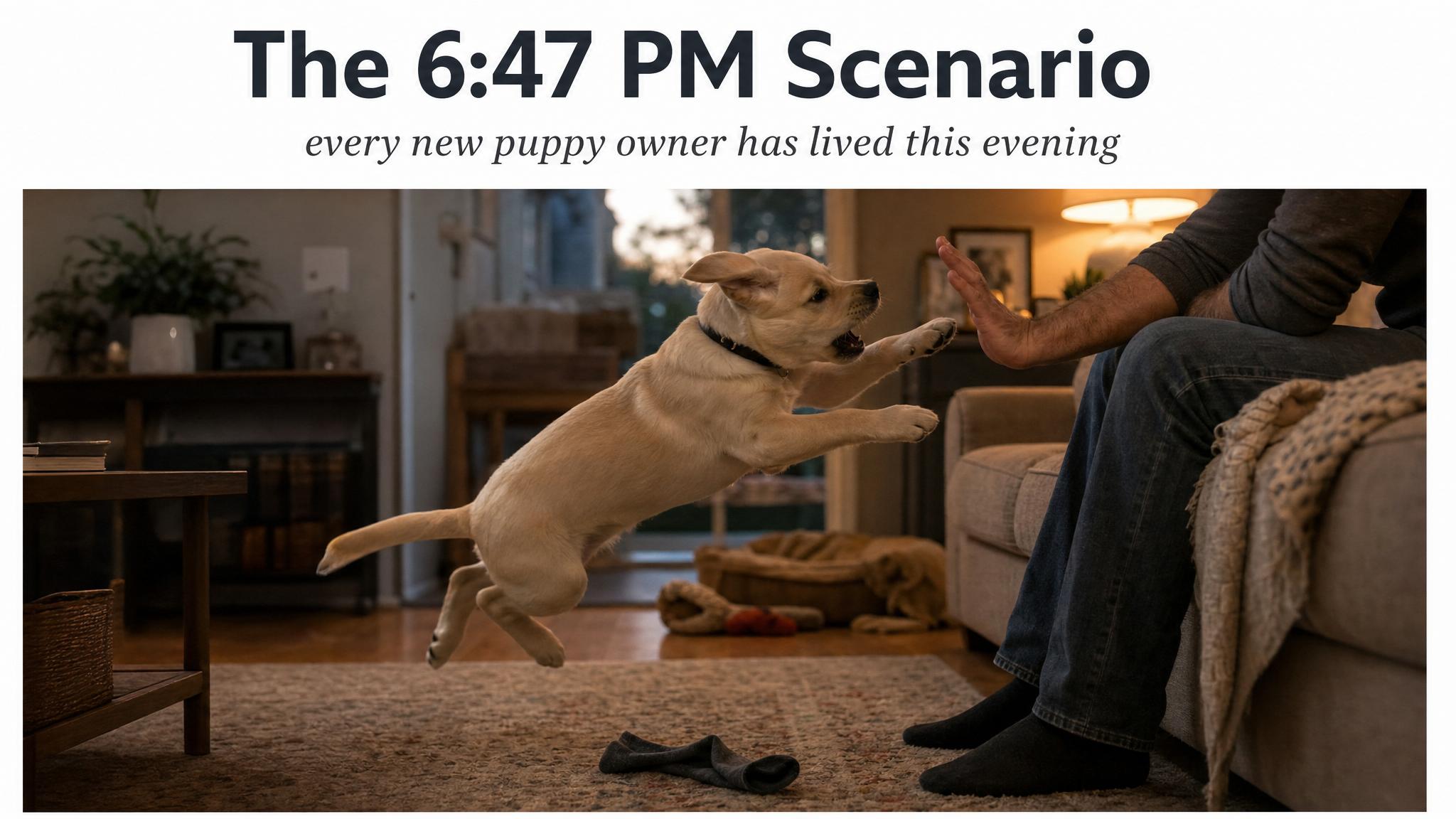
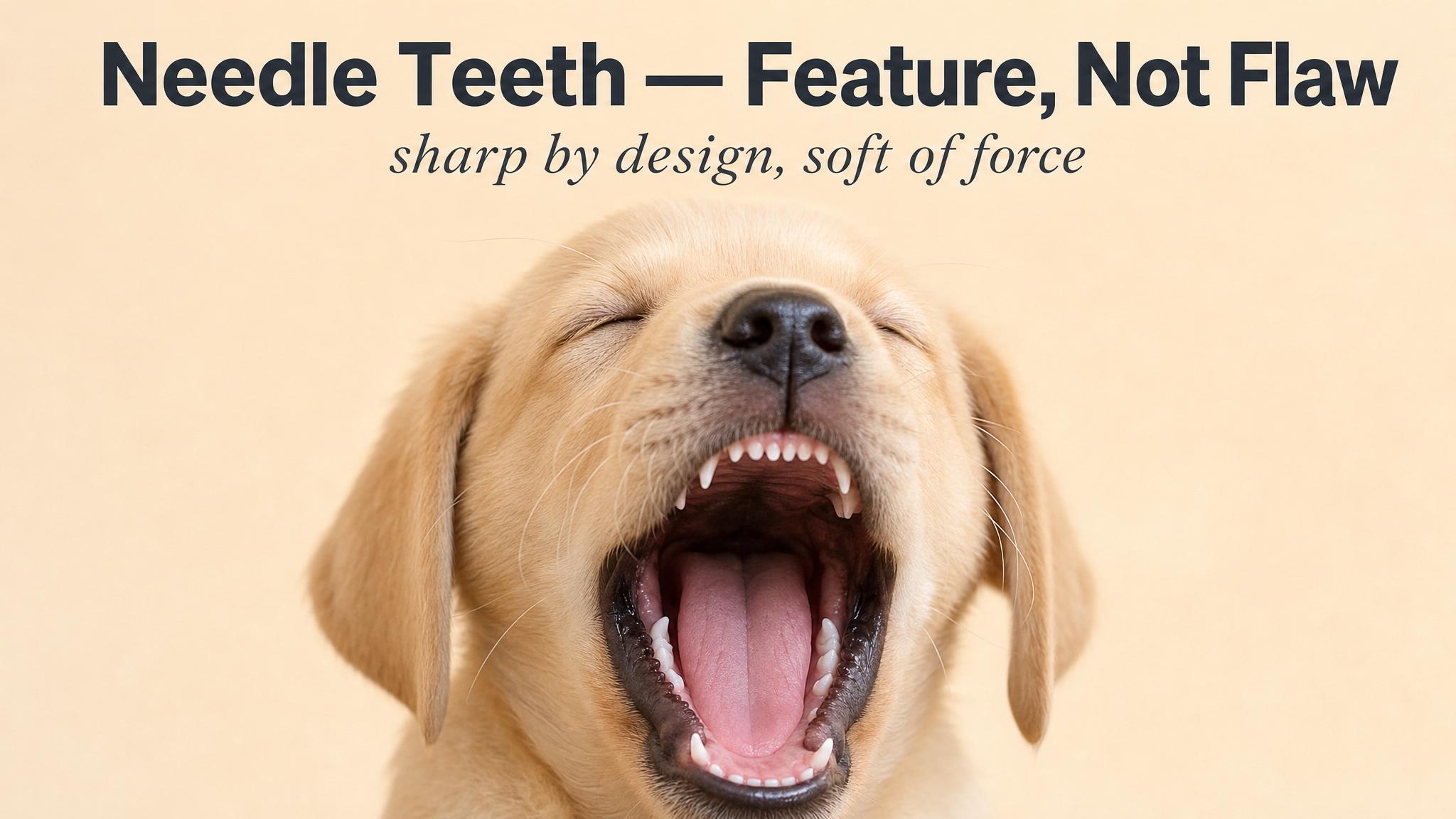
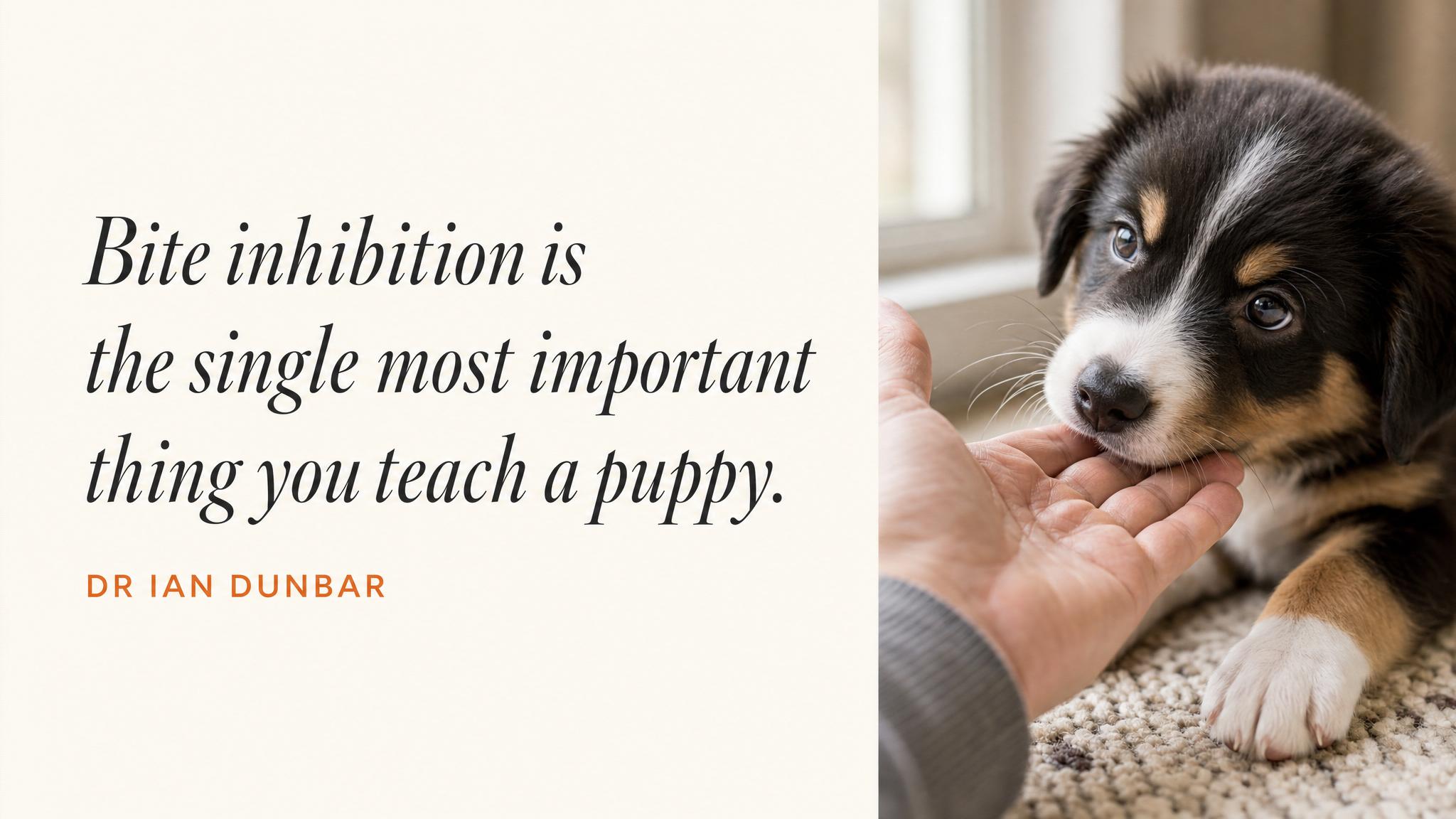
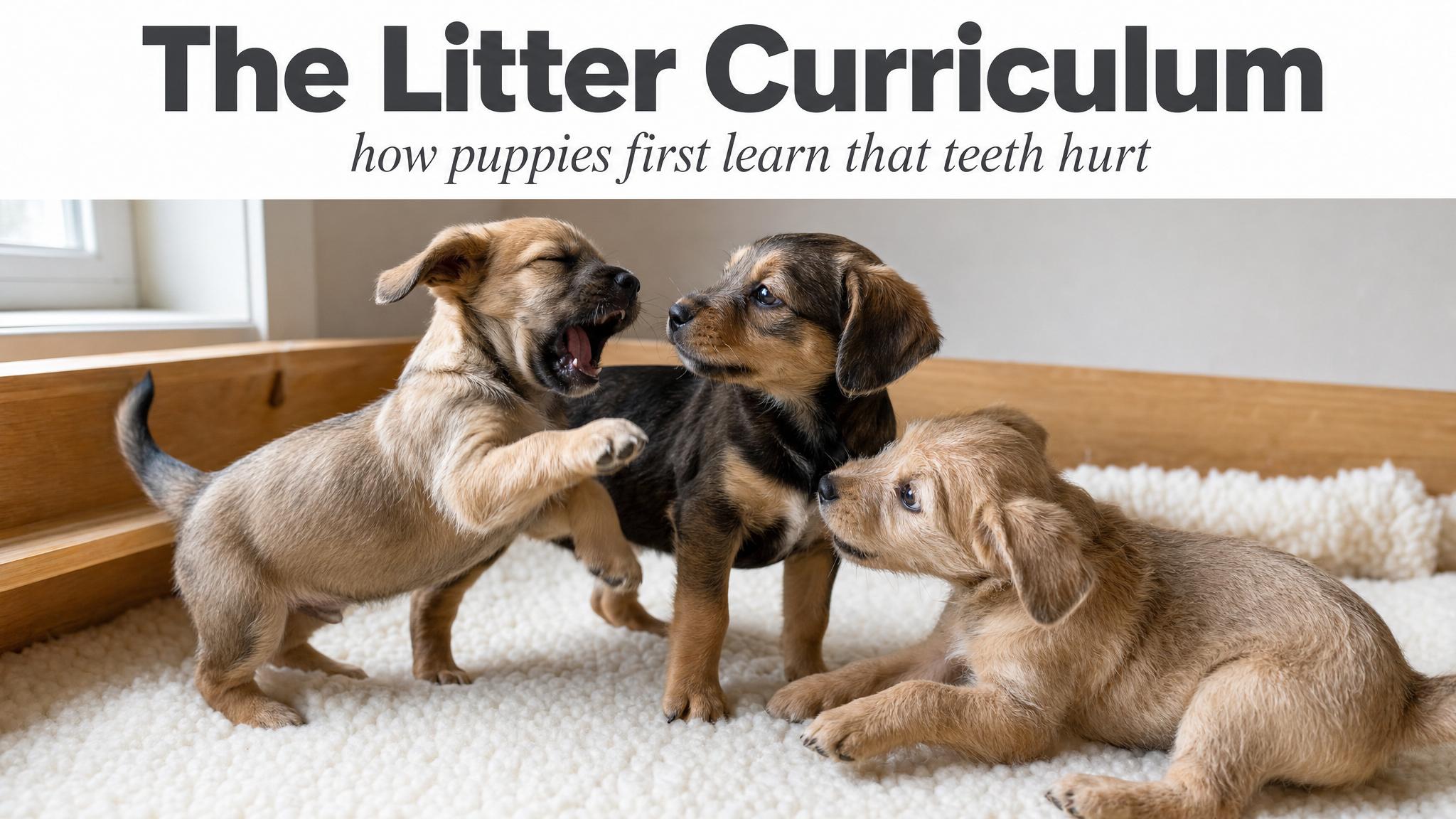
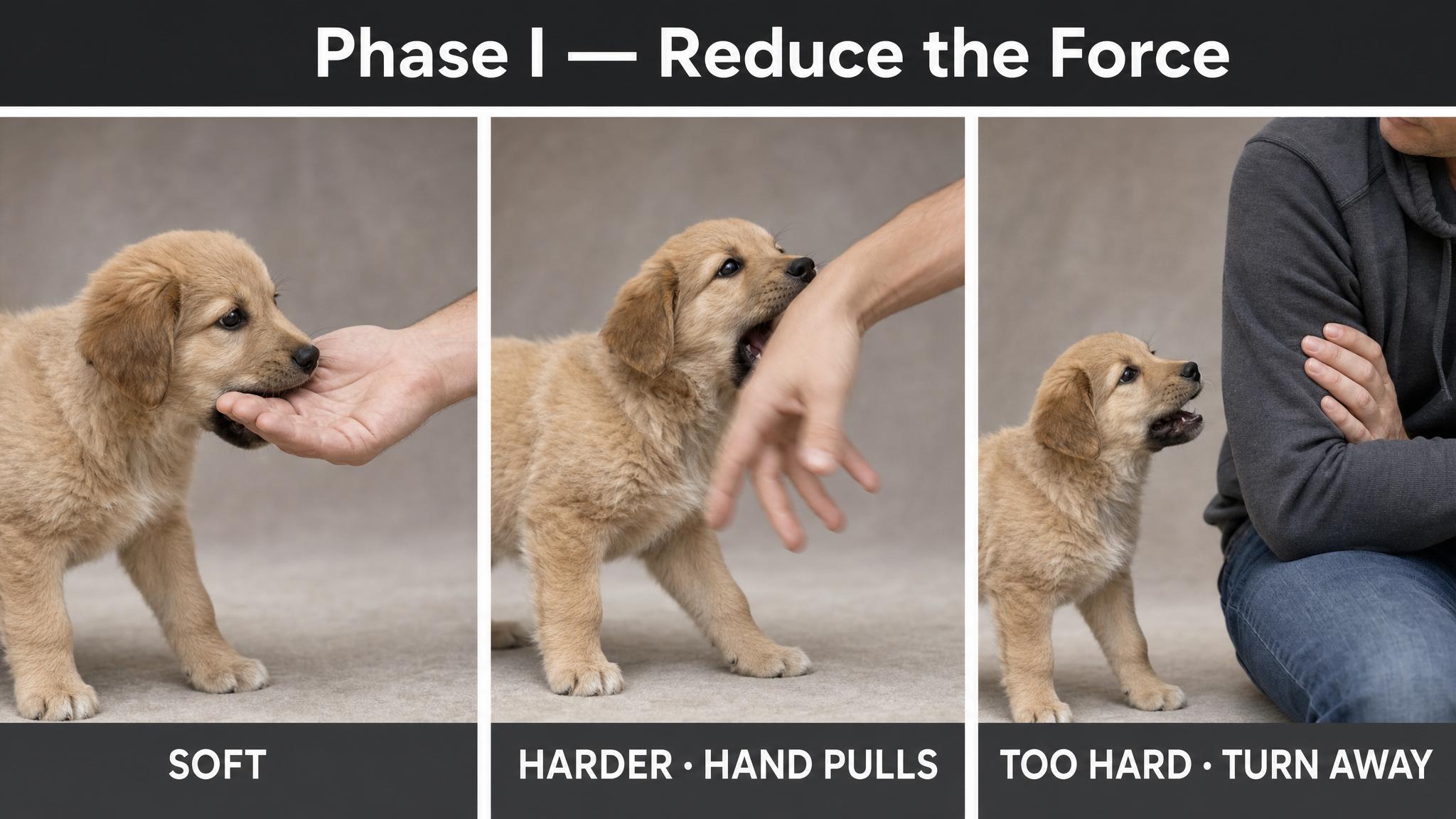
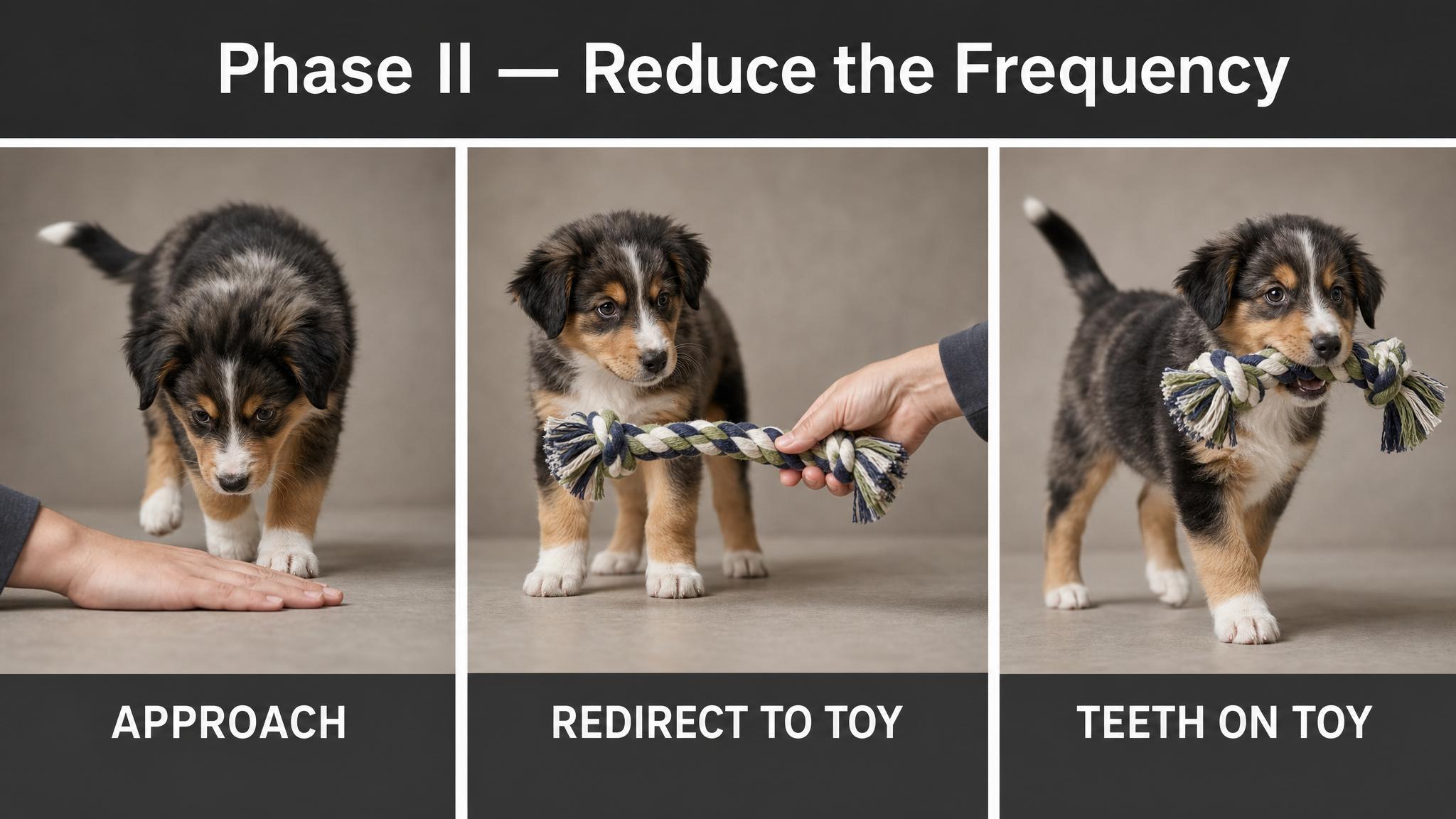
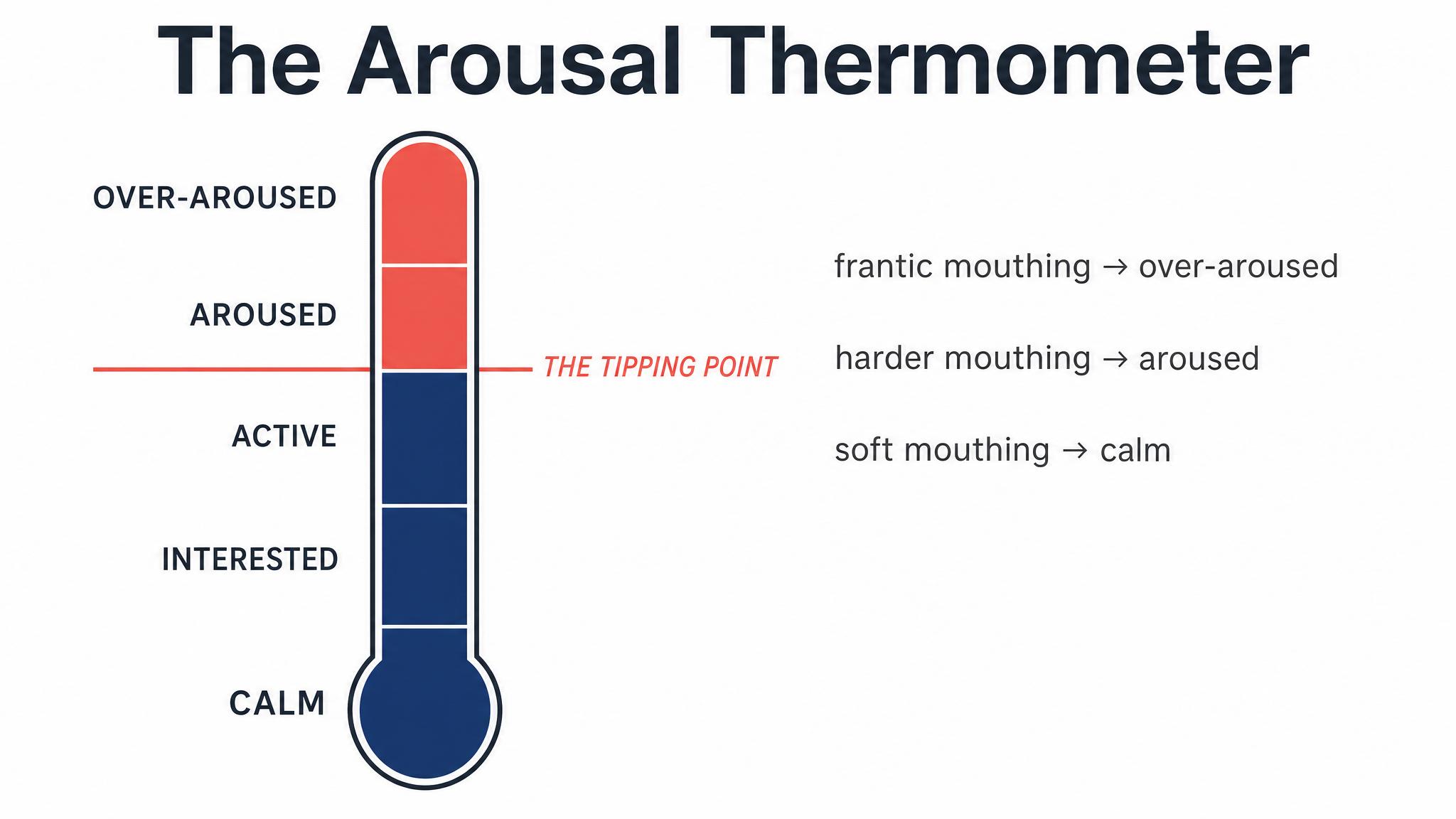
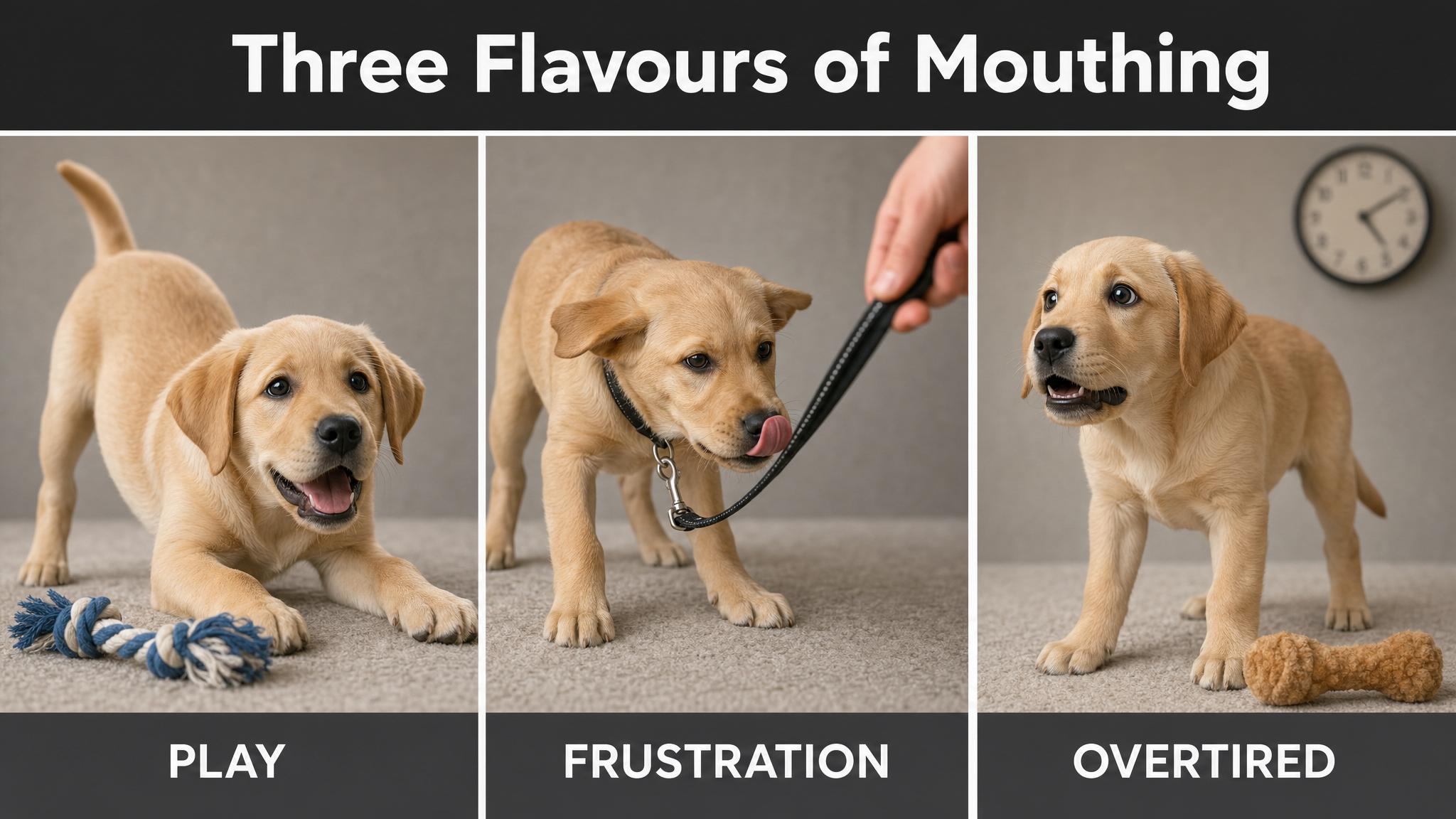
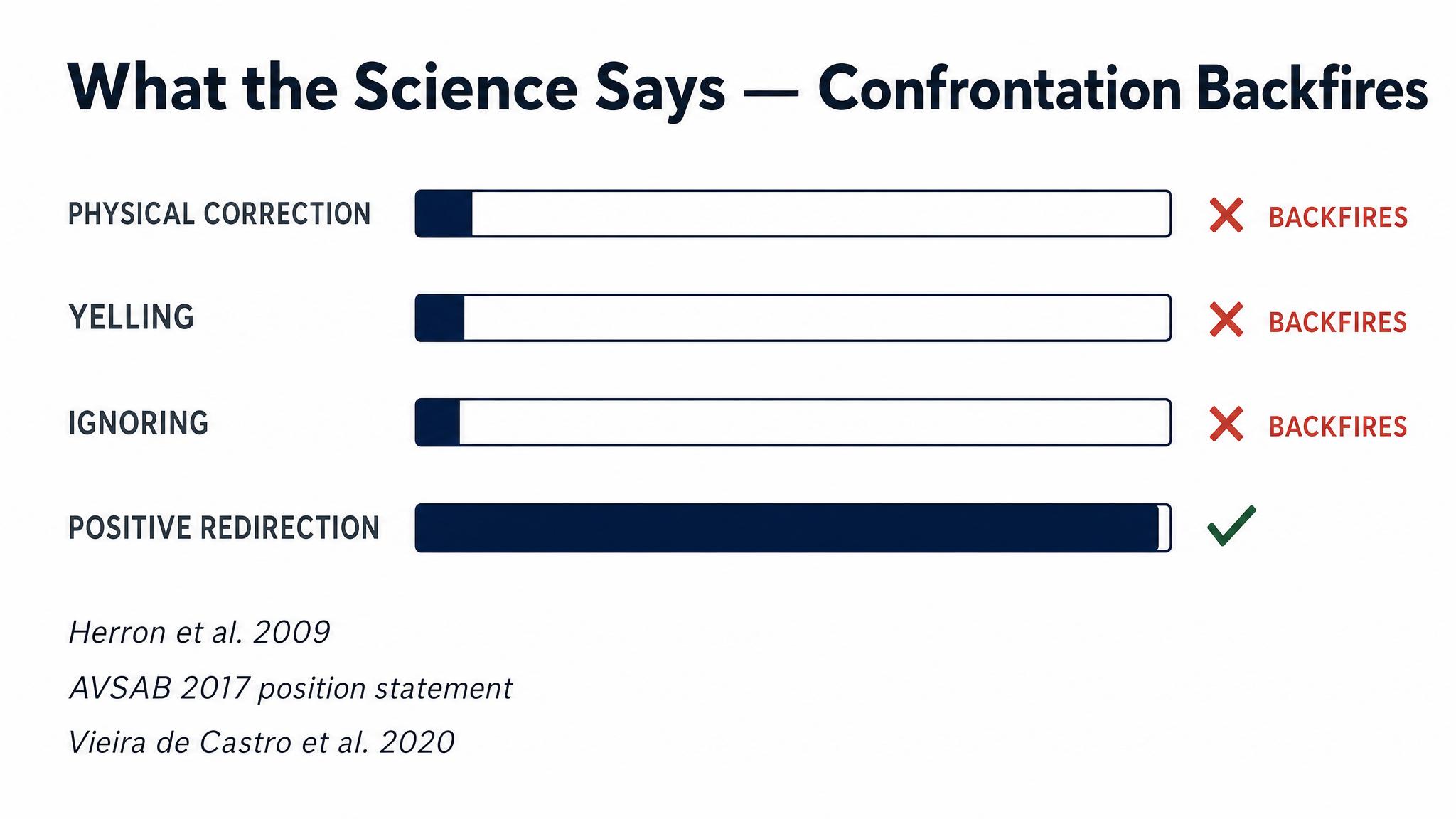
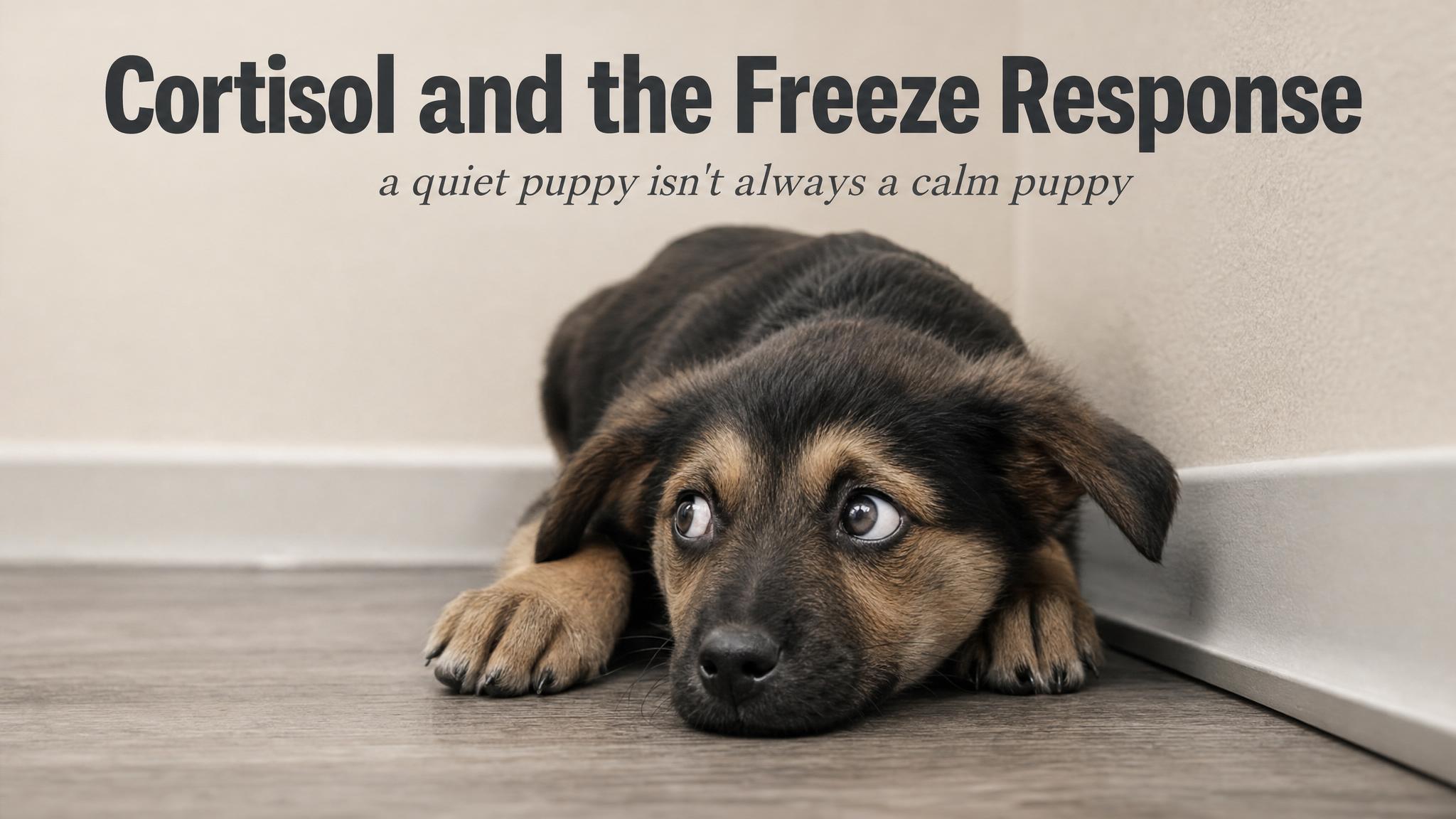
Crate Training & House Training — The Patience Chapter
This chapter tackles two of the most routine-dependent skills in puppy raising, and it does so with a central message: patience is not passive. Patience is a deliberate training strategy. We begin with crate training,…
Hot take: When your puppy pees on the carpet, it's YOUR fault for not reading the signs, not theirs for having an accident. Agree or disagree?
Hot take
Would you rather: Deal with 5 pee accidents a day, OR listen to your puppy cry in the crate for 45 minutes every single night?
Would you rather
Your roommate keeps letting the puppy out of the crate when it whines because 'it's cruel.' Do you have a conversation or start looking for a new roommate?
Roommate drama
Real question: Have you (or someone you know) ever completely given up on crate training because the crying was unbearable? What happened?
Real talk
Your neighbor says 'Just rub their nose in it when they have an accident — that's how we trained dogs for generations.' Do you nod politely or start a debate?
Old school advice
Quick poll: Crate in your bedroom so you hear every whimper all night, OR crate in the kitchen where they're totally alone and terrified?
Quick poll
House Training Schedule Builder Challenge
15-18 minutesDisplay a case study on screen (e.g., '12-week-old Labrador puppy, family works 9-5, has a balcony'). Students pair up with their seat neighbor and spend 5 minutes drafting a realistic house training schedule on paper. Then, instructor cold-calls 4-5 pairs to share their schedules. Class votes (hands up) on which schedule is most realistic. Instructor highlights what makes a schedule work: frequency aligned with bladder capacity, consistency, realistic human compliance.
Crate Training: Mistake Spotting Video Analysis
12-15 minutesShow a 2-3 minute video of someone 'crate training' a puppy (staged or real footage with common mistakes like forcing the dog in, no positive reinforcement, moving too fast). Students watch, then turn to neighbors (groups of 2-3) and list every mistake they spotted. After 4 minutes of discussion, instructor asks sections to shout out mistakes popcorn-style. Create a live list on screen. Then show a 1-minute 'correct' version and debrief the systematic desensitisation steps.
Toileting Cue Charades (Seated Edition)
8-10 minutesInstructor describes or shows brief video clips of dogs displaying pre-toileting behaviors (sniffing, circling, whining, heading to door, sudden play stop, etc.). After each clip, students have 10 seconds to discuss with their neighbor what cue they saw. Then do a 'section reveal': instructor points to a section, they shout out the cue. Award points to sections for correct identification. Include 1-2 trick scenarios (e.g., dog circling for non-toileting reason) to test discernment.
Accident Response Debate: Punishment vs. Positive
15-18 minutesPresent a polarizing scenario: 'Your 4-month-old puppy has an accident on the carpet while you were in another room. Your neighbor says to firmly scold the dog and show them the mess. What do you do?' Divide the theatre into two sides (left = Team Evidence-Based, right = Team Traditional). Give 3 minutes for each side to huddle with neighbors and prepare arguments for their assigned position (even if they don't personally believe it). Then facilitate a 5-minute rapid debate where each side presents, instructor mediates. Close with science: neurological impact of punishment, why timing matters, what positive methods achieve.
Red Flag Rapid Fire: Recognizing Regression
10-12 minutesFlash 8-10 quick scenarios on screen (e.g., 'Dog that was housetrained suddenly has 3 accidents this week,' 'Puppy has occasional accidents in new environments,' 'Older dog starts peeing in sleep'). For each, students show thumbs up (normal), thumbs sideways (minor concern), or thumbs down (red flag needing vet/behavior consult) and briefly discuss with neighbor WHY. Instructor polls the room by having students hold up their thumbs, then reveals the 'answer' with explanation. Focus on distinguishing normal learning curves from medical issues, stress responses, and true regression.
Desensitisation Timeline Race
12-15 minutesPresent a crate-phobic dog case study (e.g., rescue dog that panics in crates). In pairs, students have 7 minutes to write out a step-by-step systematic desensitisation timeline on paper—from first exposure to comfortable overnight stays. Emphasize they must include criteria for moving to next step. Instructor collects 3-4 timelines from different sections via document camera and class discusses: Is this too fast? Too slow? What's missing? Which timeline best balances patience with progress?
Transcript
It's two fourteen a.m. and you're standing in the garden in your pyjamas, barefoot in wet grass, holding a torch in one hand and a bag of treats in the other. Your ten-week-old puppy is sniffing every blade of grass with zero apparent urgency. You brought her out because she whined in her crate — the right call — but now she seems more interested in a moth than in toileting. You're cold. You're tired. You're wondering if you made a terrible mistake getting a puppy.
Then she squats. You mark the moment with a cheerful "Yes!" and deliver a treat. Back inside, she settles into her crate with a sigh and falls asleep in under a minute. That — all of it, the cold and the waiting and the tiny victory — is what house training actually looks like. It isn't glamorous. It isn't fast. But it works, reliably and predictably, when you understand the biology behind it and commit to the process. This chapter is about that process.
[short pause]
Reframing Patience as Strategy
Before we get into the mechanics of crate training and house training, we need to address the word in the chapter's subtitle: patience. In everyday language, patience implies passively enduring something unpleasant. In puppy training, patience means something entirely different. It means deliberately choosing to go slowly because the science tells you that slow is faster.
Research consistently demonstrates that aversive-based training methods — rushing, punishing, forcing — don't just fail to accelerate learning. They actively impede it. According to Vieira de Castro and colleagues in twenty twenty, dogs trained with aversive methods showed significantly higher cortisol levels and more stress-related behaviours than dogs trained with rewards, not only during training sessions but in baseline resting states afterward. As Casey and colleagues demonstrated in twenty twenty-one, dogs whose owners used two or more punishment-based techniques showed more pessimistic cognitive biases — a validated measure of negative emotional state, as Mendl and colleagues described in two thousand and nine. In plain terms: punished dogs not only learn less efficiently, they become more pessimistic about the world in general.
This matters enormously for crate training and house training, because both involve situations where it's tempting to get frustrated. The puppy has another accident. The puppy screams in the crate. The puppy was "doing so well" and then regressed. Every one of these moments is a fork in the road: you can respond with patience — the strategic, evidence-based kind — or you can react with frustration. The research is unambiguous about which path leads to a well-adjusted dog.
[short pause]
Crate Training: Building a Safe Haven
In Chapter Two, we introduced the crate as part of your puppy's safe space. Now we're going to build a complete, positive association with it using SYSTEMATIC DESENSITISATION — the same graduated-exposure technique we discussed in Chapter Three. The principle is simple: start at an intensity so low the puppy feels zero distress, and increase so gradually the puppy barely notices the change, as VCA Animal Hospitals describes in their twenty twenty-five guidance.
Why Crates Matter
A crate serves four critical functions in your puppy's life, and understanding all four will help you see why proper crate training is worth every minute you invest:
First, house training management. Dogs have an instinct to avoid soiling their sleeping area. A properly sized crate leverages this instinct to help your puppy develop bladder control.
Second, safety during travel. An unrestrained dog in a car is a projectile in a collision. A crate-trained dog rides safely and calmly.
Third, enforced rest for overtired puppies. Remember the arousal thermometer from Chapter Four? A puppy in the "red zone" — bitey, frantic, unable to settle — often needs rest, not more stimulation. A crate the puppy loves is your off switch.
Fourth, veterinary preparation. Your dog will almost certainly need to spend time in a crate at a veterinary clinic. Research on desensitisation and counterconditioning for veterinary fear, conducted by Stellato and colleagues in twenty nineteen, confirms that dogs with prior positive crate experience show significantly reduced fear indicators during veterinary confinement.
[short pause]
The Cardinal Rule
Doctor Sophia Yin's approach to confinement training rests on one non-negotiable principle: the crate must never be used as punishment, as she emphasized in her two thousand and nine work. Not once. Not even when your puppy has destroyed your favourite shoes. Placing a puppy in a crate while you're angry, slamming the door shut, or using the crate as a time-out creates a negative association that can take weeks to undo — and may lead to lasting confinement anxiety. The crate is a bedroom, not a prison cell.
Think about this for a moment. Recall the COUNTER-CONDITIONING principles from Chapter Three. If a puppy learns to associate the crate with your anger and isolation, what emotional response will the crate itself begin to trigger? How might this affect a puppy who later needs to be crated at a veterinary clinic?
[short pause]
The Ten-Step Progression
Yin's systematic desensitisation protocol for crate training follows a graduated ladder. You begin with the crate door removed or wired open, treats scattered inside, and zero expectation that the puppy enter. Over days and weeks — not hours — you progress through stages: puppy enters voluntarily, puppy eats meals inside, door closes briefly, door closes for longer, you step away, you leave the room. At every stage, you're reading your puppy's body language — the arousal signals from Chapter Four — and only advancing when you see relaxed posture, soft eyes, and voluntary engagement.
The progression involves reading your puppy's body language in the crate — distinguishing relaxed signals from stress signals, mapped to the arousal thermometer concepts from Chapter Four. You're looking for signs like loose body posture, soft blinking, choosing to lie down, versus stiff body, whale eye, frantic digging or vocalising.
[short pause]
House Training: A Management Exercise
Here is the single most important sentence in this chapter: house training is a MANAGEMENT problem, not a training problem. Doctor Ian Dunbar's concept of "errorless housetraining," outlined in his two thousand and four work, captures this perfectly. Your goal is not to teach your puppy where to toilet — puppies don't need to be taught to urinate. Your goal is to manage the environment so that virtually every toileting event happens in the right place, then reinforce that heavily. Get the management right, and the training takes care of itself.
The Biology: Bladder Capacity by Age
You cannot manage what you don't understand, so let's start with physiology. Puppy bladder capacity increases predictably with age, but it's much more limited than most new owners realise, as Dunbar notes in his twenty twenty-five guidance:
At eight weeks: approximately seventy-five minutes maximum.
At twelve weeks: approximately ninety minutes maximum.
At sixteen weeks: approximately two hours maximum.
At twenty weeks: approximately two and a half hours maximum.
These are maximums — they represent what a sleeping puppy can hold, not an active, playing, eating, drinking puppy. After meals, after play, after waking, and during excitement, the practical window is much shorter. A common rule of thumb is that a puppy can hold it for roughly one hour per month of age during waking hours, but this varies by individual, breed size, and activity level.
Think about this: If an eight-week-old puppy has a maximum bladder capacity of seventy-five minutes while resting, how realistic is it to expect that same puppy to "hold it" for a three-hour stretch while the family is out? What does this tell you about the nature of accidents at this age?
[short pause]
The Predictable Pattern
Puppies need to toilet at predictable times. Once you internalise this pattern, house training becomes a scheduling exercise. Your puppy will need to go:
Immediately upon waking — every single time, naps included.
Within five to fifteen minutes after eating or drinking.
During or immediately after play or excitement.
Every thirty to ninety minutes during active waking periods, depending on age.
As the last activity before crating or bedtime.
Dunbar emphasises that house training is both a spatial and temporal problem. You need the puppy in the right place at the right time, and then you need to make that moment feel spectacularly rewarding. That means taking your puppy to the designated toilet spot, waiting calmly, and the instant they begin to go, marking the behaviour and following up with a high-value treat. Not praise from across the garden — a treat delivered within two seconds, right there at the scene.
Recognising Toileting Cues
As your puppy matures, they'll begin to signal before they need to go. Learning to read these toileting cues is essential — and it builds directly on the body language reading skills from Chapter Four. Common cues include:
Circling — walking in tight circles, nose to ground.
Sniffing intensely — sudden, focused sniffing of the floor or carpet.
Heading toward the door — or toward a spot where they've previously toileted.
Restlessness — whining, pacing, or sudden disengagement from play.
Squatting — by the time you see this, you have about one second to act.
A daily schedule for a ten-week-old puppy would show how toilet breaks, meals, crate rest, and supervised play interlock throughout the day. Your schedule needs to be structured around your puppy's age-appropriate bladder capacity and your own daily routine, with toilet breaks positioned at all the predictable moments we've discussed.
[short pause]
When Accidents Happen: The Evidence Against Punishment
Let's be direct: your puppy will have accidents. Even with perfect management, you'll miss a cue, lose track of time, or encounter a bout of digestive upset. How you respond to accidents matters enormously — not just ethically, but in terms of training effectiveness.
Why Punishment Doesn't Work
The practice of "rubbing a puppy's nose in it" persists despite being contradicted by every credible veterinary and behavioural authority. The Australian Veterinary Association's position statement from twenty nineteen is unequivocal: punishment-based methods can increase stress responses, cause learned helplessness, suppress communication signals, and lead to unpredictable aggression. When you punish a puppy for a puddle on the carpet, the puppy does not think "I should not toilet indoors." The puppy thinks "toileting near this human is dangerous" — and may begin hiding to eliminate, making house training dramatically harder.
As Vieira de Castro and colleagues demonstrated in twenty twenty with hard data: dogs trained with aversive methods showed elevated cortisol not just during training, but at rest. The stress of punishment leaks into the puppy's general experience of the world. For house training specifically, this creates a devastating paradox — a stressed puppy needs to urinate more frequently, meaning punishment for accidents literally causes more accidents.
The Correct Response
When you catch your puppy mid-accident, calmly interrupt with a gentle "oops!" or handclap — not shouting — pick the puppy up, and carry them to the designated toilet area. If they finish there, reward. If you find an accident after the fact, simply clean it up. Your puppy cannot connect your displeasure with something that happened even thirty seconds ago.
Clean all accident sites with an ENZYMATIC CLEANER — not standard household cleaners. Standard products mask the odour to human noses but leave protein residues that a dog's nose can still detect. To your puppy, that spot still smells like a toilet. Enzymatic cleaners break down the organic compounds completely, eliminating the scent signal that says "go here again."
Think about this: A friend tells you their puppy "knows it was wrong" because it looks guilty when they come home to an accident. What's actually happening? Recall the body language chapter — what you're seeing are appeasement signals in response to your body language, not evidence of guilt or understanding.
[short pause]
Understanding Regression
REGRESSION — a period of apparent backsliding after consistent progress — is entirely normal in house training. Your puppy may be reliable for a week and then have three accidents in one day. This doesn't mean training has failed. It means one of several things: a developmental change, a routine disruption, a dietary change, overexcitement, or simply the normal non-linearity of learning. The correct response is to tighten management — go back to more frequent toilet breaks, reduce unsupervised time, and increase reinforcement for outdoor toileting.
We'll explore the concept of regression in much more depth in Chapter Eight, where it applies to socialisation, obedience, and adolescent behaviour changes. For now, know this: regression is not failure. It's data. It tells you to adjust your management, not your expectations.
When to See a Vet
Some toileting problems have medical origins. Consult your veterinarian if you observe:
Sudden increase in urination frequency without schedule changes.
Straining to urinate or producing very small amounts.
Blood in urine or stool.
Persistent diarrhoea lasting more than twenty-four hours.
Excessive water consumption.
A previously reliable puppy, sixteen weeks or older, suddenly regressing despite no changes in routine.
Urinary tract infections, gastrointestinal parasites, and dietary intolerances are common in young puppies and can mimic house training problems. Treating the medical issue typically resolves the toileting issue.
[short pause]
Night-Time Toileting: Weeks Two Through Eight
In Chapter Two, we covered your puppy's first night home. Now let's expand that plan into the following weeks. The good news: night-time bladder capacity develops faster than daytime capacity, because sleeping puppies produce less urine. The general progression looks like this:
Weeks one to two home, when the puppy is eight to ten weeks old: Set an alarm every three hours. Take the puppy out, reward toileting, return to crate. Keep interactions boring — no play, minimal light, quiet voice.
Weeks three to four, when the puppy is ten to twelve weeks: Extend to every three and a half to four hours. If your puppy is consistently dry at each alarm, push the interval out by thirty minutes.
Weeks five to six, when the puppy is twelve to fourteen weeks: Many puppies can manage a five-hour stretch. Some can do six.
Weeks seven to eight, when the puppy is fourteen to sixteen weeks: Most puppies can sleep six to seven hours. You may be able to drop the overnight alarm entirely.
The key is to follow your puppy's lead. If they're waking and whining before your alarm, the interval is too long. If they're sound asleep when the alarm goes off and dry in the crate, you can stretch it. This is systematic desensitisation applied to duration — exactly the same principle as crate training, as Sargisson outlined in twenty fourteen.
The progression from weeks eight through sixteen shows the gradual reduction in overnight wake-ups as bladder capacity develops. You're essentially teaching the puppy's body to hold longer stretches, but only as fast as their physical development allows.
[short pause]
Connecting the Crate to House Training
The crate and the house training schedule work as an integrated system. Dunbar describes this as a cycle of confinement, toileting, and supervised freedom. The rhythm goes like this:
First, crate rest — puppy rests in the crate for a duration appropriate to their age and crate training stage.
Second, toilet break — immediately upon exiting the crate, puppy goes to the designated toilet area. Wait, reward success.
Third, supervised freedom — after toileting, the puppy earns a period of supervised exploration and play. "Supervised" means your eyes are on the puppy, or the puppy is tethered to you.
Fourth, back to crate — after the supervised period of fifteen to forty-five minutes depending on age, or if you spot toileting cues, cycle back to step one or two.
This cycle is the engine of house training. It uses the crate's function — puppies avoid soiling their bed — to build bladder control, creates predictable toileting opportunities that you can reward, and prevents unsupervised accidents that would reinforce indoor toileting. It's not exciting. It's not Instagram-worthy. It works.
As Doctor Ian Dunbar said in two thousand and four: "The single most important skill in house training is not teaching — it's scheduling. Get the schedule right, and the puppy will teach itself."
[short pause]
Crate Stress Versus Toileting Need
One of the most common questions new puppy owners ask: "Is my puppy crying because they need to toilet, or because they don't want to be in the crate?" The answer matters, because the correct response is different for each. Apply the body language skills from Chapter Four:
For toileting need: Restlessness, circling inside the crate, sudden waking from sleep, whining that escalates in urgency. Respond by taking the puppy out to toilet immediately.
For crate discomfort or boredom: Barking or whining that starts immediately upon closing the door, digging at the crate floor, attempts to push through the door. This suggests you've advanced too quickly in your crate training progression — go back a step.
For attention seeking: Intermittent barking with pauses — the puppy is checking whether it's working — usually after having recently toileted. If you're confident the puppy doesn't need to go, wait for a brief quiet moment and reward the quiet.
When in doubt, especially in the early weeks, assume it's a toileting need. A false trip to the garden is far less damaging than a forced accident in the crate — which can undermine the very instinct that makes crate-based house training effective.
[short pause]
Key Takeaways
Patience in puppy training is an active, evidence-based strategy — not passive waiting. Research shows that aversive methods increase stress, slow learning, and create pessimistic emotional states in dogs.
Crate training uses systematic desensitisation: start with zero pressure, progress in tiny increments, and read your puppy's body language at every stage. The crate must never be used as punishment.
House training is fundamentally a management exercise. A puppy's bladder capacity is approximately one hour per month of age during waking hours — structure your schedule around this biological reality.
Accidents are inevitable and should be handled calmly: interrupt gently, redirect to the toilet area, and clean with enzymatic cleaner. Punishment teaches puppies to hide, not to hold it.
Regression is normal and is data, not failure. Tighten your management, increase toilet break frequency, and maintain reinforcement. Medical causes should be ruled out if regression is sudden or severe.
The crate and house training work as an integrated cycle: confinement, toilet break, supervised freedom, repeat. This cycle builds bladder control and reinforces outdoor toileting through predictable success.
[short pause]
Looking Ahead
In Chapter Six, we'll turn our attention to the socialisation window — one of the most time-sensitive periods in your puppy's development. You'll learn how to safely expose your puppy to new people, environments, sounds, and surfaces during the critical period before it begins to close, and how the foundation of positive association you've built through crate training and counter-conditioning transfers directly to the socialisation process. Bring everything you've learned about reading your puppy's emotional state — you'll need it.
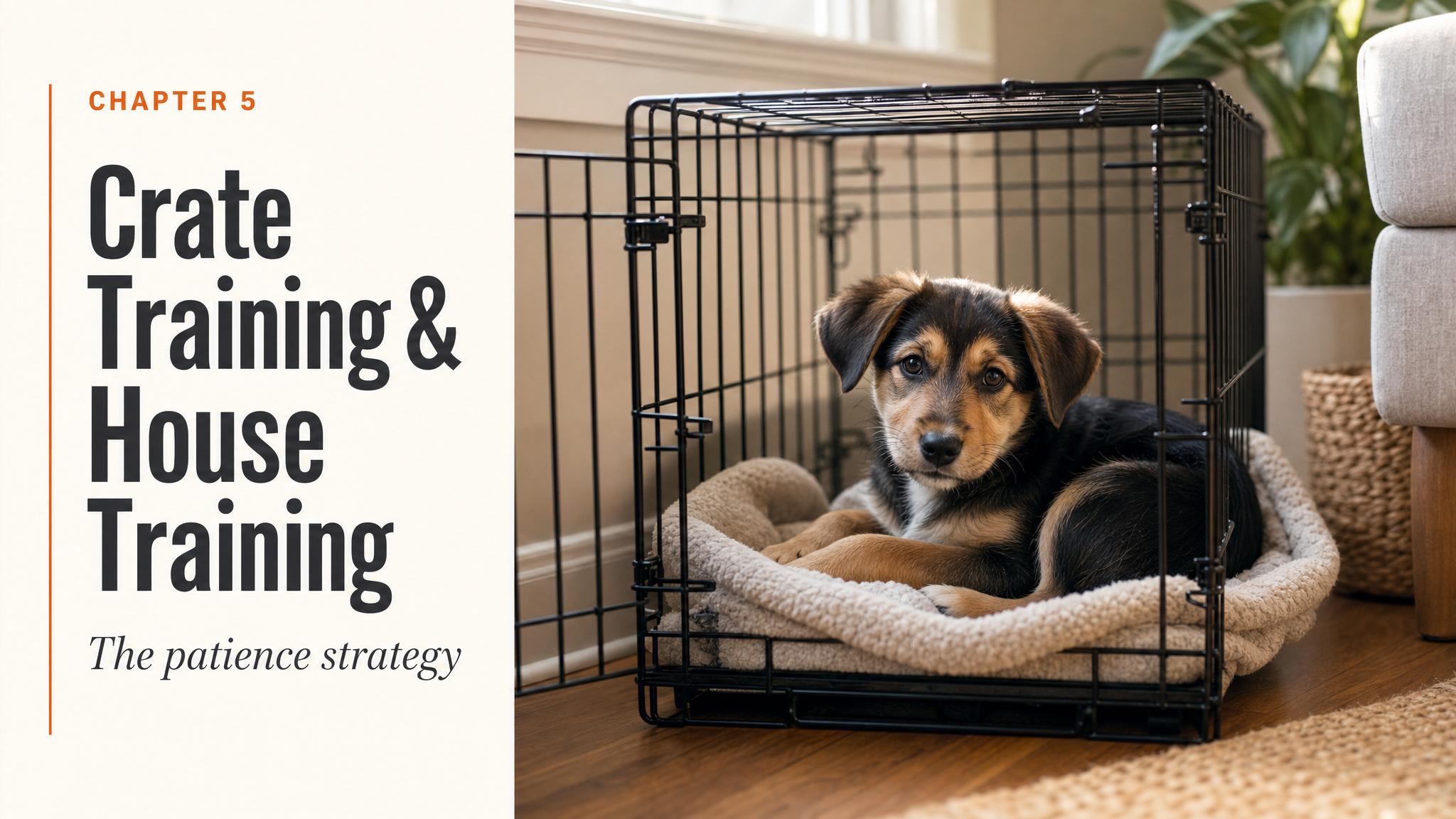
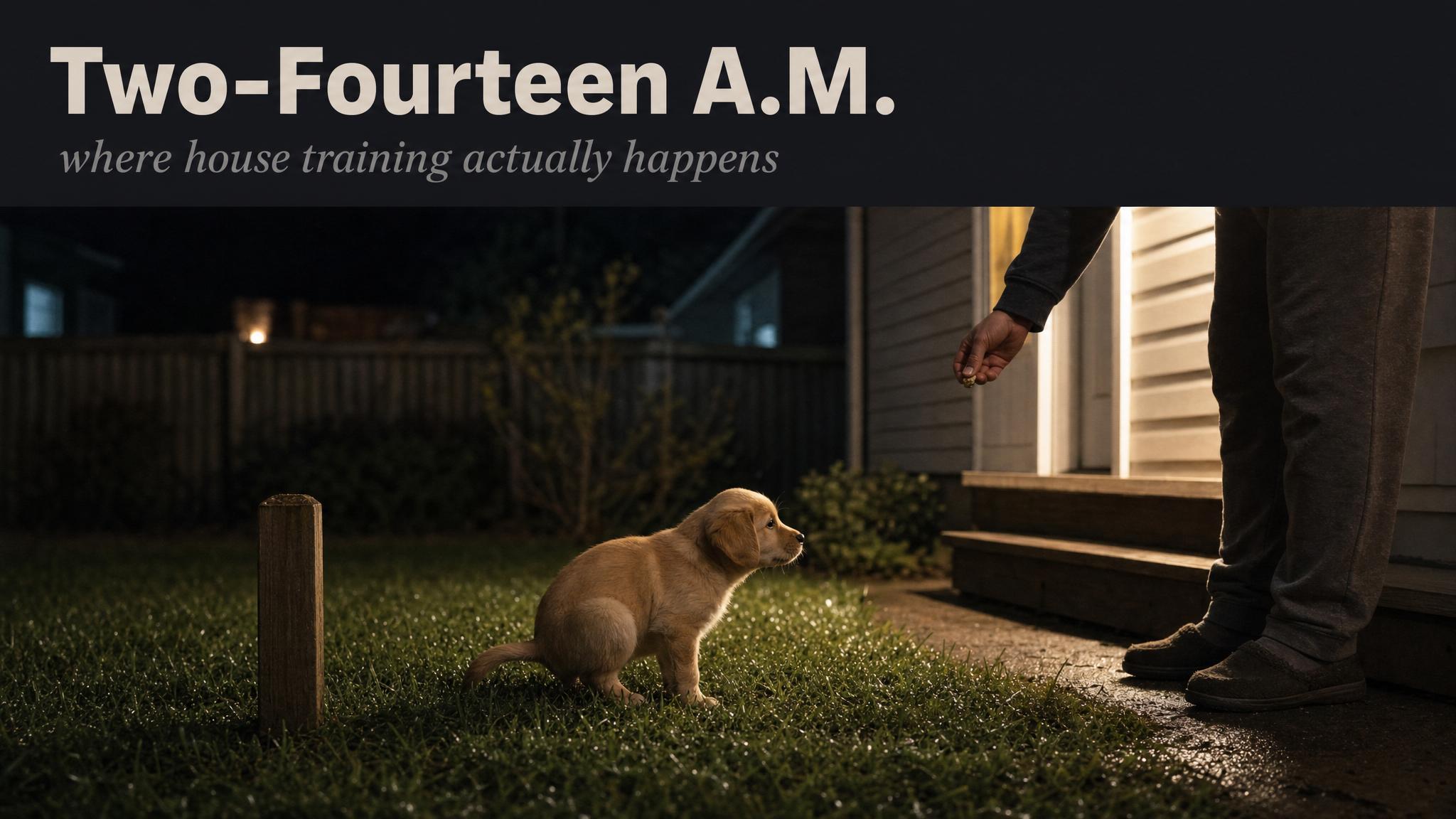
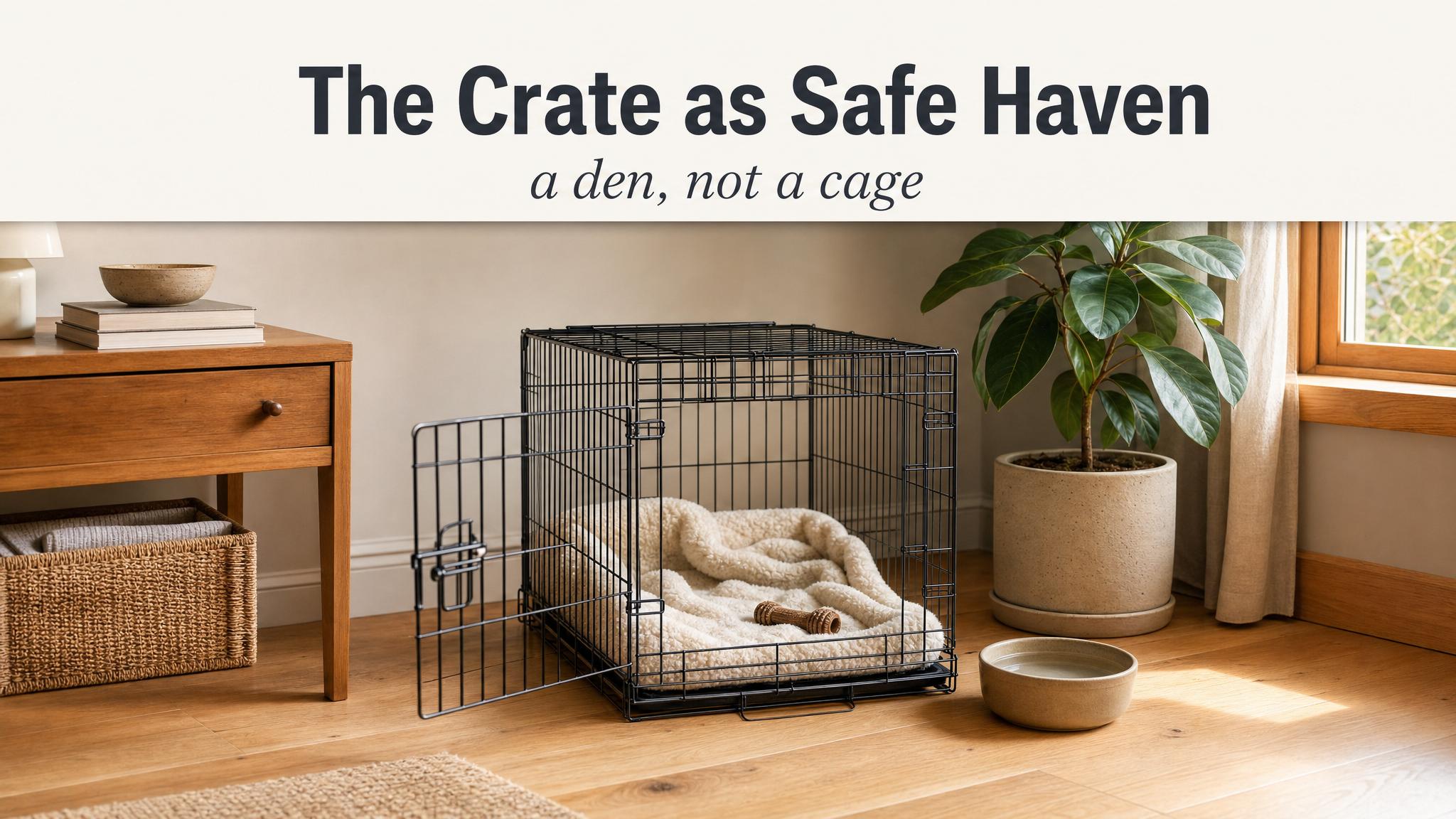
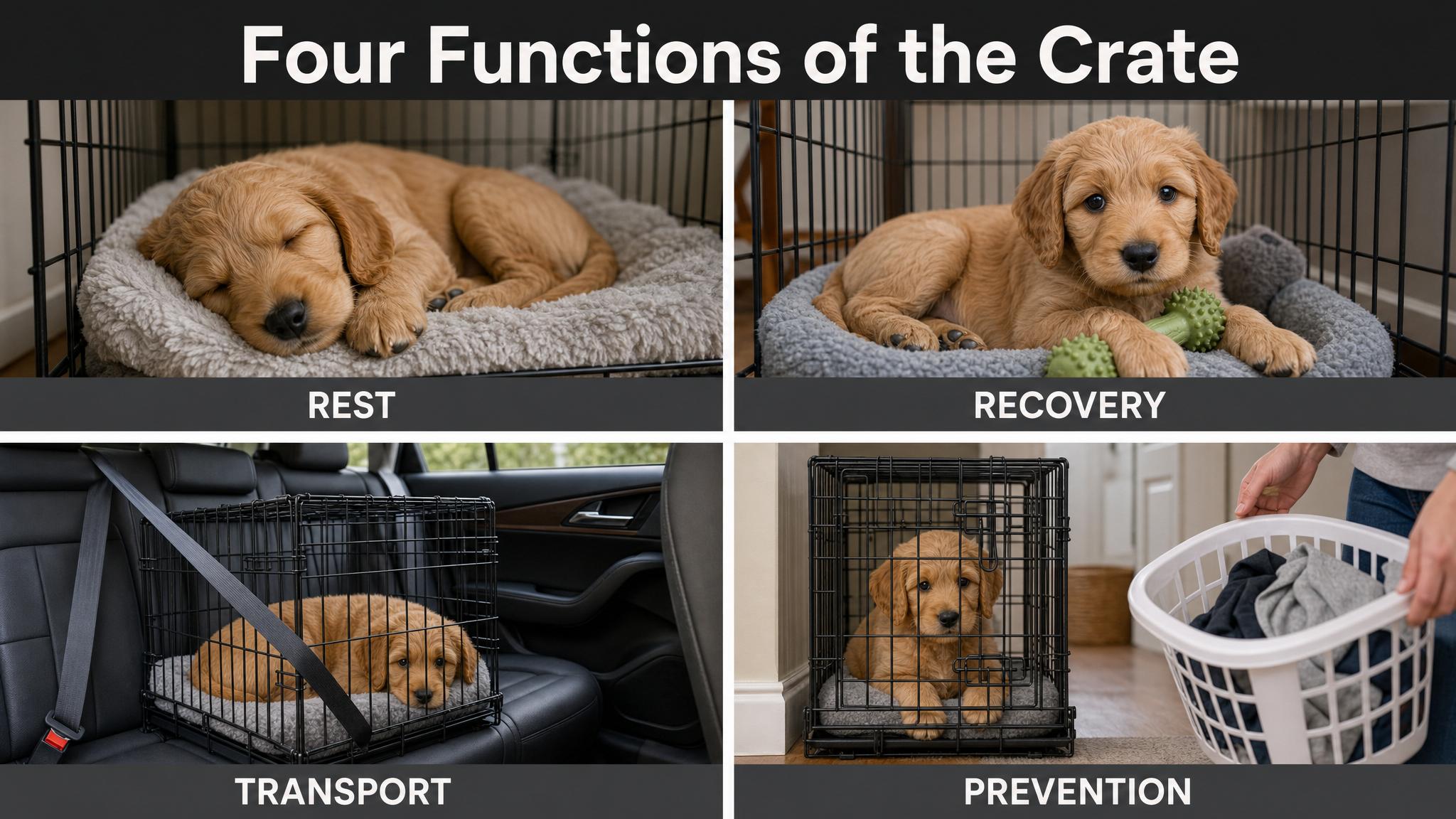
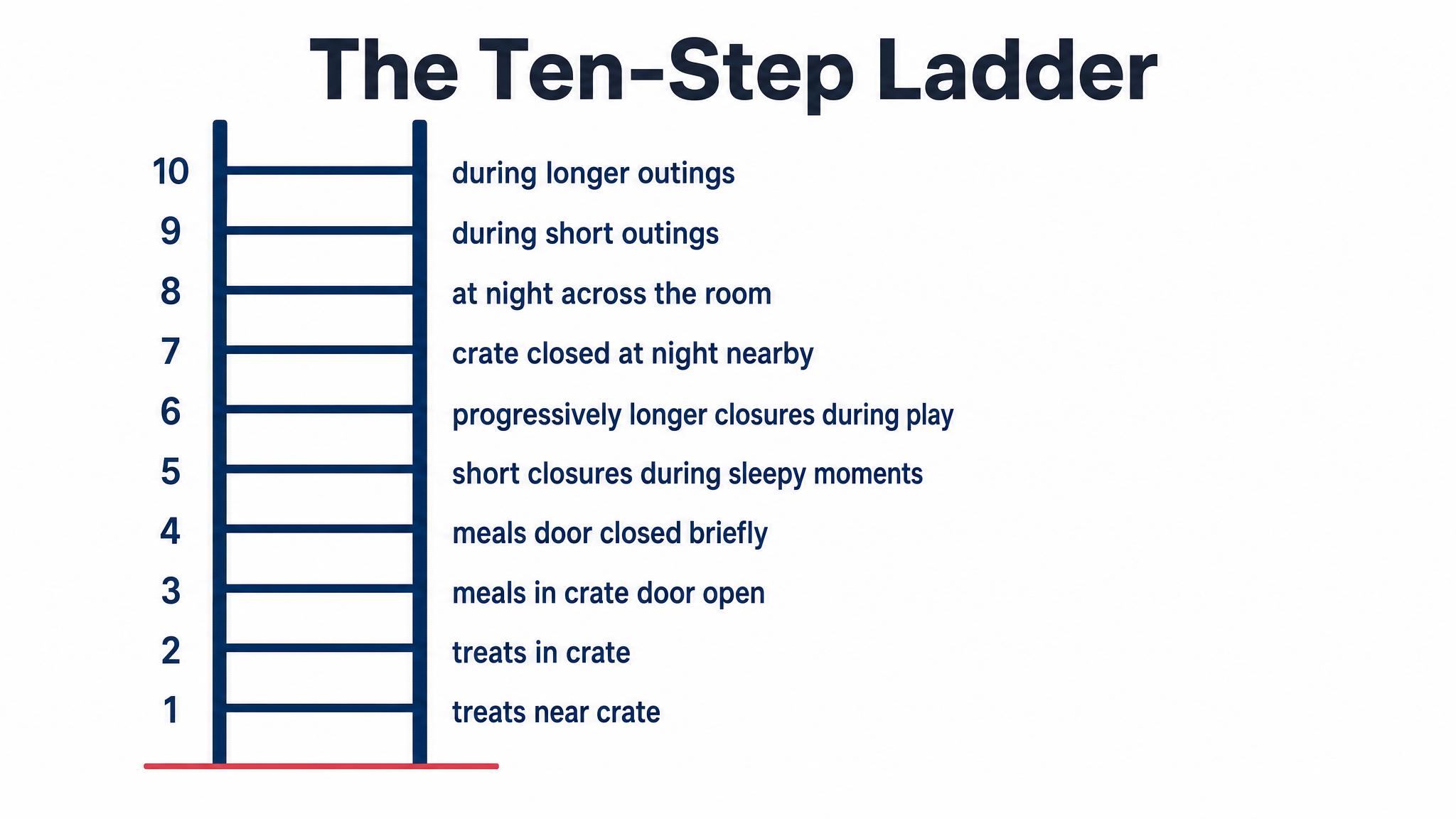
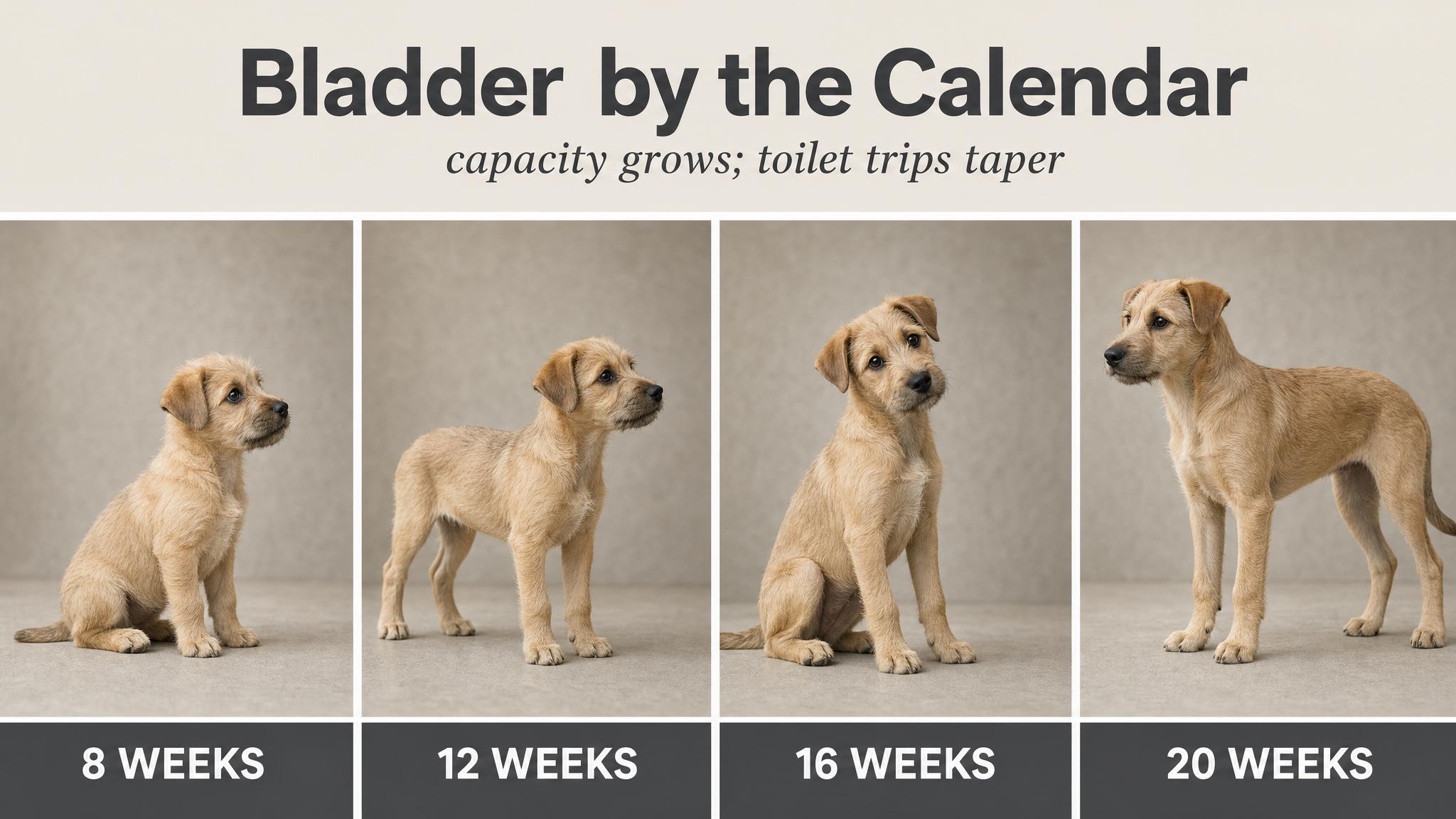
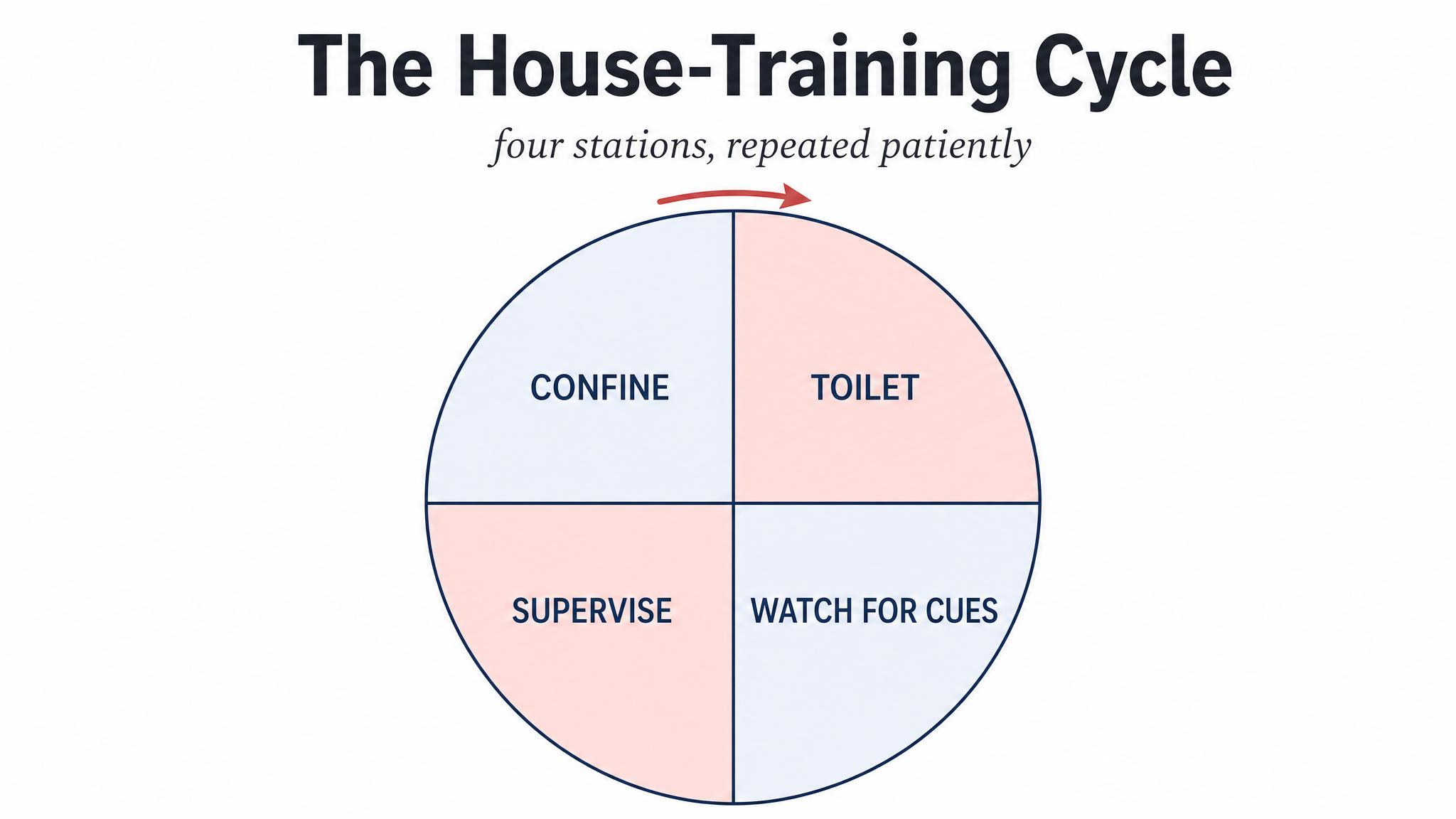
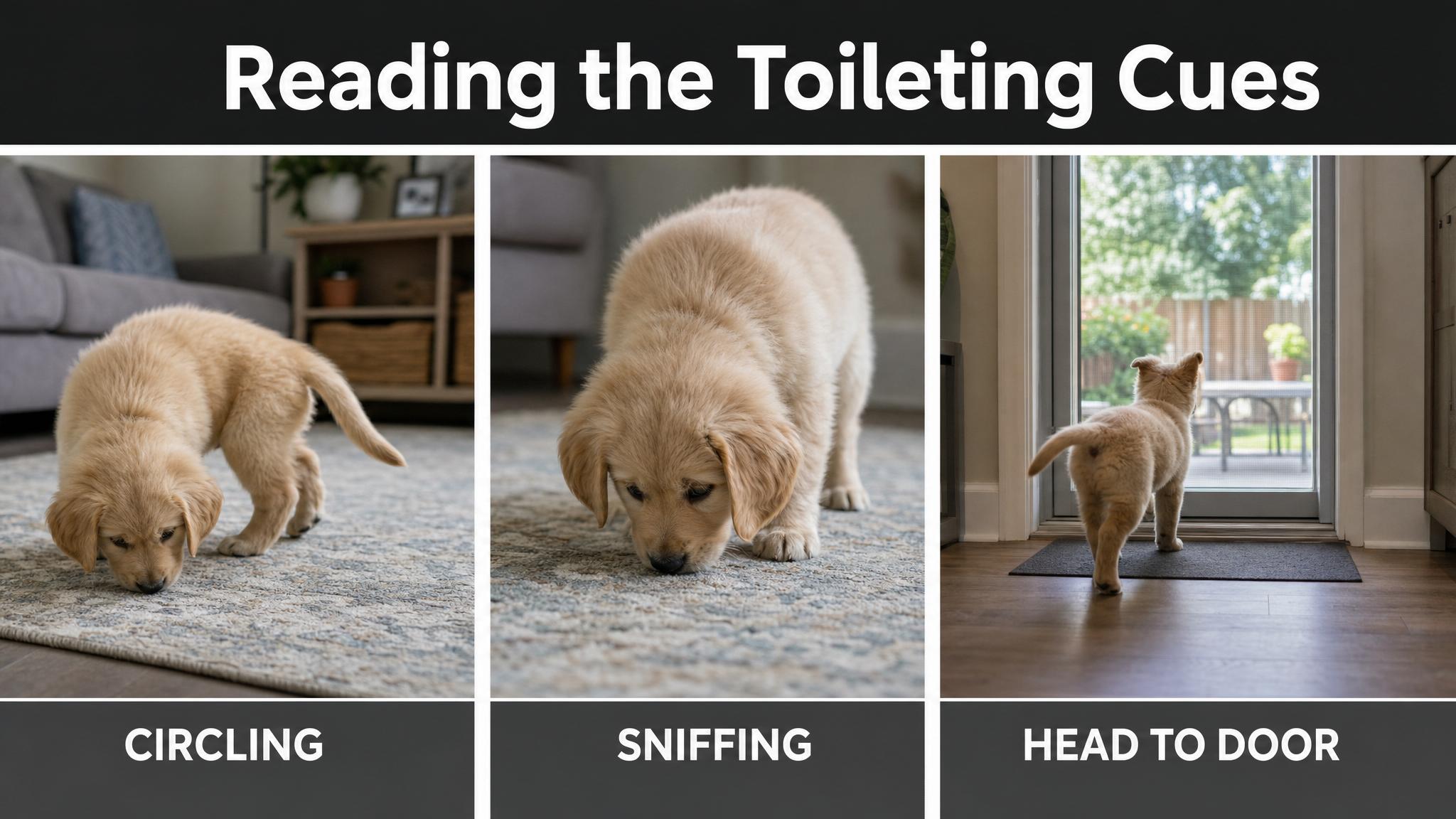
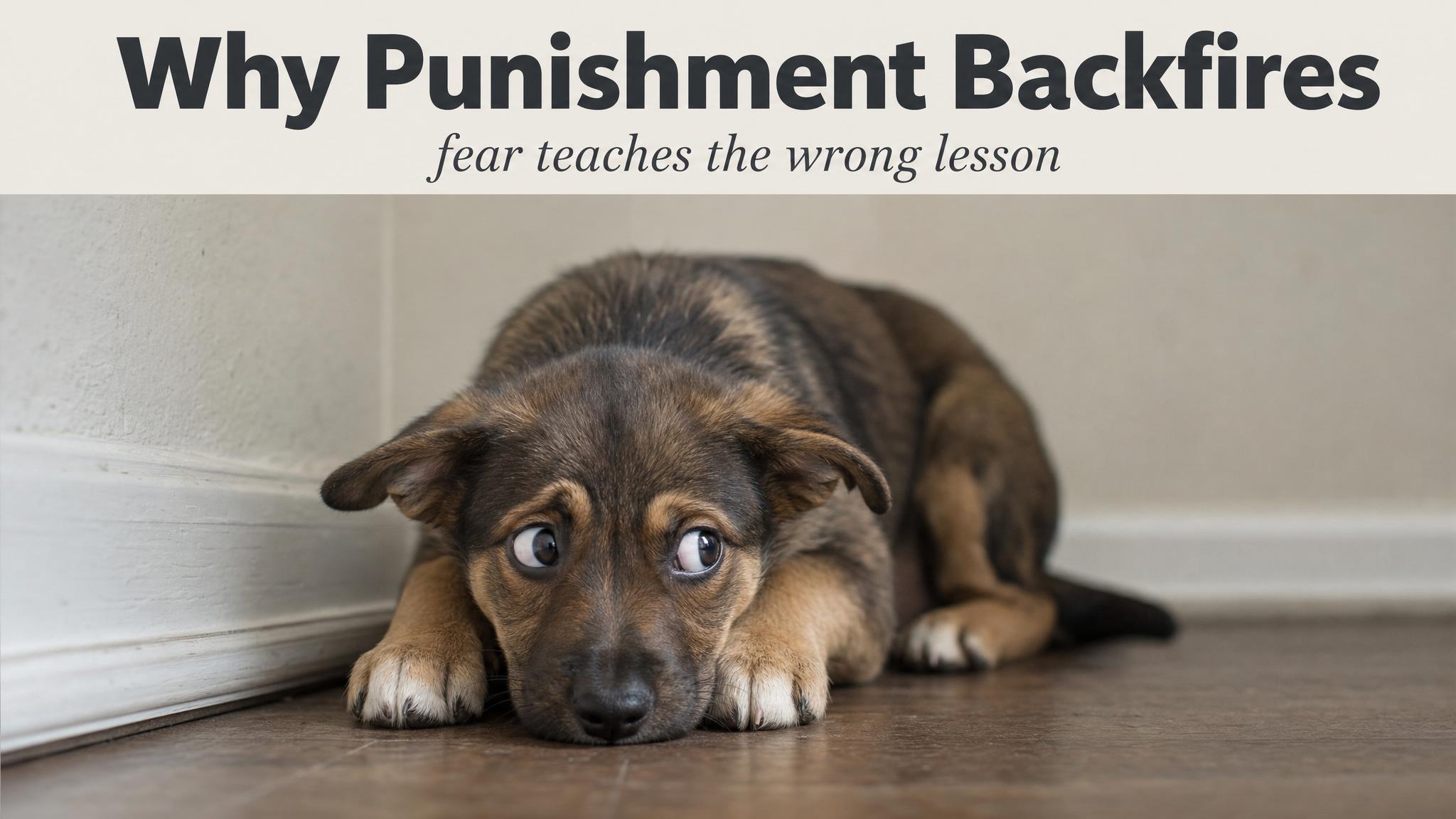
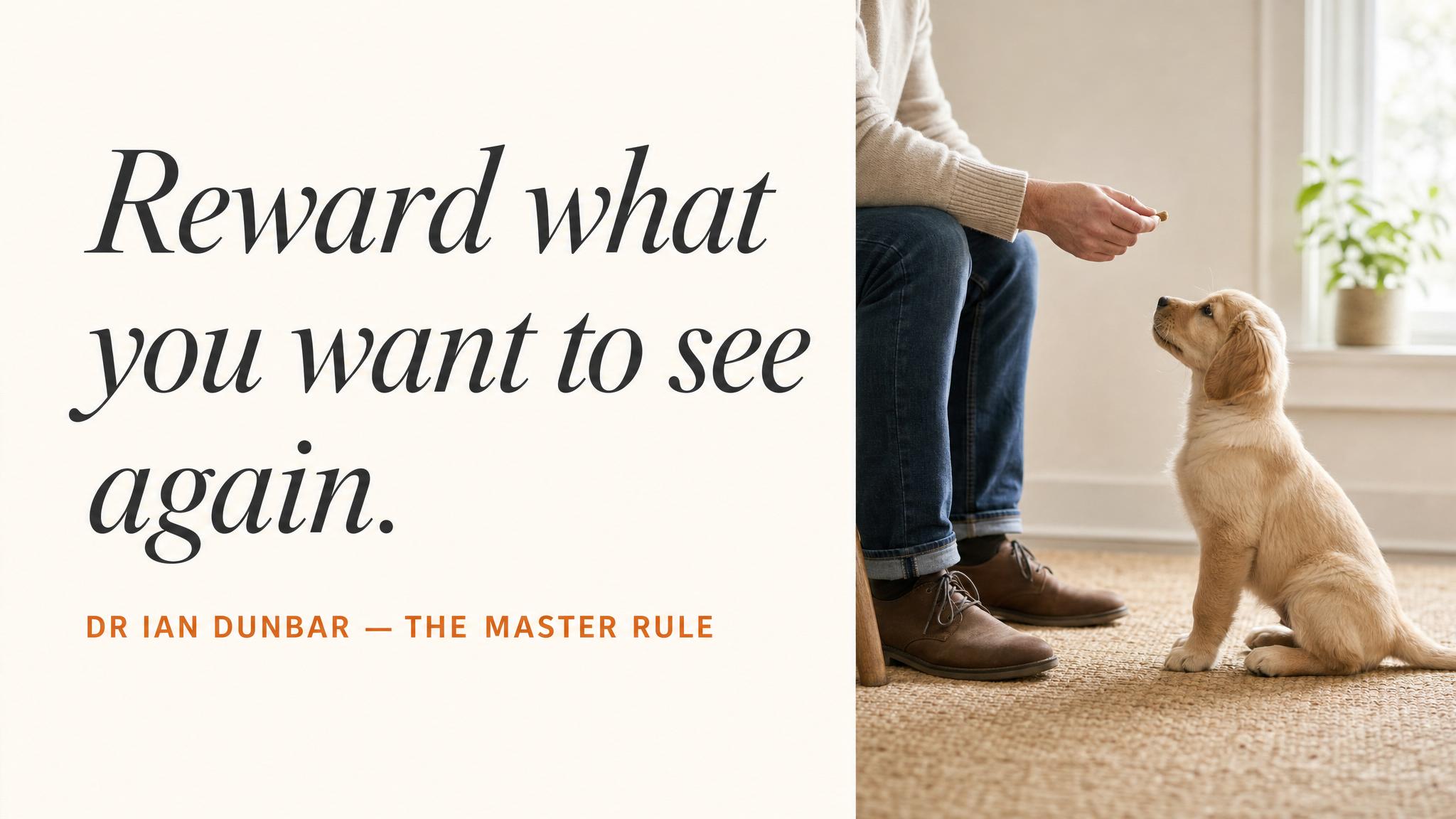
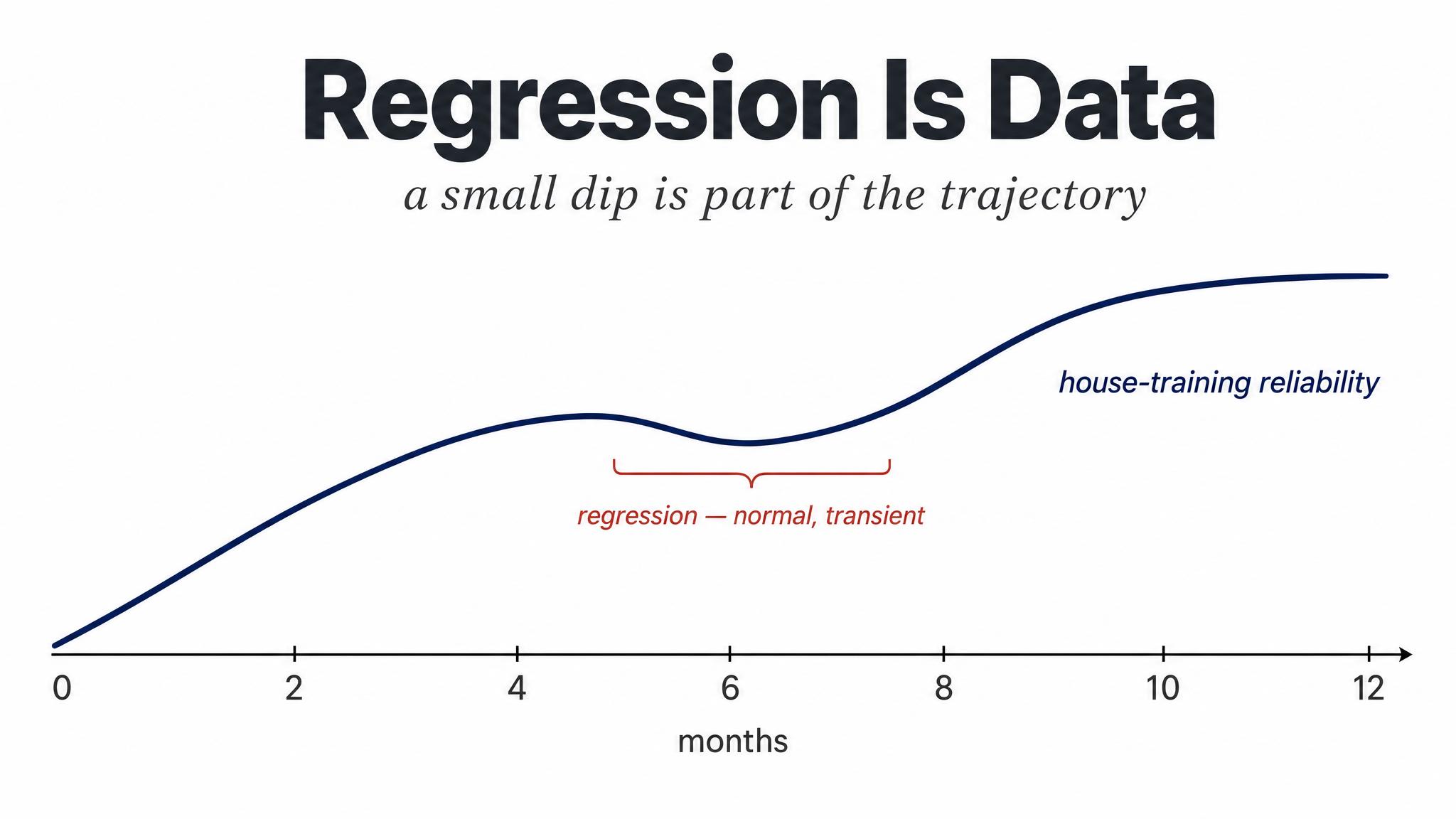
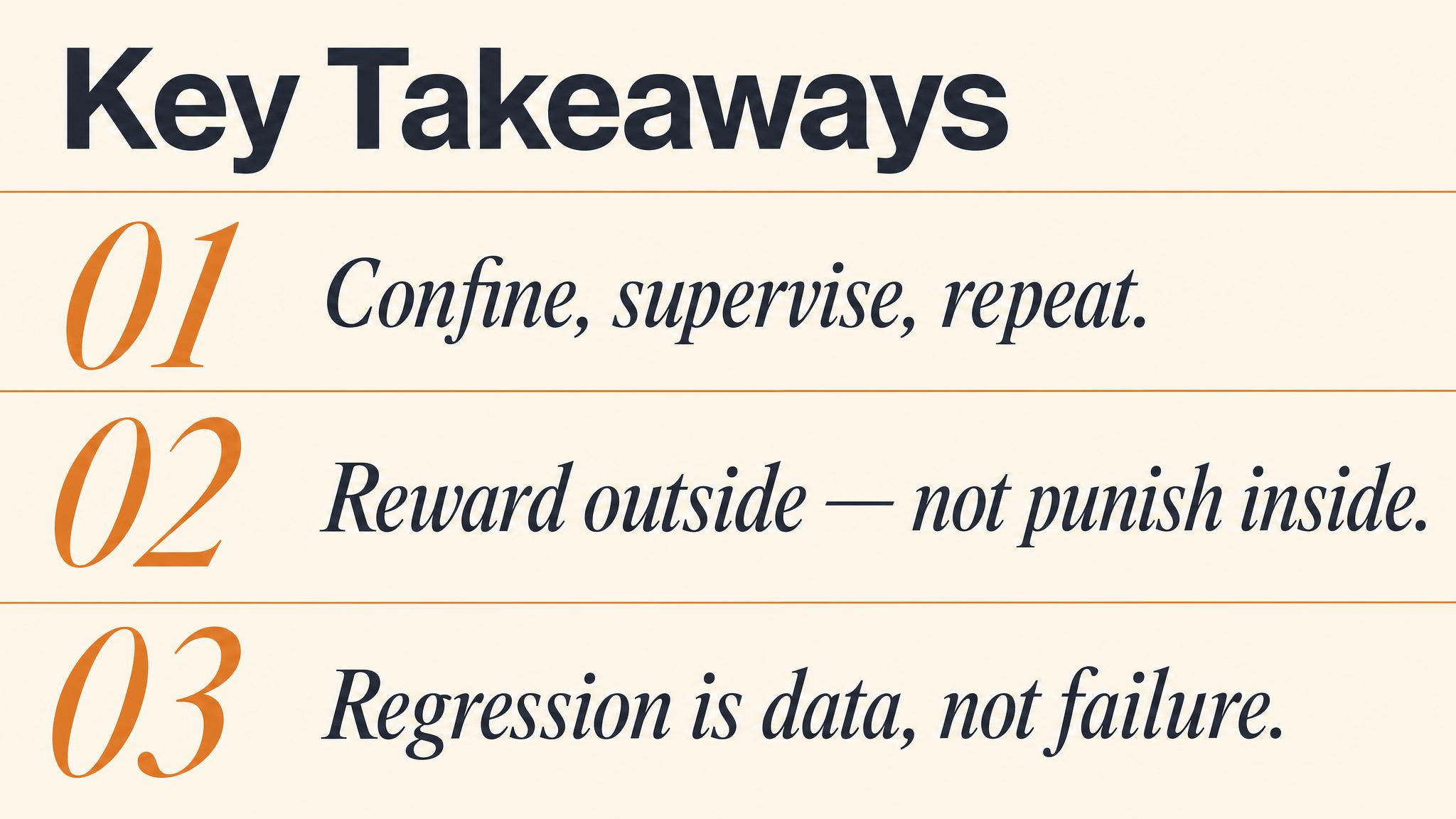
Nutrition & Feeding — What Goes In Matters (And So Does How)
Feeding a puppy should be simple, but the internet has turned it into a minefield of conflicting advice, guilt-inducing marketing, and dangerously wrong home-remedy recommendations. This chapter cuts through the noise…
Real talk: Is giving your dog table scraps actually bad for them, or are we just being dramatic because a vet said so once?
Real talk
Would you rather have a dog that begs constantly at every meal but stays perfectly slim, or a chill dog that never begs but is definitely a little chunky?
Would you rather
Hot take: Expensive 'premium' dog food is basically a scam. The cheap stuff works just fine and your dog can't tell the difference anyway.
Hot take
Your dog steals an entire pizza off the counter while you're in the bathroom. Whose fault is it — yours for leaving it out, or the dog's for being a thief?
Who's at fault?
Using treats to get your dog to obey = smart training or just straight-up bribery? Does it even matter if it works?
Debate time
Is telling someone their dog is overweight helpful honesty or are you just being rude? Would you want someone to tell YOU?
Awkward question
Food Label Detective Challenge
12-15 minutesDisplay 3-4 real puppy food labels on screen (with different quality levels). Students work with their immediate neighbors to analyze one label: identify the first 5 ingredients, find the AAFCO statement, spot marketing vs. nutrition claims, and determine if it's appropriate for puppies. Each pair/trio shouts out findings. Instructor tallies which label wins based on evidence. Competitive scoring creates engagement. Follow with 3-minute debrief on what made the winner appropriate.
Toxic Food Rapid Fire
8-10 minutesInstructor rapidly displays images of common household foods (chocolate, grapes, carrots, xylitol gum, peanut butter, onions, blueberries, etc.). Students use colored cards (green=safe, red=toxic, yellow=depends) held up simultaneously. After each reveal, instructor pauses on controversial ones where class is split. Students turn to neighbors for 30-second debate, then revote. Instructor reveals answer with toxicity level and mechanism. Keep pace fast and score left vs. right side of theatre.
The 6AM to 10PM Feeding Schedule Design
15-18 minutesPresent a case study: '8-week-old Labrador puppy, family with 2 working parents, teenager gets home at 4pm, everyone awake 6am-10pm.' Students with neighbors sketch a realistic feeding schedule (times, amounts, who feeds) on paper. Then introduce complications one-by-one via instructor callouts: 'The puppy has diarrhea at noon—now what?', 'Owner wants to use meals for training—adjust your plan', 'Puppy is consistently leaving food—problem?'. Neighbors rapidly adapt their schedules. Poll room on solutions, discuss 2-3 contrasting approaches.
Body Condition Scoring: Swipe Right or Left
10-12 minutesDisplay photos of puppies at different body conditions (BCS 1-9 scale). Students make immediate judgment: thumbs up (ideal), thumbs sideways (underweight), thumbs down (overweight). Instructor reveals correct BCS and key visual markers. Next level: show before/after photos and students debate with neighbors whether weight change is appropriate given age/timeframe. Instructor introduces nuance: 'This 5-month-old gained 10 lbs in 3 weeks—problem or not?' Students vote, discuss reasoning, learn about growth curves vs. obesity.
Training Treat Throwdown: What's in Your Pocket?
15-18 minutesStage a structured controversy: Instructor presents 5 common training treat options (kibble, hot dogs, cheese, commercial treats, freeze-dried liver) with photos and nutritional info. Assign each row/section a treat to defend. Give 3 minutes for groups to list pros/cons with neighbors. Then run a debate: each section makes 30-second pitch for their treat, others challenge ('But hot dogs are 80% fat!', 'Kibble isn't motivating enough!'). Instructor facilitates rebuttals. End with synthesis: when to use each treat type, portion control, balancing training needs with nutrition.
Myth-Busting Courtroom
12-15 minutesPresent 5-6 controversial nutrition claims commonly found online ('Grain-free is healthier', 'Raw diets are more natural', 'Puppies should eat adult food to slow growth', 'Table scraps are always bad', 'All puppies need supplements'). For each myth: students vote guilty (myth) or not guilty (fact) using hand signals. Split votes trigger 60-second neighbor debates. Instructor then presents evidence (research, veterinary consensus, case examples). Students revote. Track which myths fooled the most students. End with discussion of why these myths persist and how to evaluate nutrition information sources.
Transcript
You're standing in the pet food aisle, and there are forty-seven options staring back at you. One bag promises "ancestral grain-free nutrition" with a wolf on the label. Another claims to be "holistically crafted" with ingredients you'd find on a restaurant menu. The one your breeder recommended looks plain by comparison. Your phone has three open tabs: a blog insisting raw feeding is the only ethical option, a Facebook group where someone swears by a home-cooked diet supplemented with bone meal, and a forum post declaring that all kibble is "processed poison." Your eight-week-old puppy, meanwhile, is cheerfully trying to eat a stick in the car park.
[short pause]
Feeding a puppy shouldn't require a degree in nutritional science, but the sheer volume of conflicting advice, much of it driven by marketing rather than evidence, has turned mealtime into a source of guilt for many new owners. This chapter cuts through the noise. We'll cover what puppies actually need nutritionally, how to read a label, when and how to feed, what's safe as a treat and what could send you to the emergency vet, and how to tell whether your puppy is at a healthy weight. There is no single "perfect" diet, but there are informed choices, and by the end of this chapter, you'll be equipped to make them.
[short pause]
Why Puppy Food Isn't Just Small-Dog Food.
Puppies aren't miniature adults. They're biological construction projects. In the first twelve months of life, most puppies will multiply their birth weight by forty to fifty times. That extraordinary rate of growth requires a nutritional profile fundamentally different from what an adult dog needs, particularly when it comes to protein concentration, fat content, and the minerals that build the skeleton.
The most critical nutritional consideration during puppyhood involves CALCIUM and PHOSPHORUS, not just the amounts, but the ratio between them. Research by Dobenecker and colleagues in 2019 found that during peak growth at two to four months of age, puppies require a calcium-to-phosphorus ratio of approximately two to one, which gradually decreases to about one point four nine to one by seven to twelve months. Here's what makes this particularly important: unlike adult dogs, puppies cannot adequately regulate calcium absorption from the intestinal tract. This means that if you feed excess calcium through over-supplementation or an unbalanced diet, a puppy's body will absorb it regardless, potentially leading to serious skeletal developmental disorders, particularly in large and giant breeds.
This is precisely why well-meaning supplementation can be dangerous. Adding calcium powder, ground eggshell, or bone meal to a puppy's already complete diet can push that ratio out of balance, causing conditions like osteochondrosis or hypertrophic osteodystrophy. The safest approach? Feed a food specifically formulated for growth, and resist the urge to add supplements unless your veterinarian has specifically prescribed them based on a diagnosed deficiency.
[short pause]
Decoding "Complete and Balanced."
The phrase COMPLETE AND BALANCED isn't marketing fluff. It has a specific regulatory meaning. In Australia, pet food labelling follows guidelines aligned with the standards established by the Association of American Feed Control Officials, known as A-A-F-C-O, which define minimum, and some maximum, nutrient requirements that a food must meet. A-A-F-C-O maintains two primary nutrient profiles: Growth and Reproduction, for puppies and pregnant or lactating dogs, and Adult Maintenance. Updated profiles from 2016 include specific provisions for large and giant breed puppies, reflecting the different calcium needs we just discussed.
When you pick up a bag of puppy food, look for two things on the label. First, a statement that the food meets A-A-F-C-O nutrient profiles for "growth" or "all life stages." Second, check whether this was demonstrated through feeding trials, where the food was actually fed to dogs and evaluated, or through formulation method, where the recipe was calculated to meet nutrient minimums on paper. Both approaches are acceptable, but feeding trials provide an additional layer of real-world validation.
[short pause]
Take a moment to consider this: Look at the puppy food you're currently feeding or planning to feed. Can you find the A-A-F-C-O nutritional adequacy statement on the packaging? Does it specify "growth" or "all life stages"? Does it mention feeding trials or formulation? Being able to read this statement is one of the most practical nutrition skills you can develop as a dog owner.
[short pause]
Feeding Schedules: Connecting Meals to Your Daily Rhythm.
If you've been following the routines we established in Chapter Two and the house training schedules from Chapter Five, you already know that predictability is your puppy's best friend. Feeding schedules are the connective tissue that ties your whole daily routine together, because when you feed directly determines when your puppy needs to toilet, which determines when you need to be ready with leash in hand by the back door.
Evidence-based guidance on meal frequency is straightforward and age-dependent. According to the American Kennel Club, puppies aged six to twelve weeks need four meals per day. Small, frequent meals support steady blood sugar and rapid growth. At three to six months, transition to three meals per day, as stomach capacity increases and growth rate begins to moderate. From six to twelve months, move to two meals per day, the schedule most adult dogs will maintain for life.
The transition between meal frequencies should be gradual. When moving from four meals to three, for example, slowly increase portion sizes at the remaining meals over about a week while phasing out the dropped meal. Watch your puppy's energy levels and stool consistency during transitions. Loose stools may indicate portions that are too large for the puppy's digestive capacity at that sitting.
[short pause]
Timing Meals Around Toilet Breaks.
Most puppies will need to toilet within fifteen to thirty minutes after eating. This is driven by the gastrocolic reflex, the physiological response in which food entering the stomach triggers movement in the colon. Planning for this reflex is the single most effective thing you can do to accelerate house training. If your puppy eats at seven a-m, have your shoes on and be ready to go outside by seven fifteen. You can integrate feeding times with the toilet schedule we developed in Chapter Five by selecting your puppy's age, adjusting your wake-up time, and considering your feeding method, whether that's a standard bowl, food puzzle, or training session. This integration helps you visualize how meal times and toilet breaks naturally flow together throughout the day.
[short pause]
How You Feed Matters as Much as What You Feed.
A food bowl is the least interesting way to deliver your puppy's meals, and this is actually a missed opportunity. Every meal is a chance to build your relationship, provide mental enrichment, or reinforce training behaviours. Consider three approaches:
First, hand-feeding for bond building. Especially in the first few weeks home, hand-feeding a portion of each meal teaches your puppy that wonderful things come from your hands. It builds trust, encourages eye contact, and establishes you as the source of good things. This is particularly valuable for shy or anxious puppies.
Second, food puzzles and scatter feeding for enrichment. Spreading kibble across a snuffle mat, freezing wet food inside a Kong, or using a slow-feeder puzzle engages your puppy's brain and natural foraging instincts. A meal that takes two minutes from a bowl can take fifteen minutes from a puzzle, and that's fifteen minutes of calm, focused mental work. For puppies who eat too fast, a common issue that can cause vomiting or bloat risk, slow feeders serve a practical health purpose as well.
Third, training session feeding. This approach, which connects directly to the positive reinforcement principles from Chapter One, involves using a portion of your puppy's daily meal allowance as training reinforcers throughout the day. Rather than delivering all food in discrete meals, you measure out the day's kibble and use handfuls of it during short training sessions. Research supports that food rewards function as powerful primary reinforcers, and using the regular meal ration rather than additional treats keeps caloric intake in check, as China and colleagues demonstrated in 2021, and as noted by V-C-A Animal Hospitals.
[short pause]
Think about this: If you feed your puppy three meals a day from a bowl, each meal is consumed in roughly ninety seconds. That's four and a half minutes of eating per day. If you instead deliver one meal via hand-feeding, one through a food puzzle, and one as training rewards, you've transformed four and a half minutes into potentially forty-five minutes of enrichment, learning, and bonding, using the exact same food. What would need to change in your daily routine to make this shift?
[short pause]
Treats, Training Reinforcers, and Toxic Foods.
Using Treats Without Creating a Treat-Dependent Dog.
One of the most common concerns new owners raise is, "If I use treats for training, won't my dog only listen when I have food?" This is a legitimate question with a clear evidence-based answer: the key lies in understanding reinforcement schedules.
When teaching a new behaviour, you use continuous reinforcement, rewarding every correct response. This is essential during the learning phase because the puppy needs to clearly understand what earns the reward. Once the behaviour is reliably established, you transition to INTERMITTENT REINFORCEMENT, rewarding some correct responses but not all. According to V-C-A Animal Hospitals, intermittent reinforcement actually makes behaviours more resistant to extinction, not less. Think of it like a slot machine: the unpredictability of the reward makes the behaviour more persistent, not less.
Additionally, as training progresses, you diversify your reinforcers. Praise, play, access to a favourite toy, the opportunity to sniff on a walk, all of these become powerful rewards that supplement and eventually partially replace food. The goal isn't to eliminate food rewards entirely; it's to build a dog that responds to a rich variety of reinforcement, with food being one tool among many. We'll explore this progression in detail in Chapter Eight when we address maintaining training through adolescence.
[short pause]
The Ten Percent Rule for Treat Calories.
A simple guideline: treats and extras should comprise no more than ten percent of your puppy's daily caloric intake, with the remaining ninety percent coming from nutritionally complete food, according to the American Kennel Club. This is where most owners go wrong, not through the meals, but through the accumulation of small treats throughout the day. A single dental chew can represent twenty to thirty percent of a small puppy's daily calories. Those tiny training treats? At ten sessions of twenty repetitions each, that's two hundred treats in a day.
The practical solution: measure out your puppy's daily food allowance each morning. Set aside a portion of it for training use. Any additional treats, such as commercial training treats, small pieces of cheese or chicken, should be tiny, about the size of a pea, and mentally deducted from the day's total. If you've used a lot of training treats, reduce the next meal portion slightly.
[short pause]
What's Actually Dangerous: A Toxicity Guide.
Food-associated poisoning accounts for approximately fourteen point eight percent of all hazardous exposures in companion animals, with many episodes resulting from simple lack of awareness rather than negligence, as Cortinovis and Caloni reported in 2016. The most dangerous household foods for dogs include:
Chocolate and cocoa products, which contain theobromine and caffeine. Dark chocolate and cocoa powder are most dangerous. These can cause vomiting, diarrhoea, seizures, cardiac arrhythmias, and death.
Grapes and raisins can cause acute kidney failure even in small amounts. The exact toxic compound is not yet fully identified, making any amount potentially dangerous.
Xylitol, also known as birch sugar, is found in sugar-free gum, some peanut butters, baked goods, and dental products. It causes rapid, life-threatening hypoglycaemia and liver failure. This sweetener is increasingly common in Australian households.
Onion and garlic in all forms cause oxidative damage to red blood cells, leading to haemolytic anaemia. Cooked, raw, and powdered forms are all toxic.
Macadamia nuts, particularly relevant for Australian households, cause weakness, vomiting, tremors, and hyperthermia. Usually not fatal but requires veterinary attention.
Cooked bones. Cooking removes collagen, making bones brittle and prone to splintering into sharp fragments that can cause oral injuries, oesophageal obstruction, intestinal perforation, and peritonitis, according to V-C-A Animal Hospitals.
Corn cobs are not toxic but are a common cause of intestinal obstruction requiring emergency surgery. Dogs swallow large pieces that cannot be digested or passed.
Bread dough, raw or rising. Yeast continues to ferment in the warm stomach, producing ethanol, which causes alcohol poisoning, and gas, which causes dangerous gastric distension.
[short pause]
Keep the Poison Information Hotline number saved in your phone: one-three, one-one, two-six. That's one-three, one-one, two-six. This service is available twenty-four hours. If your puppy ingests something toxic, call immediately.
[short pause]
Body Condition Scoring: Is My Puppy the Right Weight?
Portion guides on food packaging are starting points, not prescriptions. They're based on averages and cannot account for your individual puppy's metabolism, activity level, or growth phase. The most reliable way to determine whether your puppy is eating the right amount isn't the scale. It's BODY CONDITION SCORING, known as B-C-S.
Developed by Laflamme in 1997 and now adopted by the World Small Animal Veterinary Association, body condition scoring uses a combination of visual assessment and hands-on palpation to evaluate fat cover. The system looks at three primary landmarks: rib coverage, can you easily feel the ribs with light pressure? Waist definition, when viewed from above, does the body narrow behind the ribs? And abdominal tuck, when viewed from the side, does the belly tuck up behind the ribcage?
One crucial point: a puppy's coat can mask body condition. A fluffy Samoyed puppy and a short-coated Vizsla puppy might look very different, but the assessment is done primarily by touch, not sight. You should be able to feel your puppy's ribs easily under a thin layer of fat, like feeling the back of your hand. If you have to press firmly to find the ribs, your puppy is likely carrying excess weight.
[short pause]
Why Puppy Weight Matters Long-Term.
This isn't just about aesthetics. Research associated with the Purina Lifespan Study demonstrated that dogs maintained at a lean body condition from puppyhood lived up to fifteen percent longer, and more importantly, had significantly delayed onset of chronic diseases like osteoarthritis, as Laflamme noted in 1997. Overweight puppies are also more prone to developmental orthopaedic diseases, as excess weight places additional stress on growing joints and bones. The habits you set now have consequences that extend over your dog's entire life.
The body condition scoring system typically uses a five-point scale. Your puppy should be at a score of three, which is ideal, with ribs easily felt but not prominently visible. You can practice assessing body condition by exploring what different scores look like visually and what they feel like when you run your hands along your puppy's sides and back. Learning to distinguish between an underweight puppy at score one or two, an ideal puppy at score three, and an overweight puppy at score four or five is a skill that will serve you throughout your dog's life.
[short pause]
The Raw Feeding Question.
No nutrition chapter would be complete without addressing raw feeding, and we'll do so directly and without judgement, while being honest about what the evidence currently shows.
The American Veterinary Medical Association in 2012, and the Australian Veterinary Association, both advise against feeding raw or undercooked animal-source protein to pets. Their position is based on documented risks rather than theoretical concerns: studies have consistently found pathogenic bacteria including Salmonella, E. coli, Listeria, and Campylobacter in commercially available raw pet food products. These pose risks not only to the dog but to household members, particularly children, elderly individuals, and immunocompromised people who may come into contact with the food, the dog's saliva, or faeces.
Beyond pathogen risk, nutritional imbalance is a well-documented concern in both home-prepared and commercial raw diets. Multiple analyses have found that many raw feeding recipes, including those published in books and on popular websites, fail to meet established nutrient requirements, with calcium-to-phosphorus ratio imbalances being among the most common deficiencies, according to the American Veterinary Medical Association in 2012. For puppies specifically, given their inability to regulate calcium absorption, as Dobenecker and colleagues found in 2019, this risk is amplified.
Proponents of raw feeding cite benefits including shinier coats, smaller stools, increased energy, and improved dental health. It's important to acknowledge that some of these observations may reflect real differences. A diet higher in animal protein and fat may produce visible coat improvements, for instance. However, the vast majority of purported benefits remain scientifically unproven, while the risks are documented and measurable.
[short pause]
If you choose to feed raw despite the current veterinary consensus, the most responsible approach is to work with a board-certified veterinary nutritionist who can formulate a diet specific to your puppy's breed, size, and growth stage, and to implement rigorous food handling hygiene protocols in your home.
[short pause]
Consider this when evaluating dietary claims for your puppy: Is the advice coming from a qualified veterinary nutritionist, a pet food company marketing department, or an online community with strong ideological views? What evidence supports the specific claims being made? Applying the same critical thinking to pet nutrition that you would to your own health decisions is a habit that will serve you and your puppy well.
[short pause]
Putting It All Together: Practical Feeding Guidelines.
Let's distill everything into actionable daily practice:
First, choose a food labelled for growth. Look for the A-A-F-C-O nutritional adequacy statement specifying "growth" or "all life stages." For large breed puppies, seek a formula specifically designed for large breed growth.
Second, feed on a consistent schedule aligned with your daily routine and toilet training plan. Use the age-appropriate meal frequency guidelines: four meals transitioning to three, transitioning to two. Plan toilet breaks fifteen to thirty minutes after each meal.
Third, measure, don't estimate. Use a kitchen scale or measuring cup for every meal. Adjust based on body condition scoring, not the packaging suggestion alone.
Fourth, use meals as enrichment and training. Rotate between hand-feeding, food puzzles, scatter feeding, and training sessions. Your puppy's daily food ration is your most powerful training resource.
Fifth, follow the ten percent treat rule. Keep extras to a minimum and choose training treats that are tiny, soft, and quick to eat.
Sixth, body condition score weekly. Run your hands over your puppy's ribs every week. Adjust portions before weight becomes a problem, not after.
Seventh, keep toxic foods secured. Store chocolate, grapes, onions, macadamia nuts, and xylitol-containing products out of reach. Know the Poison Information Hotline number: one-three, one-one, two-six.
[short pause]
There is no single "correct" diet for every puppy. A Labrador Retriever puppy has different nutritional needs from a Chihuahua. A working-line Border Collie burns more calories than a companion-bred Cavalier King Charles Spaniel. Your veterinarian remains your best ally in tailoring nutrition to your individual puppy, and regular weigh-ins and body condition assessments at each vaccination visit provide natural checkpoints. Feed with evidence, not anxiety, and you'll be setting your puppy up for a lifetime of health.
[short pause]
Key Takeaways.
Puppies require food specifically formulated for growth, with carefully balanced calcium-to-phosphorus ratios that they cannot self-regulate.
Look for the A-A-F-C-O nutritional adequacy statement for "growth" on puppy food labels. "Complete and balanced" has a specific regulatory meaning.
Feeding schedules should align with your house training routine: expect a toilet break fifteen to thirty minutes after every meal.
Use meals as enrichment and training opportunities. Hand-feeding, food puzzles, and training sessions transform mealtime into relationship-building time.
Transition from continuous to intermittent reinforcement as behaviours are learned to avoid treat-dependency.
Treats should be no more than ten percent of daily calories. Measure your puppy's food daily and account for everything.
Know the toxic foods: chocolate, grapes and raisins, xylitol, onions and garlic, macadamia nuts, cooked bones, corn cobs, and bread dough. Save the Poison Hotline: one-three, one-one, two-six.
Body condition scoring, feeling ribs, assessing waist and tuck, is more reliable than the scale. Puppies kept lean live longer, healthier lives.
Current veterinary consensus advises against raw feeding due to documented pathogen and nutritional imbalance risks, especially for growing puppies.
[short pause]
Looking Ahead.
In Chapter Seven, we'll tackle one of the biggest sources of new-puppy stress: Socialisation, Building Confidence, Not Fear. You'll learn the critical socialisation window, how to structure positive exposures, and why quality matters far more than quantity. The bond-building and training foundation you've established through thoughtful feeding practices will directly support your socialisation efforts. A puppy who trusts you and is motivated by food rewards is a puppy you can help navigate new experiences with confidence.
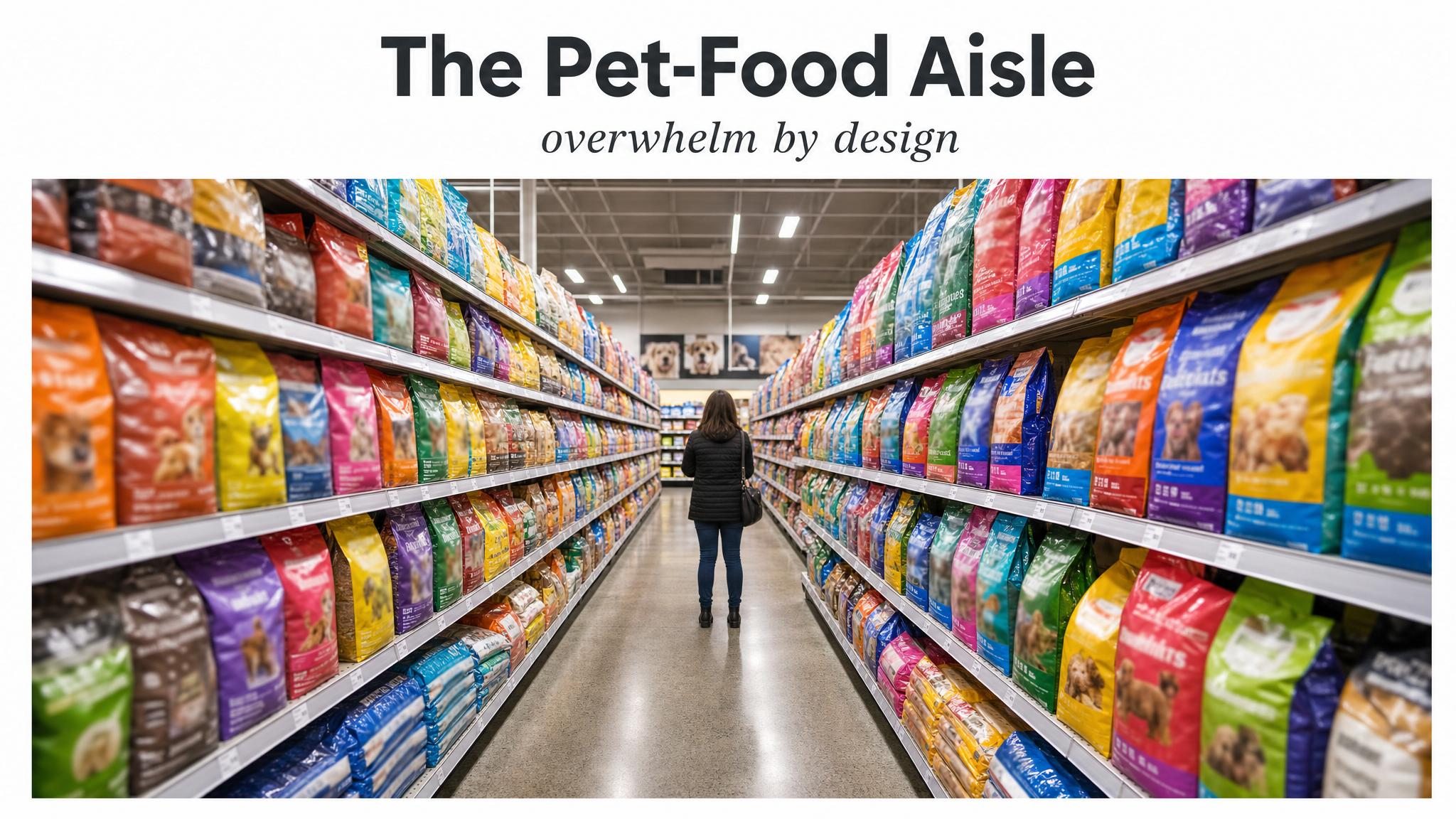
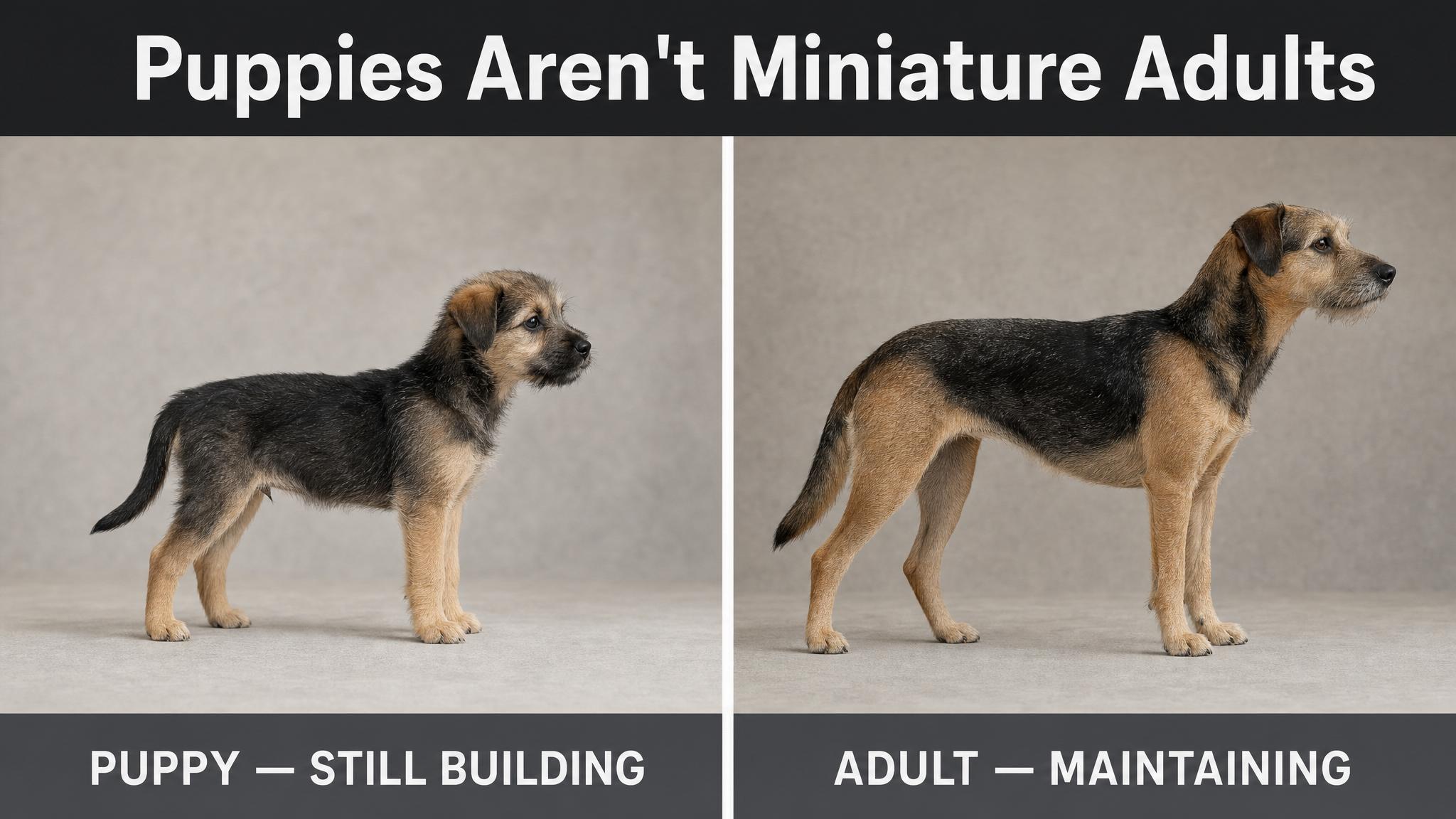
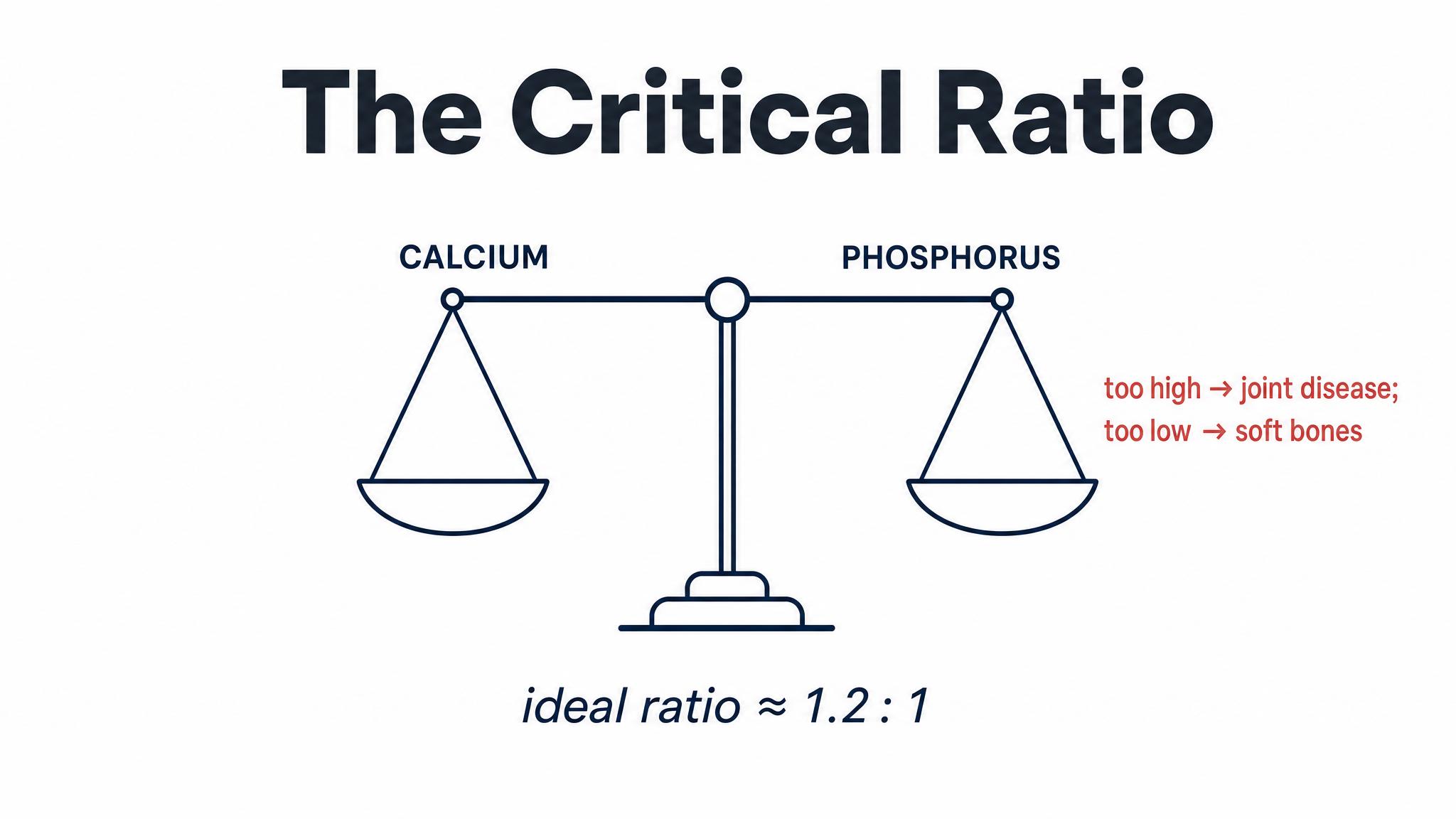
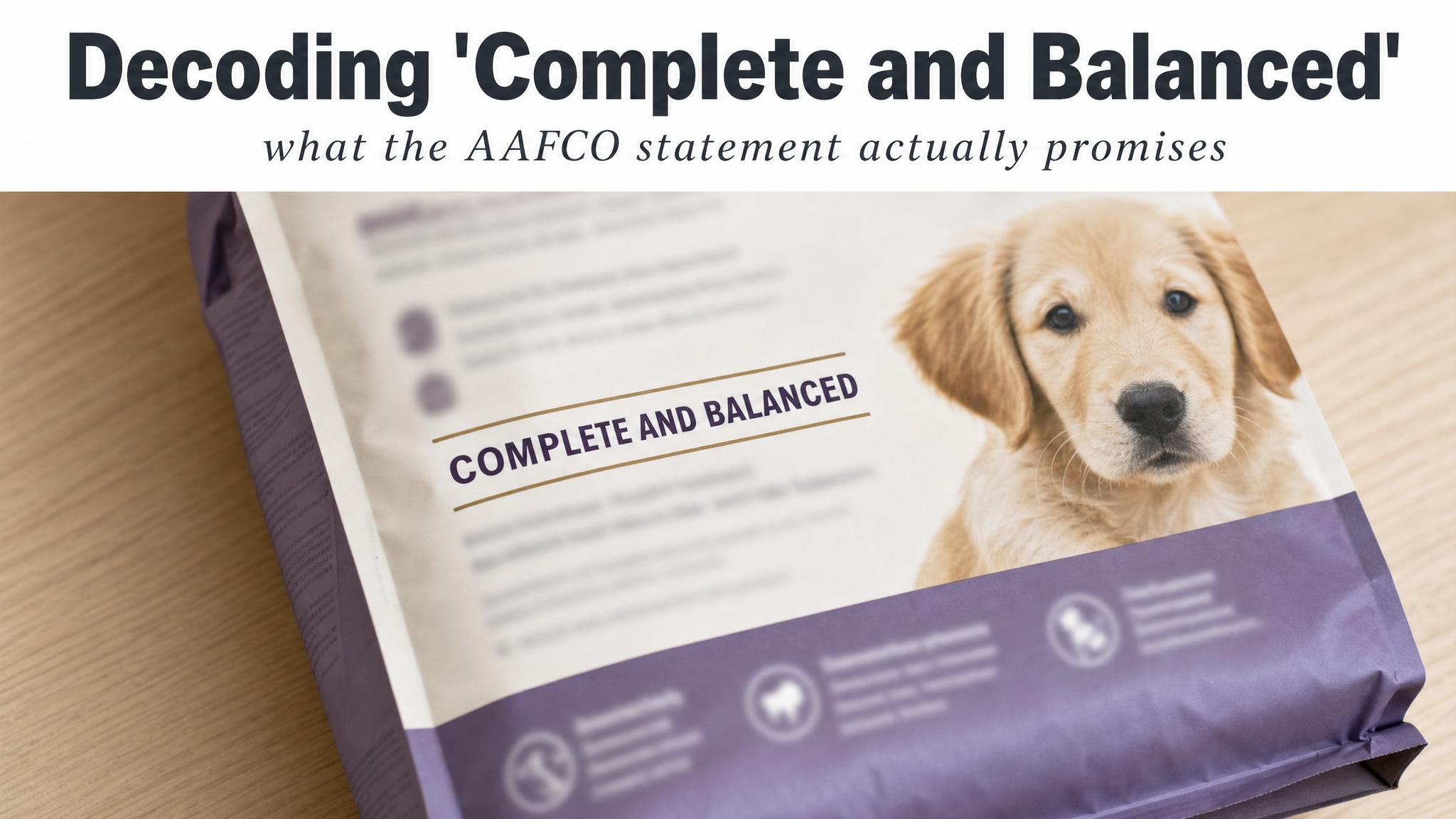
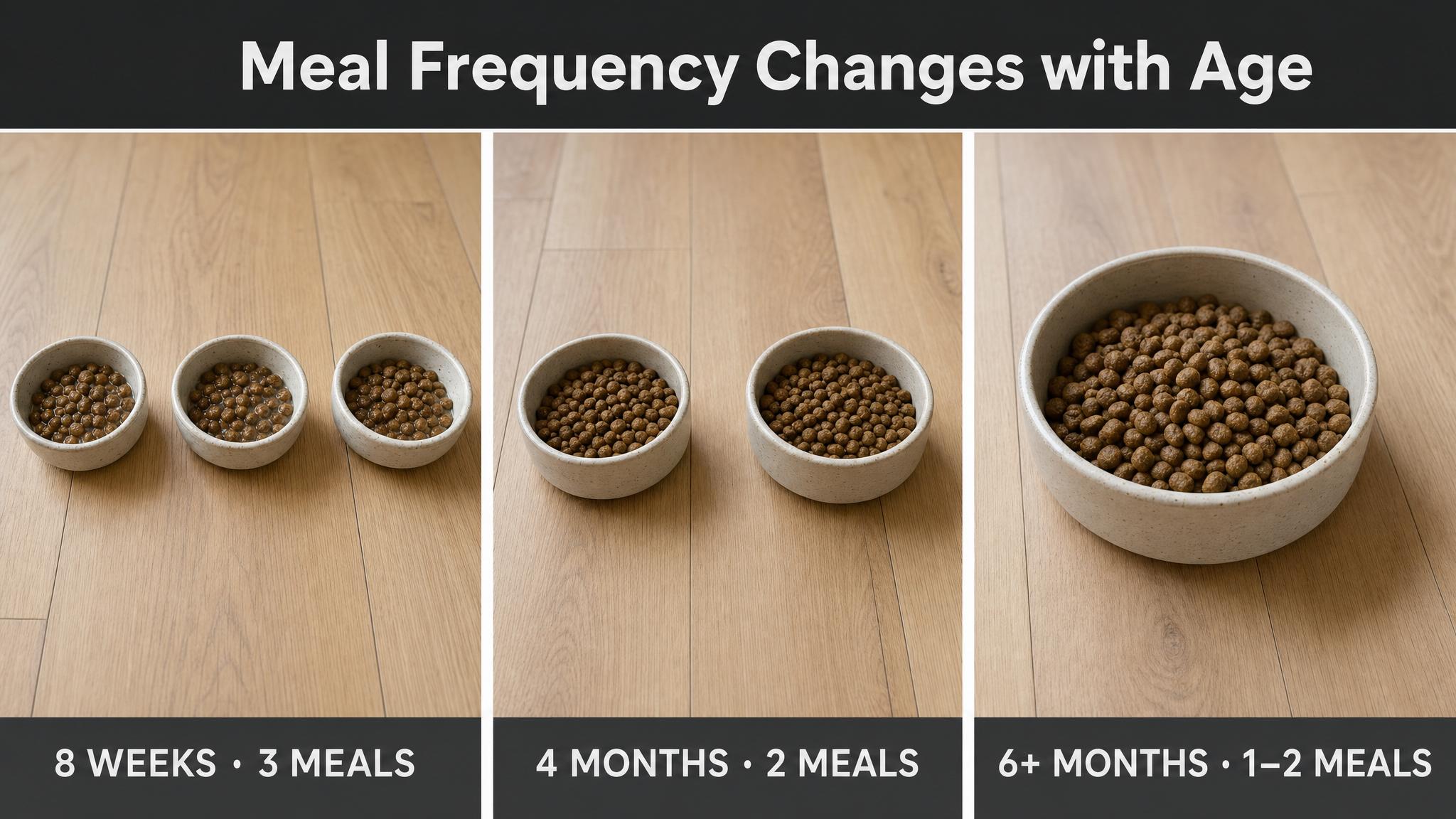

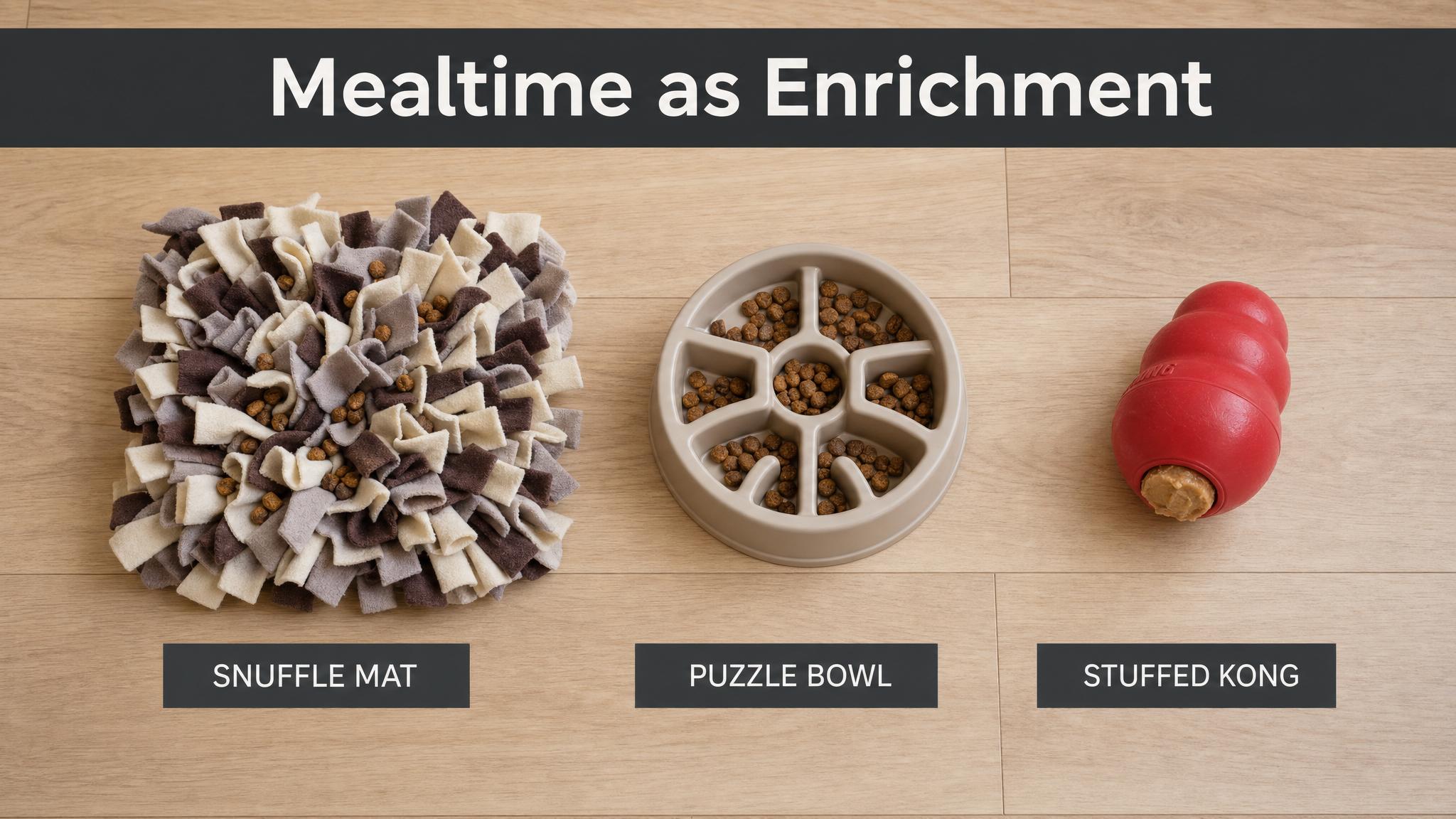
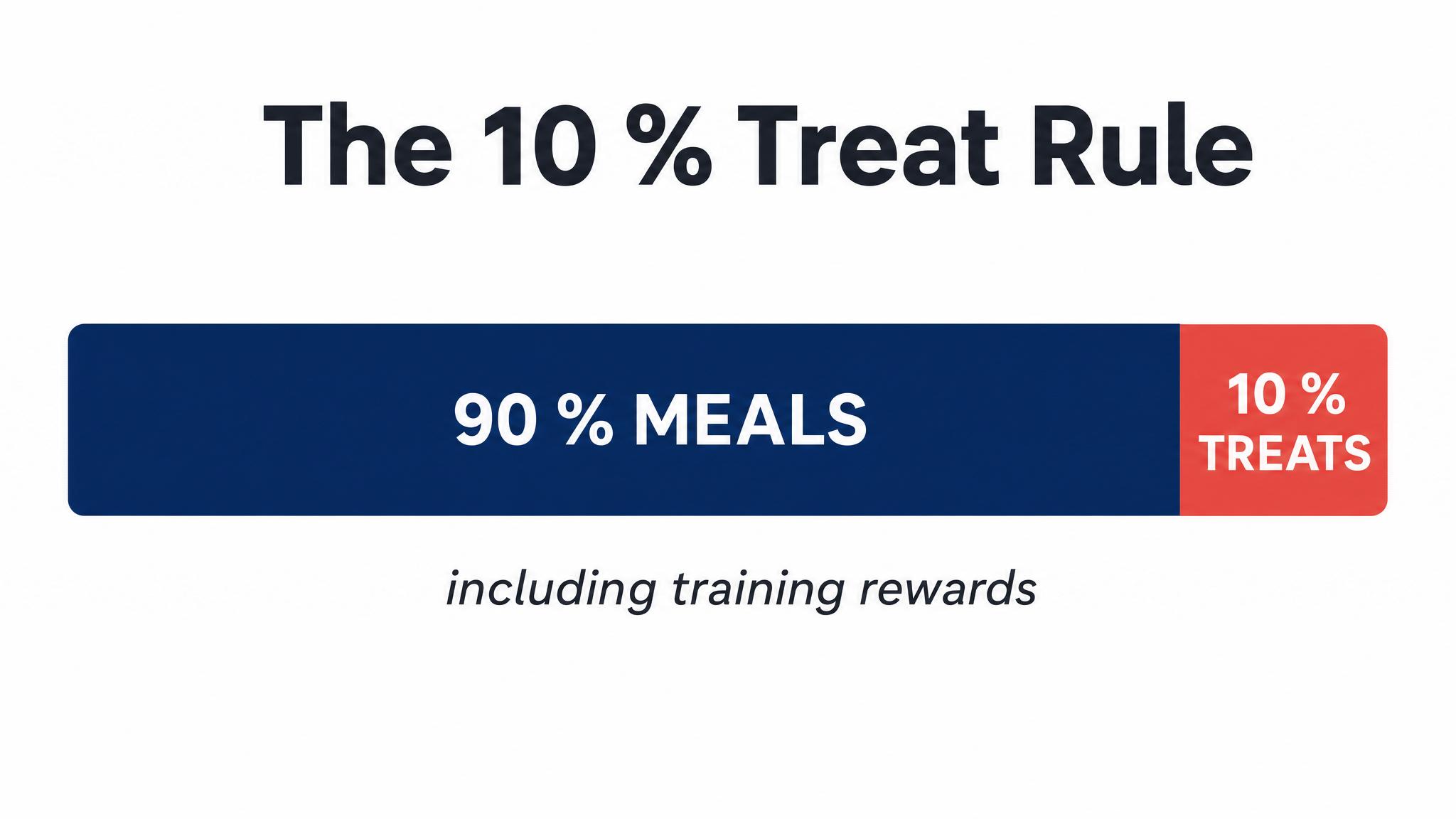

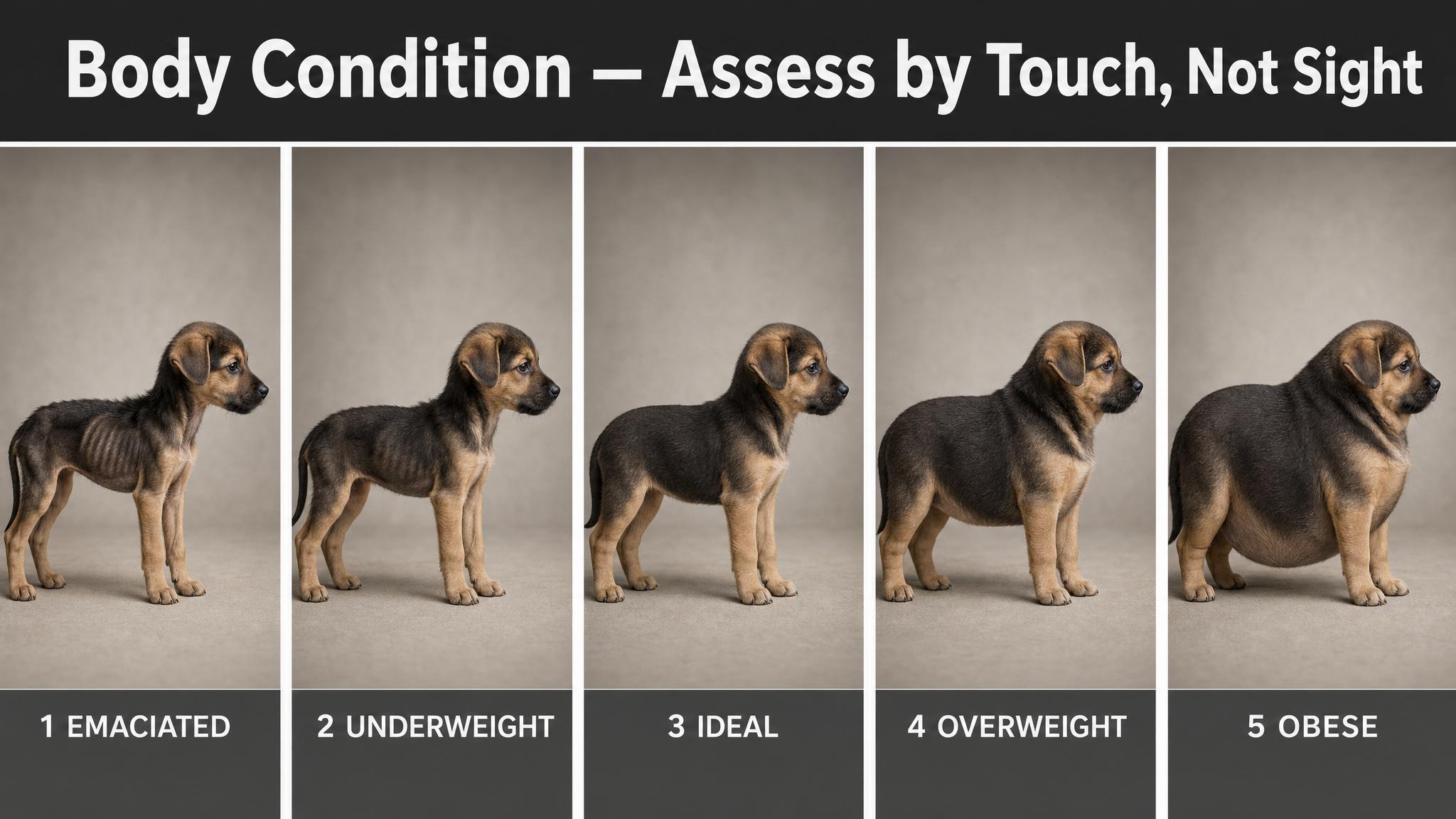
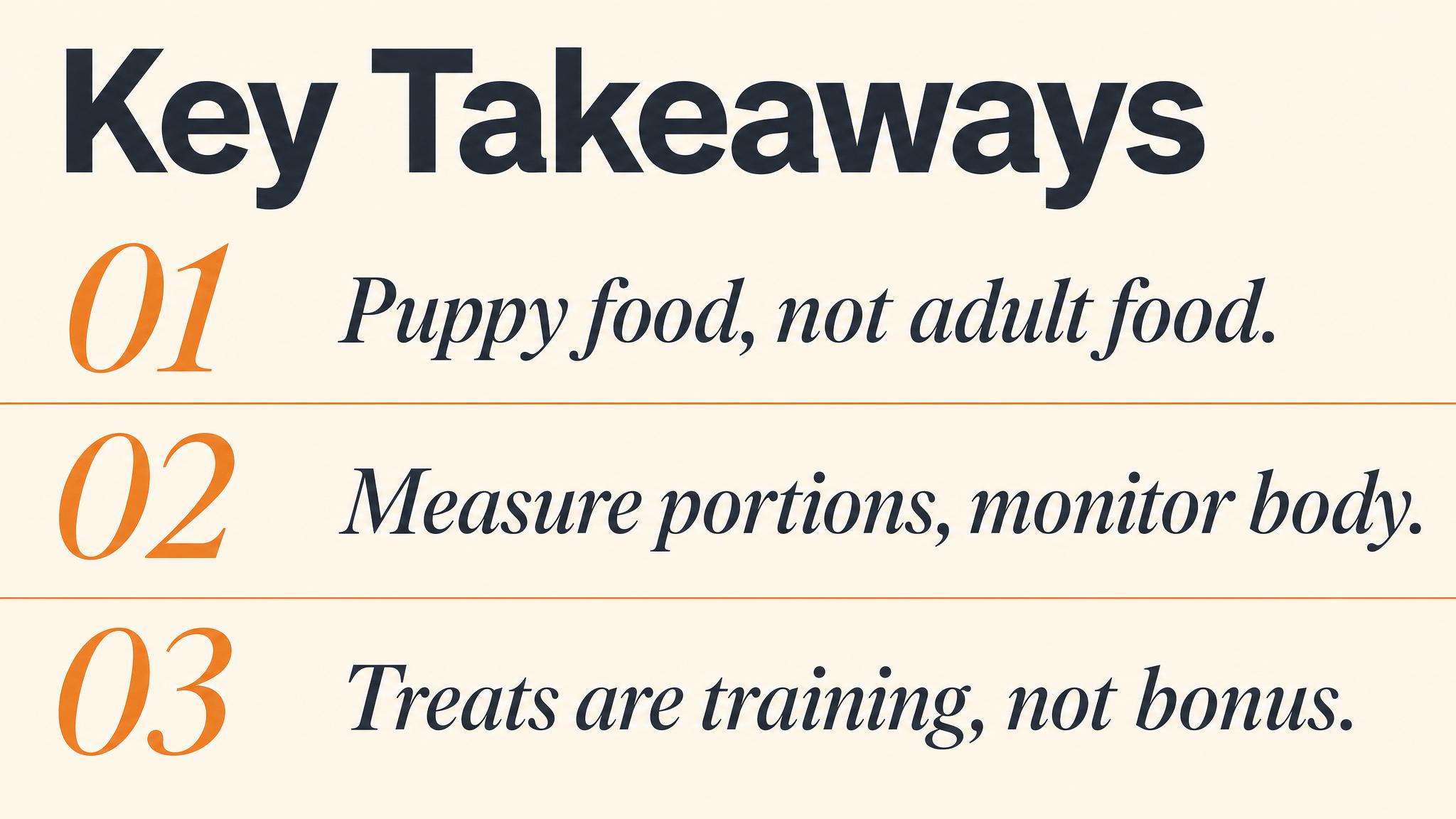
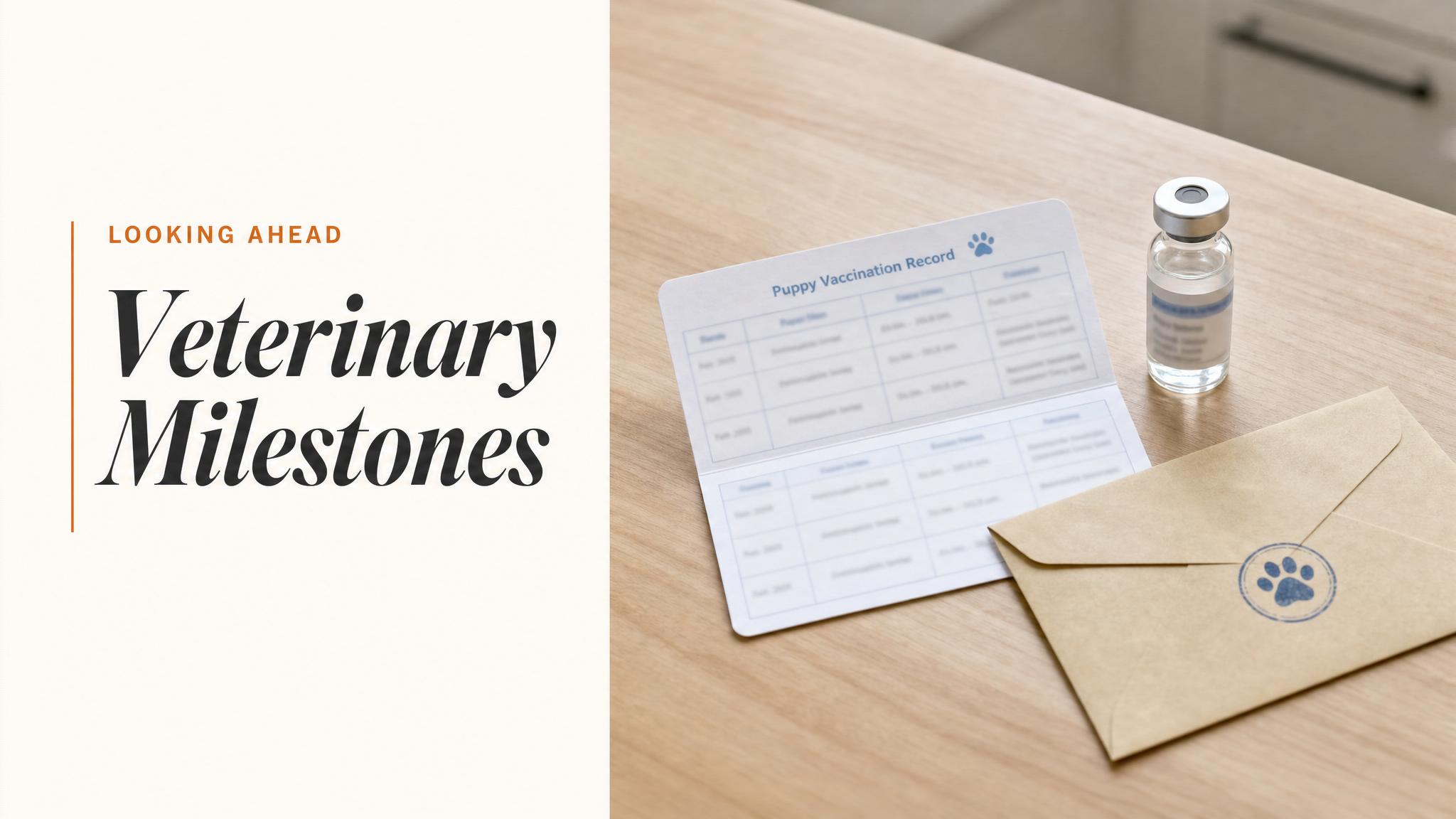
Veterinary Milestones — Your Puppy's Health Roadmap
Your puppy's veterinary journey is not just a series of needle pokes — it's one of the most important socialisation and training opportunities you'll have. This chapter provides a comprehensive health roadmap for the…
Would you rather keep your puppy in a bubble until they're fully vaccinated, or risk disease exposure to hit that critical socialization window?
Would you rather
Hot take: Desexing at 6 months is too early for large breed dogs. Agree or disagree?
Hot take
Real talk: Have you ever 'forgotten' to mention to a vet that you definitely didn't give your pet that monthly parasite prevention?
Real talk
Which is worse: A dog who needs sedation for every vet visit because they're terrified, or a dog with chronic health issues because exams are impossible?
Which is worse
Quick poll: Puppy preschool before final vaccinations — responsible socialization or unnecessarily risky?
Quick poll
Do you think paralysis ticks are actually as common as vets make them sound, or is it just good marketing for preventatives?
Unpopular opinion?
The Immunity Gap Dilemma: Neighbour Debate
12-15 minutesPresent a realistic case: 'Bella is 10 weeks old, has had 2 vaccinations, and her owner desperately wants to take her to puppy preschool starting next week. The class starts before her final vaccination is due.' Students turn to their immediate neighbours (groups of 2-3) and must reach consensus: recommend waiting or attending with precautions? After 5 minutes, instructor polls the room by section (left/middle/right). Each section nominates one spokesperson to defend their position in 60 seconds. Instructor then reveals evidence-based guidance and discusses the socialization-immunity balance.
East Coast Parasite Prevention: Myth or Fact Showdown
10 minutesDisplay 6-8 statements about parasite prevention one at a time (e.g., 'Heartworm is only a concern in tropical areas,' 'Paralysis ticks die off in winter,' 'Monthly prevention is overkill in Brisbane'). Students stand if they think it's FACT, remain seated if MYTH. After each reveal, instructor shows the correct answer and asks 2-3 students who got it right to shout out WHY (creating a rapid-fire, competitive energy). Track which rows get the most correct and crown a 'Parasite Prevention Champion' section.
Desexing Decision Tree: Interactive Case Voting
15-18 minutesPresent a branching case study of 'Max,' a 5-month-old male Golden Retriever. At each decision point, students vote by raising coloured cards (provided at entry: RED = wait, GREEN = desex now, YELLOW = need more info). Instructor takes a visible count, then calls on students from each camp to justify their vote (30-45 seconds each). Reveal additional case information (e.g., owner's lifestyle, breed-specific research, behavioural concerns) and re-vote. Discuss how evidence and individual factors shift recommendations. Conclude with current Australian veterinary guidelines.
Cooperative Care: Live Demonstration with Volunteer Commentary
12-15 minutesInstructor (or vet tech guest) demonstrates cooperative care techniques using a stuffed dog or volunteer's calm dog. Key techniques: handling exercises, mock nail trim, ear check, muzzle desensitization. Throughout demonstration, pause at 4-5 moments and ask audience: 'What did you notice I just did?' Students shout out observations. Then ask a different student: 'WHY did I do that?' This creates rapid-fire Q&A. After demonstration, students turn to neighbors and spend 3 minutes discussing: 'What's ONE thing you'd tell a new puppy owner to practice at home daily?' Instructor cold-calls 5-6 students to share.
Vaccination Schedule Speed Quiz: Row Relay
8-10 minutesDivide lecture theatre into 6-8 vertical sections (by seating columns). Display a puppy's incomplete vaccination record with missing dates and vaccine types. Each section works as a team to correctly complete the schedule. Students quickly consult with those in their column (passing whispers up/down rows). After 3 minutes, each section holds up a paper with their answers (provided at seats or use phones to text answers to instructor's polling system). Project all answers anonymously, then reveal correct schedule. Section(s) with correct answer explain their reasoning. Discuss common errors and reinforce core/non-core vaccine distinctions.
Socialization Scenarios: Risk Assessment Lightning Round
10-12 minutesRapid-fire presentation of 8-10 socialization scenarios (e.g., 'Dog park at 12 weeks, dog beach at 14 weeks, puppy class on vet clinic floor at 11 weeks, visiting grandmother's vaccinated elderly dog'). For each, students use hand signals: thumbs UP (recommend), thumbs DOWN (avoid), thumbs SIDEWAYS (conditional/depends). Instructor scans room and calls on students with different responses to defend their risk assessment (15-20 seconds each). After each scenario, provide evidence-based verdict and key considerations. Emphasize that socialization IS disease prevention—for behaviour.
Transcript
It's your puppy's second vaccination visit. As you walk through the clinic doors, your eight-week-old Labrador starts trembling, tail tucked, pulling backward on the lead. The waiting room smells of antiseptic and anxiety. Another dog is whimpering behind a door. Your puppy plants all four feet and refuses to move. The receptionist smiles sympathetically. "They all hate it here," she says.
But here's the thing: they don't have to. The puppy who learns to dread the vet at eight weeks will spend the next twelve to fifteen years being wrestled onto examination tables, muzzled for blood draws, and stressed to the point of immune suppression before every visit. The puppy who learns that the vet means cheese, gentle hands, and choices? That dog walks into the clinic with a wagging tail at age ten. This chapter gives you the roadmap, not just for what medical milestones your puppy needs, but for making every single one a positive experience that builds trust rather than fear.
[short pause]
The Immunity Gap: Why Timing Matters
Every puppy is born with a temporary shield. MATERNAL ANTIBODIES, immune proteins passed from the mother through colostrum in the first hours of life, provide passive protection against diseases the mother is immune to. This is a beautifully elegant biological system, but it has a catch: these antibodies don't last forever, and while they're circulating, they can neutralize vaccines before the puppy's own immune system has a chance to respond.
This creates what immunologists call the IMMUNITY GAP, a window, typically between six and sixteen weeks of age, when maternal antibodies have dropped too low to protect against disease but may still be high enough to interfere with vaccination. The exact timing varies between individual puppies, which is why your vet doesn't give a single "magic jab" but instead administers a series of vaccinations spaced two to four weeks apart.
[short pause]
Core Vaccines: The C-Three
In Australia, the core vaccination is the C-three vaccine, which protects against three potentially fatal diseases: canine distemper virus, canine adenovirus, or hepatitis, and canine parvovirus. The standard Australian protocol administers the C-three at approximately six to eight weeks, ten to twelve weeks, and sixteen weeks of age. That final sixteen-week dose is critical. It's the one most likely to produce a robust immune response after maternal antibodies have fully waned.
Here's where this connects directly to what you learned in Chapter Three about socialisation. The primary socialisation window closes at roughly twelve to fourteen weeks, before your puppy's vaccination series is complete. The American Veterinary Society of Animal Behavior, in 2008 and updated in 2014, addressed this tension head-on: behavioural problems are the number one cause of death in dogs under three years of age, and the risk of behavioural problems from inadequate socialisation outweighs the relatively small infection risk when appropriate precautions are taken. This means carrying your puppy to new environments, visiting vaccinated dogs in clean homes, and attending well-run puppy classes on sanitized floors, all before that final sixteen-week vaccine.
[short pause]
Take a moment to recall the socialisation strategies from Chapter Three. Given what you now know about the immunity gap, which socialisation activities carry the lowest disease risk during the eight to sixteen week period? Which carry the highest? How would you advise a new owner who says, "My vet told me to keep the puppy at home until all vaccinations are done"?
[short pause]
Non-Core Vaccines: Lifestyle Decisions
Beyond the C-three, your vet may recommend additional vaccinations based on your puppy's lifestyle and your region. Kennel cough, caused by Bordetella bronchiseptica and parainfluenza virus and covered by the C-five vaccine, is recommended for any puppy who will attend daycare, boarding, dog parks, or training classes, which, if you're following this course, means yours. Leptospirosis vaccination may be recommended in areas with high wildlife contact or flooding risk. These are conversations to have with your specific vet about your specific circumstances, not decisions to make from a textbook.
[short pause]
Parasite Prevention: An Australian Survival Guide
Australia's warm climate and diverse ecosystems mean your puppy faces a broader range of parasites than dogs in many other parts of the world. A comprehensive prevention plan covers four categories: intestinal worms, heartworm, fleas, and ticks.
[short pause]
Intestinal Worming
Puppies can be born with roundworm larvae inherited from their mother, which is why worming starts early and often. The standard Australian schedule is fortnightly worming from two weeks of age until twelve weeks, then monthly until six months, and then every three months for life. Your breeder should have started this process. Confirm what product was used and when the last dose was given at your first vet visit.
[short pause]
Heartworm Prevention
Heartworm disease, transmitted by mosquitoes, is present throughout most of Australia. Prevention should begin at twelve weeks of age, or as directed by your vet, and continue for life. Options include monthly chewable tablets, monthly spot-on treatments, or an annual injection called Proheart S-R-twelve that your vet can administer from twelve months of age. The annual injection removes the compliance problem. You can't forget a monthly dose if your vet administers it once a year.
[short pause]
Fleas
Flea prevention typically begins at eight weeks of age, depending on the product. Modern flea preventatives, isoxazoline-class products like fluralaner and afoxolaner, are highly effective and often combined with tick prevention in a single monthly or three-monthly chew. Your vet will recommend a product appropriate for your puppy's age and weight.
[short pause]
The Paralysis Tick: East Coast Australia's Deadly Threat
If you live anywhere along Australia's eastern seaboard, from North Queensland to northern Victoria, you need to understand Ixodes holocyclus, the AUSTRALIAN PARALYSIS TICK. This is not a nuisance parasite. It is a potential killer. Approximately ten thousand companion animals are affected by tick paralysis annually in Australia, according to a P-M-C review in 2014, and unlike paralysis ticks found elsewhere in the world, removing an I. holocyclus tick does not immediately reverse the paralysis. Animals can continue to deteriorate and die even after the tick has been removed.
The tick produces a potent neurotoxin called holocyclotoxin that causes rapidly ascending flaccid paralysis, as described in the P-M-C review in 2014. This means symptoms typically begin in the hind legs and move forward. Early signs include a change in bark or voice, wobbliness in the back legs, vomiting or retching, and laboured breathing. If you notice any of these signs, especially during the warmer months from September to March, and especially if you live near bushland, this is a veterinary emergency. Do not wait to see if it gets better.
Prevention is critical. Tick preventative products registered in Australia include isoxazoline-class treatments that provide one to three months of protection, as Roeber and Webster described in 2021. Longer-duration products improve owner compliance, which matters because a single missed dose during peak tick season can be fatal. However, no preventative is one hundred percent effective, so daily tick searches remain essential. Run your fingers through your puppy's entire coat every evening, paying special attention to the head, ears, neck, chest, and between the toes.
[short pause]
Consider this scenario: You're visiting friends on the New South Wales Central Coast in November. Your puppy seems fine in the morning, but by afternoon, she's wobbly on her back legs and her bark sounds strange. She had her tick prevention chew two weeks ago. What should you do, and why shouldn't you simply "wait and see"?
[short pause]
The Desexing Decision: A Framework, Not a Prescription
Few topics in companion animal care generate more heated debate than the timing of desexing, or spaying or neutering. The reality is that this is a nuanced, individual decision that depends on your dog's breed, size, sex, your living situation, and your local council requirements. Let's walk through the evidence so you can have an informed conversation with your vet.
[short pause]
What the Research Shows
The landmark study by Torres de la Riva and colleagues in 2013 examined seven hundred and fifty-nine Golden Retrievers and found that males neutered before twelve months had double the rate of hip dysplasia, ten percent versus five percent in intact males, and three times the rate of lymphosarcoma. No intact dogs in the study developed cranial cruciate ligament tears, while five percent of early-neutered males and eight percent of early-neutered females did.
Research by Hart and colleagues in 2020 expanded this research across thirty-five breeds and found something crucial: the effects of neutering timing vary dramatically by breed and size. Large breeds showed two to four times increased risk of joint disorders when neutered before one year, particularly before six months. Small dog breeds, however, showed little vulnerability to early neutering. This means a blanket "desex at six months" policy fails to account for the biology of different dogs.
A comprehensive review by Salmeri and colleagues in 2019 emphasized that the evidence for health benefits of desexing is stronger in females than males, primarily through the significant reduction in mammary cancer and elimination of pyometra risk, but noted that most existing studies are observational rather than randomized trials, meaning we're dealing with correlations, not definitive causal proof.
[short pause]
Your Decision Framework
Rather than telling you what to decide, here's how to decide:
First, check your local council requirements. Australian states and territories have different regulations. Some require desexing by a certain age unless you hold a breeder's permit. Non-compliance can mean significant fines. Research your specific council's rules.
Second, consider your dog's breed and size. For small breeds under fifteen kilograms adult weight, early desexing appears to carry minimal health risk, according to Hart and colleagues in 2020. For large and giant breeds, discuss delayed desexing, after twelve to eighteen months, with your vet to allow full musculoskeletal development.
Third, consider your dog's sex. For females, the benefit of spaying before the first or second heat cycle in terms of mammary cancer risk reduction is well-established. For males, the health picture is more complex.
Fourth, assess your management capacity. Can you reliably prevent unwanted mating? An unspayed female in heat requires careful management for approximately three weeks, twice a year. An intact male who detects a nearby female in heat may become an escape artist.
Finally, talk to your vet about your specific dog. A good vet will not give you a one-size-fits-all answer. They'll consider your dog's breed, size, sex, and your circumstances to recommend a timeline.
[short pause]
Think about this: You have a male Golden Retriever puppy and your council requires desexing by six months unless you obtain an exemption. Based on the Torres de la Riva and colleagues research in 2013, what conversation might you have with your vet? What would you need to apply for the exemption?
[short pause]
Making Vet Visits Positive: Cooperative Care
Here's where everything you've learned in this course converges. The counter-conditioning principles from Chapter Three, the desensitization protocols from Chapter Five, and the body language skills from Chapter Four, they all come together in the vet clinic. Because a puppy who learns that strange hands, bright lights, cold tables, and needle pokes predict wonderful things is a puppy who will be easier to treat, more accurately diagnosed, and less stressed for life.
[short pause]
What Is Cooperative Care?
COOPERATIVE CARE is the practice of training animals to be active, willing participants in their own handling and husbandry procedures, rather than merely tolerating them through force or restraint, as Jones described in 2018. The core principle is giving your puppy choice and agency, the ability to opt in or opt out of a procedure through trained consent behaviors.
A simple example: instead of grabbing your puppy's paw for nail trimming, you teach a "chin rest" behavior where your puppy voluntarily rests their chin on your hand. Chin down equals I consent, proceed. Chin lifts equals I need a break. This isn't permissiveness. It's a training strategy that builds trust and ultimately makes procedures faster and less stressful for everyone involved.
Research by Stellato and colleagues in 2022 confirmed that veterinary examinations are physiologically stressful for dogs, showing increased heart rate and decreased heart rate variability. Their pilot study of forty dogs found that while cooperative care training showed promise, the transfer of trained skills to the actual veterinary setting was challenging, meaning you need to practice at home and at the clinic. Simply doing chin rests in your living room isn't enough. You need to generalize the skills to the real environment.
[short pause]
Building Positive Vet Experiences: A Protocol
Start before your puppy ever needs a medical procedure:
First, happy visits. Take your puppy to the vet clinic just to get treats from the receptionist, sit on the scale, and leave. No examination, no needles, just cheese and departure. Aim for three to five happy visits before the first real appointment.
Second, handle at home daily. Practice looking in ears, lifting lips to examine teeth, touching paws, gently squeezing toes, lifting the tail, palpating the belly, and running your hands over every part of the body. Pair each touch with a high-value treat.
Third, surface training. Vet tables are cold, slippery, and elevated. Practice having your puppy stand on different surfaces, a rubber mat on a table, a raised platform, a wobble board, while receiving treats.
Fourth, restraint desensitization. Gradually teach your puppy that being gently held still predicts good things. Start with a one-second light hold, treat, release. Build duration slowly over weeks.
Fifth, consent cues. Teach a chin rest or a stationing behavior, standing still on a mat, that your puppy can use to signal willingness to proceed.
[short pause]
Reading Stress at the Vet
Revisiting the body language skills from Chapter Four, here are the specific signals to watch for in the clinic context. A puppy who is coping will show a loose body, soft eyes, willingness to take treats, and an ability to respond to known cues. A puppy who is struggling will display stress signals: lip licking, yawning, whale eye, or showing the whites of the eyes, panting when not hot, trembling, refusing treats, attempting to flee, tucked tail, or a frozen, rigid posture. If your puppy stops taking treats, that's your most reliable indicator that stress has exceeded their coping threshold.
When you see these signals, advocate for your puppy. Ask the vet to pause. Use your consent cue to give your puppy a choice. Break the procedure into smaller steps if possible. A good fear-free or low-stress veterinary practice will welcome this approach. If yours doesn't, consider finding one that does.
[short pause]
When to Worry: Knowing What's Normal
New puppy owners oscillate between two extremes: panicking over every sneeze, or dangerously assuming that a serious symptom will "sort itself out." Neither serves your puppy. What you need is a decision framework, a way to triage symptoms into categories so you know when to call the emergency vet at two A M and when a routine appointment on Monday will do.
Pay special attention to the symptoms that could indicate tick paralysis. If you're in the east coast tick zone, these are the ones that can kill in hours.
[short pause]
Putting It All Together
Your puppy's veterinary journey is not a series of isolated events. It's a continuous thread running through their entire first year and beyond. Every vet visit is simultaneously a medical event and a training opportunity. The puppy who receives their sixteen-week vaccination while doing a chin rest on the table, getting liver paste from a squeeze tube, is learning something profoundly different from the puppy who is pinned down while they thrash and scream.
Both puppies receive the same immune protection. But the first puppy is also building a foundation of trust, resilience, and cooperative behavior that will make every future vet visit, every emergency, every dental check, every blood draw for the next decade, immeasurably easier for everyone involved. That's the power of combining medical knowledge with behavioral science. That's what evidence-based puppy raising looks like.
[short pause]
Key Takeaways
The immunity gap, from six to sixteen weeks, is when your puppy is most vulnerable. The three-dose C-three vaccination series is designed to bridge it, with the sixteen-week dose being the most critical.
Socialization during the immunity gap is essential. The A-V-S-A-B position is that the risk of behavioral problems from insufficient socialization outweighs the disease risk when appropriate precautions are taken.
In east coast Australia, paralysis tick, Ixodes holocyclus, prevention is non-negotiable. Learn the signs: changed bark, hind leg wobbliness, retching, and treat any suspicion as an emergency.
Desexing timing should be an individualized decision based on breed, size, sex, management capacity, and council requirements, not a one-size-fits-all policy.
Cooperative care, giving your puppy choice and agency in veterinary handling, builds lifelong trust and makes medical procedures safer, faster, and less stressful.
Learn to triage symptoms. Know the difference between a "monitor at home" situation, a "call the vet tomorrow" situation, and a "drive to emergency now" situation.
[short pause]
Looking Ahead
In Class Eight, we'll turn to one of the most common and misunderstood puppy behaviors: mouthing, biting, and play behavior. You'll learn why your puppy bites everything, including you, what constitutes normal versus concerning bite behavior, and evidence-based strategies for teaching bite inhibition, the single most important safety skill your dog will ever learn.
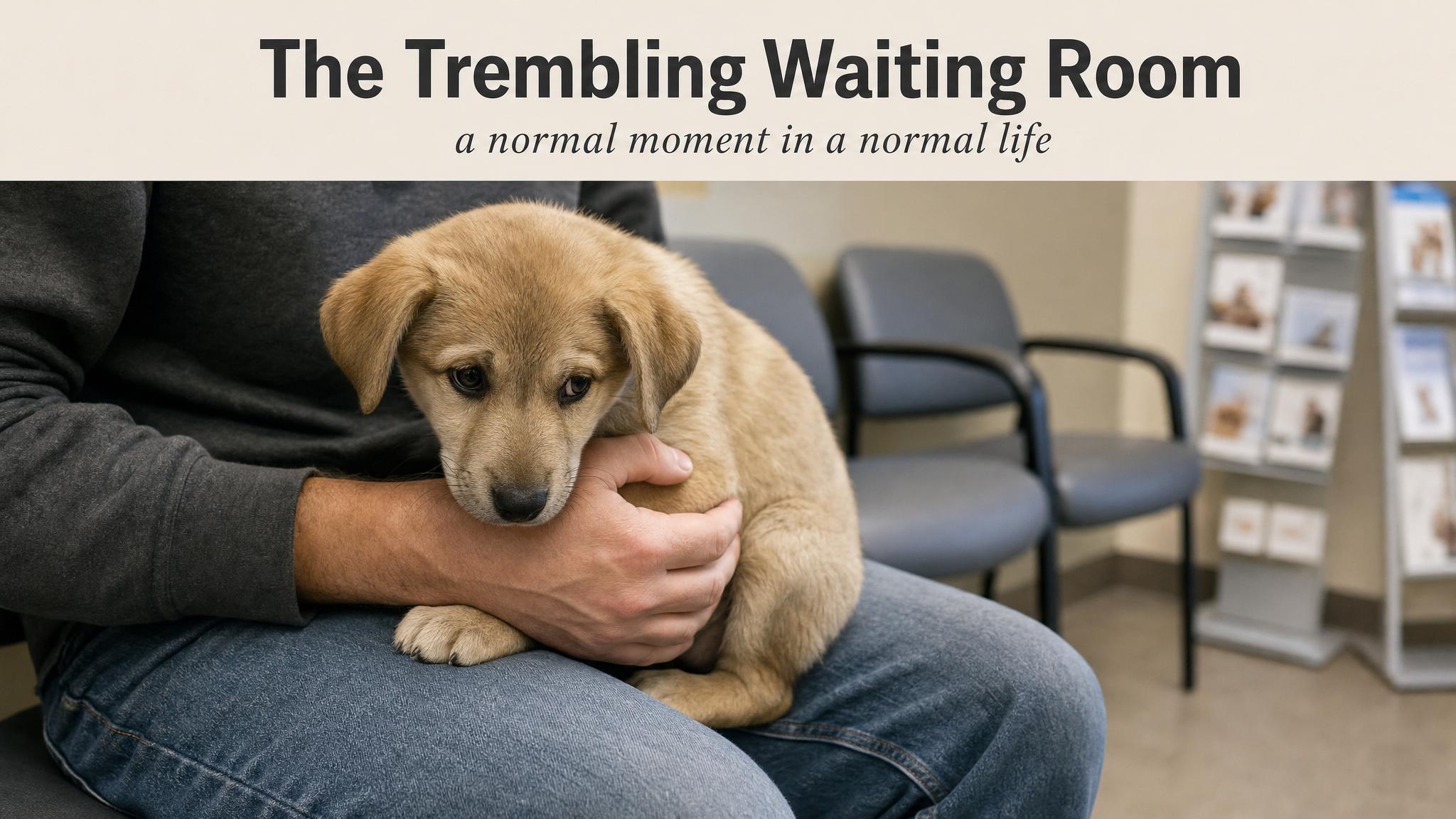
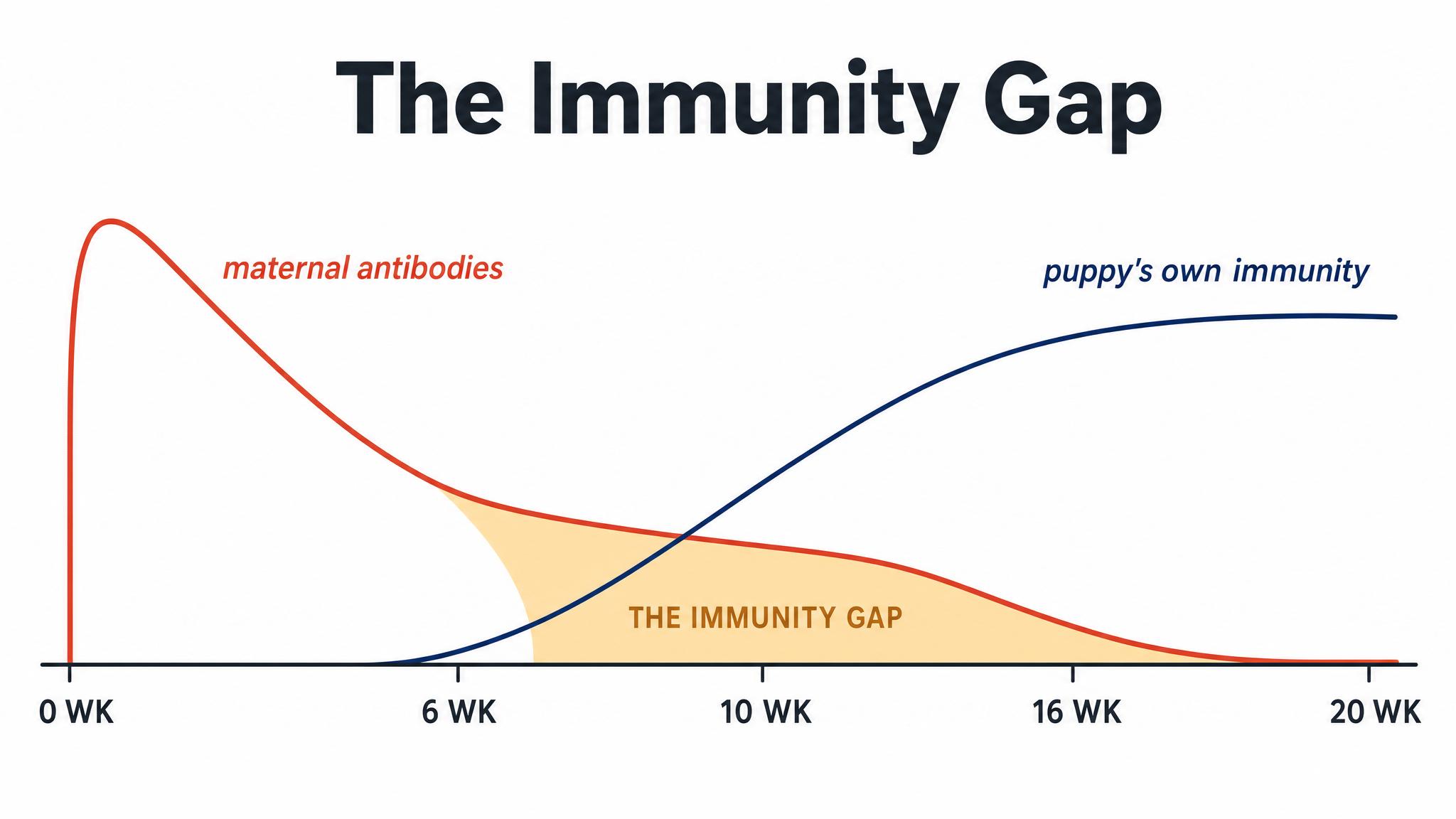
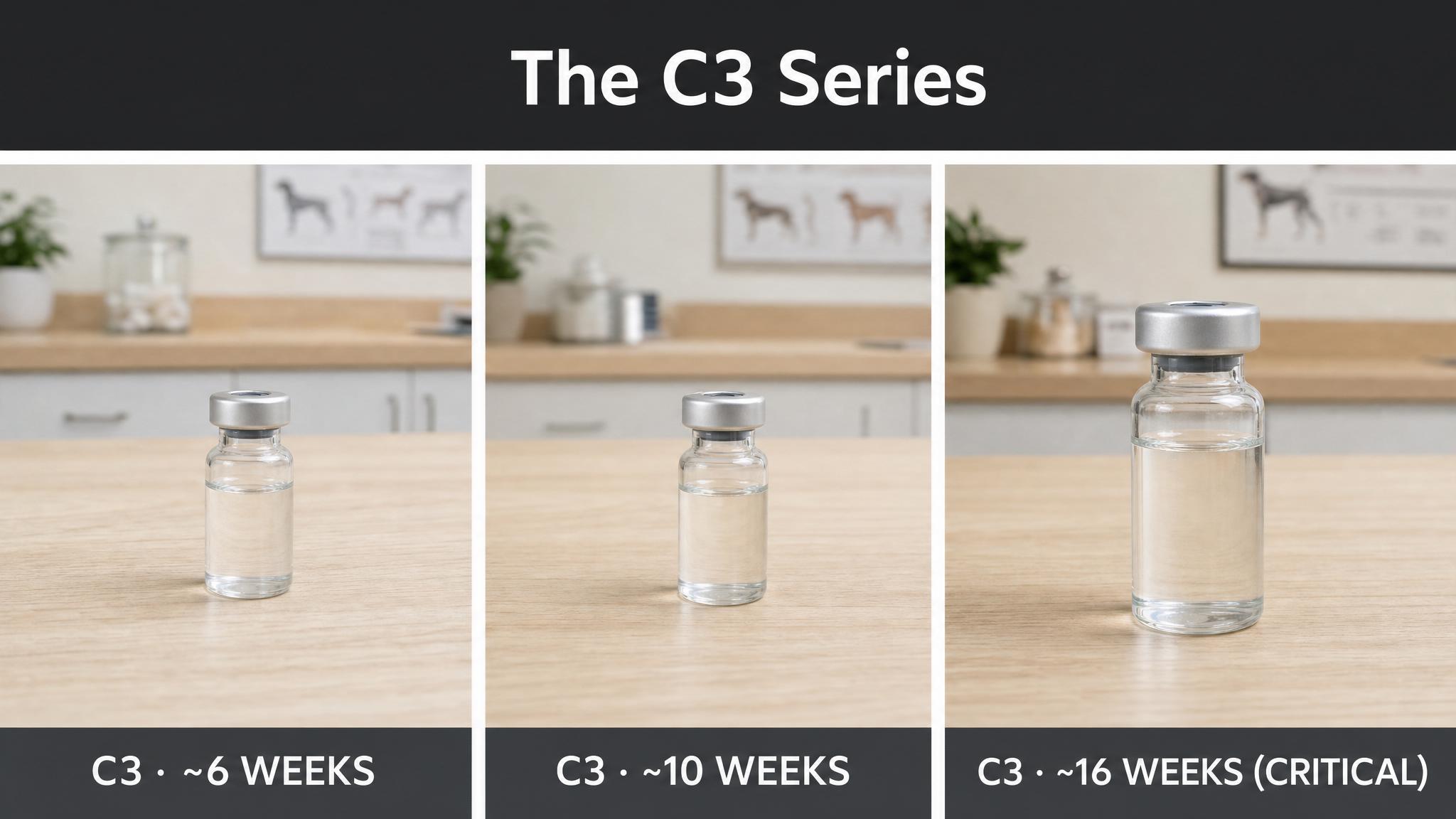
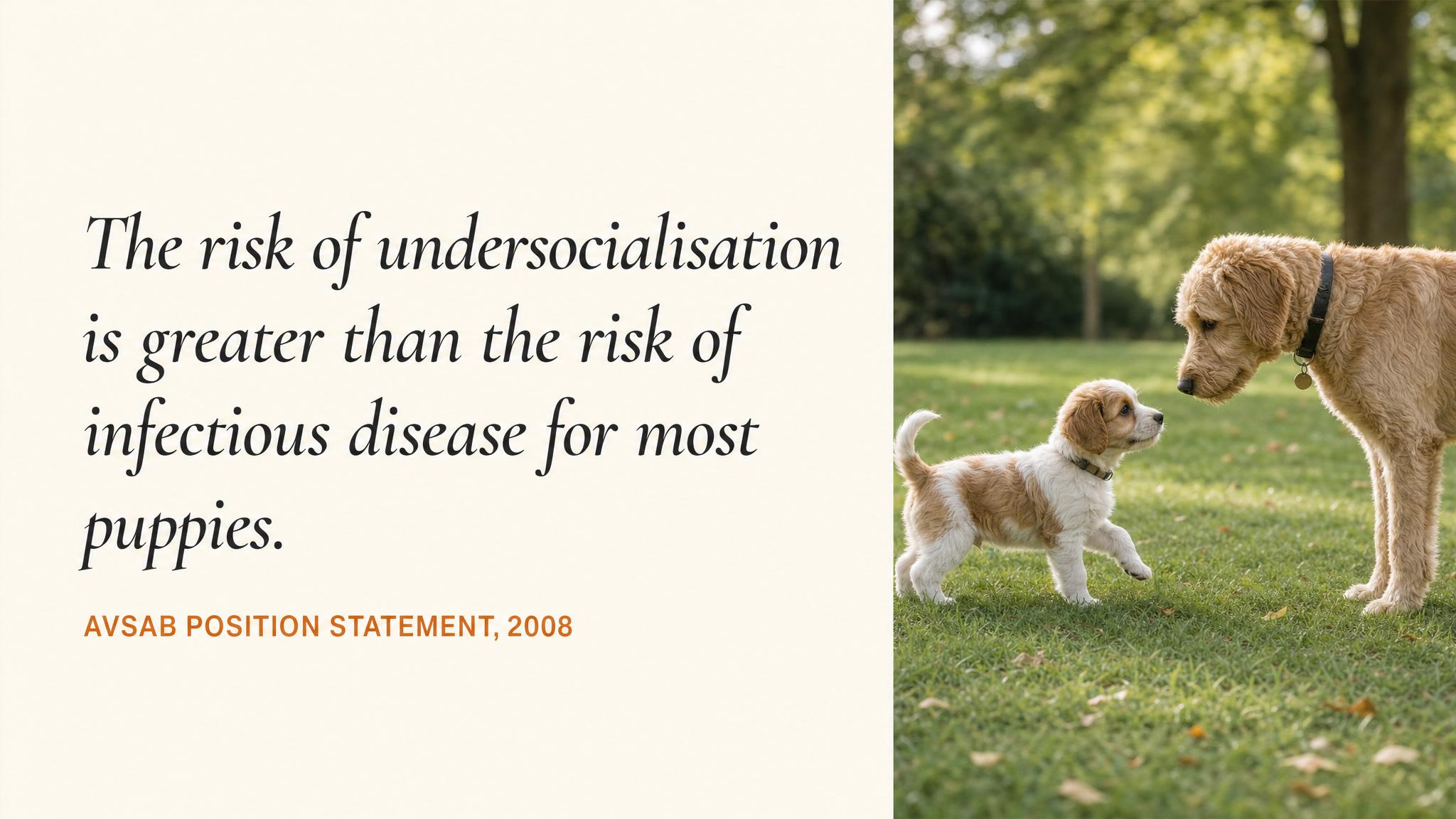
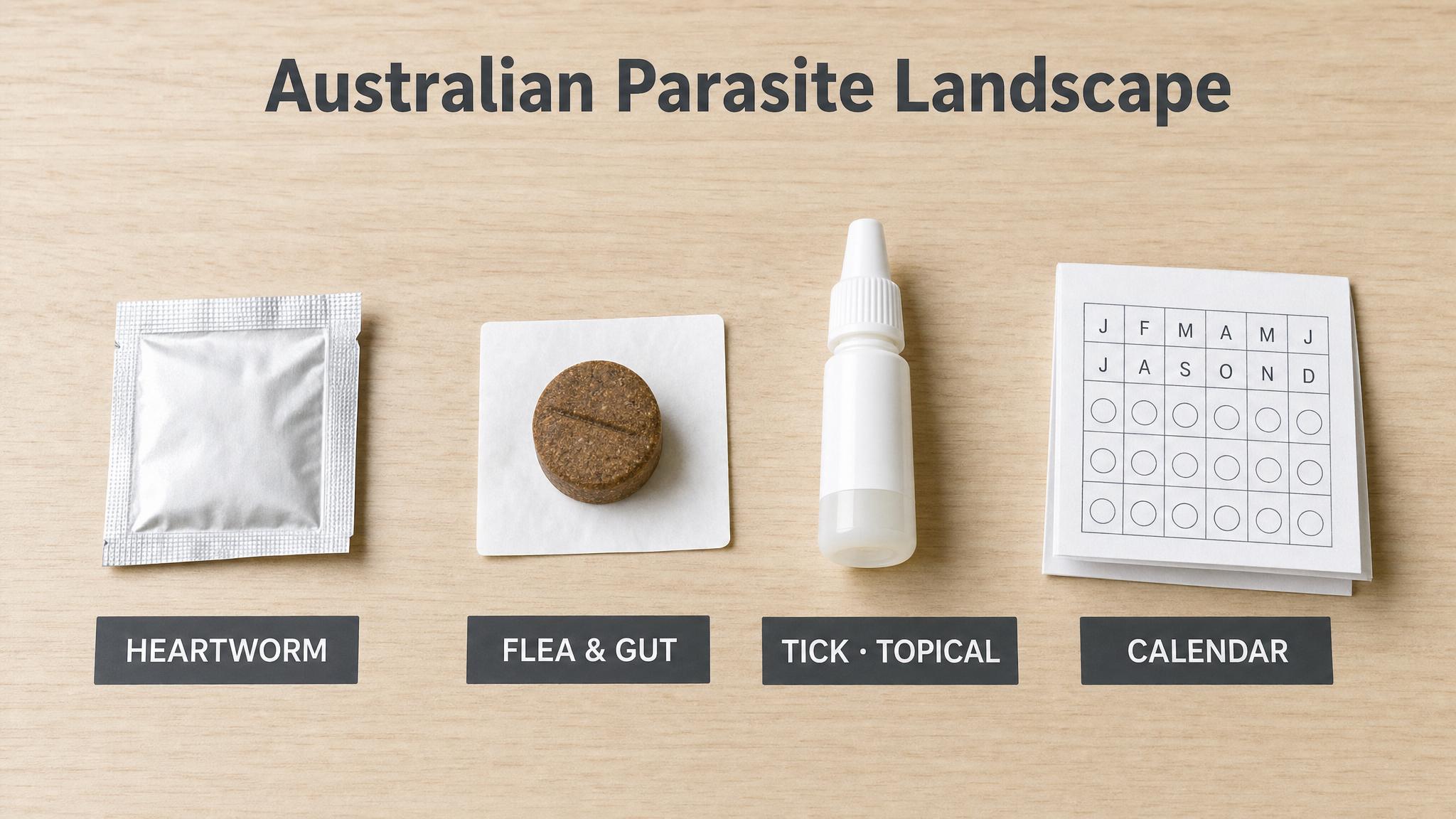
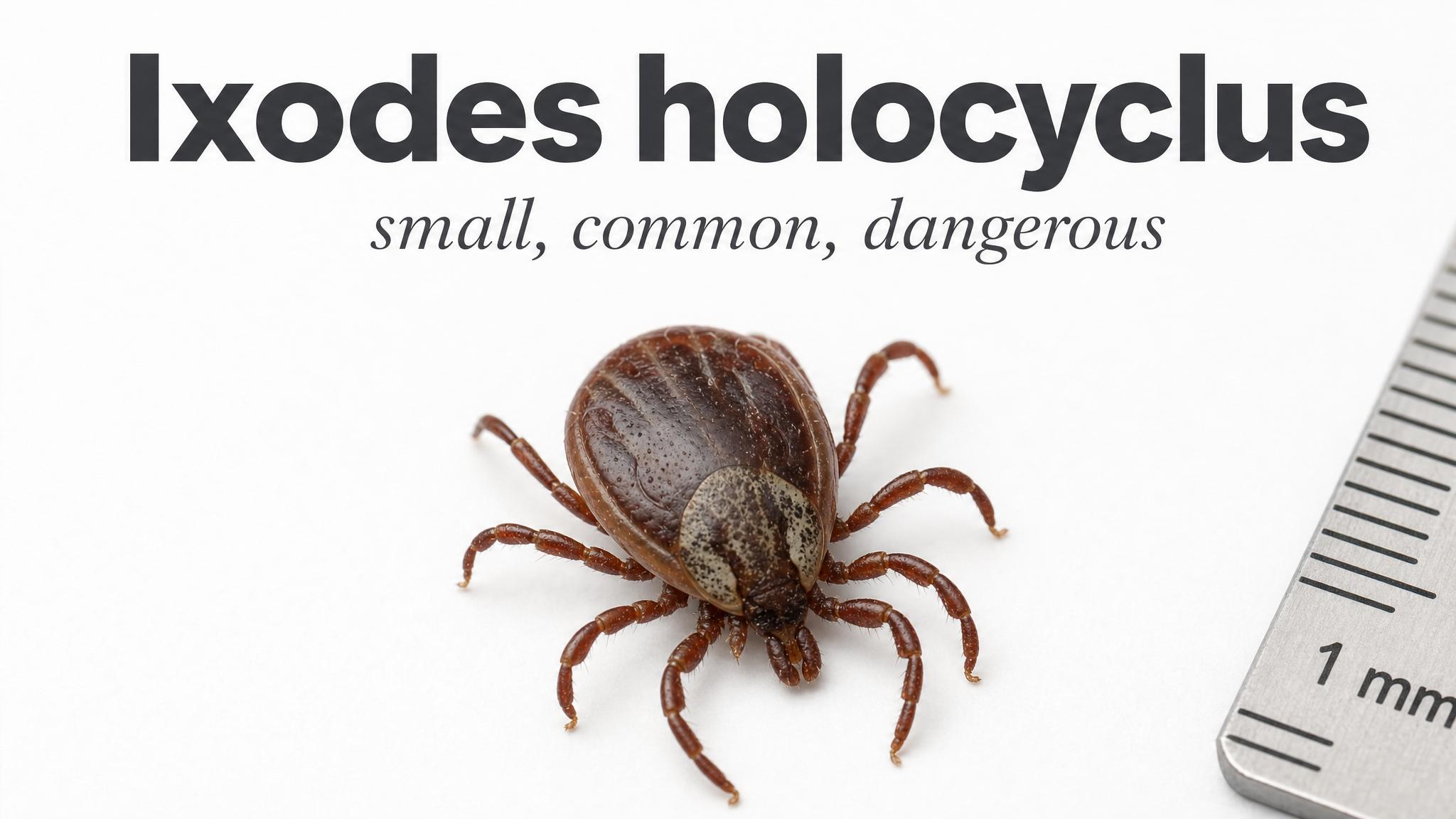
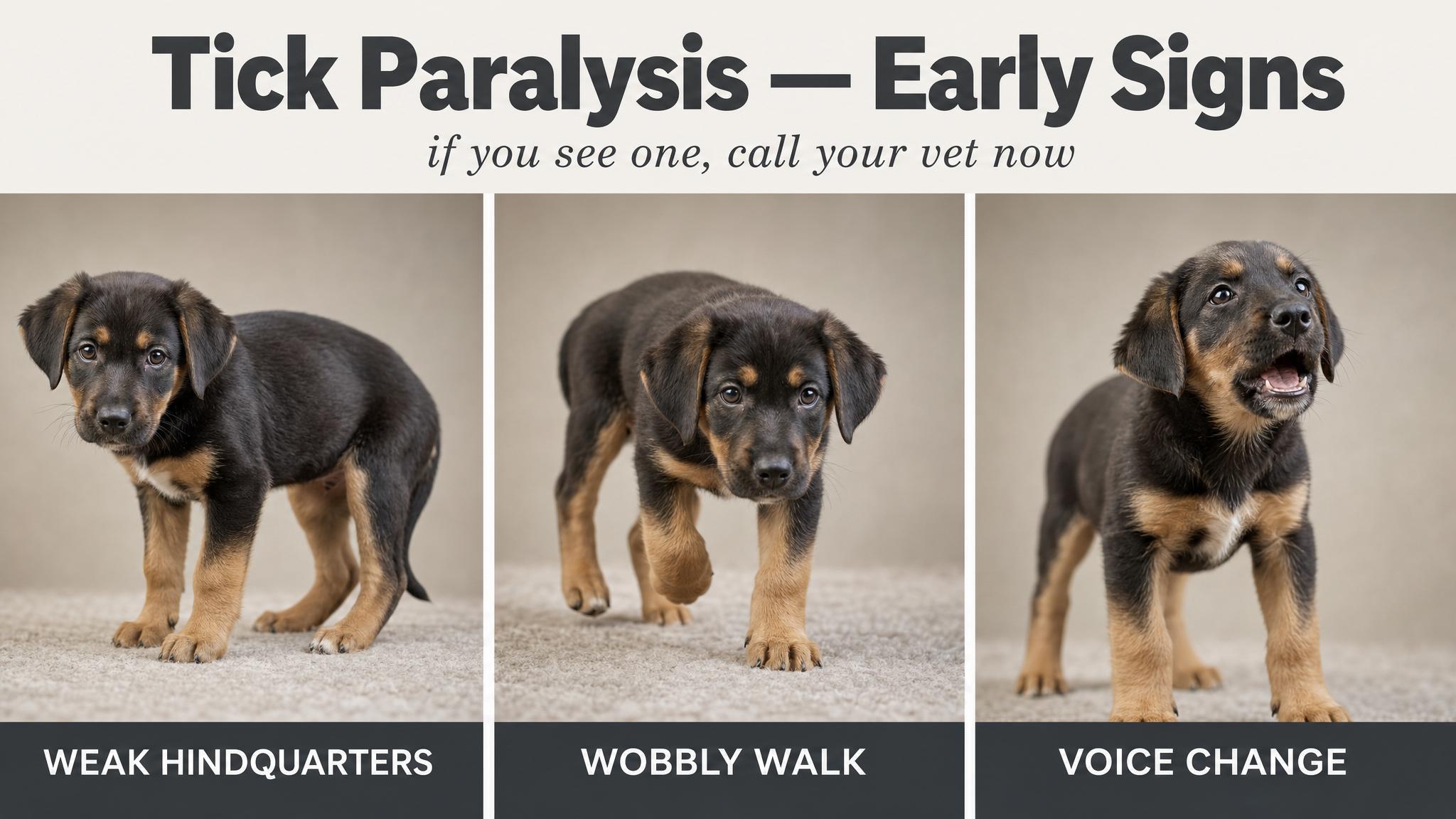
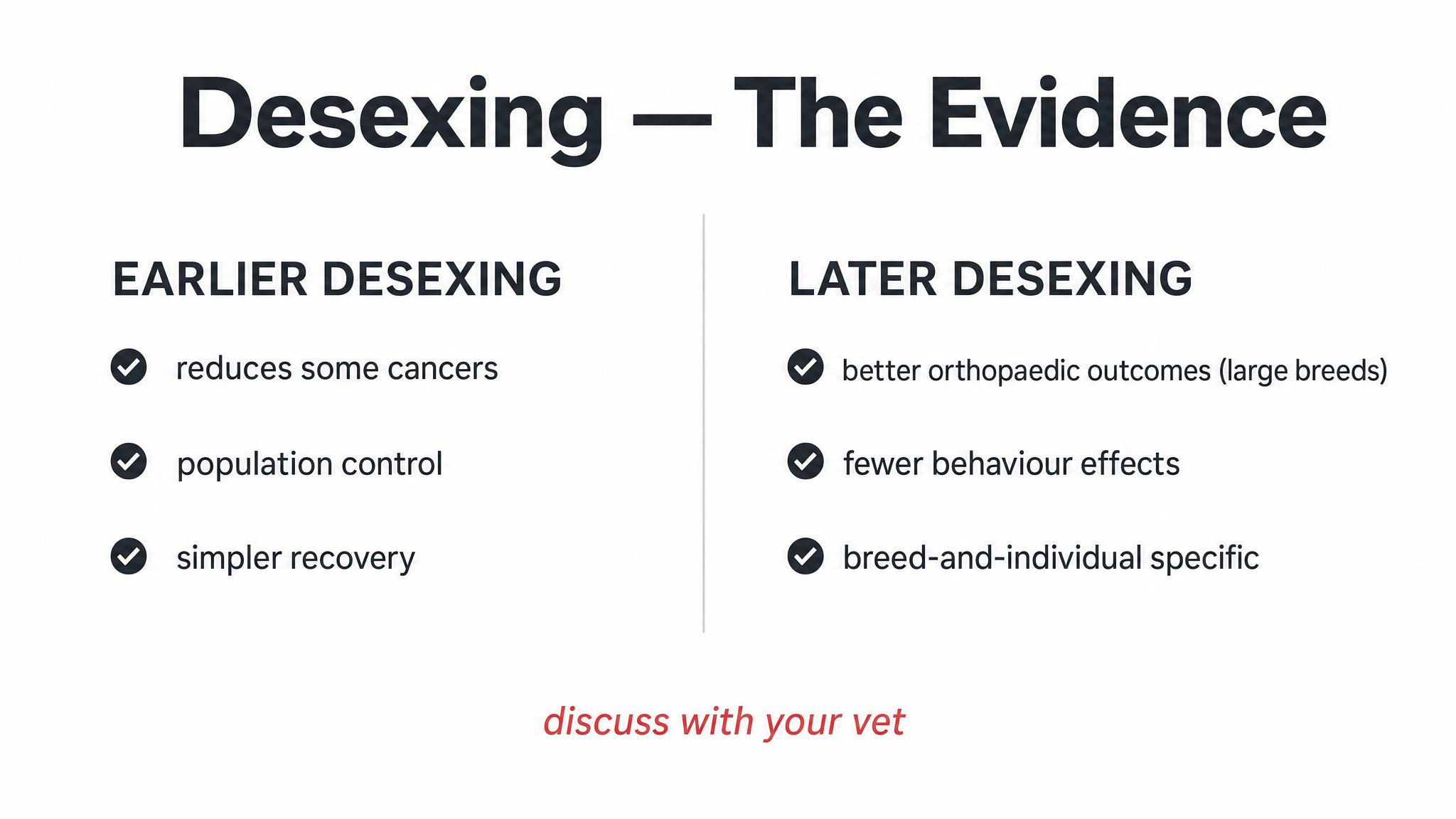
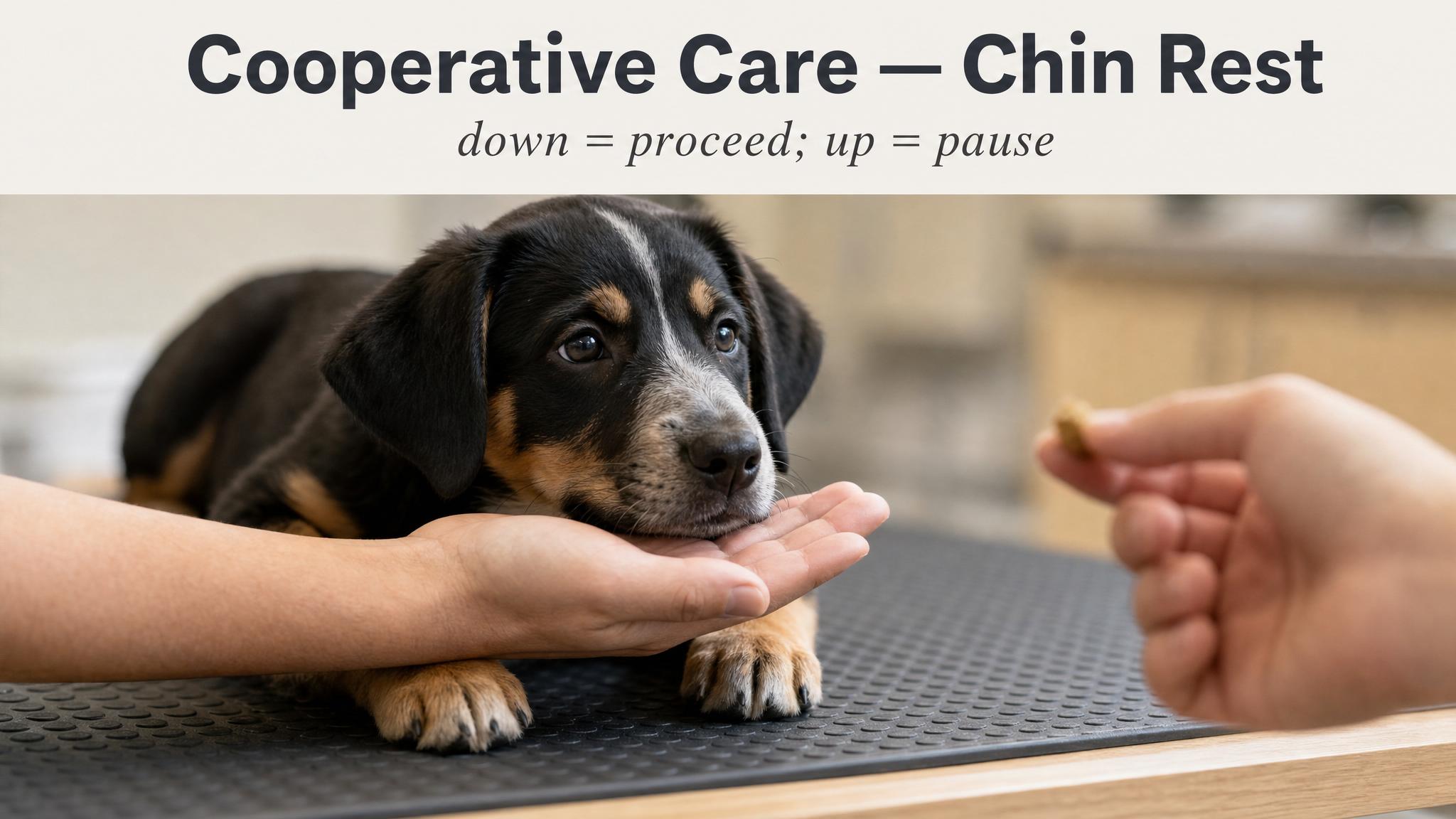
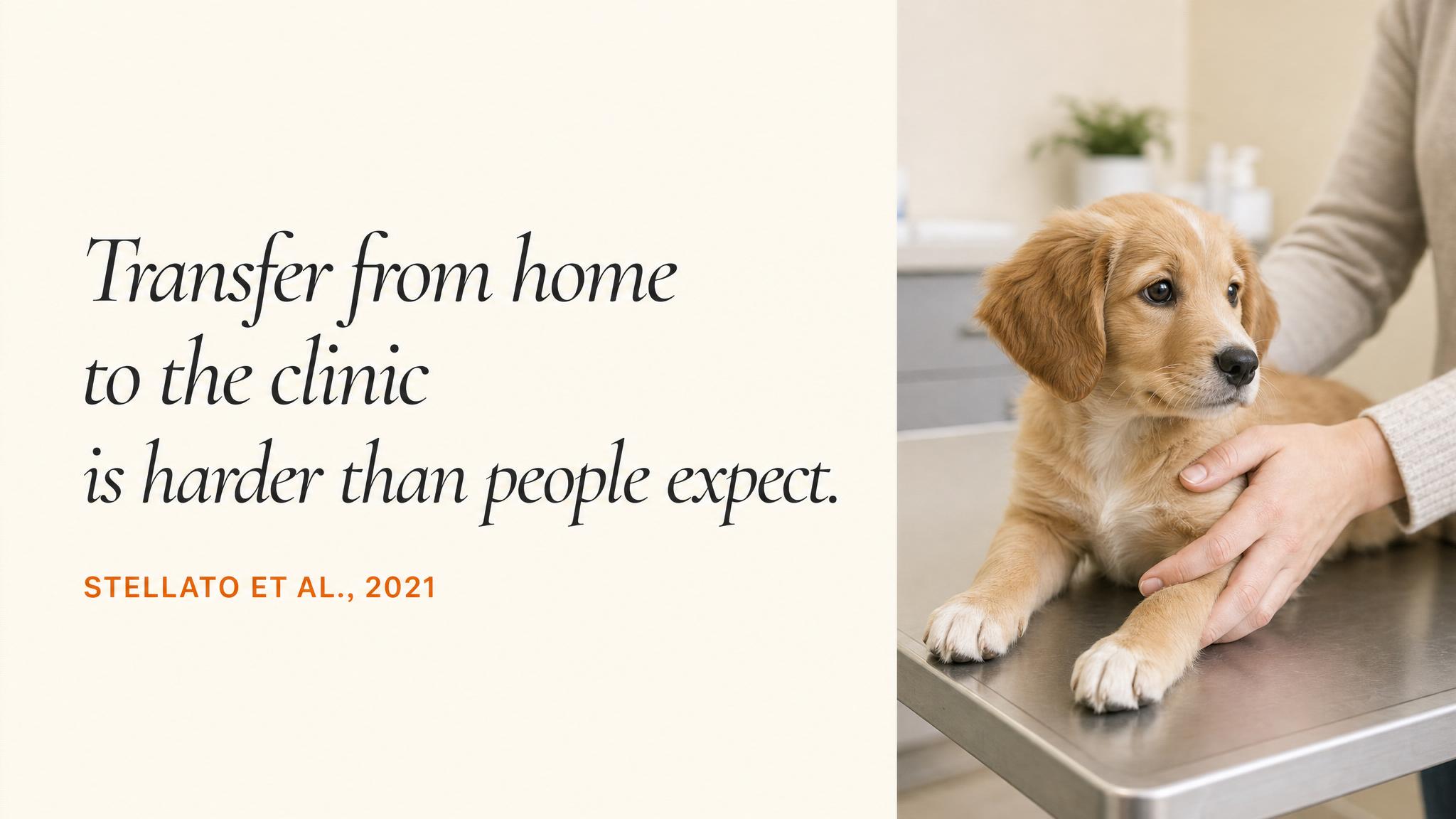
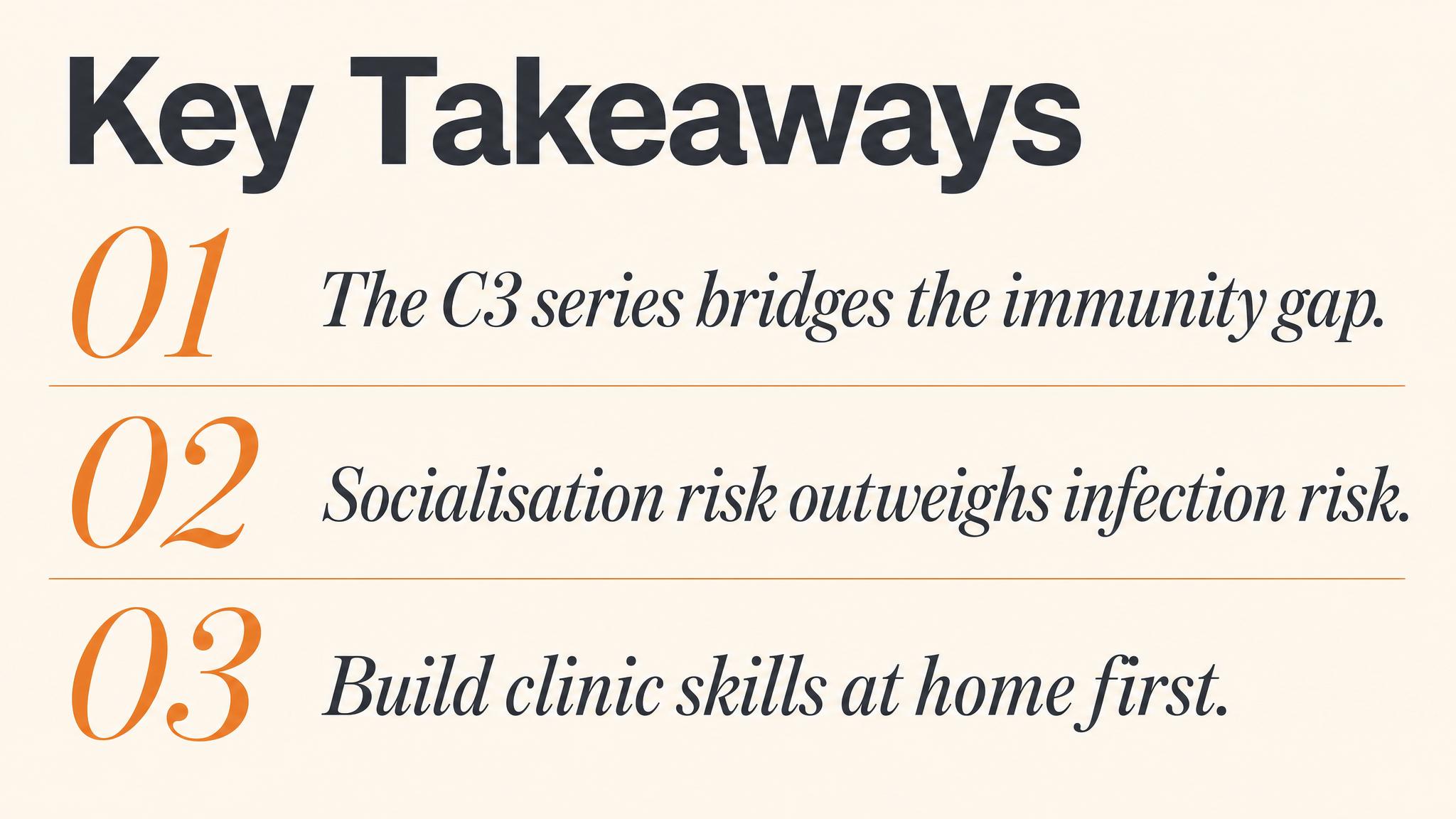
The Adolescent Dog — When Your Perfect Puppy Hits Puberty
Congratulations. You survived the needle teeth, the overnight toilet breaks, the socialisation spreadsheets, and the crate training ladder. Your puppy is reliably house trained, walks nicely on lead (mostly), and knows…
Is your teenage dog basically just karmic payback for how you acted as a 15-year-old?
Real talk
Would you rather: a dog who suddenly 'forgets' recall at the park, or one who starts barking at guests after months of being perfect?
Would you rather
Hot take: If your 8-month-old puppy acts like they've never met you before, sometimes the best training plan is just... survive until they're 2.
Hot take
Your perfectly trained puppy suddenly pulls on leash like a sled dog. Do you start over from scratch, double down on training, or just accept chaos?
Quick poll
Have you ever pretended your dog belongs to someone else when they're acting completely feral in public?
Unpopular opinion?
What's the most embarrassing thing your dog did RIGHT after you bragged about how well-trained they were?
Confession time
Regression Detective: Adolescent or Something Else?
12-15 minutesInstructor presents 5-6 short case scenarios (via slides). For each: Students first individually decide if the behavior is typical adolescent regression, a training gap, or a red flag needing professional help. Then turn to 1-2 neighbors and debate their answers (2 min per case). Instructor polls the room with a show of hands after each scenario and reveals the 'diagnosis' with brief explanation. Cases range from obvious (selective hearing on recall) to ambiguous (sudden reactivity to dogs).
The Adolescent Brain Map: What's Actually Happening Up There?
10-12 minutesInstructor displays a simplified brain diagram on screen. Students call out behaviors they've noticed during adolescence (e.g., 'forgot her name,' 'lunges at dogs,' 'counter surfing'). Instructor or volunteer maps each to brain regions/systems (prefrontal cortex development, impulse control, fear periods). Students then discuss with neighbors: Which ONE behavior in their own dog makes the most sense now? Share a few examples with whole class. Ends with brief instructor synthesis connecting neuroscience to patience and training strategies.
Training Under Pressure: The Foundational Skills Audit
15-18 minutesStudents receive a checklist of foundational skills (sit, stay, recall, loose leash walking, settle, leave it). Working with 1-2 neighbors, they: (1) Rate their dog's pre-adolescence vs. current performance for each skill (3 min), (2) Identify the TWO skills that have regressed most (2 min), (3) Brainstorm ONE specific way to reintroduce that skill with higher value/lower distraction (5 min), (4) Instructor facilitates whole-class share of creative solutions - creates a crowdsourced list on screen (5 min). Students photograph the list for reference.
The Patience Gauntlet: Confessions & Coping Strategies
10-12 minutesAnonymous rapid-fire activity. Instructor poses scenarios that test patience (e.g., 'Your dog poops in the house after 6 months of being house-trained,' 'Your dog ignores recall at the dog park for 10 minutes'). Students vote via hand raise or app on their honest reaction: (1) Stayed calm and problem-solved, (2) Frustrated but recovered, (3) Lost it completely. After each, neighbors share (30 seconds) one coping strategy they use. Instructor collects 4-5 best strategies from room and writes on screen. Ends with brief validation that frustration is normal and discussion of how stress affects training.
Red Flag or Rough Patch? The Professional Help Decision Tree
12-15 minutesInstructor presents a decision tree framework on screen (frequency, intensity, safety, duration of behavior). Students work through 3-4 complex scenarios with neighbors, using the framework to decide: Keep working on it, consult a trainer, or seek immediate professional help. Scenarios include: resource guarding that's escalating, fear of strangers that emerged at 8 months, leash reactivity that started suddenly, adolescent 'selective hearing.' After each scenario, poll the room and discuss the reasoning. Instructor highlights when multiple pathways are valid and emphasizes that seeking help is strength, not failure.
Success Story Speed Share: What Got Us Through
8-10 minutesStudents who've survived adolescence (or are currently in the thick of it) do a structured speed share with neighbors. Each person gets 60-90 seconds to share: (1) Their dog's worst adolescent moment, (2) ONE thing that helped them get through it (specific training technique, mindset shift, or support resource). After neighbor shares, instructor asks for 5-6 volunteers to share with whole class. Creates a 'survival strategies' verbal collage. Instructor synthesizes themes and connects to course concepts about patience and skill revision.
Transcript
It's a Tuesday evening. Your nine-month-old Labrador, the same dog who graduated puppy class with flying colours, who could hold a sit-stay while you answered the door, who hadn't had a toilet accident in four months, has just eaten half a couch cushion, ignored your recall so thoroughly that three strangers at the park gave you sympathetic looks, and peed on the kitchen floor while maintaining direct eye contact. You stand in your hallway, holding a soggy piece of foam, and think: What happened to my dog?
Nothing happened to your dog. Something happened inside your dog. Your puppy hit puberty. And just like the human version, canine adolescence is a neurologically distinct developmental phase that temporarily rewires the brain in ways that make previously reliable behaviour genuinely harder to produce. The good news? It's temporary, it's normal, and everything you've learned in this course has prepared you for exactly this moment.
[short pause]
The Adolescent Brain: What's Actually Happening in There
If your adolescent dog seems like a different animal, there's a neurobiological reason. Between roughly six and eighteen months of age, varying by breed with smaller breeds maturing earlier, the canine brain undergoes a period of dramatic reorganisation that mirrors, in surprising detail, what happens in human teenage brains.
Three key processes are at work. The first is SYNAPTIC PRUNING, the brain's "use it or lose it" editing process. During puppyhood, the brain overproduced neural connections. Now, during adolescence, connections that haven't been reinforced are eliminated while well-used pathways are strengthened and myelinated. This is why all that early training and socialisation from the earlier chapters matters so profoundly: you were literally building the neural architecture your dog needs to navigate this period.
The second process is a hormonal surge. Rising levels of testosterone, oestrogen, and other sex hormones don't just trigger physical maturation, they reshape brain circuitry. Hormones amplify activity in the AMYGDALA, the brain's threat-detection and emotional arousal centre, while the PREFRONTAL CORTEX, responsible for impulse control and decision-making, is still maturing. Cross-species neuroscience research confirms that this amygdala-prefrontal imbalance is a hallmark of adolescence across mammals, creating a period of heightened emotional reactivity and reduced self-regulation, as Tottenham and Galván found in 2016.
The third process is the temporary weakening of prefrontal cortex function. Your dog's ability to inhibit impulses, delay gratification, and make "good decisions" under arousal genuinely decreases during this period. When your adolescent dog "chooses" to chase a squirrel instead of responding to your recall, they aren't being defiant, their brain's braking system is literally under construction.
The adolescent dog brain: an overactive emotional centre paired with an underdeveloped impulse-control system creates a temporary period of reduced self-regulation.
[short pause]
The landmark study by Asher and colleagues in 2020 provided the first empirical evidence for adolescent-phase conflict behaviour in dogs. Their research demonstrated that dogs at eight months of age showed significantly reduced obedience to their caregivers, but crucially, not to strangers. This mirrors human teenage behaviour, where conflict is directed specifically at attachment figures. Dogs with insecure attachments to their caregivers showed even more pronounced disobedience during this phase. The study confirmed what dog trainers had long suspected: canine adolescence is real, measurable, and relationship-specific.
The Asher and colleagues finding that adolescent dogs were less obedient to their caregivers but not strangers parallels human teenage behaviour. Why might this pattern exist from an evolutionary perspective? What does it tell you about how to interpret your adolescent dog's "selective deafness"?
[short pause]
Longitudinal research tracking cognitive development in dogs from nine weeks to twenty-one months has shown that executive function, the cognitive toolkit that includes impulse control, working memory, and flexible thinking, continues to develop throughout this period, as Bray and colleagues demonstrated in 2021. The encouraging finding is that individual differences in social cognition appear early and remain stable. The temperament and social skills your puppy developed during those critical early months aren't erased by adolescence; they're the foundation that will re-emerge as the brain completes its remodelling.
[short pause]
The Adolescent Behavioural Catalogue: What You'll See and Why
Understanding the neuroscience helps, but you still need to know what to expect when it arrives in your living room. Here are the most common adolescent behavioural changes, each one connected to its underlying mechanism and the earlier chapter concepts that prepared you for it.
Reduced Recall Reliability
Your puppy who bounded back to you at the park now treats your recall cue like background noise. This isn't a training failure, it's the predictable result of increased environmental motivation, everything is more interesting to an adolescent brain, combined with reduced impulse control. The fix isn't louder commands; it's higher-value reinforcers, shorter distances, and a long line for safety. Go back to the positive reinforcement principles you learned earlier, but upgrade your rewards. If you were using kibble, switch to roast chicken. If you were using chicken, try tripe. Meet the adolescent brain where it is.
New Fears in Previously Confident Dogs
A dog who walked past rubbish bins without a second glance at four months may suddenly find them terrifying at ten months. This second fear period, typically occurring between six and fourteen months, reflects the brain's heightened threat-detection system. The amygdala is running hot while the prefrontal cortex isn't fully online to provide perspective. The counter-conditioning principles you learned earlier apply here: create positive associations with the feared stimulus at a distance that keeps the dog under threshold, and never force exposure.
Research by Serpell and Duffy in 2016 found that frightening experiences during the juvenile and adolescent periods had significant associations with lasting fear and aggression. This means adolescent fears aren't just annoying, they require careful management to prevent them from becoming permanent.
House Training Regression
Yes, it happens. A dog who was reliably toilet-trained may start having accidents again. The hormonal changes of adolescence can genuinely affect bladder control and marking behaviour. Go back to the fundamentals: more frequent toilet breaks, reward successes, manage the environment to prevent practising the unwanted behaviour, and rule out urinary tract infections with a vet check if the regression is sudden or severe.
Mouthing and Destructive Chewing
Adolescent dogs often experience a resurgence of mouthing, except now it comes from a much bigger mouth with adult teeth. Adult teeth are also settling into the jaw between four and seven months, which can cause gum discomfort and renewed chewing motivation. Arousal management strategies become critical: structured rest, appropriate chew outlets, and removing yourself from interaction when mouthing occurs. For destructive chewing specifically, environmental management, don't leave temptation accessible, is your most reliable tool.
Lead Reactivity and Barrier Frustration
Adolescence is the period when breed-typical behaviours often emerge with full force. A herding breed may start lunging at bicycles. A terrier may become fixated on small animals. A guardian breed may begin barking at strangers near the home. Additionally, barrier frustration, the emotional escalation that occurs when a dog on lead cannot reach something they want, frequently intensifies during adolescence, and can be mistaken for aggression. The heightened emotional arousal of the adolescent brain means your dog's frustration tolerance is genuinely lower than it was at five months.
Consider your own dog's breed or breed mix. What breed-typical behaviours might you expect to see intensify during adolescence? How might you provide appropriate outlets for these behaviours rather than trying to suppress them entirely?
[short pause]
Regression versus Red Flag: Knowing the Difference
Most adolescent behavioural changes are normal and temporary. But some warrant professional attention. The critical distinction lies not just in what the behaviour is, but in its trajectory. Normal adolescent regression tends to be inconsistent, good days and bad days, context-specific, and responsive to patient retraining. Behaviours that escalate steadily, generalise across contexts, or involve significant aggression may indicate something beyond typical adolescence.
According to the American Animal Hospital Association in 2015, behavioural health checks at six months and twelve months are recommended specifically to catch problems during this critical developmental window. Importantly, the guidelines emphasise that dogs do not simply "grow out" of behavioural problems, early intervention produces significantly better outcomes.
When to Seek Professional Help
Consider consulting a qualified veterinary behaviourist if you observe any of the following: aggression that is escalating in frequency or intensity; fear responses so severe that your dog cannot recover within a reasonable timeframe; self-injurious behaviour such as excessive licking, tail chasing, or self-mutilation; sudden dramatic behaviour changes that could indicate pain or medical issues; or any behaviour that makes you feel unsafe.
In Australia, look for veterinarians who are registered specialists in Veterinary Behavioural Medicine, indicated by the title "Registered Specialist" with the relevant state veterinary board, members of the Australian Veterinary Behaviour Interest Group, or who hold additional qualifications in animal behaviour from recognised institutions. For trainers, look for those who use evidence-based, reward-based methods and hold qualifications from organisations such as the Pet Professional Guild Australia or equivalent bodies.
[short pause]
The Desexing Decision, Revisited
Adolescence is typically when the desexing conversation becomes urgent. In Australia, local council regulations often require desexing by six months unless an exemption is obtained. But the research picture has become significantly more nuanced in recent years, and the "desex at six months" default is no longer considered best practice for all dogs.
Hart and colleagues in 2020 conducted a comprehensive breed-specific analysis across thirty-five breeds and found that early neutering, before twelve months, was associated with increased joint disorders in many large breeds, two to four times the rate seen in intact dogs. However, for small dogs under twenty kilograms, neutering at six months showed no increased health risks. This demonstrates that the desexing decision must be individualised based on breed, size, and individual circumstances.
From a behavioural perspective, McGreevy and colleagues in 2018 found that male dogs neutered before twelve months showed increased levels of fear, anxiety, and aggression compared to intact dogs or those neutered later. Dogs neutered between thirteen and eighteen months showed behavioural profiles closest to intact dogs. This suggests that allowing at least some hormonal exposure during adolescence may support behavioural development, though the benefits must be weighed against reproductive risk, council requirements, and individual circumstances.
The bottom line: have this conversation with your veterinarian, not the internet. Discuss your dog's specific breed, size, living situation, and any behavioural concerns. If your vet isn't familiar with the breed-specific research, it's reasonable to seek a second opinion or ask for a referral.
Recall from earlier how we discussed the importance of individualised approaches to socialisation and training. How does the breed-specific desexing research reflect the same principle, that blanket recommendations often fail individual dogs?
[short pause]
Social Maturity: The Light at the End of the Tunnel
When does adolescence end? The honest answer is: it depends. Bray and Harvey established in 2021 rational age groupings for dogs based on developmental processes, and the research suggests that SOCIAL MATURITY, the point at which a dog's brain has completed its major developmental remodelling, occurs between twelve and thirty-six months, depending on breed and individual variation. Larger breeds tend to mature later. Giant breeds may not reach full behavioural maturity until age three.
According to the American Animal Hospital Association in 2015, most dogs relinquished to shelters are between one and three years old, precisely the social maturity period. This tells us that adolescence and early adulthood are the highest-risk period for the human-dog bond. Many owners, exhausted by months of regression and challenging behaviour, give up right before the corner is turned.
Understanding the timeline helps set realistic expectations. Your dog's behaviour at eight months is not their permanent personality. The research by Bray and colleagues in 2021 showed that executive function continues to improve through the second year of life. The dog your puppy is becoming is still under construction, and the foundation you've been building all along is the scaffolding that supports the finished structure.
[short pause]
The Emotional Reality: A Note for the Humans
We need to talk about how adolescence feels, for you. Because the research on canine adolescence, while reassuring, doesn't fully capture the experience of living with an adolescent dog. The intrusive thought of "Did I make a mistake getting this dog?" is so common among owners of adolescent dogs that it might as well be a developmental milestone of its own.
Here's what we know: the Asher and colleagues finding in 2020 that adolescent dogs are specifically less obedient to their caregivers, the people who have invested the most time, effort, and love, means that the person who feels the brunt of adolescent behaviour is, by definition, the person the dog is most attached to. This isn't a sign that you've failed. It's a sign that your dog has formed a secure enough bond to test the boundaries of it.
The dogs who were most securely attached to their caregivers showed the most typical adolescent conflict behaviour, not the least. Your dog isn't acting out because you did something wrong. They're acting out because you did something right.
Guilt, frustration, exhaustion, and even grief for the "easy" puppy you used to have, these are all normal emotional responses to a genuinely difficult phase. Acknowledge them. Talk to other dog owners who've been through it. And remember that your emotional state affects your dog's behaviour: research consistently shows that anxious, frustrated owners tend to have more anxious, reactive dogs. Taking care of your own wellbeing isn't selfish, it's part of the training plan.
[short pause]
The Three Things That Matter Most Right Now
If adolescence has you feeling overwhelmed, simplify. The three things that will carry you through this period are:
Management. Prevent your dog from practising unwanted behaviour. Long lines, baby gates, crate time, and environmental control aren't training failures, they're your most powerful tools right now.
Consistency. Keep your criteria clear, your rewards high-value, and your responses predictable. An inconsistent response to adolescent behaviour makes it worse.
Patience. This is temporary. Every day that passes is a day closer to a mature brain. The foundation you built in those early months hasn't disappeared, it's just buried under construction scaffolding. It will re-emerge.
[short pause]
The final message of this course is the same as the first: you don't have to be perfect. You just have to be consistent, kind, and willing to keep learning. You chose to take an evidence-based approach to raising your dog. You invested in understanding the science behind behaviour, in building positive associations, in creating a relationship founded on trust rather than punishment. That foundation doesn't crumble during adolescence. It's exactly what adolescence is testing, and it's exactly what carries you through.
[short pause]
Key Takeaways
Canine adolescence, roughly six to eighteen months, involves genuine neurobiological changes: synaptic pruning, hormonal surges, and temporary prefrontal cortex weakening that reduce impulse control and increase emotional reactivity.
Adolescent dogs are specifically less obedient to their primary caregivers, not strangers. This is a sign of attachment, not failure, as Asher and colleagues found in 2020.
Behavioural regressions in house training, recall, mouthing, and lead walking are normal and temporary. Respond by revisiting earlier training foundations with increased management and higher-value reinforcement.
New fears during the second fear period require careful counter-conditioning. Frightening experiences during adolescence can have lasting effects on behaviour, as Serpell and Duffy found in 2016.
Desexing decisions should be breed-specific and made in consultation with your veterinarian, considering the latest research on health and behavioural outcomes.
Social maturity occurs between twelve and thirty-six months. The most common age for dogs to be surrendered to shelters is during this period. Persistence matters.
Seek professional help from a qualified veterinary behaviourist if behaviour is escalating, involves significant aggression, or doesn't improve with consistent management.
Management, consistency, and patience are the three pillars that carry you through adolescence. The foundation you've built throughout this course is exactly what this stage requires.
[short pause]
Looking Ahead
You've reached the final chapter of Puppy School, but your journey with your dog is just beginning. The skills, science, and strategies you've learned across these eight classes form a foundation that will serve you through adulthood, into your dog's senior years, and if you're lucky, into a lifetime of adventures together. The adolescent phase will pass. The bond you've built, the one tested and strengthened by every challenge in this course, is what remains. Keep learning, keep adapting, and above all, keep enjoying your dog. They're worth it.