The Strategy of Everything: An Introduction to Game Theory
This course treats game theory not as a branch of mathematics to be endured, but as a lens for seeing strategic structure everywhere — from penalty kicks to climate summits, from evolutionary arms races to spectrum aucti…
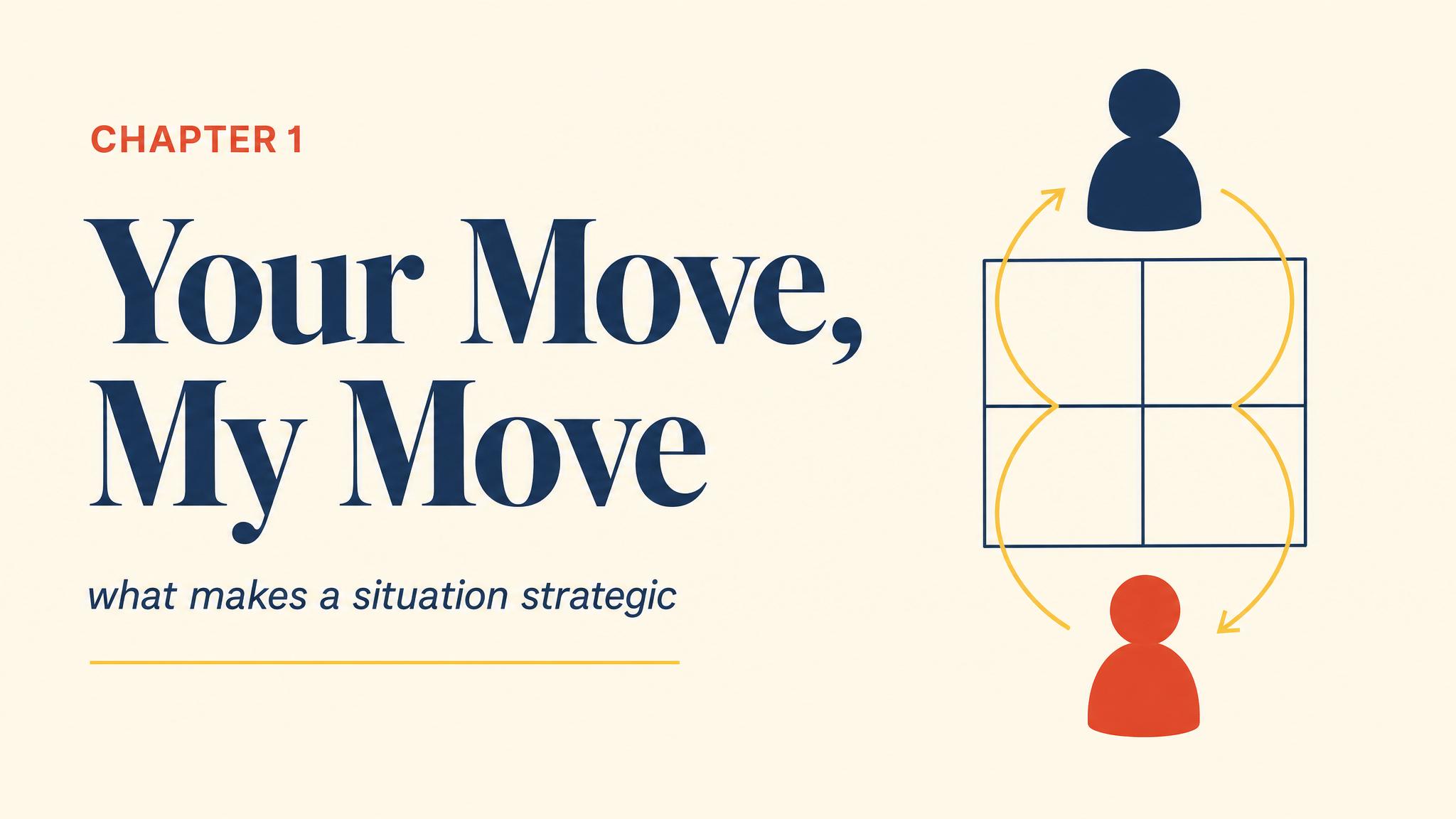
Your Move, My Move: What Makes a Situation Strategic
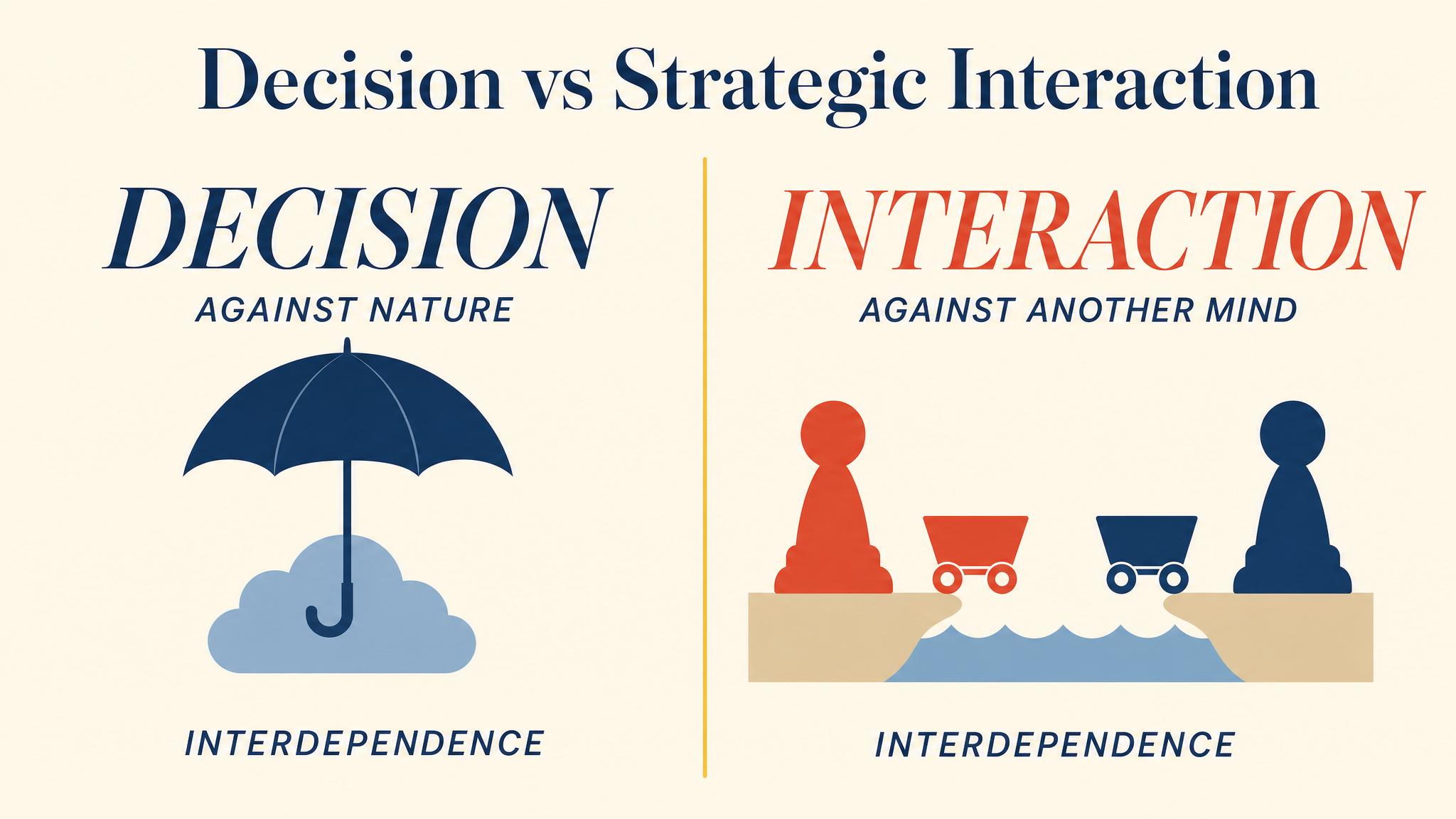
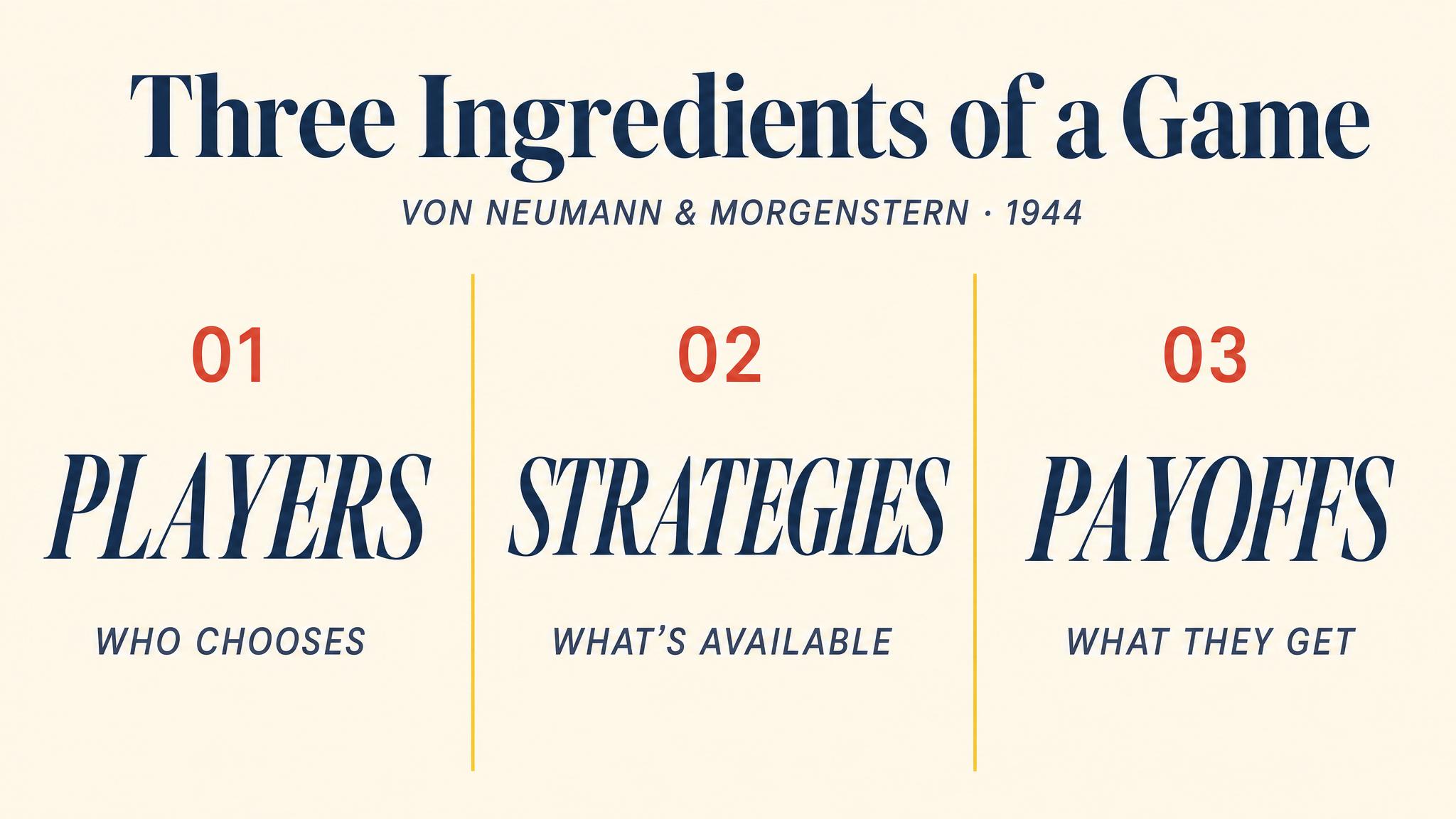
This opening chapter answers the most fundamental question in the course: when does a situation become a game? Students will learn to distinguish strategic interactions — where your best choice depends on what others do…
If someone takes 6 hours to text you back, do you reply right away or make them wait even longer? What's the power move?
Texting strategy
Be honest: when a class is graded on a curve, does it make you hope other people bomb the exam?
Curved grading
Group project game: Do your part first and hope others follow, or wait to see who actually does the work?
Group project reality
Your roommate broke something. The RA questions you both separately. Do you cover for them or tell the truth?
Snitch or cover
When splitting a bill evenly, do you order what you actually want or does everyone else's order change your strategy?
Bill split tactics
You and your friend both like the same person. Do you: go for it anyway, coordinate who asks first, or both back off?
Dating dilemma
Silent Coordination Challenge
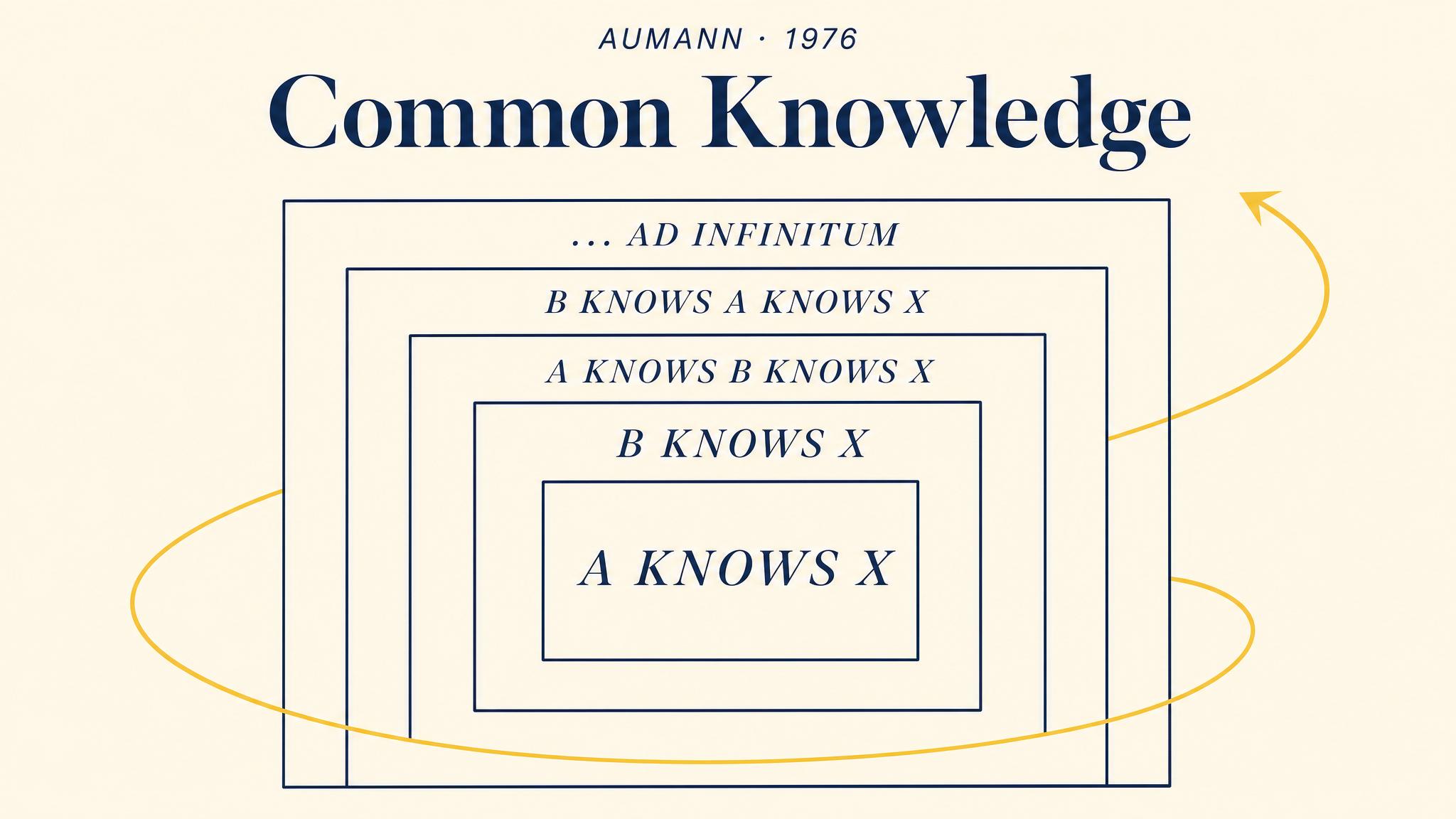
8-10 minutesTeams must coordinate without verbal communication. Round 1: Each table silently chooses a number between 1-100, trying to match the average of all tables. Round 2: Same task, but now knowing Round 1 results. Round 3: Teams try to all pick the SAME number. Debrief: What made coordination hard? Easy? How did common knowledge (knowing that others know...) help in Round 3?
Live Prisoner's Dilemma Tournament
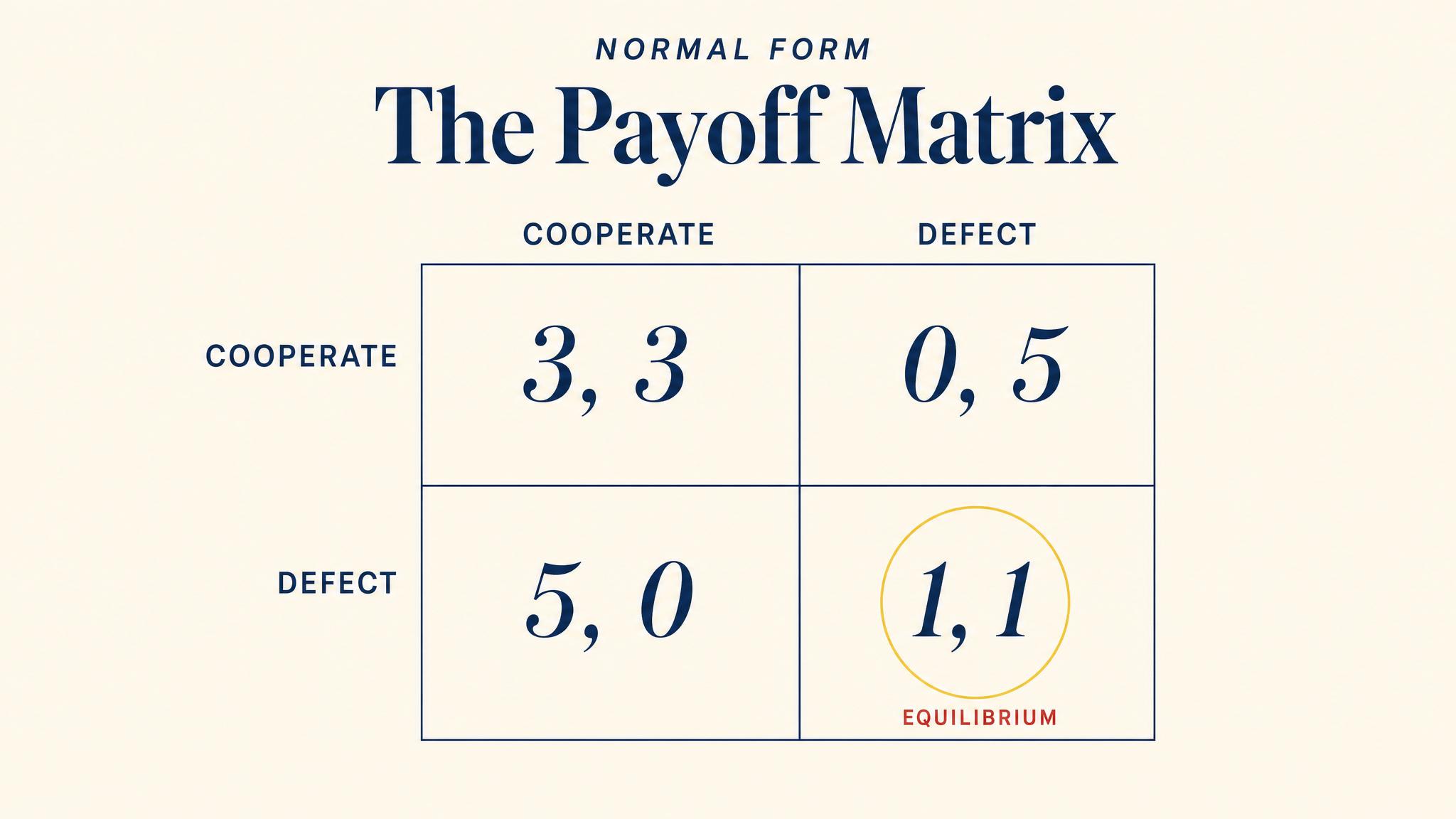
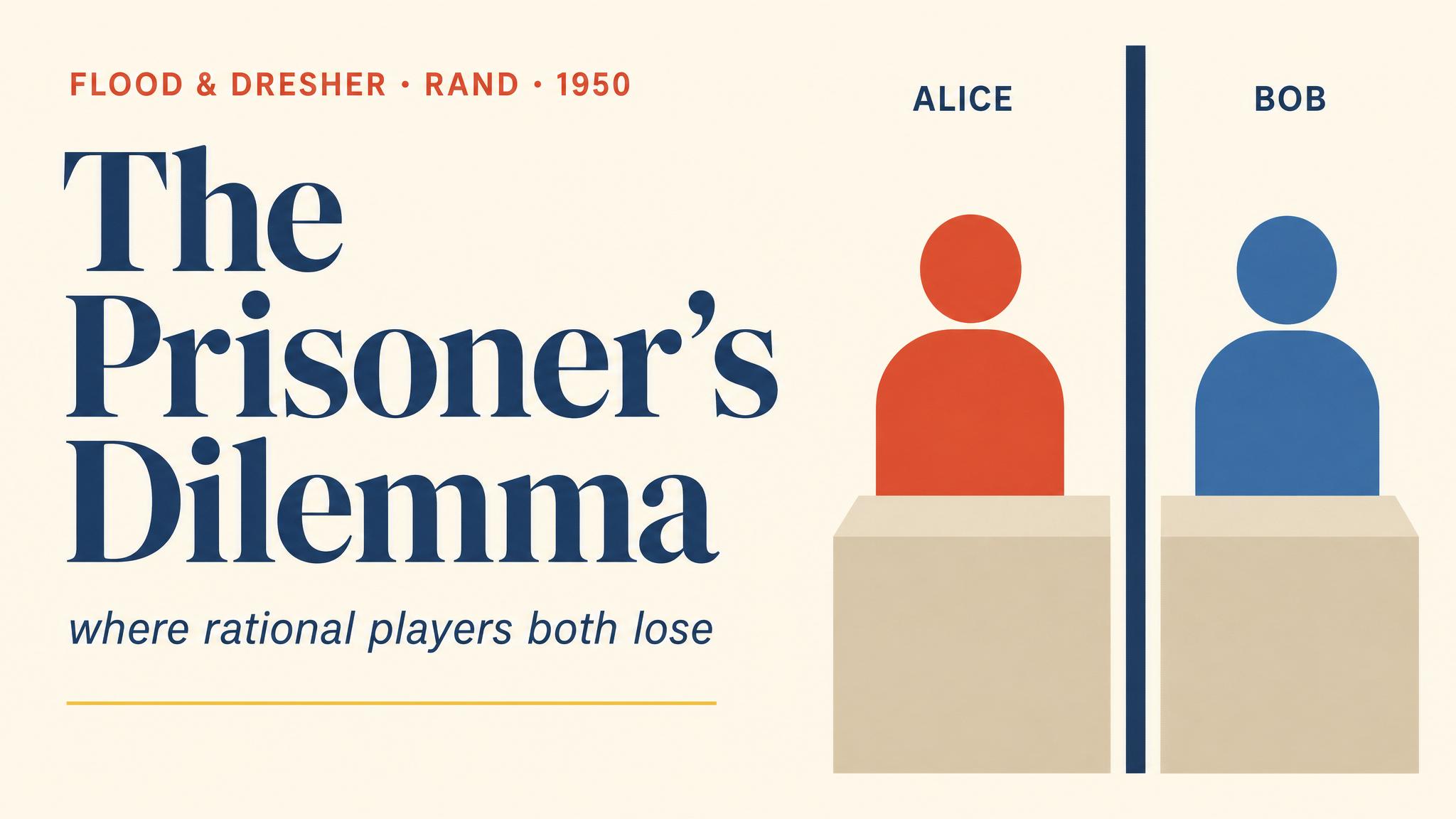
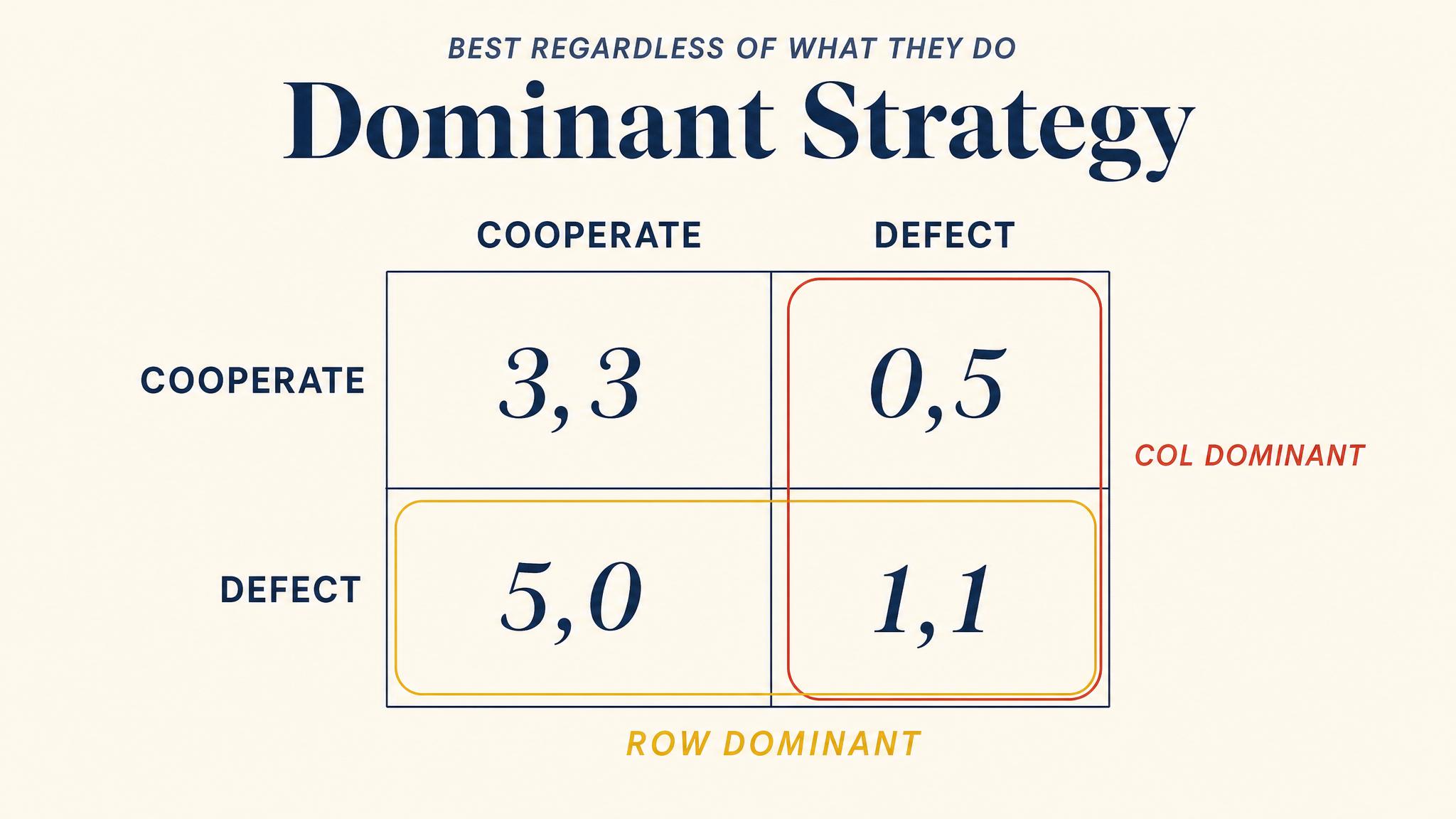
15-20 minutesEach table is a 'player' in a multi-round PD tournament. Each round, tables simultaneously vote to Cooperate or Defect. Payoffs: Both C = 3 points each, Both D = 1 point each, One defects = 5 points (defector) and 0 points (cooperator). Run 5 rounds with visible leaderboard. Include one 'final round' announcement, then one surprise 'actually one more' round. Debrief: What strategies emerged? How did knowing it was the last round change behavior?
Strategic or Solo? The Classification Game
5-7 minutesProject scenarios one at a time (e.g., 'Choosing breakfast cereal,' 'Bidding in an auction,' 'Deciding whether to study,' 'Timing your arrival to avoid traffic'). Tables have 15 seconds to discuss, then hold up 'Strategic' or 'Solo' cards. Award points for correct classifications with brief justifications. Tricky cases spark debate and reveal the boundaries of strategic interaction.
Game Theory Origin Story Jigsaw
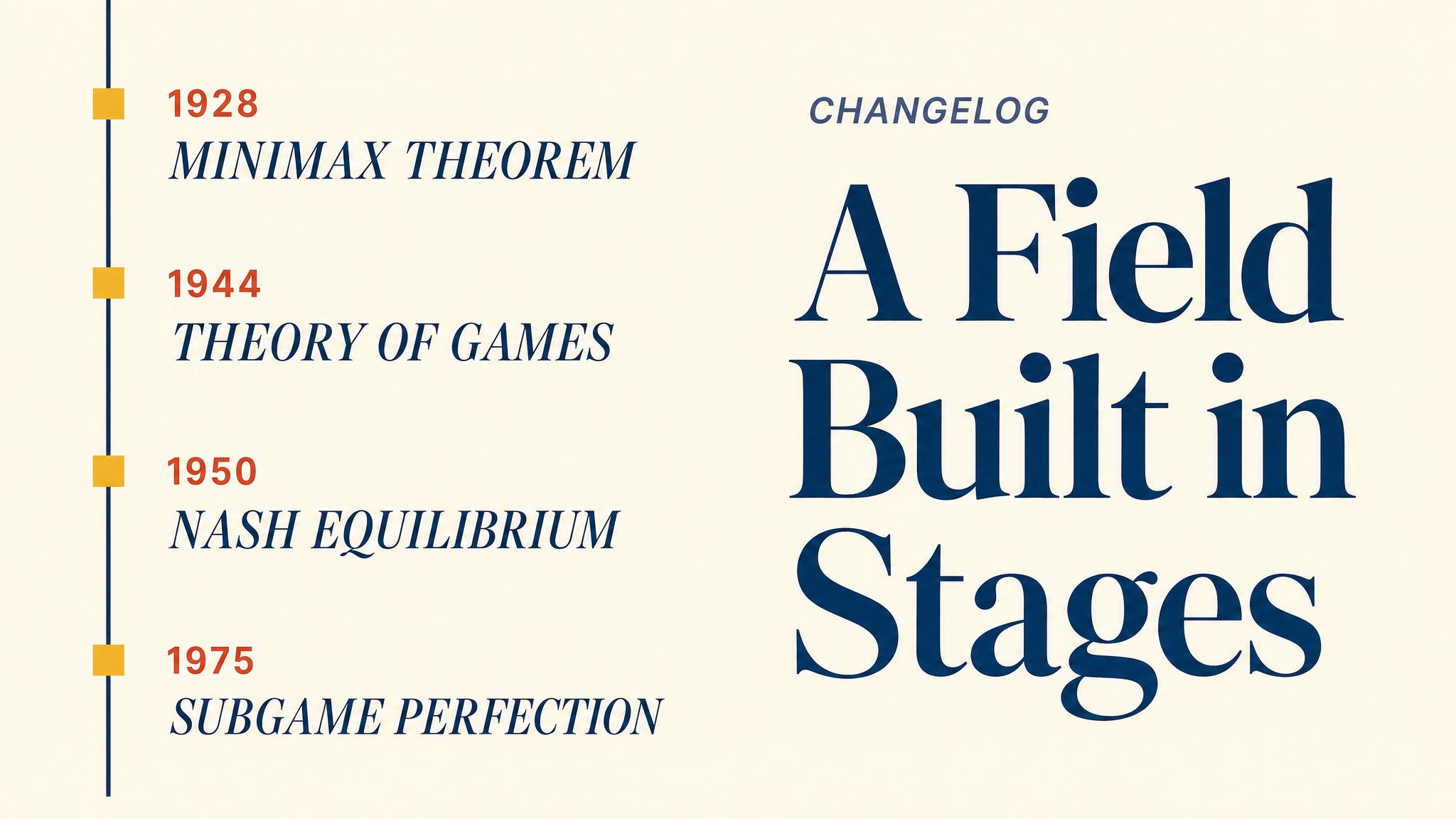
12-15 minutesAssign each table a different historical figure/event (von Neumann, Nash, Schelling, RAND Corporation, Prisoner's Dilemma origin, evolutionary game theory). Give 5 minutes to read a one-page summary. Then do 'expert exchanges': one person from each table rotates to another table to share their story (2 minutes each). After rotations, tables piece together the full timeline. Conclude with a projected timeline showing how ideas built on each other.
Predict and Pivot
10-12 minutesPresent a strategic scenario (e.g., 'Two coffee shops choosing locations on a street'). Each table secretly writes their strategy choice AND their prediction of what most other tables will choose. Reveal all choices simultaneously. Award points for correct predictions. Run 2-3 rounds with different scenarios. Debrief: When were predictions accurate? What makes other players' choices predictable (or not)?
Design a Dilemma
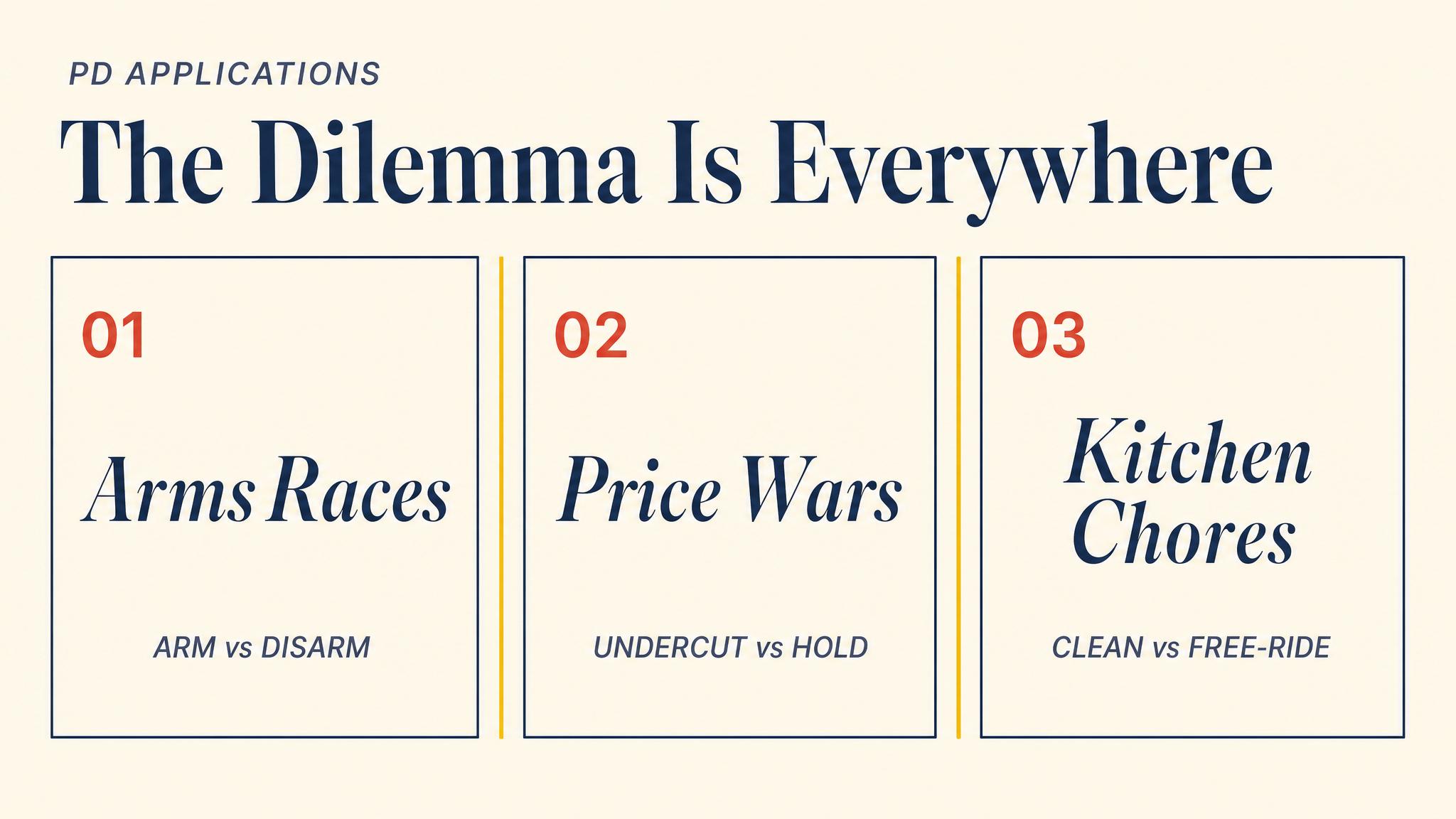
15-18 minutesChallenge: Each table creates a real-world scenario that has Prisoner's Dilemma structure. Must identify: the two players, their strategy choices, and the four payoff outcomes that create the dilemma (mutual cooperation is better than mutual defection, but individual defection is tempting). Tables present their best example (1 minute each) to 2-3 neighboring tables in a 'gallery walk' style. Class votes on most creative and most realistic examples.
The Grammar of Games: Matrices, Trees, and the Language of Strategy
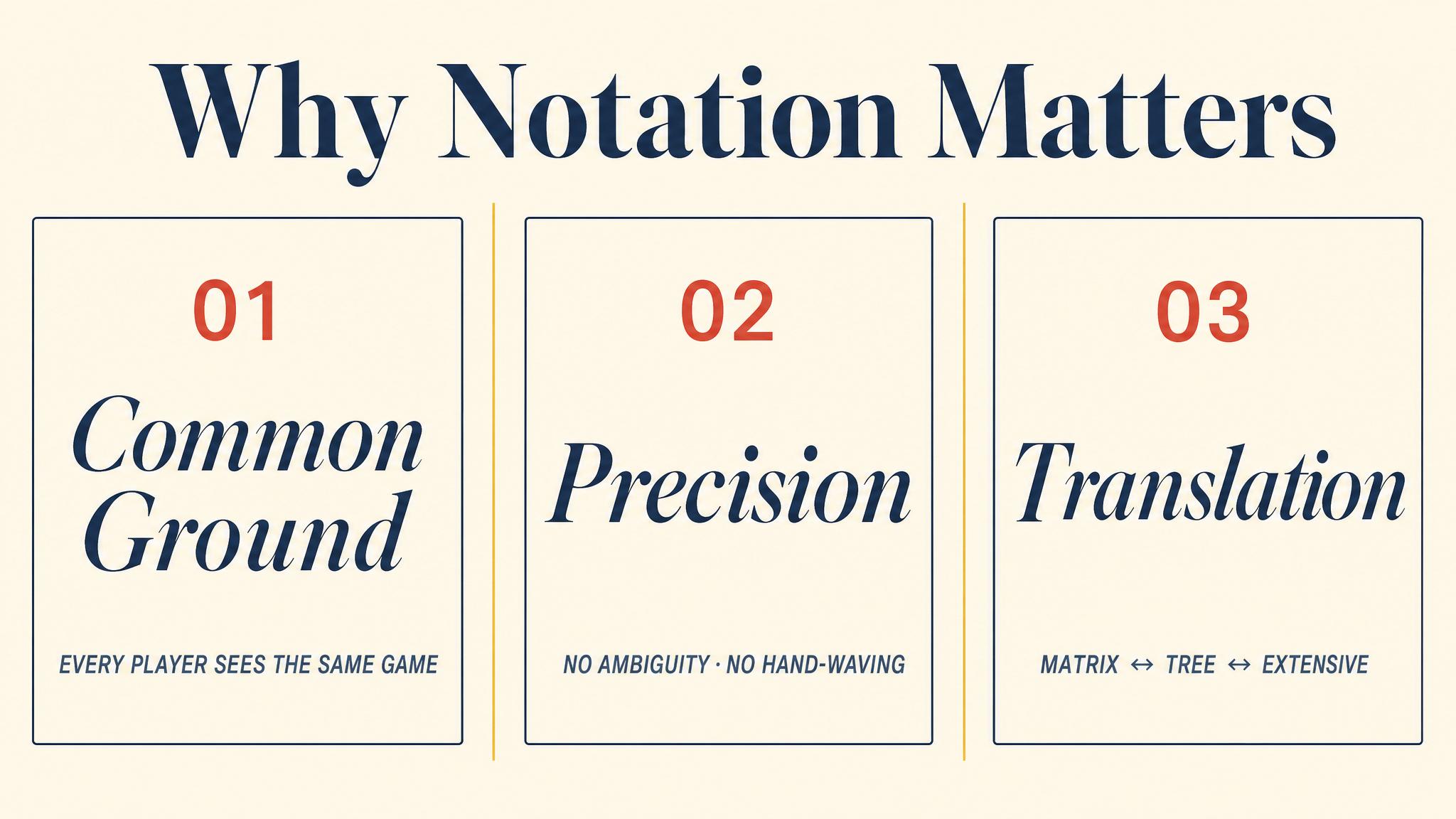
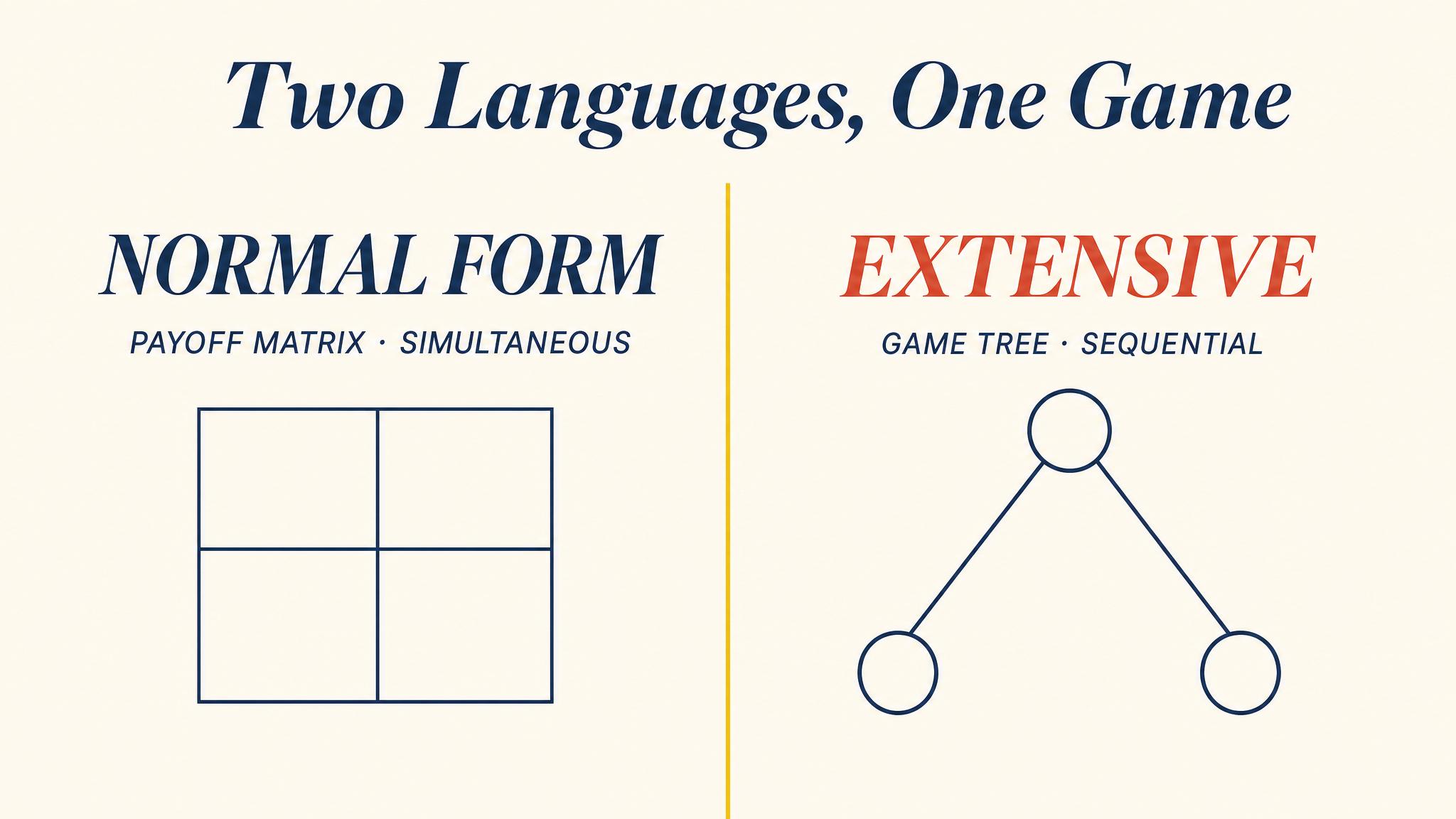
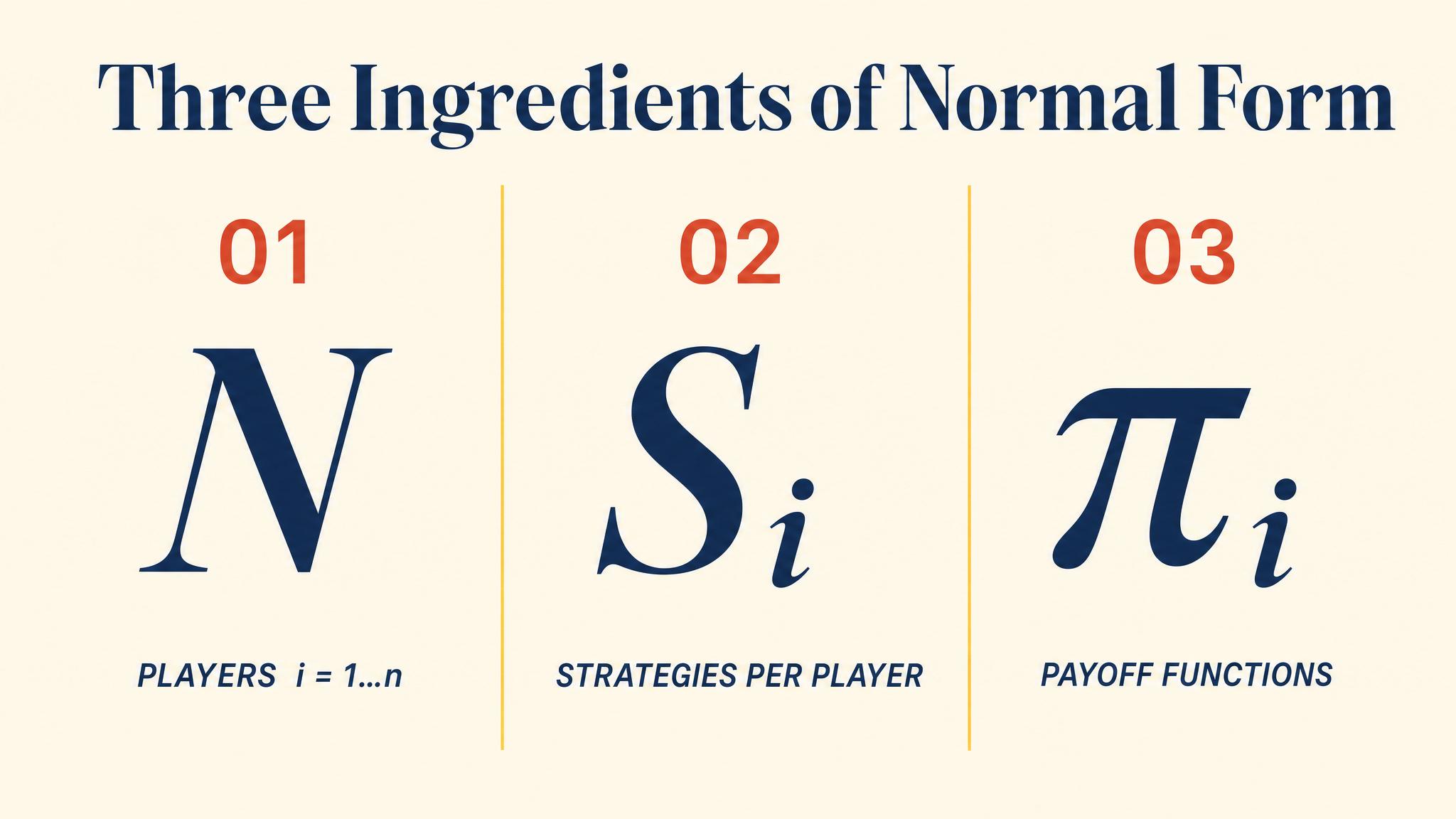
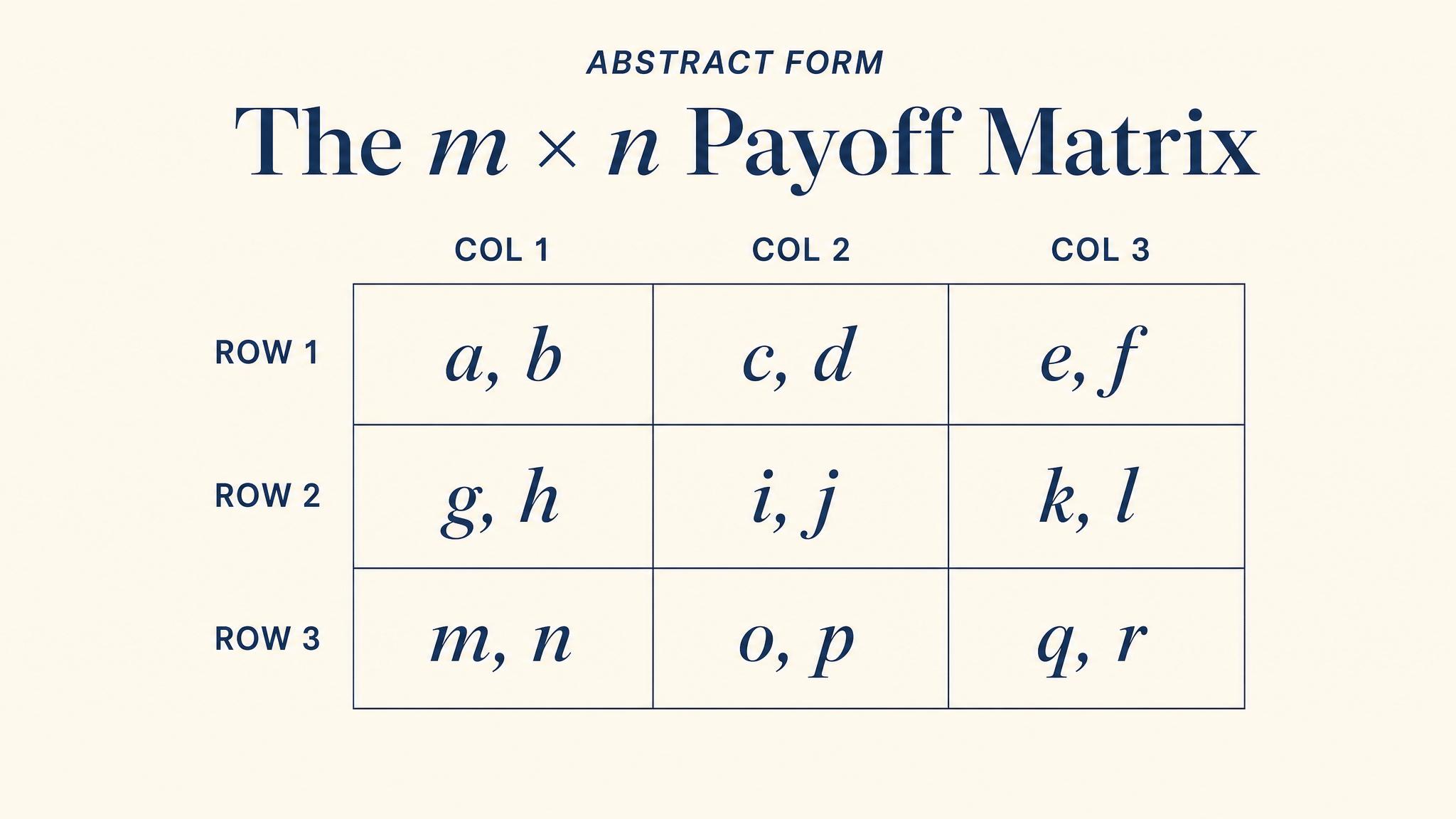
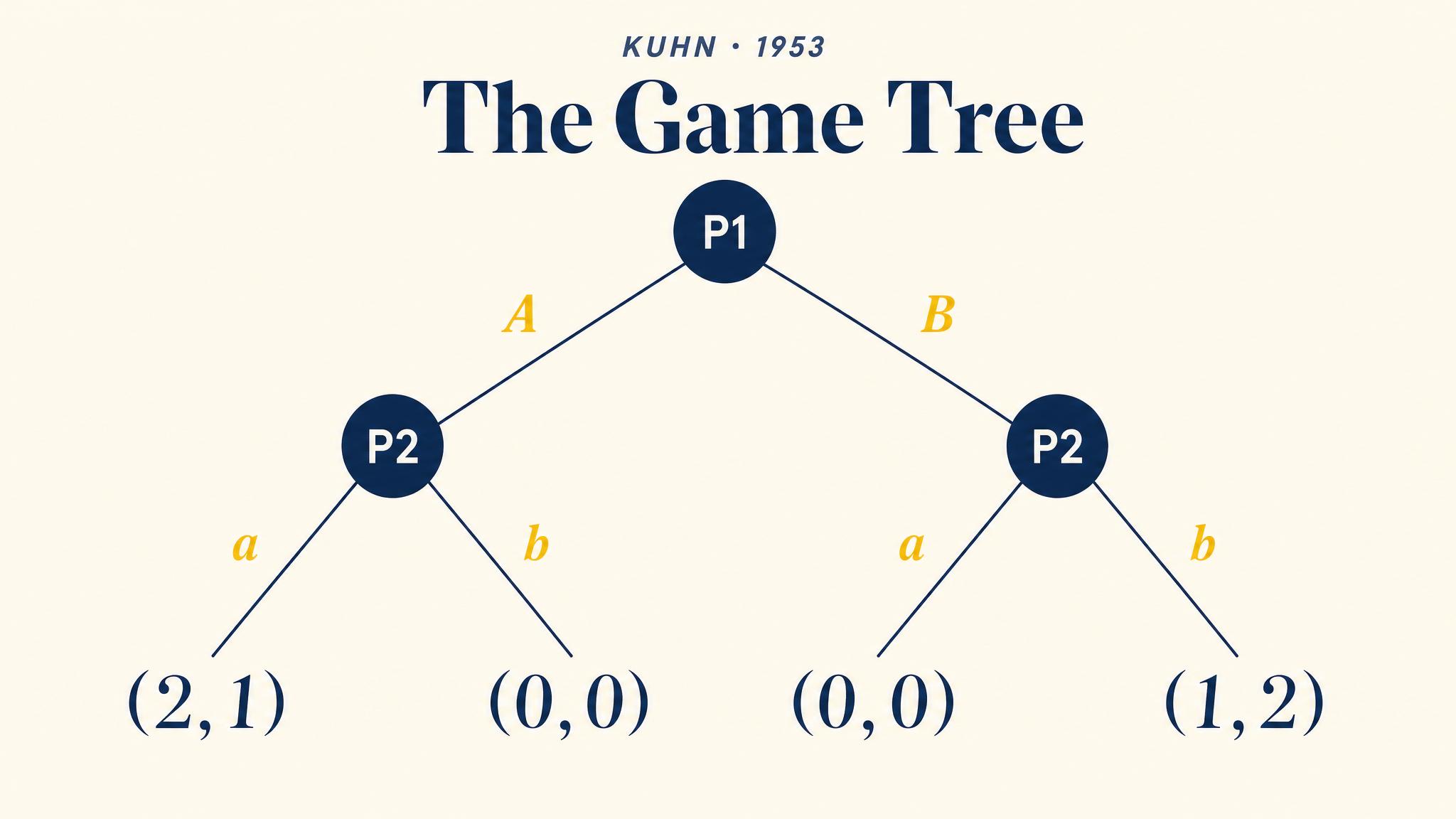
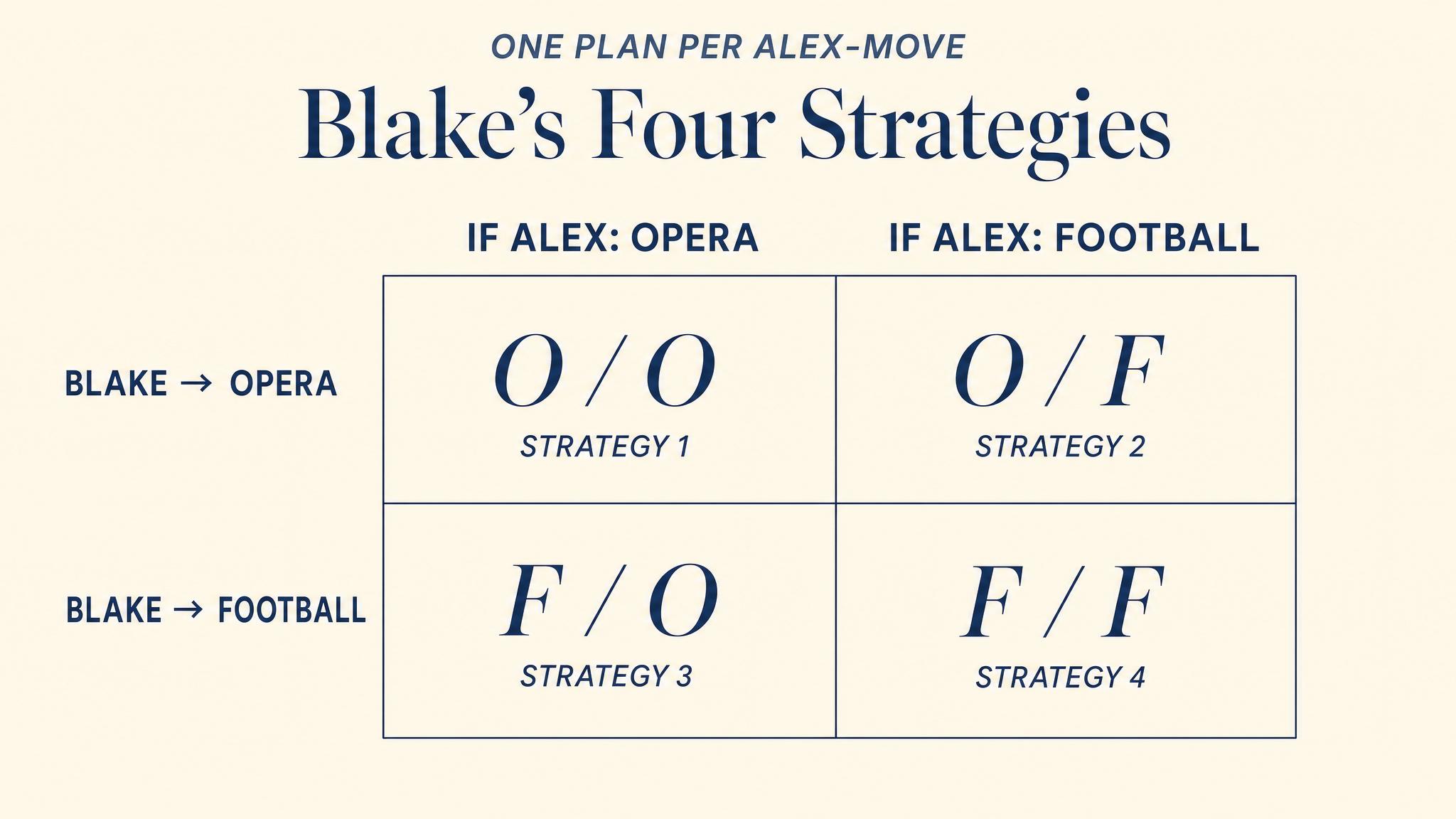
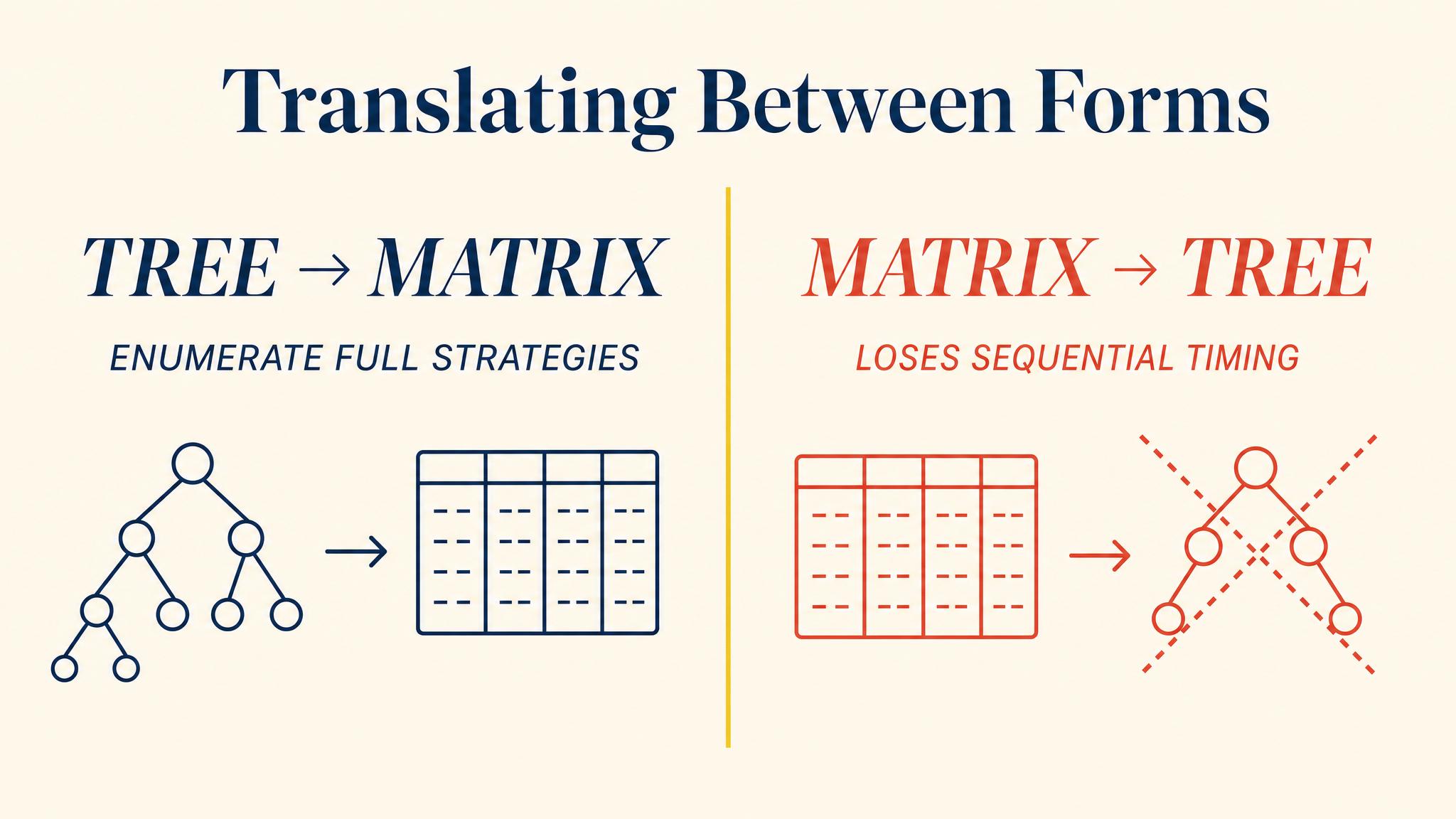
If Chapter 1 asked 'what is a game?', this chapter asks 'how do we write one down?' Students will learn the two fundamental representations — normal form (payoff matrices) and extensive form (game trees) — and discover…
Which actually takes more skill: rock-paper-scissors or tic-tac-toe? You have 30 seconds to convince the person next to you.
Debate time
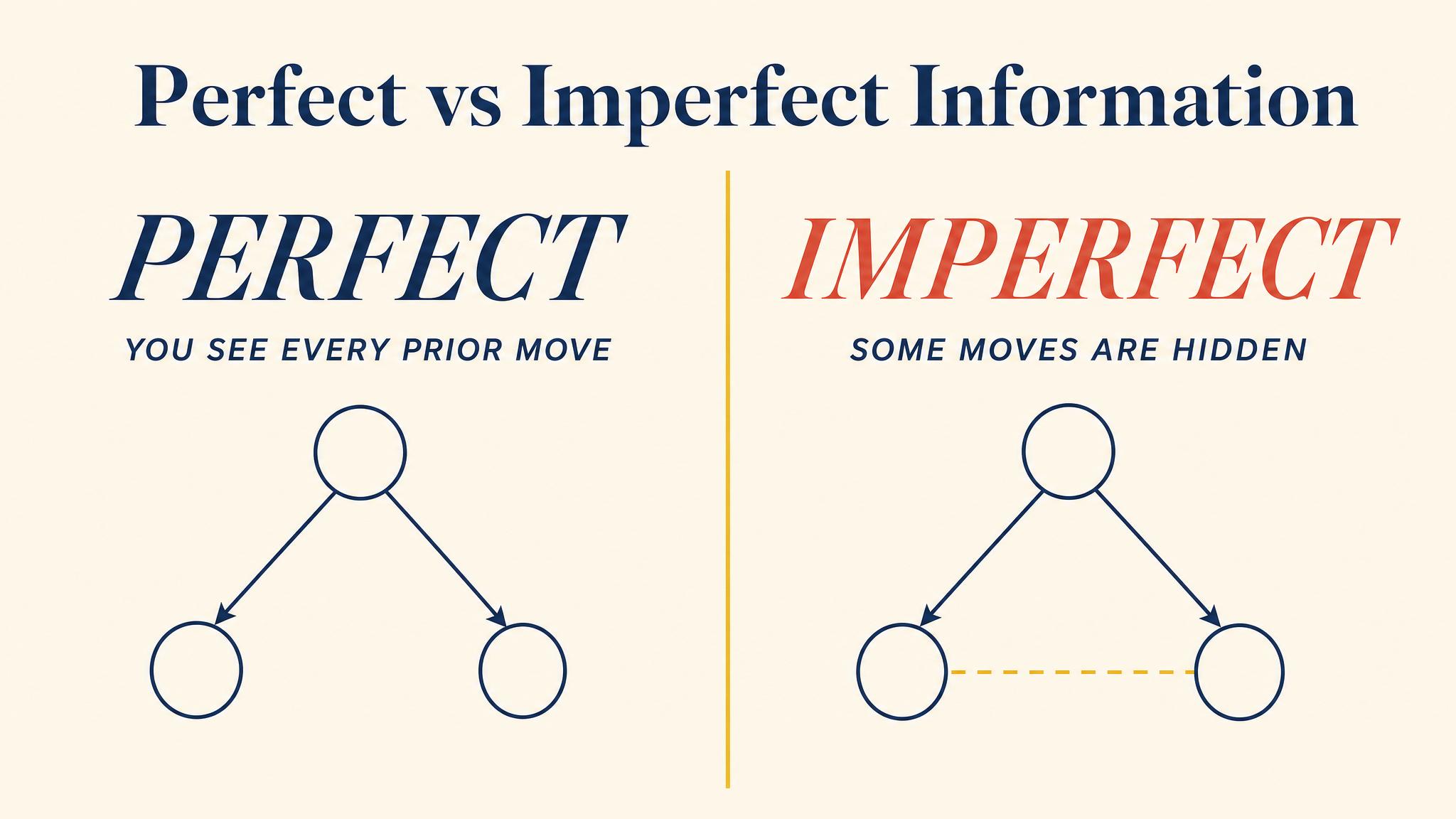
Would you rather be a world champion at chess (you see everything your opponent does) or poker (you only see your own cards)?
Would you rather
When you play a game: do you plan your whole strategy before you start, or just make the best move you can each turn and adapt?
Quick poll
You're both typing at the same time. Both messages send simultaneously. Both say something different. Who has to reply first? Does someone have the advantage?
Real talk
Hot take: Games where you can't see what your opponent is doing (like poker) take MORE skill than games where everything's visible (like chess).
Unpopular opinion?
Your friend wants to play you in chess but gets to see your next move before deciding theirs. They offer you $20 if you win. Do you take the bet?
What would you do
Matrix Construction Derby
12-15 minutesEach table receives a simple strategic scenario card (e.g., 'Two coffee shops deciding whether to offer free WiFi'). Teams simultaneously: (1) identify the players and their possible actions (3 min), (2) construct the complete payoff matrix on their whiteboard/large paper (5 min), (3) swap matrices with a neighboring table to check each other's work and identify the Nash equilibrium (4 min). Instructor calls on 2-3 tables to explain their reasoning to the full class.
Simultaneous Game Showdown
10-12 minutesTables play 3 rounds of a simple simultaneous-move game (e.g., 'Divide 100 Points': each table secretly allocates 100 points between two options; payoffs depend on all tables' choices). After each round: (1) tables submit choices via online form/cards (1 min), (2) instructor reveals aggregate results and calculates payoffs (1 min), (3) tables have 1 minute to discuss and adjust strategy. After all rounds, discuss: What strategies emerged? How did strategies differ from individual actions? What information would have helped?
Tree vs. Matrix Translation Race
15-18 minutesHalf the tables receive a game tree diagram; the other half receive the payoff matrix of the SAME game. Challenge: (1) Teams with trees must construct the normal form matrix (7 min), (2) Teams with matrices must construct the extensive form tree, including information sets (7 min), (3) Partner up with a team that had the opposite form to verify correctness (4 min). Discuss as a class: Which form makes different strategic features more visible?
Information Set Detective
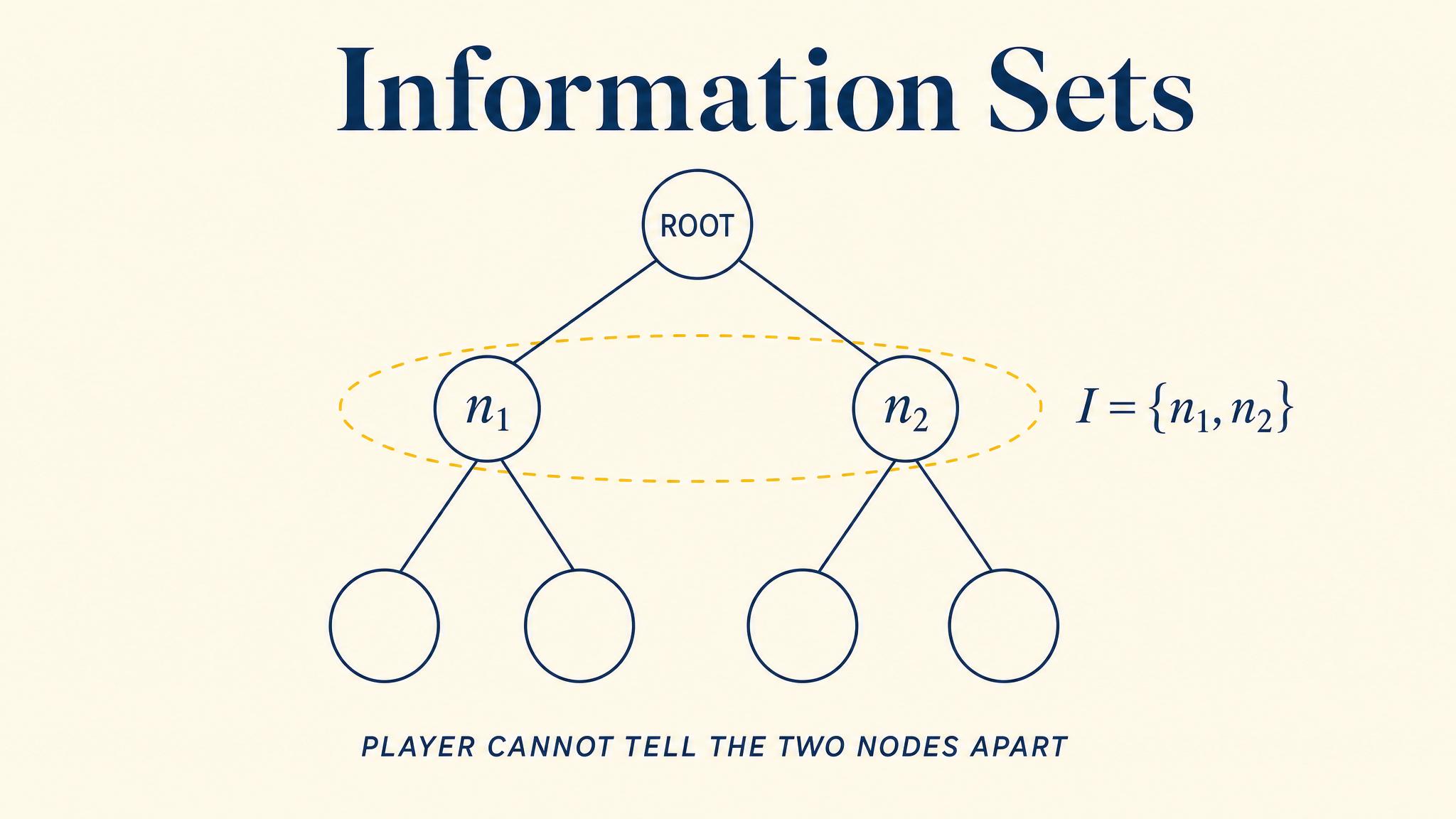
10-12 minutesEach table receives an incomplete game tree missing the information set markings. Tables must: (1) Read the game scenario description carefully to determine what each player knows when they move (3 min), (2) Add information sets to their tree using dotted lines or highlighting (4 min), (3) Exchange trees with another table and explain their reasoning for 2-3 key decision points (3 min). Class discussion: How do information sets change what counts as a 'strategy'?
Strategy Card Sorting Summit
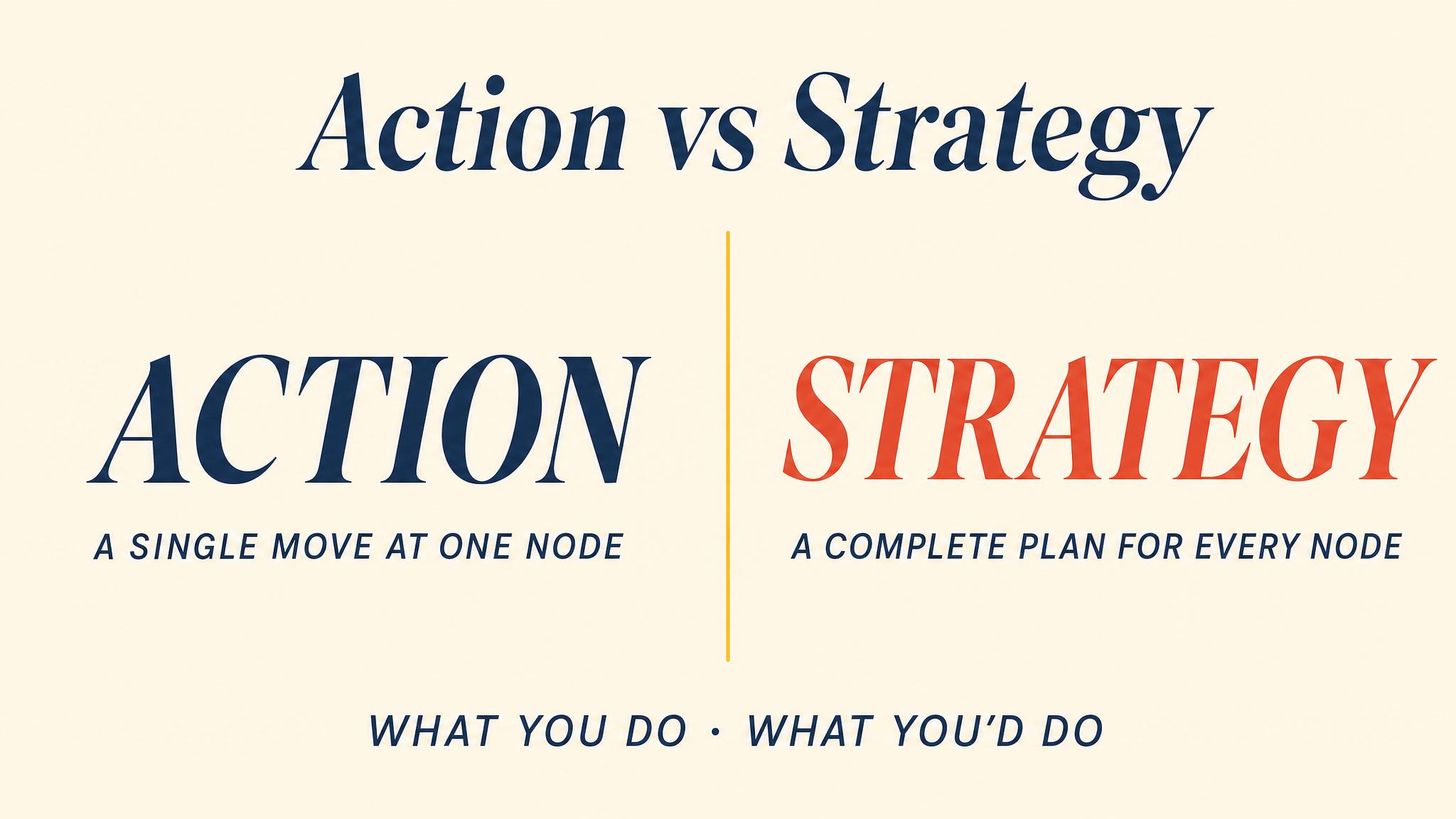
8-10 minutesEach table receives 12-15 cards with statements written on them (mix of strategies, single actions, and outcomes). Challenge: Sort cards into three piles: 'Complete Strategy,' 'Single Action,' and 'Neither/Outcome' (4 min). Tables then defend 2-3 controversial choices to neighboring tables (3 min). Instructor highlights most commonly misclassified examples and leads 2-minute discussion on why the distinction matters.
Perfect Information Transformation Workshop
15-18 minutesEach table receives a game tree representing a simultaneous-move game (imperfect information, shown with information sets). Challenge: (1) Redraw the game as a sequential game where player 1 moves first and player 2 observes before moving—perfect information version (6 min), (2) Construct the normal form matrix for BOTH versions (5 min), (3) Compare: How do the strategy sets differ? How do equilibria change? (4 min). Share one key insight with the class (3 min).
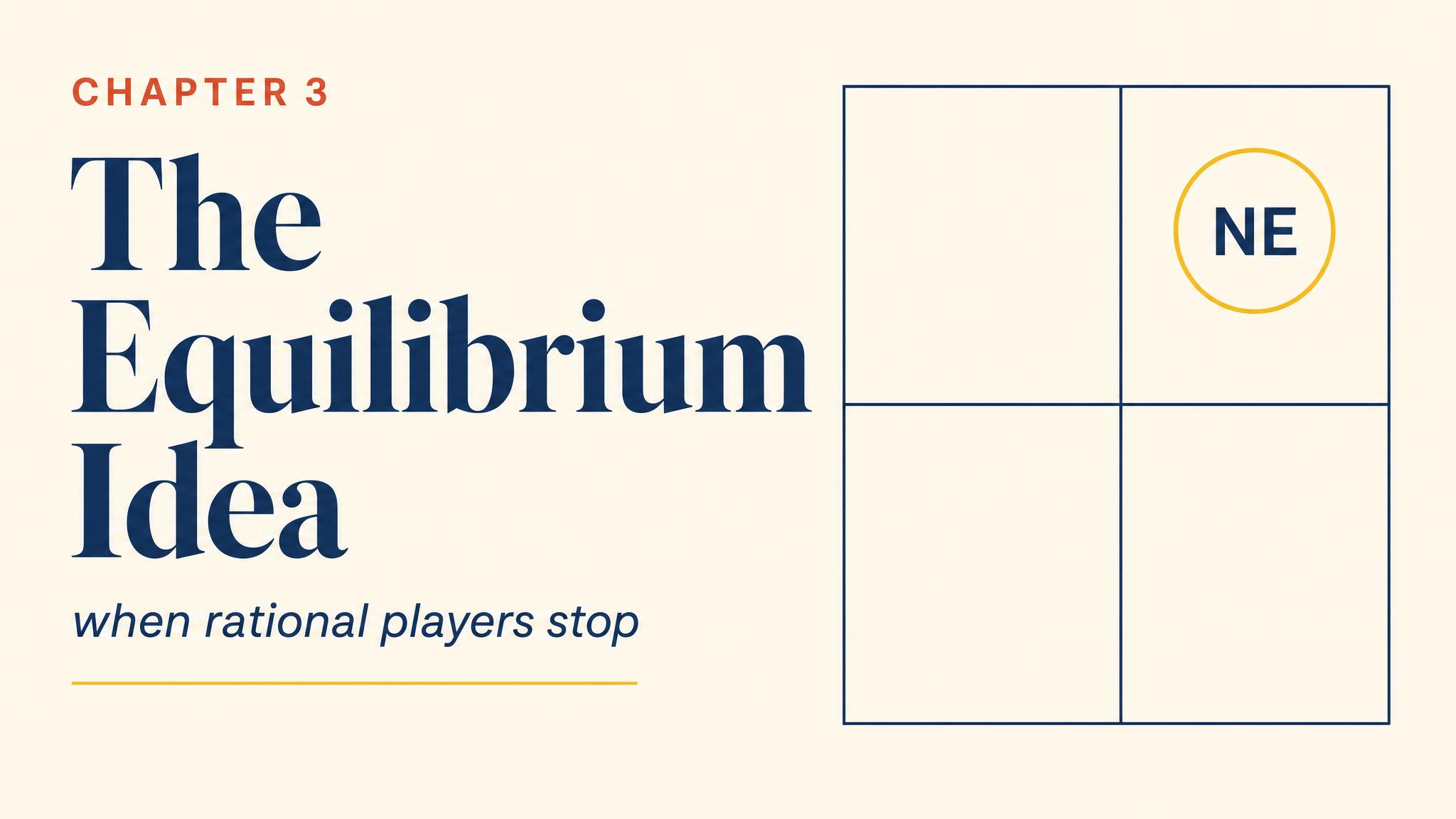
The Equilibrium Idea: When Rational Players Get Stuck
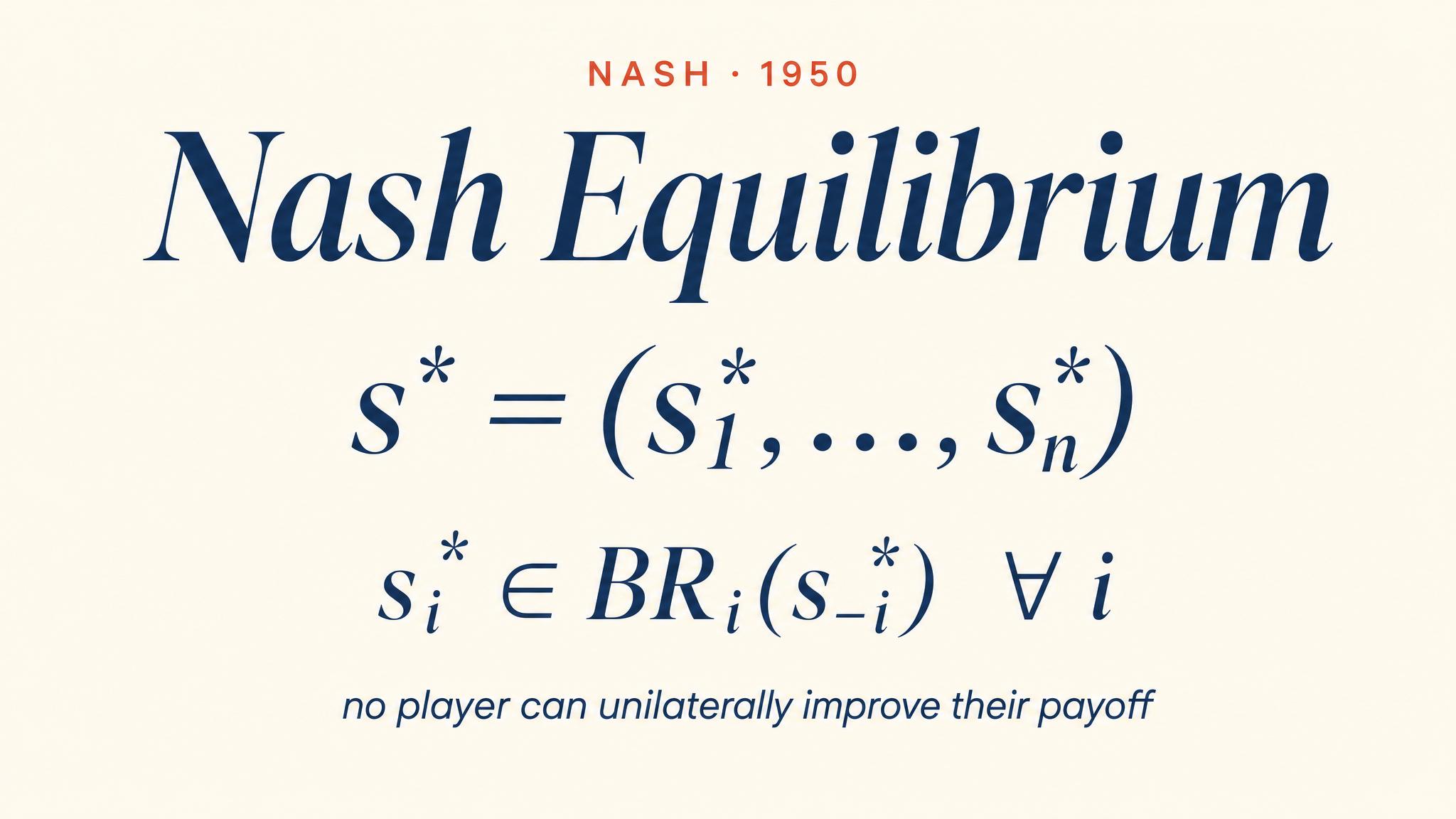
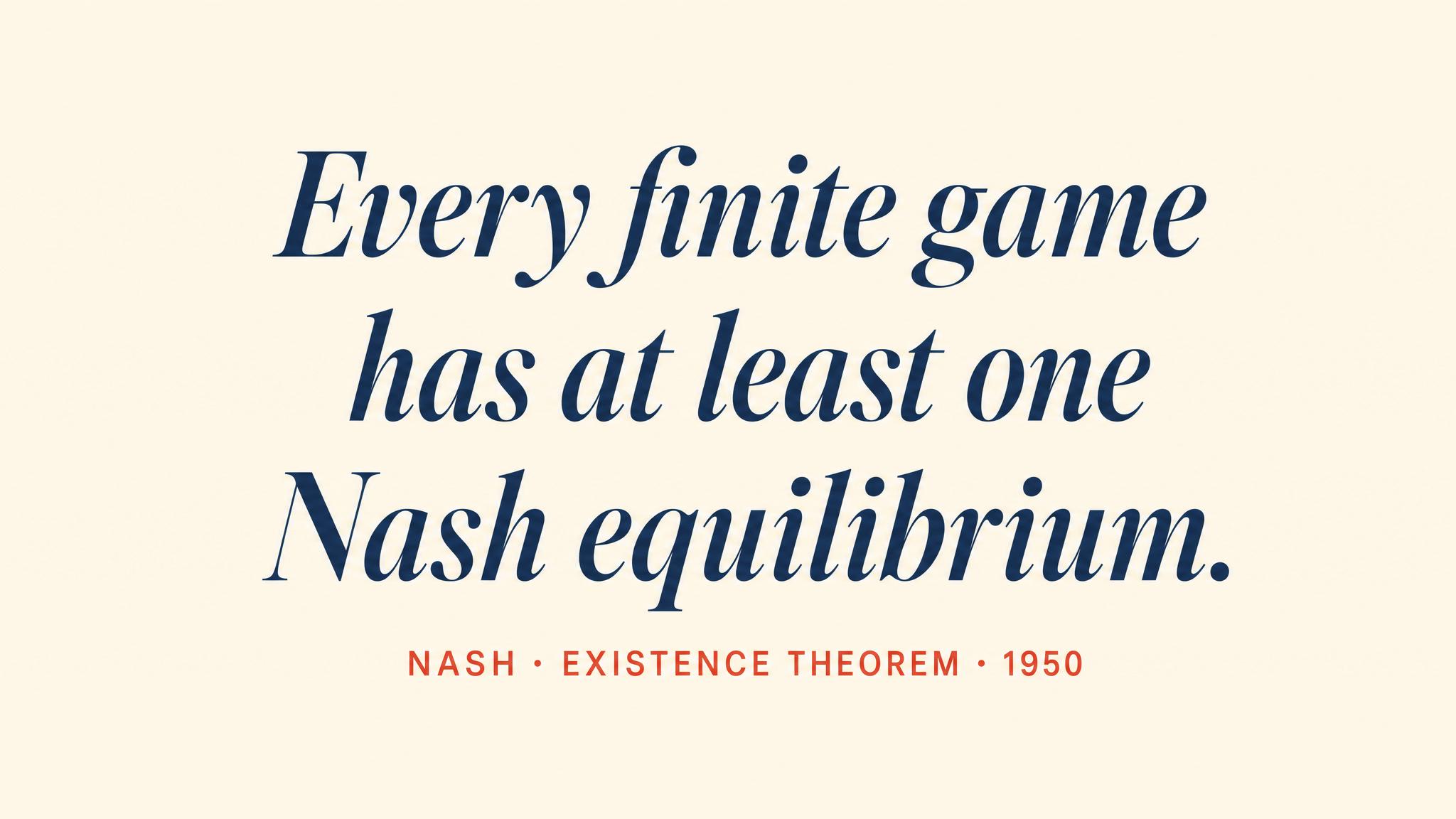
This chapter introduces the most important concept in the entire course: Nash equilibrium. But it builds there carefully, starting with the simpler and more intuitive idea of dominance. Students first learn to identify…
Why do friend groups always end up at the same mediocre spot for dinner? Like, everyone agrees it's mid, but you keep going back.
Same place again?
Would you rather show up early to a party when no one's there yet, or show up late when everyone's already hanging out?
Would you rather
Your entire floor uses one app to coordinate plans even though literally everyone thinks a different app would be better. Why doesn't anyone just switch?
Stuck with it
You and your roommate both know the dishes need doing. You both know you'd be better off taking turns. But neither wants to go first. How does this end?
Dish standoff
In rock-paper-scissors, if you could only throw ONE option for the rest of your life, which would you pick? Does it matter if your opponent knows?
One move forever
Hot take: Sometimes the smartest move is doing the mediocre thing everyone else is doing instead of the better thing no one else is doing.
Hot take
The 2/3 Average Game (Beauty Contest)
10-12 minutesEach student privately writes down a number between 0-100. Instructor collects and calculates the average, then multiplies by 2/3. The student(s) whose number is closest to this target wins a small prize. Before revealing: ask tables to discuss what number they'll choose and why. Poll the room to see distribution (show of hands for ranges: 0-10, 11-25, 26-50, 51-75, 76-100). Then reveal the winning number and debrief: What's the dominated strategy? What survives iterated elimination? What's the Nash equilibrium? Most students pick 20-40 first time, demonstrating limited depth of reasoning.
Table vs. Table Prisoner's Dilemma Tournament
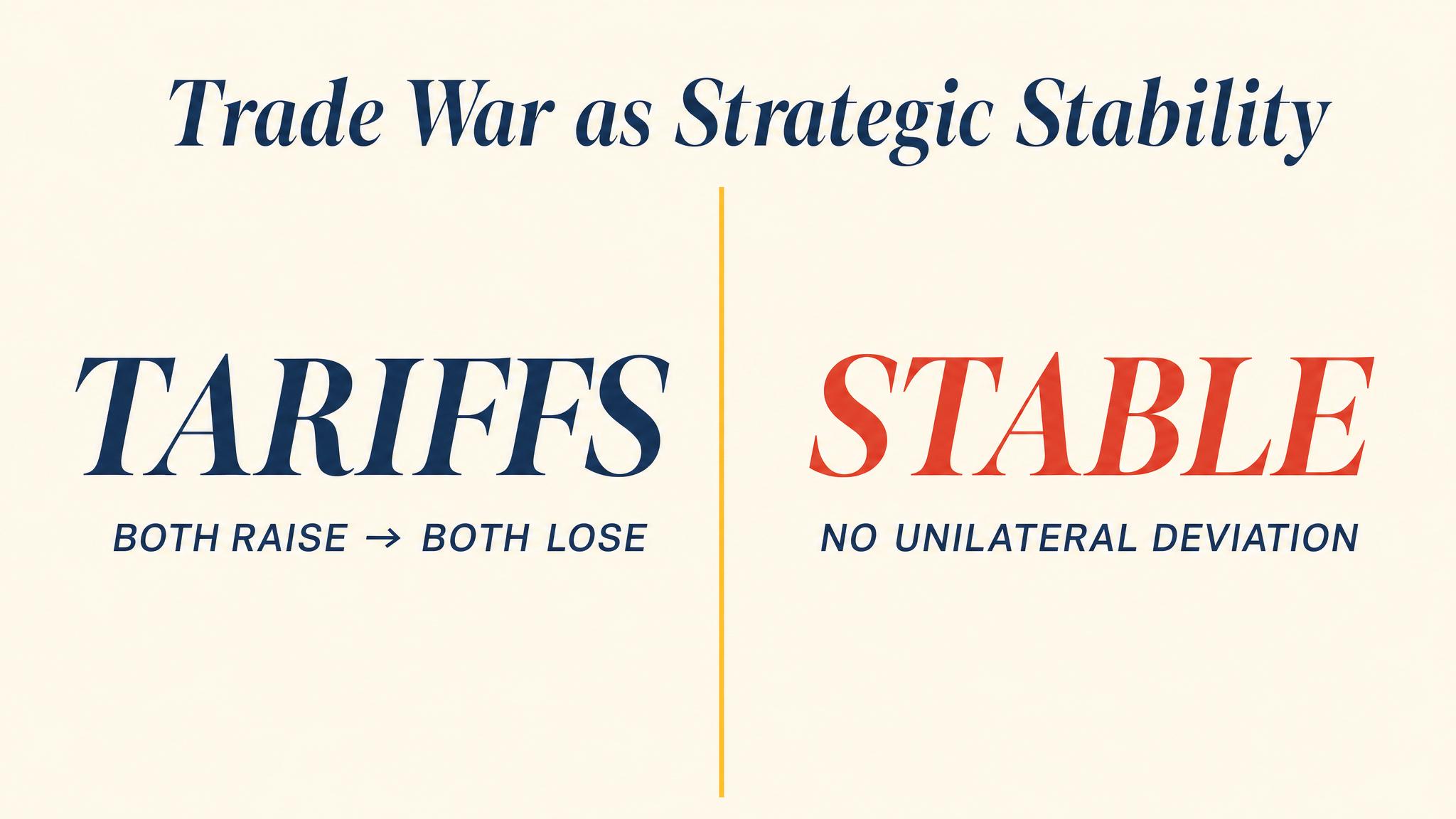
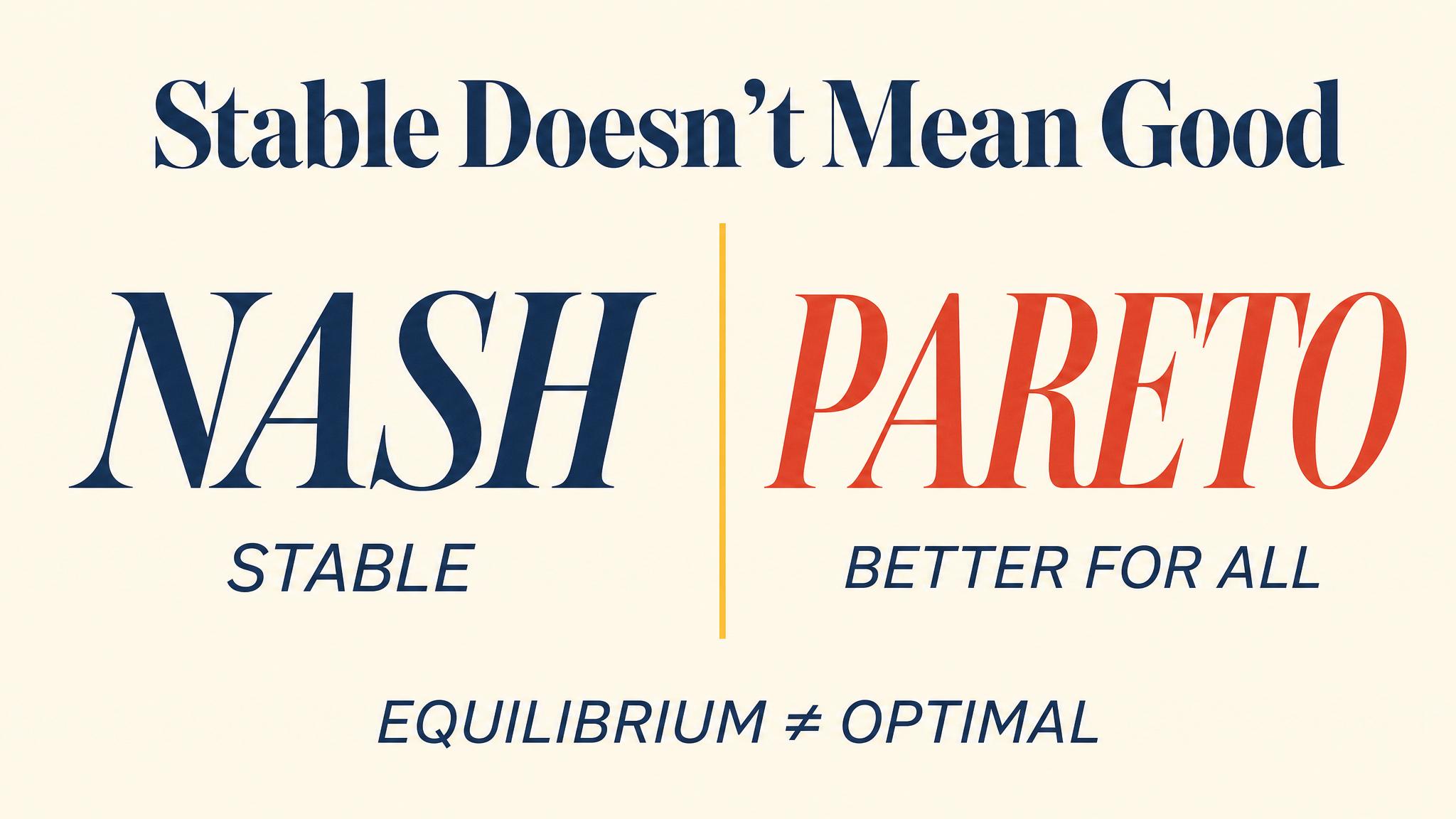
15-18 minutesPair up tables (2 tables = 1 match). Each table is a 'player' that must collectively decide: Cooperate or Defect. Give them the classic payoff matrix (both cooperate: 3,3; both defect: 1,1; one defects: 5,0). Each table has 2 minutes to discuss strategy privately. Simultaneously reveal choices using colored cards (green=cooperate, red=defect). Play 3-5 rounds. Debrief: Did tables play the dominant strategy? Why or why not? What happened over multiple rounds? Introduce the concept that defection is strictly dominant, yet cooperation is mutually better—this is the tragedy of Nash equilibrium.
Red/Blue Coordination Crisis
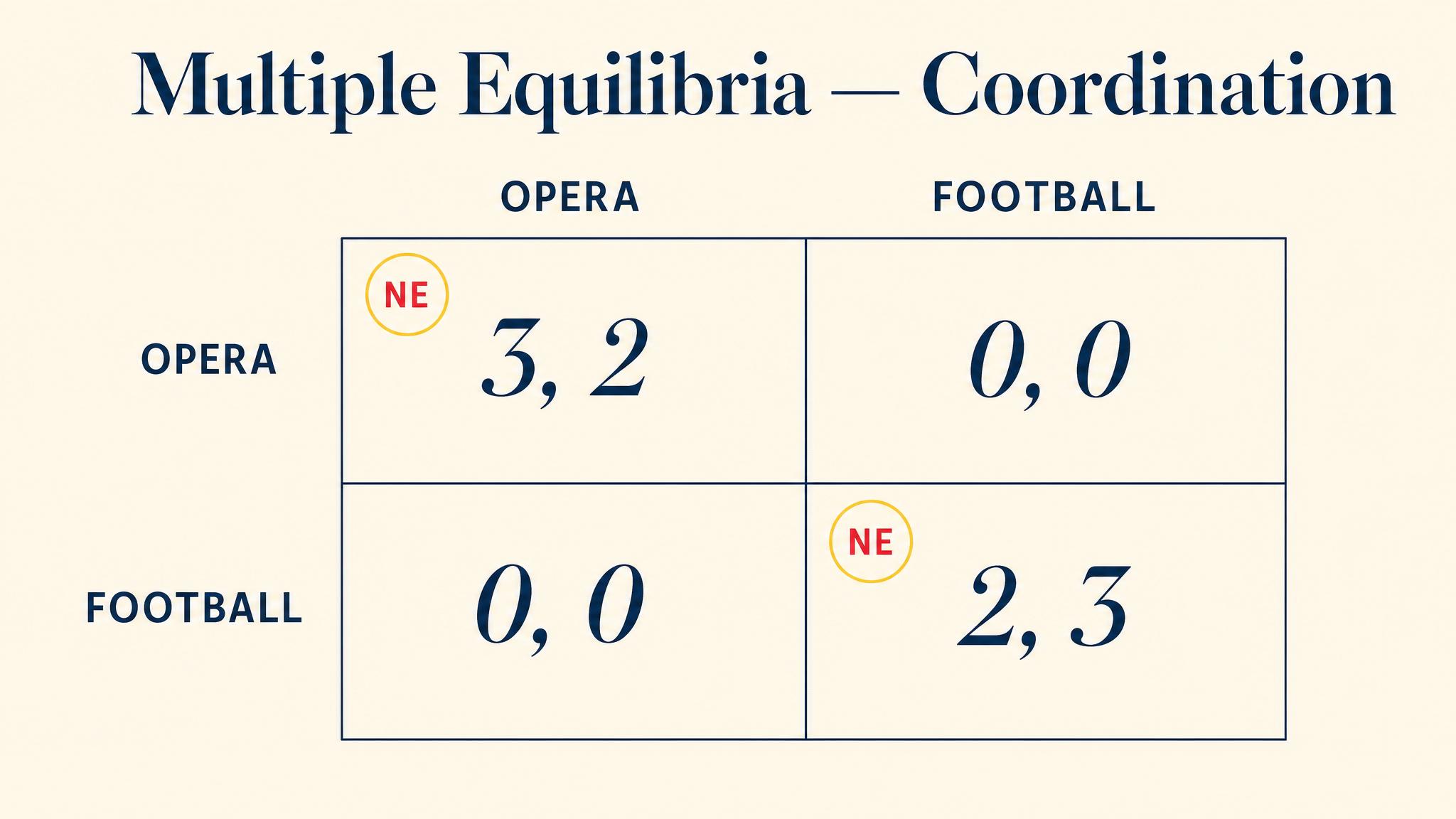
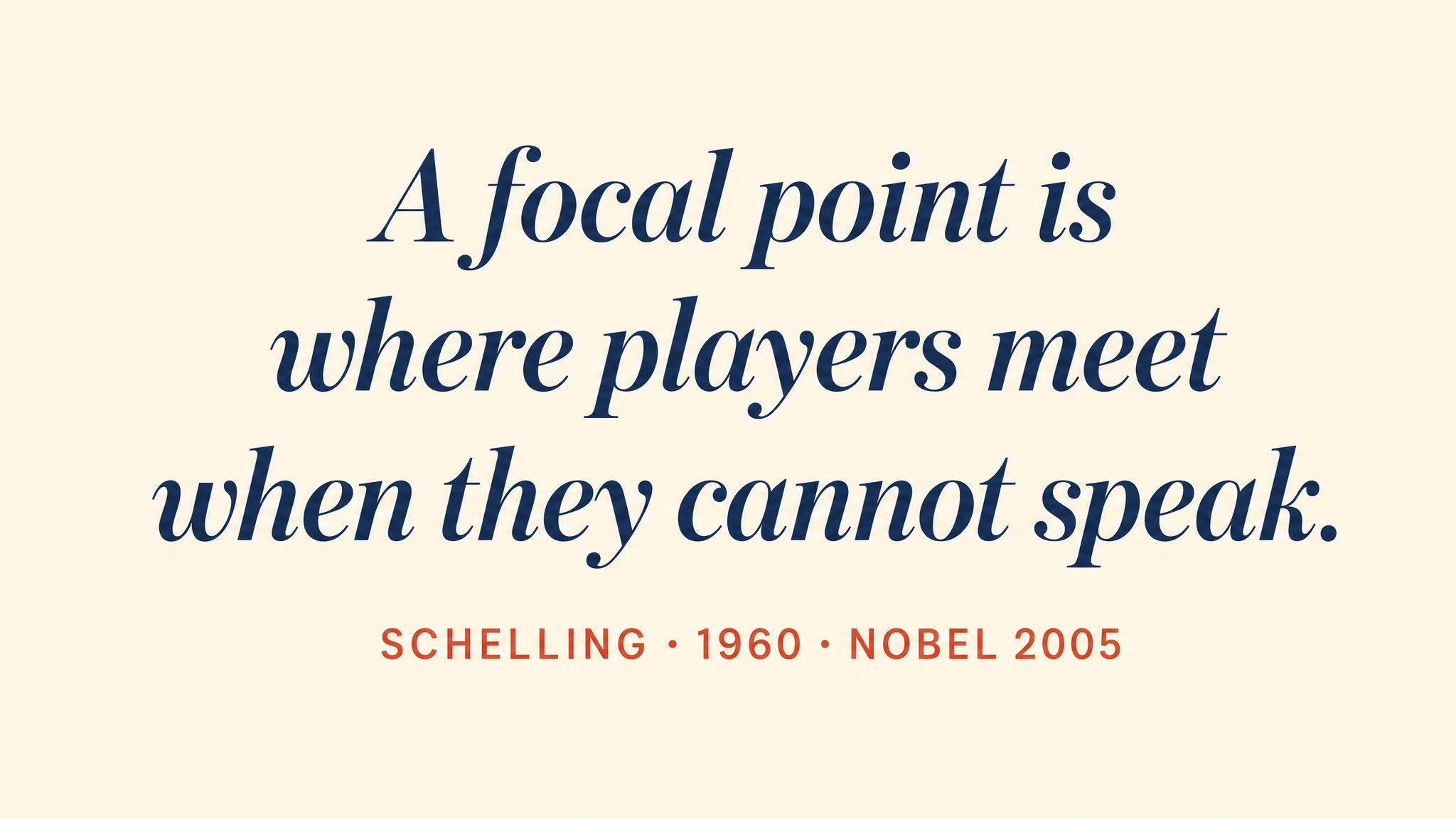
8-10 minutesGive each table two cards: RED and BLUE. Explain payoffs: If your table and your 'partner table' both choose RED: 10 points each. Both choose BLUE: 10 points each. Mismatch: 0 points for both. Randomly assign partner tables (announce via projection: 'Table 1 partners with Table 8'). No communication allowed between partner tables. Tables have 90 seconds to choose. Reveal simultaneously. Most will fail to coordinate in round 1. Round 2: Allow 30 seconds of shouted signals. Did coordination improve? Debrief: This game has TWO Nash equilibria (both RED, both BLUE). How do players coordinate when both strategies are equally good? Introduce focal points and the coordination problem.
Best Response Speed Mapping
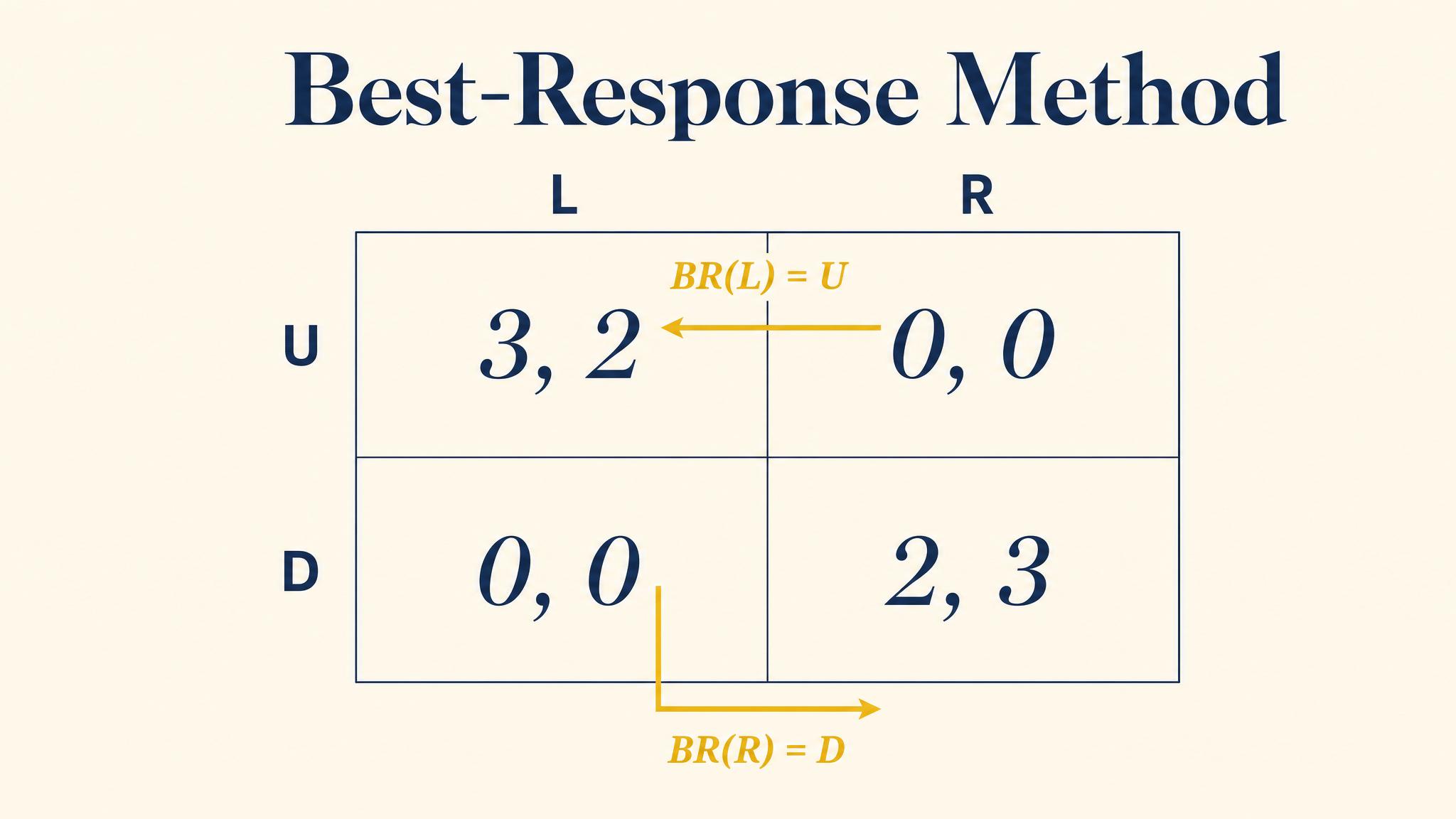
12-15 minutesProject a 3x3 payoff matrix on screen. Each table receives a printed copy. Challenge: 'Circle all best responses as fast as you can, then identify all Nash equilibria.' This is a race—first table to correctly identify all NE wins. After winner declared, walk through as class: For Player 1, underline best response to each of Player 2's strategies. For Player 2, do same for columns. Nash equilibria are where both players are best-responding (marked cells have both underlines). Use a simple game with 2-3 Nash equilibria. Repeat with a second, trickier matrix. Debrief: Best response analysis is the systematic way to find Nash equilibria.
Stag Hunt Dilemma: Safe vs. Risky Coordination
10-12 minutesEach student chooses: STAG or HARE. Payoffs: Both hunt Stag (requires coordination): 4 points each. One hunts Stag, other hunts Hare: Stag hunter gets 0, Hare hunter gets 3. Both hunt Hare: 3 points each. Pair students at their tables. Round 1: No communication, write down choice. Reveal and calculate points. Round 2: Same pairing, but 30-second discussion allowed. Survey: Who switched strategies? Debrief: (Stag, Stag) and (Hare, Hare) are both Nash equilibria, but (Stag, Stag) is better. Why don't people always coordinate there? Introduce concepts: risk dominance vs. payoff dominance. Hare is 'safer' but Stag is better if you trust others.
Dominated Strategy Scavenger Hunt
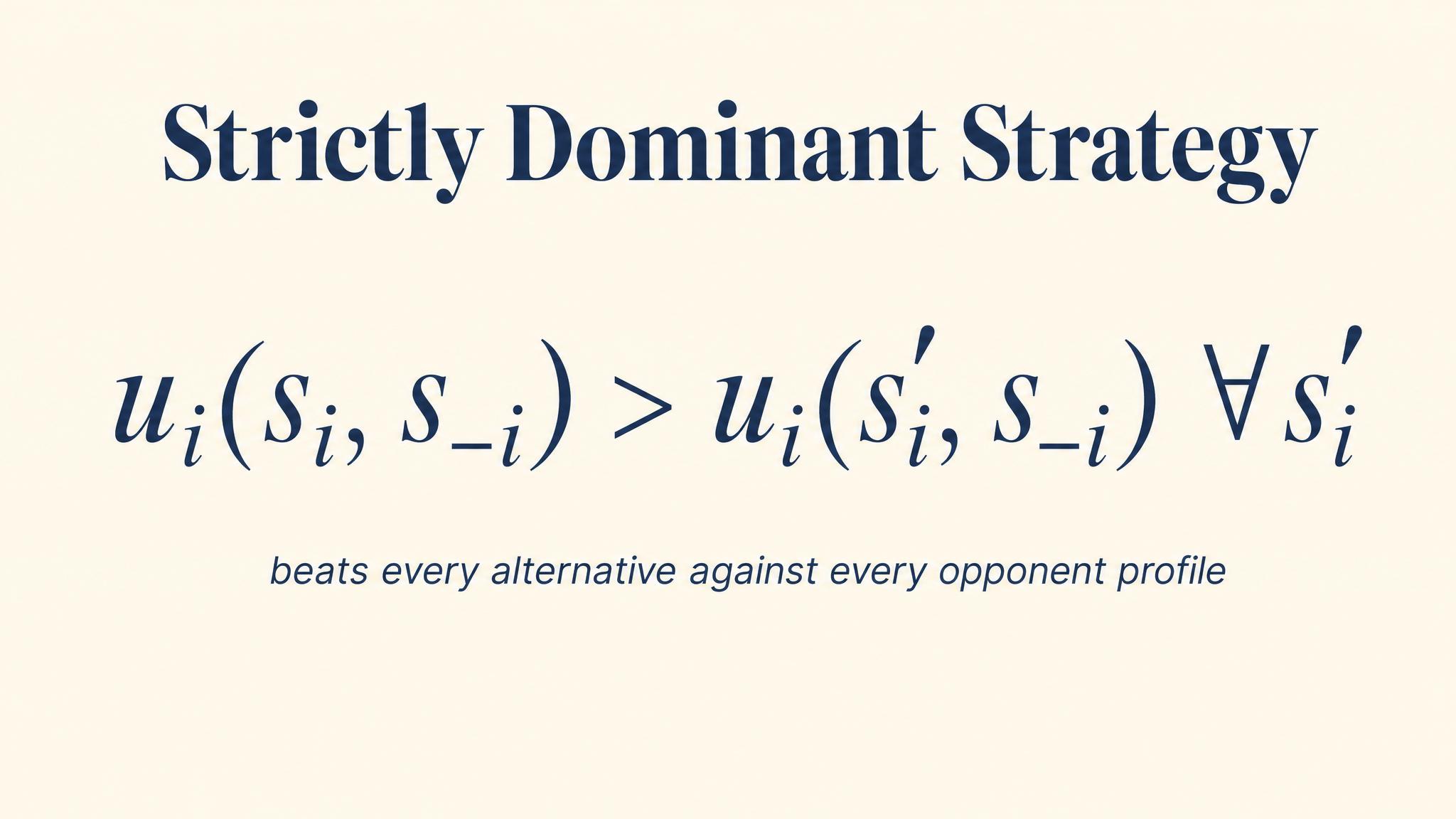
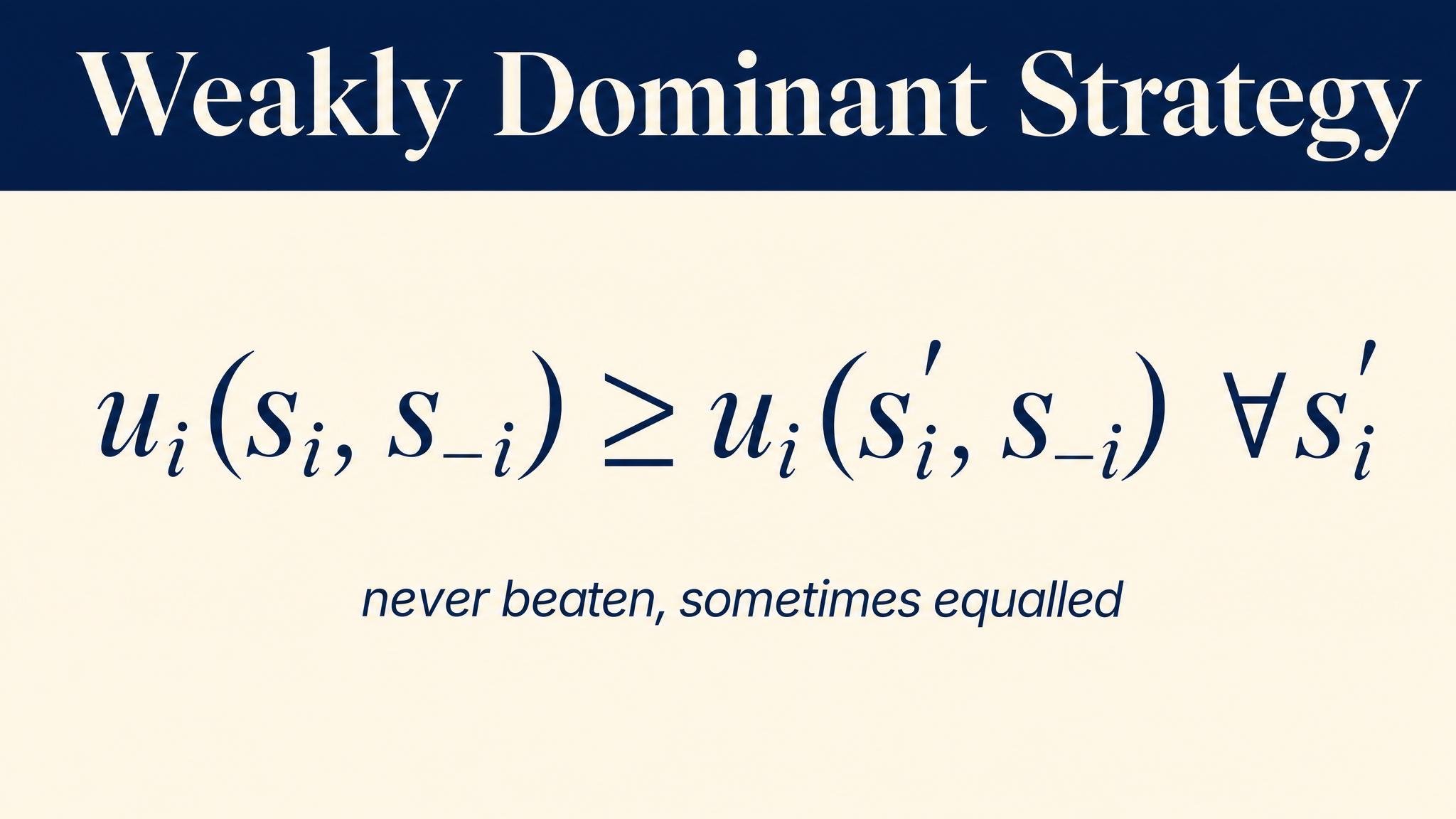
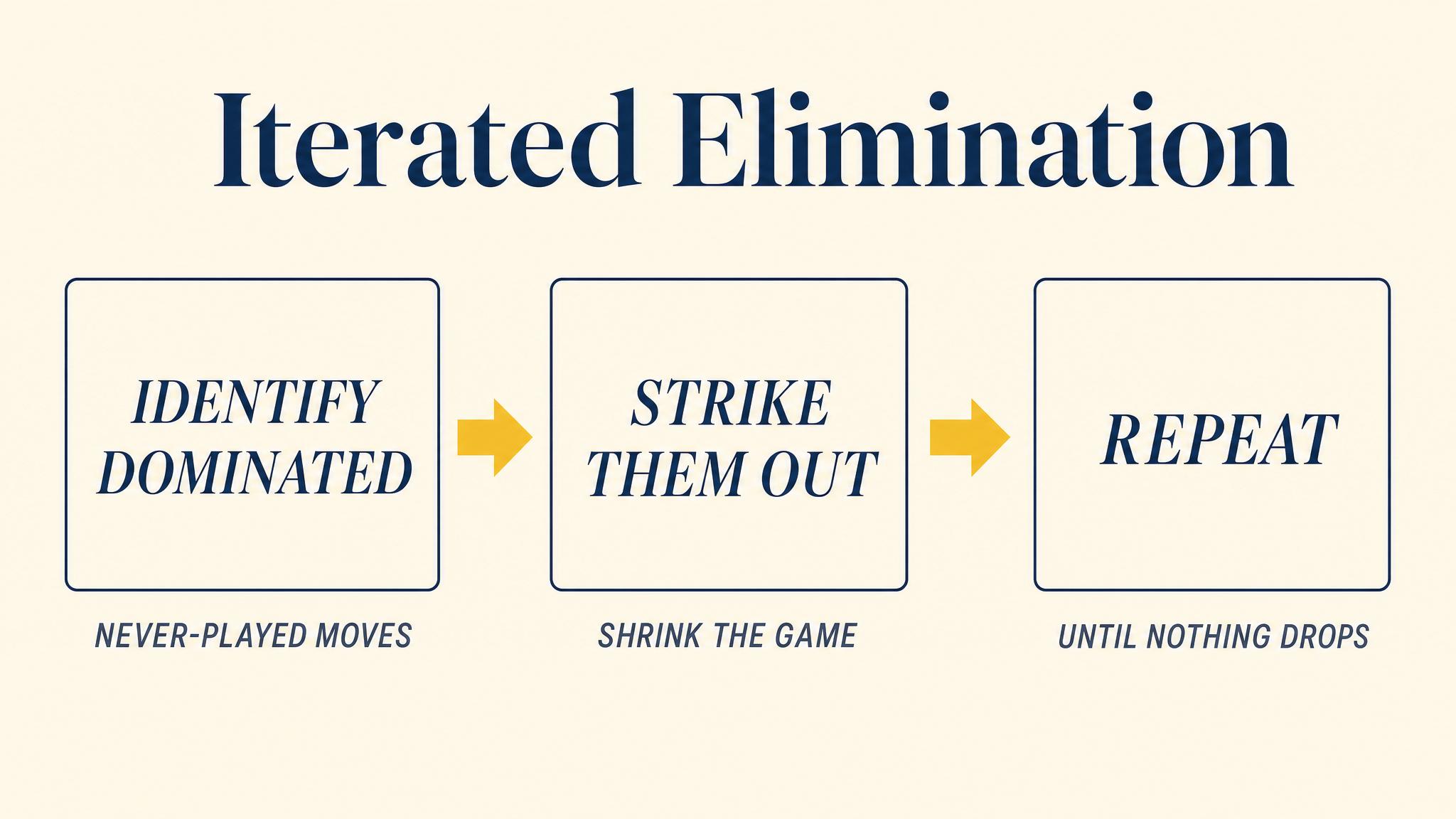
8-10 minutesProject 4-5 different game matrices sequentially (5x4, 3x3 variations). For each matrix, tables have 60 seconds to identify: (1) Any strictly dominated strategies, (2) Any weakly dominated strategies, (3) Write answers on whiteboard/paper. After time's up, cold-call tables for answers. Award points for correct identifications. After 3-4 games, announce winner. Final challenge: Show a game where iterated elimination works—can they find the Nash equilibrium by eliminating dominated strategies round by round? Debrief: When is dominance useful for predicting play? What survives iterated elimination?
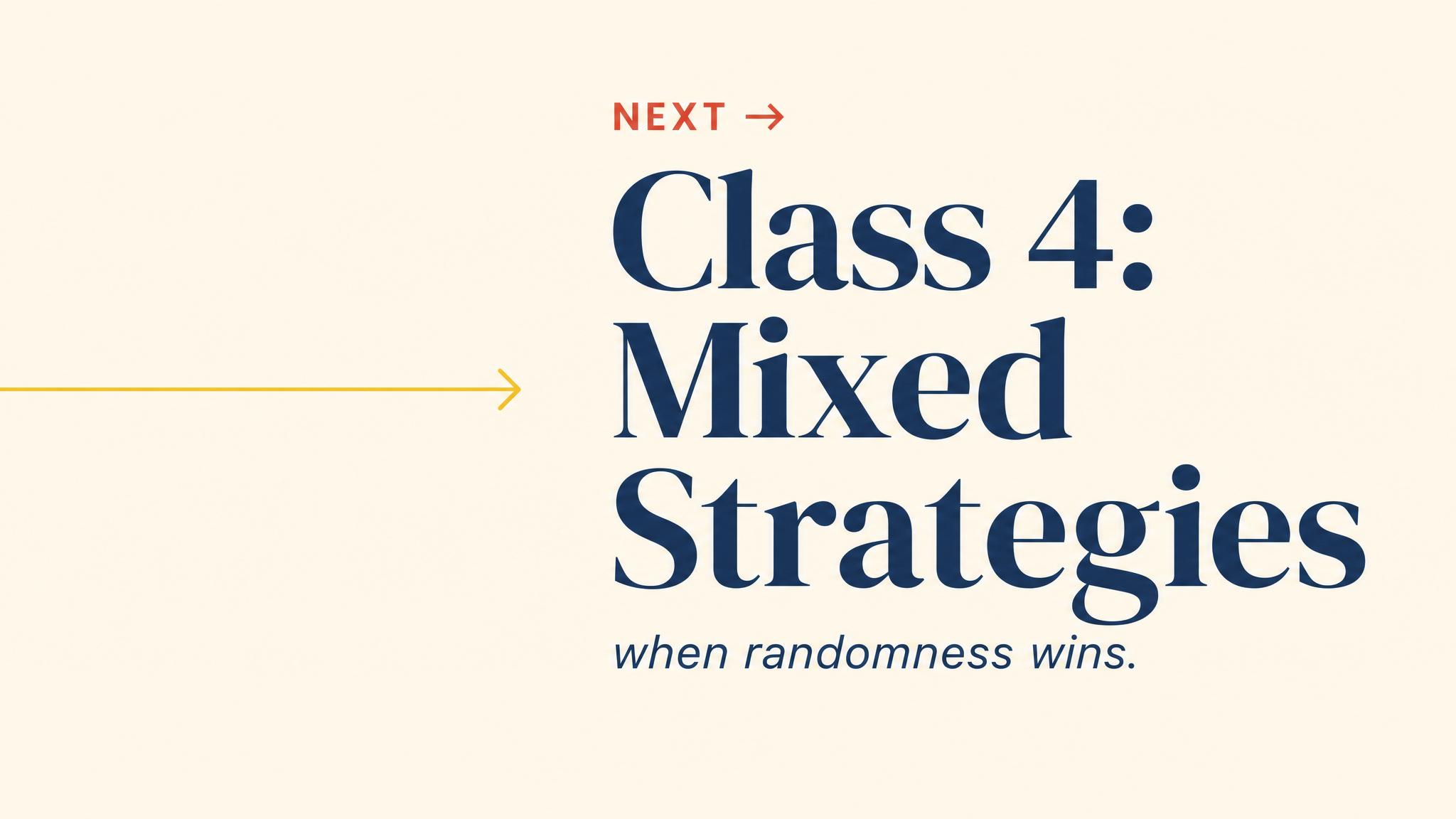
The Art of Unpredictability: Why Randomness Is Rational
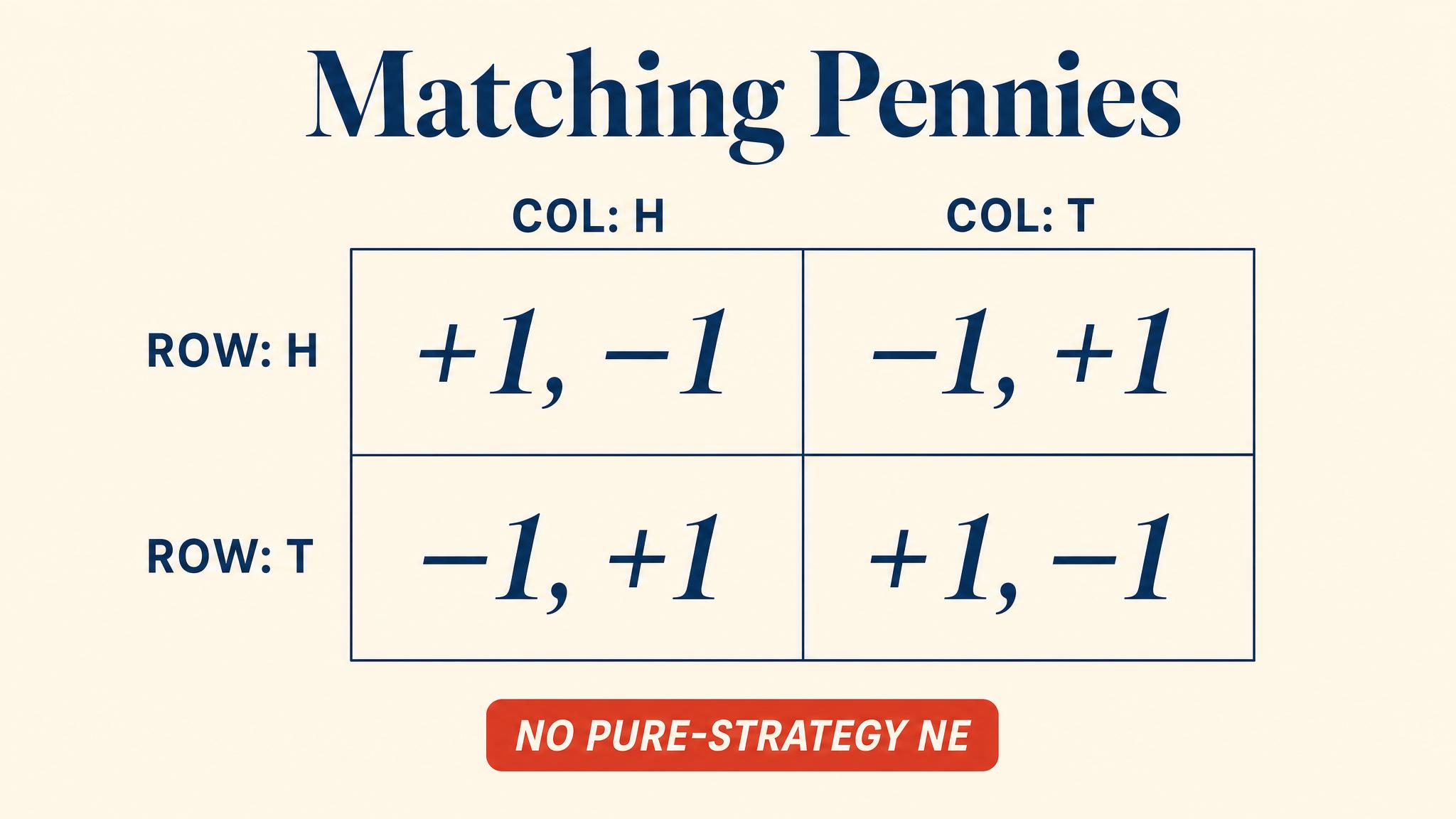
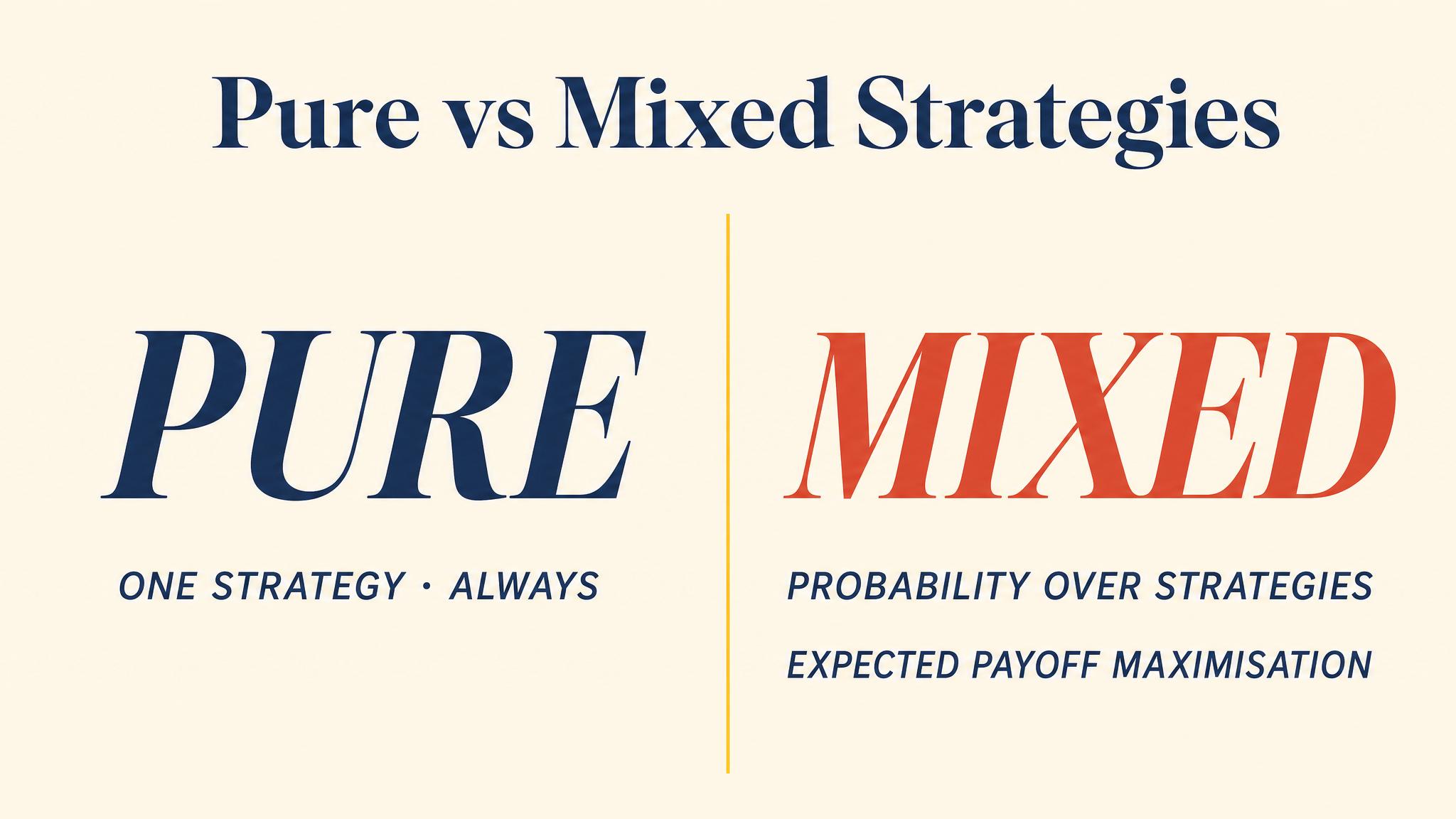
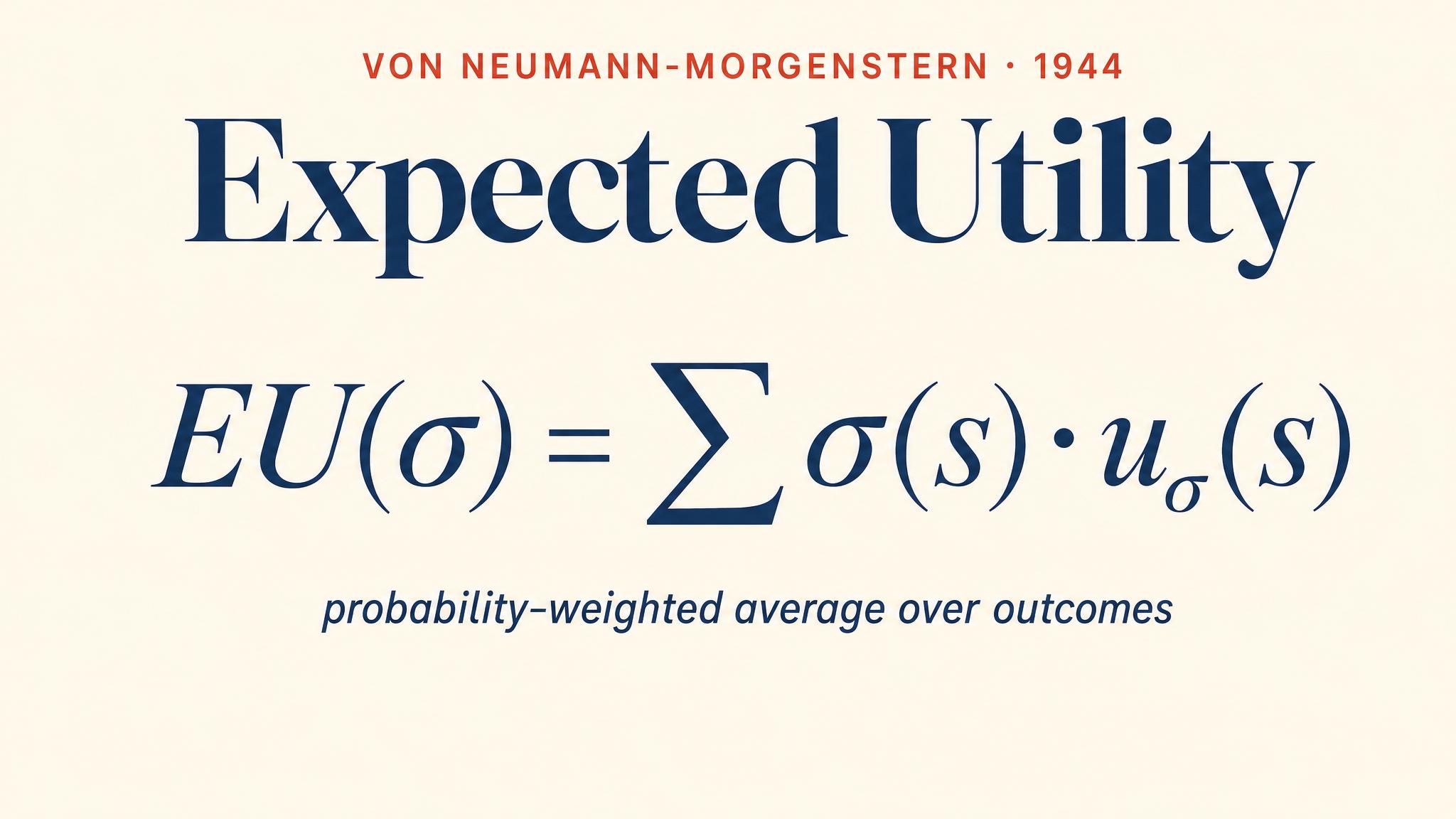
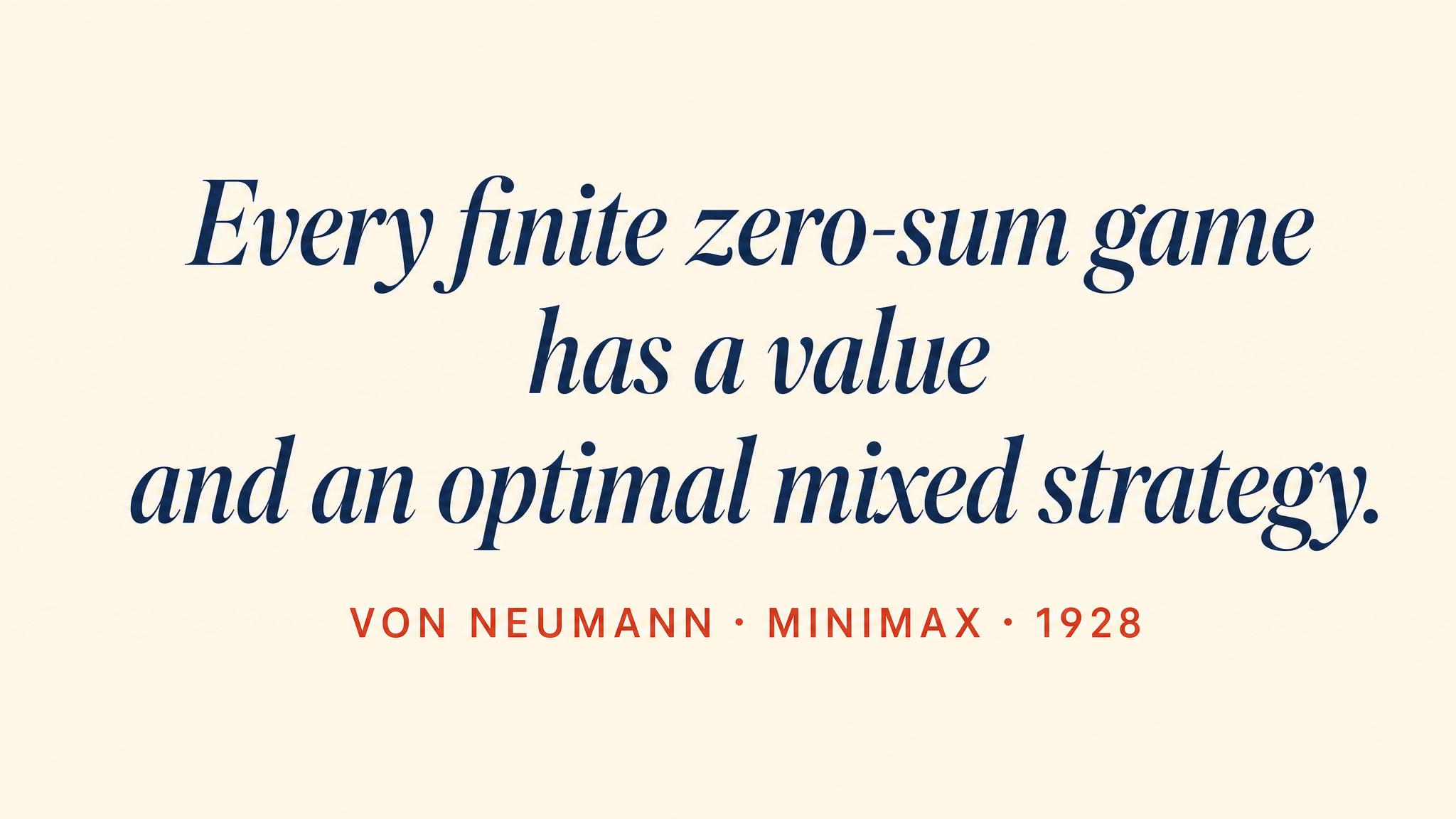
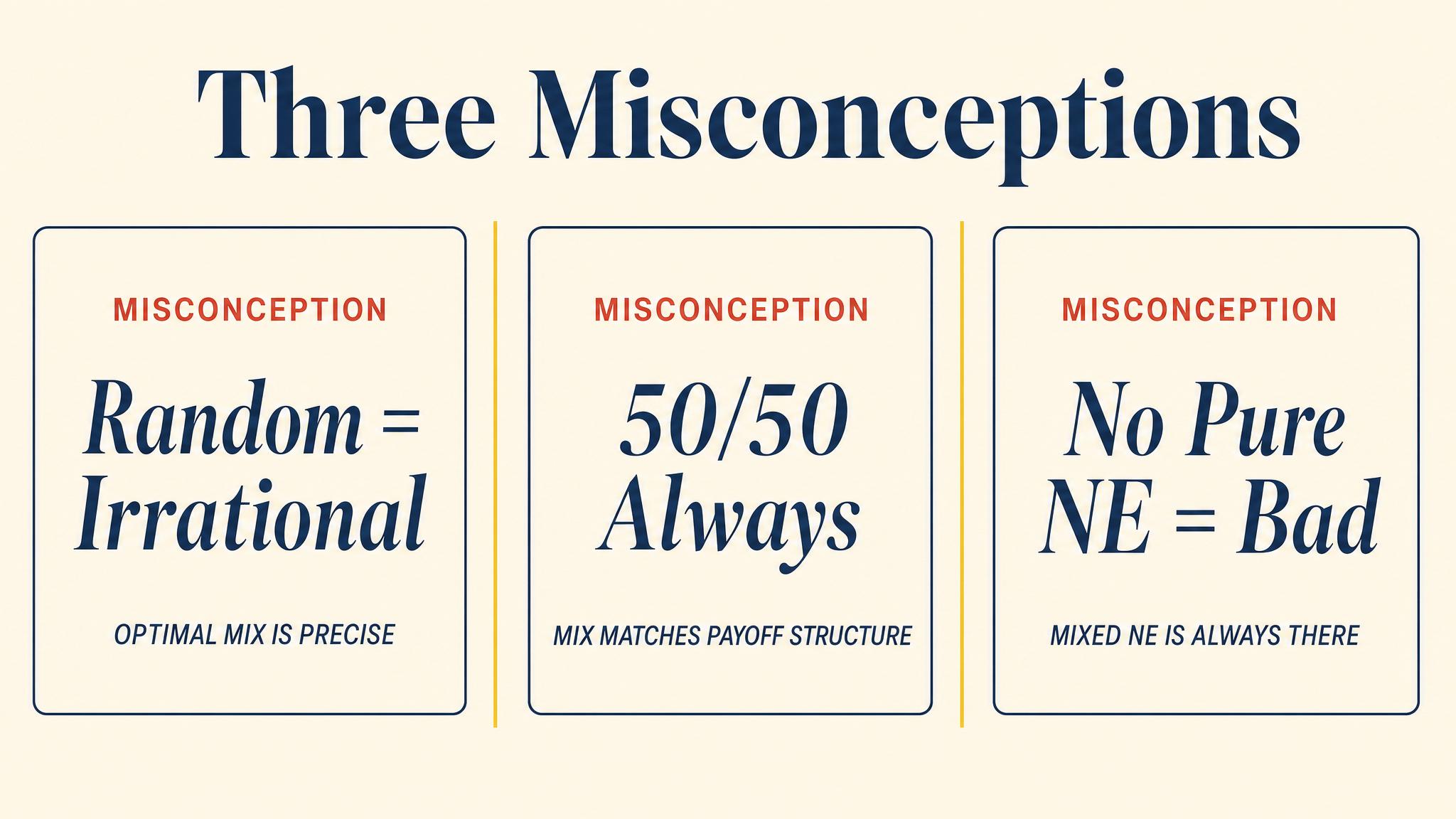
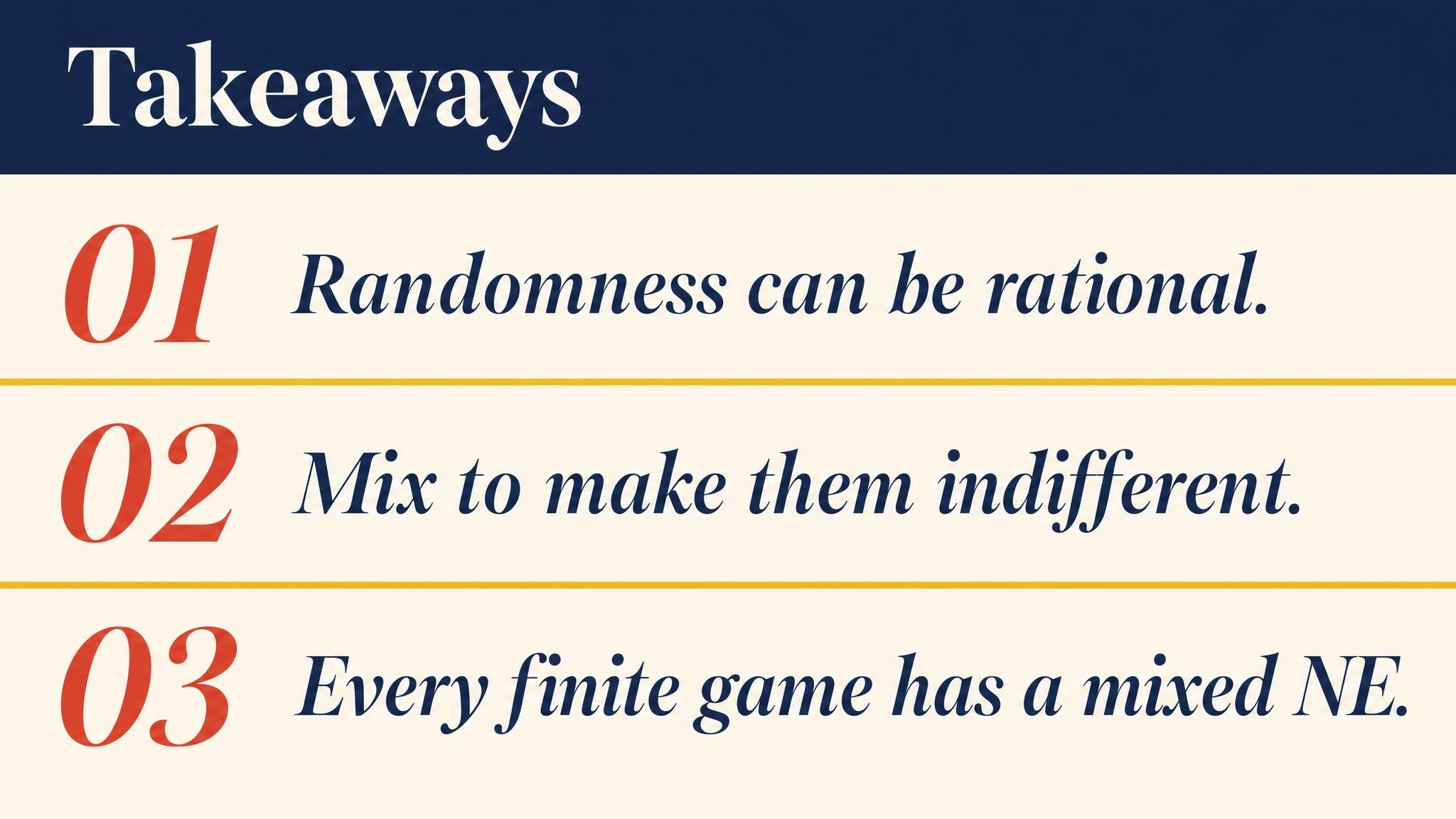
Chapter 3 ended with a puzzle: some games, like Matching Pennies, have no Nash equilibrium in pure strategies. If every deterministic choice can be exploited, what should a rational player do? The answer is one of game…
Is being 100% predictable in a relationship romantic (reliable and consistent) or a massive red flag (boring and stuck in a rut)?
Hot take
You're down to the final round of rock-paper-scissors for $1000. Your opponent has watched you play 10 times. Do you keep doing what's been working or completely change it up?
What would you do?
Which makes you better at poker: always having a strategy in mind, or sometimes making totally random moves to keep people guessing?
Debate time
Your roommate can predict exactly what you'll order at every restaurant. Is that a sign of deep friendship or proof you're too predictable?
Quick poll
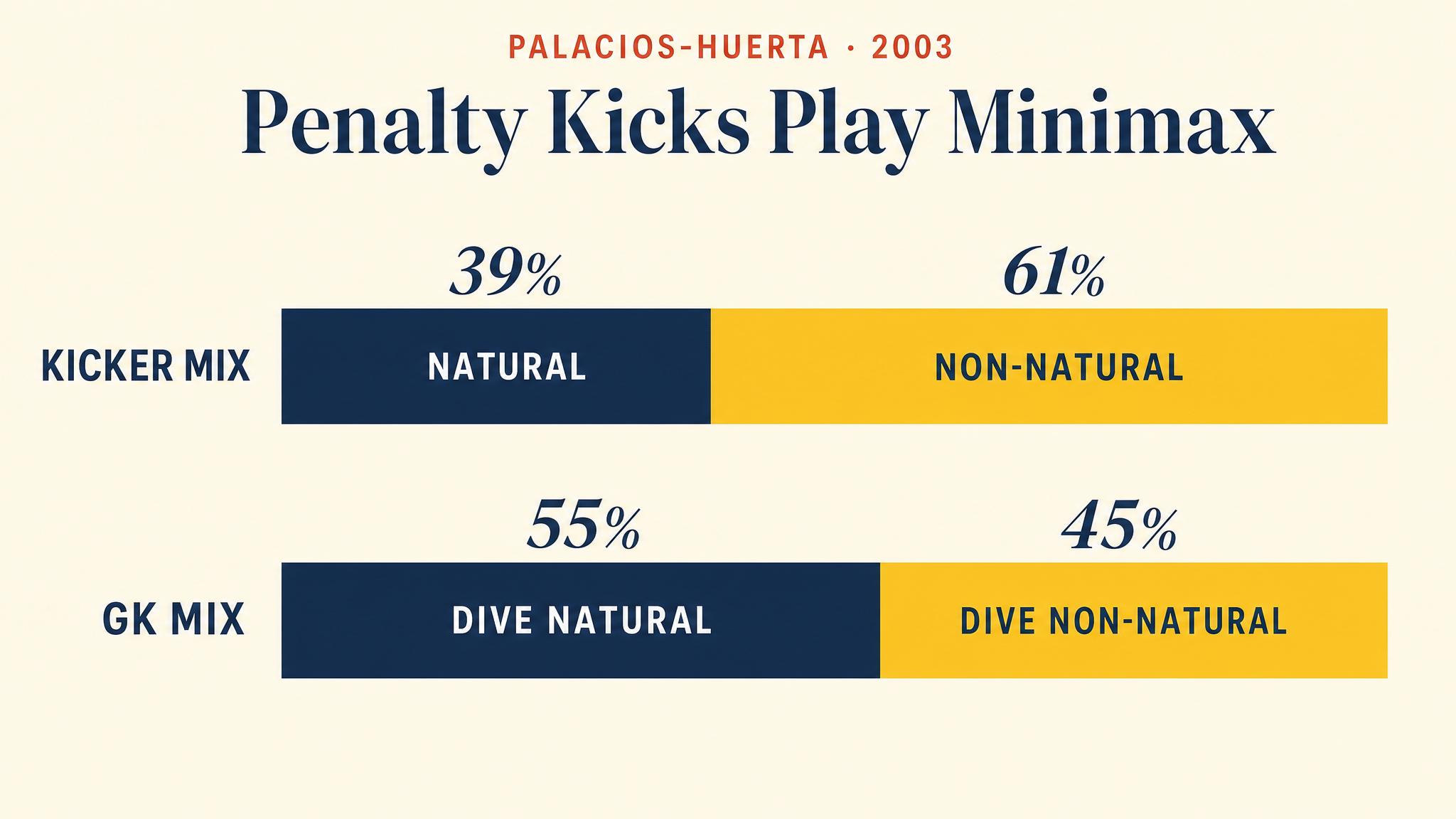
If a soccer goalie always dives right on penalty kicks, should the shooter ALWAYS go left, or is there a reason to still go right sometimes?
Would you rather
Is being spontaneous and unpredictable actually a personality trait, or is it just another kind of strategy to seem more interesting?
Real talk
Predictable Humans: The Randomness Challenge
10-12 minutesEach table splits into two groups. Group A writes down what they think is a random sequence of 20 L's and R's (left/right). Group B then tries to predict the next choice in the sequence by looking for patterns humans unconsciously create (alternation bias, avoiding long runs, etc.). Groups swap roles and compare prediction accuracy. Discuss why humans are terrible random number generators and why this matters for mixed strategies.
Penalty Kick Tournament: Finding the Mix
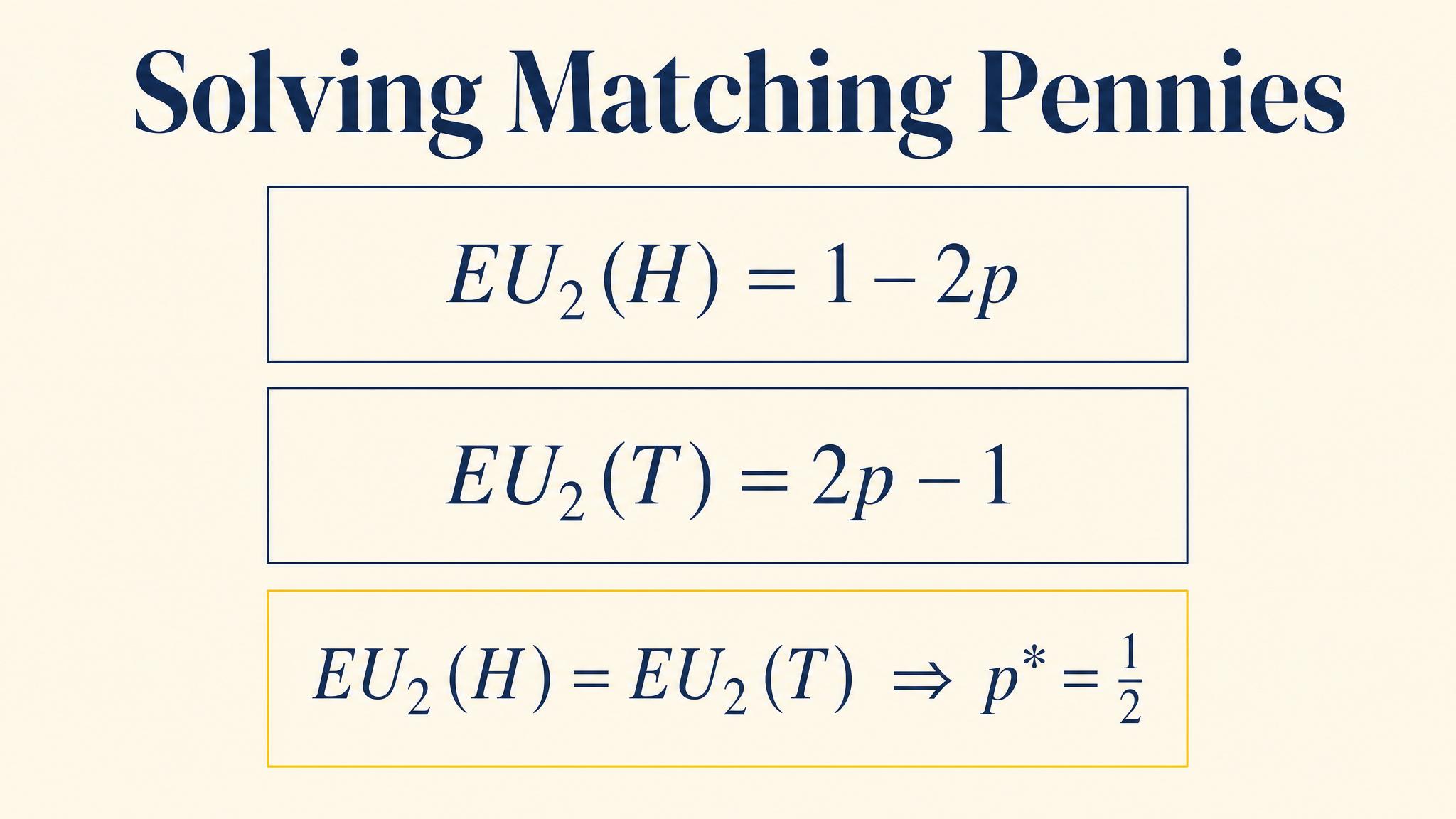
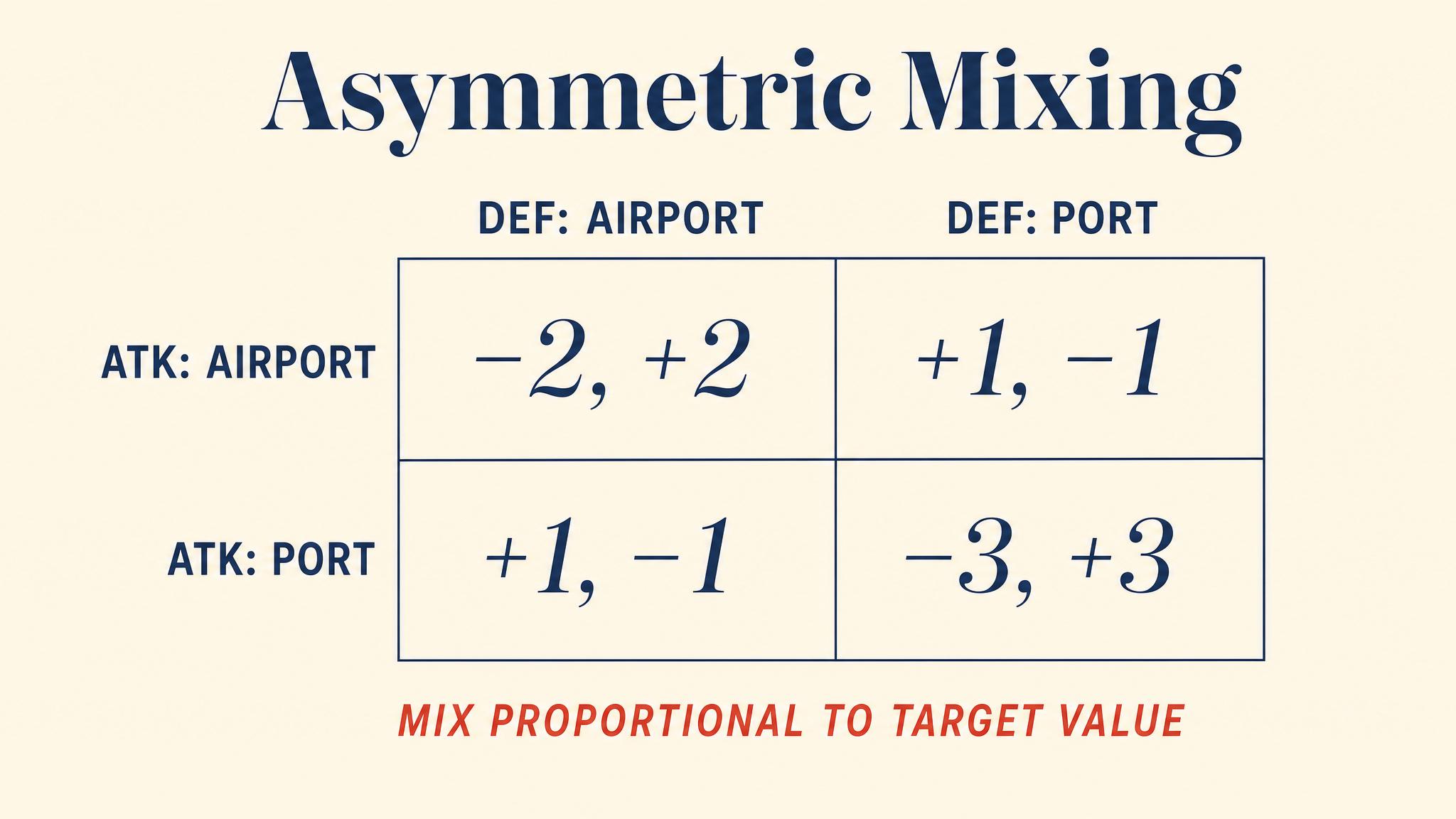
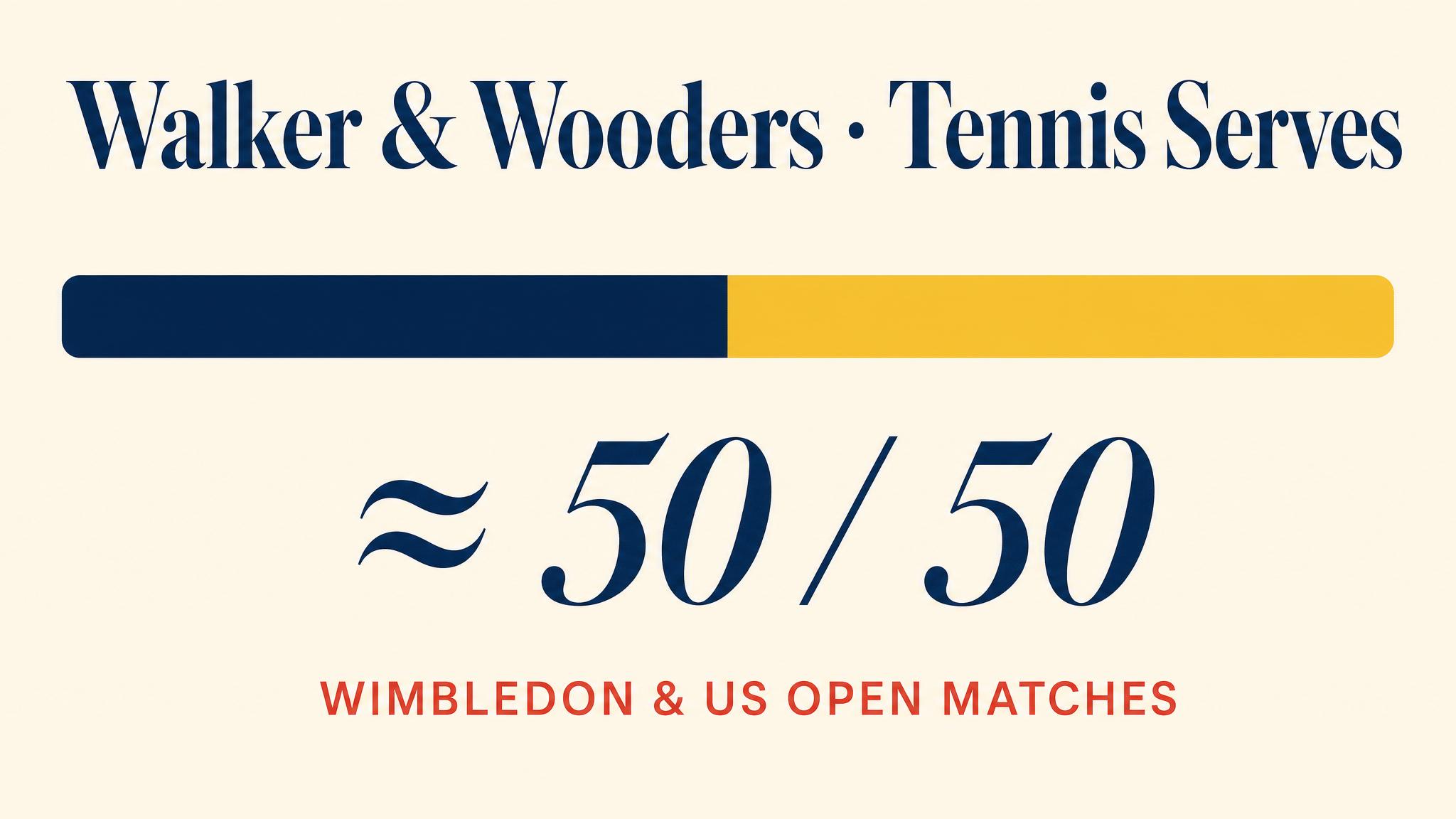
15-18 minutesWithin each table, pairs play a simplified penalty kick game (kicker: left/right, goalie: left/right). If choices match, goalie saves (goalie +1, kicker -1); if different, goal (kicker +1, goalie -1). Round 1: 10 kicks, play intuitively. Round 2: Calculate the Nash equilibrium mixed strategy (50/50). Round 3: 10 more kicks trying to implement the mix. Tables discuss: Did anyone deviate from 50/50? Did anyone get exploited? What happened to win rates?
Rock-Paper-Scissors Evolves: Payoff Asymmetries
12-15 minutesTables play modified RPS tournament. Round 1: Standard RPS (winner gets 1 point). Round 2: Rock wins get 3 points, Paper/Scissors wins get 1 point. Students predict: How should strategy change? Play 15 rounds and track frequencies. Round 3: Calculate expected utility for different mixing probabilities against the observed distribution. Did the equilibrium shift? Why should Rock now be played less often (not more)?
The Exploitation Game: Memory vs. Mixing
10-12 minutesEach table plays 'Matching Pennies' in teams (Team A wants to match, Team B wants to mismatch). Twist: After every 5 rounds, teams huddle to decide if they see patterns in opponents' play and adjust strategy. Teams must simultaneously reveal strategies. Then play 5 more rounds. Can teams exploit each other, or does awareness force convergence to 50/50? Debrief: When is randomization essential vs. when can you exploit non-equilibrium play?
Minimax Detective: Solve Then Play
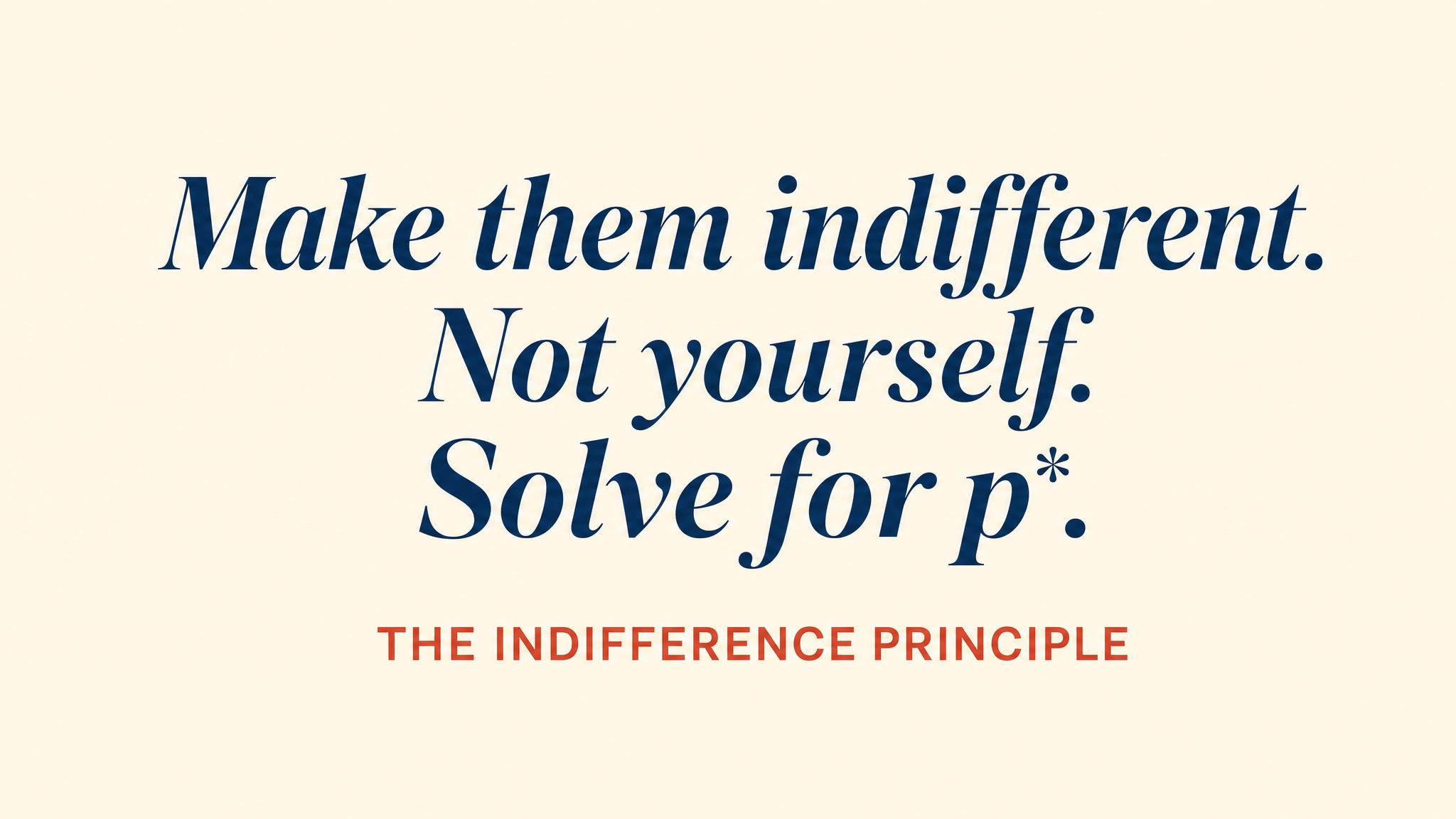
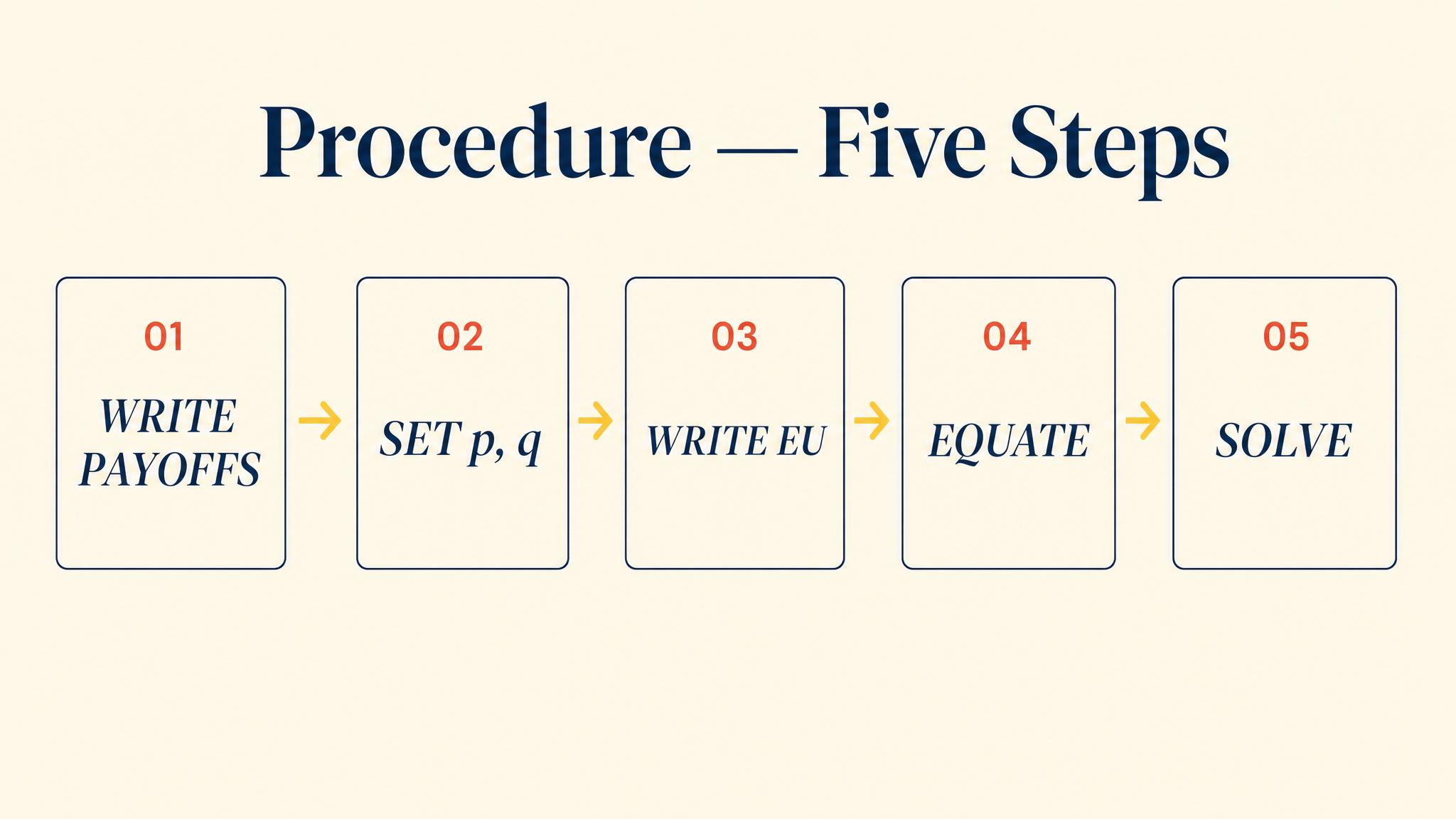
15-18 minutesInstructor provides each table with a 2x2 game matrix (asymmetric, no pure Nash). Tables have 7 minutes to: (1) Calculate the mixed strategy Nash equilibrium using the indifference equations, (2) Calculate expected utility at equilibrium. Then tables pair up and play 20 rounds against another table. Did actual play approximate the equilibrium? Which table came closest? Were payoffs near the predicted expected utility?
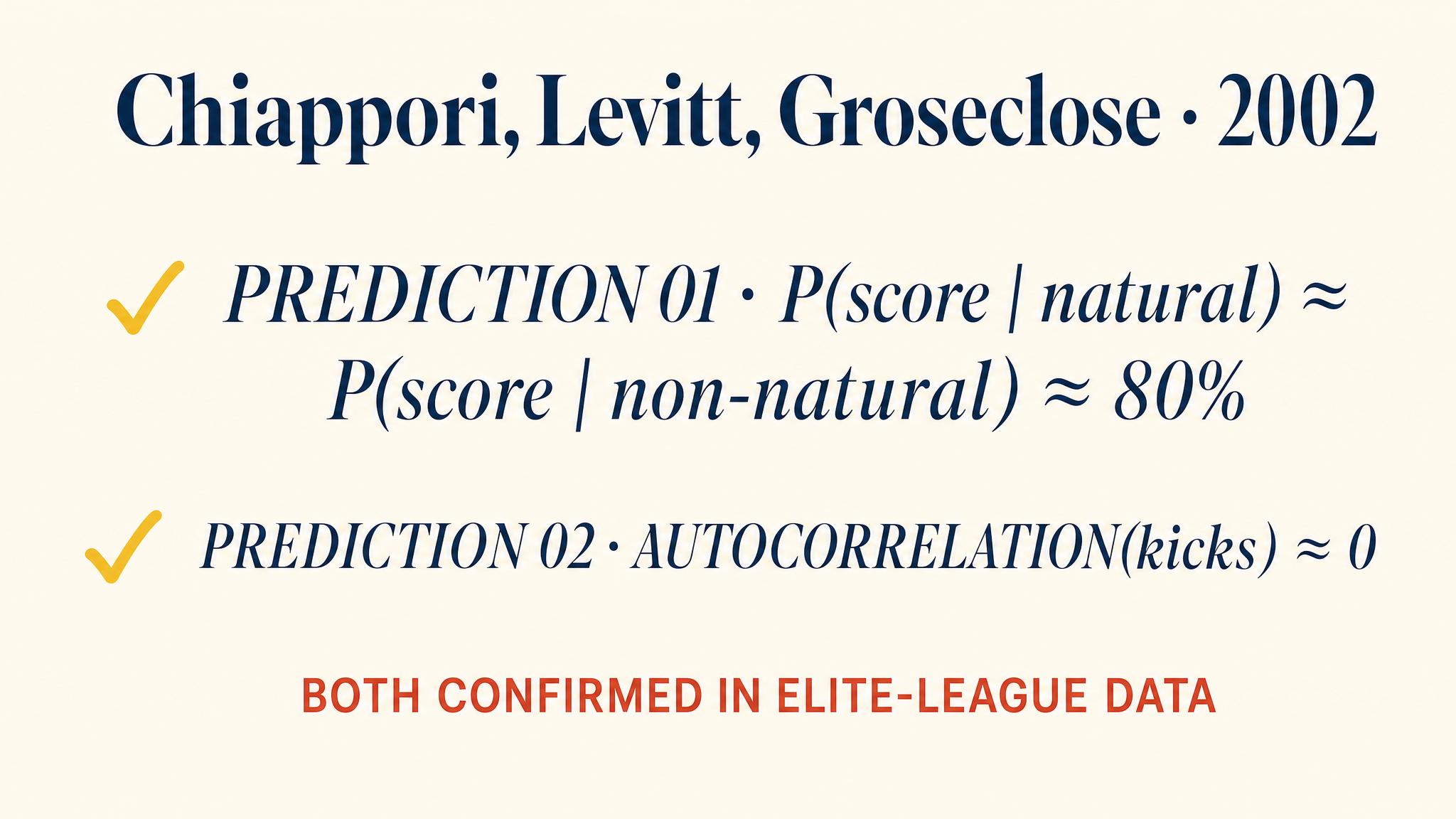
Serial Correlation Hunt: Streaks and Strategy
8-10 minutesQuick empirical test: Each table member simultaneously reveals a choice (A or B) for 15 rounds, trying to be 'maximally random.' Then analyze: (1) Was overall frequency 50/50? (2) Count streaks (AAA, BBB). (3) Calculate how often choices switched vs. repeated. Compare to what true randomness would generate (binomial distribution). Discuss: If opponents track these patterns, how could you be exploited? This reveals why genuine mixing requires external randomization (coins, dice).
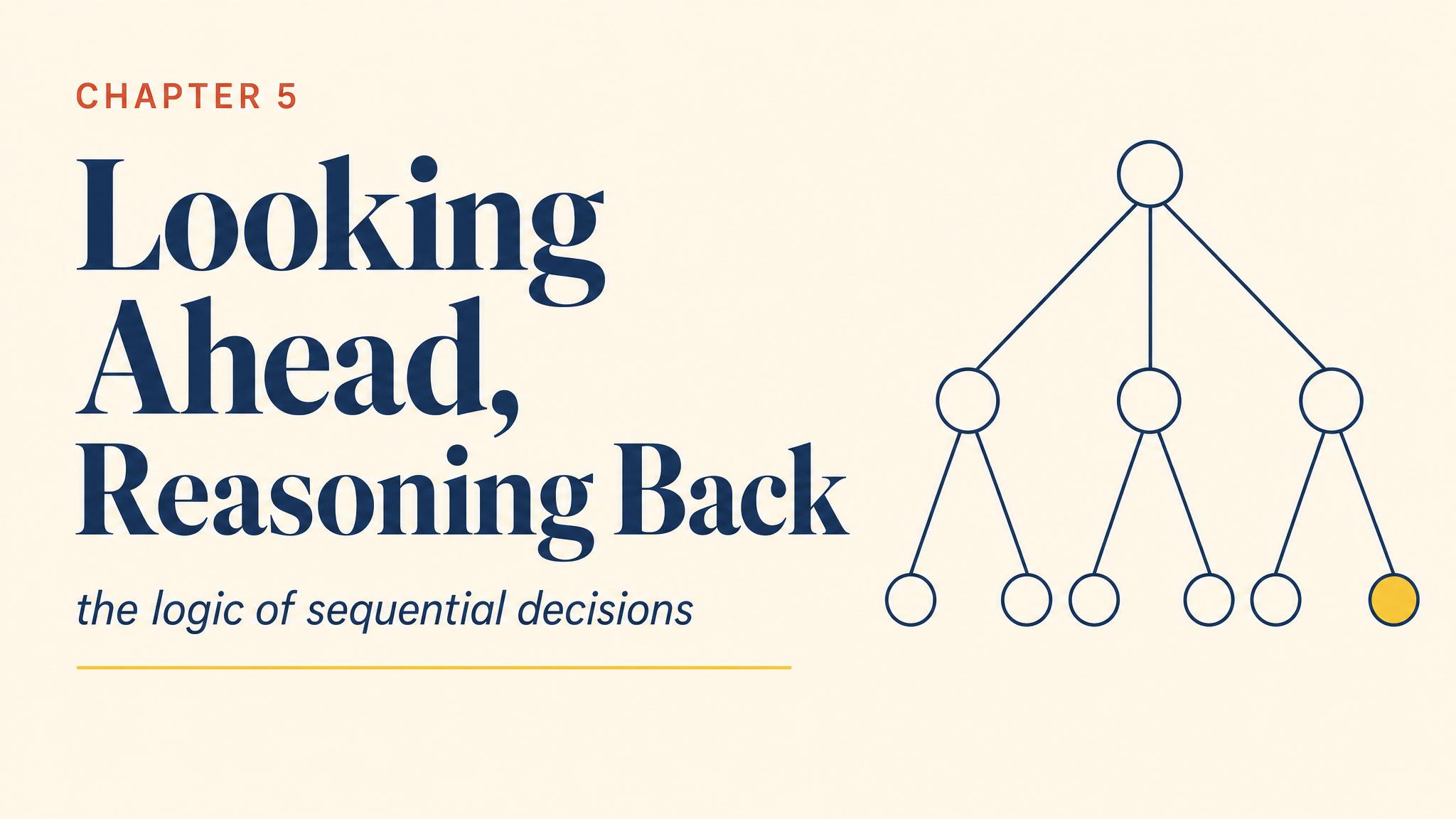
Looking Ahead, Reasoning Back: The Logic of Sequential Games
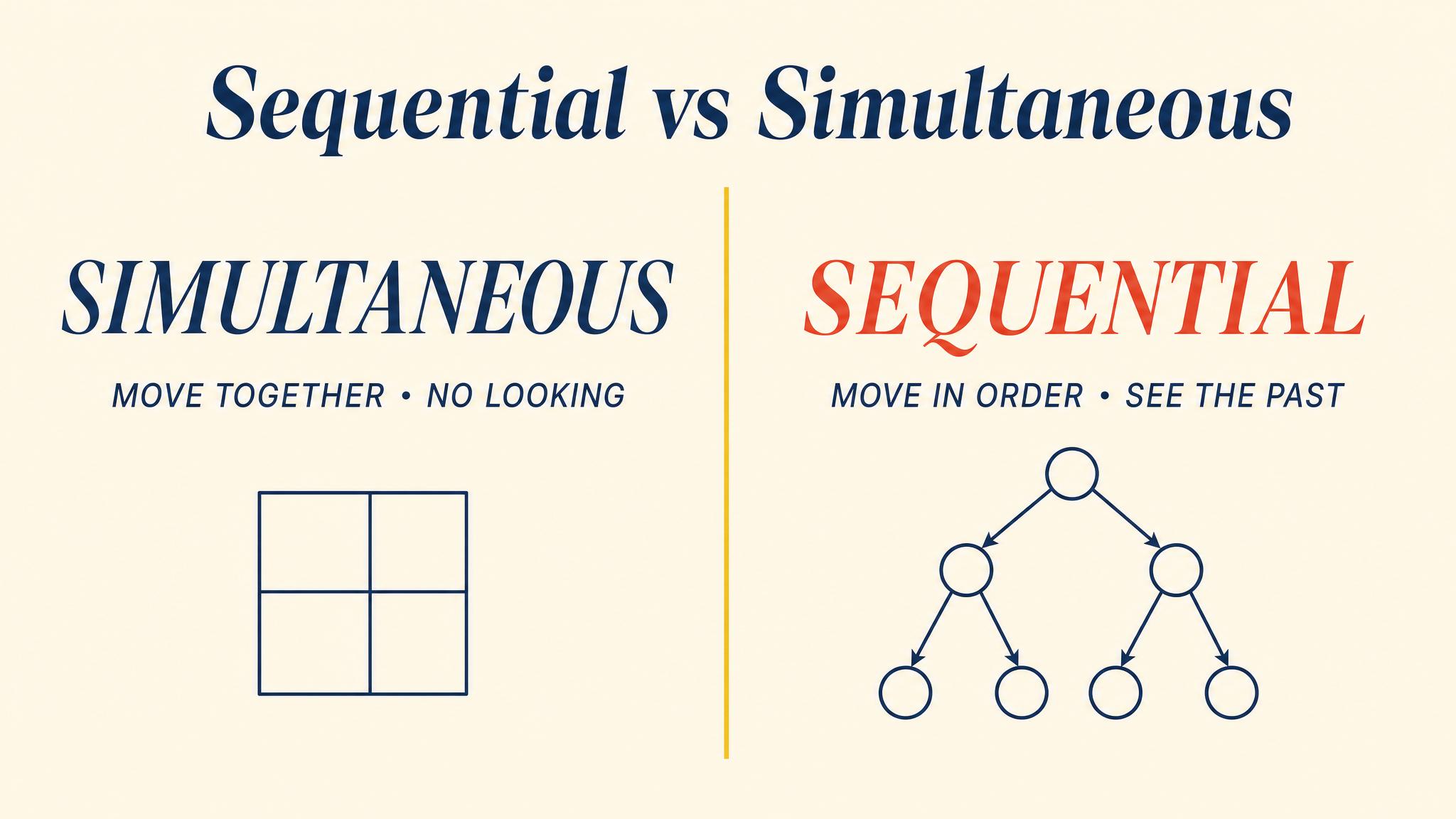
Chapters 3 and 4 analysed games where players choose simultaneously, unable to observe each other's moves. This chapter introduces time. When players move in sequence — when one can see what the other has done before…
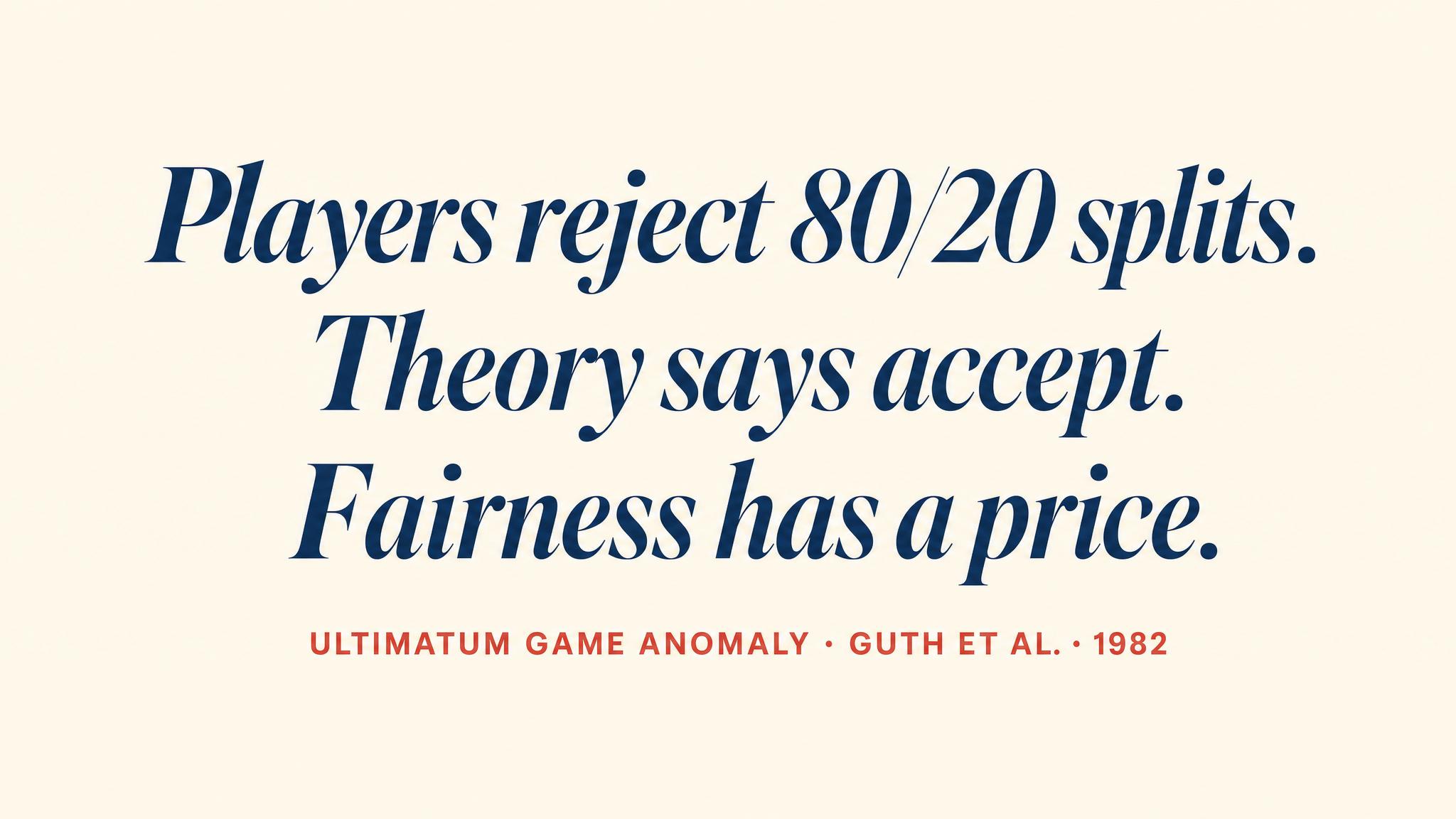
Someone offers you a deal: they'll give you $50 from a $100 pot, and they keep $50. BUT if you say no, you both get nothing. Do you take it? What if they offered you $30? $10? $1?
Quick poll
Would you rather make the first move when asking someone out, or wait for them to make the move? Does going first give you power or just make you vulnerable?
Would you rather
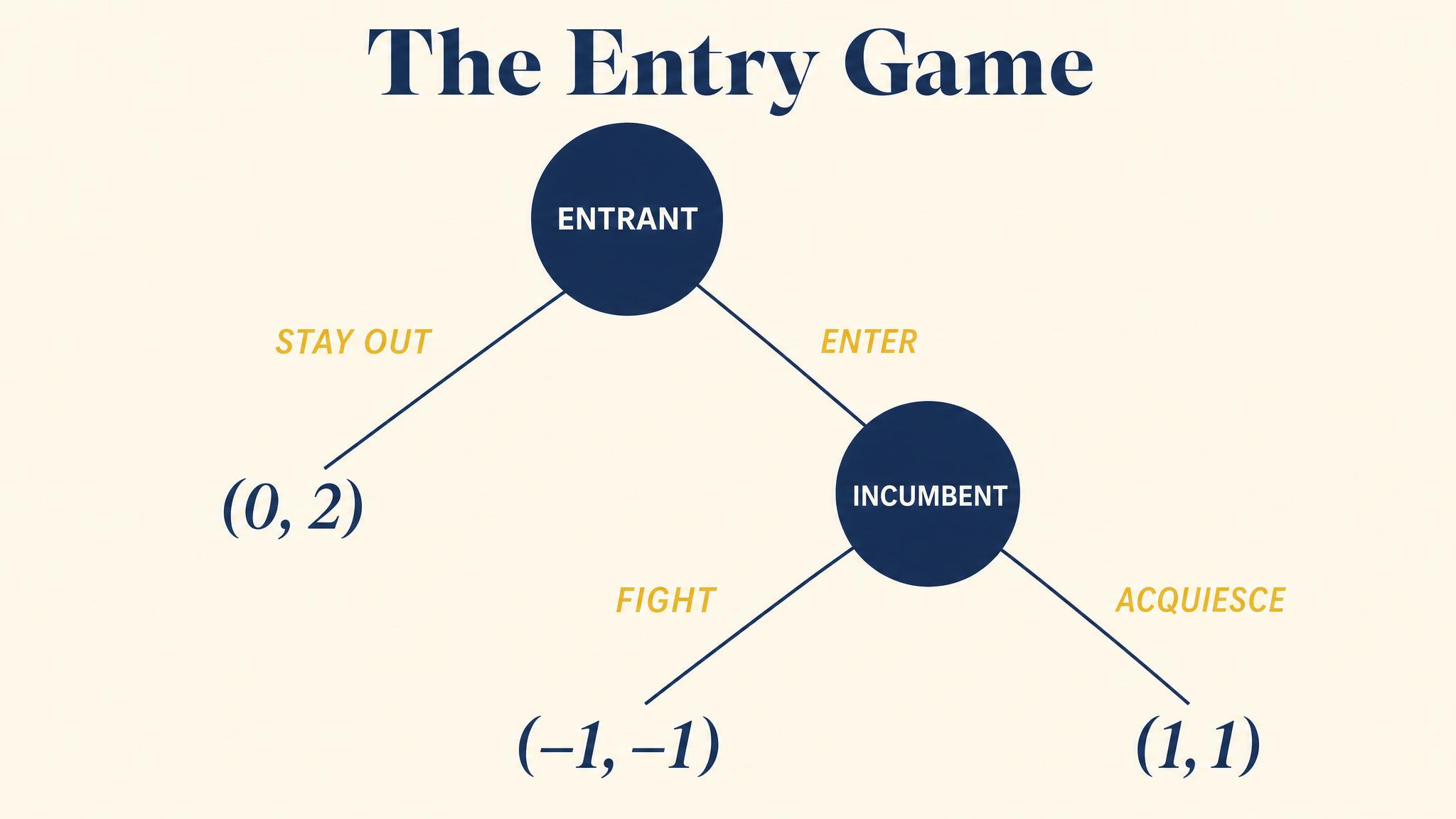
Your roommate threatens to move out if you don't do the dishes. You know they won't actually leave. Should you call their bluff, or do empty threats still work?
Real talk
You're in a group negotiating how to split up a big project. Someone says 'I'll pick my part first, then you can choose from what's left.' Are you getting screwed, or does order not matter?
Debate time
If you were planning your career, would you start by picking your dream job and work backwards, or just see where life takes you? Does thinking backwards from your goal actually work?
Hot take
When someone threatens to break up with you or quit the team, should they ALWAYS mean it? Or are threats a normal part of negotiating what you want?
Unpopular opinion?
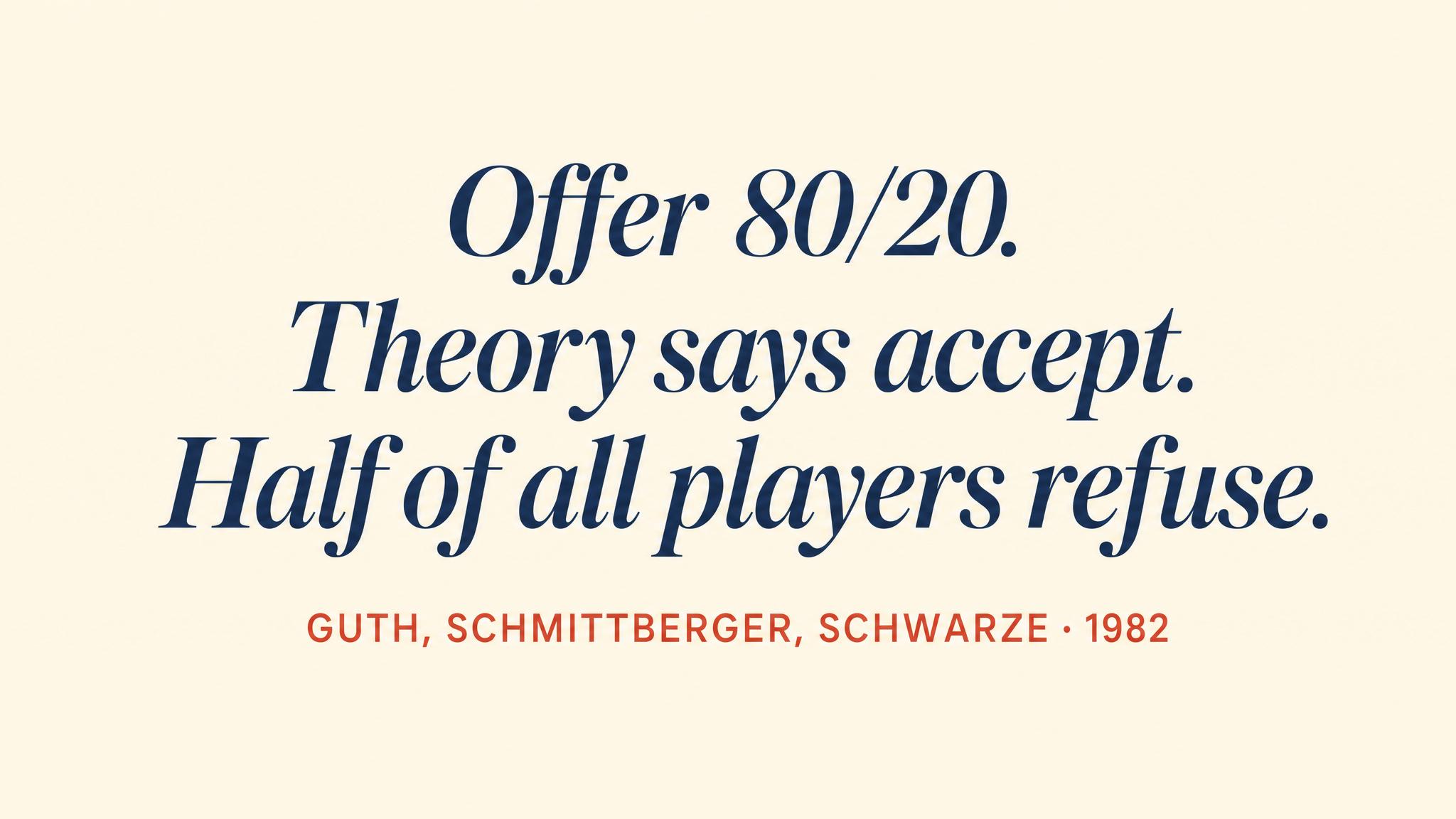
Live Ultimatum Game Experiment & Data Reveal
15-20 minutesEach table splits into proposers and responders. Round 1: Proposers write down their offer (split of $100) on paper, responders simultaneously write accept/reject threshold. Collect data live via quick poll or show of hands. Display aggregate results on screen. Round 2: Tables discuss predictions using backward induction - what SHOULD rational actors do? Round 3: Run again with new roles, compare actual behavior vs. theoretical prediction. Debrief on why people deviate from subgame perfect equilibrium.
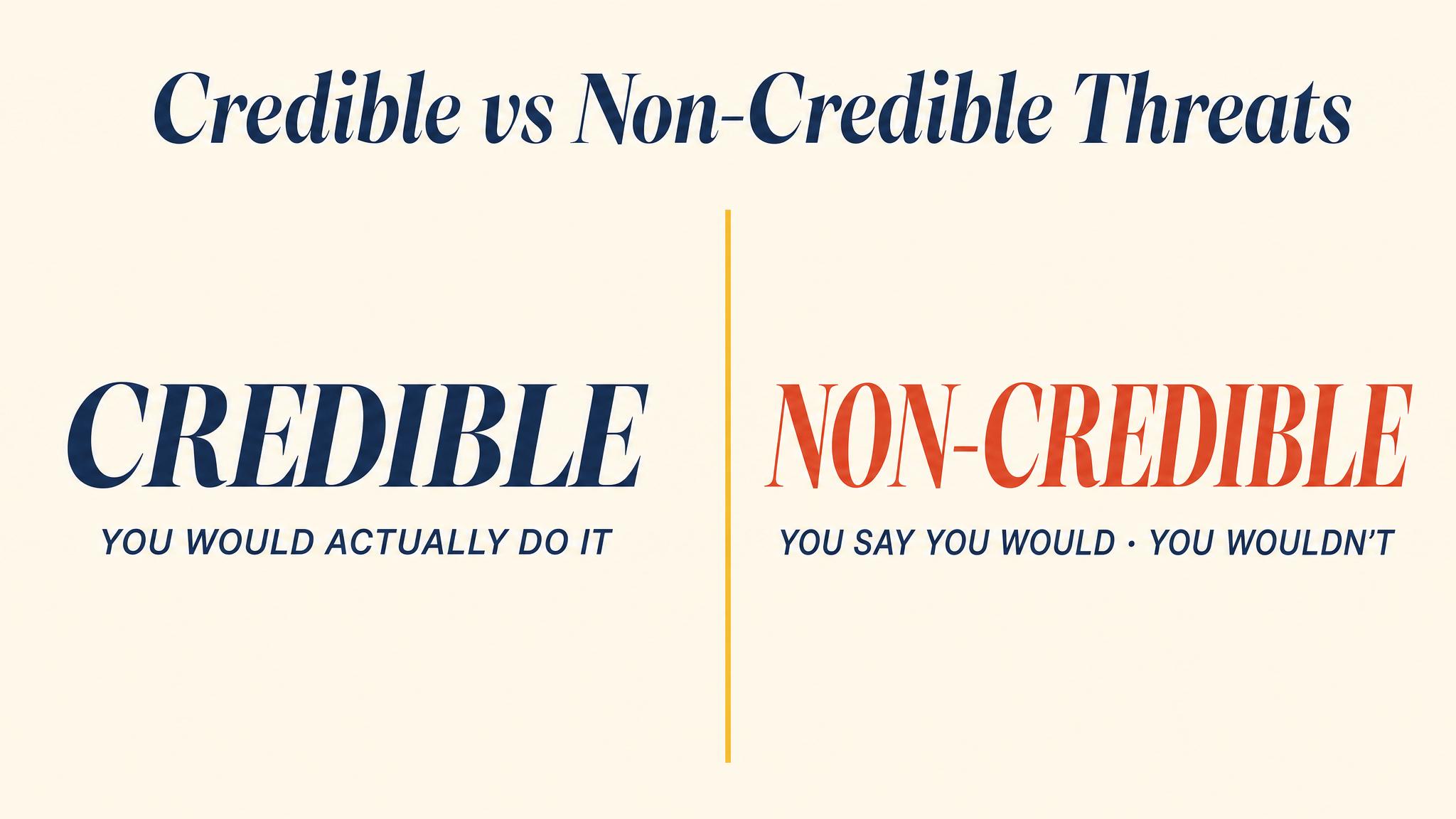
The Credible Threat Courtroom
12-15 minutesPresent 3 business scenarios (e.g., 'CEO threatens to shut down division if workers strike', 'Firm threatens price war if competitor enters market', 'Parent company threatens to pull funding from subsidiary'). Each table acts as a 'credibility court' - they have 3 minutes per scenario to determine if threat is credible using backward induction. Tables hold up color cards: GREEN (credible), RED (non-credible), YELLOW (depends). Randomly call on tables to defend their verdict. Score points for correct reasoning, not just correct answer.
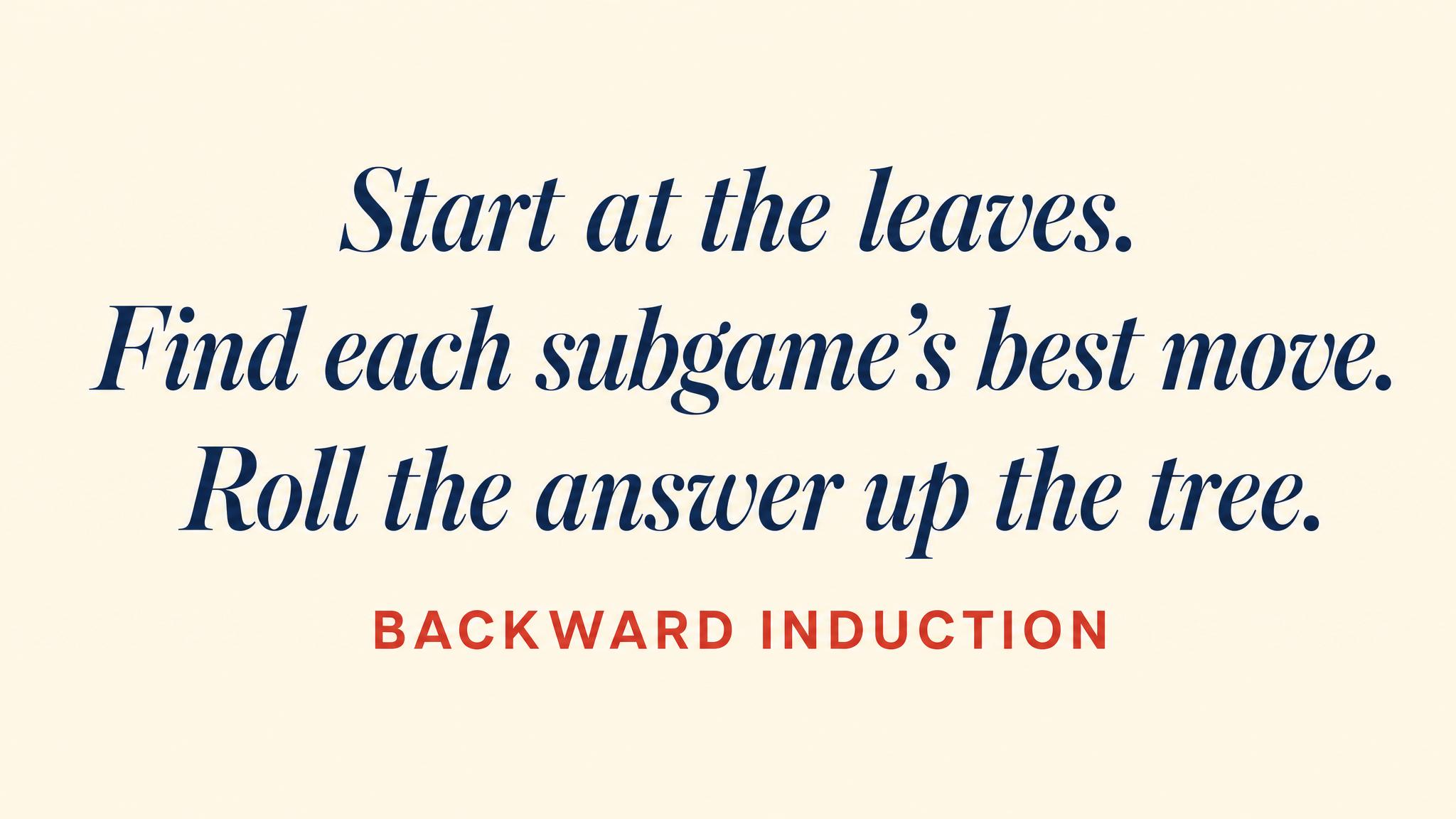
Backward Induction Speed Puzzle Race
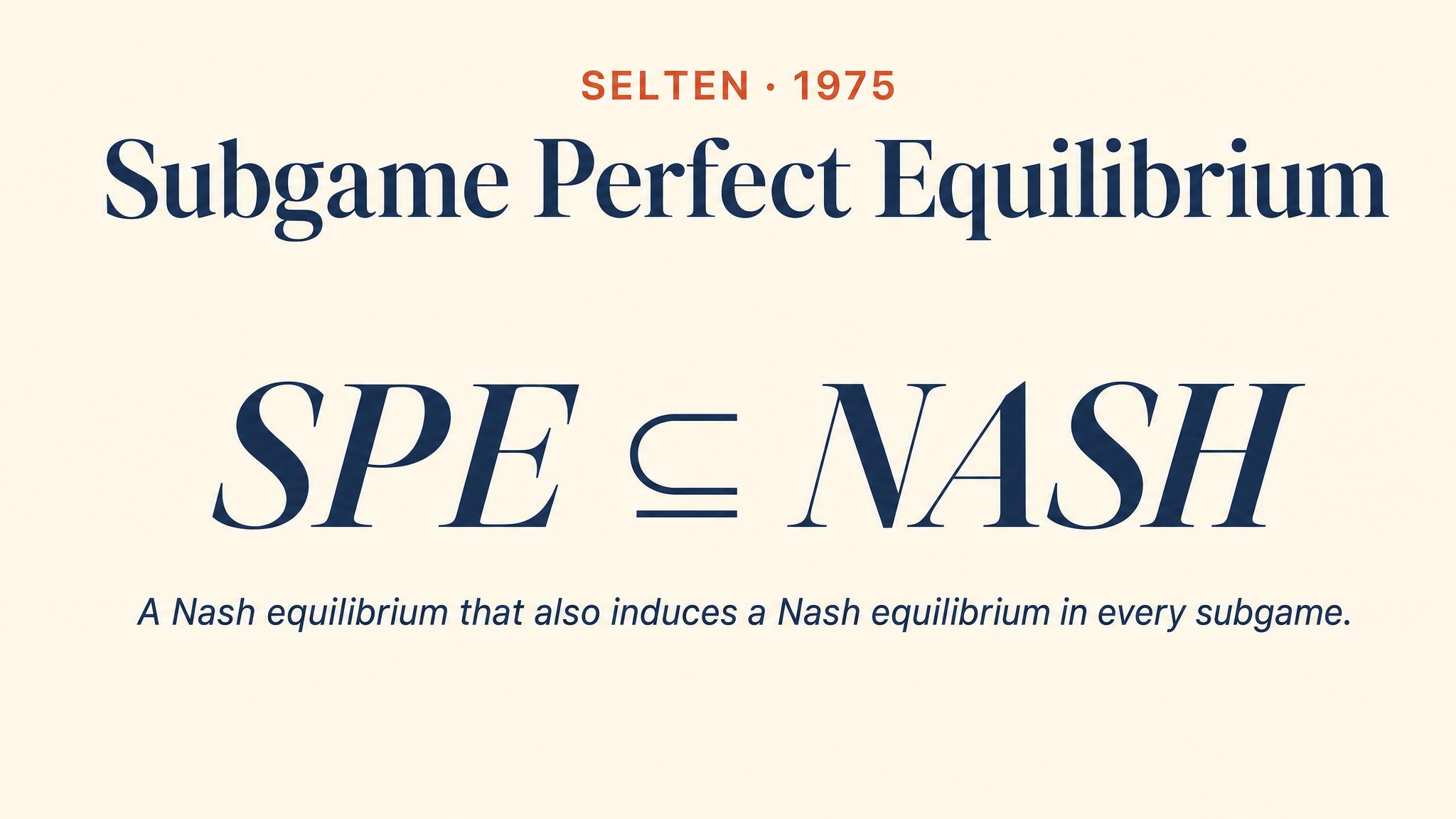
10-12 minutesProject a game tree on screen (start simple, get complex). Tables race to solve via backward induction. First table to correctly identify the subgame perfect equilibrium path rings bell/raises hand. They explain their reasoning; if correct, they get point. Run 4-5 increasingly complex trees. Include at least one trick tree where the Nash equilibrium differs from subgame perfect equilibrium. Winning table gets to challenge instructor to solve one THEY create.
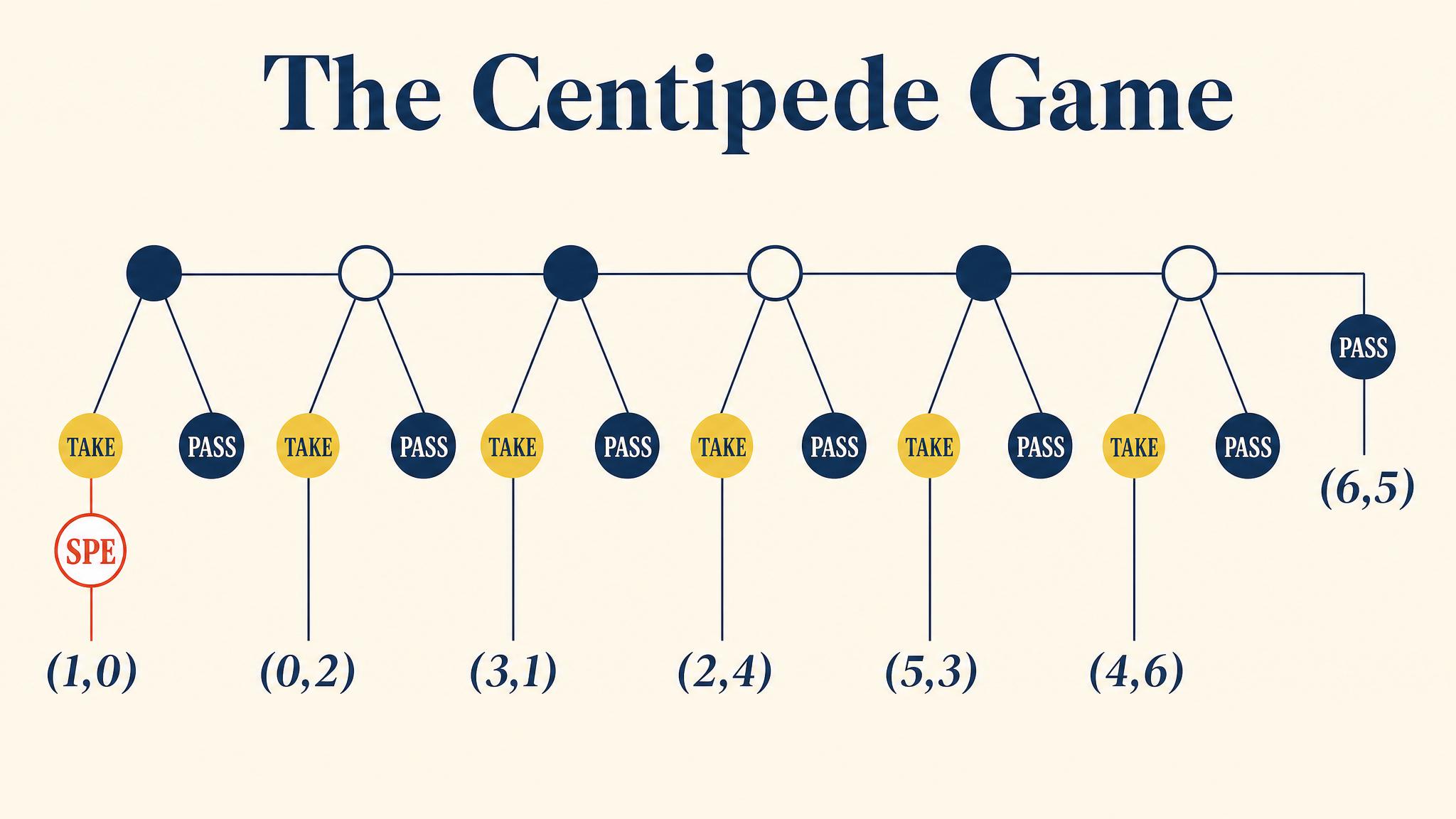
Centipede Game Tournament with Betrayal Tracker
15-18 minutesTables pair up to play multi-round centipede game. Each table designates Player 1 and Player 2. Start with small pot ($4), double each round. Players alternate taking or passing. TWIST: Use a 'betrayal scoreboard' - track which tables cooperate longest before someone takes. After 3 pairings, discuss: Did first-mover advantage matter? When did people take vs. theory prediction (immediately)? Did reputation across rounds change behavior? Reveal that longest-cooperating table wins bonus point.
The First-Mover Advantage Auction
10-12 minutesPresent a sequential market entry scenario: Two firms can enter a market, but first mover gets cost advantage. Each table splits into Firm A (decides first) and Firm B (observes then decides). Firm A writes 'Enter' or 'Stay Out' privately. Then reveal simultaneously. Calculate payoffs based on game tree logic. Rotate roles and change parameters (e.g., vary first-mover advantage size). Tables track when first-mover advantage matters vs. doesn't. Debrief: When is moving first valuable? When is it better to wait and observe?
Fix the Faulty Strategy
8-10 minutesShow 3-4 proposed strategies for sequential games that contain non-credible threats or backwards induction errors. Example: 'Player 2 will reject any offer below $80 in the ultimatum game' or 'We'll flood the market if competitor enters, even though we'd lose money'. Tables have 2 minutes per case to: (1) identify why strategy fails backward induction, (2) write a credible alternative. Cold-call tables for explanations. Vote on best 'fixed' strategy.
The Shadow of Tomorrow: How Repetition Breeds Cooperation
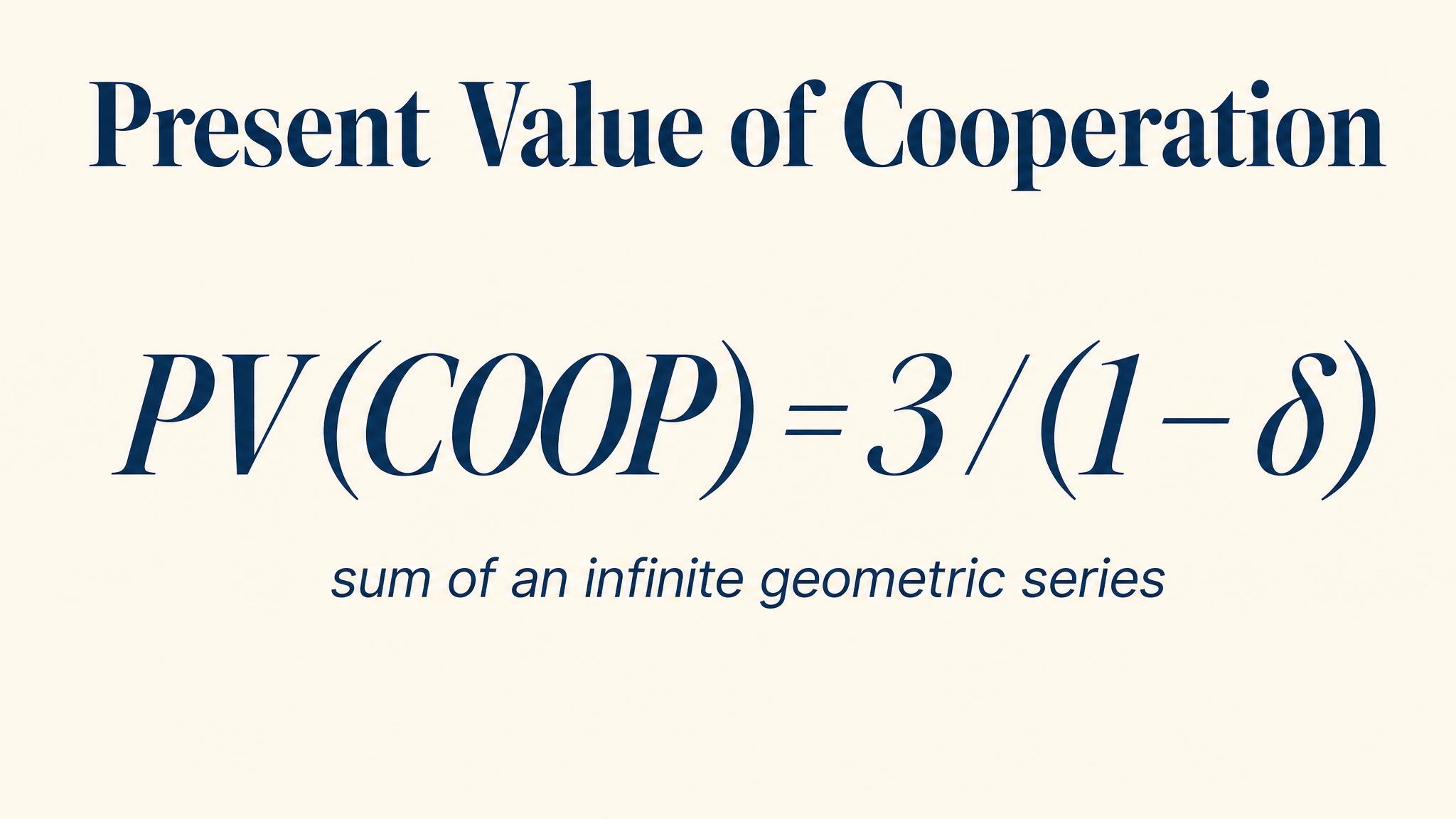
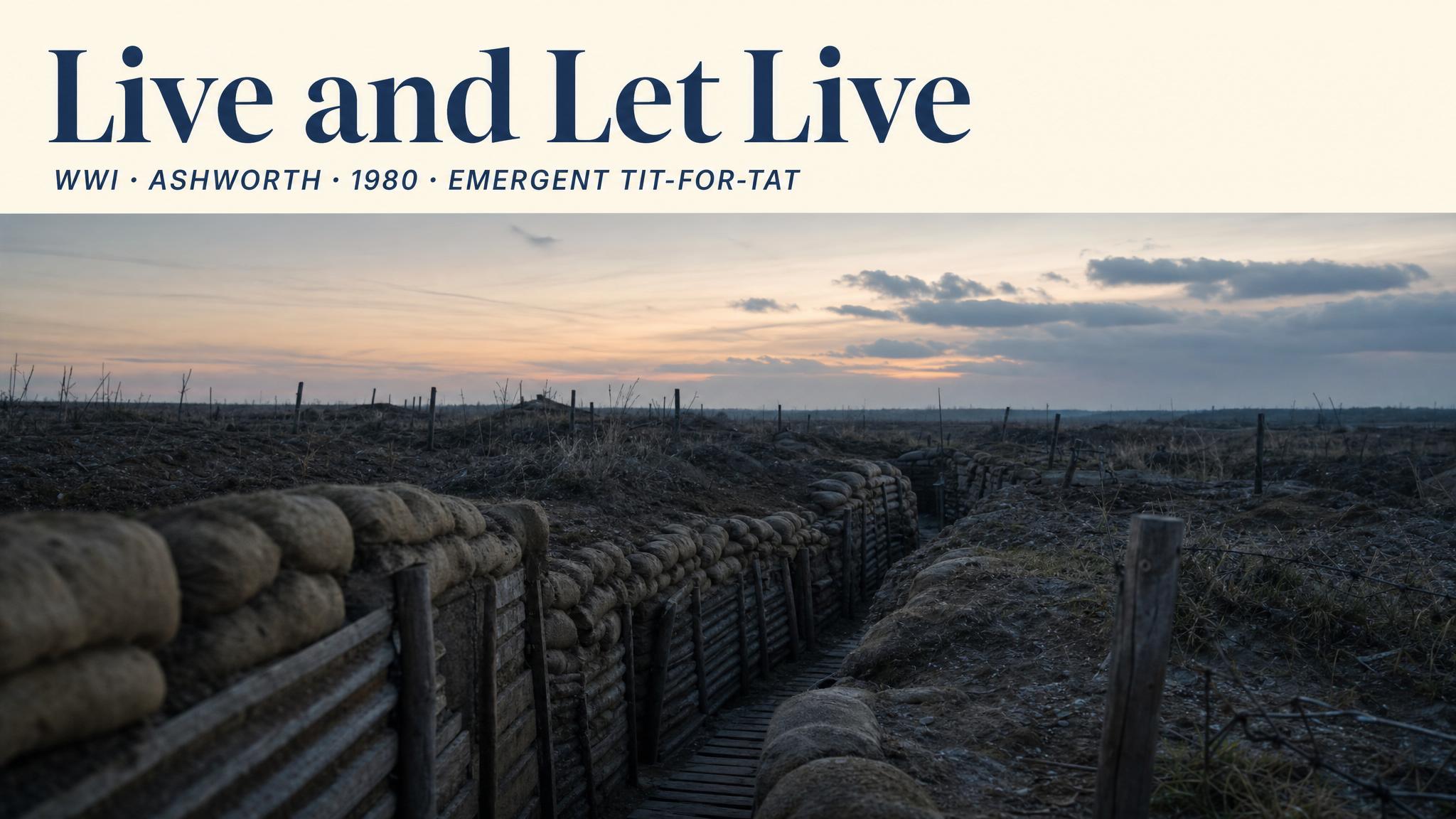
Chapter 1 introduced the Prisoner's Dilemma's devastating punchline: rational self-interest leads to mutual destruction. Chapter 3 confirmed it with Nash equilibrium. This chapter overturns that despair — or at least…
Be honest: Would you be ruder to a barista in a city you're visiting for one day than one in your hometown? Why or why not?
Tourist test
Someone in your group project does zero work. Do you: (A) call them out immediately, or (B) do nothing and just never work with them again?
Group project revenge
Your roommate eats your food from the fridge ONE time without asking. Are you the type to forgive and move on, or is it war until someone moves out?
One strike policy?
If you knew for certain you'd never see someone again after today, would you treat them differently than someone you'll see every week?
Last day energy
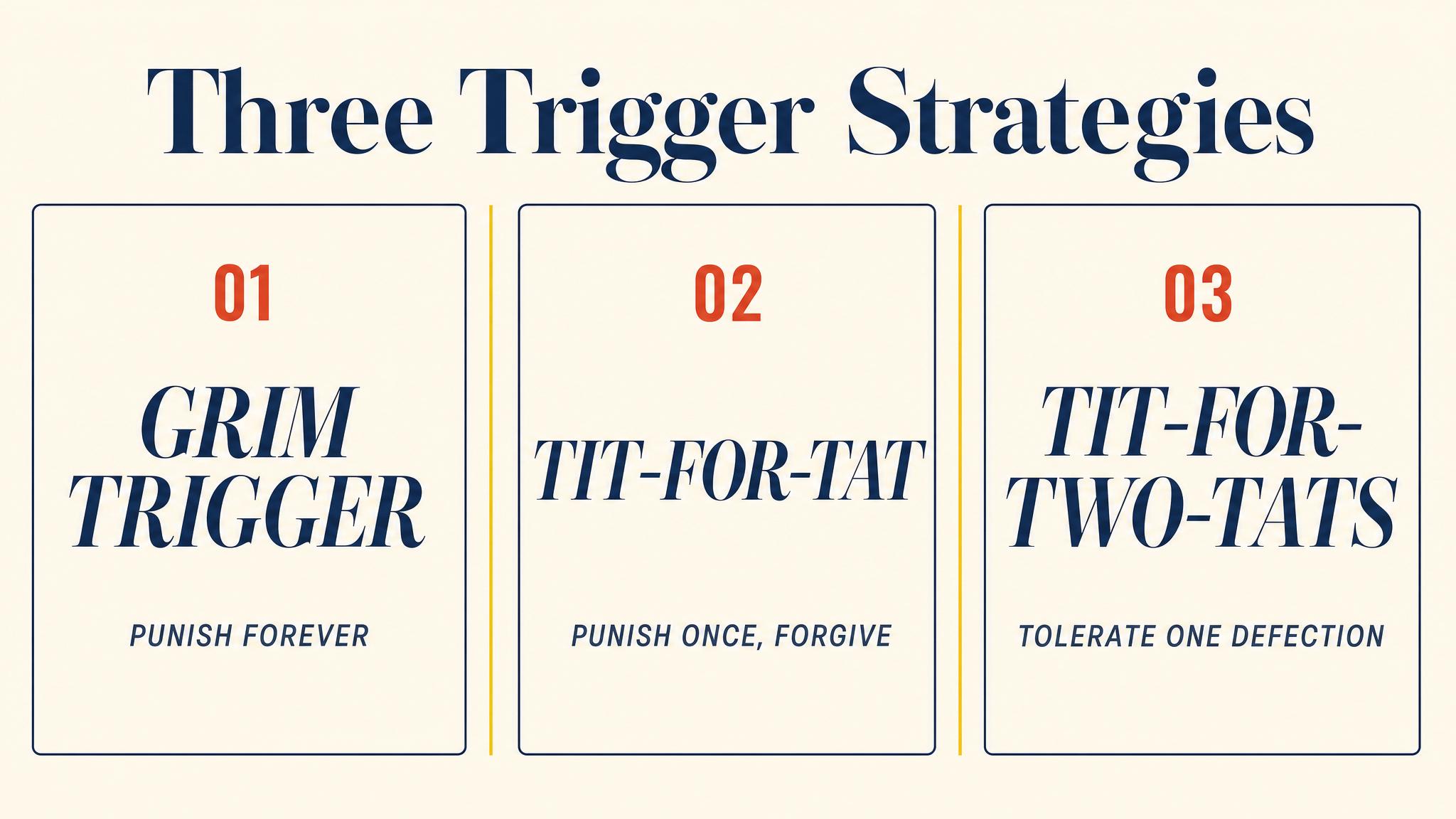
What gets better cooperation: threatening to cut someone off forever if they screw up once, or giving them multiple chances?
Tough love debate
You loan a friend $20. They don't pay you back. Do you: (A) never loan them money again, or (B) loan them $20 every time they ask and keep getting burned?
Fool me twice?
The Revenge Game: Live Prisoner's Dilemma Tournament
15-20 minutesEach table is a team. Teams simultaneously play iterated Prisoner's Dilemma against other tables (instructor projects matchups on screen). Round 1: 5 iterations against Table A. Round 2: 5 iterations against Table B. Teams record their strategy choices on whiteboards and hold them up simultaneously each round. After each pairing, teams briefly discuss what happened and adjust their strategy. Instructor tracks cooperation rates on a live scoreboard. Debrief: Which teams cooperated most? Did your strategy change based on your opponent's reputation?
Strategy Auction: Design Your Algorithm
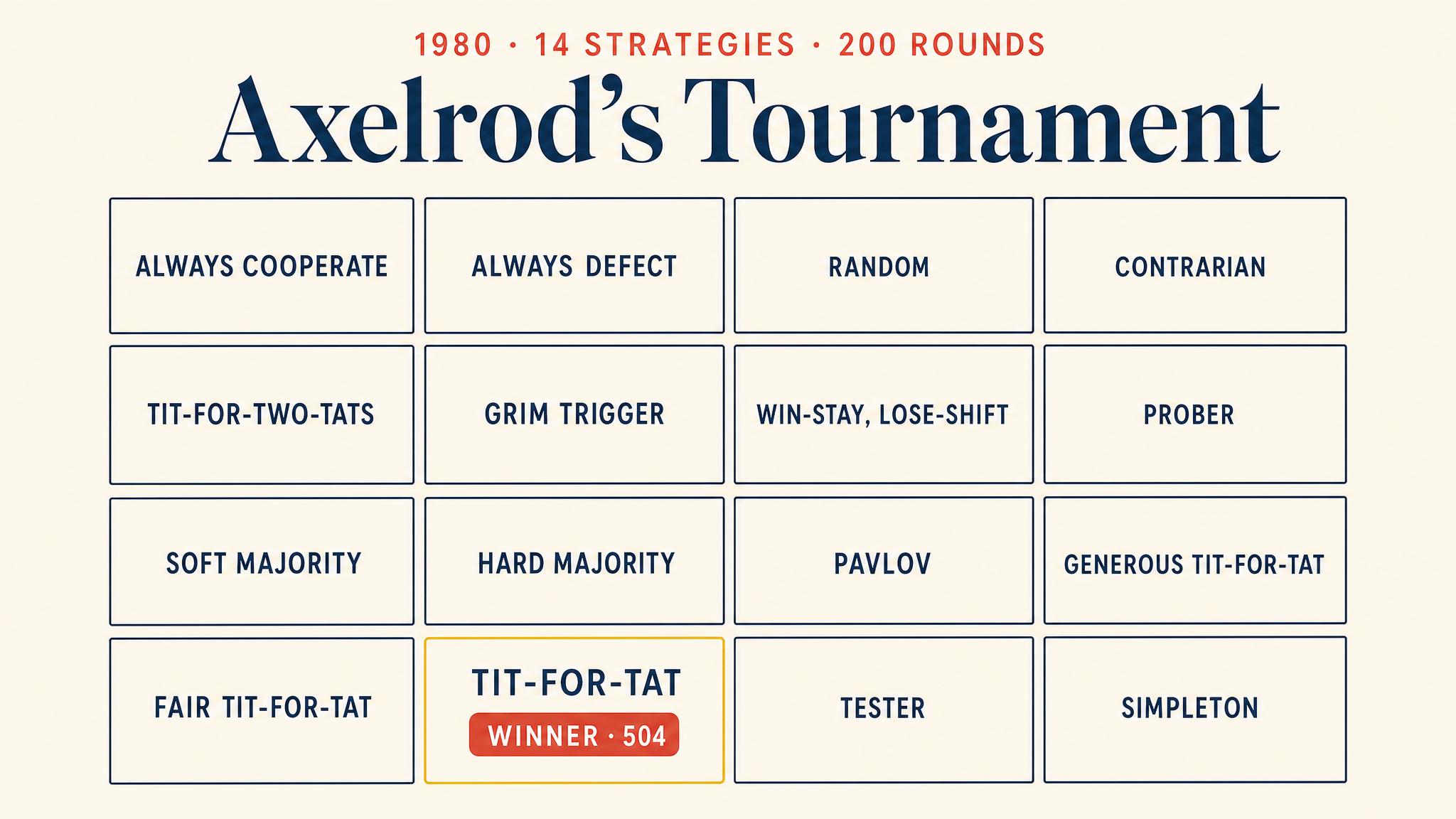
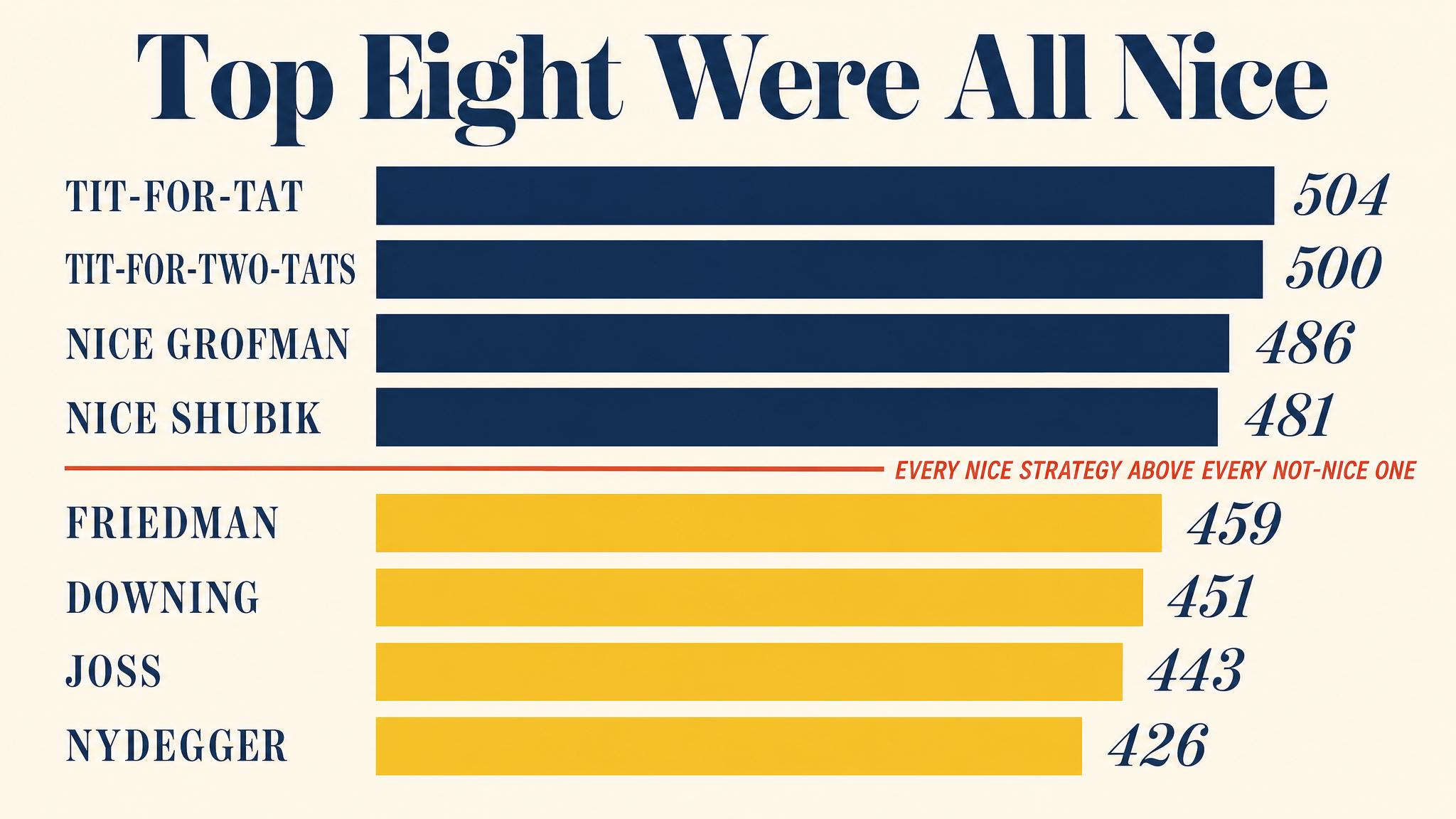
12-15 minutesTeams have 5 minutes to design a repeated-game strategy (not just Tit-for-Tat — be creative!). Write it as a simple algorithm on a poster: 'IF opponent did X, THEN we do Y.' Teams present their strategy (1 min each, 2-3 teams volunteer or are randomly selected). The class votes on which strategy they predict will perform best in a 10-round game against various opponents. Instructor reveals that these are variations of actual submitted strategies from Axelrod's tournament. Discuss why complexity doesn't always win.
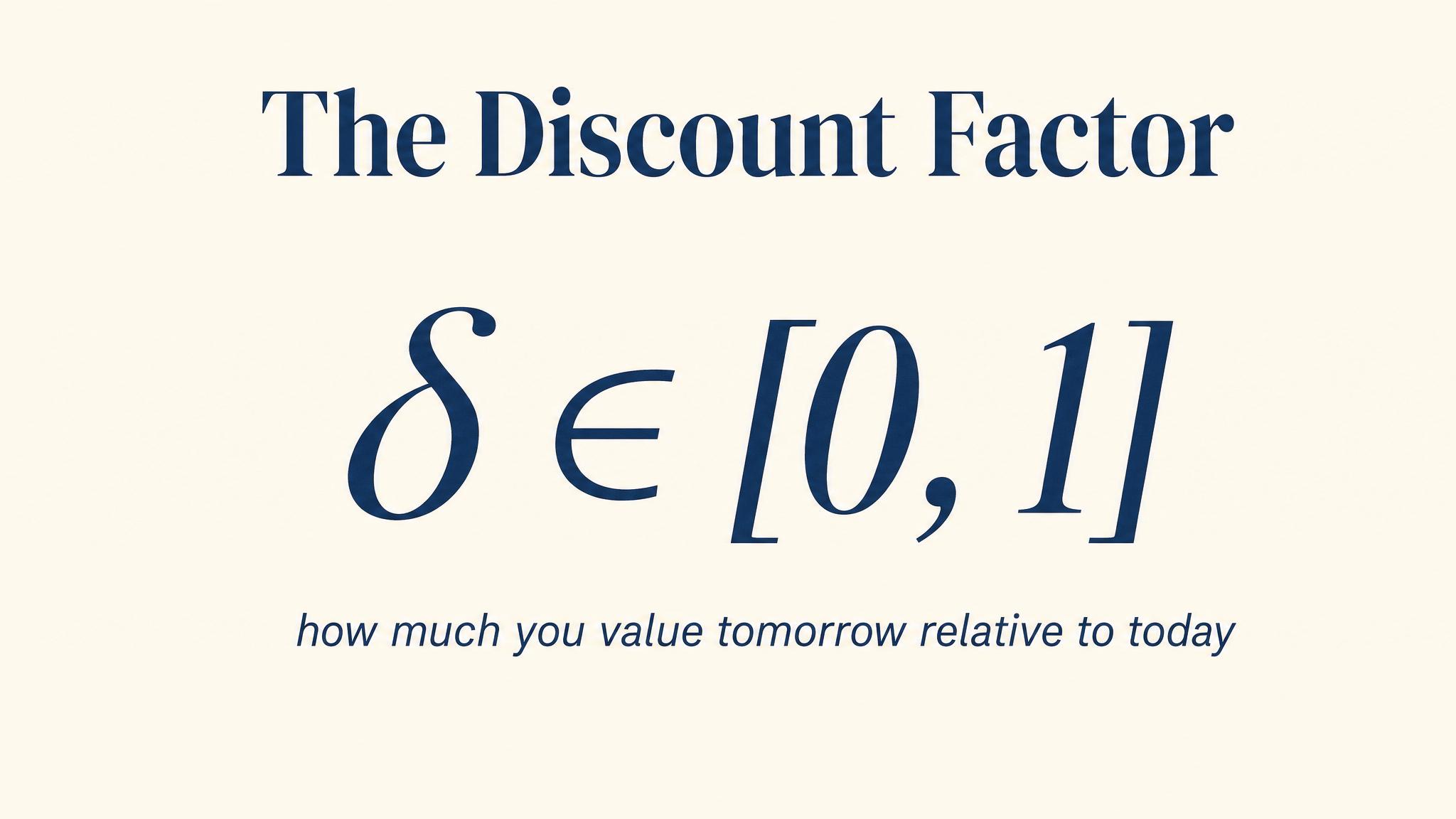
The Discount Factor Slider: Future You vs. Present You
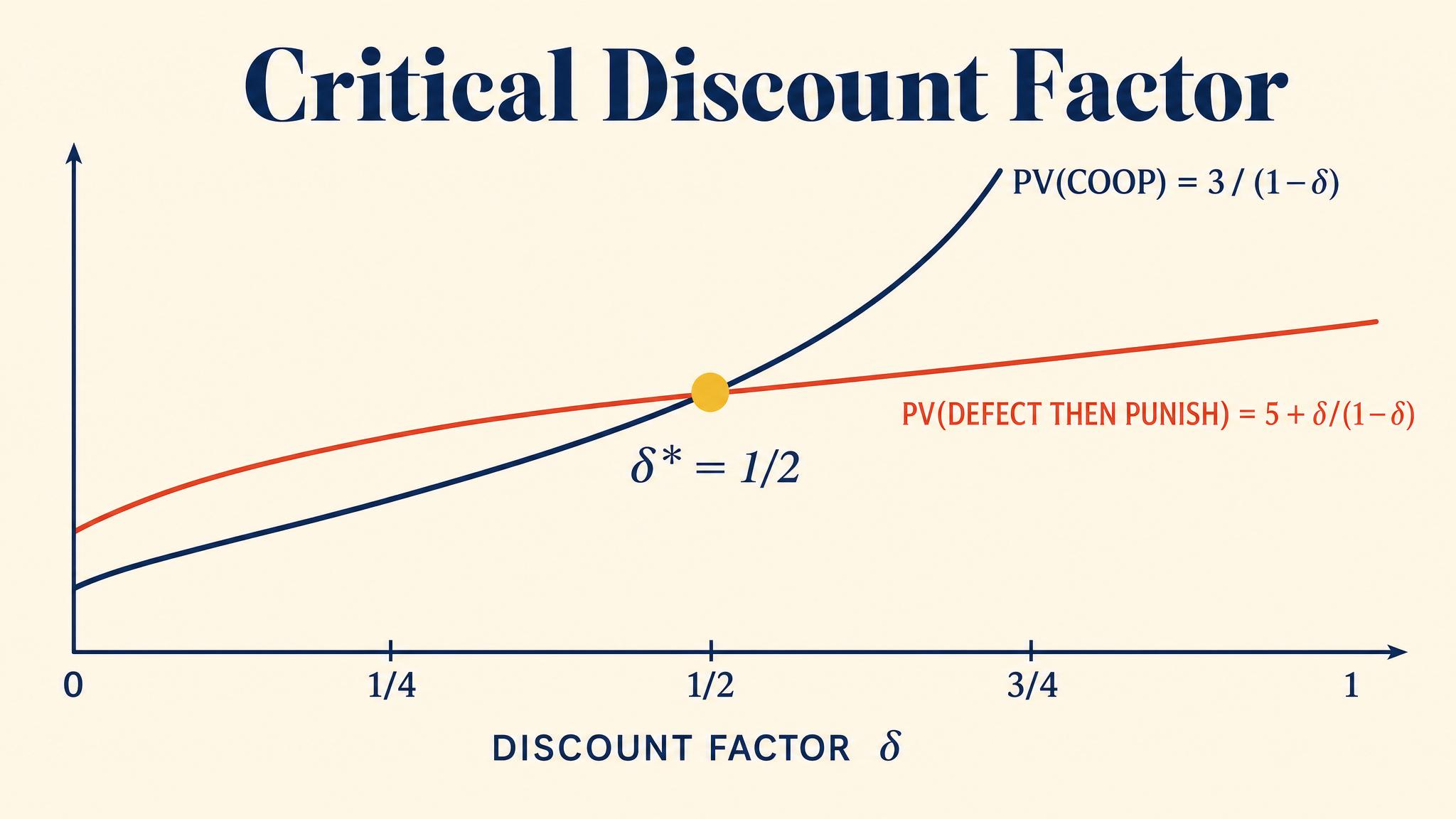
10 minutesInstructor presents a repeated game scenario. Each table receives a 'discount factor' card (ranging from δ=0.3 to δ=0.95). Tables calculate whether cooperation is sustainable in their assigned world. Tables physically arrange themselves along a spectrum in the room from 'Cooperation Impossible' to 'Cooperation Easy' based on their calculations. Teams at different points debate: why do those with δ=0.9 cooperate when you with δ=0.4 can't? Instructor connects to real-world: which environments/situations have high vs. low discount factors?
Grim Trigger Firing Squad: When to Forgive?
10-12 minutesInstructor sets up a 3-round scenario where 'Country A' (one volunteer) plays against 'Country B' (another volunteer) with the class as advisors. Country A commits to grim trigger. In Round 2, Country B 'accidentally' defects (instructor reveals it was a misunderstanding/error, not intentional). Pause the game. Tables debate for 3 minutes: Should Country A forgive or trigger eternal punishment? Each table votes and justifies. Execute the majority decision and play out the remaining rounds. Compare outcomes with the road not taken. Discuss commitment vs. flexibility.
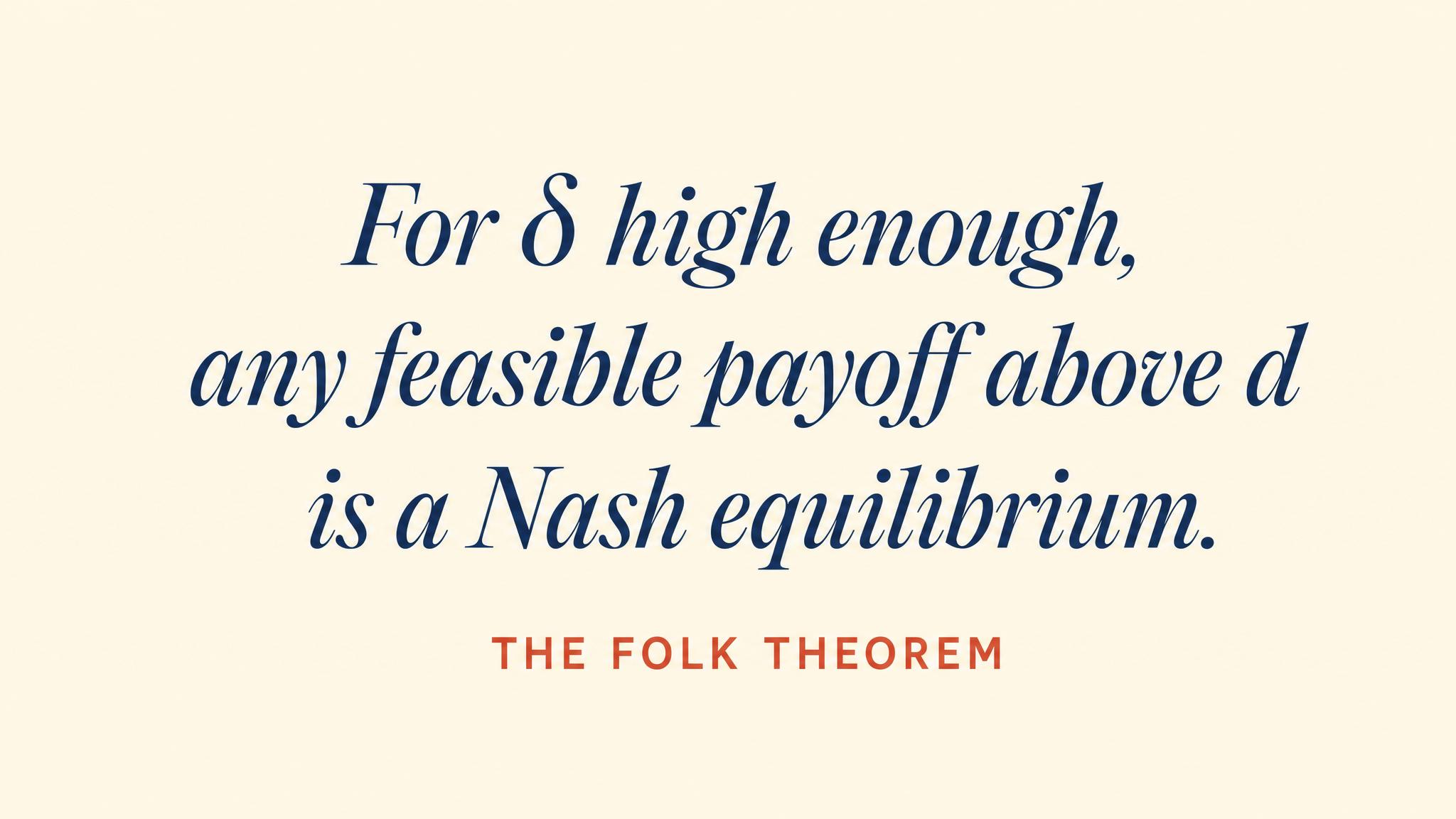
Folk Theorem Challenge: Sustaining the Impossible
15 minutesPresent a 2x2 game with a Pareto-dominated outcome (e.g., both players getting low payoffs) and challenge tables: 'The folk theorem says ANY individually rational outcome can be sustained in equilibrium. Design a strategy profile that keeps us stuck at this terrible outcome forever.' Tables have 7 minutes to design punishment schemes that make deviation unprofitable. Gallery walk: half the tables stay to explain their mechanism, half rotate to hear others' designs. Reconvene to vote on most creative/robust mechanism. Debrief: If we can sustain bad outcomes, what's the coordination problem in reaching good ones?
The Reputation Market: Trust as Currency
12-15 minutesEach table starts with 10 'reputation points.' Tables simultaneously decide whether to 'cooperate' (invest 2 points) or 'defect' (invest 0) in a public goods game each round. Cooperating tables earn returns based on total cooperation (the more who cooperate, the higher the multiplier). BUT tables can spend 3 reputation points to 'investigate' another table's history and make it public. After 3 rounds, tables with highest combined wealth AND reputation win. Debrief: Did reputation matter more than immediate payoffs? When did you spend points to signal or investigate?
Hidden Knowledge: Bluffing, Signalling, and the Price of Information
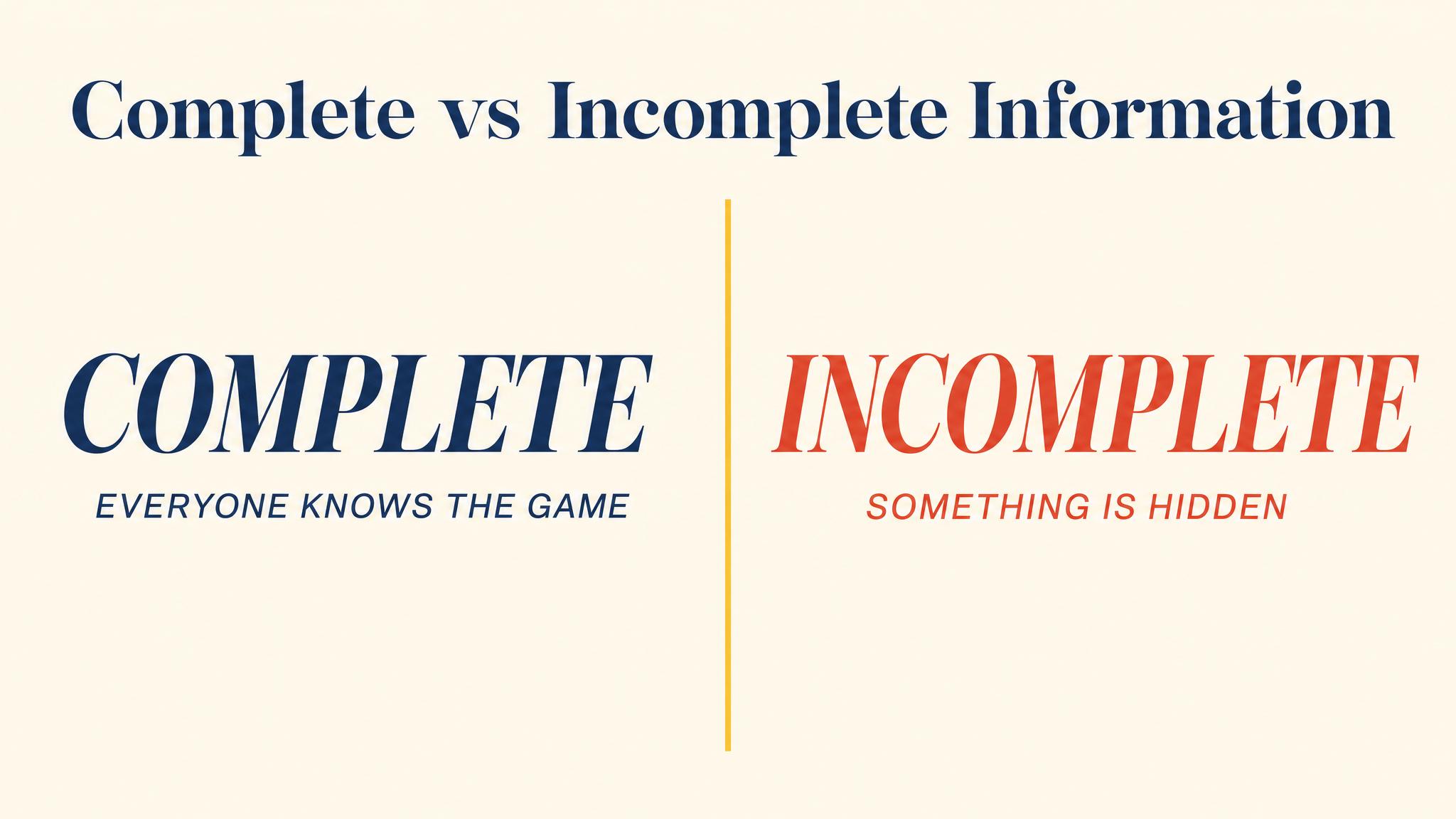
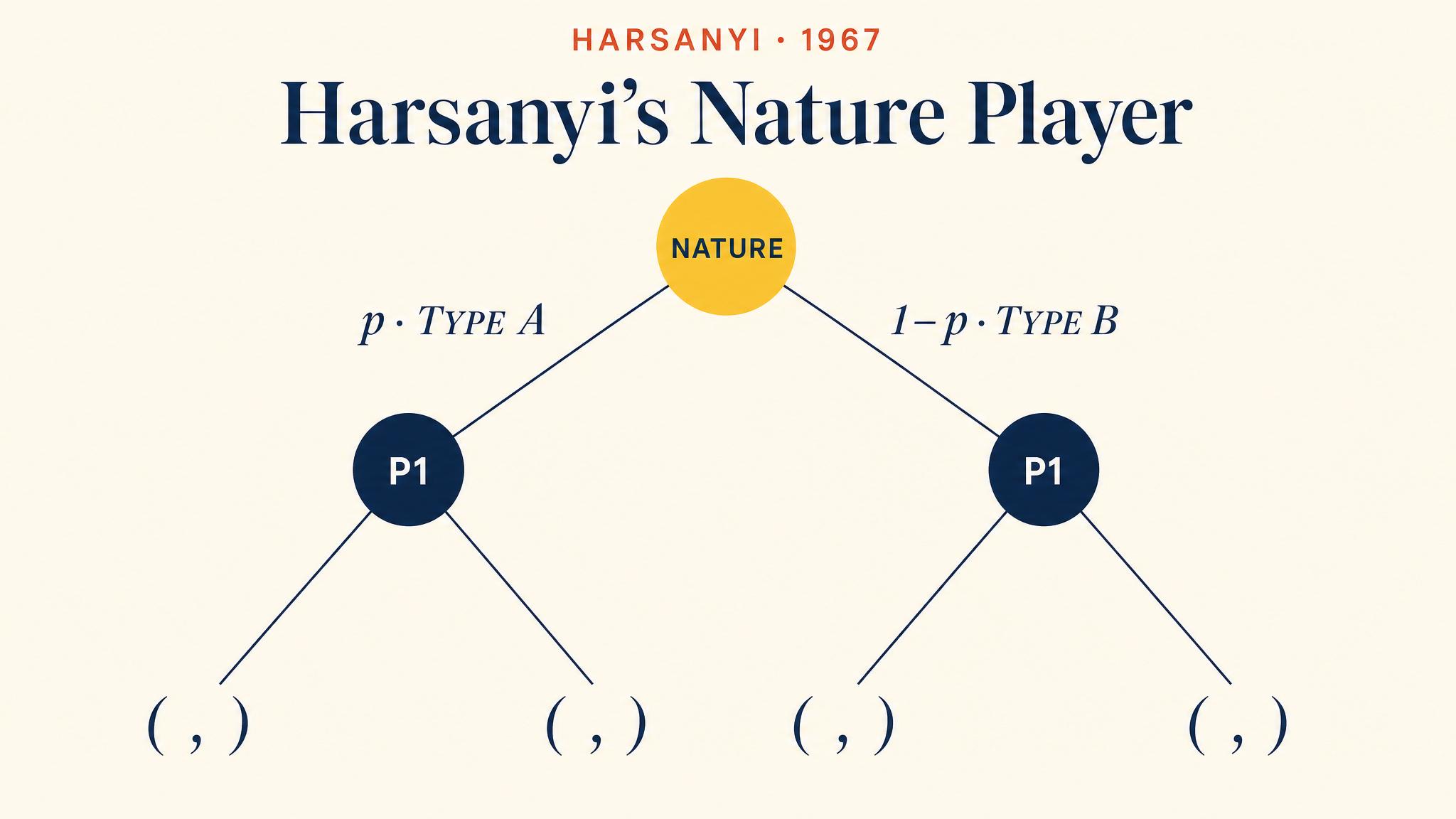
Every game analysed so far has assumed that players know each other's payoffs — that preferences are common knowledge. This chapter shatters that assumption and enters the rich, messy world of incomplete information,…
If your date shows up in a Ferrari, are you impressed or immediately suspicious?
First impressions
Is bluffing in poker basically lying, or is it just part of the game?
Debate time
Would you rather hire someone with a 4.0 who bombed the interview, or a 2.8 who absolutely crushed it?
Would you rather
Hot take: Saying you're a 'hard worker' on your resume is completely meaningless because literally everyone says it.
Unpopular opinion?
Do people with private Instagram accounts seem mysterious and cool, or like they're hiding something sketchy?
Real talk
Your Tinder match has a photo with a tiger. Swipe right or immediate left?
Quick poll
The Used Car Market Game
12-15 minutesEach table is randomly assigned 'seller' or 'buyer' role. Sellers secretly draw a card indicating if their car is a 'peach' (high quality) or 'lemon' (low quality). Round 1: Sellers can only state a price; no other communication allowed. Buyers must decide whether to buy. Round 2: Sellers can now make ANY claims about their car. Round 3: Introduce costly inspection option for buyers ($50 fee to see the card). After each round, calculate market outcomes and discuss why pooling happens, why the market might collapse, and how screening mechanisms help.
Bayesian Spy Hunt
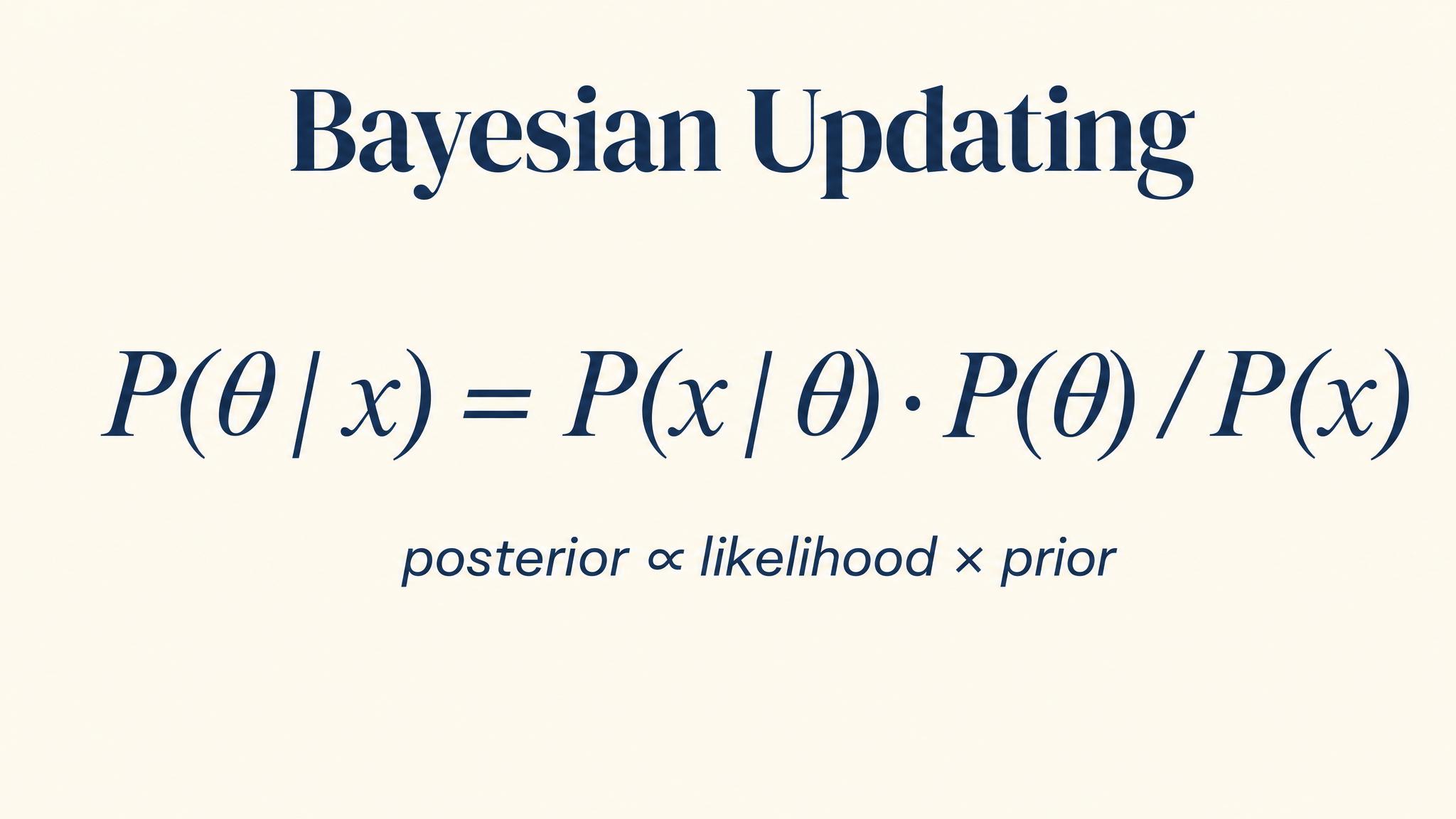
10-12 minutesOne student per table is secretly designated 'the spy' (knows a hidden number 1-100). Tables must identify their spy through questioning, but the spy can lie. Before questioning starts, what's the prior probability for each person? After each answer, tables must UPDATE their beliefs using Bayesian logic and track probability assignments on their board. After 5 questions, teams make their final accusation. Reveal spies and calculate which teams used evidence most effectively. Debrief: How did you weight contradictory signals? When did you dismiss vs. incorporate lies?
Education Signalling Marketplace
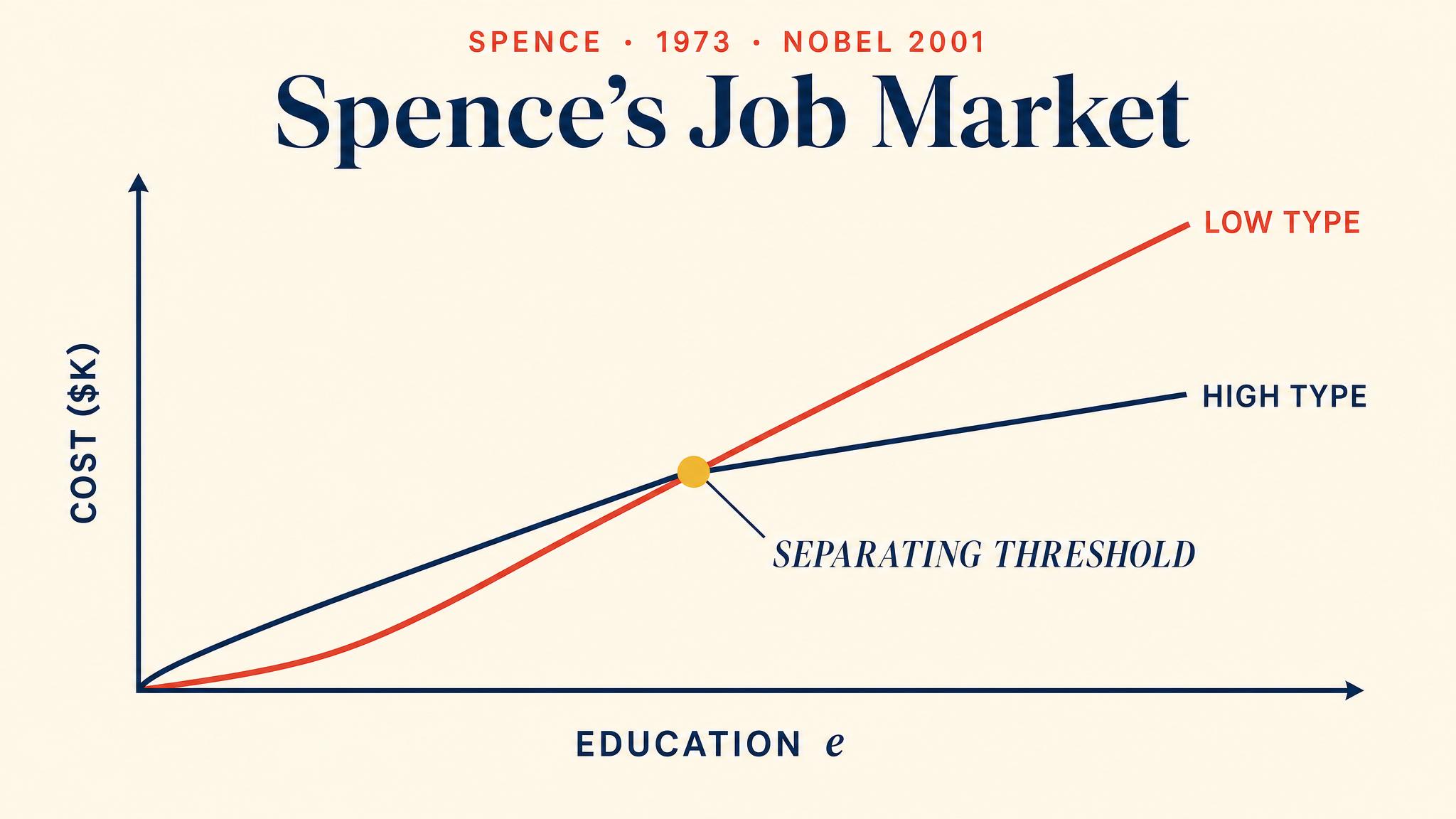
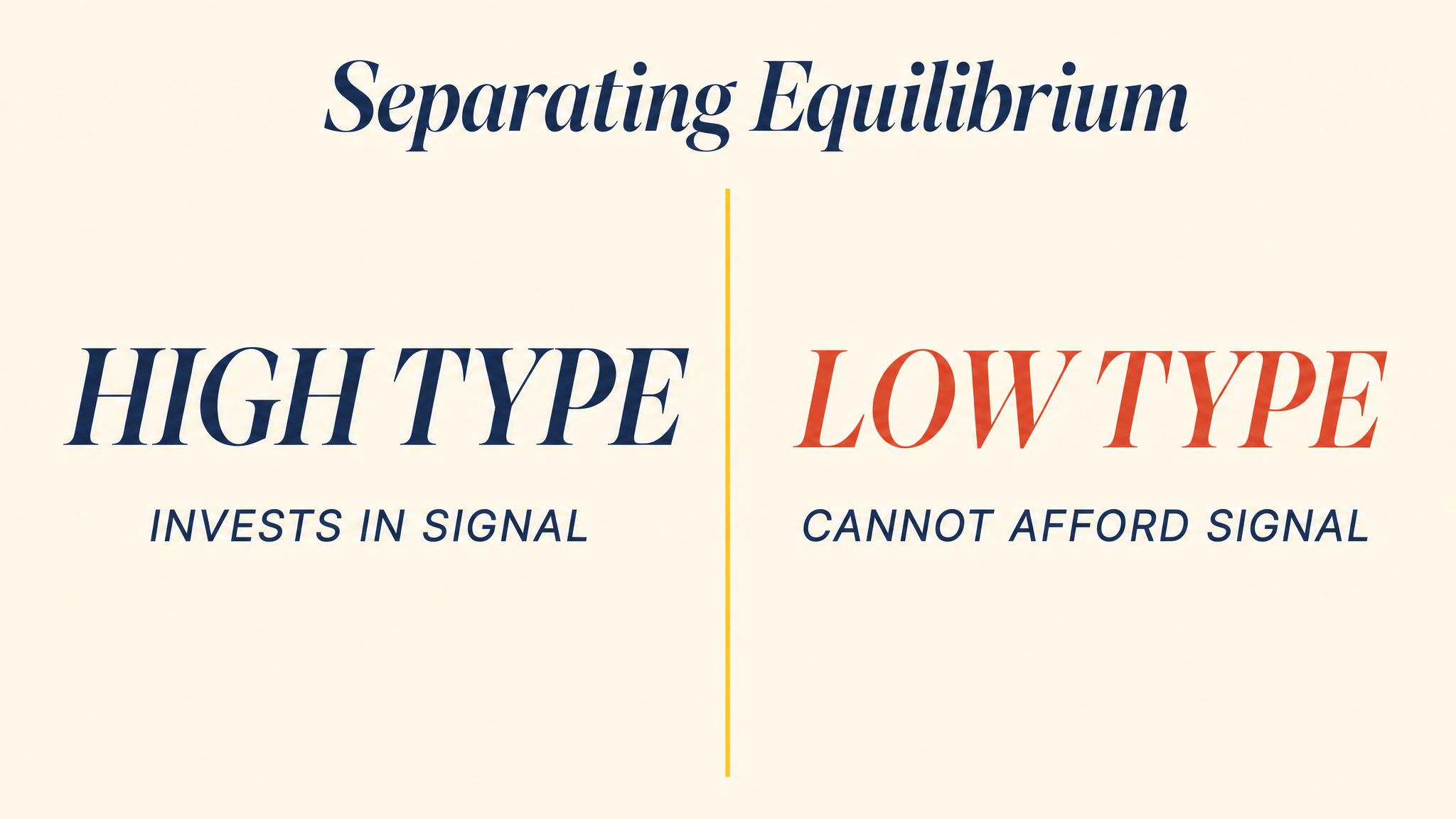
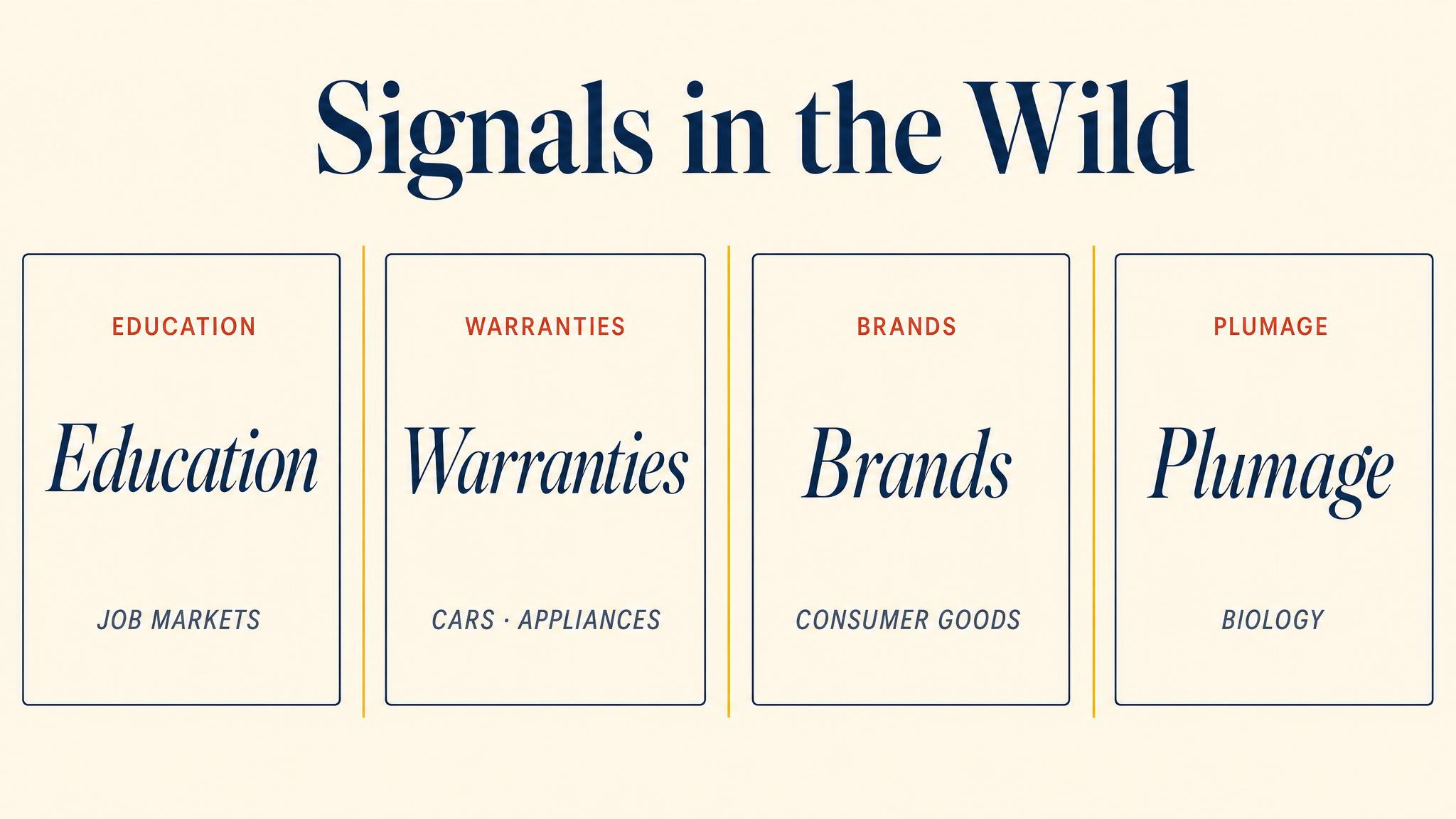
15-18 minutesWithin each table, randomly assign students as 'high ability' or 'low ability' workers (private information). High ability workers produce $100 value, low ability $40. All workers can purchase 'education' (0-4 years) at differential costs: $15/year for high ability, $35/year for low ability. Employers (instructor or designated tables) announce wages based on education level only. Round 1: Workers choose education levels simultaneously, employers set wage schedule. Round 2: Employers adjust wages after seeing Round 1 choices. Do separating or pooling equilibria emerge? Which workers are better off? Is education socially wasteful?
Cheap Talk Negotiation Tournament
12-15 minutesPair up tables (2 tables work together). One table represents a seller who knows their product quality (high/medium/low - draw randomly). Other table represents buyers. Sellers can make ANY claims about quality but cannot provide proof. Buyers must decide how much to pay (winning bid closest to true value gets points). After 3 rounds, rotate partners. Key insight: When are cheap talk claims credible? Students discover that only when interests align (e.g., repeated interaction, reputation concerns) does cheap talk gain credibility. Debrief strategic communication vs. verifiable information.
Screening Contract Design Challenge
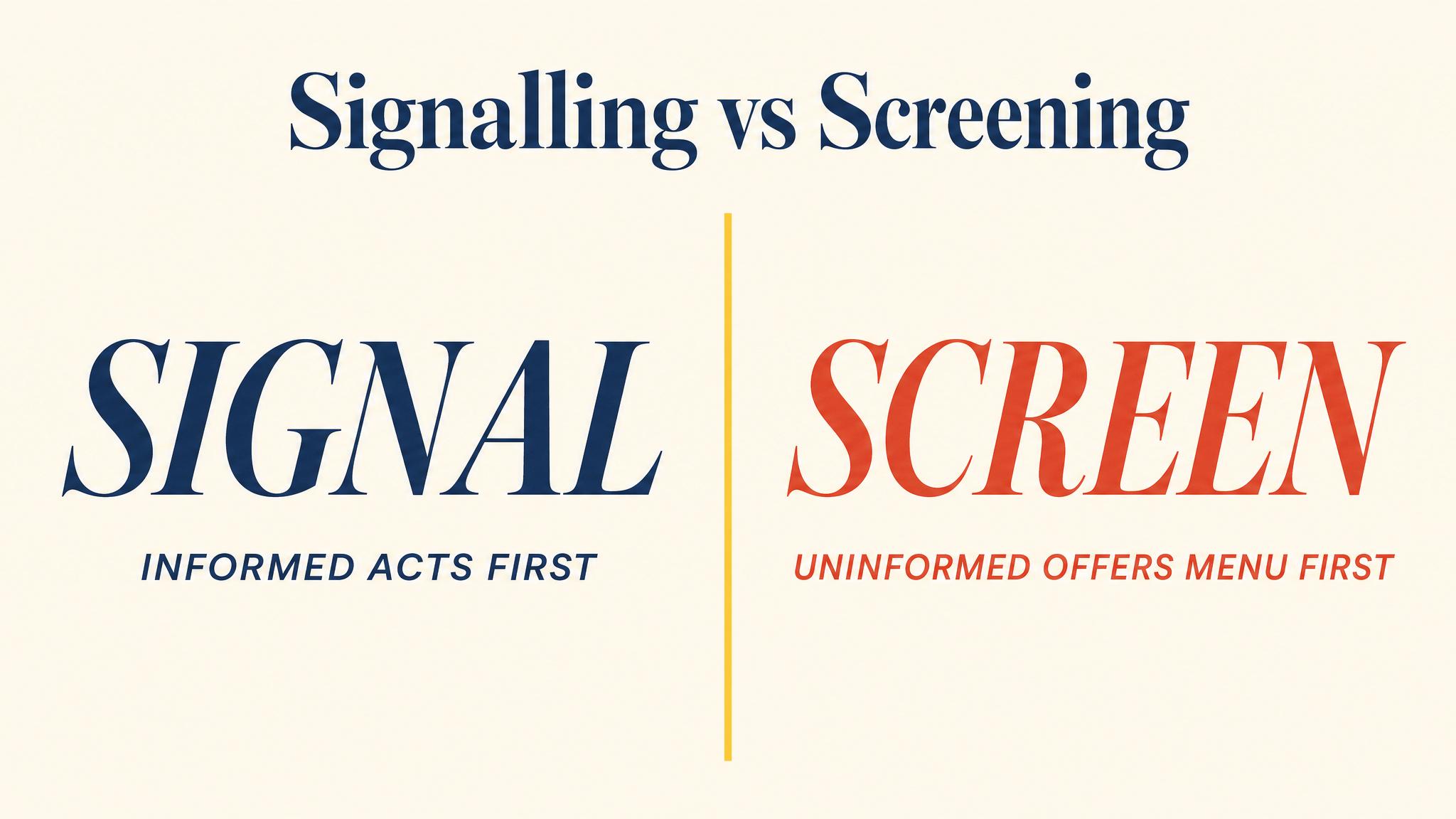
15-20 minutesTeams are insurance companies who must design menu of contracts to screen customers into 'high risk' and 'low risk' without knowing their type. Each team designs 2-3 contract options (coverage level + premium). Then teammates secretly draw risk-type cards and choose which contract they'd select. Did the menu successfully separate types? Did low-risk subsidize high-risk (pooling)? Teams present their menus, compare separation success rates, discuss what made effective screening mechanisms. Introduce adverse selection death spiral scenario where low-risk exit entirely.
Pooling vs. Separating Equilibrium Prediction Market
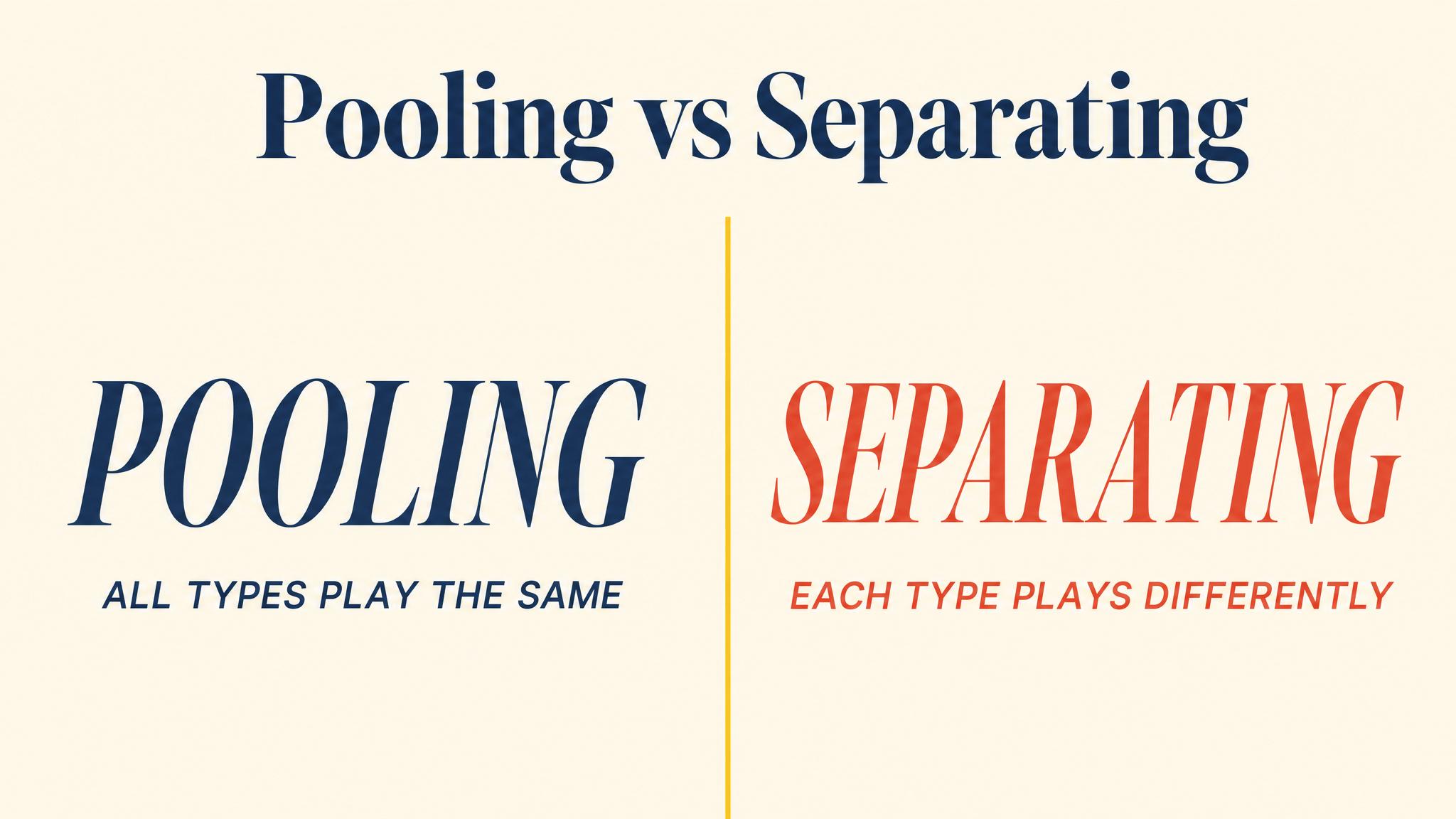
10-12 minutesPresent a real-world scenario (e.g., college admissions, restaurant health ratings, startup funding). Tables must predict: Will this market reach pooling or separating equilibrium? Why? Each table stakes reputation points on their prediction and must justify with game theory logic. Introduce perturbations (e.g., 'cost of signal drops by 50%' or 'regulation bans certain signals'). How does equilibrium change? Tables update predictions in real-time. Award points for correct predictions AND quality of reasoning. Creates debate about what conditions favor each equilibrium type.
Going Once, Going Twice: The Surprising Science of Auctions
Auctions are game theory in its purest applied form — a strategic interaction with clearly defined players, strategies, payoffs, and rules, where billions of dollars ride on the analysis. This chapter introduces the…
eBay strategy: Do you bid your max early and walk away, or do you snipe it in the last 10 seconds? Defend your answer.
Strategy check
Would you rather pay exactly what you bid, or pay $1 more than whoever came in second place?
Would you rather
Hot take: Whoever wins an auction always overpaid. You can't win without losing.
Hot take
Concert tickets should go to a random lottery at face value, not to whoever pays the most. Agree or disagree?
Unpopular opinion?
You find your dream apartment but learn 8 other people applied. Does this make you offer MORE rent than you originally planned?
Real talk
eBay sniping (waiting till the last second to bid): genius strategy or low-key unethical?
Debate time
Four Auction Formats Speed Round
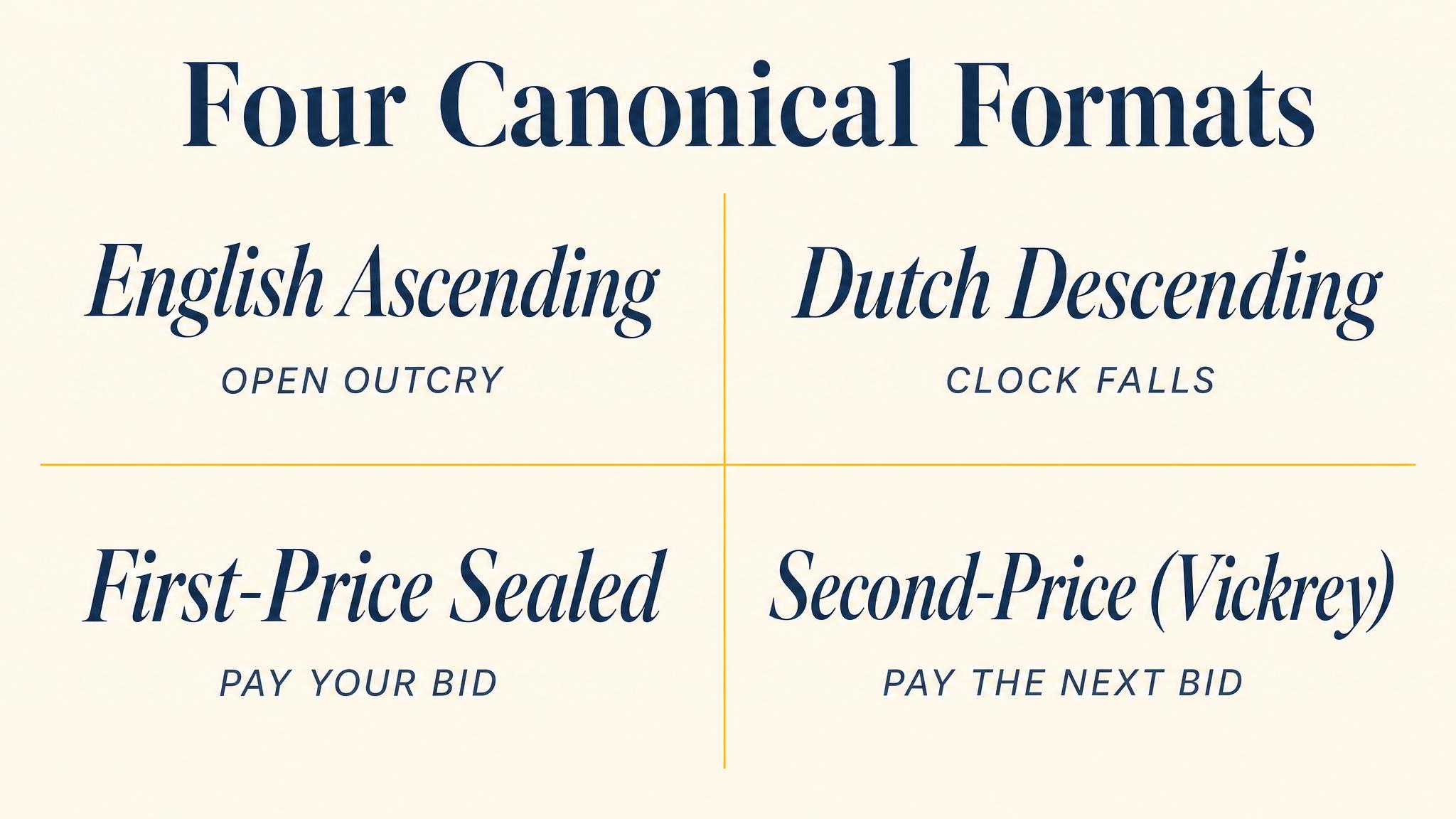
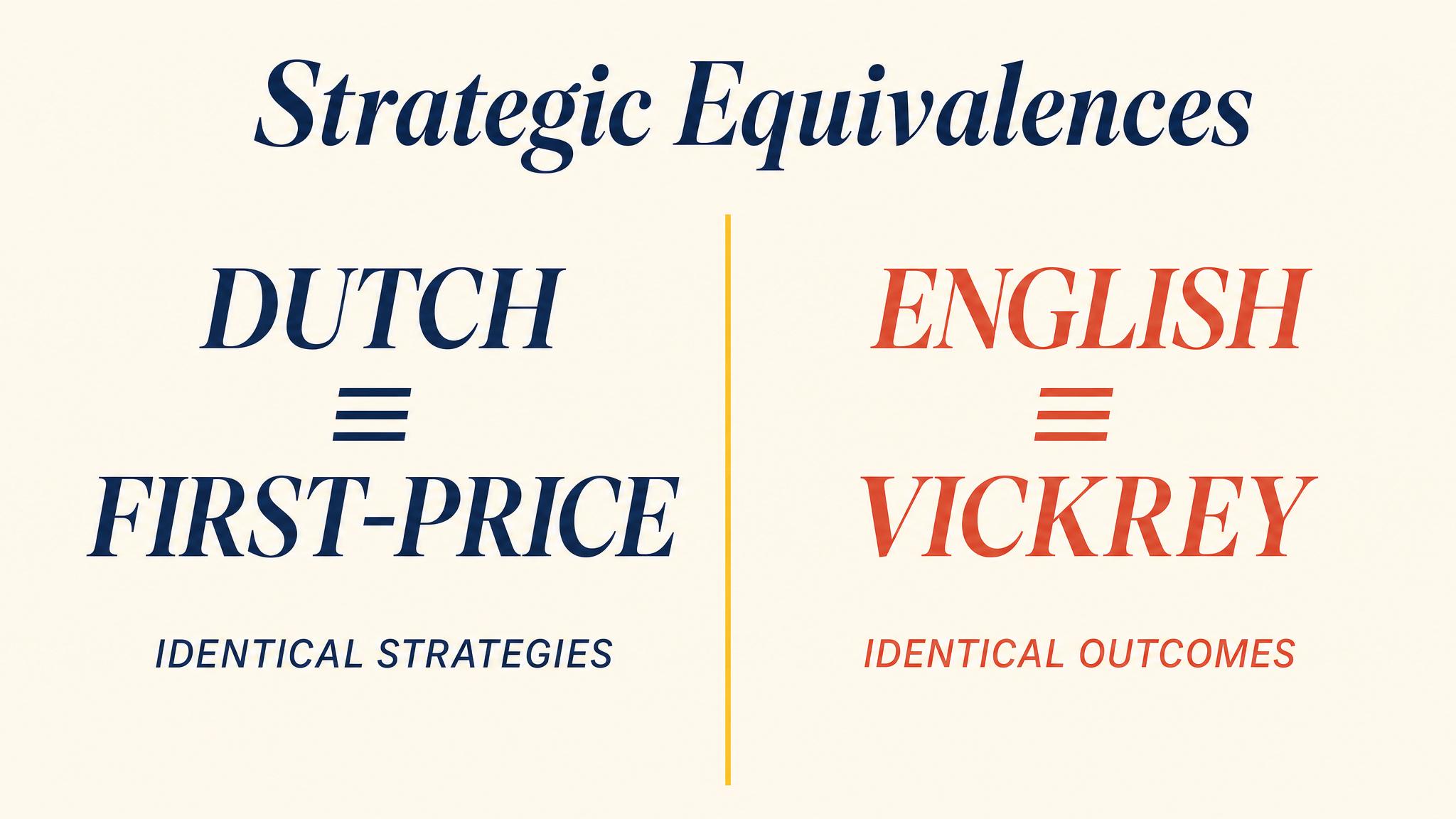
15-20 minutesRun four simultaneous mini-auctions for identical items (e.g., $5 gift cards), each using a different format. Assign 2-3 tables to each format. Round 1: English auction (open ascending). Round 2: Dutch auction (descending clock). Round 3: First-price sealed-bid. Round 4: Vickrey (second-price sealed-bid). Teams pool their hypothetical budgets and submit one bid per team. After all four rounds, debrief: Which format generated highest revenue? How did bidding behavior differ? Did teams bid differently when they could see others vs. sealed? Connect to revenue equivalence theorem and why it might break down in practice.
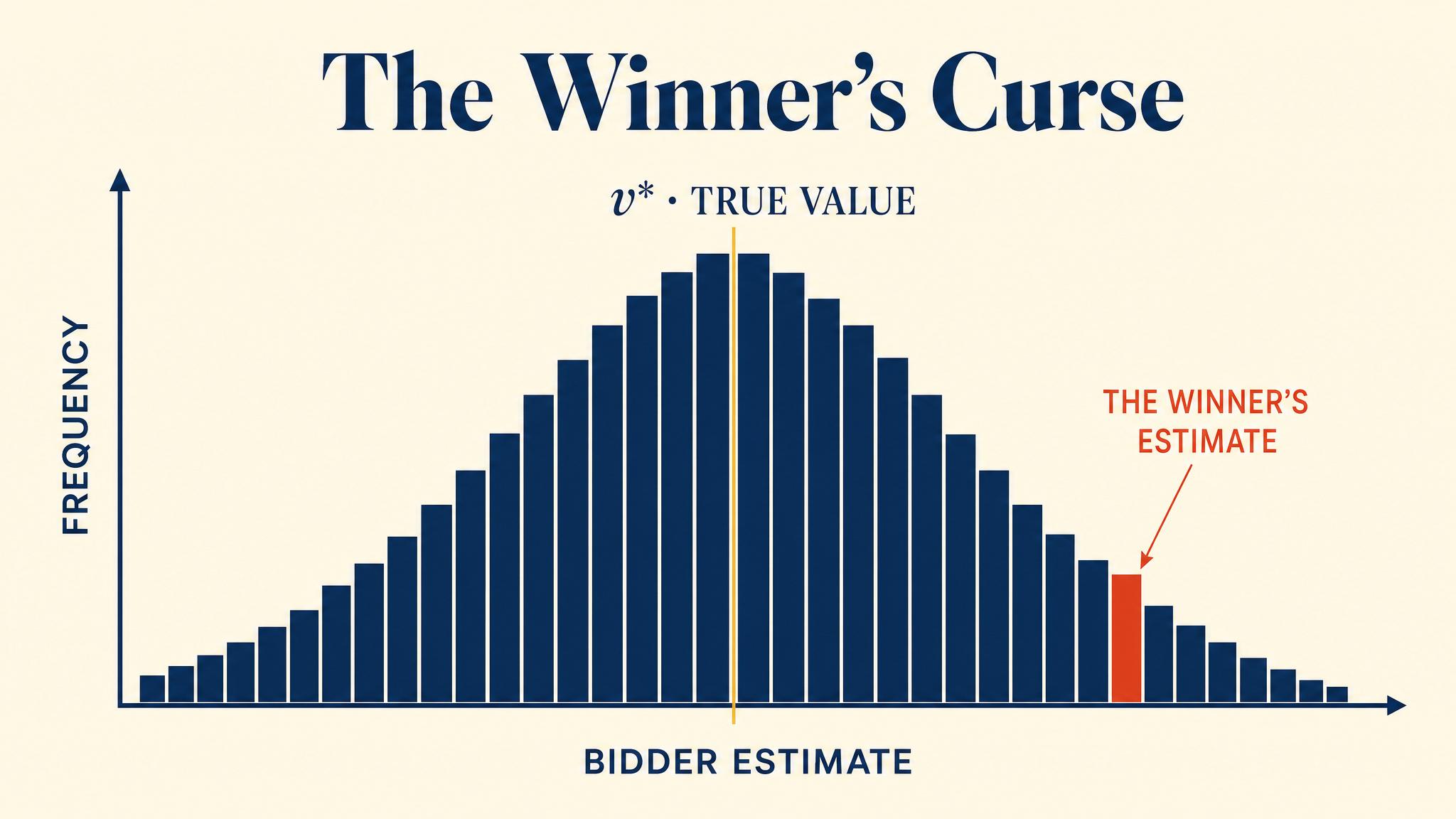
The Winner's Curse Penny Jar
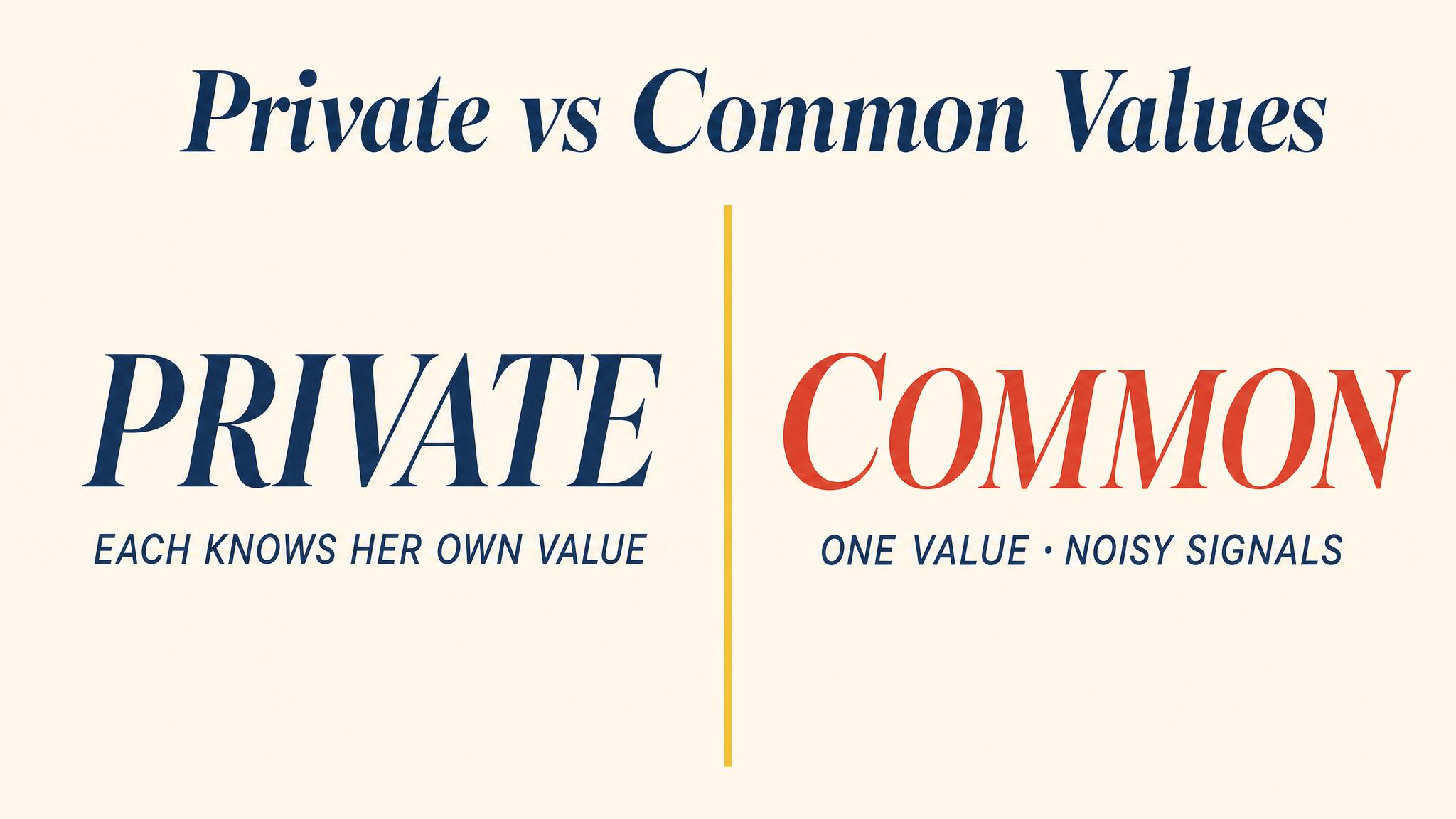
10 minutesDisplay a jar filled with pennies (or show an image). Each table estimates the value and submits a sealed bid. The highest bidder wins but pays their bid and receives the actual value. Reveal the true value. The 'winner' likely overbid (winner's curse). Discuss: Why does the winner typically lose money? Connect to common value auctions, oil drilling rights, and spectrum auctions. Key insight: You win only when you've overbid everyone else, which suggests you've probably overestimated. Tables then revise their bids accounting for winner's curse and resubmit. Compare first-round vs. second-round bids to show learning.
Vickrey Truth-Telling Challenge
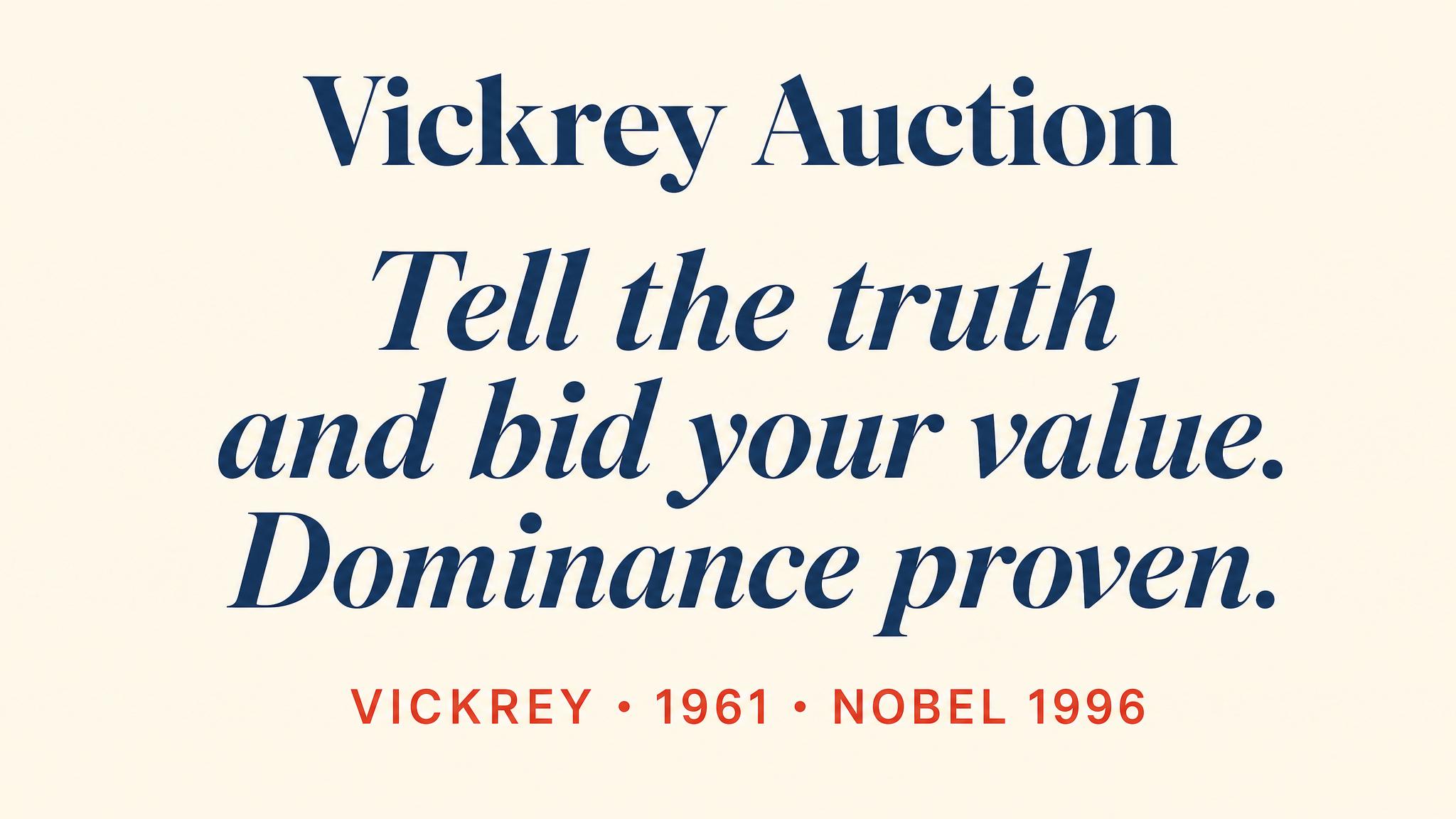
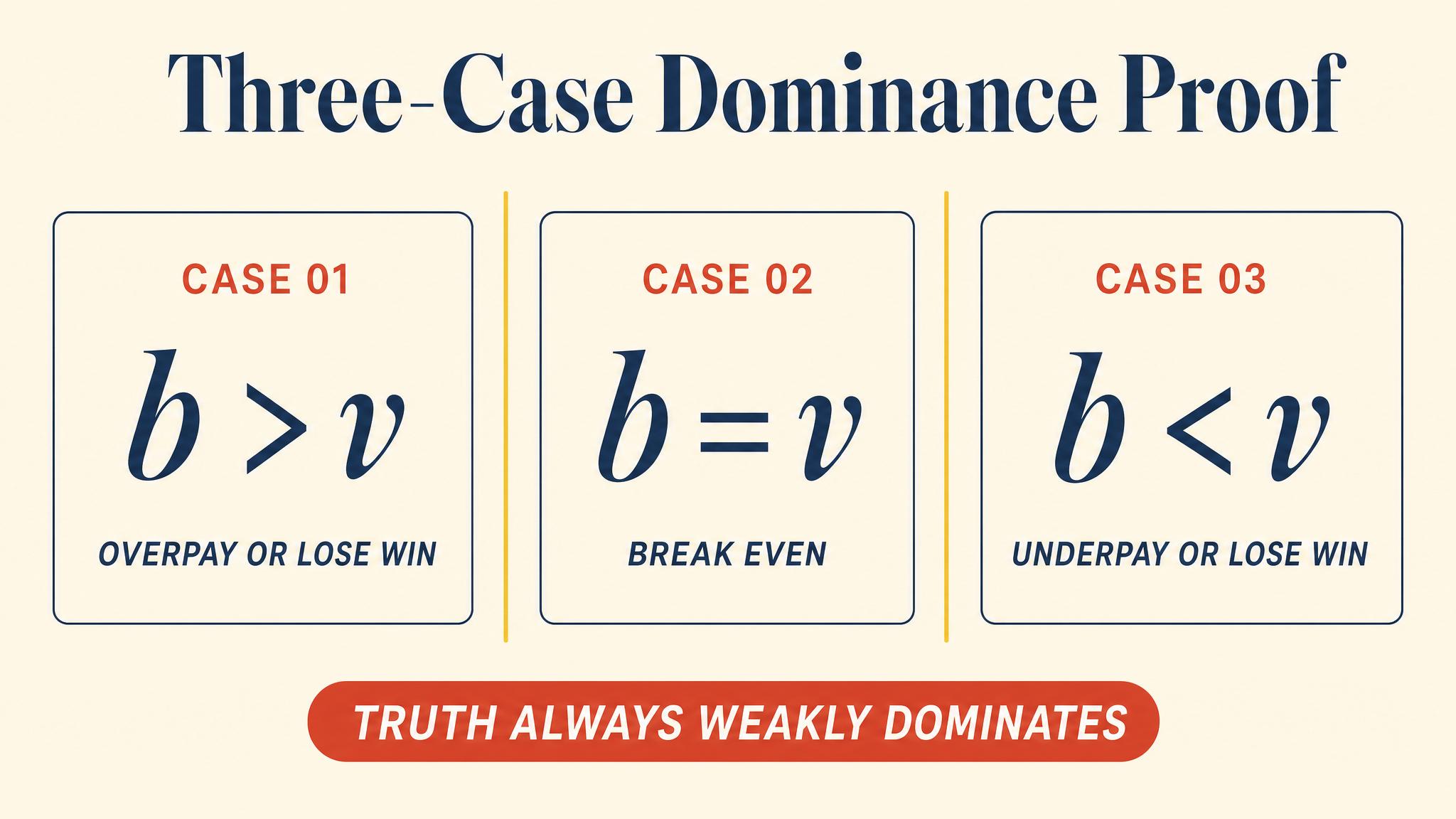
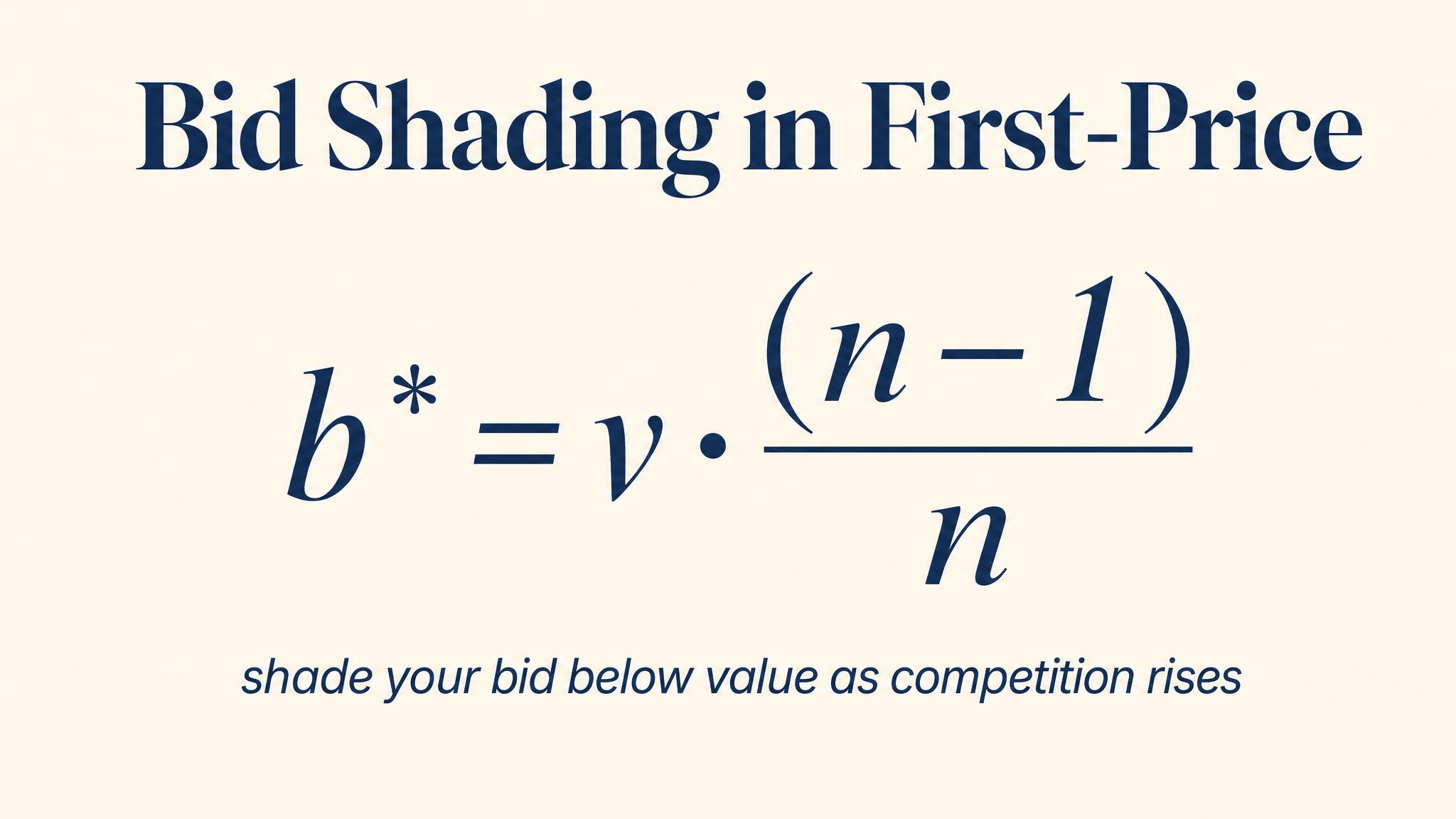
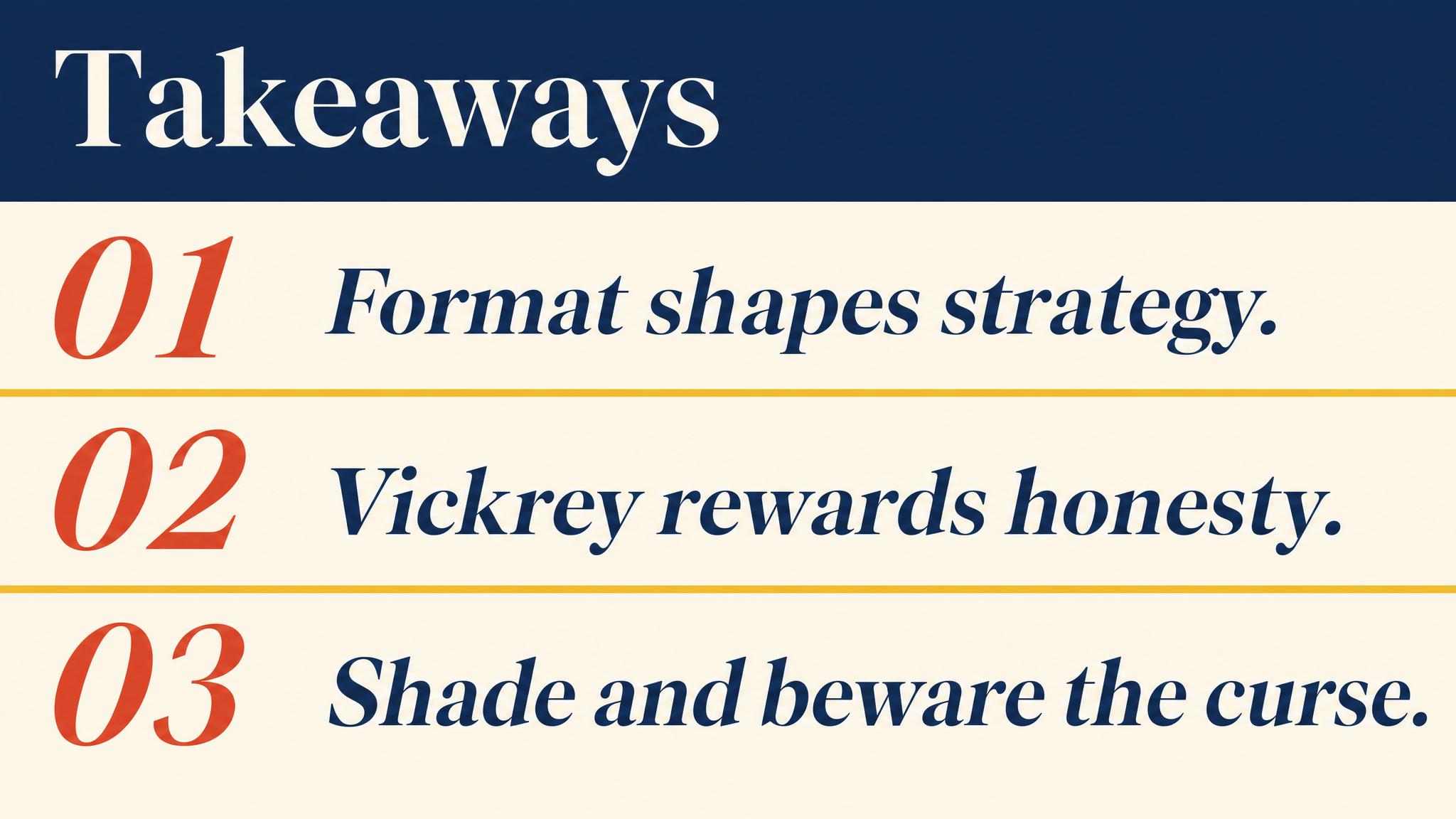
12-15 minutesGive each table a secret private valuation for a hypothetical item (values vary across tables: $10, $15, $20, etc.). Run a Vickrey auction where teams submit sealed bids. Reveal all bids and explain: highest bidder wins but pays the second-highest price. Ask: Did anyone bid differently than their true valuation? Run a second round encouraging strategic deviations. Show that bidding your true value is dominant: overbidding risks overpaying without increasing win probability; underbidding risks losing when you would have won profitably. Calculate counterfactuals on board to prove this. Contrast with first-price auction where strategic shading is optimal.
Spectrum Auction Design Challenge
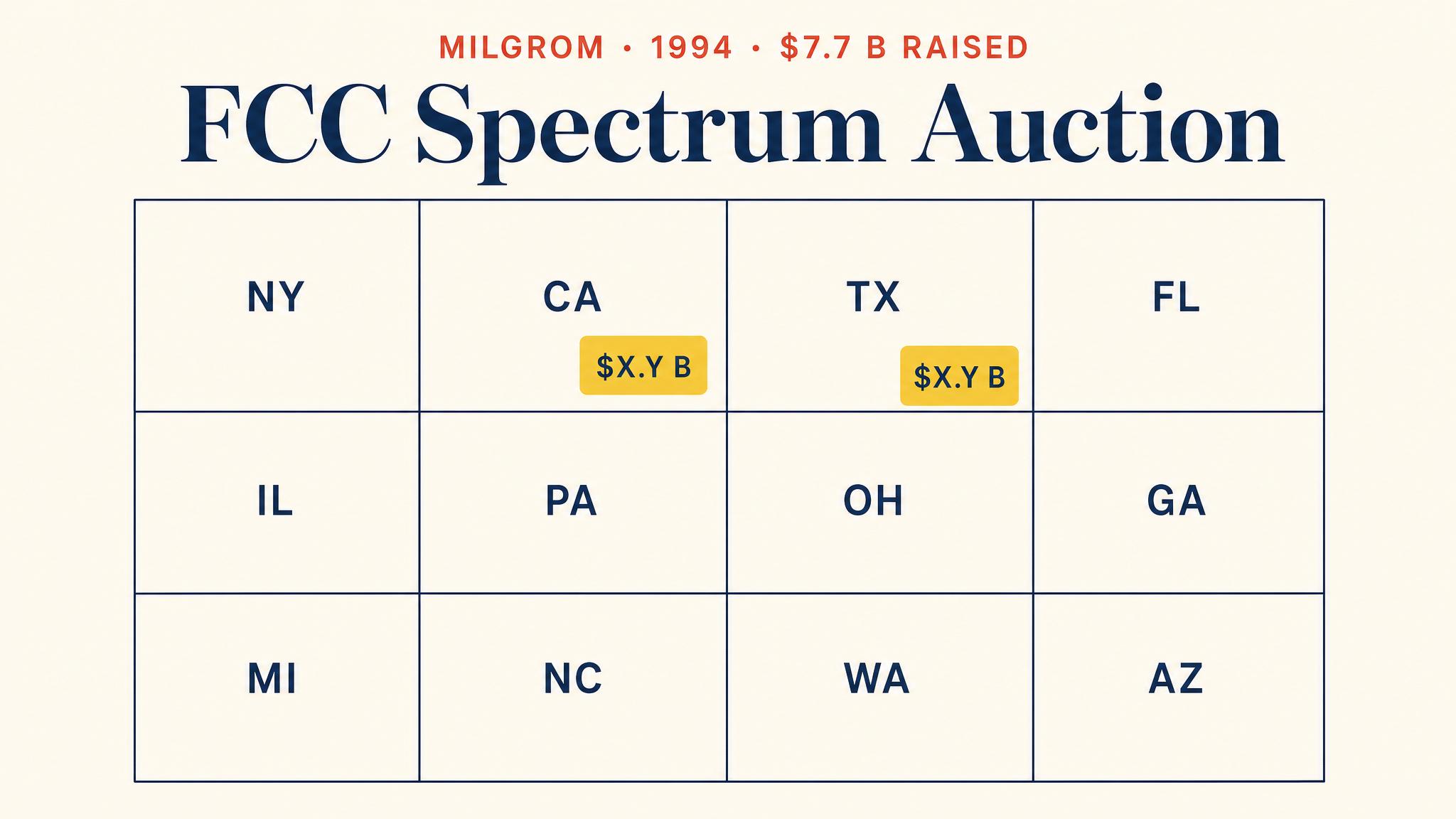
18-20 minutesPresent a realistic scenario: A government wants to auction 3 regional telecom licenses. Teams are competing telecom companies with different synergies (e.g., 'you already own the north license, so the south license is worth more to you'). Give each table a valuation sheet showing their values for different license combinations. Phase 1 (8 min): Tables strategize their bidding approach. Phase 2 (6 min): Run a simplified simultaneous ascending auction where tables can bid on any license. Phase 3 (4 min): Debrief the outcome. Who won what? Was it efficient? Did anyone face exposure problems (bid on complementary licenses but won only one)? Connect to real FCC spectrum auctions and mechanism design challenges.
Auction Format Debate Tournament
15 minutesAssign each table a specific auction format to defend (English, Dutch, first-price, Vickrey). Give a context: 'A city wants to auction a food truck permit.' Each table gets 3 minutes to prepare arguments for why their format is best for this scenario considering: revenue maximization, efficiency (highest-value bidder wins), simplicity, and fraud resistance. Run 2-minute pitches from 4 selected tables, followed by a class vote on most convincing argument. Instructor then reveals theoretical insights: revenue equivalence under certain assumptions, but practical considerations matter (entry costs, collusion risks, bidder sophistication). Create tension between theory and practice.
Revenue Equivalence Reality Check
12-15 minutesTest the revenue equivalence theorem empirically. Run two simultaneous auctions for identical prizes: half the tables participate in a first-price sealed-bid auction, half in a Vickrey auction. Give everyone the same budget. Collect all bids and reveal: winning bids and average revenue from each format. Theory predicts equal expected revenue, but do results match? Discuss deviations: risk aversion (underbidding in Vickrey, over-shading in first-price), joy of winning, spite, or confusion. This shows both the power of theory and the importance of behavioral factors. Run a second round after discussing theory and observe if behavior changes.
Evolution's Strategists: Game Theory Without a Brain
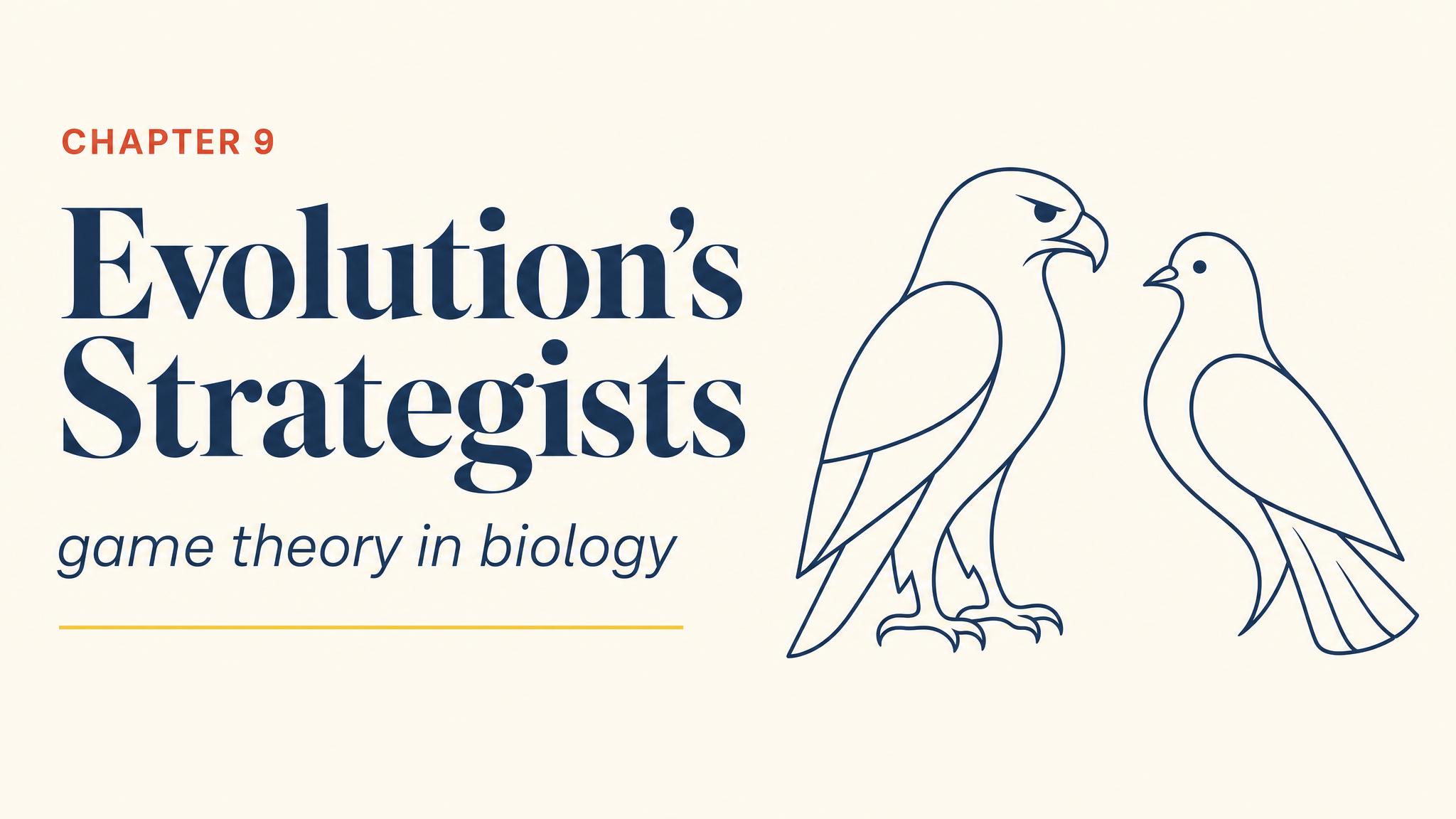
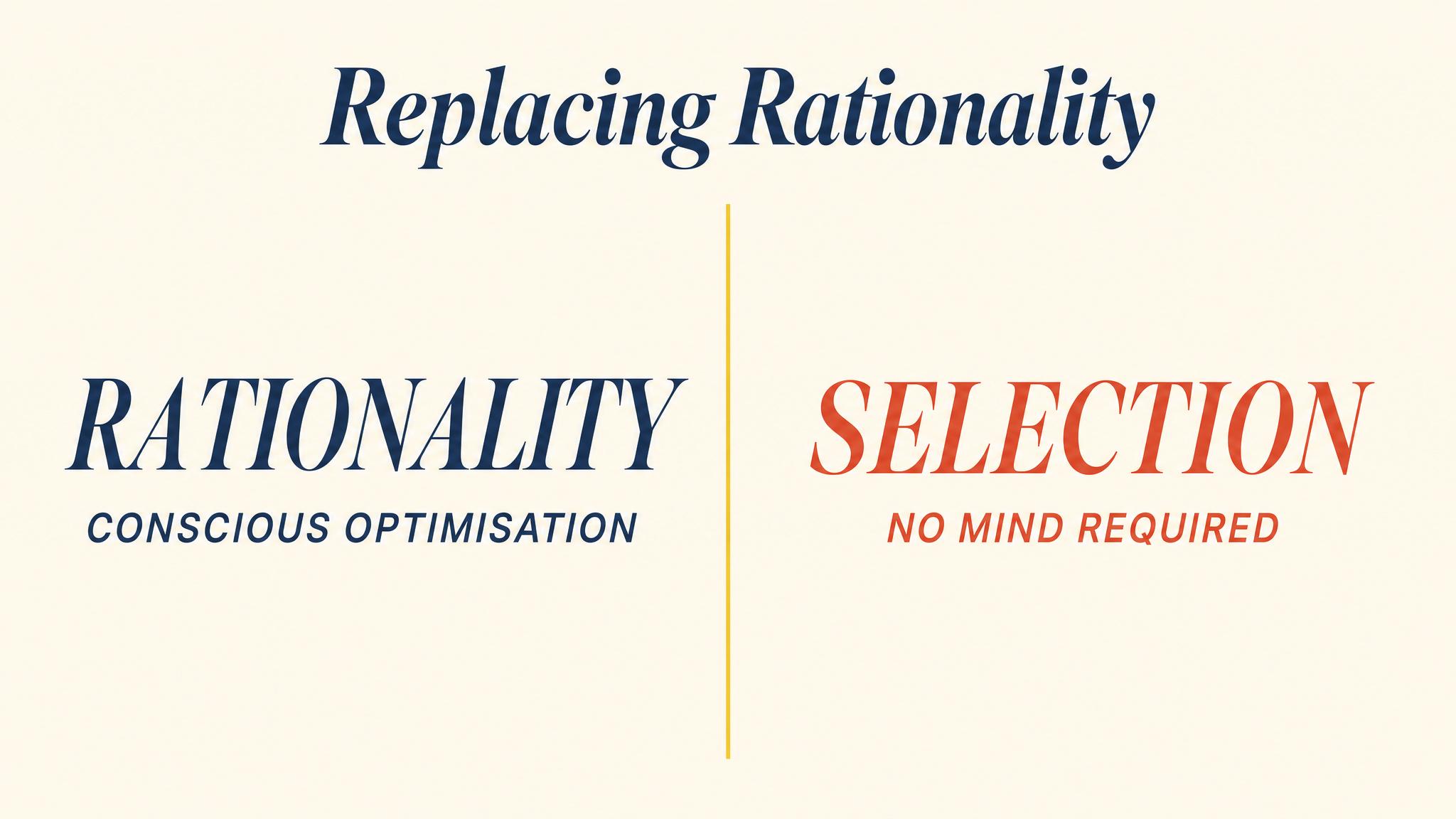
This chapter performs a breathtaking shift in perspective. For eight chapters, game theory has rested on the assumption that players are rational, calculating agents who reason about their opponents' strategies. Now…
If you could only save one person from danger — your sibling or three strangers — which would you pick? Is that selfish or just human nature?
Tough choice
You see two birds fighting over food. One backs down and flies away. Is that bird smart or weak?
Quick poll
Do you think being consistently nice is actually a winning strategy in life, or do nice people just get walked over?
Hot take
Someone screws you over once. Do you give them a second chance or immediately cut them off? Which approach has worked better for you?
Real talk
Is nature mostly about survival of the fittest (brutal competition) or animals helping each other out? What have you actually observed?
Debate time
Would you rather be someone who shares resources and sometimes loses out, or someone who always grabs what they can and sometimes makes enemies?
Would you rather
Live Hawk-Dove Tournament
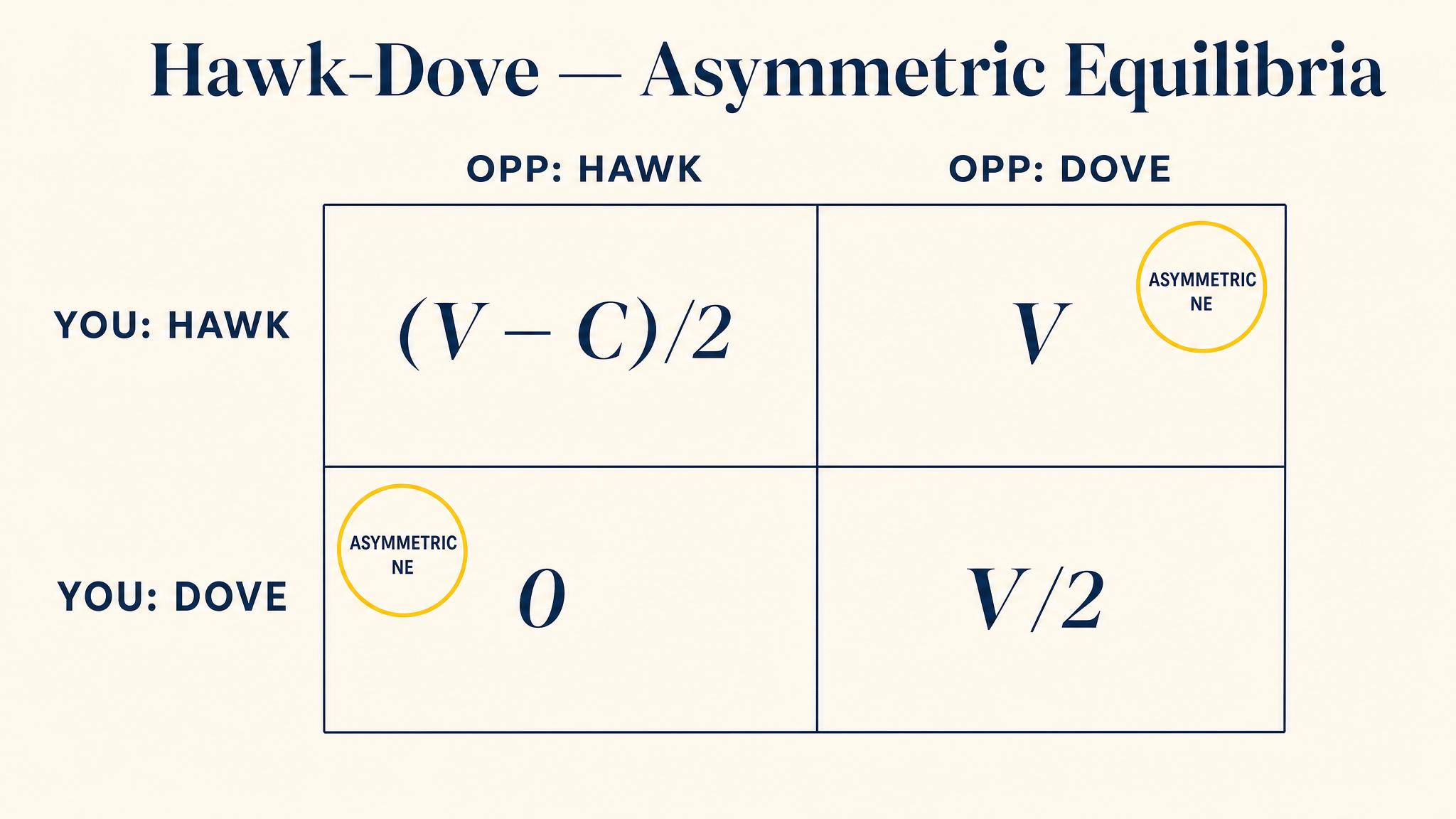
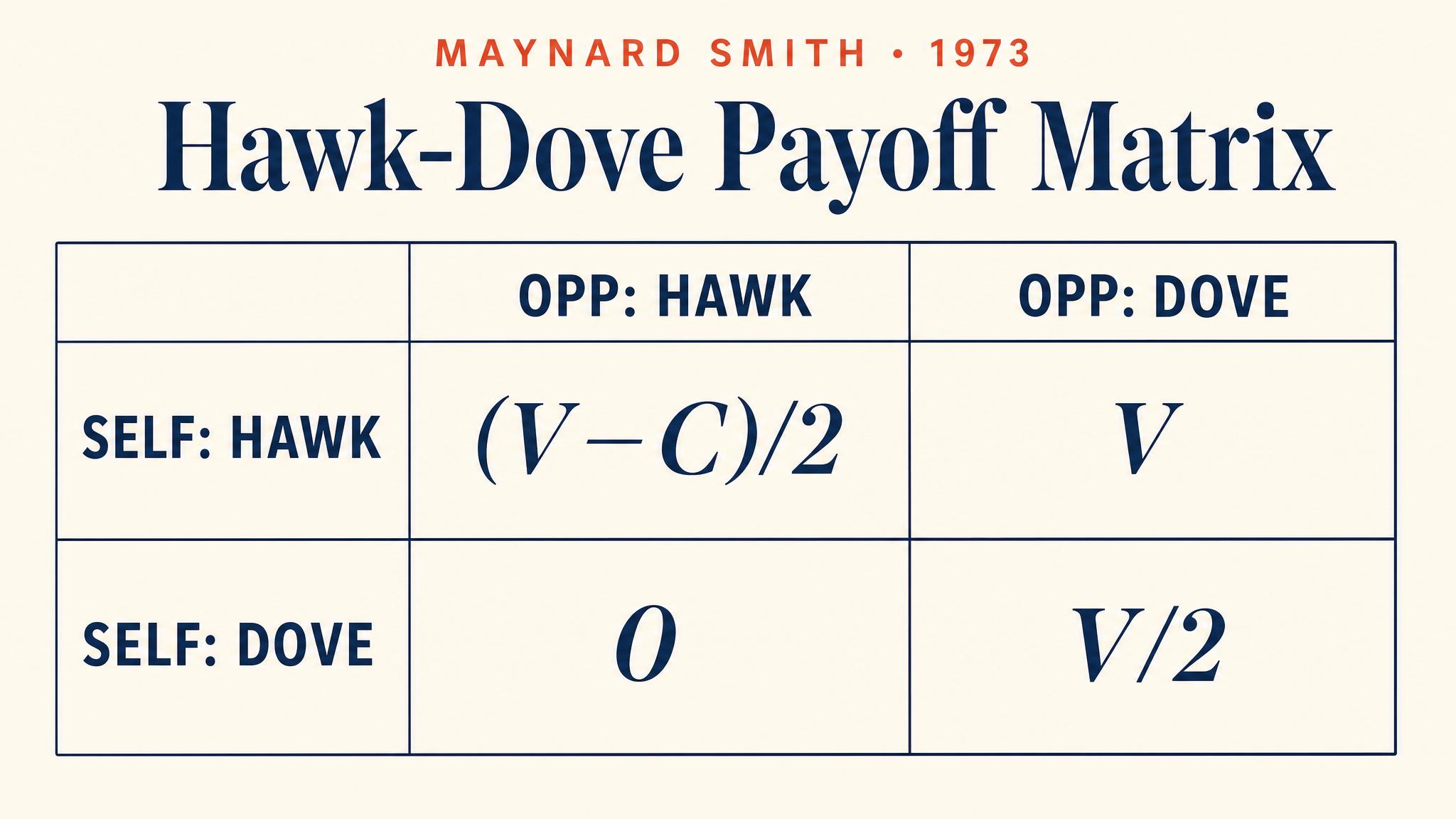
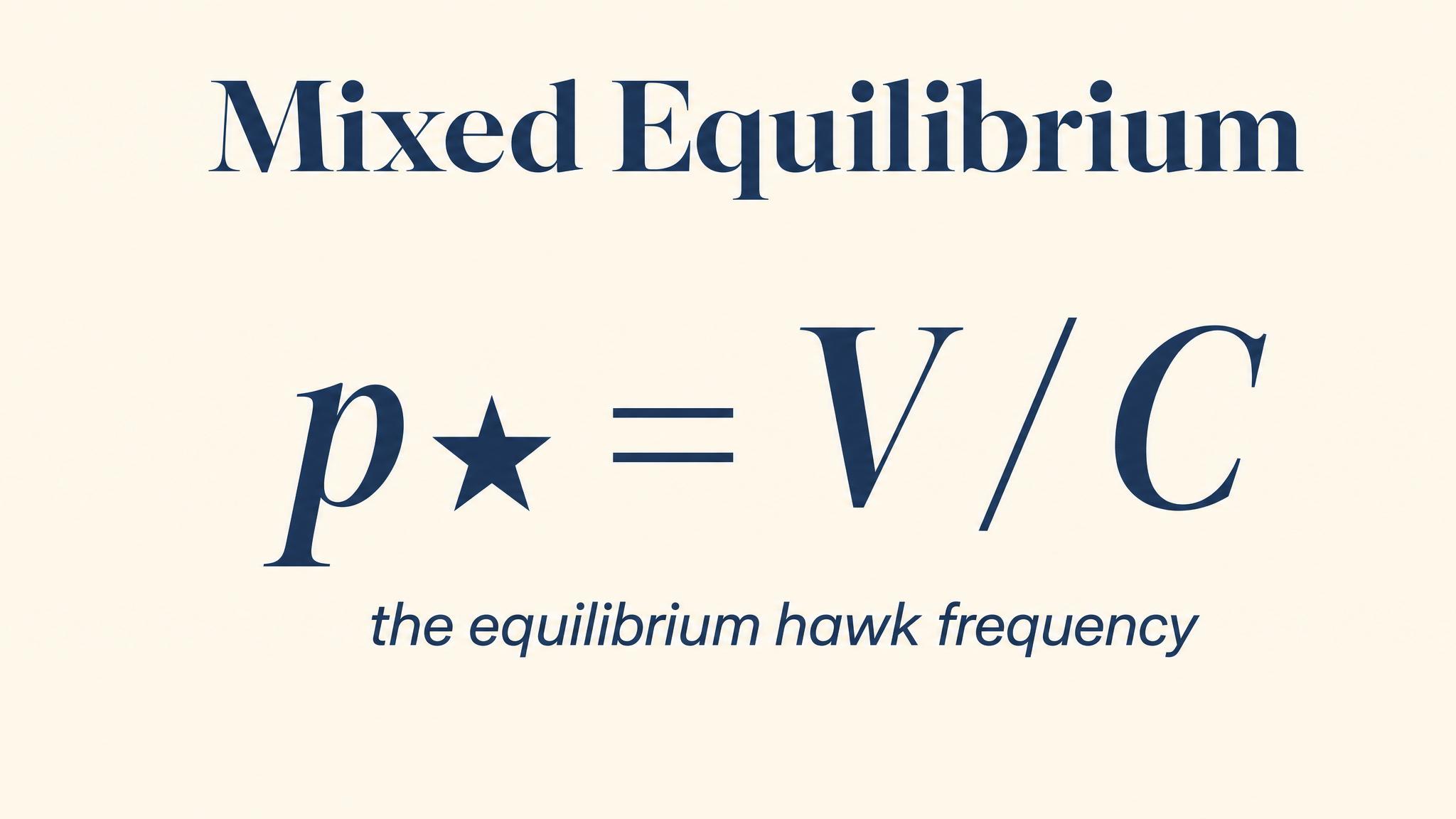
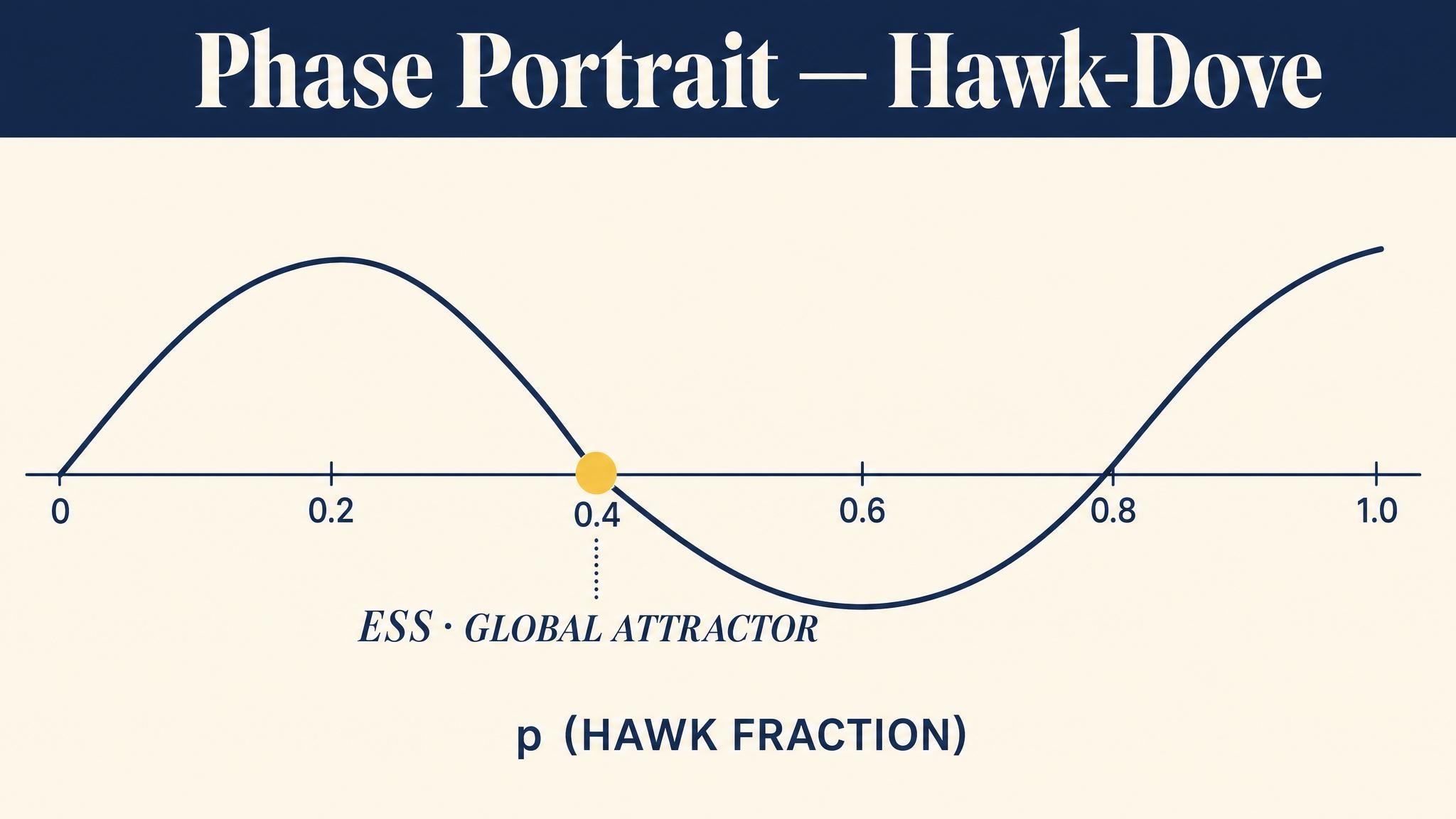
15-20 minutesEach table represents a 'population' adopting either Hawk or Dove strategy (or mixed). Round 1: Tables announce their strategy. Round 2: Instructor randomly pairs tables to 'compete' for resources. Teams calculate payoffs using the classic Hawk-Dove matrix (Hawk vs Hawk = 0, Hawk vs Dove = 3, Dove vs Hawk = 1, Dove vs Dove = 2). Round 3: Based on cumulative payoffs, teams can 'evolve' — switch strategies if they want. Round 4: Repeat pairings and calculations. Round 5: Class discusses which strategy dominated and why (introduces ESS concept). Instructor reveals that mixed strategy or conditional play often emerges as stable.
Tit-for-Tat vs. All Strategies Showdown
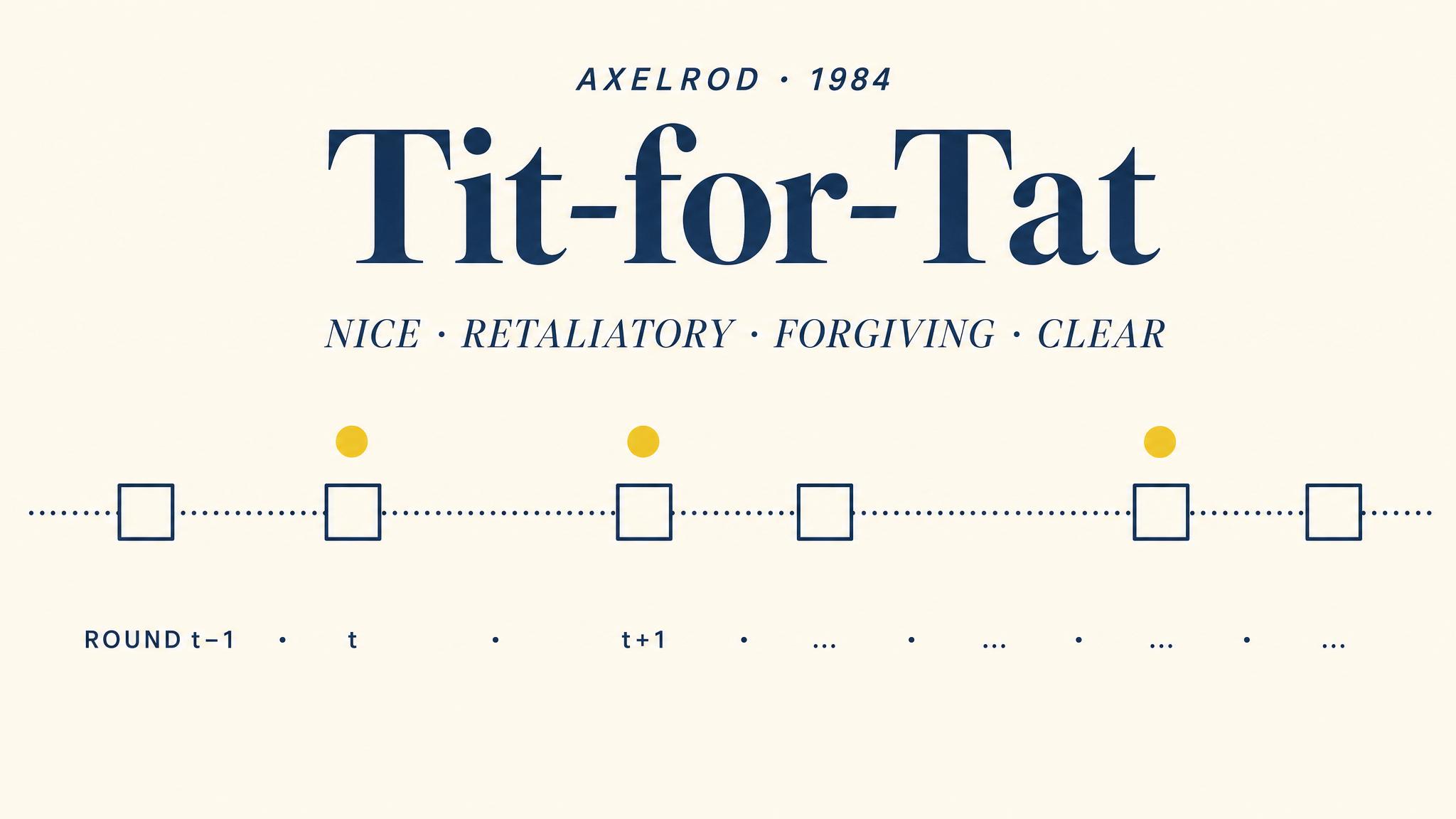
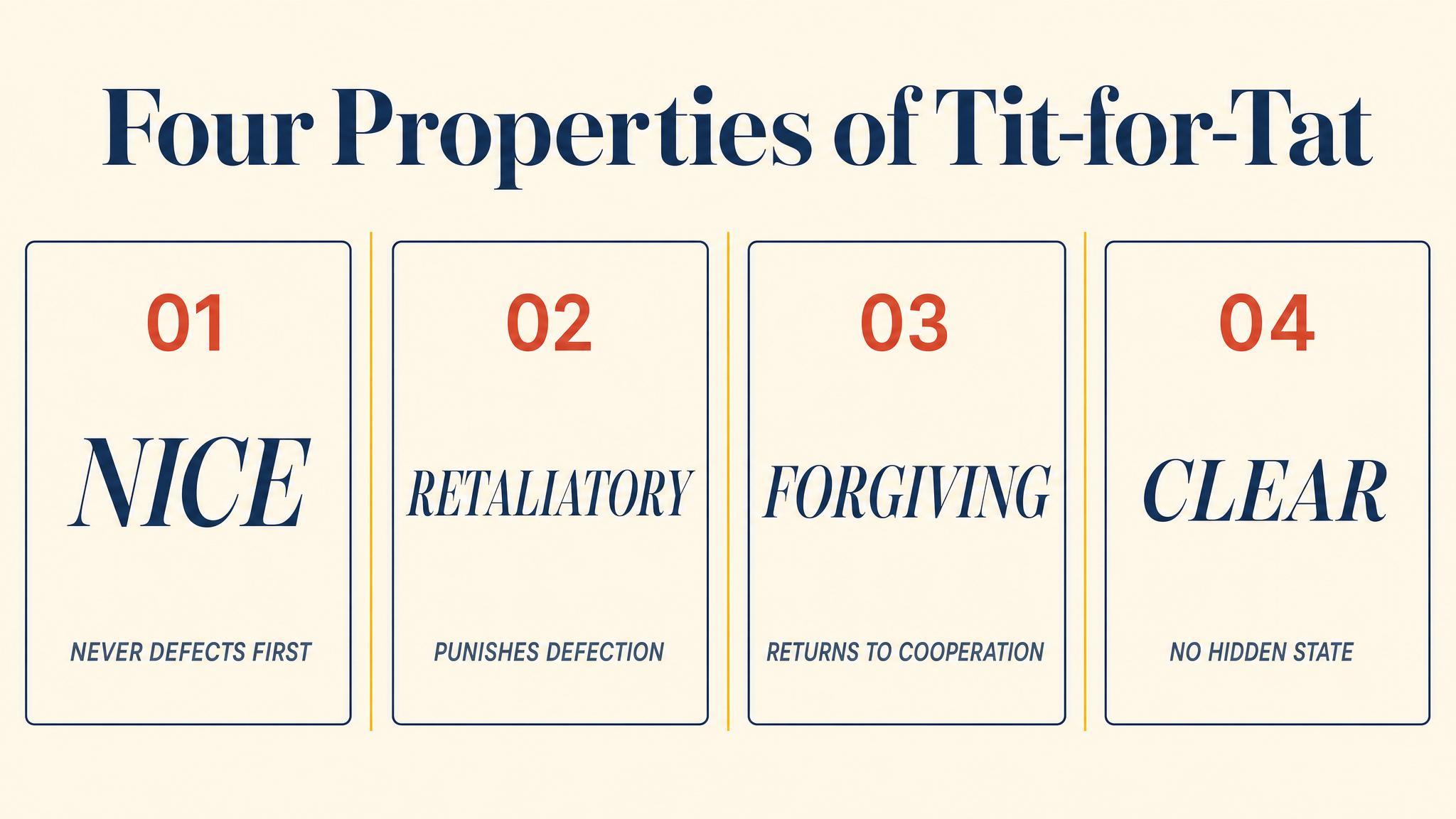
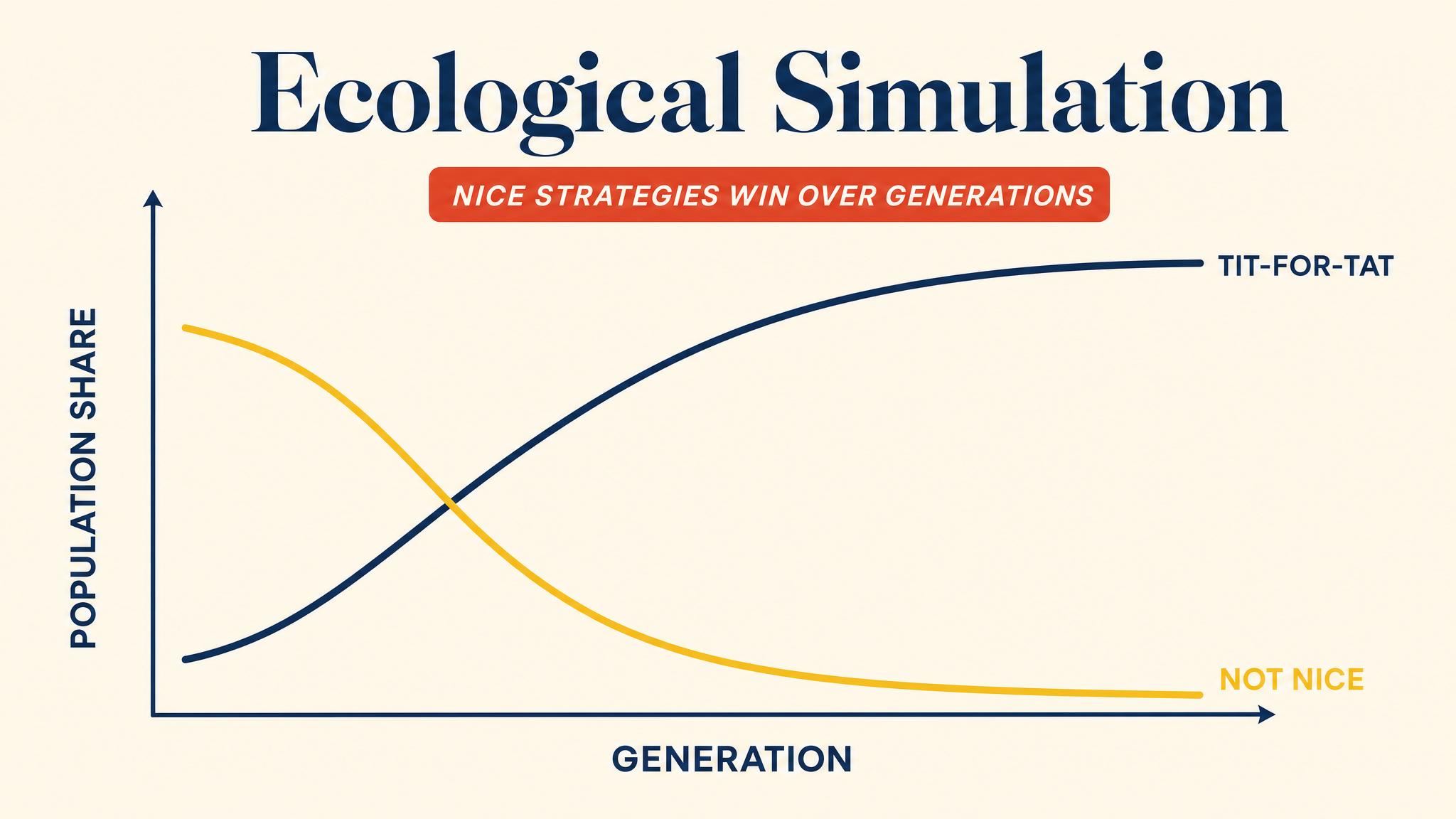
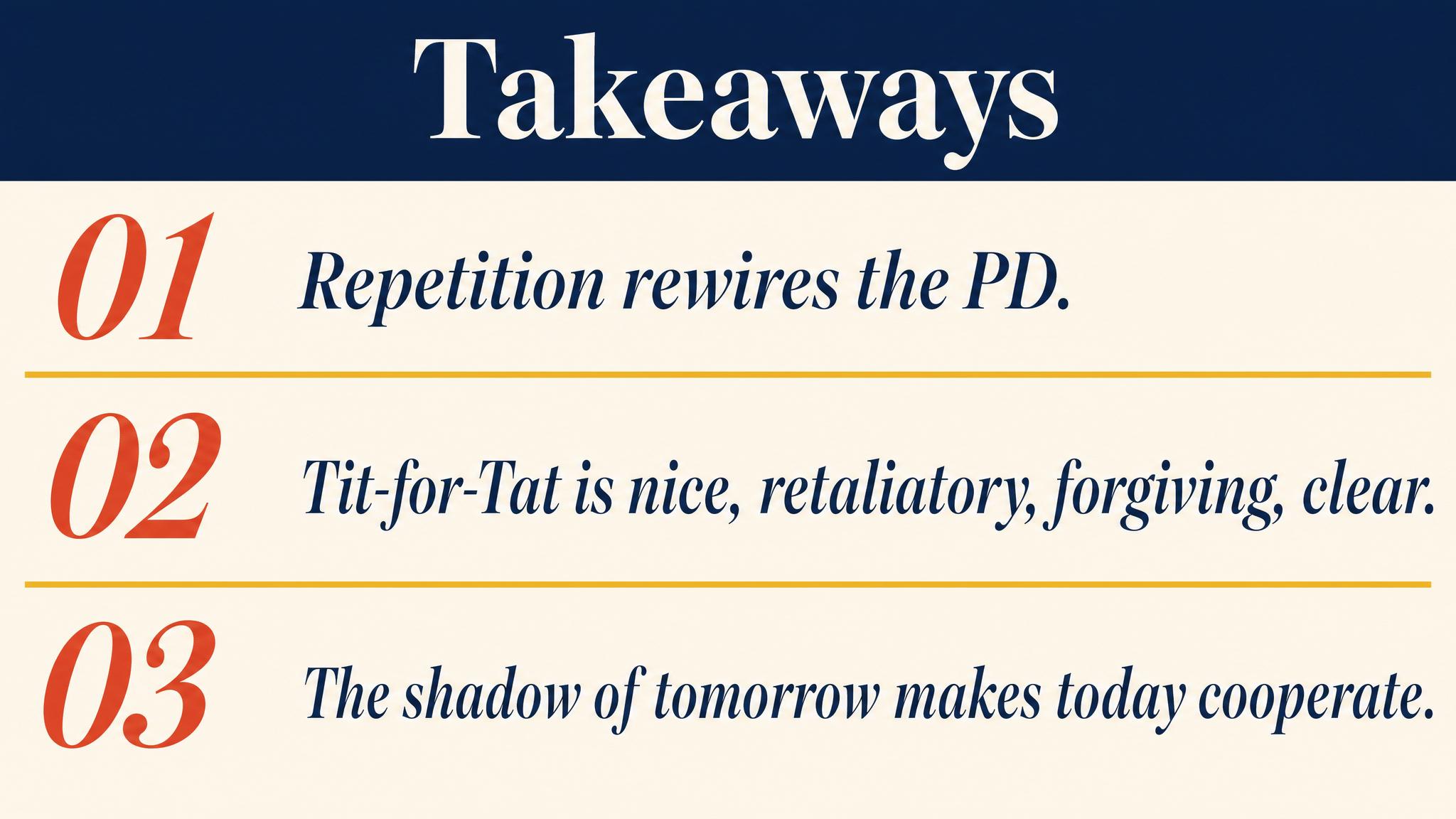
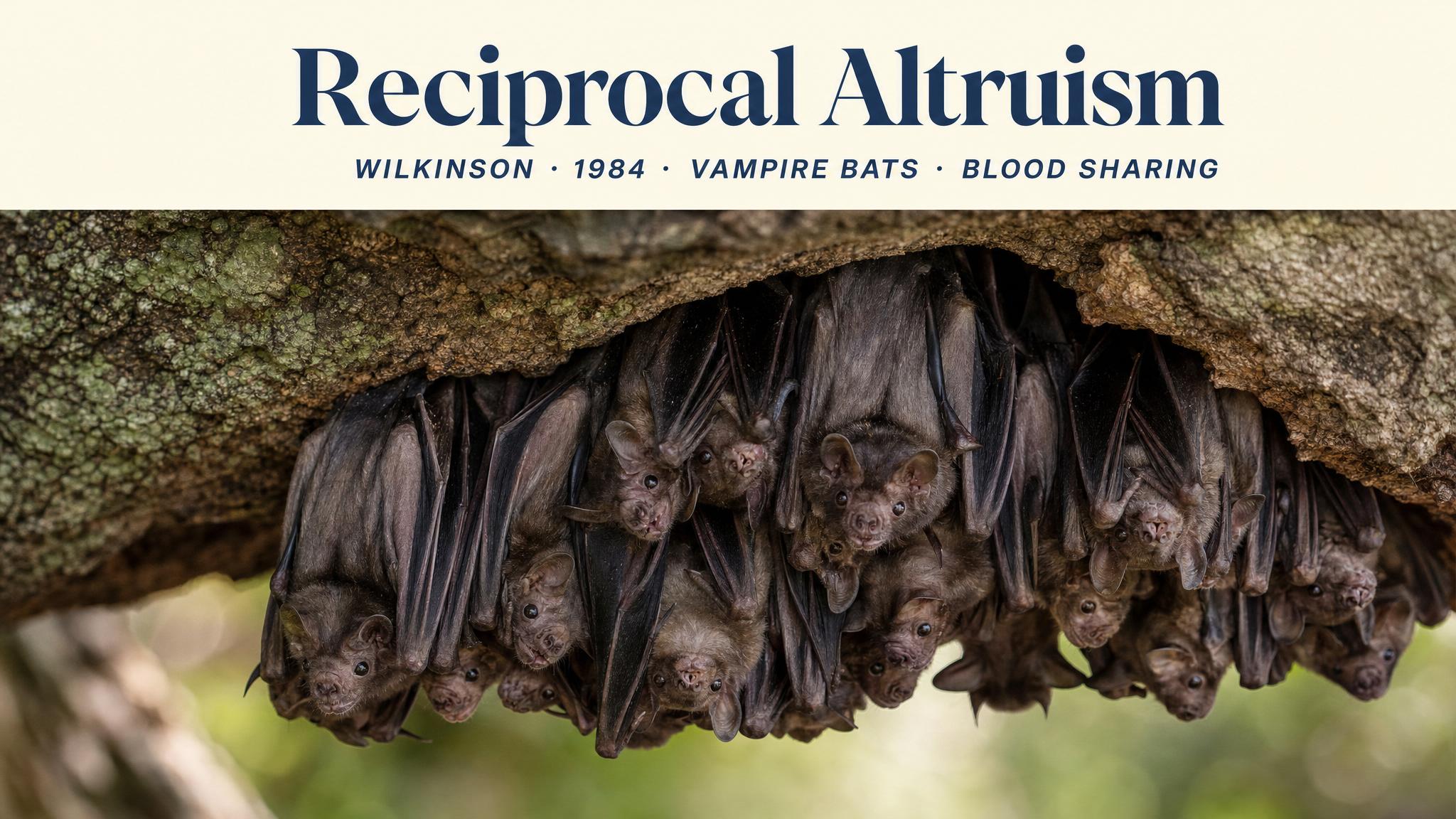
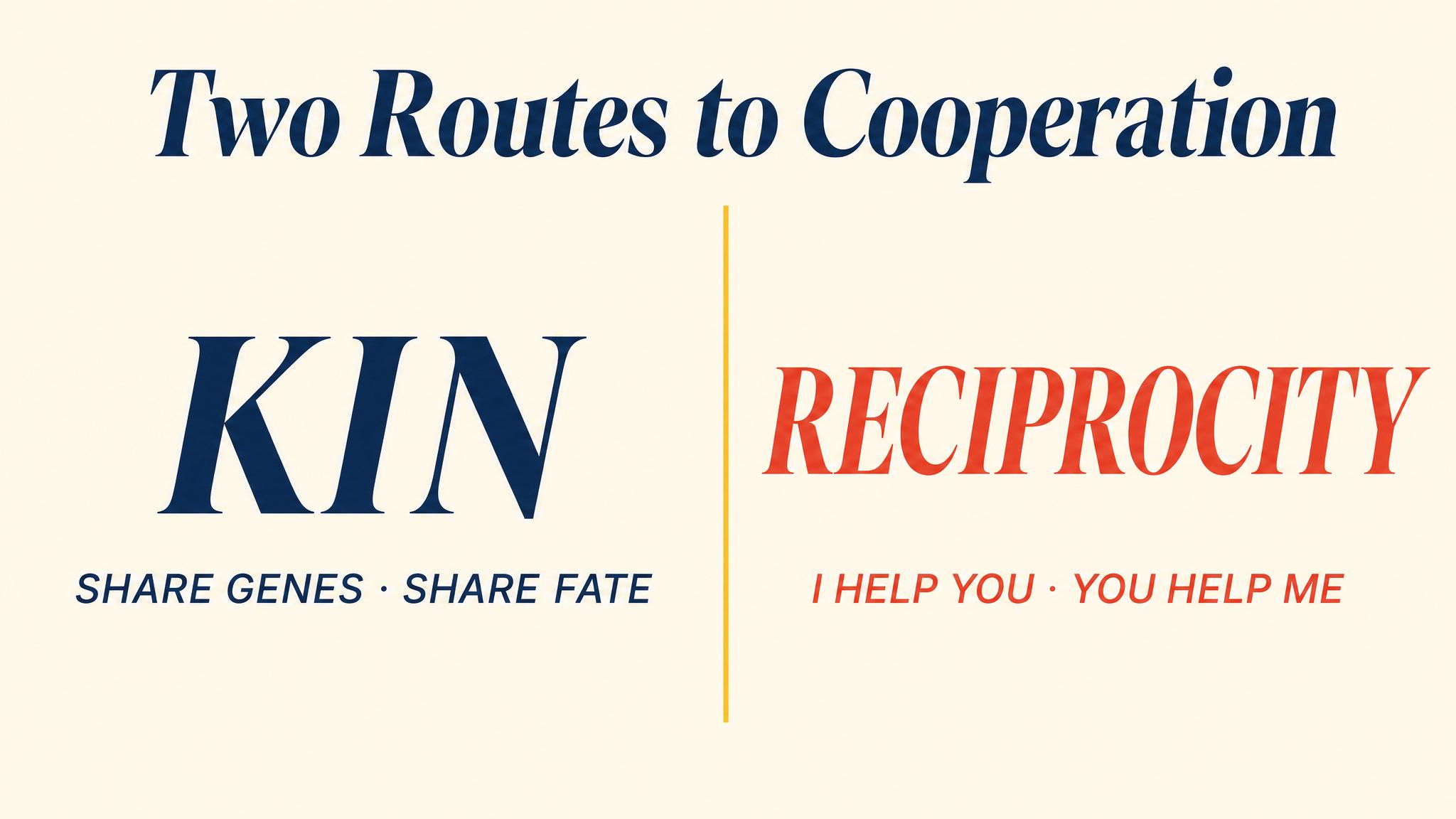
12-15 minutesAssign each table a different strategy for iterated prisoner's dilemma: Table 1 = Always Cooperate, Table 2 = Always Defect, Table 3 = Tit-for-Tat, Table 4 = Random, Table 5 = Grudger (cooperate until betrayed once, then defect forever), etc. Each table plays 5 rounds against 2-3 other tables, tracking total points (Cooperate/Cooperate = 3/3, Cooperate/Defect = 0/5, Defect/Defect = 1/1). After all matches, tables report total scores. Instructor plots scores on board. Tit-for-Tat typically wins. Class discusses why: it's 'nice, retaliatory, forgiving, clear.' Connect to reciprocal altruism in vampire bats, sticklebacks, and grooming in primates.
Hamilton's Rule: Save Your Siblings?
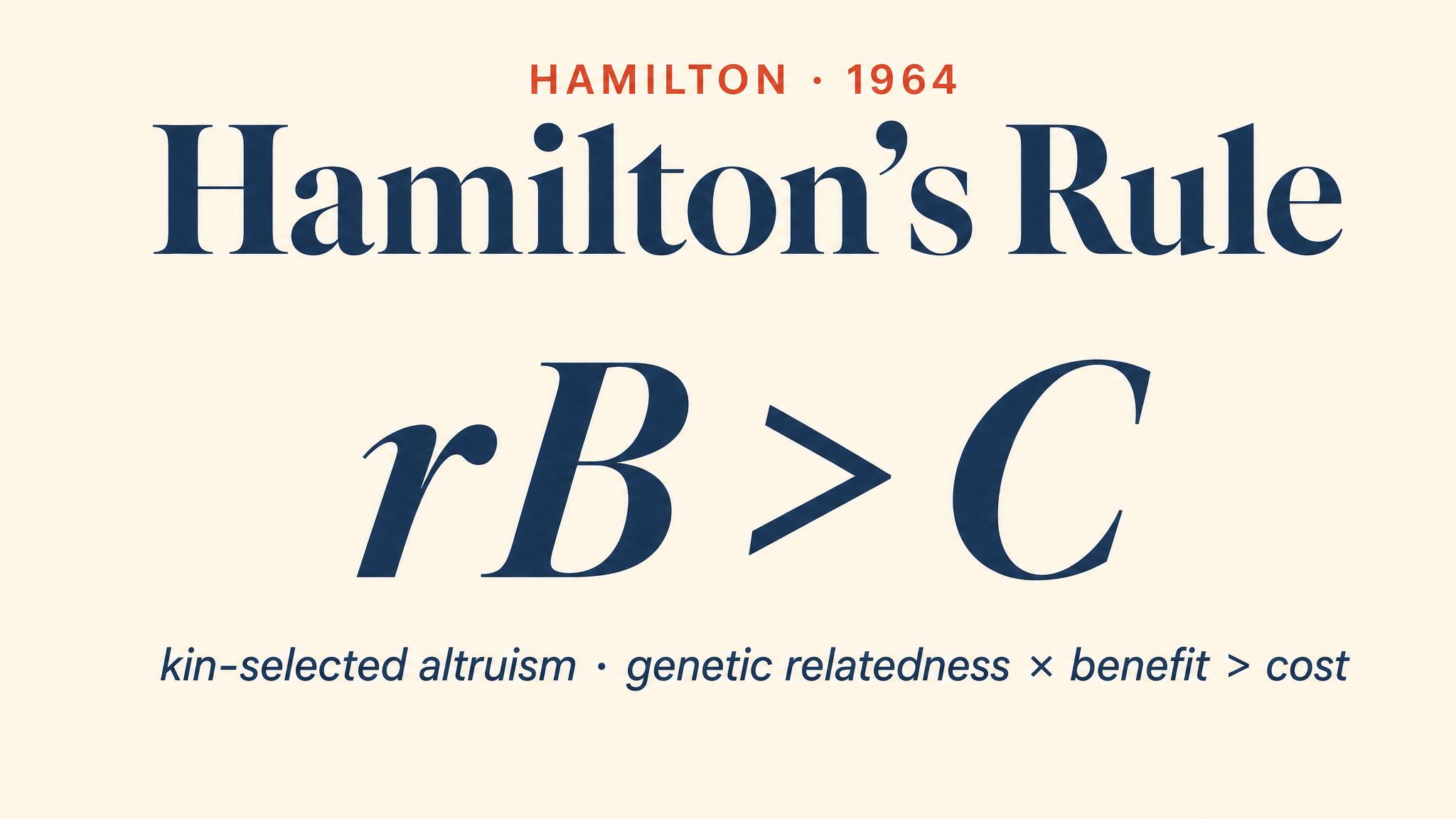
10-12 minutesPresent 5 scenarios on slides where animals must decide whether to help relatives at personal cost. Each table gets a worksheet with scenarios like: 'Ground squirrel alarm calls attract predators (cost = -0.3 fitness). Siblings nearby = 4, relatedness = 0.5, each benefits +0.2 from warning. Does Hamilton's rule (rB > C) predict helping?' Tables race to calculate and vote. After each scenario, reveal answer and briefly explain. Include mix of obvious (full siblings high benefit) and tricky cases (cousins, low benefit). Final scenario is a twist: helping non-kin who help back (introduces reciprocal altruism contrast).
Invader or Stable? ESS Gauntlet
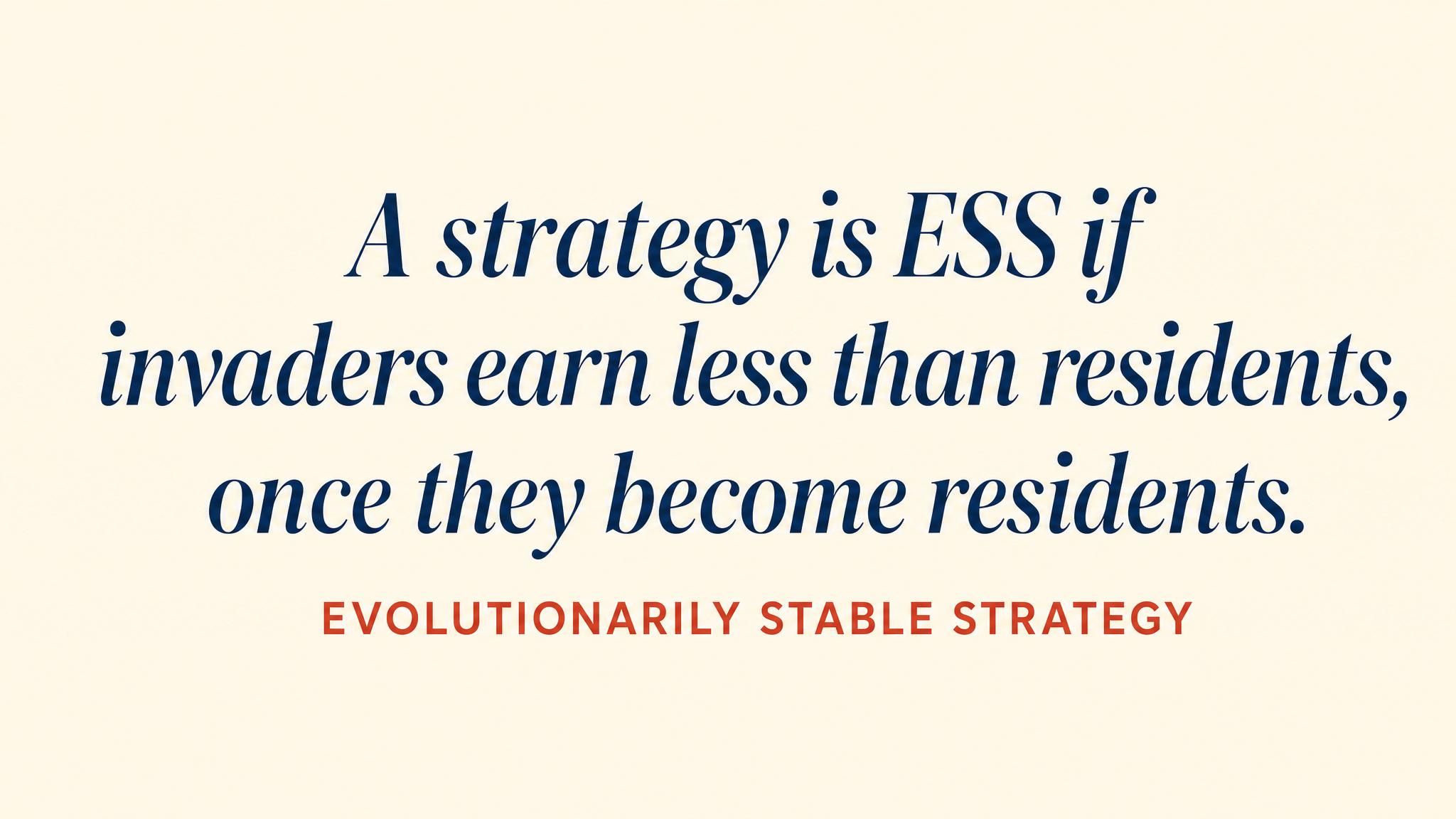
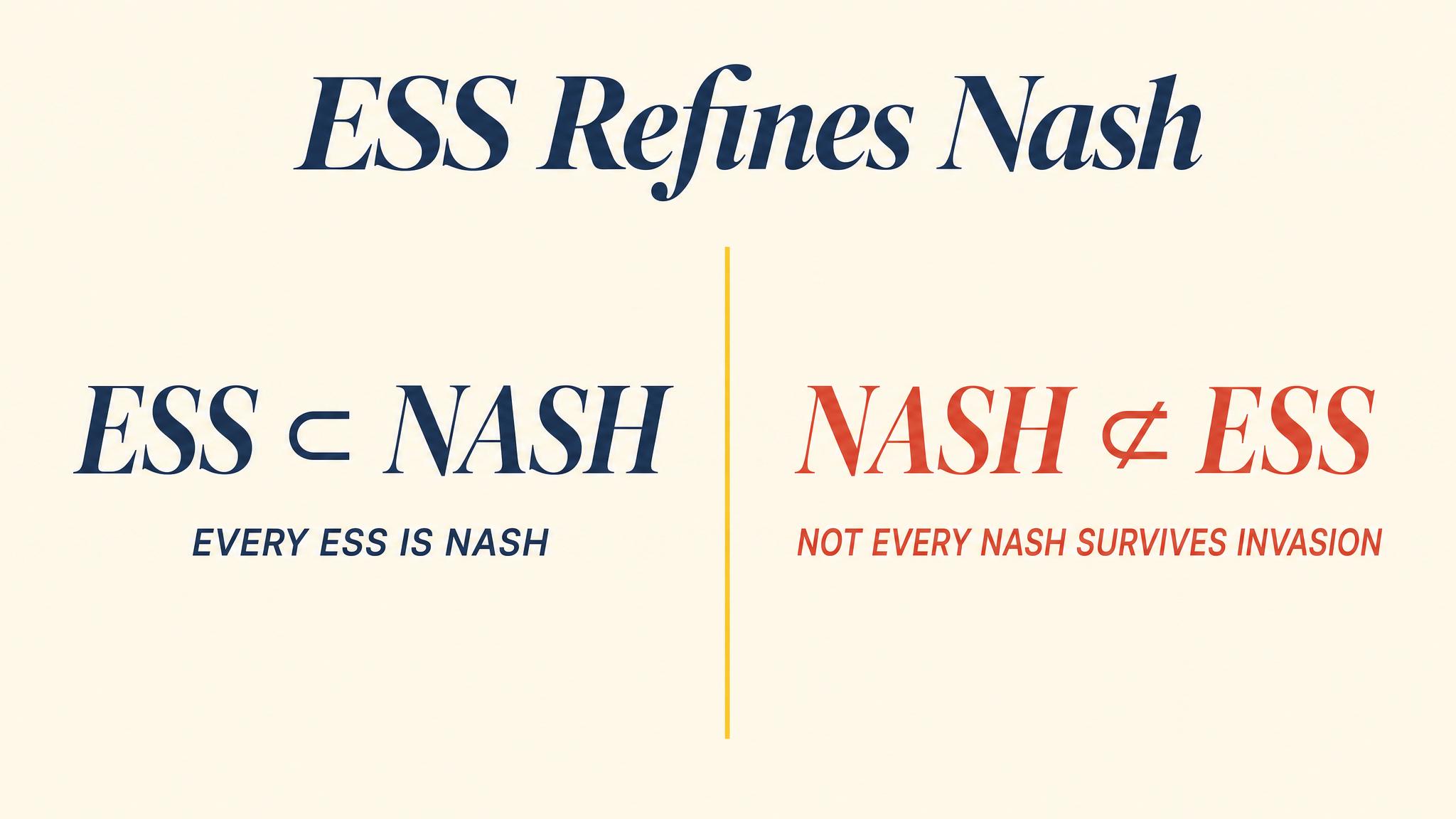
15-18 minutesInstructor presents 4 'resident' strategies with payoff structures. Each table is assigned one strategy to test for ESS status. Tables must: (1) Define a plausible 'mutant' strategy, (2) Calculate payoffs when mutant is rare in population of residents, (3) Determine if mutant can invade (earns higher payoff than resident against resident), (4) Prepare 2-minute presentation. Tables then present findings. Class votes on whether each strategy is ESS. Instructor facilitates discussion of what makes something evolutionarily stable (must earn higher payoff against itself than any mutant does against it).
Replicator Dynamics: Strategy Population Crash
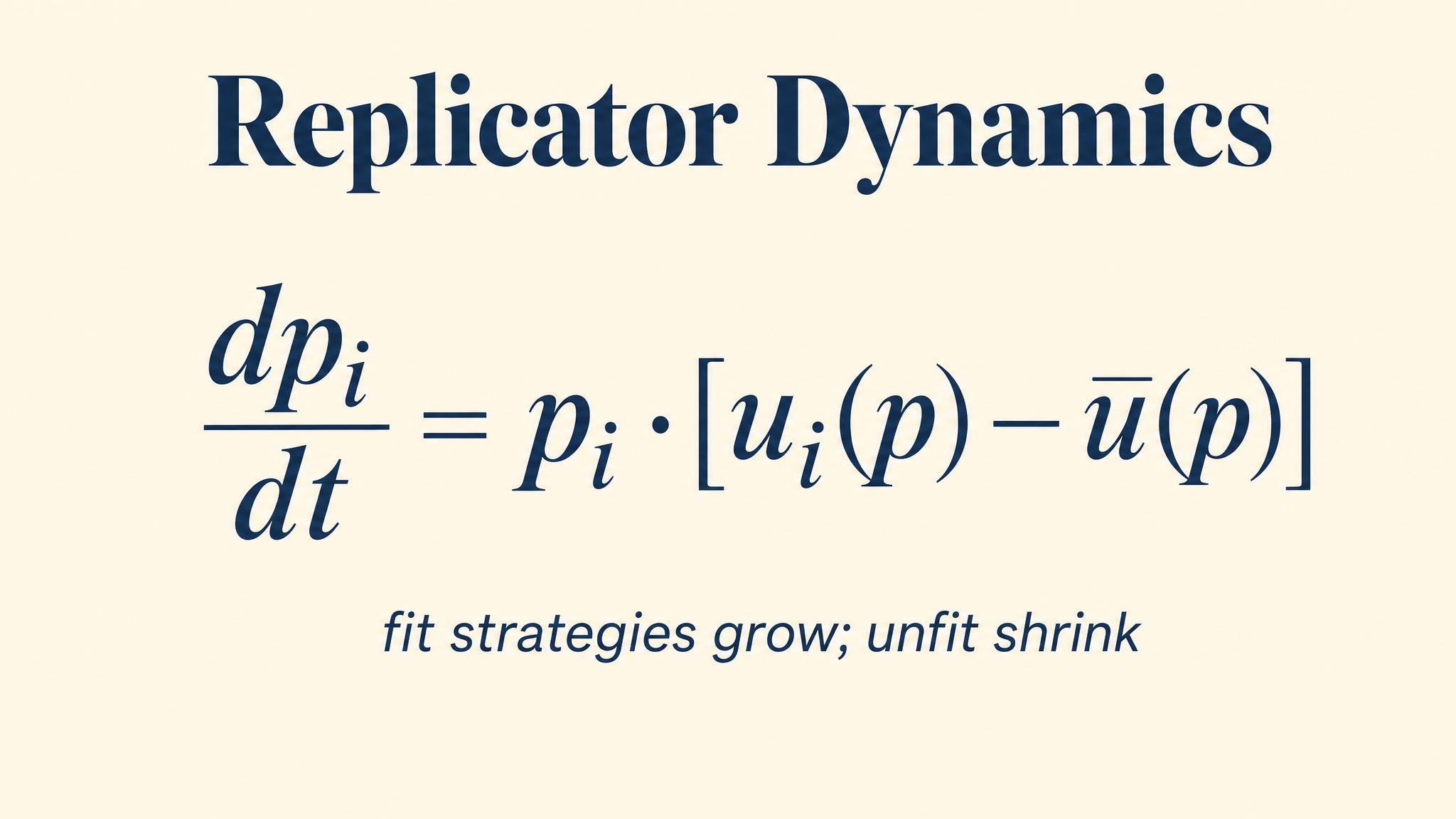
10-12 minutesSet up three 'zones' in room: Hawk Zone, Dove Zone, Mixed Strategy Zone. All students start in Mixed (representing initial population distribution). Instructor runs 3 'generations': In each generation, students at their tables calculate expected payoffs for their current strategy given current population frequencies (count heads in each zone). After calculation, students physically move to zone of strategy that performed best. Watch population distribution shift in real-time. Often see oscillations or convergence to mixed strategy equilibrium. Debrief: This is replicator dynamics—frequencies change based on relative fitness. Connect to classic examples like male beetles with different mating strategies.
Real Animal Behavior: What's the Game?
12-15 minutesShow 3 short video clips of animal behavior (e.g., dung beetle fights, baboon grooming, bee waggle dance, lioness cooperative hunting). After each clip, tables have 3 minutes to: (1) Identify what game-theoretic situation this represents (Hawk-Dove? Prisoner's Dilemma? Coordination game?), (2) Predict the likely ESS or evolutionary outcome, (3) Explain what keeps 'cheaters' from dominating. Each table holds up colored card with their answer (A=Hawk-Dove, B=Reciprocal Altruism, C=Kin Selection, D=Other). Instructor polls class, reveals correct interpretation, discusses the mechanisms maintaining cooperation or mixed strategies in each case.
Splitting the Pie: The Logic of Bargaining
Almost every strategic interaction of consequence — salary negotiations, international treaties, corporate mergers, divorce settlements, even dividing household chores — involves bargaining. This chapter provides the…
In any negotiation, whoever cares less wins. Agree or disagree?
Hot take
You're negotiating a salary. Should you name a number first, or make them go first?
Quick poll
Your roommate wants to split rent 50/50 but they got the bigger room. Do you push back or let it go?
Real talk
Is it ever okay to bluff about having another offer when you're negotiating?
Debate time
Would you rather negotiate with someone who has way more power than you, or someone who has nothing to lose?
Would you rather
Have you ever walked away from a deal and regretted it? Or walked away and felt like a boss?
Real experiences
The Shrinking Pie: Live Rubinstein Bargaining
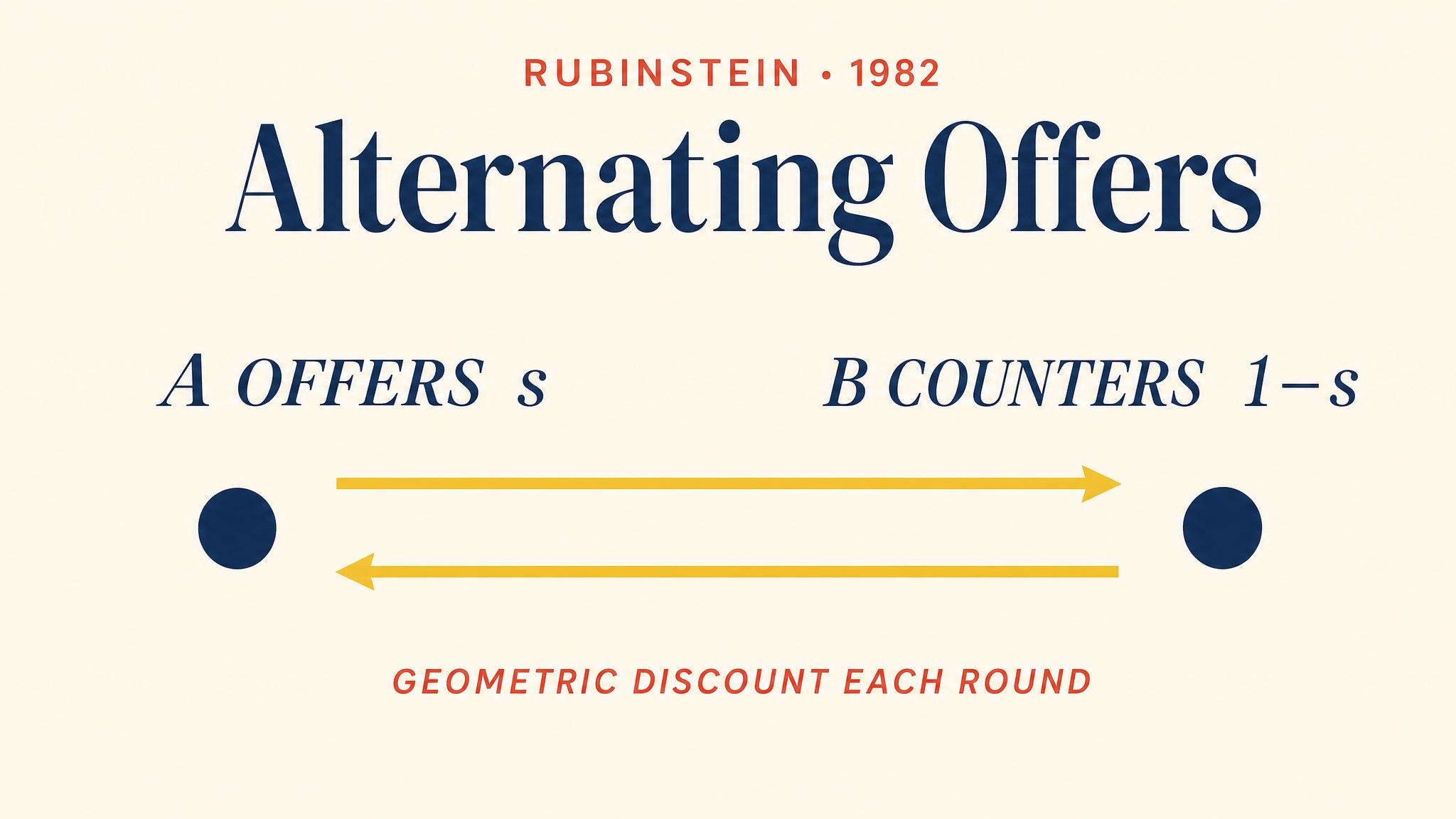
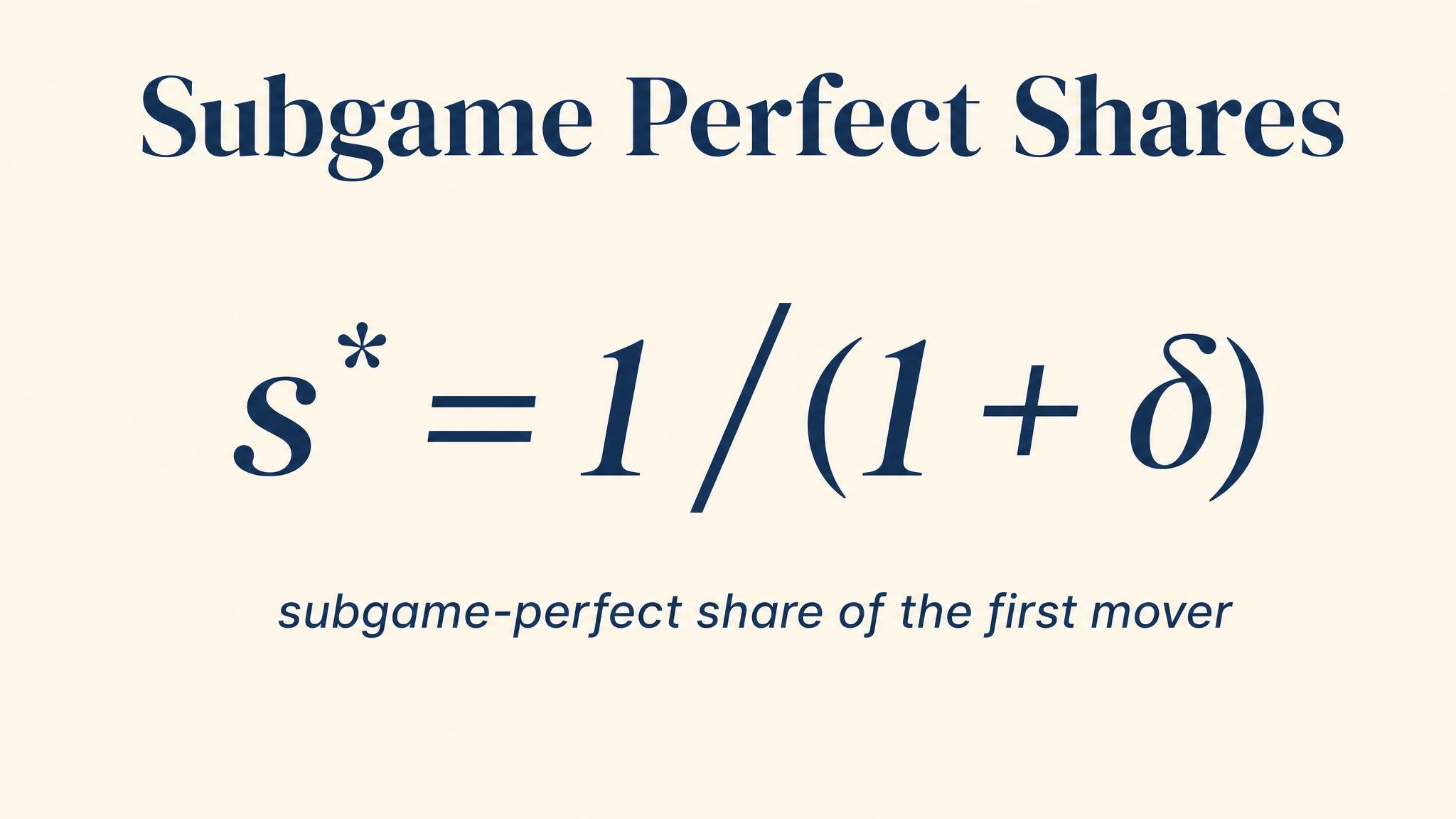
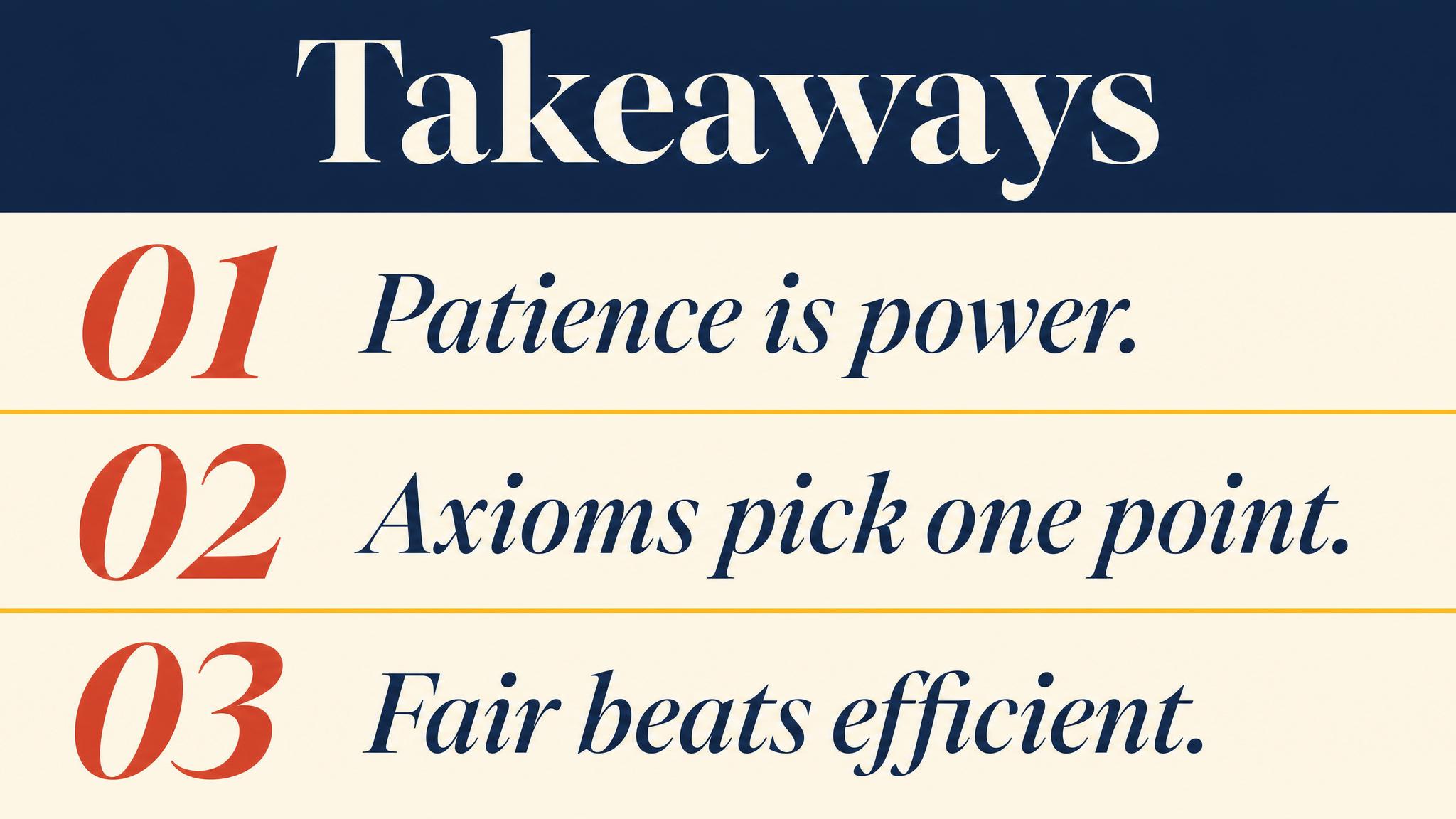
12-15 minutesWithin each table, students pair up. Each pair negotiates to split 100 points using alternating offers. The twist: after each round of back-and-forth offers (30 seconds each), the total pie shrinks by 20%. If they haven't agreed after 5 rounds, both get zero. After playing, pairs share with their table: When did they settle? Who proposed the deal? Was it close to the theoretical prediction? Instructor then reveals the subgame perfect equilibrium and compares to actual outcomes.
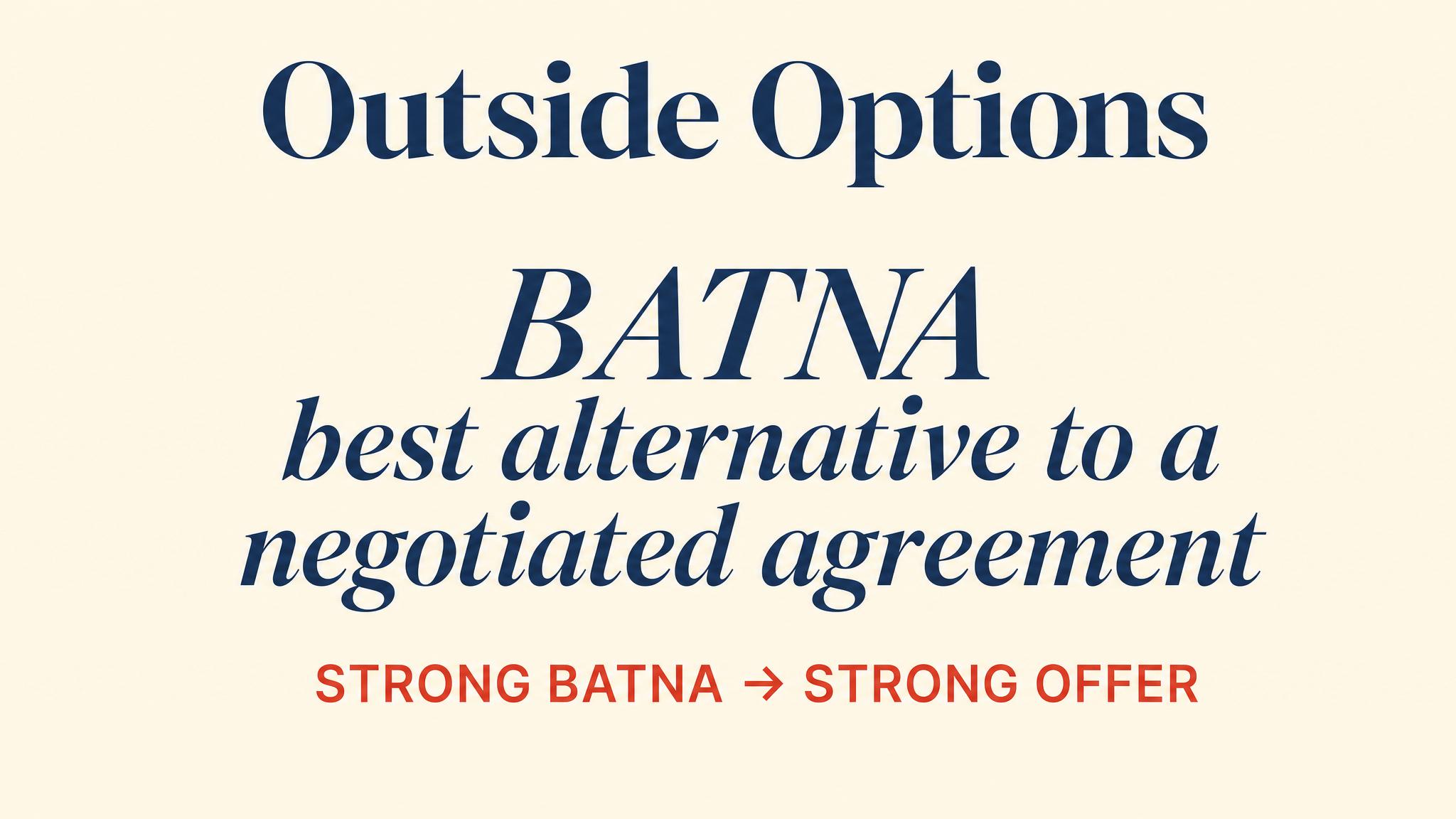
BATNA Showdown: Outside Options Tournament
10-12 minutesEach table receives 3 real-world bargaining scenarios (e.g., salary negotiation, used car sale, business partnership). For each scenario, teams have 3 minutes to: (1) identify all possible outside options for both parties, (2) rank which party has stronger BATNA, (3) predict the settlement range. Teams write predictions on large post-its. Then, tables swap post-its and critique each other's analysis. Instructor facilitates quick whole-class debrief: Which BATNAs were hidden? How does BATNA strength shift the bargaining range?
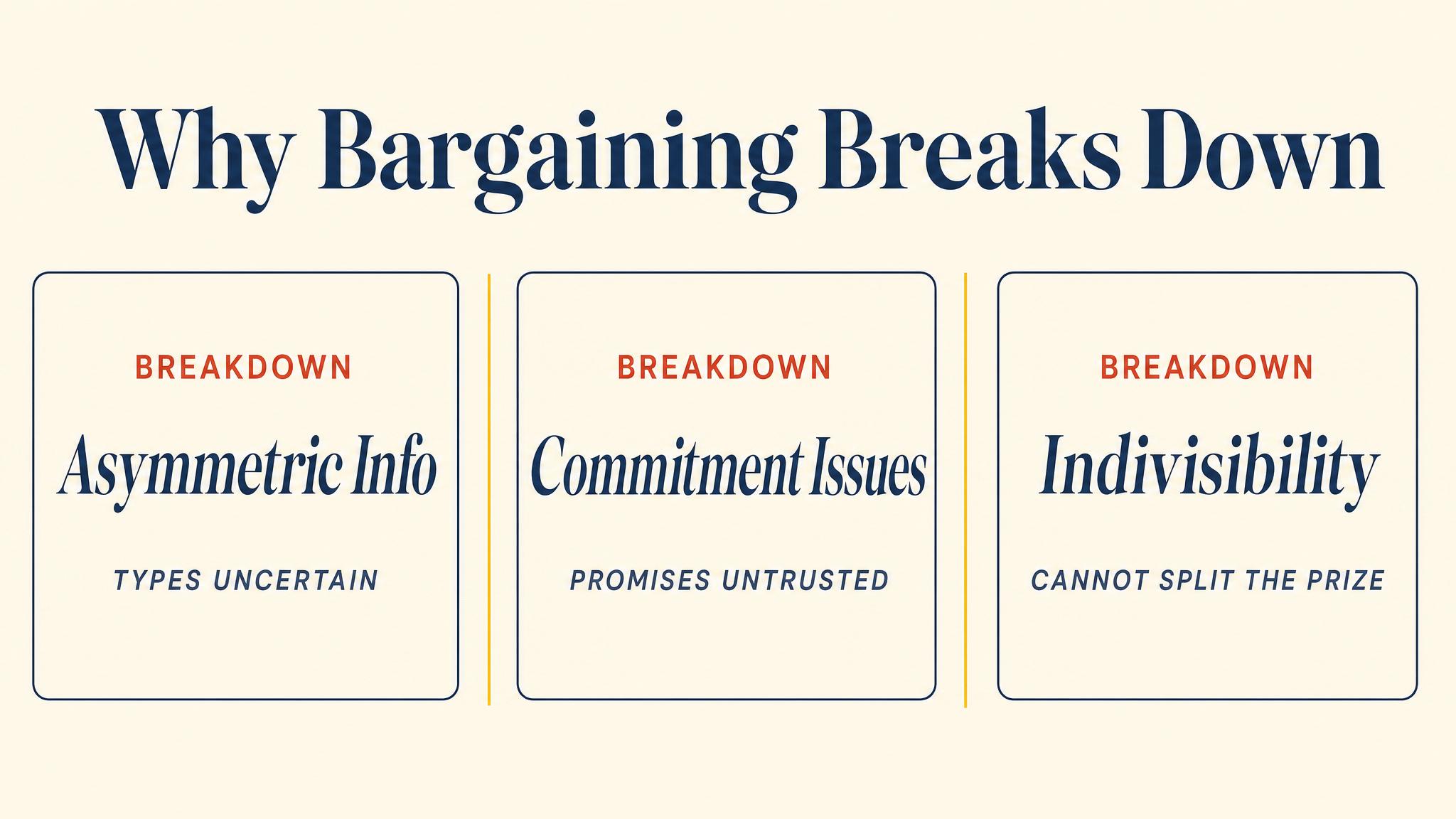
Asymmetric Information Breakdown
15-18 minutesEach table splits into sellers and buyers negotiating the sale of a 'company.' Sellers receive a card showing the company's true value (varies by table: $50K, $75K, or $100K). Buyers only know it's worth between $40K-$100K. They have 5 minutes to negotiate a price. After Round 1, debrief: How many deals? Then Round 2: everyone knows all possible values but not which specific value their table has. Compare deal rates. Tables discuss: Why did some negotiations fail? How did uncertainty change offers? Connects to the 'lemons problem' and why information asymmetry causes bargaining failure.
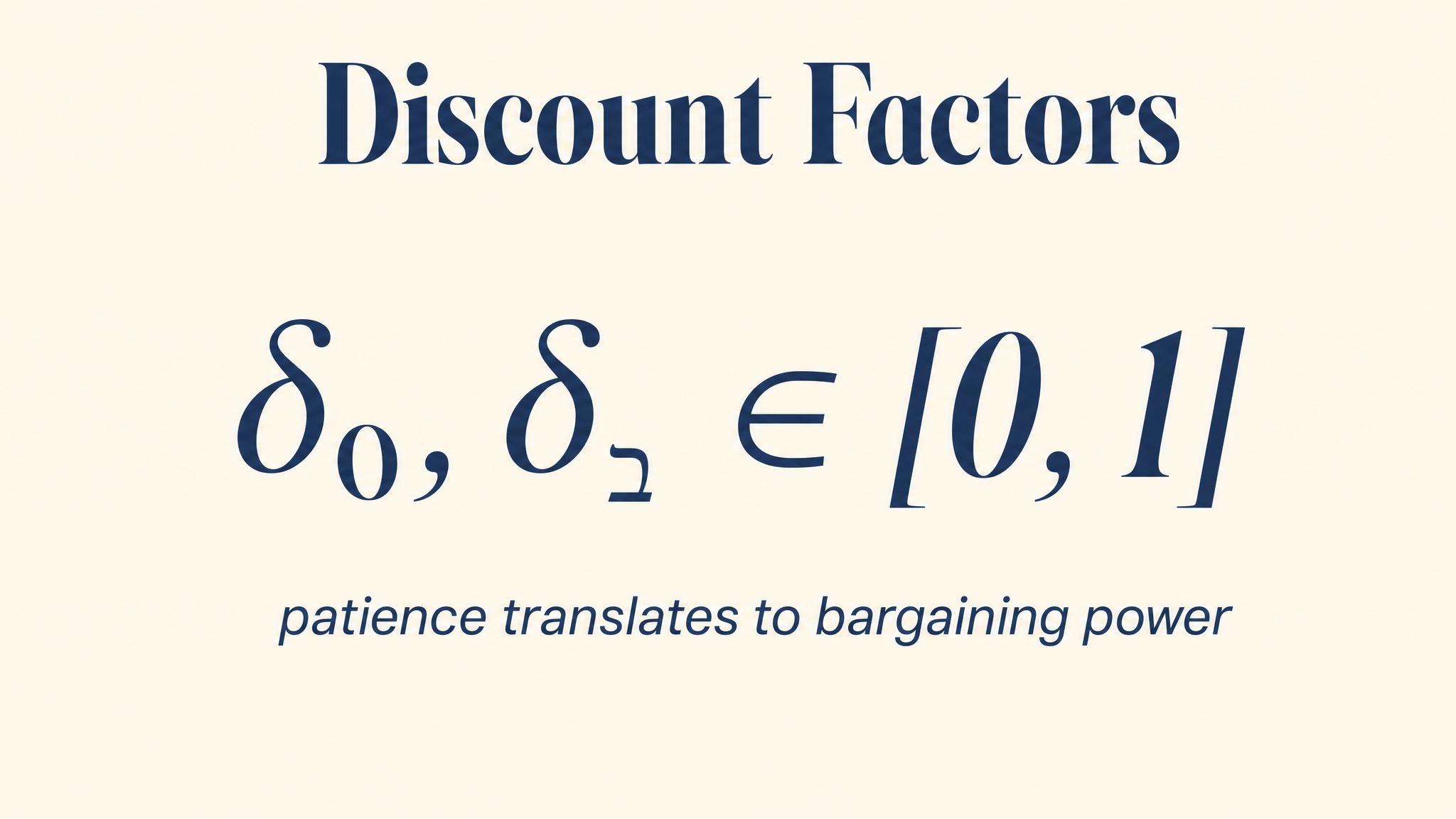
Patience Pays: Discount Rate Negotiation
10-12 minutesTables form pairs again. Each negotiator draws a 'patience card' (high patience = 0.95 discount factor, medium = 0.75, low = 0.50). They can't show their card to their partner. They negotiate to split $100, but must calculate their own payoff using their discount factor for each round that passes (30-second rounds). After agreements, reveal cards and calculate actual payoffs. Then table discusses: Did the patient person capture more surplus? Did anyone bluff about their patience? How did uncertainty about the other's patience affect strategy?
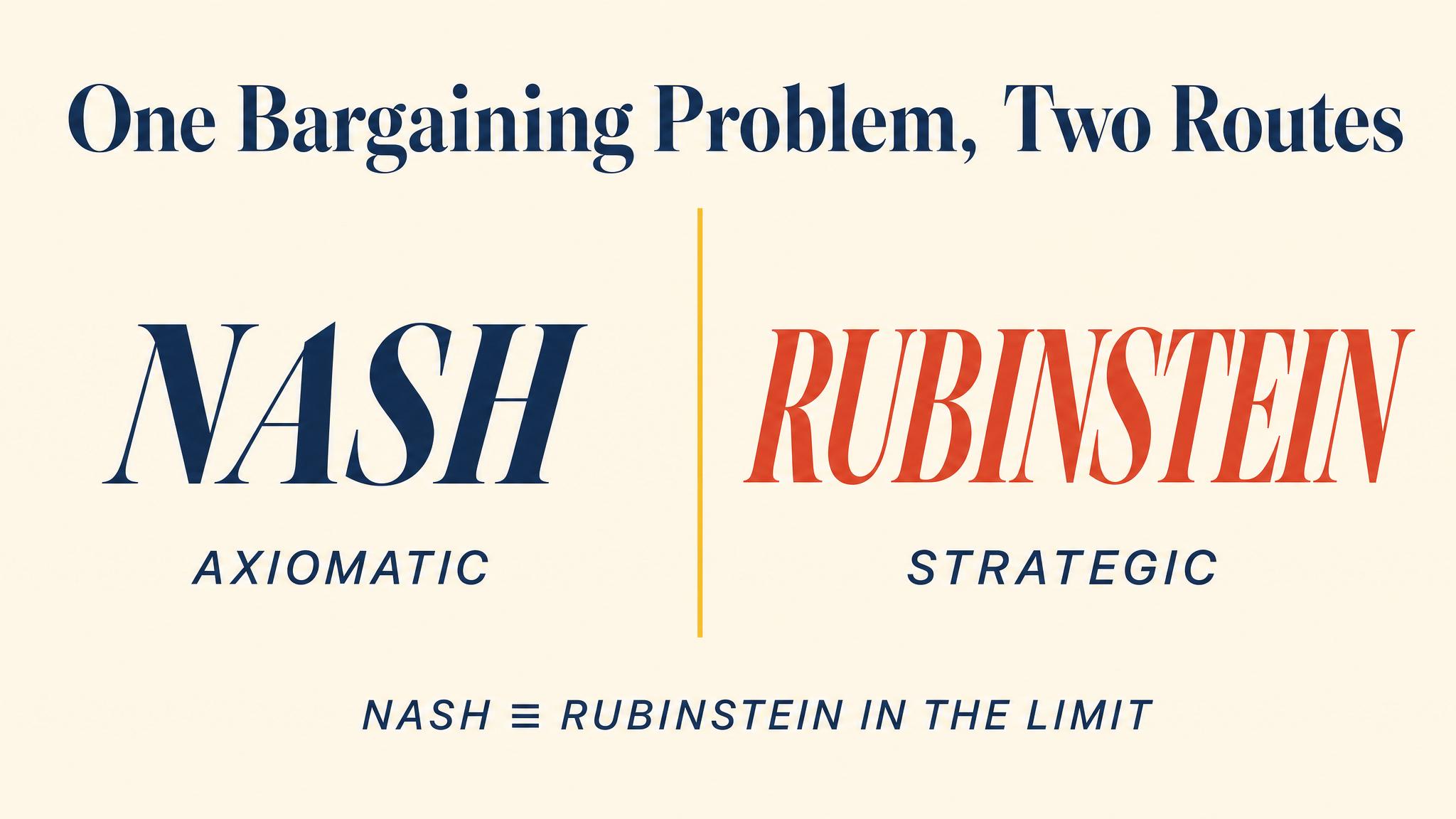
Nash Solution Face-Off: What's Fair Anyway?
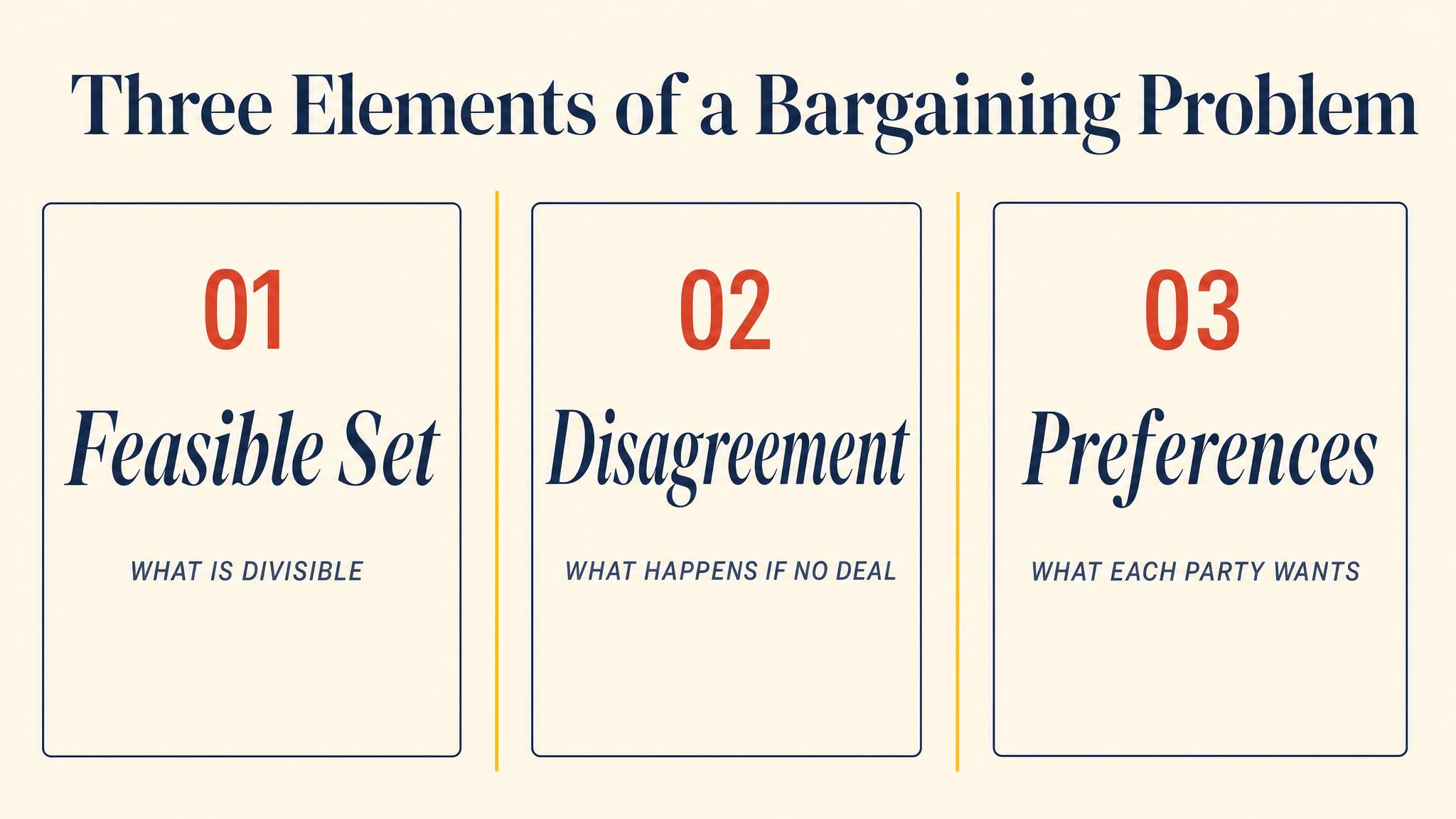
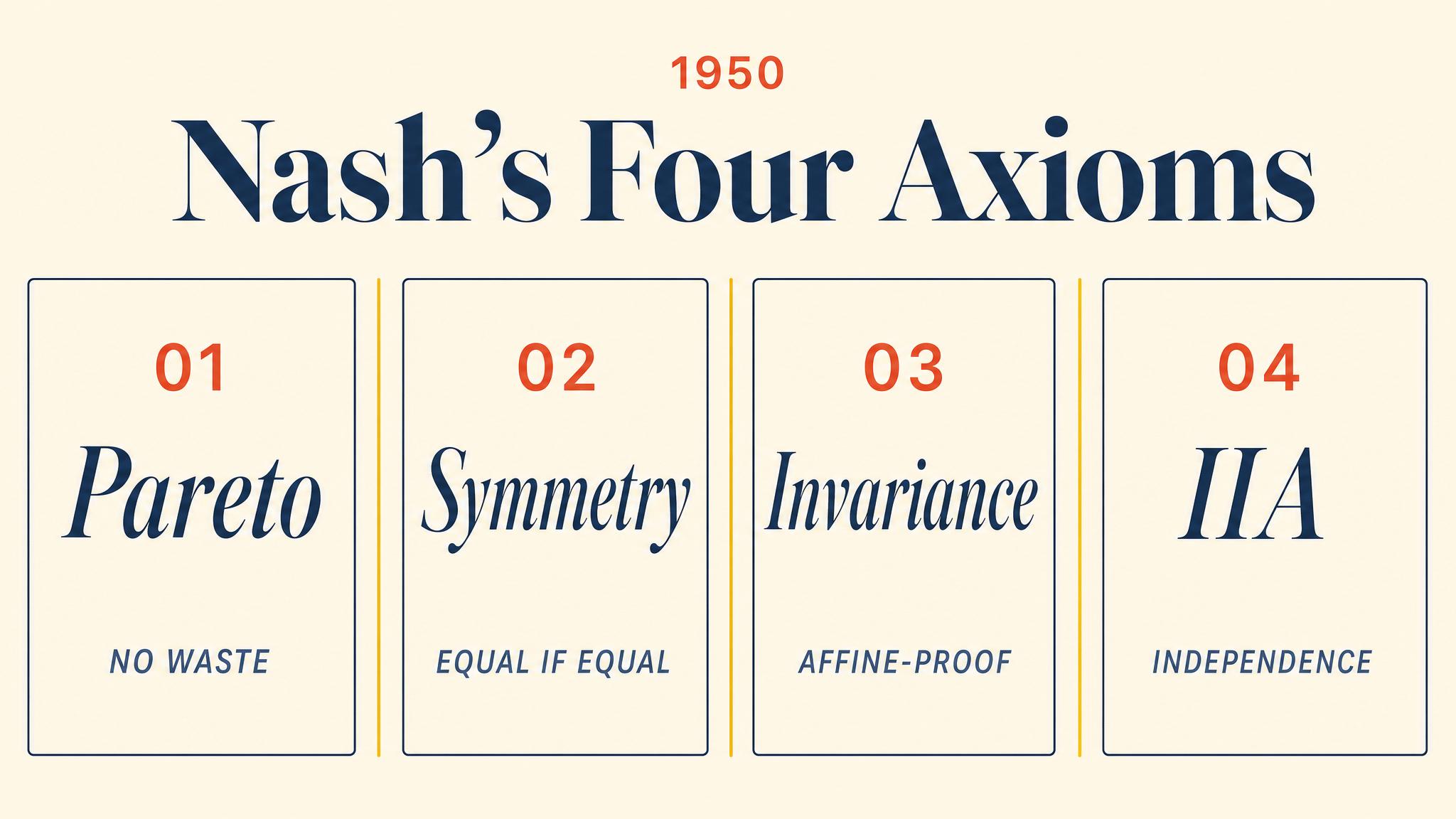
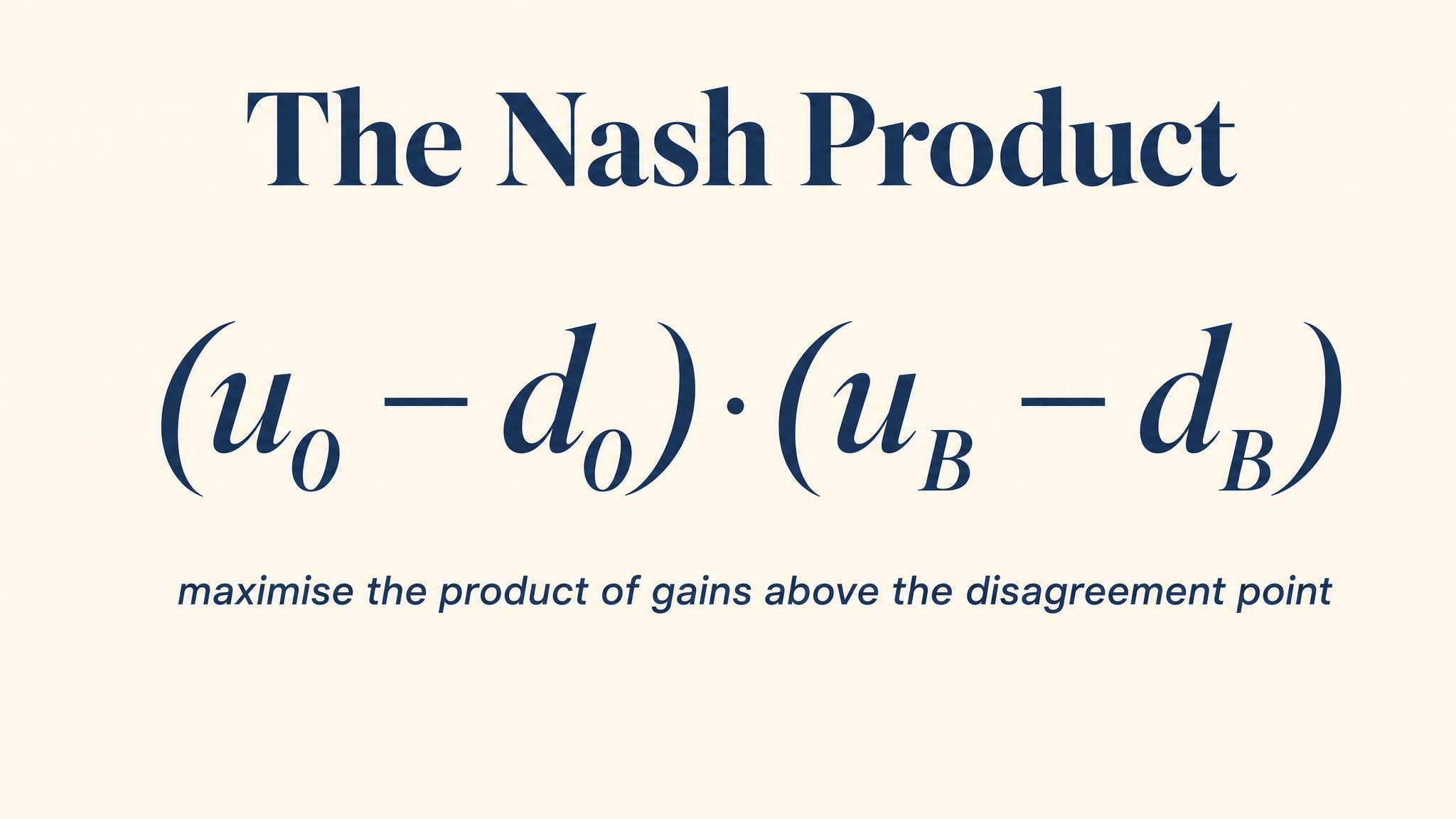
12-15 minutesEach table receives a bargaining problem with specific utility functions and disagreement points (e.g., two partners splitting profits with different risk preferences, labor-management negotiation with asymmetric costs of delay). Teams have 5 minutes to: (1) propose a 'fair' split and justify it, (2) calculate the Nash bargaining solution. Teams post both solutions. Instructor highlights where intuitive fairness diverges from Nash solution. Class votes on which is truly 'fair.' Sparks debate about what fairness means and whether Nash axioms (Pareto efficiency, symmetry, independence of irrelevant alternatives) actually capture justice.
Three's a Crowd: Coalition Bargaining Chaos
15-18 minutesEach table splits into groups of 3. They must split a $120 pie, but here's the twist: any 2-person coalition can take $80 and exclude the third person entirely. Students have 8 minutes to negotiate. Most groups will experience: unstable coalitions (someone always wants to defect to form a new coalition), chaotic re-negotiation, possible breakdown. After time, debrief: Who ended up with what? How many groups deadlocked? Instructor connects this to Shapley value, core solutions, and why bilateral bargaining models fall apart with more players. Demonstrates limits of simple models.
The Will of the People? Voting, Paradox, and Impossibility
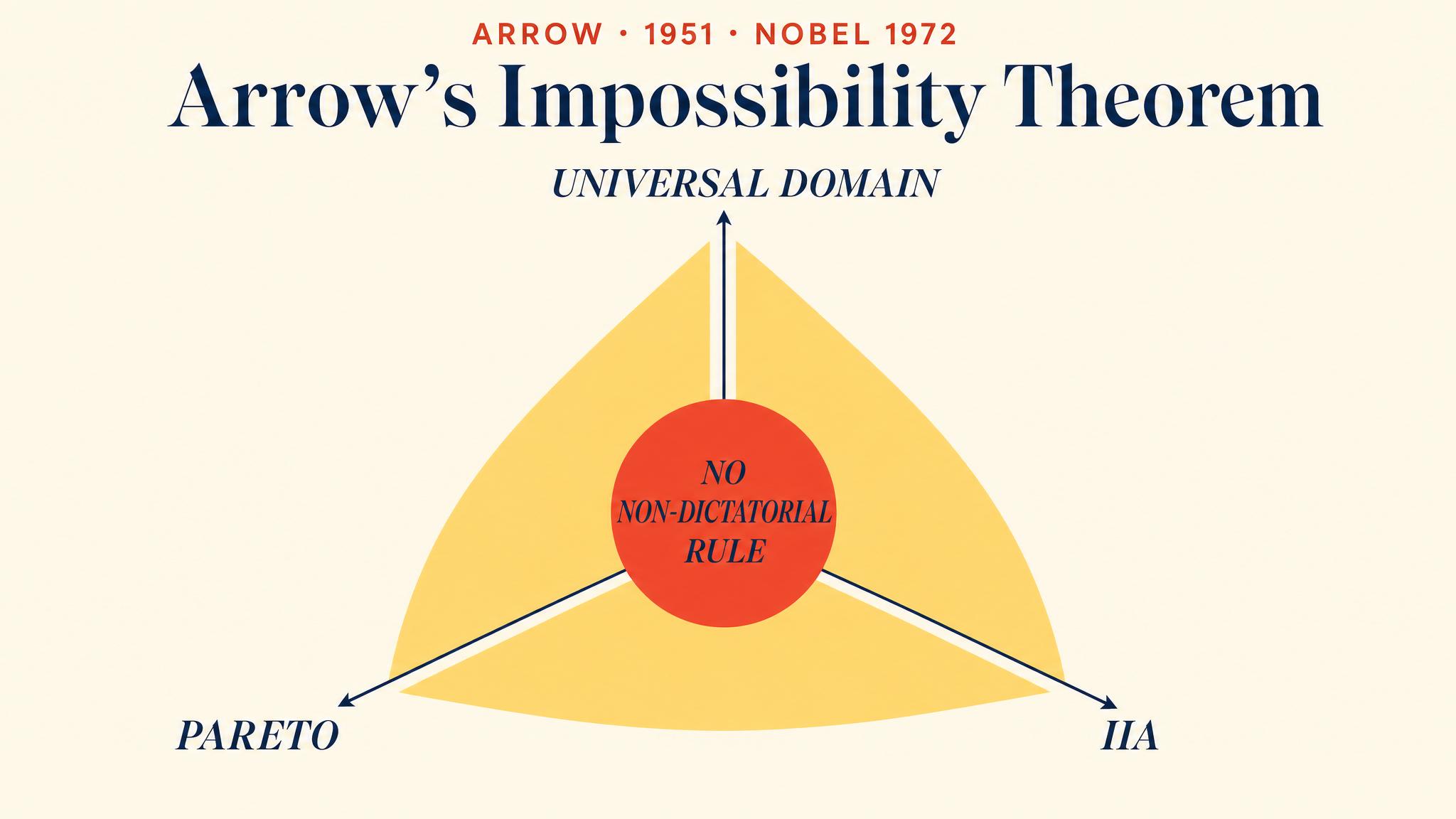
Democracy seems simple: people vote, and the majority rules. This chapter demolishes that comforting illusion with one of the most startling results in all of social science: Kenneth Arrow's Impossibility Theorem, which…
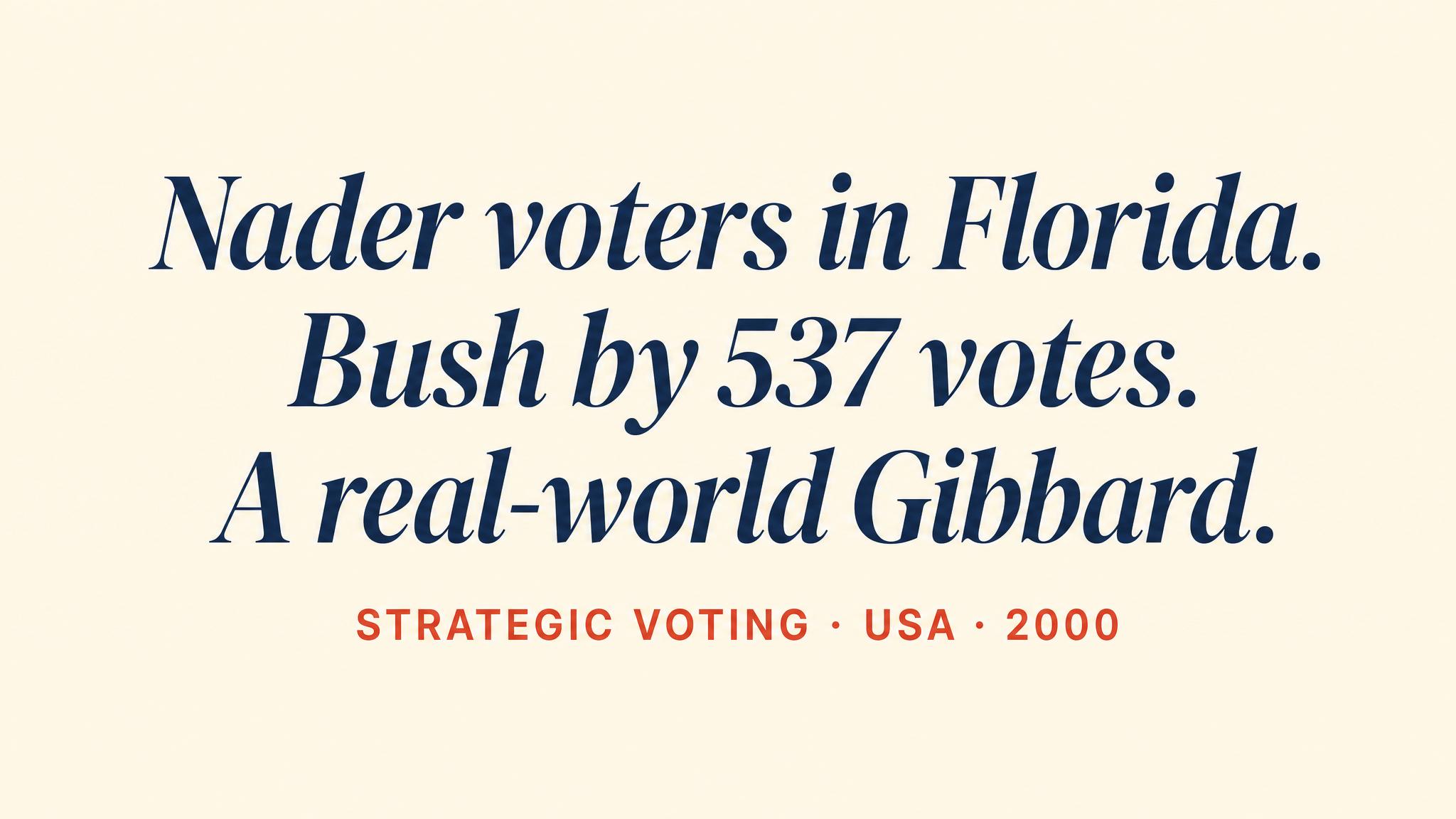
Have you ever voted for your second choice because your favorite had no shot at winning? Smart strategy or selling out?
Be honest
Your friend group: 5 want pizza, 3 want Thai, 2 want burgers. But the pizza people would rather have burgers than Thai. What does the group ACTUALLY want?
Quick puzzle
Hot take: It's mathematically impossible to design a voting system that's always fair and can't be gamed. Agree or disagree?
Hot take
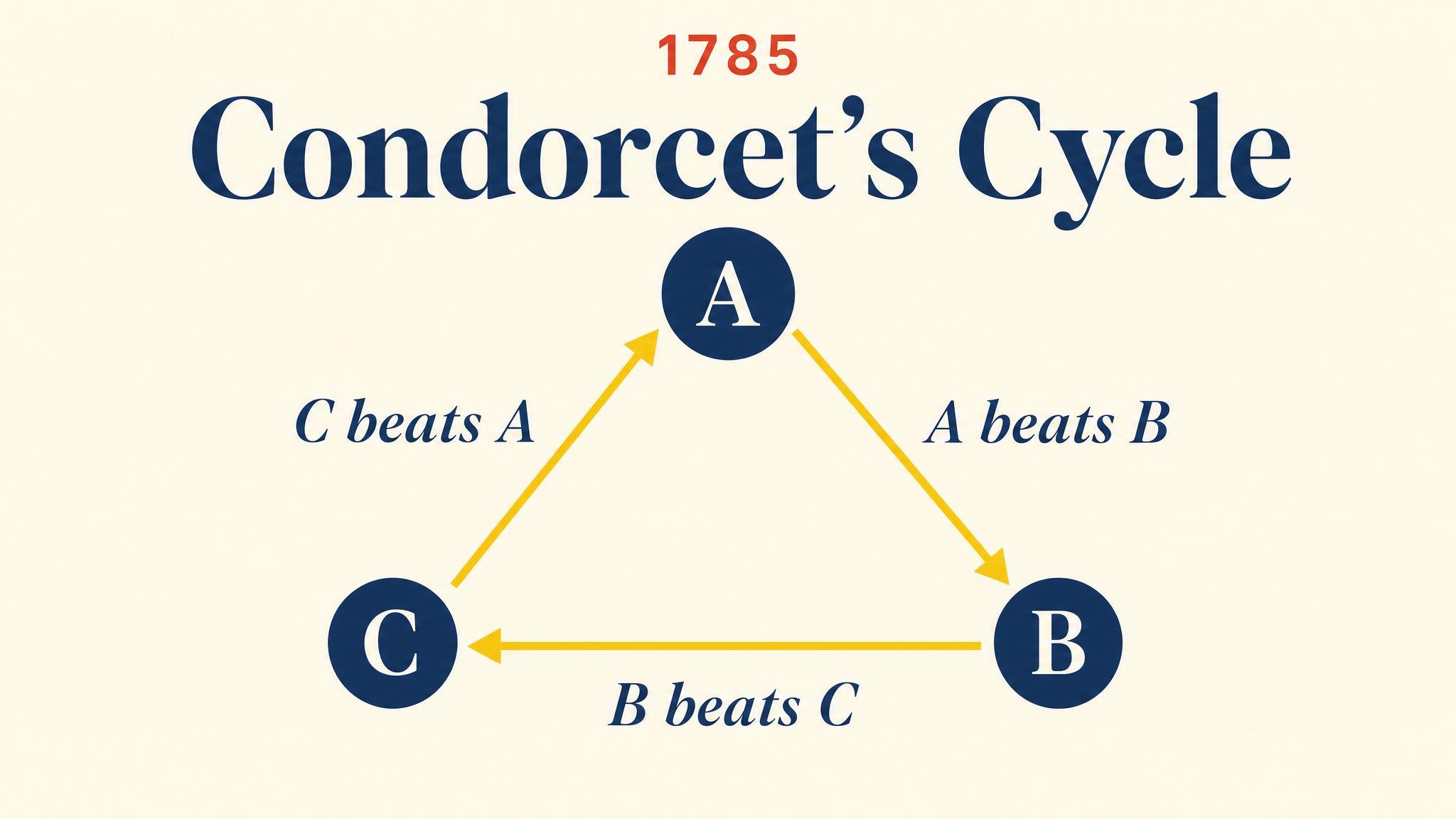
Can voting work like rock-paper-scissors where A beats B, B beats C, but C beats A? If everyone's both a winner and a loser, who actually won?
Mind-bender
Would you rather: everyone votes honestly (even if the system produces weird winners) OR everyone votes strategically (but at least you can try to game it)?
Would you rather
When politicians shift their positions toward 'the middle' to win elections, are they selling out their beliefs or just playing the game smart?
Real talk
The Condorcet Paradox Experience
12-15 minutesEach table receives three real-world policy options (e.g., environmental policy A, B, or C) with detailed descriptions. First, students individually rank all three options (1st, 2nd, 3rd choice). Then tables aggregate using pairwise majority votes: A vs. B, B vs. C, then C vs. A. Watch as tables discover they have created voting cycles where A beats B, B beats C, but C beats A. Tables then discuss: How can all three pairwise outcomes reflect 'majority will' yet contradict each other? Debrief as whole class about which tables found cycles and why transitive individual preferences produce intransitive collective preferences.
Design a 'Fair' Voting System (Then Watch It Fail)
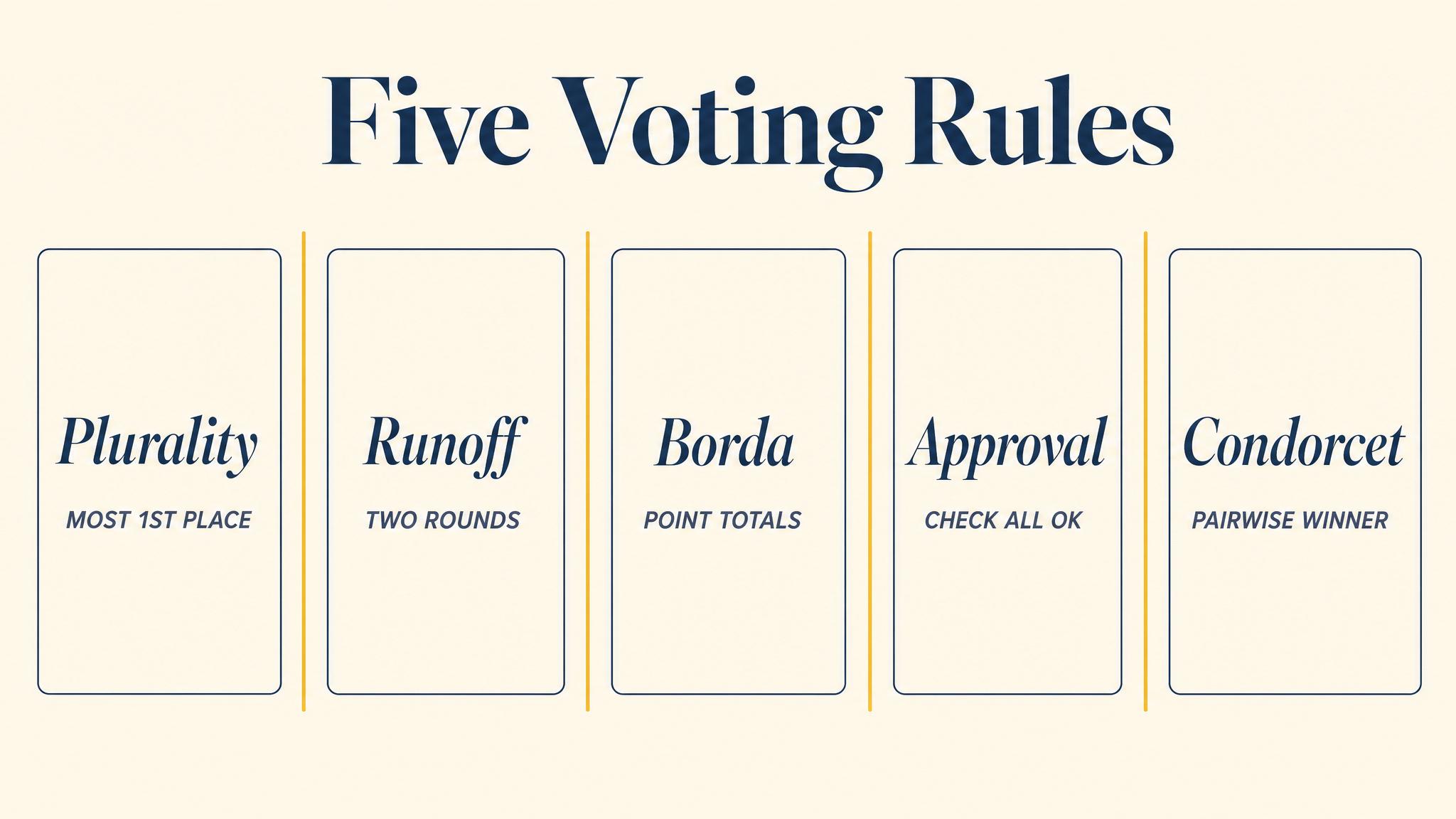
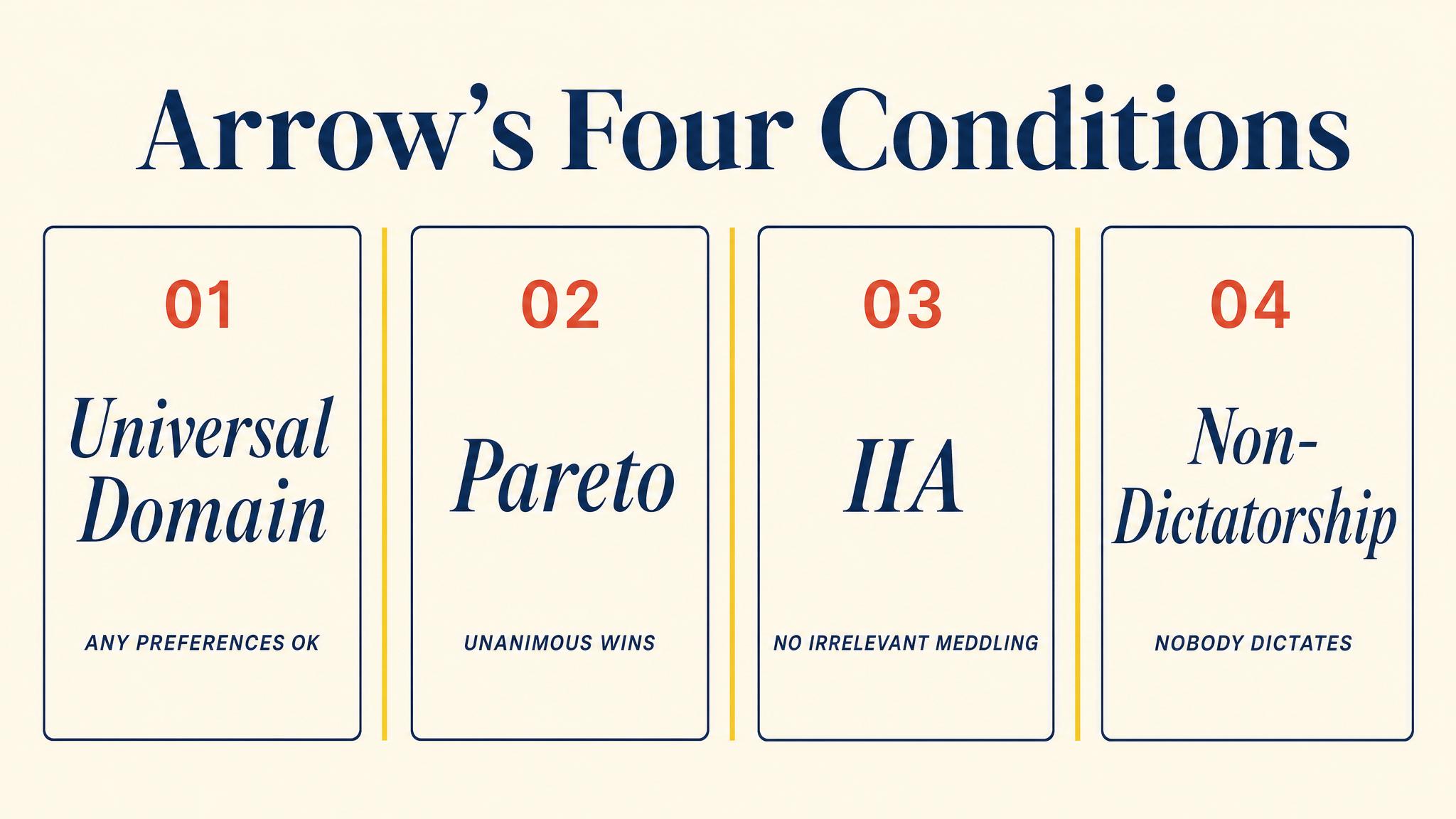
18-20 minutesChallenge each table: 'Design the fairest possible voting system for electing a class president from 4 candidates.' Give them 8 minutes to invent and document their system's rules. Tables present their systems (2 min each for 3-4 tables). Instructor then presents Arrow's conditions on the board and walks through each presented system, showing exactly which Arrow condition it violates. If plurality voting: fails IIA when a spoiler enters. If Borda count: fails to satisfy majority criterion. Tables race to see if ANY table avoided all violations (spoiler: none will). Concludes with revelation of Arrow's theorem: this failure was guaranteed.
Strategic Voting Tournament
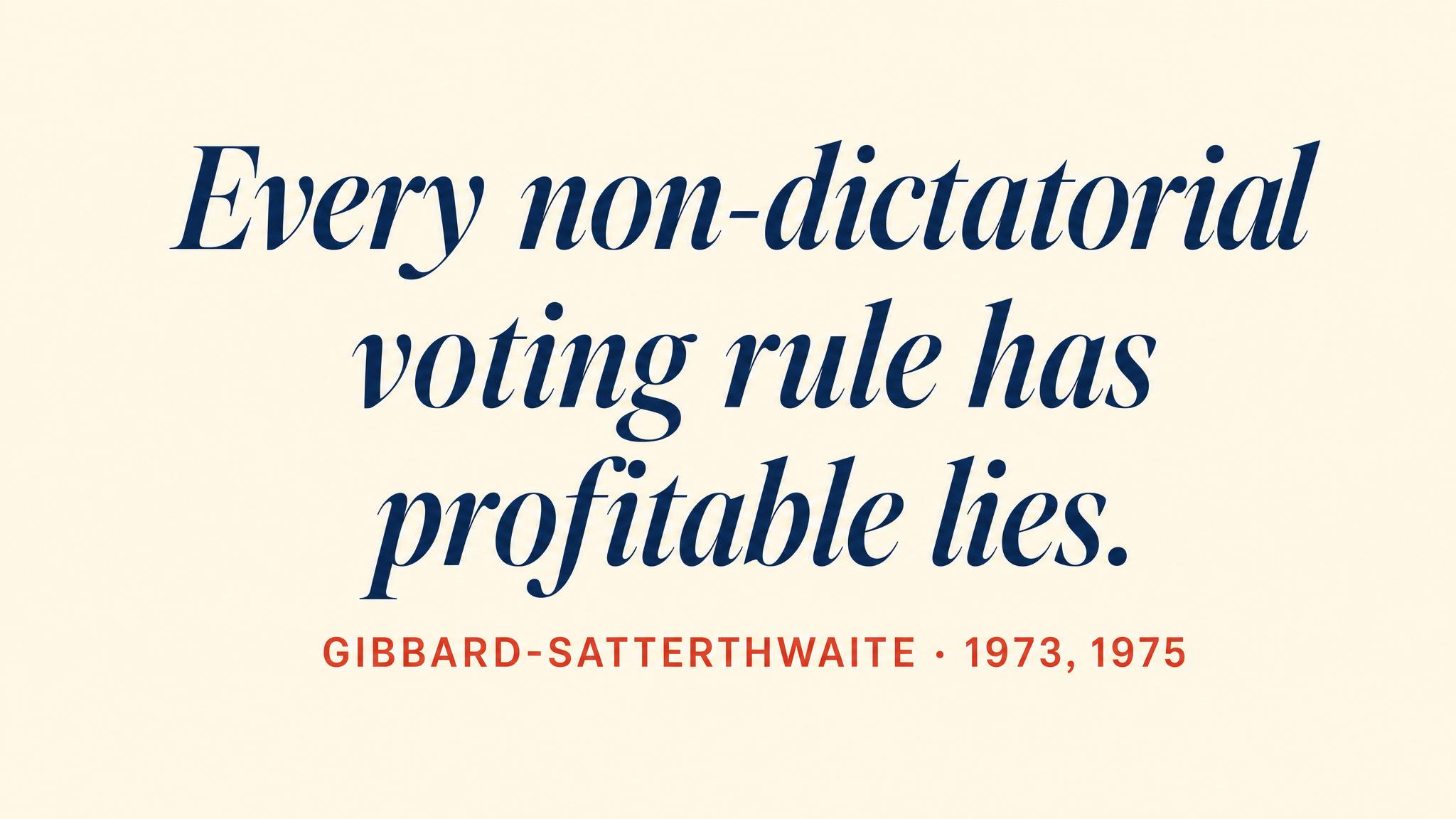
15-18 minutesThree-round voting game. Each table is a political party choosing how to vote on a bill with amendments. Round 1: Everyone votes sincerely based on their table's assigned preferences. Round 2: Tables can see how others voted and revote—watch strategic voting emerge. Round 3: Tables simultaneously submit strategies, knowing others are strategizing. Track how outcomes shift across rounds. Instructor reveals: This demonstrates Gibbard-Satterthwaite—when stakes matter and information exists, sincere voting becomes irrational. Discuss: If everyone votes strategically, is anyone actually representing their true preferences? What does this mean for interpreting election results?
Median Voter Spectrum Walk
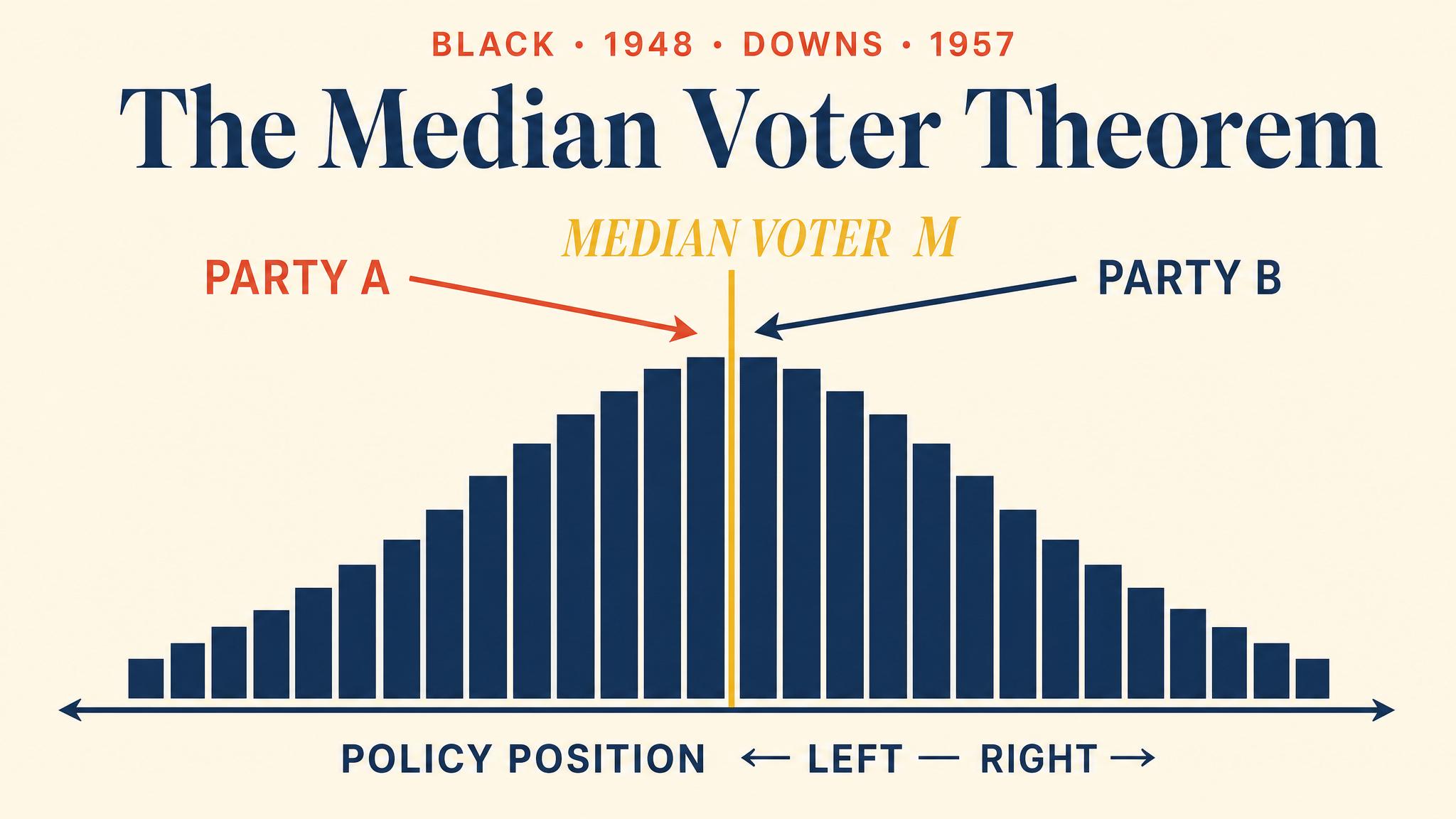
10-12 minutesPick a genuine campus policy issue (e.g., 'How late should the library stay open?'). Each table sends a representative who positions themselves along a spectrum taped on the floor (9pm to 3am). Representatives can see each other's positions. Run a vote: Majority-rules between the two most extreme positions. Loser drops out. Repeat until one position remains. It will be at/near the median. Now let tables strategically reposition knowing how the voting works. Watch as extreme positions pull toward the median or mediocre compromise emerges. Debrief: Why do candidates campaign for the 'center'? What gets lost when extremes are ignored?
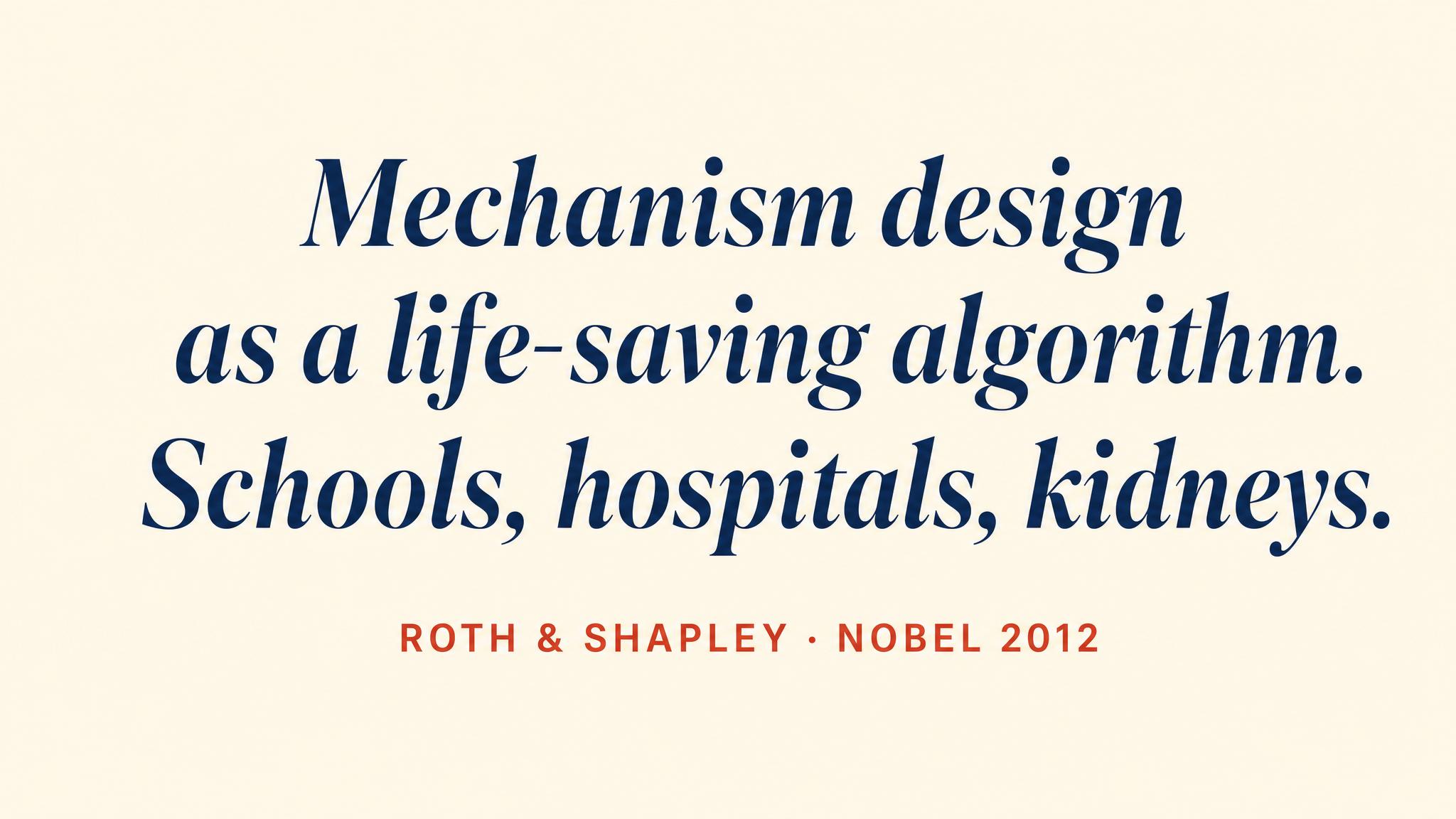
Mechanism Design Challenge: Truth or Consequences
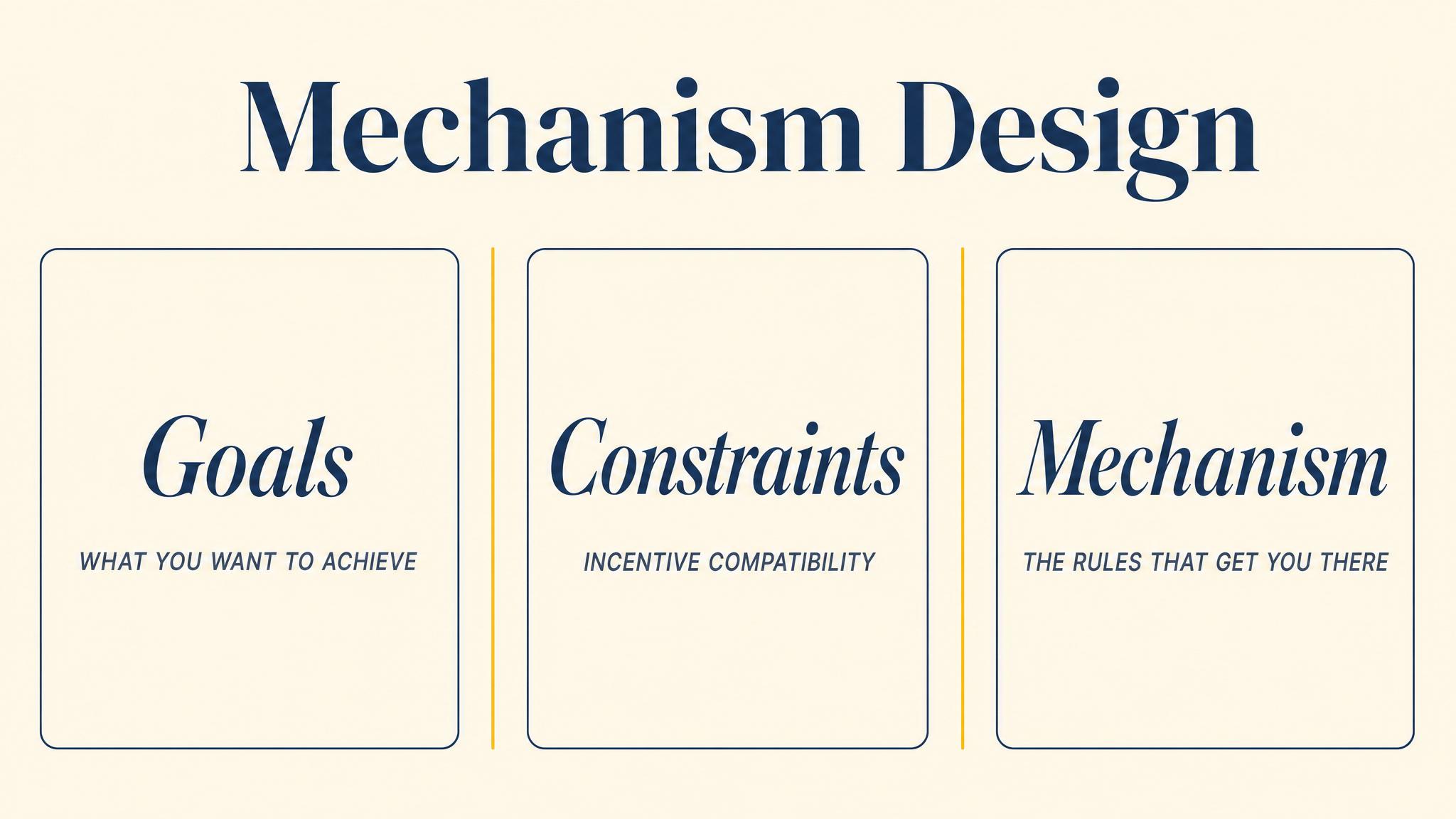
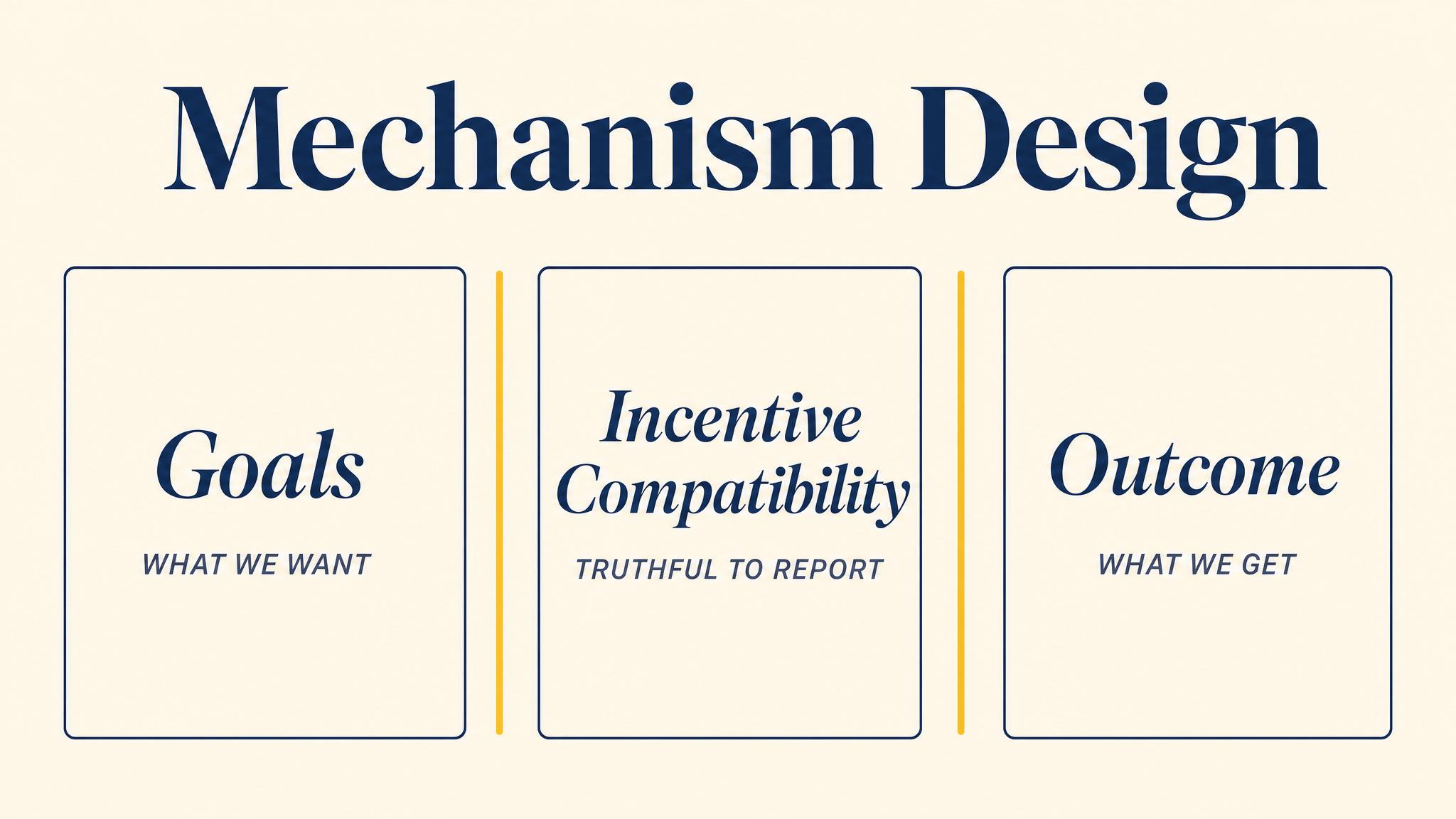
16-20 minutesEach table gets a different social choice problem: (1) Allocate a shared resource fairly, (2) Discover who values an item most, (3) Form project teams efficiently, (4) Choose a budget split. Tables have 8 minutes to design a mechanism (rules, incentives, procedure) that gets people to reveal true preferences and achieves the desired outcome. Tables visit neighboring tables to test each other's mechanisms: Can you manipulate this system? Does lying benefit you? Report back. Instructor highlights: Which mechanisms were strategy-proof? Which achieved efficiency? This is mechanism design—engineering social systems that work even when people are self-interested.
Arrow's Conditions Auction: What Would You Sacrifice?
8-10 minutesPresent a real-world voting scenario (e.g., Academy Awards, Olympic host city, department chair election). Each table gets 'currency' to bid on which Arrow condition they'd pay to violate. Non-dictatorship costs 10 points to violate (obviously). But what about IIA? Pareto efficiency? Unrestricted domain? Tables must decide: We can have a dictator OR we can have a system where adding a candidate changes outcomes between original candidates. Which is worse? Tables bid, then defend their choices. Reveals: There's no 'right' answer—it depends on what you value. Democracy isn't about perfect systems but about conscious tradeoffs.
Games in the Wild: From Climate Summits to Algorithms
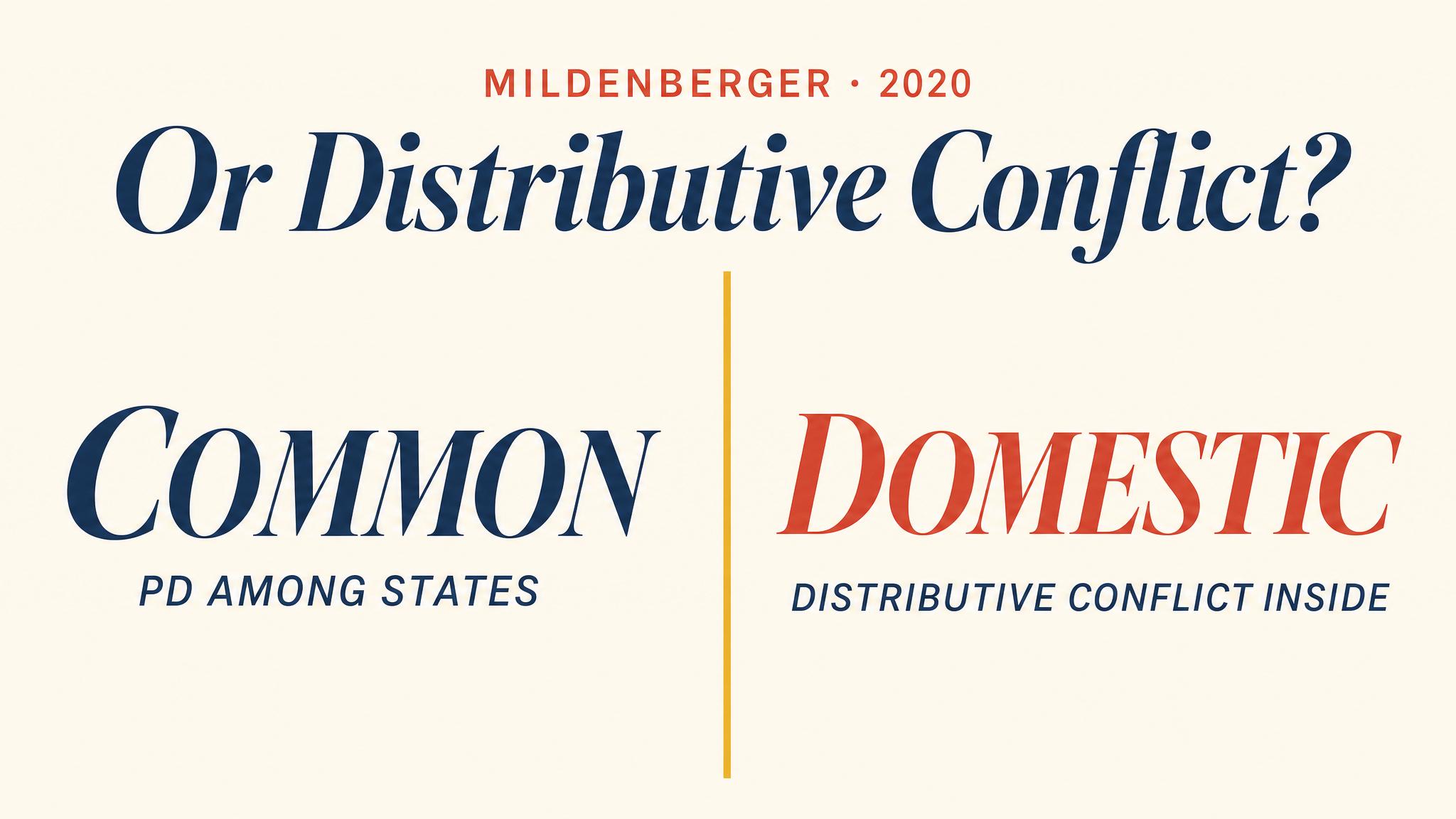
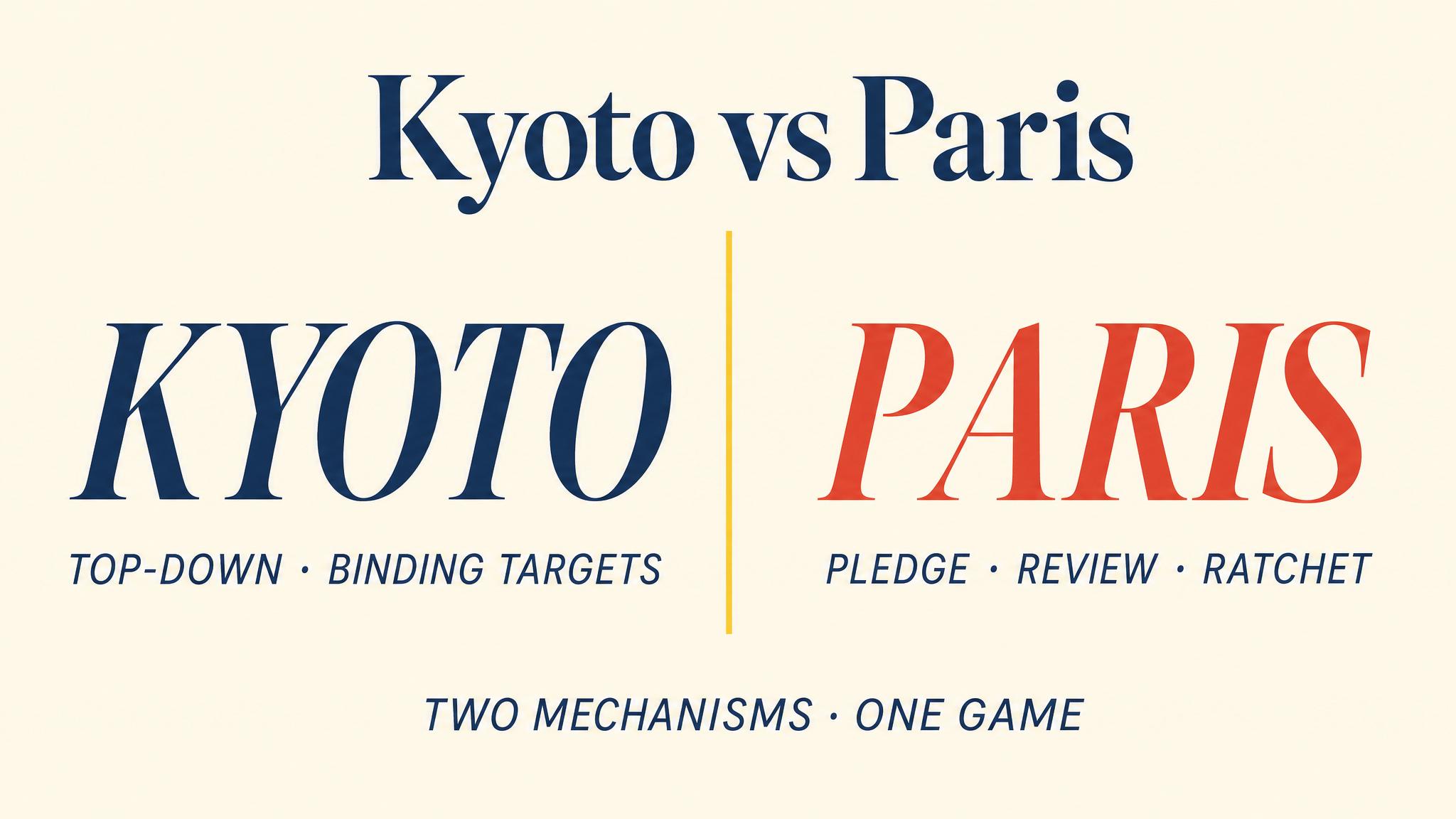
This capstone chapter does two things simultaneously: it applies the full game-theoretic toolkit to some of the most consequential strategic interactions on the planet, and it honestly confronts the limits of everything…
Your roommate cranks the heat to 75° every day. Do you match it, or freeze alone trying to save the planet?
Tragedy of the thermostat
Would you quit Instagram for a better app if you knew your friends weren't coming with you?
Stuck on bad platforms
Everyone in your study group just bought the $60 premium test prep. The arms race is on. Do you buy it?
Spending wars
A dating app's algorithm knows you consistently pick people who ghost you. Should it hide those profiles from you?
When algorithms babysit
You know the logical choice, but your gut screams the opposite. Which one do you actually follow?
Logic vs. instinct
What's worse: staying on a platform you hate because everyone's there, or switching to a better one where you're alone?
Network effect nightmare
Climate Summit Negotiation
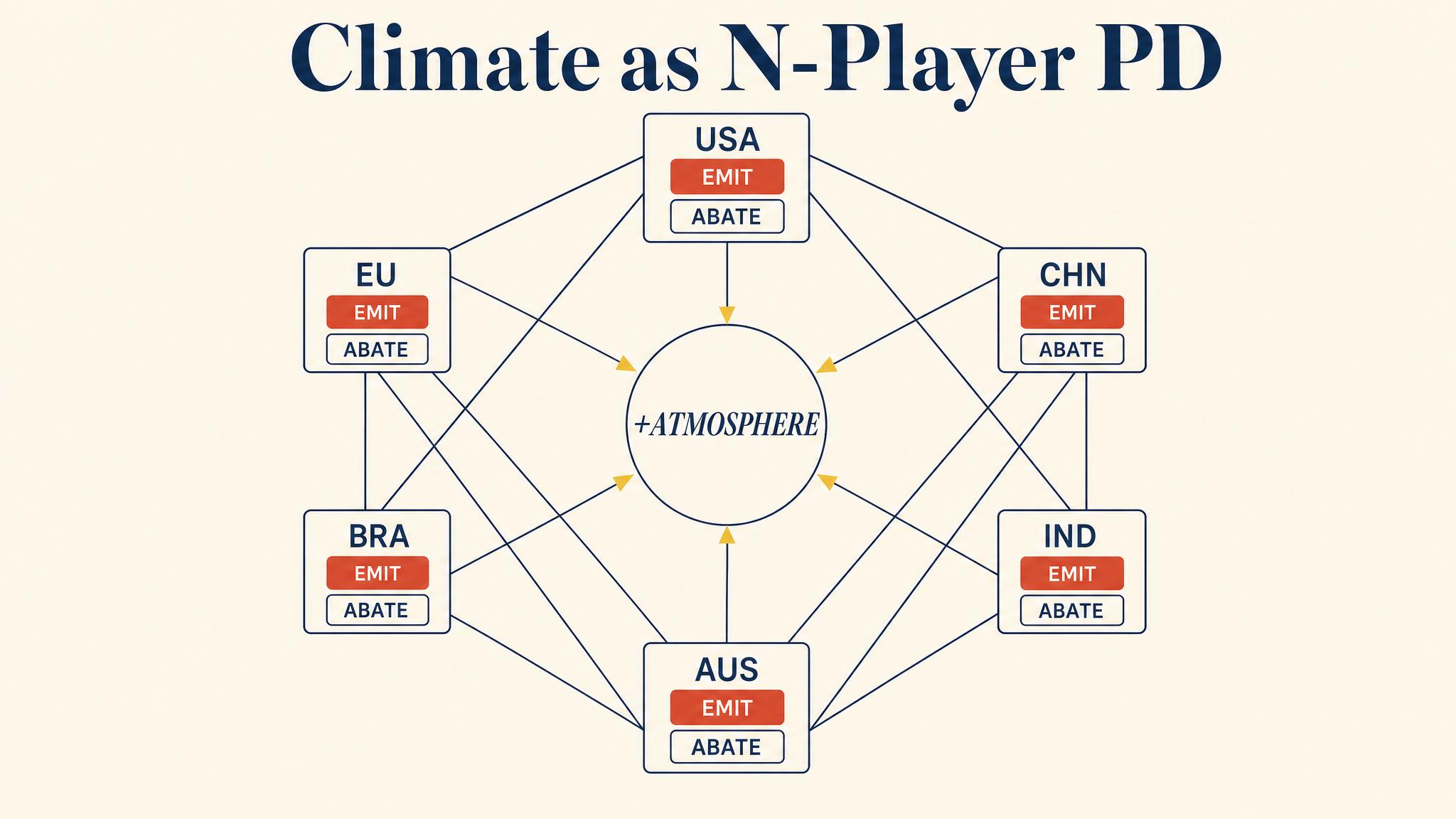
15-20 minutesEach table receives a country profile card (e.g., 'Industrial Power: High emissions, strong economy' or 'Vulnerable Island Nation: Low emissions, existential threat'). Tables have 3 minutes to review their incentives. Then open negotiation begins—tables can form coalitions, make side deals, or defect. After 10 minutes, all tables simultaneously commit to an emission reduction level (0-100%). Calculate global outcome and reveal which countries 'win' vs. which face climate disaster. Debrief: Why did cooperation fail/succeed? What mechanisms might help?
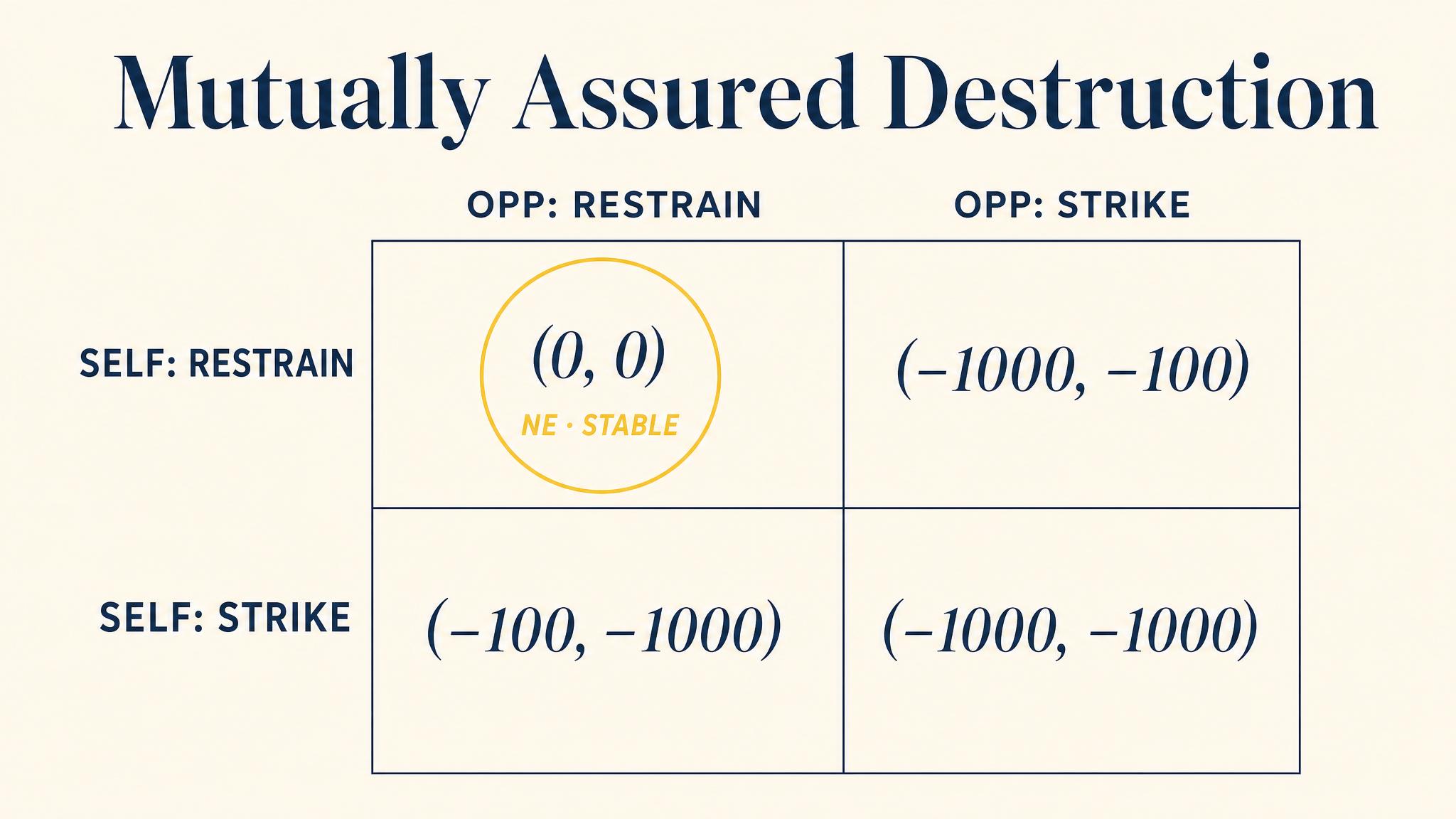
Nuclear Escalation Chain Reaction
10-12 minutesRound 1: Each table secretly decides to 'Build Weapons' (aggressive) or 'Seek Diplomacy' (cooperative). Reveal simultaneously. Tables that built while others sought diplomacy gain 'dominance points.' Round 2-4: After each reveal, tables see what others did and decide again. Payoff matrix visible on screen. Watch as paranoia spreads and nearly everyone escalates. Final debrief: How did it feel when others defected? Could you have avoided the arms race? Connect to real Cold War history and current nuclear tensions.
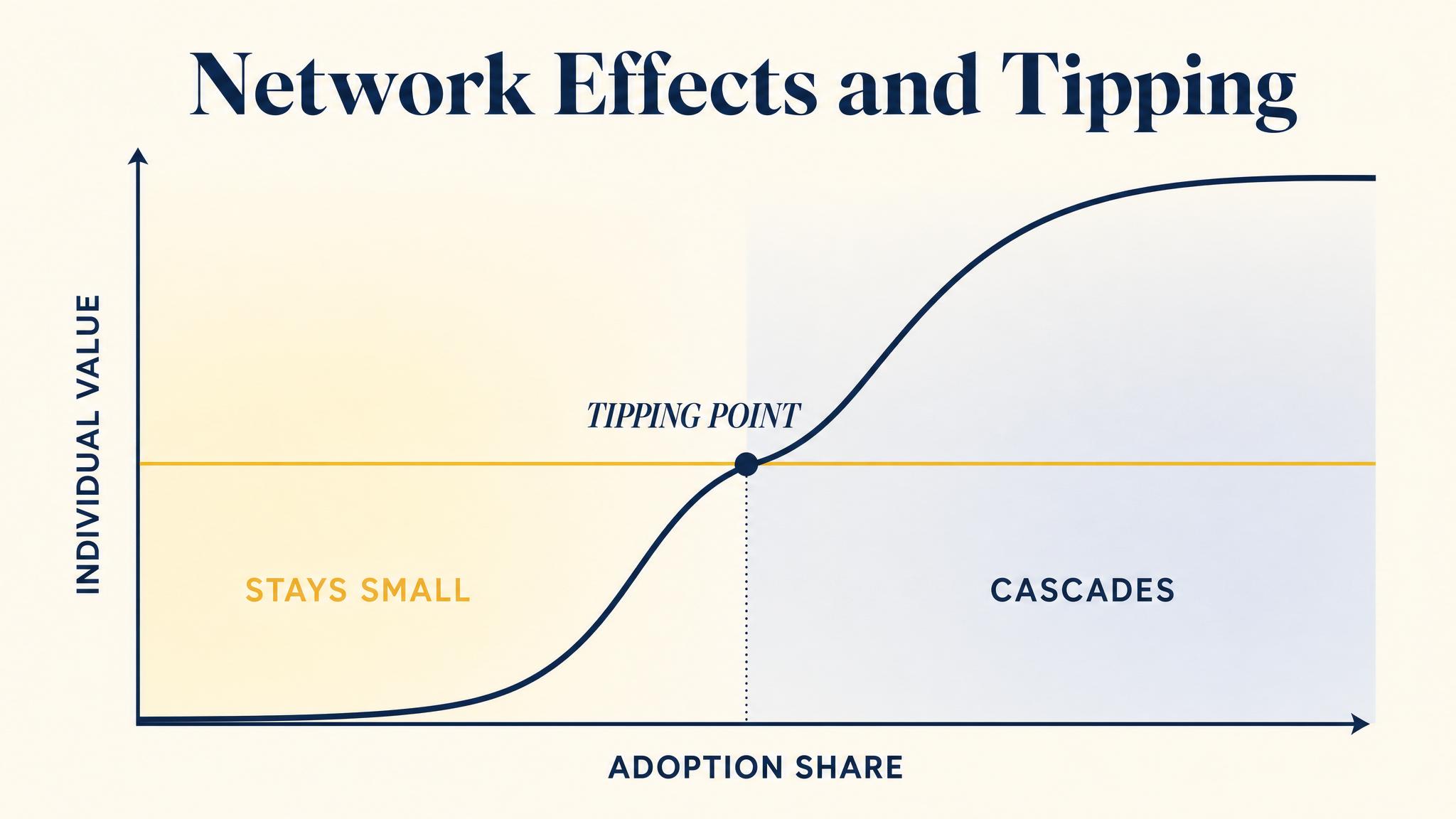
Platform Wars: The Network Effects Battle
15-18 minutesEach table is a competing social platform. Students have individual 'user cards' with preferences (e.g., 'I want to be where my friends are' or 'I prefer best features'). Round 1: Platforms pitch their features (2 min prep, 30 sec each). Users vote with feet—physically stand behind chosen platform. Round 2: Platforms see where users went, can adjust strategy. Users can switch (but lose 'switching cost' points). Round 3: Final choice. Count users at each platform. Discuss: Did winner have best features or just got lucky early? How did network effects compound? Why are platforms so prone to winner-take-all?
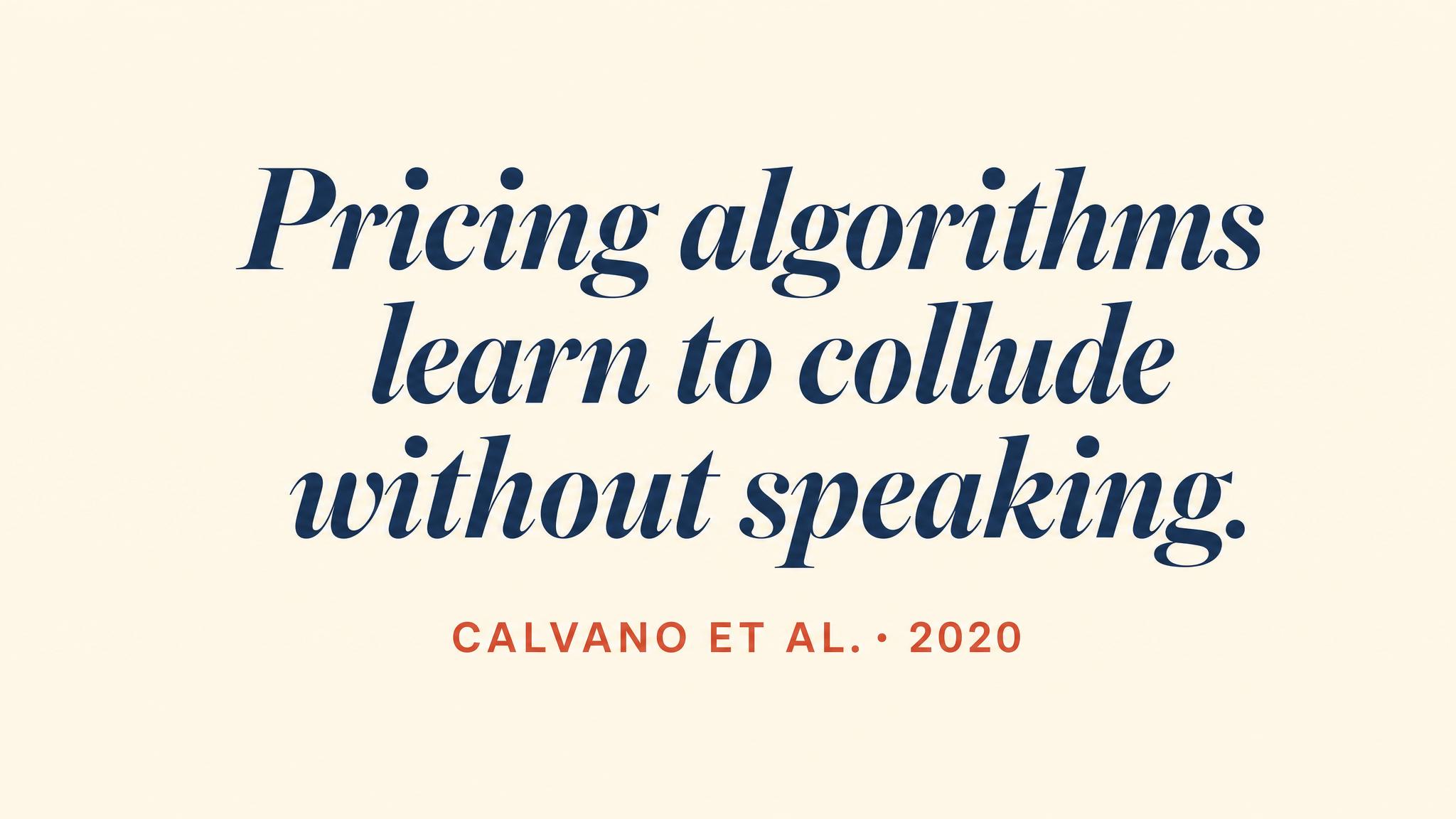
Algorithm vs. Algorithm Auction Showdown
12-15 minutesScenario: Online ad auction. Each table designs a simple bidding algorithm: 'Always bid X', 'Bid high if competitors are low', 'Randomize', etc. Write it as IF-THEN rules. Instructor runs 5 auction rounds on screen, applying each table's algorithm. Track wins and costs. Then: Groups can revise algorithms based on what they learned. Run 5 more rounds. Debrief: What strategy emerged as dominant? How did algorithms learn/adapt? What happens when algorithms optimize against each other without human oversight?
Game Theory on Trial: A Debate Tournament
15-18 minutesAssign each table a case: 'Game theory in nuclear strategy', 'Game theory in climate policy', 'Game theory in platform regulation', etc. Half the tables are prosecutors (critique game theory's use here), half are defenders (argue for its value). Give 5 minutes to prep arguments. Then run quick 2-minute 'trials' where one prosecutor table faces one defender table, class votes on winner. Rotate pairings for 2-3 rounds. Debrief: When is game theory illuminating vs. dangerous? What assumptions break down in real life?
Tragedy of the Commons: Real-Time Resource Depletion
10-12 minutesThere's a shared resource (fishing ground, forest, atmosphere) with 100 units. Each round (4 rounds total), each table secretly decides how many units to extract (0-20). If total extracted ≤ sustainable threshold, resource regenerates. If exceeded, resource degrades permanently. After each round, reveal total extraction and remaining resource. Watch as overconsumption likely collapses the resource. Then: Give tables 3 minutes to negotiate a binding agreement and run 3 more rounds. Compare outcomes. Discuss: What made cooperation hard? What mechanisms helped?